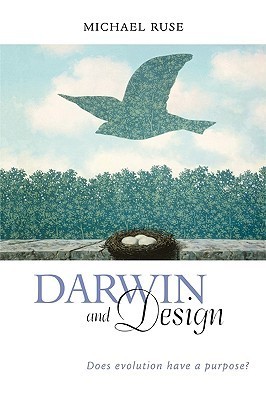
The intricate forms of living things bespeak design, and thus a nearly 150 years after Darwin's theory of natural selection called this argument into question, we still speak of life in terms of design--the function of the eye, the purpose of the webbed foot, the design of the fins. Why is the "argument from design" so tenacious, and does Darwinism--itself still evolving after all these years--necessarily undo it?
The definitive work on these contentious questions, Darwin and Design surveys the argument from design from its introduction by the Greeks, through the coming of Darwinism, down to the present day. In clear, non-technical language Michael Ruse, a well-known authority on the history and philosophy of Darwinism, offers a full and fair assessment of the status of the argument from design in light of both the advances of modern evolutionary biology and the thinking of today's philosophers--with special attention given to the supporters and critics of "intelligent design."
The first comprehensive history and exposition of Western thought about design in the natural world, this important work suggests directions for our thinking as we move into the twenty-first century. A thoroughgoing guide to a perennially controversial issue, the book makes its own substantial contribution to the ongoing debate about the relationship between science and religion, and between evolution and its religious critics.
Michael Escott Ruse was a British-born Canadian philosopher of science who specialised in the philosophy of biology and worked on the relationship between science and religion, the creation–evolution controversy, and the demarcation problem within science. Ruse began his career teaching at The University of Guelph and spent many years at Florida State University.
You have probably heard or read that a certain bird's beak was "designed" to crack nuts or catch insects, or that the eye is "designed" to focus light. This manner of speaking seems to imply that we all believe or accept that evolution has a purpose, that it might even have a designer. This book examines these habits of language to explore whether evolution really can be said to have a purpose.
The author begins by examining the history of the philosophical subject of "final causes", wherein a future event is said to "cause" a current event, like a student taking a course (current event) because she plans to earn a certain degree (future cause). He then moves on to a history of evolution, with a particular focus on final causes leading organisms to become more and more complex. One thing I learned is that Darwin didn't "invent" evolution. The idea that life forms evolved into different forms had been around and generally accepted for some decades. What Darwin invented was a plausible mechanism in adaptation through natural selection.
In the final chapter or two, the author examines the 20th century conflict between science and religion over evolution, a conflict that was by no means universal in all religious thinking. He gives his opinion, without forcing it on you and expecting you to believe the same.
This is largely a work of philosophy, and although it is easier to read than other philosophical works I have read, it still requires effort and attention to follow the arguments and the chains of reasoning. The author has a tendency to assume that you remember points made and historical figures mentioned dozens of pages ago, a habit that can add to the difficulty if you take long breaks between reading sessions.
Overall, I found this a thought-provoking book and an eye-opener to the subtler-than-expected nuances in arguments for and against purpose in evolution.
Many parts of a person's or animal's body seem to be perfectly designed for what they are used for, and nothing else. Moreover, it is difficult to imagine how they could have evolved in that fashion if evolution is driven solely by a neutral force such as natural selection. Hence, the question of "design" has been particularly vexing for evolutionists since Darwin's time. This book discusses the competing scientific, philosophical, and religious views on the question of "design" in evolution. It presumes a great deal of familiarity on the part of the reader with the ideas it discusses and the jargon it uses. As a result, it can be difficult for a generalist to follow the thread of the arguments, even if the reader is a fairly knowledgeable generalist, which I fancy myself to be. On the whole, however, this book offers an interesting discussion of an important question in evolutionary biology.
This was written in 2004, and basically addresses the question of “What do biologists mean when they say that the bird’s beak has this function?” and therefore, the biologist implies design. It pretty much gives the standard answer, i.e. “Design as Metaphor” (as was the title of one of the chapters), but the majority of it gives a history essentially from Descartes and Plato to modern biology, which is quite fascinating to read. It also brings up subjects like imperfect design and the role of adaptation, so it’s still technical, even though the majority is history. The last chapter basically critiques some of the ideas proposed by intelligent design advocates, which is part of the reason I bought this in the first place. Unfortunately though, I think it’s a bit outdated and has already been rebutted in later editions of ID books and other works. Still quite a good read though.