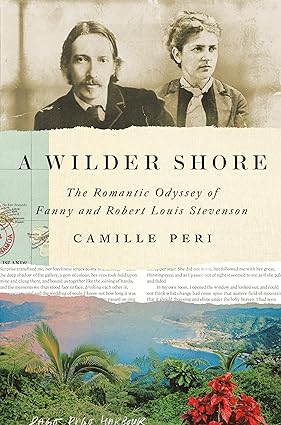
This is a double biography, the story not just of Robert Louis Stevenson, author of Treasure Island and Dr. Jekyll and Mr. Hyde, but of his American wife, Fanny. And we start with her, maybe to correct an imbalance of attention, maybe because, being older, she had a running start on life before he was born. They are both impressive characters, resisting convention, cultivating eccentricity, devoted to each other. She was a beauty and a force of nature; he was a great wit as well as a great writer, cultivated by other greats of his day as different from each other (and him) as Henry James and Oscar Wilde. Fanny was already a wife and mother when they met — moreover, a mother who had tragically lost one of her three children,. The American and the Scot met in France, at an artists’ colony, and fell in love quickly but married only eventually. Fanny was still married to and semi-supported by her philandering ne’er-do-well of a husband, and RLS had to wait for her, even pursue her across half the world before they were married (and after she was duly divorced). It wasn’t as if they settled down then. They led a peripatetic existence, eveR searching for healthier climes for the sickly Louis (as Fanny and most others called him), sometimes in the mountains, sometimes on coasts, at last in the islands of the Pacific. Despite long bouts of illness, RLS never stopped writing, producing his aforementioned masterpieces, regular gems of serialized non-fiction and opinion pieces, poetry (most famously his Child’s Garden of Verses), and not least of all political statements (which, like his later fiction, inveighed against colonialism). Peri follows a long line of biographers, reviewers, sometimes collaborators, and fellow writers in documenting RLS. This is a burden to work under, but also a treasure trove to mine, and she is especially good at noting the fans of Stevenson in our own time (as different as Stephen King and Hillary Mantel) as well as his own time (including Mark Twain and Joseph Conrad, whose Heart of Darkness apparently owes much to the late Stevenson work The Ebb Tide). If the book sometimes reads less like a straight narrative than an appraisal of appraisals, it is richer (and not just longer) for it.