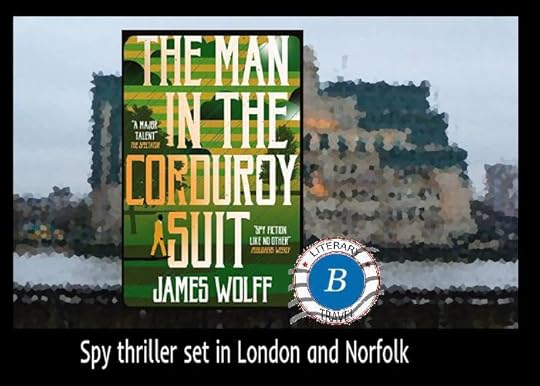
The story of an internal investigation into the past of a British spy suspected of having been turned by Russian agents. British intelligence is in a state of panic. Cracks are appearing, or so a run of disciplinary cases would suggest. To cap it all, Willa Karlsson, a retired secret services officer collapses, the victim of what looks like a Russian poisoning.
Leonard Flood is ordered to investigate – and quickly. Notorious for his sharp elbows and blunt manner, Leonard’s only objective is to get the job done, whatever the cost. When Leonard discovers that he is also a suspect in the investigation and that Willa’s story is less a story of betrayal than one of friendship and a deep sense of duty, he must decide whether to hand her to her masters or to help her to escape.
The third in the espionage trilogy The Discipline Files, after the acclaimed debut Beside the Syrian Sea, and its follow-on novel How to Betray Your Country.
Written by an insider: James Wolff is the pseudonym of a young English novelist who worked for the British government for over ten years before leaving to write spy fiction.
Against the backdrop of increasing Russian spying and interference (including assassination) in the UK, this novel explores themes of loyalty and betrayal in modern intelligence work, threatened from the inside by whistle-blowers, serial leakers and Robin Hood hackers. A taut thriller about the thin line between following your conscience and following orders. A fascinating conundrum we have been struggling with for decades. Edward Snowden, hero or traitor?
James Wolff grew up in Beirut and has lived in Damascus, Cairo and Istanbul. He worked as a British intelligence officer for over ten years.
His first novel, Beside the Syrian Sea (2018), was a Times Thriller of the Month and an Evening Standard Book of the Year. Upon publication of Wolff's second novel, How to Betray Your Country (2021), the Spectator described him as 'a major talent'. The New York Times called his third novel, The Man in the Corduroy Suit (2023), evidence of 'a memorable voice in the genre'.
His new novel, Spies and Other Gods, will be published in February 2026.
If you enjoy Mick Herron's SLOW HORSES/SLOUGH HOUSE series, you will love this book. Le Carre-lite, and I mean that in a good way. I'm eager to read the other books in the trilogy.
The Man In The Corduroy Suit's premise is straightforward: What do you do when your spies don't do what they're told to? Who watches the watchmen? Willa Karlsson, 64, is in hospital with symptoms suggesting she was poisoned. She resigned from the intelligence services the previous year, after dedicating much of her life to being a vetting officer - essentially deciding whether a prospective candidate is suitable. Charles Remnant, all tweed jacket and regimental tie, is recruiting Leonard Flood - the titular man in the corduroy suit; it's his adopted uniform, rendering him semi-invisible and looking harmless - from the ordinary intelligence ranks to that of a "Gatekeeper". Quis custodiet ipsos custodes? Remnant does, and now so does Leonard. What sets him apart from his colleagues is an ability to get answers from people in what could be described as a "robust" fashion - one assessment says he has "an impressive ability to kneel on the bruise"; one of many glorious lines in this novel. Now he is to look into Willa's life, after GCHQ has intercepted a suggestive piece of data. Has she really got long-standing links with Russia? It seems so far-fetched... Searching her flat, it's evident her personality outside work was very different to that projected in the office. His exploration and interrogation of the neighbourhood - dry cleaner, hairdresser, church priest - is a delight; probing questions but with a veneer of politeness and concern. A link to a country house hotel in Norfolk is revealed, which yields some details and a potential target. Back in London, Remnant reveals to Leonard that there is more to all this than he was first told - and then Willa wakes up in hospital, and things get very interesting indeed as we hurtle to the final pages. The qualities that make Leonard an excellent hard interviewer are also those which make him difficult to like, but as the book progresses and he deliberates on everything he has discovered, the reader is encouraged to be more sympathetic. There's plenty of warmth, wit and charm with just enough sharp edges in these pages - it's not exactly a cosy, but the body count is minimal. All in all it's a very modern spy story with an old-fashioned flavour and a refreshing reliance on the power of words rather than violence.
Did you ever notice when you read a book about England's MI5 there is always more infighting than actual spying? Feuds, double crosses, betrayals, disinformation, misinformation. And this is internal, before they even try to catch a Russian spy. And they are always short of funding, running missions on a shoestring budget. "The Man in the Corduroy Suit" is a kind of a poor man's John LeCarre. It wasn't bad, it just felt like it was written on a shoestring budget.
When a retired MI5 officer ends up in the hospital for poisoning, MI5 goes into overdrive. Why would an MI5 officer in charge of hiring new agents have an attempt on her life a year after she retired? in the world of MI5 it doesn't take a giant leap to question whether she herself was a Russian double agent who had spent the last 30 years hiring agents that she could turn. The top brass task Leonard Flood, a hard driving up and comer, with looking into her past to see if she was, in fact, a double agent. And, if so, who was her Russian contact? He has a deadline of two weeks to find out everything he can and report back. The job seems easy. Leonard makes surprisingly good progress but when the deadline is cut to one week and he is given a partner to boot, Leonard begins to smell a rat.
And I kind of smelled a rat too. It was too easy. LeCarre's agents acted like the first team. They wore suits. These guys acted like the scrubs. Corduroy? In a John LeCarre book you have to pay attention; something you dismissed on page 25 might reappear on page 325. Not with "Corduroy". Everything followed a straight path to its conclusion which didn't keep you on your toes or keep you on the edge of your seat. Another non-surprise: You know that partner he was given? Don't be surprised if there is a sequel. I guess in conclusion the best way to sum up this book is: Real MI5 agents don't wear corduroy.
A spy/counter spy/traitor or spy kind of book. Complex yet not confusing. Several points of view throughout, but never any question about whose shoulder we're looking over. Also memos, emails, personal or private correspondence spread throughout which breaks up the book. Yes it does, but also lends a certain realistic creditability. (Is that an oxymoron? It fits.)
Leonard Flood is assigned the task of finding out why a British intelligence agent was poisoned. This agent was in her 60's, recently retired. Her task through the years was to vet possible new agents, check them out - in intimate detail - to decide if they had what it takes to join British intelligence. Looking at everything about them: background, education, friends and acquaintances, hobbies and interests, special talents, and emotionally, how they'd hold up in the excruciating detailed, difficult and demanding task of safeguarding the home state from all possible enemies.
But as Leonard moves through the process of scoping out this woman - and was she all she seemed to be, too? - he gets embroiled in a complicated web of 'who can you trust?"
I’ve just spotted from the Goodreads label for this novel that it’s the third in a series, but I had no idea that that was so and read it as a standalone with enormous enjoyment and satisfaction. We are in the land of the intelligence services, the UK’s MI5, to be precise. When a recently retired MI5 staffer is felled by a mysterious poison, all indications point to the Russians, and a house of cards begins to topple. Was she a double agent suspected of disloyalty and punished? An absolute bulldog of an agent is turned loose to get to the bottom of things. The most fun I’ve had with spies since Slough House, though this owes a lot to Le Carre as well.
I feel like I need to go back and read the first two books now! Literary, intelligent espionage fiction is something I just love to read and Wolff is a great example. Fascinating characters, suspenseful and high stakes yet carefully and creatively written. Wolff makes you feel like you are working a case yourself in some ways, with memos and documents from the past. Painting a picture and allowing the reader to put together the puzzle (to mix metaphors). Somehow he does all this with a sense of humor and a light hand even as the subject is frequently dark or at least comes from a world of cynicism and weary politics.
Our heroes are no longer the brutal misogynist James Bond (the one from the novels) or the man who spends his life operating in the shadows of the Eastern Bloc like Alec Leamas, but men and women who employ psychology and process data. Leonard Flood is one of this new breed. Not an imposing specimen of manhood, in his outward manner and appearance, dressed in his favourite brown corduroy suit he could easily be mistaken for a librarian from Hull. First impressions can be deceptive though, he has a first-class analytical mind, can be rather bluff when getting down to business, tenacious when following the thread of a clue and doesn’t give a jot about who he upsets in the process. Obnoxious and no respecter of authority, colleagues wonder how he managed to pass the vetting process, but then he does get results.
Leonard is seconded on to the Gatekeeping team, the spying equivalent to policing professional standards, with a particular task in mind. Retired Willa Karlsson who until recently was a respected member of the Service’s vetting team has been poisoned and lies in a coma. Russian State Security is suspected, but this is usually a method used to despatch traitors. Leonard is given the task of investigating Willa’s life for evidence of the betrayal of State secrets and to establish and locate any Russian handler. The twist is Willa was the one who approved Leonard’s application, what he discovers may have implications about his future at the service.
His help is a recent recruit to the Service, a young woman Franny who is very data and IT analysis led but with little field experience. Together they make progress, but nothing is quite what is seems. Leonard has been doing the bidding of others, set up to expose himself. There is a breakdown of trust leaving Leonard to operate alone, using his wits and devious nature to stay one step ahead. The structure of the storyline begins rather like a traditional police procedural as Leonard uses his charm and deviousness questioning people, whilst pretending to be Willa’s nephew, behaving how no police officer would ever be allowed to. Then it becomes a battle of wits before building up to a clever set-piece where Leonard summons his hidden Charlie Muffin. The prose is broken up by interludes, a style currently vogue, in this case introducing documents ‘from the archives’ in the form of memorandum and correspondence. Here it proves to be a very clever device to introduce background to the reader without unduly spoiling the flow of the story, also laying bare bureaucracy and the motivations of those up the chain of command.
Much of modern spying is mundane office work not using Q’s latest invention in the field. It is the talent of the author and the quality of the writing that manages to demonstrate this but produce an intriguing and very entertaining story. Compelling at times, never dull.
The characterisation is excellent. In Leonard we have a kind of objectionable anti-hero, who we begin to understand and eventually like. He is an outsider in the establishment, the way the Service must develop and modernised in the future but not trusted because he is different. His deliberately obtuse and combative nature is perfectly highlighted during his interactions with Charles Remnant the head of Gatekeeping. He is ex-army and old school just the kind of man to get under Leonard’s skin. The dialogue between them doesn’t exactly sparkle but it is compelling, it’s more akin to two boxers jabbing but trying to land a telling blow as they slug it out.
Franny provides the tension dynamic between men and women, colleagues but with a hint more could develop. Willa has a small but illuminating cameo, but Ernesto is the other interesting character. We never quite get a handle on him, a man with limited choices but one who somehow manages to find contentment in simple things. Perhaps this is the answer to true happiness.
Thematically it’s a novel about trust and loyalty. Placing your trust in people who are like you isn’t necessary the answer, the old ‘tap on the shoulder’ at Cambridge as a route to recruitment proved to be a disaster. Bringing in new blood is the answer but by reason of them being different breeds suspicion in the old order. The act of questioning loyalty usually results in disaster akin to the breakdown of trust between a married couple. Unquestioning loyalty is there though as in the case of Ernesto.
The Man in the Corduroy Suit is the story of Leonard Flood’s investigation into Willa Karlsson’s life after she collapses in what looks like one of those Russian poisonings. She had an important, though not thrilling, job in British Intelligence. She evaluated potential hires and decided who got to go forward or not. This put her at the heart of personnel recruitment and suddenly they realize she could have been recruiting double agents. Leonard was someone who went through her interview and is tapped by Charles Remnant, the head of Gatekeeping, a kind of Internal Affairs for spies, to investigate Willa to determine the truth.
Leonard does a phenomenal of investigating Willa, often making intuitive leaps based on scant evidence. As the case heats up, he is given an assistant who is gung ho with the enthusiasm of the new hire. However, the more he learns about Willa, the more he questions himself.
The Man in the Corduroy Suit is the third in a series called The Discipline Files. It makes me want to read the first two, because the plot is complex and full of tension. It’s excellent in merely referring to the first two as scandals that happened that are not at all necessary to know what’s happening in this thriller. In terms of suspense, I love that it’s fair, that we can figure things out with Leonard. Or not.
This story has plenty of surprises. Despite the many espionage necessary tropes such as evading surveillance and so on, it is a completely fresh and original. Not only that, but I really liked the characters, at least most of them. I also love how rationales for people’s actions are learned without any aha! moment. Noted in passing.
I received an ARC of The Man in the Corduroy Suit from the publisher.
The Man in the Corduroy Suit at Bitter Lemon Press James Wolff author site
-audiobook version -love the narrator, British narrators are always so much better, Americans put me off sorry but shut up cowboy -great main character, so funny -love a spy book and hit exactly where I wanted it to
Excellently twisty, and arguably a hair better than Wolff's two previous novels, which are also quite good. The plot here twists and redoubles and re-redoubles back on itself in a way that's satisfying and complex and hard to resolve--a lot of people have remarked on how stuffed the early CIA was with English majors and poets from Yale, whose schemes had a baroque imagination to them (not that often successful baroque imagination, to be honest), and this novel takes the essentially lit-crit nature of espionage as its main theme in terms of narrative but also in the very clever recursion of what felt like throwaway details and in metaphors that both structure the story and serve as critical character reveals--or are they? This takes Angleton's "wilderness of mirrors" paranoid epistemology to its logical conclusion of utter indeterminacy (to use another lit-crit term) in a way that feels entirely contemporary. You don't have to have read the previous novels, though all together they form a satisfying post-Smiley narrative arc.
The poisoning of a recently retired MI5 officer throws the intelligence services into a panic. Fearting a Russian plot the brass sends Leonard Flood, an awkward man with a talent for getting information out of people, to investigate. What he discovers as he picks apart a life lived in the shadows will shake the whole system to its foundations. That what Kipling called ‘the great game’ is really a decidedly grubby one is by now something of a truism. Real world espionage is a business transacted by shabby people working in equally shabby offices devoid of anything resembling glamour, as described by John Le Carre in his novels featuring the crumpled George Smiley. Since his departure the damp and smoky torch of the realistic British espionage novel has been taken up by Mick Herron and his novels about the inmates of Slough House, a dumping ground for operatives for whom intelligence is an oxymoron. In this book and his two previous ones James Wolff makes a credible case for being named as co-heir to a battered and rusty crown. This is, on one level, a novel about the paranoia and careerism of people employed to do unpleasant things in the name of national security. Familiar ground for the genre but covered here with skill by Wolff as he goes about the business of cross and double cross in an entirely convincing way. As is only appropriate for a writer who takes the world of espionage as his subject matter there is more going on under the surface than at first meets the eye. The real subject of this book is how individuals and nations form their identity, the forces that would hand them one off a peg caring little whether it fits or not, and the small rebellions individuality launches in response. Flood, and the possible double agents he is investigating are all engaged in a form of spy craft as they negotiate a set of social norms as imposing and arbitrary as a wall topped with barbed wire. Forever struggling to come in from the cold with only a hard landing waiting on either side of the wall. This is a worthy addition to the long tradition of novels about spies who have deeper concerns than whether their martini is shaken or stirred.
Set primarily in the spy world in London, the book opens in a hospital where someone who worked for the security services is suspected of having been poisoned. That raises questions of course and concerns as to why and if this person was poisoned.
Enter the man in the corduroy suit. Leonard Flood is recruited to be in the intelligence services and become a ‘Gatekeeper. To be fair he looks so not what you expect a spy to look like, he effectively becomes invisible which is handy. (Maybe my Georgraphy teacher had another secret job….). He’s a good spy – gets people to divulge information for a start which is a great skill for any spy to have. He is given access to data from GCHQ and off he goes to find out why the former intelligence officer now in hospital, was poisoned and why. Could she have suspected links to Russia?
The man in the corduroy suit ( I love that title!) goes to the suspect’s flat and then ends up on his way to Norfolk and a nice hotel to try and find answers. Called back to London, he finds out that the suspect has woken up and has something to tell them….
This was a spy novel but one with a very human face. Everyone felt real and perfectly drawn from the real world which made me tune into them very well from the start. I got a sense that some of this could be really what happens in MI5 etc and this made it all the more interesting. The man in the corduroy suit is a character hard to like or get to know at first but he grew on me as he does the people he works with. Clever. I honestly felt I had met these people and even worked for Mi5 at some points!
Could I say this was a cosy spy thriller? Not the flash bang whallop of the cold war spy thrillers but one that elevated the genre above that in my opinion. I will be reading the others in the series that’s for sure!
I hesitate with my rating because I did honestly like the story. I think it was extremely charming, with some fun twists. I enjoyed the characters of Willa and the Gardener as well as Charles Remnant. I thought the forays into spywork were fun, interesting, and surprisingly accurate at times (later confirmed by learning that Wolff is retired intelligence). The stakes felt low the entire book, only ramping up at one point near the end in a fun escape told from multiple perspectives. This was in part due to the narrative frequently being put on hold for communications and files through which more information was conferred to the reader. It made for a fun way of the story being told, but it did lessen any sense of urgency. In my opinion, all this makes the book a good late night or bathtub read, something a bit titillating and interesting but overall cozy and simple. My low rating comes from the tone of the writing and personality of the characters. I did not like the main characters, and didn't feel any particular kinship or desire for them to succeed. I liked Remnant as an overworked, stressed semi-failure who couldn't play politics quite well enough, because I found him and his failures (and ability to concede to his failures) endearing. The communications we're provided allow the reader to get a good sense of his character and desires. I felt no such endearment to Flood, whose prickliness and lack of openness unfortunately extended from his colleagues to the reader. I did not feel attuned to his motives or interests other than a general fascination in breaking things, which later feels off-kilter from a simple desire to "do the right thing". I didn't feel these two interests merge together or one transform into the other, it just seemed to be a shift in personality. I found the first few chapters pretty tough to read, in fact, as I did other chapters that concentrated primarily on Flood's thoughts (usually recollection for backstory or current observations for setting). All in all, not a terrible read, but nothing I'd repeat or particularly seek out.
A very different spy thriller set in LONDON and NORFOLK
The Man In The Corduroy Suit is a very different kind of spy thriller. It is much more human, and much more based on human relationships, than many in the genre. The pace is (for the most part) relatively gentle…
A recently retired member of MI5, Willa, is poisoned and the incident bears all the hallmarks of a targeted Russian attack. She was not really a senior member of the service, but she was one of those responsible for vetting new recruits. The fear is that she may have been a Russian agent and may intentionally have recruited some whom she could use in her nefarious activities. People who are still serving MI5 officers, Leonard Flood and the ‘surname-less’ Franny are set a very tight timeline by their bosses to establish whether Willa was in fact a Russian spy. They are very different creatures – Leonard works mostly on instinct and intuition, and Franny is a data analyst looking for digital connections. They make a very good team.
They discover that, over the years, Willa has made many a trip to a country house hotel in Norfolk. They believe this is where she may have met her Russian handler. But what they discover at the hotel surprises them… They find a long-standing relationship between Willa and Ernesto, a gardener at the hotel. Leonard is thrown off course. Could Ernesto be the handler he is looking for or is he observing an ‘innocent’ (if secret) affair between the two of them?
The Man In The Corduroy Suit is different in that it handles the mutual affection between Willa and Ernesto in non spy thriller manner. Leonard struggles to find out the truth, and is sympathetic to what he finds out.
The Man In The Corduroy Suit is a really good read. It exposes a more human side of the spy business.
The Man In The Corduroy Suit by James Wolff was a unique take on the spy thriller genre with brilliant dialogue.
It started so strongly, and I was completely absorbed in the story of Leonard and Willa. Leonard’s initial investigation with the people who knew Willa I found fascinating. Then, towards the beginning I sort of got lost in all the emails and reports from the archives. I find that sometimes they worked really well and complimented the story, but other times, there was just a few too many that I didn’t see as entirely necessary.
The dialogue is sharp and always on point and realistic. The dialogue really carried the story a lot of the time for me as I felt it was just written so well and was completely believable. I felt the dialogue added a lot in terms of getting to know the characters and just overall understanding of the scene – it really was brilliantly written.
I just wanted to get to know more about Leonard and see a little more character development though.
I loved the way Leonard delicately sympathised with what he discovered. I thought that the more difficult parts of the novel were handled with great care, and I think that’s what really made it for me. The emotions evoked where what set it apart from most spy thrillers for me.
It was clearly intelligently written, although sometimes I did find it a little slow for me. Also, the unique way it was presented through various reports from the archives and email on top of other chapters I found unique, but sometimes they were a little hard to keep track of and get my head around their actual purpose. It wasn’t the most approachable book in terms of being able to read it easily and not having to concentrate too much on understanding it, but I don’t mind that.
Overall, it was a unique and enjoyable read.
Thank you, Bitter Lemon Press and Anne (Random Things Tours), for my copy.
‘The Man in the Corduroy Suit’ is a very different type of spy thriller. There are no high octane car chases or even any running really. It has the sedate pace of an afternoon out in the English countryside. It's old school. But even a new take on that. It delves into the quandary of how to deal with those in the business who might have nefarious inclinations and how do you police them. I LOVED it! I have read the previous book in this series but it deals with different characters this time round and I have to say that I loved Leonard. Utterly and completely. But this means you can pick this book up and don't need to have read anything else by this author. I recommend you do though!
This is the story of an internal investigation into the past of a British agent that is suspected to have been a Russian double agent. British Intelligence is in a panic as they can't have another scandal especially one dealing with Russia. Willa Karlsson, a retired agent has been poisoned and Russia is suspected. But why? Leonard Flood has been tasked to investigate and he has a reputation for having notorious sharp elbows and a blunt manner. He gets the job done basically.
This book surprised me. I devoured it literally in one sitting and there will be scenes from it that I will always remember. Especially the train journey - that was a stroke of genius. This book became more about relationships and how friendships can form under pressure and have a lasting impact. I don't want to say too much as there was a joy in seeing it all unfold in a very pleasing manner!
I felt a certain empathy with Leonard Flood, protagonist of this enjoyable novel about the intelligence world.
Mr Flood is socially awkward, almost to the extent of having become a self-appointed pariah among his workplace associates, and has a tendency to be over-literal in his approach to work. Well, this is LibraryThing, so I imagine we have all been there, done that and garnered the relevant T-shirts, haven’t we?
Flood is commissioned by MI5’s Head of the Gatekeepers, a sort of equivalent of the police’s internal Affairs Division, to review the recent life and associates of Willa Karlsson. Willa is currently very ill, and presumed to have been the victim of a poisoning arranged by rogue Russian agents operating in London. This is significant because Willa herself had worked for MI5, where she had been overseen the vetting process. Indeed, Leonard himself had been one of the prospective applicants to whom she had, eventually, granted admission to the Service. Lenard duly embarks upon his investigation, but is surprised to find himself assigned a colleague, Franny, who has only just completed her basic induction into the Service.
The book is very amusing, with much of the charm lent by Flood’s idiosyncrasies. I can imagine that with longer acquaintance, he might become incredibly annoying as a character (and certainly as a colleague), but the dose offered in this book was aout right.
The story is interspersed with various documents from the MI5 archive, police files and press reports, filling in background developments.
I am a great fan of spy fiction, and this fell right up my street.
Wolff’s wry, satiric look at British/Russian relationship and spy fiction is also a great spy procedural as Leonard Flood is tasked by the feared head of the secretive squad who polices MI5’s spies to unmask a sleeper Russian agent who probably poisoned one of the agents now in the hospital. This sends ever inquisitive Leonard on a mission that twists in the middle into something completely different, and then by the very satisfactory ending, something else. Leonard is known as the “Rat Catcher” and his ability to question until his subject just gives up from the verbal pummeling. The dialogue is scintillating and witty, the plotting serpentine and familiar to spy novel readers for its tropes, and the Tone varies from humorous to a bit foreboding and matches the Pace up to the last acceleration in the last quarter of the book. Leonard will annoy and fascinate. The other CHs all have their quirks and secrets, motives, and unwavering beliefs no matter the lack of evidence to support them. What is the truth? What is perceived as real when you have no real evidence to support it? The use of archived Top Secret files and transcripts added to the fast Pace and enhanced my understanding of the Story Line. This was an enjoyable hoot and a unique look at spy craft. This was the third in the Discipline Files and I will look for the first two. Readers who enjoy Tom Bradby, Andy McNab, and especially, Mick Herron should take note.
I was absolutely hooked from the minute I opened the book and met the main character , Leonard Flood.leonard is one of those unique individuals who you will either love or hate , and I loved him. The manner in which Leonard investigates what looks like a Russian poisoning is brilliantly written in a way that leaves the reader feeling that they know him personally. His persistent determination to find out all the facts, and more, strongly linked to his autistic tendencies, has the reader both cringing at, and understanding, his tactics at the same time.
I loved the way that Leonard had the ability to turn a situation back on itself and look at it from completely different angles - putting the pieces of the jigsaw together in a different order. You also find yourself wondering about Leonard's loyalties and who is he working for - whose side is he on - or both ? All complex questions that you may , or may not get to the bottom of.
For me this was an incredibly well written book and James Wolff has that style of gripping writing that keeps you wanting to carry on turning the pages until you actually find out what happened - or not . A huge 5 star read for me and I would love another book that lets me know what Leonard, and possibly Franny do next.
With this third instalment of the Discipline Files we are taken into the wilderness of mirrors, as J J Angleton called the counterintelligence world. A world full of shadows, of paranoia, of endless suspicions of double or triple crosses, a world where nothing is what it seems.
The Man in the Corduroy Suit is kind of a disconcerting book inasmuch as some sections handle the above subject like the best authors of the genre would, with the due depth and gravitas, while other parts look rather juvenile and the final sting slides into a burlesque.
There's also an extensive use of internal memoranda to complement the actual events; to some extent the technique is not meritless as it adds a touch of realism and it offers a different point of view of the same facts. Beyond a certain limit though, this becomes quite repetitive and redundant.
So, a rather uneven performance which makes me feel like my experience with the author has been going downhill: after a very solid debut (Besides the Syrian Sea), I thought the weakness of the follow up was the typical sophomore syndrome effect and I was expecting a return to form in the third book. Unfortunately it didn't happen; yet, I still believe the author has a lot of potential and I'll keep an eye on him in the future.
The author has a penchant for producing a potent cocktail of almost farcical humour and touching storylines at the same time and this is as good as the previous two books of his I have read. The principal male character Leonard Flood is as offbeat as his two forebears and his investigation as to whether the woman who hired him for MI5 Willa Karlsson was a Russian agent or not leads him on quite a voyage of discovery. Whether he is really up to being an MI5 agent is one thing and sparks some of the humour when he pretends to be a journalist looking into scandals at country hotels and buttonholes the housekeeper, at the hotel where Willa has stayed regularly, who is busy hoovering. "Christ you are a chatty bugger," she says. "Can't you see I'm busy? Your girlfriend's bath will be run over by now." Leonard lives for moments like this one. There is the challenge of talking to a terrorist or a spy, but the challenge of talking to a cleaner with no patience and no time to spare is another version of exactly the same thing.' This is a wonderful and entertaining read with a good deal of pathos to boot. May the author continue to create such fabulous stories and characters, though, MI5 may not be as amused.
finished 29th december 2024 good read three stars i liked it kindle library loaner first from wolff james and third book in series discipline files #3 entertaining and interesting "spy" story england the setting london and other areas a man is asked to be a "gatekeeper" investigating a woman who was recently poisoned and who may have been a russian (never used the word "soviet" that i recall) agent. and so the story goes. interesting for what is portrayed, the man's actions in investigating some dynamic with the human intuition vs technology focus. some...or lots...it's relative...use of various forms of communication written and electronic. good read.
This appears to be one of a series, or at least the author’s third book, or perhaps both. You never can tell for sure in the wilderness of mirrors that is the intelligence world.
In any event this is a fine introduction to a talented author and his world. One that is grounded in his actual experience according to the afterword. He writes believable character who are unique. And he puts them in interesting situations that keep you guessing and turning pages.
Now my challenge is to find the two previous novels in this series and follow his future work.
This wasn't my kind of reading, although it was somewhat interesting. I wasn't crazy about Leonard or Willa or Franny or any of the characters. The story was supposed to be sneaky and confusing and about being duplicitous and deceptive spies. It just didn't work for me. Apparently the author has a background in spying but his writing kind of left me cold -- also apparent I am in the minority of his readers so congratulations to him! and at least it was a short novel.
A really interesting and well written book. I read the book from cover to cover in one sitting. The Man in the Corduroy Suit will be a great book for a discussion group because the ending is vague. Any number of interpretations might fit. Perhaps the author could not find an ending that follows the main story. James P. Carr
Not nearly as good as the previous books in the series. It's as though there were only enough good material for 150 pages, but the book had to be made to each 300. One problem was endless reports, memos, and emails. He did this occasionally in the previous books. There they were useful if not exciting. Here they were repetitive and not particularly useful.
Tried this one out on a whim. It was a decent spy thriller, but it didn't completely wow me. I enjoyed the story overall and it was a quick read. I did like how the story ended with a good resolution for the main characters, but it wasn't blatantly obvious what happened and who the double-agent really was.
I really like this author, who was new to me. I liked this book a little less than the first two. The plot was more confusing and the characters a little less relatable. Nevertheless, the same shades of Greene and Le Carre updated to the present.
This is a totally different spy story. Who is the enemy agent and who isn't? Leonard is sent to find out if Willa is a spy as she has been poisoned by an unrecognized chemical. At the same time Leonard is being examined as a possible Russian spy.