Alan Alexander Milne (pronounced /ˈmɪln/) was an English author, best known for his books about the teddy bear Winnie-the-Pooh and for various children's poems.
A. A. Milne was born in Kilburn, London, to parents Vince Milne and Sarah Marie Milne (née Heginbotham) and grew up at Henley House School, 6/7 Mortimer Road (now Crescent), Kilburn, a small public school run by his father. One of his teachers was H. G. Wells who taught there in 1889–90. Milne attended Westminster School and Trinity College, Cambridge, where he studied on a mathematics scholarship. While there, he edited and wrote for Granta, a student magazine. He collaborated with his brother Kenneth and their articles appeared over the initials AKM. Milne's work came to the attention of the leading British humour magazine Punch, where Milne was to become a contributor and later an assistant editor.
Milne joined the British Army in World War I and served as an officer in the Royal Warwickshire Regiment and later, after a debilitating illness, the Royal Corps of Signals. He was discharged on February 14, 1919.
After the war, he wrote a denunciation of war titled Peace with Honour (1934), which he retracted somewhat with 1940's War with Honour. During World War II, Milne was one of the most prominent critics of English writer P. G. Wodehouse, who was captured at his country home in France by the Nazis and imprisoned for a year. Wodehouse made radio broadcasts about his internment, which were broadcast from Berlin. Although the light-hearted broadcasts made fun of the Germans, Milne accused Wodehouse of committing an act of near treason by cooperating with his country's enemy. Wodehouse got some revenge on his former friend by creating fatuous parodies of the Christopher Robin poems in some of his later stories, and claiming that Milne "was probably jealous of all other writers.... But I loved his stuff."
He married Dorothy "Daphne" de Sélincourt in 1913, and their only son, Christopher Robin Milne, was born in 1920. In 1925, A. A. Milne bought a country home, Cotchford Farm, in Hartfield, East Sussex. During World War II, A. A. Milne was Captain of the Home Guard in Hartfield & Forest Row, insisting on being plain 'Mr. Milne' to the members of his platoon. He retired to the farm after a stroke and brain surgery in 1952 left him an invalid and by August 1953 "he seemed very old and disenchanted".
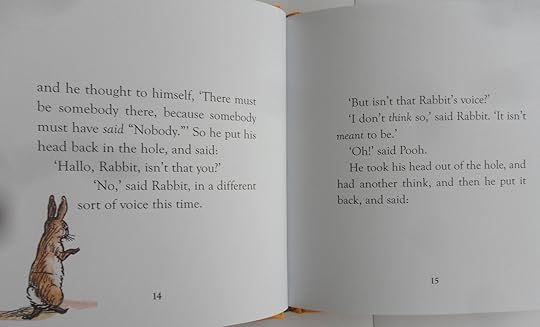
'Pooh goes visiting' by A.A Milne, is a great example of what a children's book should be. Milne shows examples of how you can use words and pictures blended together, for children to follow along with when they are reading by themselves or with an adult. For instance, from the first page, we as a reader are invited to joy in and hum along with Pooh Bear and his morning routine. If we just focus on the language for the moment, we can consider the way Milne and E.H.Shepard, have chosen to write and position the words throughout the book, is very cleverly done as it allows the intended reader to use the writing as a way to follow through the book in one smooth direction. This would suggest to the intended reader that they are the narrator of the story as if they already have a connection to Winnie the Pooh and his friends. This book has a continuous narrative, which will show that the main character is portrayed in more than one way, throughout the book and possibly in more than one setting across the page. This can be seen when we follow Pooh, whilst he continues to go through his morning routine humming all the way through until he comes across 'Rabbit's Home.' Pooh Bear is illustrated skipping across the pages. The illustrations displayed throughout the book is on its own is incredible to look at, the way E.H Shepard switched between black and white drawings of Pooh Bear and his friends. In addition to this, they have chosen to draw Pooh Bear and rabbit as actual sketches of the woodland animals. `The framing of the story helps the intended reader in identifying the world in which they embark from the beginning of the story to the end of the book. Overall I love this book, I personally feel this makes for a great children's picture book.
I thought this book was cute but it gives the wrong idea about losing weight. You shouldn't starve yourself for a week. That's pretty much common sense but this is just the sort of thing I would have misunderstood as a kid. The version I read was illustrated by Ernest H. Shepard and I didn't care for the black and white lines, though it was done in 1926 so I suppose the art style was different for the series then.
»»» A compra: Fã desta coleção inglesa, com capas lindas, lindas mesmo, e tamanho e ilustrações mimosas. Veio via Bertrand online.
»»» A aventura: Num passeio pela floresta o urso Poo encontra uma toca na base uma árvore e espreita. Lá dentro está o Coelho e acabam os dois na toca a trocar palavras e a lanchar. No final Poo tenta sair da toca mas fica preso pela cintura. Da parte de dentro o Coelho tenta ajudar empurrando Poo pelo rabo, de fora Christopher Robin e mais amiguinhos tentam ajudar puxando pelos braços. Só todos juntos podem ajudar o Poo a sair depois de um lanche demasiado generoso.
»»» Sentimento final: Muito bom. Mantém-se a inocência que vi no 1.º livro que li e mantém-se a elegância de tudo neste livro. Siga o próximo.
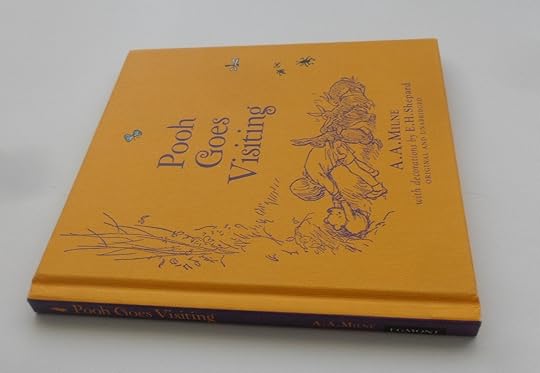
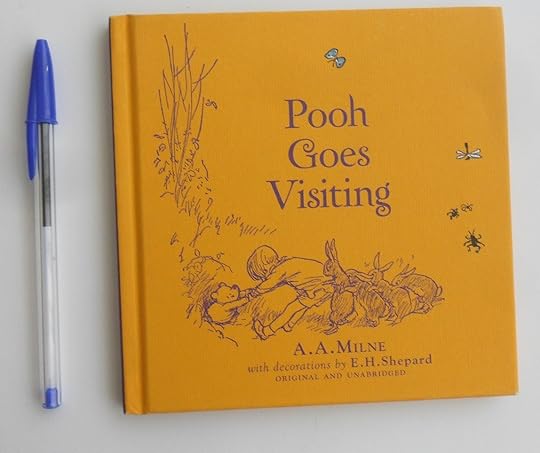
»»» Nota final (capa e outras considerações): --- [Capa] – Capa linda, mais uma vez. Esta edição da editora Egmont é um luxo, na beleza do desenho e das cores escolhidas, mas também no material escolhido, capa dura com uma textura que parece tecido. Uau. --- [Tamanho] – Mantém-se o tamanho mimoso de um azulejo. --- [Desenho] – O livro contém novamente algumas ilustrações dispersas, bem agradáveis.
A humorous, sweet collection of stories about toys that are alive and their adventures with their human boy Christopher Robin. I didn’t read this as a child, which is puzzling because it seems like something I would have liked YET as a child I had a strong aversion to Winnie-the-Pooh. Maybe it was the scratchy voice of the actor in the cartoon, or the fact that all the animals are very stupid and have very annoying traits… I also found it grating as a child when adults portrayed children as too childlike—I think I found it condescending or like adults were making fun of children for being innocent, which I didn’t get that reading this as adult—but then again, not a child anymore! I did enjoy this as an adult and would recommend it to readers of all ages, even though my younger self didn’t appreciate it then.
A takeaway from the story: visiting friends means that friends have to offer you food.
Milne's classic is different from Disney's version, yet the charm does not differ that much. Pooh is a character who is very relatable to children, and the story serves as a quick, light-hearted read that is enjoyable beyond time.
This book has a lot of words, but they are easy words that students will be able to read if they are young. The beloved Pooh wounds up getting stuck, and has to call on his friends for help. This book is funny, loving, and has easy morals that children can use in their lives such as calling on friends for help if they get stuck, and to not be too selfish when going to a friends house. I will always love Pooh and his friends, and think this is a fun book to read.
I so enjoyed this book! So clever and hilariously cute. A story where Winnie The Pooh goes visiting friends and stops in at rabbits. After his visit and snack he gets stuck in the rabbit hole front door (rabbit thinks because he ate too much). Christopher Robin concludes that Pooh needs to wait until he is thinner, which will probably take a week, with NO meals. Pooh is very sad and distraught. He would heave a sigh but he is too tightly stuck to! They offer to read to him to pass the time (and he is so very upset about no eating for a week), and my favorite line was Pooh saying, "Then would you read a Sustaining Book, such a would help comfort a Wedged Bear in Great Tightness?" Haha! Rabbit uses his legs "on the south end" to hang his laundry and towels. So many gems of greatness. Maybe one of my favorite Milne stories to date.
An abridged version of an original A. A. Milne tale about what happens when Pooh invites himself to elevensies (wait, wrong series...) and eats too much. The original illustrations by Ernest Shepard are a nice touch for this board book. If the board book was a little larger it might show off these illustrations better; nonetheless, kid1 loves to look at the pictures.
This is such an adorable book. Pooh visiting Rabbit at his home is one of my favorite stories un the series. Winnie The Pooh has always been one of my favorites and I love how when Pooh and his friends think that something terrible has happened, Christopher Robin always seems to have a positive attitude. What a great message for children and adults alike.
This has been so much fun. This one Pooh goes to visit Rabbit and he sticks his head in Rabbits entry hole and gets stuck. The adventure of getting him unstuck was a lot of fun. These sure are cute.