Jump to ratings and reviews
Rate this book

Coventry

Rate this book
Helen Humphreys draws on history to delve into the lives torn asunder by the German attack of November 14, 1940. Harriet, a widow from World War I, is atop Coventry Cathedral, part of the nightly watch, when first the factories and then the church itself are set on fire. In the ensuing chaos she bonds with a young man, very much like the husband she lost, who relies on her to find the way back to his home where he left his mother. On their journey through a hell of burning shops and collapsed homes, Harriet awakens to emotions she had long put aside. At home, the youth's mother awaits his arrival and rethinks the life that has brought her to this city and her life raising her son alone. Ultimately, together these two women must face a world as immeasurably changed as their own selves.

177 pages, Hardcover

First published January 1, 2008

57 people are currently reading
1098 people want to read

About the author

Helen Humphreys

31 books421 followers
Helen Humphreys is the author of five books of poetry, eleven novels, and three works of non-fiction. She was born in Kingston-on-Thames, England, and now lives in Kingston, Ontario, Canada.

Her first novel, Leaving Earth (1997), won the 1998 City of Toronto Book Award and was a New York Times Notable Book of the Year. Her second novel, Afterimage (2000), won the 2000 Rogers Writers' Trust Fiction Prize, was nominated for the Commonwealth Writers' Prize, and was a New York Times Notable Book of the Year. Her third novel, The Lost Garden (2002), was a 2003 Canada Reads selection, a national bestseller, and was also a New York Times Notable Book of the Year. Wild Dogs (2004) won the 2005 Lambda Prize for fiction, has been optioned for film, and was produced as a stage play at CanStage in Toronto in the fall of 2008. Coventry (2008) was a #1 national bestseller, was chosen as one of the top 100 books of the year by the Globe & Mail, and was chosen one of the top ten books of the year by both the Ottawa Citizen and NOW Magazine.

Humphreys's work of creative non-fiction, The Frozen Thames (2007), was a #1 national bestseller. Her collections of poetry include Gods and Other Mortals (1986); Nuns Looking Anxious, Listening to Radios (1990); and, The Perils of Geography (1995). Her latest collection, Anthem (1999), won the 2000 Canadian Authors Association Award for Poetry.

Helen Humphreys's fiction is published in Canada by HarperCollins, and in the U.S. by W.W. Norton. The Frozen Thames was published by McClelland & Stewart in Canada, and by Bantam in the U.S. Her work has been translated into many languages.

Ratings & Reviews

What do you think?
Rate this book

Friends & Following

Create a free account to discover what your friends think of this book!

Community Reviews

5 stars
336 (18%)
4 stars
796 (44%)
3 stars
527 (29%)
2 stars
106 (5%)
1 star
20 (1%)
Displaying 1 - 30 of 291 reviews
Profile Image for Orsodimondo.
2,458 reviews2,430 followers
July 2, 2023
IL POTERE DEL CASO


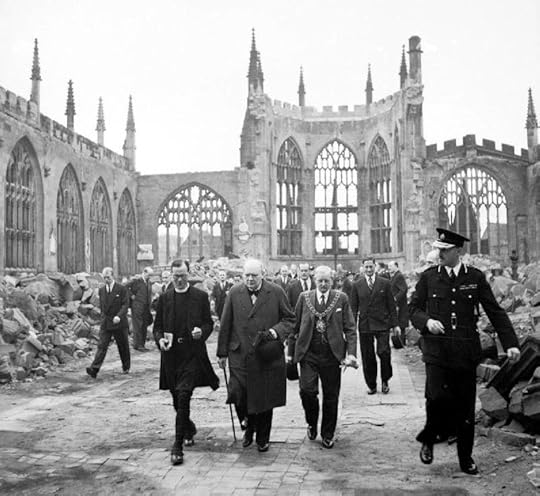
Settembre 1941: Winston Churchill e il sindaco di Coventry in visita alla Cattedrale distrutta dal blitz aereo nazista.

Una ragazza di diciotto anni, Harriett, fresca di nozze, accompagno il suo sposo alla stazione ferroviaria: il giovane, Owen, ha i suoi stessi anni, indossa la divisa militare, sta per prendere il treno che lo porterà in Francia a combattere contro i “crucchi”. È il settembre del 1914.
La giovane coppia si è trasferita a Coventry, città a un paio d’ore di macchian più a nord di Londra, per un’opportunità di lavoro: occorre sapere che in quella città si raggruppavano le principali industrie automobilistiche (Daimler) e motociclistiche (Triumph) e meccaniche e aeronautiche dell’intero paese.
I tedeschi volevano preparare l’invasione via mare dell’Inghilterra e si preparavano la strada con bombardamenti massicci. Quello di Coventry duro più di dieci ore ininterrotte, nella notte di luna piena del 14 novembre 1940.
La città fu rasa al suolo e agli inglesi non restò che ricostruirla: ci furono più di mille morti, feriti, dispersi. Un altro esempio di “storia naturale della distruzione”.


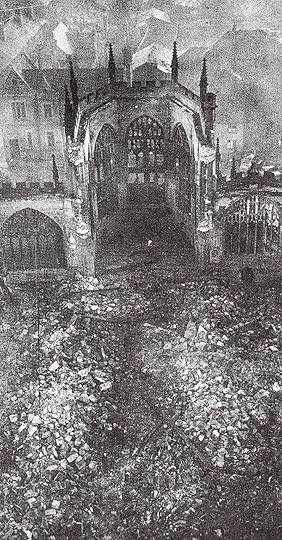
La Cattedrale di Coventry subito dopo il raid aereo della Luftwaffe del 14 novembre 1940.

Harriett è da così poco tempo a Coventry che ha problemi a ritrovare la strada per casa: chiede indicazioni a una ragazza, Maeve, che sta disegnando la cattedrale. Maeve è in visita a un’amica, di Coventry ne sa tanto quanto Harriett: ma è ben disposta a fare il possibile per riportare la recente conoscenza a casa. Maeve promette di tornare in visita, Harriett è interessata ai suoi disegni, e adesso che è rimasta sola, avrebbe tanto piacere di rivederla.

Harriett ancora non lo sa: ma è davvero rimasta sola. Suo marito Owen rimane ucciso nelle battaglie di Ypres un mese dopo aver messo piede sul continente. Alla giovane moglie viene data la notizia senza certezza: suo marito è disperso o morto. Nell’incertezza Harriett non riesce a staccarsi dal ricordo di Owen. A fine guerra, in una specie di pellegrinaggio a Ypres, capirà che Owen non può essere che morto. E quindi, finalmente si rende conto della perdita definitiva.
Riuscire a elaborarla, ad andare avanti, a rifarsi una vita, è impresa altra, altrettanto complessa.


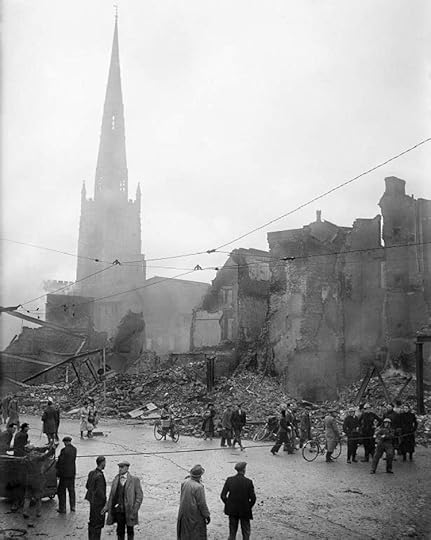
La Holy Trinity Church rimasta in piedi dopo la devastazione aerea.

Ventidue anni dopo Harriett vive ancora a Coventry impiegata nella biblioteca centrale. Fa servizio volontario di guardia antincendio. E la notte del 14 novembre 1940 è di turno sul tetto della celebre cattedrale di S. Michele, capolavoro architettonico del XIV secolo. Harriett comprende presto che la notte di plenilunio agevola gli attacchi aerei tedeschi. E con le prime fiamme che si innalzano dal tetto, fa la conoscenza di un altro volontario pompiere, il giovane Jeremy, che ha giusto la metà dei suoi anni.

Resteranno insieme quasi tutta la notte per poi separarsi e mai più rincontrarsi. Data la situazione rischiosa e difficile – Helen Humphreys è magistrale nel descrivere e raccontare le ore di bombardamenti, incendi, crolli, distruzione, sangue, ferite, morti, un’impresa davvero notevole – tra loro la distanza si accorcia presto, per diventare vicinanza, per trasformarsi in…


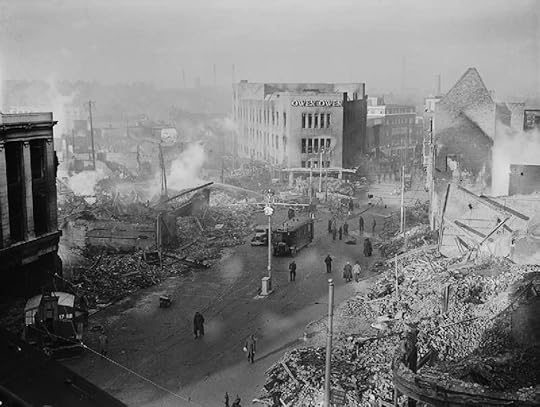
Il centro della città di Coventry.

In questo breve davvero bel romanzo di intrecci e incastri, Helen Humphreys segue un altro personaggio: quella Maeve che avevamo conosciuto all’inizio. È tornata a vivere a Coventry da qualche mese perché il figlio ha trovato lavoro alla Triumph. Figlio concepito senza conoscere il padre, uno dei soldati incontrati durante la Grande Guerra, ai quali regalava per passione e compassione qualche ora d’amore, ai quali donava il suo corpo. Il figlio ha ventidue anni e nella notte del 14 novembre 1940 è di servizio volontario antincendio sul tetto della celebre cattedrale.

Queste centocinquanta pagine, che ho molto amato, sono un inno al caso, alla coincidenza o al destino. Maeve disegna, si porta sempre dietro un blocco e una matita: disegna un piede, una mano, il ritratto di suo figlio di fianco, un albero… E sarà proprio questo particolare che porterà Harriett a riconoscerla quando si troverano, ognuna arrivata per strada diversa, in un campo fuori città, lontane dalle bombe. E a questo punto sarà impossibile per Harriett non accompagnare Maeve in cerca del figlio Jeremy che è rimasto a Coventry.


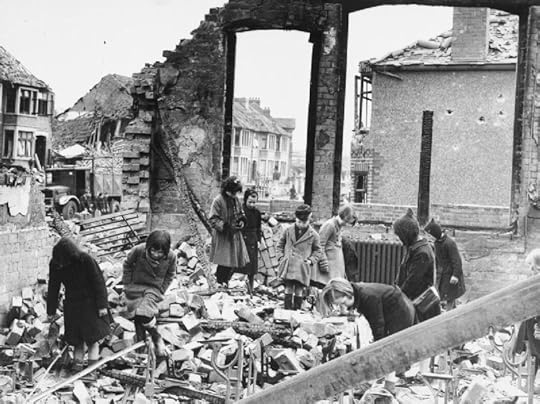
Bambini che esplorano le rovine della loro scuola.

Se Maeve disegna, Harriett ha invece l’abitudine di scrivere brevi note: descrizioni, pensieri, riflessioni, anche lei, ovunque vada, si porta dietro carta e penna.
E quando nel 1962, ventidue anni dopo quella notte tremenda passata alla storia, scrive una cartolina a Maeve che la riceve sulle isole Aran dove si è trasferita a vivere, al largo di Galway, innamorata della luce dell’oceano Atlantico, e quando Maeve riceve la cartolina e si appresta a leggerla, il breve romanzo si chiude con un tuffo al cuore di questo lettore.


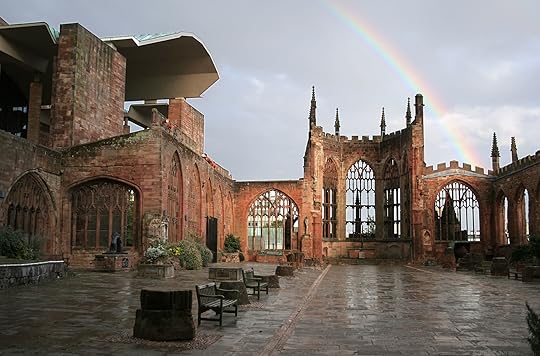
La Cattedrale di Coventry oggi.
Profile Image for Libby.
622 reviews153 followers
July 1, 2020
Even though I’m a fan of elaborate prose that leans toward the lyrical and poetic, I found myself absorbed in Helen Humphreys’s simply told story. Not that her prose isn’t pretty fine. It is...but straightforward in an elegant kind of way. She has an easy, gentle tone that belies the horrific nature of the scenes that unfold before our eyes. The bombing of Coventry, England by the German Luftwaffe on November 14, 1940, is at the heart of the narrative. Coventry was an industrial center where Triumph Motor Company, the Daimler Motor Company, and Alfred Herbert manufacturing which made machine tools, and many other factories were bombed. The streets became chaotic as people died in their homes, in air raid shelters, in Anderson Shelters, which were corrugated metal shelters set up in many gardens and backyards, and as they went about searching for safety. Besides the loss of life, the most heartfelt loss was probably St. Michael’s Cathedral, built in the late 14th and early 15th centuries, the only Cathedral that England lost to bombing during WW2.

We meet Harriet Marsh first in 1940 as a fire watcher; she is taking the place of a friend who has twisted his knee. Fire watchers are mostly old men and young boys who watch the roofs of Coventry and send up an alarm when bombs start falling. Dressed in her friend’s overalls and tin helmet, Harriet is on the roof of the Cathedral. When the author summons us to 1914 we meet Harriet as a young bride. Her groom, Owen, eighteen years of age, is going off to war. It is here that I become absorbed, for Humphreys’s descriptions are like an old vintage picture, soft around the edges. This is a young couple in love, and their lovemaking is new and sweet. Harriet observes Owen as he shaves and thinks him most beautiful. Before Owen’s leavetaking, he assures his bride that the war will soon be over.

There are two more main characters. One of them is Maeve, a young woman that Harriet meets briefly in 1914, just after Owen boards his train for basic training in France. It’s a meaningful meeting that will ripple out through time, a pebble dropped in the center of their young lives. The other main character is Jeremy, a young man, and fellow fire watcher in 1940. Jeremy seems so young to Harriet and more than a little lost as the entire city begins to catch fire. Harriet will accompany Jeremy as he searches for his mother. Their route is hellish and unforgettable.

It was interesting to me that Harriet writes ‘descriptions’ and Maeve is a bit of an artist. Through these pathways of communication, I gained insight into the characters. Harriet’s search for the perfect word and Maeve’s powers of observation as she sketches remind me that all of us are trying to bring meaning to our world and life experiences. Humphries details the horrors of a bombing blitz and shows how in the midst of war, we still look for relationship, a tender touch, a softening of the heart. This beautiful and well-written story is like an arrow there...to the heart.
Profile Image for Sara.
Author 1 book935 followers
July 2, 2020
This beautiful and quite short novel was the perfect distraction for me while I sat on hold for two hours today waiting for my turn to talk to someone at Social Security. It is primarily the story of one day in the lives of two people during the Blitz in England. Harriet Marsh, a forty-something widow, is enlisted as a fire-watcher to fill in for a disabled friend and the boy on the cathedral roof with her is Jeremy Fisher, a young man in his twenties and new to Coventry. When the cathedral is bombed, the two of them escape together and set out in search of Jeremy’s mother.

To say more would give away plot, and I always strive to never do that. What I can tell you is that by the end of the novel you feel you really know both Harriet and Jeremy, just as they come to know one another. What can you know or feel about a person you have just met when they share a moment in time with you unlike any other you have ever experienced? Does the attachment last beyond the moment? Can a memory form an attachment in itself? What is there to cling to when your world and everything you own is destroyed before your eyes?

Helen Humphreys is a powerhouse writer. She can pack more into 200 pages than many authors are able to put into 600. Her works are always sprinkled with tidbits of wise observation that make you nod your head in agreement.

Maybe reading was just a way to make her feel less alone, to keep her company. When you read something you are stopped, the moment is stayed, you can sometimes be there more fully than you can in your real life.

Harriet does not like the idea of the story bleeding through into real life. She trusts a story, and doesn’t trust real life. But what makes her trust a story is the knowledge that it will stay where it is, that she can visit it but that there is no chance it will visit her.


I have surely used reading over the course of my life to escape reality, to lessen loneliness and to sink into a world that felt more real than anything going on in my own. Which reader doesn’t understand that part of the thrill of the book is that you can experience danger and be in none, feel heartache without suffering the betrayal, travel the world without leaving your doorway?

She has been happy with the rhythm of her days. It is not as though she’s greedy for happiness, but she wishes that she’d been able to recognize it completely when she had it.

Goes without saying that I have experienced this. You cannot reach my age without wishing you had lived a little more fully in some of the ordinary wonder that you took for granted.

The end of this book was poignant and unexpected, another thing Humphrey’s does well. I closed the last page a bit grateful to the bureaucracy that kept me holding, for without it I would not have slid this little gem off the shelf and had such a pleasant experience today.
Profile Image for JimZ.
1,297 reviews757 followers
August 16, 2020
A short historical novel on the bombing of Coventry during WW II. There are three protagonists — Harriet, who lost her husband in WW I (they had only been married a month and je died in Ypres France), Maeve who has a child out of wedlock in the period around the time of WW I, and the child himself, Jeremy. The time and setting of the novel is the evening of November 14, 1940 when German bombers set the town of Coventry ablaze. The novel concerns the here and the now, as well as recollections from Harriet’s and Maeve’s life since WW I, revealed by their self-reflections. They meet by happenstance on that November night and it turns out that it is their second meeting — they had initially met in Coventry over tea one day in September 20, 1914 just after Harriet had seen her husband off at the train station…he was headed off to boot camp (never to see him again).

This is the third work of Humphreys I have read the first two being Afterimages (2000, winner of the Rogers Writers' Trust Fiction Prize) and The Frozen Thames (2017).

Humphreys is not sappy in her depiction of events on the burning of Coventry in this historical novel. It’s a sobering read, and for me is a solid 3 stars.

Reviews:
https://quillandquire.com/review/cove...
https://historicalnovelsociety.org/re...
From a blog site: https://diaryofaneccentric.wordpress....
Profile Image for Antoinette.
1,049 reviews238 followers
August 2, 2025
4.5 STARS

“In Coventry, and in all the other British towns and cities, people wait anxiously for morning.”

This book takes place for the most part on November 14, 1940 on the night that Germany unleashed a major attack on Coventry. It was a prime target because it was an “industrial town full of motor works and armament factories”.

In this short novel (175 pages), Helen Humphrey brings that night alive to her readers.We follow 3 individuals: Harriet, a 42 year old woman who is on fire watch at the Coventry Cathedral. With her on fire watch is Jeremy, a 22 year old young man who is fairly new to the city, and Maeve, Jeremy’s mother, who once the bombing and the fires start, fears for her son.

Everything about that night felt immediate to me- all the destruction, the deaths, the palpable fear. We follow Harriet and Jeremy on an odyssey through the burning, collapsing town in search of Jeremy’s mother. It was a night that the people who lived through it , never forgot. After reading this novel, I know I will not soon forget it either.

I have nothing but praise for Helen Humphrey who managed to convey so much in so few pages.

My thanks to my friend, Sara Steger, who recommended this book to me.

Published: 2008
Profile Image for Diane S ☔.
4,901 reviews14.6k followers
September 19, 2014
A new author for me and one in whose writing I quickly fell in love. Her sentences are so fluid, her words almost lulling, just wonderful. This provides a sharp contrast to the heartfelt descriptions of the bombing and destruction of Coventry during WWII. Can goods bursting, Windows shattering, broken glass raining down, potatoes rolling on the now crooked floor, a man shaving one minute but gone the next, people running through the streets with metal pots on their heads, and of course houses no longer standing, piles of rubble and the bodies laying wherever they fell. The Cathedral which was the towns pride and joy would be the only Cathedral in Britain to be destroyed during the war.

Helen, only 18, during the last war, newly married, would shortly loose her young husband at Ypres. She has never remarried and stayed in the house in Coventry that they had shared. She would be one of many who would loose everything that night. Love the story of her and Maeve and of course Jeremy, they added a very real face to this tragedy, a shared experience that would connect them always.

Real people who had to start over in a time when things were not easily replaceable and government agencies were not expected to rescue one. I loved this quote, "I don't feel alive," says Maeve, and Harriet knows what she means. The world they left is unrecognizable, not a place they want to inhabit. It feels like a sort of afterlife. They are their own ghosts."

This is an author I definitely want to read more of, so if anyone has any suggestions please share them.
Profile Image for Hannah.
820 reviews
May 26, 2011
Rating Clarification: 3.5 Stars

Author Helen Humphreys' novel, Coventry, primarily revolves around the night and early morning hours of November 14-15, 1940, when over 500 German Luftwaffe blitzed the entire town of Coventry, England. Over 600 residents were killed, thousands of homes and businesses were reduced to rubble, and the beautiful medieval Coventry Cathedral was turned into a shell of its formal grandeur.

Humphreys writing of the blitz of this town was strikingly, hauntingly beautiful. You got a real feeling of the total devastation and horror of the bombing, as well as what the residents might have felt during the attack. Less successful, IMO, was the fictional story itself; a story of two women who first met briefly in 1914 at the beginning of WWI, lost touch, and reunited during the attack of November 14-15th. I didn't quite buy all the incredible coincedences that played out to facilitate their reunion, and one plot thread in particular: , didn't ring true to me at all and just felt like a cheap, sexual titillation into what was heretofore an interesting character dynamic. That being said, Coventry was still an interesting novel as it pertains to the actual events of the blitz, and well worth the time to read if you enjoy this period of history. There are 2 flashbacks to 1914 to set the stage and introduce the two female characters, and 1 (lackluster) flashfoward to 1962 that ends the novel. It's a very quick read, with only 177 pages, with some thoughtful, beautiful prose like the following:

"The good thing about books is that they remain themselves. What happens in their pages stays there. Harriet does not like the idea of the story bleeding through into real life. She trusts a story, and doesn't trust real life. But what makes her trust a story is the knowledge that it will stay where it is, that she can visit it but there is no chance it will visit her".
Profile Image for Shane.
Author 12 books297 followers
August 30, 2010
I visited Coventry Cathedral (the newer version) back in the ‘70’s on a trip to Oxford but never took much time to understand its fiery genesis. This book was a welcome filler-in of my information gaps from the perspective of the survivors of that inferno.

The lives of the two protagonists, Harriet and Maeve, intersect at critical points during World Wars I and II in the city of Coventry. At the dawn of WWI, Harriet and Maeve meet by happenstance and enjoy a double decker bus ride together, soon after the former has said goodbye to her recently married, 18-year old husband, Owen, who is heading off to the battle front in Belgium, never to return alive. The women forget to trade names or addresses on that first meeting and lose contact. During WWII, the two women meet again as refugees when the city of Coventry is under aerial bombardment; both are looking for the 22-year old Jeremy who has affected their lives in different ways, and who has gallantly gone off to save lives from the inferno. Outside of these two ghastly global conflicts, the two women’s lives seem unlived, but the crucible of war gives them definition and purpose. Their wartime experiences bind them inextricably, well into old age, and each in her own way begins to express and record the indelible images of war: Harriet as a writer and Maeve as a painter.

This is a very short novel, almost a novella, and the prose is simple and elegant. It is also an interior book as we see Coventry through the eyes of these two women, and much of the political machinations behind the bombing of that city are out of scope. That said, I found much of the back story, outside of the wartime events, being “told” to us: Maeve’s expulsion from her family when she gets pregnant, and Harriet’s wicked mother who is hell bent on burning everyone, are two examples; we even get a page of exposition on Maeve’s late marriage to Tom, another painter, just three pages from the end of the book.

The book woke me to the fact that much of the tragedy of history occurred, or was exacerbated by the technology (or lack of technology) of its time. For instance, if cell phones had been around at the time of the bombing of Coventry, finding Jeremy would not have been such a difficult thing for either of the women, and their lives (and Jeremy’s) may have taken a completely different direction. The book also woke me to the fact that so many hapless, silent, and stoic women of that period not only lost their husbands in one war, but they turned around to lose their sons in the next one – a truly persecuted generation. Humphreys pays tribute to this forgotten cohort with great sensitivity, without lapsing into sentimentality.

Profile Image for Almira.
669 reviews2 followers
February 26, 2019
If you are an English history, particularly WWII, "fan", then you will know the horrific story of the bombing of the English town of Coventry - on November 14, 1940.
If you do not know the history of the WWII bombing of Coventry, and are interested in learning a shortened version of events, then this book is a real eye-opener.

Helen Humphreys takes us on the event of a lifetime - in all its "gory" details of this one night.

The German bombing is virtually non-stop from darkness on the 14th Nov to dawn of the 15th Nov, 1940. The Cathedral of Coventry was the only Cathedral in the United Kingdom to be destroyed by the Germans.

The sounds of the bombs falling, the screams of the victims, the staunch of the burning bodies is vividly brought to the page as Harriet Marsh attempts to reunite Jeremy with his mother Maeve. The two women have a connection from the beginning of the war, that unfolds throughout the story.

Profile Image for Carrie .
1,032 reviews621 followers
October 9, 2015
This story spans both World Wars, and we get to follow the lives of two women and their losses and experiences through out.

The bulk of the story is about the Germans air raids on the town of Coventry, the author has done a wonderful job in describing the scenes taking place, the emotions, the sounds. From all this destruction and death a bond of friendship is formed.

I love books set during the war, especially WW2, as a history lover I always tend to goble them up if written well, and this one was done very good.
Profile Image for Krista.
1,469 reviews854 followers
July 3, 2015
“Fire!” yells the old man on the south chapel roof.

From the cathedral roof Harriet can clearly see the neighbouring spires of Christ Church and Holy Trinity Church. She can see the dark hunch of roofs and the rivering streets between them, but after that the buildings fall off into shadow. The fire appears as a small orange smudge in the distance. It seems so far away that Harriet feels more relief than worry at first, until she remembers that most of the large factories in Coventry are on the outskirts of the city, right where the fire begins to bloom across the horizon line.

For a few minutes the fire-watchers live up to their name – four dark figures stamped against a moonlit sky, standing sentinel on the roof of the cathedral while the edges of the city begin to curl up and burn.

Famously, Joseph Stalin said, “One death is a tragedy; one million is a statistic”, and in fiction about WWII – an event that caused the deaths of 50 to 80 million people – it's often most compelling to focus on the stories of a few individuals, bringing the tragedy down to a level that the human brain can comprehend. To this end, Coventry tells the story of one night – November 14, 1940 – through the eyes of two women, with a couple of flashbacks thrown in to set the scene.

If I knew WWII history better, I would have recognised the date of November 14, 1940 as when the Germans bombed the British city of Coventry, destroying its 500-year-old cathedral; the only British cathedral to fall during the war. That would have made the opening scene – with Harriet on the cathedral's roof, posing as a man to fill in as a fire-watcher for her injured neighbour – that much more urgent, but the absence of foreshadowing didn't lessen the tension. As the cathedral begins to burn, Harriet decides to help a young man – Jeremy, a newcomer to the city – find his mother. Meanwhile, Jeremy's mother Maeve begins searching for her son. In a flashback chapter, we learn that Harriet had met Maeve at the dawn of WWI; immediately after Harriet had sent her newly-wedded husband off to meet his fate in the trenches of Belgium. And this is the part of the book that really bothered me: as a reader, I hate a big coincidence, and when you set up a situation where two women – who spent a couple of hours together, 26 years ago – have their journeys chronicled from alternating points of view, and you know they're going to meet up, and the whole point of the plot becomes the bringing of the two of them together, there's a weakening of dramatic tension as I'm frogmarched towards the big-coincidence-as-climax moment that I don't even want to arrive at.

What does work, however, are all the small moments that these women witness along the way, as the Germans kept up the bombing raid until dawn. There are many tragedies, always immediate and at the individual level, as when a good-natured man dies while trying to share a twist of tea or when the voice pleading beneath the rubble goes silent before enough of the hot bricks can be removed by bloody and blistered fingers or when an entire family is discovered in a frozen domestic tableau, having suffocated where they sat as a bomb sucked the oxygen out of their home. The danger and the fear and the exhaustion of a night-long bombing raid is perfectly captured in these small moments, and as another nice touch: the beginning of the book has several flashbacks, as I noted, but once the main journey of Jeremy and Maeve trying to find each other begins, all of the action is in the present tense, without chapter breaks, and I began to find it relentless; began hoping for another flashback to get a break from all the fires and rubble and dead bodies. This format really worked for me. But then a pointless flash-forward is tacked onto the end, and, meh.


Another curiosity: Harriet had received a letter from her husband while he was off fighting – which is shared in full – and in the acknowledgments, author Helen Humphreys states that this was an actual letter written by her own grandfather who fought at Ypres in 1914. It is a surprisingly compassionate letter – surprising for having being written by a soldier while sitting in a trench – which says at one point, “Whatever happens, you must not believe that the Germans are worse than us.” It then goes on to give examples of German soldiers helping their injured enemies. Now, this would have been written before the Huns began their widely condemned gassing campaigns, and certainly long before the atrocities that the Germans committed during WWII, so I find it to be a very curious document for Humphreys to have decided to include. On the one hand, if the bombers were flying so low that Harriet could make out the faces of the pilots, the Luftwaffe was close enough to see that they were targeting homes and fleeing civilians. On the other hand, the Allies eventually did the same thing to German targets – not to mention the H bombs in Japan – but that was well in the future for the characters of this book. Whatever happens, you must not believe that the Germans are worse than us. That's such an extraordinary statement for a soldier to have made that perhaps Humphreys couldn't help but want to preserve her grandfather's insight, or perhaps it was meant to be ironic (considering Harriet's husband's ultimate fate), or perhaps, this is an unsavoury bit of moral equivalence that undermines the entire experience that is suffered by Harriet and Maeve and the other innocent civilians that endured the night of November 14, 1940. Just a curious inclusion in a book about WWII.

In the end, this was an uneven reading experience for me: I liked the small details but not the overall story arc. I appreciated learning about this bit of history that I hadn't known before, and for the most part, I enjoyed Humphreys' writing style. A middle-of-the-road 3 star read.
Profile Image for Charlene.
1,079 reviews122 followers
May 24, 2020
A beautifully written short novel that takes place November 14-15, 1940, when Coventry, England was bombed almost into oblivion.

There are occasional flashbacks to WWI, when the main character, Harriett, age 18, loses her husband in its first months, a loss that she cannot seem to get completely recover from, and for her casual friend, Maeve, who has a baby as it draws to an end. And there's a last chapter that doesn't work as well as the rest of the novel, where Harriett revisits Coventry at the dedication of its new cathedral in 1962. But the heart of the story is the night of the bombing and the descriptions are vivid. Hot, burning butter running down one of the streets from a dairy on fire. A man shaving one moment in a bombed out house, using water that has been heated in pipes touched by fire; dead the next moment when another bomb comes.

I liked the characters, especially Harriett, who takes the place of her injured neighbor as a fire watcher on the cathedral roof for that one night. A fellow firewatcher is a very young man working in Coventry's factories (that are drawing the German bombers) and they set out together to make their way through the bombs that night to their homes at the edges of Coventry.

Will definitely look for more books by Helen Humphreys.


Profile Image for Jeanette (Ms. Feisty).
2,179 reviews2,184 followers
March 16, 2009
This wasn't too bad. I deducted one star because it's written in the present tense. This is history! Past tense, please.
It was interesting and saddening to learn about the bombing destruction of Coventry, but I thought Humphreys cheapened it a little by throwing in some tawdriness that could easily have been left out. Also, I felt there wasn't enough depth for such a heavy story.

Couple of good quotes:

"When a building is lost, everything that happened within its walls is lost as well."

"It was as though love and sex was a room she had once entered, and now she had simply left that room, turned off the lights, and gently closed the door. It didn't feel as though she had given up anything. It had given her up."
Profile Image for Jennifer.
748 reviews114 followers
July 2, 2009
Very few people gave this book as few as 2 stars but I decided not to be influenced by peer pressure. This book does have some enjoyable qualities. Harriet is a fairly believable character. We learn about her past - married very young, her husband leaves for the first world war after only a few weeks of marriage and, of course, doesn't return. Fortunately most of the book is told from her perspective and she carries us with her through the devastated city.

The story telling is interesting when Humphrey's is describing the devastation of war but too contrived in the way that she links people and events together. It's bad enough that these two women, Harriet and Maeve, meet randomly in 1914 and spend a day together without even knowing each others name (how would you never say "I'm Jane Doe" when you invite someone into your house???) then happen to randomly meet again in 1940 in a field on the night of the blitz. And Harriet just happens to have been fire watching on Coventry church with Maeve's missing son! What a coincidence! Lets go find him together and never lose touch again! But there are other devices that the author throws in that act as symbolic book ends to the story - the swallow, the bus, the visit years later to the war site. Many reviewers call this book poetic but I felt like these little devices cheapened the plot and the writing.
This entire review has been hidden because of spoilers.
Profile Image for Jackleen.
282 reviews
May 14, 2013
I do love Helen Humphreys lovely little books. I sat for a quiet couple of hours on mothers day and read this book cover to cover. The story of Coventry is set in Coventry on November 14, 1940 during a horrific bombing raid which leveled most of the city. The entire story takes place on November 14, with the exception of the beginning in which our two main characters briefly meet in 1919, and some flash backs memories from the two main characters of their life preceding this fateful night. The reader is taken on a cross city run as our three main characters move from place to place seeking shelter and safety, as well as each other, while the city literally falls down or rather, blows up around them. Humphrey presents her characters realistically, in both their attempts to survive the night, and their demonstrations of human kindness. The shear horror of this night, the sights and smells, are brought to life with writing that can only be described as elegant in both it's delivery and simplicity.

The amount of emotion, sites, events that Humphrey packs into just 177 pages is an achievement. I have read other books by Helen Humphreys and each is a small shining jewel, bearing up the expression, less is more.
Profile Image for Suni.
546 reviews47 followers
October 31, 2018
Coventry è un romanzo tutt'altro che perfetto – ma sapevo già prima di iniziarlo che i migliori della Humphreys sono altri – e lascia la sensazione che gli manchi qualcosa, anche se non riesco bene a definire cosa.
Però ha due caratteristiche che me lo hanno fatto apprezzare molto, al di là dei difetti: alcuni momenti di puro e altissimo lirismo (del resto l'autrice è anche, o forse prima di tutto, una poetessa) e, pregio ancora più rilevante, fa calare perfettamente nell'atmosfera di terrore che hanno vissuto gli abitanti di Coventry la notte del 14 novembre 1940, quando la Luftwaffe ha pressoché raso al suolo la città. Sembra di essere lì con loro, tra le macerie di edifici già crollati e i boati di quelli che stanno crollando, a respirare aria piena di fumo, a sentire addosso il calore degli incendi, a vedere il primo cadavere e impressionarsi e poi vederne altre decine e farci presto l'abitudine, a tirare fuori una parte di sé che non si pensava di avere, quella più legata all'istinto, in fondo siamo animali, che entra in gioco nelle situazioni di estremo pericolo e ci fa superare le paure e lottare per la sopravvivenza.
Profile Image for Dsinglet.
335 reviews
October 24, 2017
A well crafted story based on the bombing of Coventry during WW2. She follows the lives of two women, both who have experienced loses in their lives. Harriet lost her husband in the First World War. She finds herself on top of the cathedral when the bombing starts. She holds on to a young man and they fight their way through the terrible night of death, destruction and fires. They have a brief affair before parting ways. He turns out to be the only son of an casual friend. Harriet and Maeve bond as they suffer the loss together. Both find solace in their art, one as a writer, one as an artist.
A view for the reader of the effects of war on lives.
Profile Image for Magdelanye.
2,014 reviews247 followers
June 14, 2016
November 14, 1940
A harrowing day in the life of an English town being bombed by the German airforce during the second world war, with references to the past and the future for context. The randomness and futility of war are emphasized, and the impact on lives of those who were forced to normalize its horror.
HH skillfully recreates the mood of the times and her vivid prose gives movement to those moldering black and white photos that we try to keep in the closet of our memory.
Profile Image for Fran.
169 reviews5 followers
July 31, 2014
This is a tender book about the horror and devastation of the bombing of Coventry in November 1940. The writing is spare and jewel like, about a relationship that unfolds over the course of that dreadful night. I appreciated the humanness of the three main characters and the juxtaposition of ordinariness in the midst of the bombing and destruction.
Profile Image for Carolyn.
8 reviews2 followers
July 30, 2015
Jumps back and forth between WWI and WWII. Is a very short read, highly readable. I liked her style and the history.
This entire review has been hidden because of spoilers.
Profile Image for Ubik 2.0.
1,073 reviews294 followers
December 23, 2023
Morte dal cielo

Fatta eccezione per un paio di prologhi ed un ancor più breve epilogo, tutto il romanzo si concentra sui tragici avvenimenti del 14 novembre 1940 allorché la città di Coventry, strategicamente importante per le industrie meccaniche ed areonautiche, fu devastata da dieci ore di ininterrotto bombardamento da parte della Luftwaffe che rasero al suolo gran parte dell’abitato.

Questo è l’argomento del romanzo della Humphreys e ne rappresenta in qualche modo anche il limite perché la narrazione segue con accorata ed emozionante partecipazione le vicissitudini dei tre abitanti protagonisti, con tutto l’immaginabile repertorio di esplosioni, fughe, terrore, rifugi, rovine, corpi dilaniati, ma sacrifica a mio avviso l’originalità ed il particolare stile curioso che hanno caratterizzato le opere più significative dell’autrice, come “Cani selvaggi” o “Amuleto celeste”.

“Coventry” è un romanzo emotivamente coinvolgente e diligentemente documentato, in cui la prosa della Humphreys offre momenti di commozione, sconcerto e smarrimento per il senso di distruzione che circonda i testimoni di fronte allo sfacelo della cattedrale, all’incendio delle fabbriche ed alla polverizzazione di tante semplici abitazioni, ma si ferma ad uno sguardo essenzialmente descrittivo e ad un anelito di sopravvivenza interrotto da improvvisi e istintivi atti di eroismo e pietà nel soccorso di sconosciuti moribondi.

Non mi ha lasciato molto più di una testimonianza, pur doverosa e sincera, su uno dei tanti episodi di devastazione fisica e psicologica che ogni guerra lascia nel suo percorso, soprattutto a danno delle persone più innocenti ed indifese.
Profile Image for Susan.
404 reviews4 followers
June 2, 2024
A very absorbing and beautifully written little book by Helen Humphreys. This little book centres on November 14th, 1940, the day that the city of Coventry was almost completely destroyed by an aerial attack by Germany. The central theme is that of war and its horrible destruction and loss, and how the main characters of the story deal with this terrible day are changed because of it. I found it very moving and it was hard not to think of the thousands and thousands of people who are dealing with this destruction and loss today.
Profile Image for cameron.
441 reviews123 followers
November 21, 2023
A short but incredible story of the bombing of WW2 and the almost total destruction of the city. When I visited there we wandered into a tiny pub from the 17th C, pretty much the only old
Building left. You could see in your mind the missing heritage.
Profile Image for Trisha.
804 reviews69 followers
April 9, 2017
On the night of November 14, 1940, 400 German planes dropped over 500 tons of explosives on the town of Coventry in the English midlands igniting a firestorm that left the city devastated. Code named “Moonlight Sonata” the attack occurred on a cloudless night and after 11 hours of nonstop bombing many of the city’s historic buildings, including the magnificent medieval cathedral had been reduced to rubble. Over 500 men, women and children were killed and tens of thousands of those who survived were left homeless and separated from their families without food, water or electricity.

The events of that horrific night are detailed in this richly textured historical novel told from the points of view of two women (Harriet Marsh and Mauve Fisher) who had met briefly in 1914 at the beginning of WWI. Although they did not stay in touch during the years that followed, their lives were to intersect once again during the Coventry Blitz.

The novel is written in the present tense and I felt that it added a sense of immediacy to the events as they unfolded that night. Harriet had been on fire watch duty at the Cathedral but when it quickly became impossible to contain the fire with stirrup pumps and sand, she headed out across the city moving from shelter to shelter, stopping at first aid stations and heping rescue workers in their desperate attempts to free those who were trapped in the rubble of their homes.

By the time the all clear sounded the following morning, those who survived the worst of the bombing emerged from their shelters in a state of shock to confront the destruction of their city. Humphreys has vividly described their panic and sense of despair as they fled from the city to wander the countryside in search of missing relatives.

The novel ends by flashing forward 22 years to 1962 as Harriet returns to Canterbury for the dedication of the new cathedral. But she “finds the new architecture ugly, certainly no replacement for the seventeenth-century buildings that used to occupy the space.”

Like all good historical novels based on careful research this one sent me scurrying for more information, and I found the following link particularly fascinating because it included archival films and poignant interviews with men and women who had survived the Blitz:
https://www.youtube.com/watch?v=PHknZ...

Profile Image for Felice.
250 reviews82 followers
February 16, 2012
On November 14th, 1940 the city of Coventry in England suffered through horrific bombings from the German Air Force. Coventry was a big industrial area and its manufacturing included munitions. On that night 515 bombers were set from Germany to destroy Coventry’s factories. By the end of this blitz two thirds of the area’s factories were either destroyed or severely damaged, public utilities were out of commission, 2 hospitals had been destroyed, Coventry Cathedral was a ruin, over 4,000 homes were gone , approximately 1,100 people were hurt and an estimated 600 people were killed.


Set on that same awful night, Coventry by Helen Humphreys follows three people during the bombing: Jeremy a young man who has recently moved to Coventry to find a job in one of the war related factories, his mother, Maeve and Harriet. Maeve is a devoted mother and artist who has spent her life going from job to job in an effort to keep herself and her fatherless son afloat. Harriet is a long time widow. Her husband died in the first few weeks of fighting in WW1. Even twenty years after that loss she has been unable to find happiness in life.


Fate brings Harriet and Jeremy together as firewatchers on the 14th. They spend a night together that is appalling and fantastic. In between the horrific damages, the devastating loss of life and the constant attempt at rescuing, Harriet realizes that she has a connection with Jeremy and his mother. When the bombing starts Maeve heads home to wait for Jeremy’s return. Before that happens she gets caught up in the exodus out of the city. When the night is finally over the lives of all three of the main characters will be forever altered and forever connected.


This huge story is told by Helen Humphreys with a minimum of muss or fuss. Her writing is spare and direct but not in a bullet point, journalist style. Rather Humphreys calm, matter of fact prose juxtaposes the horror of the events in Coventry with her very ordinary characters who are living through it in a way that leaves the reader transfixed.
Profile Image for Carol.
1,843 reviews21 followers
May 20, 2013
Coventry by Helen Humphreys is an almost poetic depiction of the devastation of the bombing by the Germans in WWII upon that town.

I felt very close to one of the main characters, Harriet Marsh and her reaction to her husband's death in WWI. I could understand why she felt the way that she did. The only thing that keeps this book from getting a five star rating from me is an act by Harriet that just did not did believable. I also enjoyed reading about Maeve but didn't feel close to her.
Coventry was targeted by the Germans because of the munitions factories but so much more was destroyed than that. On the cover of the book is a picture of the shell of the only cathedral in Great Britain that was destroyed. That is what drew me to this book. I talked about to my friends who live close by and they remember going to see the ruins. The author puts Harriet as a firewatcher and Maeve’s son, Jeremy at the cathedral on November 14, 1940 on the beginning of the horrible night and the main part of the book focuses on that night.

So we see the people move into the bomb shelters and hear the ear piercing sounds of the bombs, smell the fires that were set off by the flares and made worse by the bombs. I really felt that I was walking around in the dark with Harriet and Jeremy. Hearing the moans of the trapped people and not sure where to go.

I highly recommend this book to people who love historical fiction. I want to read more of Helen Humphries books.
Profile Image for Anne.
2,440 reviews1,170 followers
September 13, 2009
Helen Humphreys uses powerful, yet simple language to relate the events of the night of November 14 1940 as Coventry is beseiged by bombs.

Harriet is on fire watch duty, as a favour to her neighbour - she was widowed during the first months of the last war. During the long and eventful night Harriet meets Jeremy, a young man recently moved to Coventry. Through flash backs to events over 20 years ago, the reader soon realises that Harriet and Jeremy have a link. Their link is Maeve; Jeremy's mother who Harriet met years ago and spent just a couple of hours with and has not seen since.

Helen Humphrey writes beautifully, her sparse prose really brings the terrible events of the night alive and her characterisation of Harriet, Maeve and Jeremy is excellent.

Although only a short novel, this is a vivid and sometimes breathtaking read. Not just about the horrors and loss caused by war, but about lost loves, rememberance, family and friends relationships and at times, desperation.

'Coventry' has been compared to Ian McEwan's 'On Chesil Beach' - I think it is a far better story with believeable characters and a writing style that pulls the reader in from page one.
Profile Image for Lindy.
118 reviews37 followers
March 14, 2017
Helen Humphreys is a Canadian author with a talent for poetic prose and who excels at close examination of human nature. The main story in Coventry takes place on one night: November 14, 1940. Harriet Marsh is volunteering as a fire warden, standing on the roof of the cathedral, where she meets another fire warden, Jeremy Fisher. He is about 20 years younger than Harriet and reminds her very much of her husband who died in WW I. Harriet and Jeremy become friends as they share the horrors of an extended bombing raid that destroyed much of the city of Coventry.

This short (175 pages) novel closely resembles one of Humphreys' previous works, The Lost Garden. It also has many similarities to Sarah Waters' The Night Watch, including the British WW II setting, the focus on individual lives affected by extraordinary times, and the shifts in time period. (These shifts are mostly parenthetical in Coventry, giving the reader some backstory and epilogue.) I wish I could add the similarity of lesbian content, but in typical Humphreys style, there is only lesbian subtext. Nevertheless, this book is a gem.
Profile Image for Joanne.
1,229 reviews25 followers
August 15, 2016
It takes a special kind of talent to distill so much emotion into such a short book. A great deal happens in less than 200 pages.
Harriet lost her husband of two months in WWI. She never recovered completely from the loss and lived a lonely life in Coventry. When WWII happened, Coventry was one of the biggest targets in all of Britain for the Germans, being almost levelled on the night of November 14, 1940. It was during this air raid that Harriet met Jeremy, a young air warden, and later his mother Maeve.
As they stumbled through the rubble of the bombs and collapsed buildings, Harriet and Jeremy formed a permanent bond. When they became separated, Harriet met Maeve, and, due to the events of that night, they became lifelong friends.
In spite of the topic, this book is sweet, gentle, and beautiful. I found myself savouring every paragraph. This author has a wonderful way of conveying so much in so little space. Her work is beautiful.
458 reviews6 followers
February 14, 2013
I am so happy to have discovered Helen Humphreys! She is quite a talented writer and this book is excellent. Telling the story of the bombing of Coventry and how a few of its citizens fared was brilliantly recounted. I am looking forward to reading more of her books since she has a strong voice and a fine writing style. I was so taken in by this story because the characters felt so real and the descriptions of the bombing were like nothing I had ever read before.
Displaying 1 - 30 of 291 reviews

Can't find what you're looking for?

Get help and learn more about the design.