

What do you think?
Vivian Apple #1
Vivian Apple at the End of the World
Seventeen-year-old Vivian Apple never believed in the evangelical Church of America, unlike her recently devout parents. But when Vivian returns home the night after the supposed "Rapture," all that’s left of her parents are two holes in the roof. Suddenly, she doesn't know who or what to believe. With her best friend Harp and a mysterious ally, Peter, Vivian embarks on a desperate cross-country roadtrip through a paranoid and panic-stricken America to find answers. Because at the end of the world, Vivan Apple isn't looking for a savior. She's looking for the truth.
262 pages, Hardcover
First published August 5, 2013
About the author
Katie Coyle
7 books34.9k followersKatie Coyle's debut novel VIVIAN APPLE AT THE END OF THE WORLD was named one of the forty best YA novels of all time by Rolling Stone, and was followed by a sequel, VIVIAN APPLE NEEDS A MIRACLE. Her short fiction has won the Pushcart Prize, and has been featured in BEST AMERICAN NON-REQUIRED READING, One Story, The Southeast Review, and Critical Quarterly, among others. She lives in New Jersey with her husband, and blogs at katiecoyle.com.
Ratings & Reviews
Friends & Following
Create a free account to discover what your friends think of this book!
Community Reviews
Displaying 1 - 30 of 959 reviews

December 23, 2013
Yo this book is pretty solid.

December 4, 2017
Vivian Apple at the End of the World is a breezy apocalyptic read that I appreciated, but came up short of loving. Published in 2014, the novel focuses on a model seventeen-year-old who not only watches freakish weather and economic recession rampage across the U.S., but witnesses the rise of the Church of America, whose half-baked gospels instruct an alarming number of Believers how to be raptured into heaven on Judgment Day, while all others will be set on the road to damnation. When her parents appear to be taken up by God and the apocalypse is at hand, she's left to fend for herself. The author succeeds at hitting all the right notes, but the tune itself never grabbed me.
Opening in Pittsburgh (in a refreshing change of pace from cities glamorized on TV), honors student Vivian Apple is introduced at a party thrown by her best friend of late, the wild Harpreet Janda. The girls have been become inseparable Non-Believers as one calamity after another--an earthquake in Chicago, a terrorist bombing at a Yankees game, the extinction of the U.S. bee population--have led to the rise of Beaton Frick, a wingnut from (where else?) Florida who claims to have spoken to Jesus at Starbuck's. Frick's business scheme, the Church of America, has grown massively popular as national crisis deepens, hopelessness surges and its forecast for Rapture Day grows nigh.
While Vivian and Harp have rejected the Book of Frick and the Believer parents who've attempted to convert them, the party host implores her friend to live like the world is ending and chat up a cute boy. Quiet and intense, Peter Ivey is in the mood for a conversation, which Vivian is sure she's failed at when he excuses himself. Vivian's social ineptitude is nothing compared to her shock the next morning to find that her parents have disappeared, leaving behind two holes in the ceiling. She's joined by Harp and her brother Raj, Raj's boyfriend Dylan and Dylan's seven-year-old sister Molly, all apparently orphaned after roughly three thousand Believers in the U.S. vanish at once.
I help make Molly a fort out of couch cushions and pillows; I throw open the kitchen cabinets and laugh when my friends' mouths fall open at my hoard. The food is all Church of America brand; in addition to founding the Church itself, Frick was the CEO of its accompanying multi-million dollar corporation. They publish the magazines and run the Church television networks, and they produce end-of-the-world provisions like these--bottles of Holy Spring Water, a bland SpaghettiOs knockoff called Christ Loops. For a long time I took a moral stand by not consuming them but now the Rapture has come and I'm starving. We eat cold Christ Loops out of the can, even though the electricity still works, for now.
Though her high school has been mostly empty her junior year (public education derided by the Church of America as "harbingers of secular terrorism"), Vivian walks to class on Monday with a sledgehammer over her shoulder for self-defense. Remaining students have filled the classroom of her history teacher Ms. Wambaugh, but the last adult in Vivian's world and her peers offer little more than progressive platitudes for rebuilding society with no plan of action. Harp always has a plan but before the girls can formulate one, Vivian's sophisticated maternal grandparents arrive to take custody and return with her to New York.
In the Big Apple, Vivian is quarantined in her grandparents' apartment in Central Park West. Electricity is out, the university where her grandfather teaches has been closed and on the streets, a youth movement calling itself the New Orphans rails against Frick. Her grandparents remain in denial but as a massive hurricane heads for the Eastern Seaboard, Vivian decides to steal their car and return to Pittsburgh. Before she initiates her first act of rebellion, the house phone rings in from a caller in San Francisco. No one speaks when Vivian answers, but she is left with the feeling that her mother was on the other end of the line.
Vivian ventures to Lawrenceville where Raj and Dylan lived to find Harp, drunk. She reports that a mob of young men lured Raj and Dylan to a football field, shot Raj and returned his body for them to bury. Dylan took Molly to New Jersey while Harp remained to be scorned by a second wave of Believers who feel their entrance to heaven hinges on punishing the sinners. Harp has contacts in the New Orphans and takes Vivian to meet their communications director, Peter Ivey, the boy who Vivian embarrassed herself with at the Rapture Eve party. Vivian shares her California phone call and Peter reveals that Frick might have a secret compound there, where the "Raptured" could be hiding. Vivian, Harp and Peter hit the road to find out. Their first stop is the holy site of Mount Rushmore.
The Book of Frick claims that in the late 1970s Jesus personally appeared to Frick in a powder-blue Chrysler convertible that had the power to travel instantly through space and time. Jesus used the vehicle to usher Frick to seven different spots in the United States that were personally blessed by God for one reason or another and at which Believers and Non-Believers alike could expect to find redemption. The list includes everywhere you'd think it would: the Grand Canyon, the Pentagon, Wall Street ("For God saw that Americans were industrious and made money in His name, and he saw that it was good.") It's one of the many parts of the Book of Frick that make you wonder whether or not Frick was just straight-up on 'shrooms when he was writing it; make that accusation to a Believer, however, as I did to my parents in their mission to convert me, and they will whine that "it's only a metaphor!" and imply that your inability to grasp nuance is a large part of what ensures your eternal damnation.
Katie Coyle strikes a clinically precise balance between lighter and darker elements in Vivian Apple at the End of the World. Her frequent references to the Book of Frick are droll, but her exploration of how religious gospels interpreted at their most literal extreme are the antithesis of humanity are potent. There is violence and terror in the story, but they remain mostly in the background rather than imperiling the characters. The same could be said of the novel's sex, drug and alcohol content, which Coyle suggests that Harp partakes in and does exist in the world of her teenagers without being described graphically.
Coyle recognizes that readers of Young Adult fiction tend to be open to the truth and the author takes advantage of it. Her running satire on the cult-like aspects of a religion are admirable, as well as very creative. She even creates new vocabulary words: "Magadalene" being parlance for the indoctrination of a Non-Believer female by a wholesome Believer male, with Harp considered vulnerable to considering her fetish for clean-cut boys. The writing is creative and the characters endearing, but it never grabbed me by the collar and threw me across the room the way a great apocalyptic novel would. It hits all the right notes as a satire, but I didn't believe it.
What kept me from being engaged with the doomsday scenario Coyle conjures up are the pages that lapse into melodrama. Vivian has at least one heart to heart meltdown with each character and each of those characters has an emotional breakdown with Vivian or someone else, grinding the story to a halt while people talk it out. There's too much talking about the end rather than showing how the characters plan to survive it. Theatrics are a recurring feature of this genre but it's one that holds the novel between three or four stars rather than between four or five. It's a very well written novel, but one I thought more about that felt.
Opening in Pittsburgh (in a refreshing change of pace from cities glamorized on TV), honors student Vivian Apple is introduced at a party thrown by her best friend of late, the wild Harpreet Janda. The girls have been become inseparable Non-Believers as one calamity after another--an earthquake in Chicago, a terrorist bombing at a Yankees game, the extinction of the U.S. bee population--have led to the rise of Beaton Frick, a wingnut from (where else?) Florida who claims to have spoken to Jesus at Starbuck's. Frick's business scheme, the Church of America, has grown massively popular as national crisis deepens, hopelessness surges and its forecast for Rapture Day grows nigh.
While Vivian and Harp have rejected the Book of Frick and the Believer parents who've attempted to convert them, the party host implores her friend to live like the world is ending and chat up a cute boy. Quiet and intense, Peter Ivey is in the mood for a conversation, which Vivian is sure she's failed at when he excuses himself. Vivian's social ineptitude is nothing compared to her shock the next morning to find that her parents have disappeared, leaving behind two holes in the ceiling. She's joined by Harp and her brother Raj, Raj's boyfriend Dylan and Dylan's seven-year-old sister Molly, all apparently orphaned after roughly three thousand Believers in the U.S. vanish at once.
I help make Molly a fort out of couch cushions and pillows; I throw open the kitchen cabinets and laugh when my friends' mouths fall open at my hoard. The food is all Church of America brand; in addition to founding the Church itself, Frick was the CEO of its accompanying multi-million dollar corporation. They publish the magazines and run the Church television networks, and they produce end-of-the-world provisions like these--bottles of Holy Spring Water, a bland SpaghettiOs knockoff called Christ Loops. For a long time I took a moral stand by not consuming them but now the Rapture has come and I'm starving. We eat cold Christ Loops out of the can, even though the electricity still works, for now.
Though her high school has been mostly empty her junior year (public education derided by the Church of America as "harbingers of secular terrorism"), Vivian walks to class on Monday with a sledgehammer over her shoulder for self-defense. Remaining students have filled the classroom of her history teacher Ms. Wambaugh, but the last adult in Vivian's world and her peers offer little more than progressive platitudes for rebuilding society with no plan of action. Harp always has a plan but before the girls can formulate one, Vivian's sophisticated maternal grandparents arrive to take custody and return with her to New York.
In the Big Apple, Vivian is quarantined in her grandparents' apartment in Central Park West. Electricity is out, the university where her grandfather teaches has been closed and on the streets, a youth movement calling itself the New Orphans rails against Frick. Her grandparents remain in denial but as a massive hurricane heads for the Eastern Seaboard, Vivian decides to steal their car and return to Pittsburgh. Before she initiates her first act of rebellion, the house phone rings in from a caller in San Francisco. No one speaks when Vivian answers, but she is left with the feeling that her mother was on the other end of the line.
Vivian ventures to Lawrenceville where Raj and Dylan lived to find Harp, drunk. She reports that a mob of young men lured Raj and Dylan to a football field, shot Raj and returned his body for them to bury. Dylan took Molly to New Jersey while Harp remained to be scorned by a second wave of Believers who feel their entrance to heaven hinges on punishing the sinners. Harp has contacts in the New Orphans and takes Vivian to meet their communications director, Peter Ivey, the boy who Vivian embarrassed herself with at the Rapture Eve party. Vivian shares her California phone call and Peter reveals that Frick might have a secret compound there, where the "Raptured" could be hiding. Vivian, Harp and Peter hit the road to find out. Their first stop is the holy site of Mount Rushmore.
The Book of Frick claims that in the late 1970s Jesus personally appeared to Frick in a powder-blue Chrysler convertible that had the power to travel instantly through space and time. Jesus used the vehicle to usher Frick to seven different spots in the United States that were personally blessed by God for one reason or another and at which Believers and Non-Believers alike could expect to find redemption. The list includes everywhere you'd think it would: the Grand Canyon, the Pentagon, Wall Street ("For God saw that Americans were industrious and made money in His name, and he saw that it was good.") It's one of the many parts of the Book of Frick that make you wonder whether or not Frick was just straight-up on 'shrooms when he was writing it; make that accusation to a Believer, however, as I did to my parents in their mission to convert me, and they will whine that "it's only a metaphor!" and imply that your inability to grasp nuance is a large part of what ensures your eternal damnation.
Katie Coyle strikes a clinically precise balance between lighter and darker elements in Vivian Apple at the End of the World. Her frequent references to the Book of Frick are droll, but her exploration of how religious gospels interpreted at their most literal extreme are the antithesis of humanity are potent. There is violence and terror in the story, but they remain mostly in the background rather than imperiling the characters. The same could be said of the novel's sex, drug and alcohol content, which Coyle suggests that Harp partakes in and does exist in the world of her teenagers without being described graphically.
Coyle recognizes that readers of Young Adult fiction tend to be open to the truth and the author takes advantage of it. Her running satire on the cult-like aspects of a religion are admirable, as well as very creative. She even creates new vocabulary words: "Magadalene" being parlance for the indoctrination of a Non-Believer female by a wholesome Believer male, with Harp considered vulnerable to considering her fetish for clean-cut boys. The writing is creative and the characters endearing, but it never grabbed me by the collar and threw me across the room the way a great apocalyptic novel would. It hits all the right notes as a satire, but I didn't believe it.
What kept me from being engaged with the doomsday scenario Coyle conjures up are the pages that lapse into melodrama. Vivian has at least one heart to heart meltdown with each character and each of those characters has an emotional breakdown with Vivian or someone else, grinding the story to a halt while people talk it out. There's too much talking about the end rather than showing how the characters plan to survive it. Theatrics are a recurring feature of this genre but it's one that holds the novel between three or four stars rather than between four or five. It's a very well written novel, but one I thought more about that felt.

May 23, 2014
Nothing prepared me for this book. I mean it's young adult right? Get this..
no insta-love!
no love triangle
no damn Mary Sue!
Vivian Apple is the main character and in the beginning I thought well she is kinda ho-hum. I loved her friend Harp (an Indian-American!). So I thought maybe I would enjoy some of the story at least.
You have a cultish atmosphere with a man named Frick who seems to have brain-washed most of the world into believing the apocalypse is coming. The thing is people do disappear. Including Harp and Vivian's parents. They were believers so it appears they were taken during this rapture.
Vivian begins to doubt the events that take place. She teams up with Harp and a guy named Peter and they do a road trip to find out all they can about the apocalypse.
Vivian's character started off kind of bland but the author does a great job of having her grow and change over the story. She ends up being a kick ass character and I'm dying for the next book in this series.
Now that frigging ending though!

I recieved a copy of this book from Netgalley in exchange for an honest review.
no insta-love!
no love triangle
no damn Mary Sue!
Vivian Apple is the main character and in the beginning I thought well she is kinda ho-hum. I loved her friend Harp (an Indian-American!). So I thought maybe I would enjoy some of the story at least.
You have a cultish atmosphere with a man named Frick who seems to have brain-washed most of the world into believing the apocalypse is coming. The thing is people do disappear. Including Harp and Vivian's parents. They were believers so it appears they were taken during this rapture.
Vivian begins to doubt the events that take place. She teams up with Harp and a guy named Peter and they do a road trip to find out all they can about the apocalypse.
Vivian's character started off kind of bland but the author does a great job of having her grow and change over the story. She ends up being a kick ass character and I'm dying for the next book in this series.
Now that frigging ending though!
I recieved a copy of this book from Netgalley in exchange for an honest review.

October 27, 2013
Spoilers galore.
What the fuck did I just read.
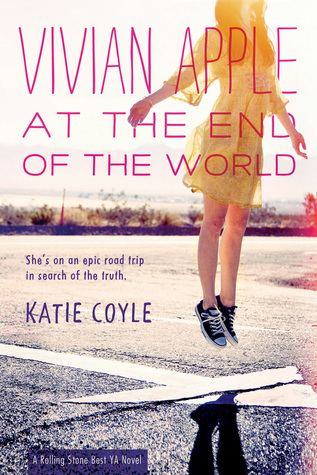
I thought this was going to be fantastic. I thought I'd found some sort of dystopian contemporary romance - which, if you know me or regularly prowl through my bookshelves, you'd guess would be perfect, right? I mean, look at that cover. That cover practically screams hipster. I love the font and the American wasteland image and the cool girl hovering above the ground in Converse and a yellow dress. I love the colours on it. So this book should have been THE ONE, right?
Wrong.
How this got so many four and five star reviews, I honestly don't understand. It started out pretty good - yes - and I was very excited to find out how things would unfold. That was the problem. They didn't.
So the end of the world is approaching, apparently. I never once felt like this was the case, and not just because Vivian didn't Believe. There was no real sense of urgency or anything. At one point she just goes off to live with her grandparents and lazes around the house for weeks. Then they most probably die once she leaves - oops - and Vivian doesn't feel anything for them. There was one character who I actually liked who was killed off in the first few chapters, once Vivian returns home to gather her best friend Harp and persuade her to come on a roadtrip with her. What happens to the people Harp was with, we never find out. They just go away somewhere. So they're roadtripping for a while, until they randomly go to the house of this guy Viv met once at a party, who doesn't remember her because she's so forgettable. Peter has some information for them so they take him on the roadtrip even though they aren't supposed to be trusting anyone, but hey ho. They also pick up this random girl Edie who used to go to school with Vivian and Harp, for no particular reason other than she's pregnant and working in a fast food joint, and they go to a 'rebel' compound which is supposed to oppose the Church Of America, who is the big badass corporation who are Rapturing all the people and getting everyone to Believe. The rebels are not rebels. They're all preachy and weird. Nothing really happens except Harp has a fling with Goliath, the head guy who turns out to be manipulating all the rebels for money, again for absolutely no reason. After staying there for a few weeks - for no reason - Vivian drags everyone except Edie, who decides to stay because she's complacent and has no depth, to her dad's sister's house, where she finds out she has a long-lost older sister. She gets creeped out, so they leave and go to their old teacher's parents' house, and then they have an argument with her. For no reason other than her being Catholic and 'depressed'. Vivian decides she'll never see her again. And then they leave.
They find the Believer compound in a random forest somewhere and find out that Frick (the head guy) has actually murdered all the Believers that came to the compound and that they weren't actually Raptured, and that he's also being manipulated by the Church Of America who also just want to make money. He has a mental breakdown and they leave Peter with his dad, Adam Taggart, who is also a Bad Bad Man, and run away after Vivian breaks her hand punching Frick in the face. Peter tells her off for doing so, but they hug so it's all fine! Punching a mass murderer is bad because he's old, folks. Remember that.
So yeah. Viv and Harp then go to Viv's long-lost sister Winnie's house, and yaaaay, her mom is there hiding and safe. Her dad's dead, but oh well! Winnie calls Viv a whiny bitch and then goes to work, and Viv's mom admits that she carved holes in the ceiling and abandoned her daughter to fend for herself for three months, so Viv gets angry but doesn't actually do anything about it other than eats breakfast, and then leaves without telling her mom. She finds Harp and then they get into the car.
And that's the entire plot in a nutshell.
There was no closure whatsoever. The whole plot was stupidly ridiculous. The whole book was just weird and pointless. They seemed to 'always have a plan' but there was no reason for any of their next moves. Lord, it was just stupid.
Don't read this. It'll drive you mad.
What the fuck did I just read.
I thought this was going to be fantastic. I thought I'd found some sort of dystopian contemporary romance - which, if you know me or regularly prowl through my bookshelves, you'd guess would be perfect, right? I mean, look at that cover. That cover practically screams hipster. I love the font and the American wasteland image and the cool girl hovering above the ground in Converse and a yellow dress. I love the colours on it. So this book should have been THE ONE, right?
Wrong.
How this got so many four and five star reviews, I honestly don't understand. It started out pretty good - yes - and I was very excited to find out how things would unfold. That was the problem. They didn't.
So the end of the world is approaching, apparently. I never once felt like this was the case, and not just because Vivian didn't Believe. There was no real sense of urgency or anything. At one point she just goes off to live with her grandparents and lazes around the house for weeks. Then they most probably die once she leaves - oops - and Vivian doesn't feel anything for them. There was one character who I actually liked who was killed off in the first few chapters, once Vivian returns home to gather her best friend Harp and persuade her to come on a roadtrip with her. What happens to the people Harp was with, we never find out. They just go away somewhere. So they're roadtripping for a while, until they randomly go to the house of this guy Viv met once at a party, who doesn't remember her because she's so forgettable. Peter has some information for them so they take him on the roadtrip even though they aren't supposed to be trusting anyone, but hey ho. They also pick up this random girl Edie who used to go to school with Vivian and Harp, for no particular reason other than she's pregnant and working in a fast food joint, and they go to a 'rebel' compound which is supposed to oppose the Church Of America, who is the big badass corporation who are Rapturing all the people and getting everyone to Believe. The rebels are not rebels. They're all preachy and weird. Nothing really happens except Harp has a fling with Goliath, the head guy who turns out to be manipulating all the rebels for money, again for absolutely no reason. After staying there for a few weeks - for no reason - Vivian drags everyone except Edie, who decides to stay because she's complacent and has no depth, to her dad's sister's house, where she finds out she has a long-lost older sister. She gets creeped out, so they leave and go to their old teacher's parents' house, and then they have an argument with her. For no reason other than her being Catholic and 'depressed'. Vivian decides she'll never see her again. And then they leave.
They find the Believer compound in a random forest somewhere and find out that Frick (the head guy) has actually murdered all the Believers that came to the compound and that they weren't actually Raptured, and that he's also being manipulated by the Church Of America who also just want to make money. He has a mental breakdown and they leave Peter with his dad, Adam Taggart, who is also a Bad Bad Man, and run away after Vivian breaks her hand punching Frick in the face. Peter tells her off for doing so, but they hug so it's all fine! Punching a mass murderer is bad because he's old, folks. Remember that.
So yeah. Viv and Harp then go to Viv's long-lost sister Winnie's house, and yaaaay, her mom is there hiding and safe. Her dad's dead, but oh well! Winnie calls Viv a whiny bitch and then goes to work, and Viv's mom admits that she carved holes in the ceiling and abandoned her daughter to fend for herself for three months, so Viv gets angry but doesn't actually do anything about it other than eats breakfast, and then leaves without telling her mom. She finds Harp and then they get into the car.
And that's the entire plot in a nutshell.
There was no closure whatsoever. The whole plot was stupidly ridiculous. The whole book was just weird and pointless. They seemed to 'always have a plan' but there was no reason for any of their next moves. Lord, it was just stupid.
Don't read this. It'll drive you mad.

August 15, 2013
I guess much like the lead up to the apocalypse I steadily sped through this book at an ever increasing pace until the final 80 pages when you could not have pried it out of my hands despite my desperate need for sleep. This book is faced paced and excellent fun, just what you might expect from a young adult apocalyptic novel: we have a budding first romance, a trying but supportive friendship between two wonderful young women and a sense of excitement and exploration to keep them all going. On top of this, however, the book provides the dark and disturbing notes necessary to create a believable apocalypse full of impact. There were certainly some loose threads and what remain to be seemingly farfetched plot lines/explanations that will hopefully be expounded upon in the sequel but all together the author creates an excellent sense of drama and mystery. Not to mention the likability factor that the main characters, for me, possessed, which is something much sought after in my reading diet.
A feelings summary: intriguing, shocking, sad, cute and exciting!
A feelings summary: intriguing, shocking, sad, cute and exciting!

April 16, 2014
2.5 Stars
Road Trips. Um, I love road trips. I once drove from Pennsylvania to Las Vegas for funsies. Road trips are epic. So when these crazy apocalypse pals grab a car and roll west, I am all for it!
Mystery! I love a good mystery, and I was pretty excited that there was a mystery piece involved in this book, because I didn't know there would be.
The Characters* Vivian started off pretty weak, with her ridiculous indecision, timidness, and selfishness. Of course, she evolved during the book, which wasn't particularly surprising, as a book about some scared girl hiding in the corner would be awful. However, her friend Harp kind of outshines her as a character. Harp got the personality in this group for sure. Peter was a pretty decent character too, albeit a bit forgettable.
Entertainment Value. It was entertaining at times, it was a quick read, and I was curious about what would happen in the next book.
What I Didn't:
I just didn't believe it. Plain and simple, though I tried to just pretend in its believability, it wasn't there for me. How exactly did some guy get an entire country to believe that he was a prophet who could predict the end of the world? Sure, I get convincing a group of people, but society as a whole? I just don't see how that is possible. Especially since it seemed silly even while reading. Yes, some of these things could have happened on a small scale, but for an entire nation to buy in? Nope, not buying it.
Speaking of nations, where is everyone else? Seriously, aren't a few other countries wondering why the U.S. has collectively lost its shit? If Canada started predicting the apocalypse and citizens went missing... let's just say I'd be concerned.
Logical Inconsistencies Okay, maybe I am nitpicking, but here's an example: There's a hurricane, one of the firsts of the season. They're talking about it because it is unusually early, and perhaps a sign of the apocalypse? Anyway, the hurricane is dubbed Hurricane Ruth. But that isn't how hurricanes are named. And the adults, except for one random (and awesome) teacher, act like complete asses throughout the entire book. Some people being awful makes sense. Everyone being awful for no apparent reason? Does not make sense.
The Characters* Yes, again, hence the asterisk. It's a mixed bag. Vivian's character growth was just way too severe, way too fast. I get that if you think your parents were raptured, you'd probably change your tune in a hurry. Vivian did not agree. She spent a good portion of time wallowing in pity, and thinking snarky things about her grandparents, all while ditching her friend. Then she's like "oh, sorry, nevermind, let's melt this popsicle stand!" and heads off to save the world or whatever. And as I have said before, 99% of the adults in this book are just wretched human beings.
The plot never really went anywhere. There was a lot of meandering that didn't really fit. There was discussion of weather patterns and then... it was dropped. There was talk about exorbitant fuel prices... but then they were over that too. Basically, there was no real sense of urgency about anything, which is ironic considering it may or may not be the end of the world.
Bottom Line: It wasn't the worst book I have ever read or anything, but it was far from the best too. It had entertainment value, so that's a plus, but the story itself just didn't come together as I'd hoped. I would read the second book if it were lying around, but I am not rushing off to get it, unfortunately.
This review was originally posted on It Starts at Midnight
Have you ever wanted to like a book so much that you actually tried to pretend you did? Like during the actual reading of the book, you feigned enthusiasm, ignored things that drove you crazy? I gave that a solid effort, but in the end, I just couldn't. I am sad about this, just so we're on the same page. It wasn't all bad either, it just simply wasn't as amazing as I'd hoped.
What I Liked:
Road Trips. Um, I love road trips. I once drove from Pennsylvania to Las Vegas for funsies. Road trips are epic. So when these crazy apocalypse pals grab a car and roll west, I am all for it!
Mystery! I love a good mystery, and I was pretty excited that there was a mystery piece involved in this book, because I didn't know there would be.
The Characters* Vivian started off pretty weak, with her ridiculous indecision, timidness, and selfishness. Of course, she evolved during the book, which wasn't particularly surprising, as a book about some scared girl hiding in the corner would be awful. However, her friend Harp kind of outshines her as a character. Harp got the personality in this group for sure. Peter was a pretty decent character too, albeit a bit forgettable.
Entertainment Value. It was entertaining at times, it was a quick read, and I was curious about what would happen in the next book.
What I Didn't:
I just didn't believe it. Plain and simple, though I tried to just pretend in its believability, it wasn't there for me. How exactly did some guy get an entire country to believe that he was a prophet who could predict the end of the world? Sure, I get convincing a group of people, but society as a whole? I just don't see how that is possible. Especially since it seemed silly even while reading. Yes, some of these things could have happened on a small scale, but for an entire nation to buy in? Nope, not buying it.
Speaking of nations, where is everyone else? Seriously, aren't a few other countries wondering why the U.S. has collectively lost its shit? If Canada started predicting the apocalypse and citizens went missing... let's just say I'd be concerned.
Logical Inconsistencies Okay, maybe I am nitpicking, but here's an example: There's a hurricane, one of the firsts of the season. They're talking about it because it is unusually early, and perhaps a sign of the apocalypse? Anyway, the hurricane is dubbed Hurricane Ruth. But that isn't how hurricanes are named. And the adults, except for one random (and awesome) teacher, act like complete asses throughout the entire book. Some people being awful makes sense. Everyone being awful for no apparent reason? Does not make sense.
The Characters* Yes, again, hence the asterisk. It's a mixed bag. Vivian's character growth was just way too severe, way too fast. I get that if you think your parents were raptured, you'd probably change your tune in a hurry. Vivian did not agree. She spent a good portion of time wallowing in pity, and thinking snarky things about her grandparents, all while ditching her friend. Then she's like "oh, sorry, nevermind, let's melt this popsicle stand!" and heads off to save the world or whatever. And as I have said before, 99% of the adults in this book are just wretched human beings.
The plot never really went anywhere. There was a lot of meandering that didn't really fit. There was discussion of weather patterns and then... it was dropped. There was talk about exorbitant fuel prices... but then they were over that too. Basically, there was no real sense of urgency about anything, which is ironic considering it may or may not be the end of the world.
Bottom Line: It wasn't the worst book I have ever read or anything, but it was far from the best too. It had entertainment value, so that's a plus, but the story itself just didn't come together as I'd hoped. I would read the second book if it were lying around, but I am not rushing off to get it, unfortunately.
This review was originally posted on It Starts at Midnight

March 13, 2014
I don't know if I can express how much I disliked this book. Maybe it's disappointment coupled with wanting to pull my hair out after reading this painful excuse for a YA dystopian... but if I ever hear about the titular heroine, Vivian Apple, again, it'll be too soon.
Dystopian novels have a lot of promise. When the horrible events that happen in the real world don't make a lot of sense, sometimes it's helpful to be able to read one of these books and remind ourselves that things could be a whole lot worse. But when these books aren't done right, they can fail spectacularly... like this one did.
From the moment Vivian returns home the morning after the "Rapture" to find her parents missing -- and two human-sized holes in their bedroom ceiling -- the reader might expect that they're in for a good story. But that couldn't be further from the truth. Instead, the reader is treated to a haphazard road-trip sort of story, with characters who pop into and out of the narrative for no particular reason (unless they're some sort of set-up for -- heaven forbid -- a sequel). And the road-trip portion of the story doesn't even begin until more than a quarter of the way through the book; before that, Vivian just hangs out with her grandparents in New York City, a couple of stodgy old folks who are such staunch atheists that they apparently don't even believe in weather (I don't know how else to explain their refusal to leave the city when a killer hurricane is approaching).
I get that the author was trying to create a dystopian setting in the present-day U.S.A., but I just didn't buy it. The Church of America is like a cross between the Westboro Baptist Church, the fundamentalist Mormons, and QVC... and it's completely incomprehensible that hundreds of thousands of Americans (including the President) would convert to such an extreme belief system. I spent the majority of the book thinking that there had to be some sort of mass drugging involved, that the water supply was spiked with some sort of mind-control drug. But that wasn't the case, and as a result it comes across as pretty insulting to Americans. Are they really so gullible and stupid as to abandon their previous beliefs, ways of life, and (in some cases) children to follow a misogynist, pro-capitalist religious cult? I don't think so... at least, not on the scale that is implied here.
I hated the characters in this book. Vivian is a bland, self-deprecating goody two-shoes, who's also completely clueless, usually figuring things out after everyone else already did. The rest of the characters aren't much better, mostly because they are inconsistent. One character could be bemoaning the judgment and condemnation of another character and in the next breath be judging and condemning them with equal vigor. Vivian's friend, Harp, is especially guilty of this. She's altogether annoying: inappropriate, bitchy, promiscuous, popping Xanax pills like they're candy, drinking vodka for her nerves, telling Vivian that when a boy says he doesn't want a relationship, he really does:
If this was two guys talking about a girl, would this "no means yes" crap have made it past the editor?
In addition to all that, there was the fact that it was often difficult to tell the characters apart. When they spoke, they often sounded the same. And no fewer than four characters called Vivian by her full name, which was just odd.
The writing and editing in this book was also pretty bad. I couldn't tell if the book was supposed to be funny or serious. The subject matter was too serious to be funny, but some of the writing tried so hard to be "literary" that it came across as unintentionally amusing. Add to that the idioms that weren't quite right ("all of the sudden" was used repeatedly), the weirdness at one point where the author apparently forgot how to use the word "the", the logical inconsistencies (like saying it's May and then implying it's still April... or having moonlight streaming in through a window when it's pouring rain... or being able to see the stars when you're in the midst of a dust storm so thick that you can't see more than a few feet in front of you and you kill an owl with your car), and the characters repeatedly -- and literally -- shrugging their speech, and my inner proofreader was absolutely screaming in frustration. It really started to fall apart at the halfway mark; I'm not sure if that was because I was getting tired (reading a book you're not enjoying can be exhausting) or if the editor only bothered with the first half of the book. In any case, the last half was kind of excruciating, with caricature characters, a willy-nilly plot, and weak writing.
I practically wrote a book of snark as I was reading this, making notes in Adobe Digital Editions as I went along. In fact, I wrote so many notes, I repeatedly crashed the software as I neared the end of the book. I think that speaks volumes about my impression of Vivian Versus the Apocalypse.
On the plus side, I did learn an important lesson: Just because a book has won a contest and just because a book has a good rating on Goodreads doesn't mean it's actually good.
Now I know.
http://theladybugreads.blogspot.ca/20...
Dystopian novels have a lot of promise. When the horrible events that happen in the real world don't make a lot of sense, sometimes it's helpful to be able to read one of these books and remind ourselves that things could be a whole lot worse. But when these books aren't done right, they can fail spectacularly... like this one did.
From the moment Vivian returns home the morning after the "Rapture" to find her parents missing -- and two human-sized holes in their bedroom ceiling -- the reader might expect that they're in for a good story. But that couldn't be further from the truth. Instead, the reader is treated to a haphazard road-trip sort of story, with characters who pop into and out of the narrative for no particular reason (unless they're some sort of set-up for -- heaven forbid -- a sequel). And the road-trip portion of the story doesn't even begin until more than a quarter of the way through the book; before that, Vivian just hangs out with her grandparents in New York City, a couple of stodgy old folks who are such staunch atheists that they apparently don't even believe in weather (I don't know how else to explain their refusal to leave the city when a killer hurricane is approaching).
I get that the author was trying to create a dystopian setting in the present-day U.S.A., but I just didn't buy it. The Church of America is like a cross between the Westboro Baptist Church, the fundamentalist Mormons, and QVC... and it's completely incomprehensible that hundreds of thousands of Americans (including the President) would convert to such an extreme belief system. I spent the majority of the book thinking that there had to be some sort of mass drugging involved, that the water supply was spiked with some sort of mind-control drug. But that wasn't the case, and as a result it comes across as pretty insulting to Americans. Are they really so gullible and stupid as to abandon their previous beliefs, ways of life, and (in some cases) children to follow a misogynist, pro-capitalist religious cult? I don't think so... at least, not on the scale that is implied here.
I hated the characters in this book. Vivian is a bland, self-deprecating goody two-shoes, who's also completely clueless, usually figuring things out after everyone else already did. The rest of the characters aren't much better, mostly because they are inconsistent. One character could be bemoaning the judgment and condemnation of another character and in the next breath be judging and condemning them with equal vigor. Vivian's friend, Harp, is especially guilty of this. She's altogether annoying: inappropriate, bitchy, promiscuous, popping Xanax pills like they're candy, drinking vodka for her nerves, telling Vivian that when a boy says he doesn't want a relationship, he really does:
This morning when he was in the shower, I hurriedly whispered to Harp what he said to me last night, and she rolled her eyes at my despair.
"Girl, please. Don't you realize what that means? You're already in. You just have to make him want it."
If this was two guys talking about a girl, would this "no means yes" crap have made it past the editor?
In addition to all that, there was the fact that it was often difficult to tell the characters apart. When they spoke, they often sounded the same. And no fewer than four characters called Vivian by her full name, which was just odd.
The writing and editing in this book was also pretty bad. I couldn't tell if the book was supposed to be funny or serious. The subject matter was too serious to be funny, but some of the writing tried so hard to be "literary" that it came across as unintentionally amusing. Add to that the idioms that weren't quite right ("all of the sudden" was used repeatedly), the weirdness at one point where the author apparently forgot how to use the word "the", the logical inconsistencies (like saying it's May and then implying it's still April... or having moonlight streaming in through a window when it's pouring rain... or being able to see the stars when you're in the midst of a dust storm so thick that you can't see more than a few feet in front of you and you kill an owl with your car), and the characters repeatedly -- and literally -- shrugging their speech, and my inner proofreader was absolutely screaming in frustration. It really started to fall apart at the halfway mark; I'm not sure if that was because I was getting tired (reading a book you're not enjoying can be exhausting) or if the editor only bothered with the first half of the book. In any case, the last half was kind of excruciating, with caricature characters, a willy-nilly plot, and weak writing.
I practically wrote a book of snark as I was reading this, making notes in Adobe Digital Editions as I went along. In fact, I wrote so many notes, I repeatedly crashed the software as I neared the end of the book. I think that speaks volumes about my impression of Vivian Versus the Apocalypse.
On the plus side, I did learn an important lesson: Just because a book has won a contest and just because a book has a good rating on Goodreads doesn't mean it's actually good.
Now I know.
http://theladybugreads.blogspot.ca/20...
February 24, 2016
Um bom entretenimento, às vezes bobinho, mas uma leitura divertida no geral. Acho que fico em **3.5**.
O livro traz uma visão sobre religião, fanatismo e manipulação da sociedade de uma forma muito bacana. A adaptação e o conceito da religião no mundo do livro é bem diferente (até meio engraçado), mas serviu ao propósito e acabou sendo bem criativo. A forma como essa questão religiosa se amarrou, pra mim, foi surpreendente (difícil falar mais sem dar spoilers).
Entretanto acho que o livro não aproveitou o seu potencial e não foi contado da melhor forma possível. Toda a questão do impacto no universo deles ainda me pareceu um pouco superficial (explico já já). Comecei a leitura achando "qualquer coisa", depois passei a amar os aspectos de road trip durante o meio, e fiquei um pouco decepcionado com o final.
Apesar de quase tudo ter sido esclarecido, acho que o "big picture" do livro, aquilo que podia ser muito mais impactante, acabou sendo ofuscado pelo draminha teen, um romance qualquer e pelos momentos de novela mexicana (sério, teve uma hora em que eu realmente cantei a música de "a usurpadora" na minha cabeça).
Existiram momentos anti-climáticos em relação à profundidade do livro que foram, em quase todos os casos, causados pelos personagens (que também achei bobinhos - um adendo aqui para atestar o meu ódio à Harp). Acho que algumas "revelações" acabaram servindo esse anti-clima à resolução do livro e à questão do Arrebatamento. Sei lá, achei estranho.
De qualquer forma, uma leitura super rápida e divertida. Espero que o segundo livro explore melhor as coisas que faltaram nesse.
O livro traz uma visão sobre religião, fanatismo e manipulação da sociedade de uma forma muito bacana. A adaptação e o conceito da religião no mundo do livro é bem diferente (até meio engraçado), mas serviu ao propósito e acabou sendo bem criativo. A forma como essa questão religiosa se amarrou, pra mim, foi surpreendente (difícil falar mais sem dar spoilers).
Entretanto acho que o livro não aproveitou o seu potencial e não foi contado da melhor forma possível. Toda a questão do impacto no universo deles ainda me pareceu um pouco superficial (explico já já). Comecei a leitura achando "qualquer coisa", depois passei a amar os aspectos de road trip durante o meio, e fiquei um pouco decepcionado com o final.
Apesar de quase tudo ter sido esclarecido, acho que o "big picture" do livro, aquilo que podia ser muito mais impactante, acabou sendo ofuscado pelo draminha teen, um romance qualquer e pelos momentos de novela mexicana (sério, teve uma hora em que eu realmente cantei a música de "a usurpadora" na minha cabeça).
Existiram momentos anti-climáticos em relação à profundidade do livro que foram, em quase todos os casos, causados pelos personagens (que também achei bobinhos - um adendo aqui para atestar o meu ódio à Harp). Acho que algumas "revelações" acabaram servindo esse anti-clima à resolução do livro e à questão do Arrebatamento. Sei lá, achei estranho.
De qualquer forma, uma leitura super rápida e divertida. Espero que o segundo livro explore melhor as coisas que faltaram nesse.
April 23, 2013
I'm going to write a much longer review later, but here's a preview: THIS BOOK HAS A BADASS FEMALE PROTAGONIST WITH REAL AGENCY, AND IT'S TOTALLY AWESOME. #pullquote

July 20, 2013
As soon as I saw the cover and title of this book, I had to know what it was about - it looked contemporary but the title sounded a bit dystopian - with those being my favourite genres, I had to investigate! I read the description and it did sound fantastic. I was curious to see how the author would put this together and I hoped that it would work out well - thankfully it did!
This isn't really like any other book that I've read and that is a fantastic thing. This is a contemporary, realistic book, but it's also apocalyptic. We're introduced to a situation where a lot of the American population have decided to follow a new religion and under the Church of America, many, but not all, of these people have disappeared in what has been known as the 'Rapture'. With Believers and non-believers left behind, a group of teenagers set out to try and discover what is really going on. Of course, there are plenty of twists and some stumbling blocks along the way which makes this book a definite page turner. There was a constant wonder in my mind as to what the Church of America really was, or what it involved. There is a lot of substance to this book and the characters also face a lot of other issues that are interwoven into the book alongside the Rapture.
I can't tell you about all of the issues - you'll have to read it for yourself - but nothing ever seems clear-cut or fully comprehensible, at least not until the end of the book. It's interesting to see how your thoughts and opinions change as the book progresses and we learn new things. The pace is consistent and there always seems to be something new to find out, making this a real page turner. There is one warning for you though - it is extremely hard to put it down! I could have happily sat and read this all in one go, it had me hooked!
The characters really helped this book to be a success. Our main character, Vivian, was really easy to connect with, she had real guts and determination but there was always that sense of vulnerability around her, which made her so real. I loved meeting her best friend, who seemed awesomely kick-ass whilst still being obviously fragile, especially due to problems within her own family. I also enjoyed reading about Edie, a pregnant Believer - it was interesting to see the differences between a Believer and the non-Believers. The character who grew on me most was Peter, the love interest to our protagonist. I was a little sceptical when we first met him, he seemed to be just thrown into the story quite randomly and I feared it would be an awful case of instant love between the two characters, but I was happily proved very wrong. The relationship between Vivian and Peter was so lovely to read about - it all felt so natural, slightly shaky (as a teenage romance can be) and both characters bonded in such a gradual, loving way. Their romance somehow felt intricate, it felt precious and a lot deeper than a lot of other YA romances - perhaps due to the problems they both faced and the conflicts that arose. I would have loved to read more about Vivian and Peter - I don't know if there will be a follow on to this book, but if there was, I wouldn't hesitate to pick it up.
Vivian Versus The Apocalypse has been one of my top summer reads of 2013 and will be a highlight of the books I have read throughout the year due to the fantastic writing and the compelling, refreshing plot idea. Katie Coyle has already won the Hot Key Books Young Writers Prize for this book and I truly hope that she wins more - she is clearly extremely talented and I think her writing rivals that of some of the current top YA authors. I will be recommending this to anyone I can!
This isn't really like any other book that I've read and that is a fantastic thing. This is a contemporary, realistic book, but it's also apocalyptic. We're introduced to a situation where a lot of the American population have decided to follow a new religion and under the Church of America, many, but not all, of these people have disappeared in what has been known as the 'Rapture'. With Believers and non-believers left behind, a group of teenagers set out to try and discover what is really going on. Of course, there are plenty of twists and some stumbling blocks along the way which makes this book a definite page turner. There was a constant wonder in my mind as to what the Church of America really was, or what it involved. There is a lot of substance to this book and the characters also face a lot of other issues that are interwoven into the book alongside the Rapture.
I can't tell you about all of the issues - you'll have to read it for yourself - but nothing ever seems clear-cut or fully comprehensible, at least not until the end of the book. It's interesting to see how your thoughts and opinions change as the book progresses and we learn new things. The pace is consistent and there always seems to be something new to find out, making this a real page turner. There is one warning for you though - it is extremely hard to put it down! I could have happily sat and read this all in one go, it had me hooked!
The characters really helped this book to be a success. Our main character, Vivian, was really easy to connect with, she had real guts and determination but there was always that sense of vulnerability around her, which made her so real. I loved meeting her best friend, who seemed awesomely kick-ass whilst still being obviously fragile, especially due to problems within her own family. I also enjoyed reading about Edie, a pregnant Believer - it was interesting to see the differences between a Believer and the non-Believers. The character who grew on me most was Peter, the love interest to our protagonist. I was a little sceptical when we first met him, he seemed to be just thrown into the story quite randomly and I feared it would be an awful case of instant love between the two characters, but I was happily proved very wrong. The relationship between Vivian and Peter was so lovely to read about - it all felt so natural, slightly shaky (as a teenage romance can be) and both characters bonded in such a gradual, loving way. Their romance somehow felt intricate, it felt precious and a lot deeper than a lot of other YA romances - perhaps due to the problems they both faced and the conflicts that arose. I would have loved to read more about Vivian and Peter - I don't know if there will be a follow on to this book, but if there was, I wouldn't hesitate to pick it up.
Vivian Versus The Apocalypse has been one of my top summer reads of 2013 and will be a highlight of the books I have read throughout the year due to the fantastic writing and the compelling, refreshing plot idea. Katie Coyle has already won the Hot Key Books Young Writers Prize for this book and I truly hope that she wins more - she is clearly extremely talented and I think her writing rivals that of some of the current top YA authors. I will be recommending this to anyone I can!

Read
March 8, 2015Huh. It's hard to know what to say about this book, and I'm still sorting thoughts out in my mind. It was definitely original, yet strangely disconcerting.
Vivian Apple at the End of the World a post-apocalyptic cult story with a road trip. Just saying that illustrates a strange thing about the book: its tone was hard to interpret. Serious or satire? Humorous parody or biting social commentary? To me, it sort of veered back and forth between both.
The book's premise is that, after a series of catastrophic events (a bombing at Yankee Stadium, a Chicago earthquake and the death of the entire bee population) a bunch of people join a religious cult that believes the world is coming to an end. Then there's a supposed Rapture in which a bunch of kids parents' disappear. Like, fly-through-the-roof-and-leave-people-shaped-holes disappear.
After that, the rest of the population either a) gets scared into becoming extremely religious and goes around killing people who are gay or girls who aren't virgins or b) becomes all countercultural and anti-religious and chooses new names for themselves off the internet. I kept wondering what happened to all the in-between people. The ones who were like "whoa, I'm not happy with either of these choices, thanks."
When Vivian's parents disappear through their ceiling, she sets off on a road trip from Pennsylvania to California with her friend Harp and a guy named Peter, to look for their parents and stop and see some other people along the way.
I loved Harp, and I always love a good road trip story. I guessed Peter's secret right off, but he was a great character too, though I wished he'd been a little more conflicted about his secret. I also wished that Vivian had spent more time working out her own beliefs, instead of just reacting to other people's. Her parent's disappearance has made her fairly anti-religion, but then there's this lecture-y interlude when Vivian and the gang visit her History teacher and get an awkward speech about how Religion Can Be Okay and Not All Religious People Are Evil.
The story presents some scenarios that, while requiring serious suspension of disbelief, could also spark interesting discussions. What, if anything, would make you believe in a Doomsday scenario? Or join a cult? But, as I said above, the camps set up here are pretty extreme: smite people like in the Bible or live off the grid?
If you're in a book club with members who love to really get in there and argue, this could be a great choice for you. I'm still not sure where I come out.
Vivian Apple at the End of the World a post-apocalyptic cult story with a road trip. Just saying that illustrates a strange thing about the book: its tone was hard to interpret. Serious or satire? Humorous parody or biting social commentary? To me, it sort of veered back and forth between both.
The book's premise is that, after a series of catastrophic events (a bombing at Yankee Stadium, a Chicago earthquake and the death of the entire bee population) a bunch of people join a religious cult that believes the world is coming to an end. Then there's a supposed Rapture in which a bunch of kids parents' disappear. Like, fly-through-the-roof-and-leave-people-shaped-holes disappear.
After that, the rest of the population either a) gets scared into becoming extremely religious and goes around killing people who are gay or girls who aren't virgins or b) becomes all countercultural and anti-religious and chooses new names for themselves off the internet. I kept wondering what happened to all the in-between people. The ones who were like "whoa, I'm not happy with either of these choices, thanks."
When Vivian's parents disappear through their ceiling, she sets off on a road trip from Pennsylvania to California with her friend Harp and a guy named Peter, to look for their parents and stop and see some other people along the way.
I loved Harp, and I always love a good road trip story. I guessed Peter's secret right off, but he was a great character too, though I wished he'd been a little more conflicted about his secret. I also wished that Vivian had spent more time working out her own beliefs, instead of just reacting to other people's. Her parent's disappearance has made her fairly anti-religion, but then there's this lecture-y interlude when Vivian and the gang visit her History teacher and get an awkward speech about how Religion Can Be Okay and Not All Religious People Are Evil.
The story presents some scenarios that, while requiring serious suspension of disbelief, could also spark interesting discussions. What, if anything, would make you believe in a Doomsday scenario? Or join a cult? But, as I said above, the camps set up here are pretty extreme: smite people like in the Bible or live off the grid?
If you're in a book club with members who love to really get in there and argue, this could be a great choice for you. I'm still not sure where I come out.

January 8, 2015
This book is fantastic. Somehow, from the book description, I didn't quite get how complex the issues dealt with in the book actually are--Vivian's parents disappear in the Rapture, as the description says, but it's after converting to a huge new religion, one that takes over much of America. The religion is all the more horrible from how familiar it sounds: it encourages the rich to get richer ("God loves capitalism"), traditional gender roles (women are even expected to walk BEHIND their husbands), and the inevitable combining of church and state.
Coyle uses the success of this religion to explore what's happening right now in America. When Vivian heads across the country on a road trip with her best friend, the story barrels forward, introducing a slacker culture opposed to religion, a very wise Believer working behind the counter of a Burger King, and a country ripped apart by global warming (or is it the wrath of an angry God?). When Vivian arrives in California with her friends, the story becomes an adventure story and a mystery to solve. I finished this one in a day, and started the sequel immediately.
Coyle uses the success of this religion to explore what's happening right now in America. When Vivian heads across the country on a road trip with her best friend, the story barrels forward, introducing a slacker culture opposed to religion, a very wise Believer working behind the counter of a Burger King, and a country ripped apart by global warming (or is it the wrath of an angry God?). When Vivian arrives in California with her friends, the story becomes an adventure story and a mystery to solve. I finished this one in a day, and started the sequel immediately.

January 29, 2015
Unexpected surprise: I really liked this!
I'm shocked.
This story poses so many interesting questions, so many possibilities. Is it being tongue-in-cheek? Is it being serious? Might there really be a rapture? Would the Left Behind start panicking for real? What would it be like to be a leftover child whose parents have been taken to a heaven you didn't actually think existed? How far is our country from being taken over by a Christian conglomerate that promotes "old-fashioned family values" for all (all = straight, white, middle-class, indoctrinated people)?
While I think the story definitely pokes fun at right-wing, crazyass corporate megachurches -- Lot's Wife Jeans - "Go ahead, turn around!" and the super popular song Jesus, thank you for making me American = HILARIOUS! OMG, I died! -- it also supports the power of belief and community, of spirituality and faith. At the same time, it doesn't shame those who do not believe, those who find their own spirituality outside of a god. I felt it was trying to say "Do good, whatever your reason, and don't be an asshole, especially not when you're assholing in the name of something (or nothing, in the case of Vivian's grandparents) else"
While everything was laid out fairly obviously, there was always room for question. Were the Apple parents really raptured away, leaving holes in the roof of the house? How? How is that even possible? But...is it possible? What if it is? What if 3,000 people really ascended to immortality. What if I've been wrong this whole time, what if Vivian had come to the wrong conclusion? What if this really could happen? Then what?
My brain just kept mulling this over. The story unfolds, everything becomes a little more obvious, especially in light of the New Orphans, but...there was always that niggling doubt. What if?
And then the truth turns out to be sinister yet commonplace and obvious in retrospect...because you kind of know that's what is going on but maybe it hurts a little too much to believe your own cynical worldview.
Unlike many YA heroines I've read recently, Vivian displayed growth in her journey. Harp, too, though not to the same extent. No, they didn't change drastically but...there was real progress and I appreciated that to no end.
Still, I was left with questions, and this really is spoilery so don't click it if you don't want to be spoiled:
I'm shocked.
This story poses so many interesting questions, so many possibilities. Is it being tongue-in-cheek? Is it being serious? Might there really be a rapture? Would the Left Behind start panicking for real? What would it be like to be a leftover child whose parents have been taken to a heaven you didn't actually think existed? How far is our country from being taken over by a Christian conglomerate that promotes "old-fashioned family values" for all (all = straight, white, middle-class, indoctrinated people)?
While I think the story definitely pokes fun at right-wing, crazyass corporate megachurches -- Lot's Wife Jeans - "Go ahead, turn around!" and the super popular song Jesus, thank you for making me American = HILARIOUS! OMG, I died! -- it also supports the power of belief and community, of spirituality and faith. At the same time, it doesn't shame those who do not believe, those who find their own spirituality outside of a god. I felt it was trying to say "Do good, whatever your reason, and don't be an asshole, especially not when you're assholing in the name of something (or nothing, in the case of Vivian's grandparents) else"
While everything was laid out fairly obviously, there was always room for question. Were the Apple parents really raptured away, leaving holes in the roof of the house? How? How is that even possible? But...is it possible? What if it is? What if 3,000 people really ascended to immortality. What if I've been wrong this whole time, what if Vivian had come to the wrong conclusion? What if this really could happen? Then what?
My brain just kept mulling this over. The story unfolds, everything becomes a little more obvious, especially in light of the New Orphans, but...there was always that niggling doubt. What if?
And then the truth turns out to be sinister yet commonplace and obvious in retrospect...because you kind of know that's what is going on but maybe it hurts a little too much to believe your own cynical worldview.
Unlike many YA heroines I've read recently, Vivian displayed growth in her journey. Harp, too, though not to the same extent. No, they didn't change drastically but...there was real progress and I appreciated that to no end.
Still, I was left with questions, and this really is spoilery so don't click it if you don't want to be spoiled:

July 22, 2015
It's so strange but so enjoyable. I immediately bought the second book after finishing this one.

December 12, 2017
Quick review for a progressive read. Dude, this book was a wild ride on the whole. I wasn't expecting much from "Vivian Apple at the End of the World", but for a dystopian novel about a religious rapture that takes place with a cross country road trip and self-discovery/conspiracy/family story rolled into one - it tackles a lot. That might be the reason why it's a story that's likely to be hit or miss.
This book has a lot of religious contexts within it, but it's a part of the set piece of the world. The predominant religion is determined by the Book of Frick, a religious leader who says the rapture will have two comings - each impacting the world in some rather apocalyptic ways and spreading chaos throughout the United States. In the midst of things, Vivian Apple is abandoned by her parents, thought to be lost with the first coming of the rapture, and taken up by her grandparents who reveal to her that her parents weren't all that they seemed. Vivian eventually returns home, determined to figure out what happened to her parents and taking a road trip with her best friend and a random boy (Peter) who has a mysterious connection with the "believers" among them.
The story has waves of interesting conflict, but other moments dragged their heels a bit much, to the point where when I put this book down, it was hard to pick back up in a slower moment. Thankfully, I did end up finding a steady rhythm, and after a few weeks I finally finished it. (Though I blame it for making me hit something of a reading slump. Urgh.)
It was a good book, but not one of my favorite dystopian stories on the whole. I'm definitely planning to (and intrigued enough to) read the sequel. I really liked Vivian's best friend Harp, and there's plenty of cultural diversity in this book to be had, though I wish the presentation of the story had better turns. It tackles a lot - particularly when it comes to faith, and feels like an ambitious narrative, but I'm wondering if some pieces of it were overwhelming the narrative on the whole and could've had better focal and pacing points.
Overall score: 3/5 stars.
This book has a lot of religious contexts within it, but it's a part of the set piece of the world. The predominant religion is determined by the Book of Frick, a religious leader who says the rapture will have two comings - each impacting the world in some rather apocalyptic ways and spreading chaos throughout the United States. In the midst of things, Vivian Apple is abandoned by her parents, thought to be lost with the first coming of the rapture, and taken up by her grandparents who reveal to her that her parents weren't all that they seemed. Vivian eventually returns home, determined to figure out what happened to her parents and taking a road trip with her best friend and a random boy (Peter) who has a mysterious connection with the "believers" among them.
The story has waves of interesting conflict, but other moments dragged their heels a bit much, to the point where when I put this book down, it was hard to pick back up in a slower moment. Thankfully, I did end up finding a steady rhythm, and after a few weeks I finally finished it. (Though I blame it for making me hit something of a reading slump. Urgh.)
It was a good book, but not one of my favorite dystopian stories on the whole. I'm definitely planning to (and intrigued enough to) read the sequel. I really liked Vivian's best friend Harp, and there's plenty of cultural diversity in this book to be had, though I wish the presentation of the story had better turns. It tackles a lot - particularly when it comes to faith, and feels like an ambitious narrative, but I'm wondering if some pieces of it were overwhelming the narrative on the whole and could've had better focal and pacing points.
Overall score: 3/5 stars.

November 9, 2014
I couldn’t resist the idea of an Armageddon road trip and Vivian at the End of the World (originally published as Vivian Versus the Apocalypse) did not let me down--I read the book straight through because I couldn’t bear to stop. Sixteen-year-old Vivian had been on the meek side--she was the sort no one notices, including boys--but she’s not a blind follower so when natural disasters start piling up, a new religion’s prophecies predict the end of the world, her free-thinking friends are attacked by paranoid wanna-be-saved hordes, and her parents are apparently raptured away to heaven through the ceiling of their bedroom, Vivian makes the choice to chuck her passive persona, get some answers, and DO something.
That DOING something involves a car journey from Pittsburgh to California with her best friend and a good looking guy they’ve just met, battling weird weather extremes, rescuing a pregnant half-believing former classmate, hoping their limited money supply doesn’t run out (gas is over $13 a gallon and rising), dodging desperate converts looking earn paradise points by smiting nonbelievers, and falling in love.
This is the first book of the series and it’s full of wonderful characters I can’t wait to meet again. Though the new religion of the story is a rabidly patriotic End Times doctrine, people on all parts of the belief spectrum are ultimately treated by the author with sympathy and respect. There’s some violence and plenty of action and suspense, but the tone isn’t as grim as in The Hunger Games or Divergent--which are both series that I enjoyed, but even with the seriousness of Vivian’s situation there’s more fun in this book. For instance, Vivian’s blossoming first romance doesn’t diminish the tension, but it does allow for some witty repartee.
That DOING something involves a car journey from Pittsburgh to California with her best friend and a good looking guy they’ve just met, battling weird weather extremes, rescuing a pregnant half-believing former classmate, hoping their limited money supply doesn’t run out (gas is over $13 a gallon and rising), dodging desperate converts looking earn paradise points by smiting nonbelievers, and falling in love.
This is the first book of the series and it’s full of wonderful characters I can’t wait to meet again. Though the new religion of the story is a rabidly patriotic End Times doctrine, people on all parts of the belief spectrum are ultimately treated by the author with sympathy and respect. There’s some violence and plenty of action and suspense, but the tone isn’t as grim as in The Hunger Games or Divergent--which are both series that I enjoyed, but even with the seriousness of Vivian’s situation there’s more fun in this book. For instance, Vivian’s blossoming first romance doesn’t diminish the tension, but it does allow for some witty repartee.

January 10, 2024
I wish I was writing that this was clever, fun, and a poke in the eye to established religion and religious fanatics, but it was none of those things. It's just dumb. I recommend a hard pass.

Read
November 2, 2024Parable of the Starbucks…. Oh eat my ass this is so cringe and stupid (and not in a fun way)

September 5, 2013
Actual rating: 3 - 3.5
YAY
- Peter/Viv
- Strong female friendship (challenged and developed)
- Viv's struggle to becoming "the hero of her own story"
- Genuine voice
- The "Rapture", the "Church of America" concept was intriguing and pretty original
UGH
- Emotional impact wasn't so strong
- Sometimes confusing, inconsistent and a little hard to grasp (didn't feel realistic)
YAY
- Peter/Viv
- Strong female friendship (challenged and developed)
- Viv's struggle to becoming "the hero of her own story"
- Genuine voice
- The "Rapture", the "Church of America" concept was intriguing and pretty original
UGH
- Emotional impact wasn't so strong
- Sometimes confusing, inconsistent and a little hard to grasp (didn't feel realistic)

January 29, 2015
This book was worth the wait list at the library. I've had my eye on it for some time before that, and I'm so glad that I'm not disappointed. I'm really really pleased, actually.
I got everything that I wanted out of this book and then some. But there's very little that I'm willing to say about this book in detail, because I enjoyed reading it all with a fresh mind, so I think others should approach the book that way.
The main players are easy enough to discuss. So often in YA novels female narrators end up being whiny, bitchy, self-centered assholes. Vivian brings life to this book. In the beginning she's confused, defeated, depressed, because her parents have been Raptured. For a seventeen year old to be left all alone in the course of a few hours when she believed the Rapture to be a hoax, I can appreciate ALL of those feelings. She doesn't moan and groan at every second about how unfair life is. She doesn't bitch at every person who will offer a listening ear. She keeps being Vivian: subservient, quiet, and good. Thankfully, she breaks out of her shell, goes back to her friends, and embarks on a journey before the apocalypse hits. Because while she once was a skeptic, after seeing the holes in the ceiling where her parents were taken, she at least believes that SOMETHING happened to them.
Harp is Viv's best friend, and her opposite of course. Harp lives to party, hook up with guys, loves to drink, and is incredibly outspoken. Her parents were Raptured as well, and so she ends up traveling with Viv with no questions asked. She ends up bringing out the best in Vivian, calling her Vivian 2.0. She struggles with family problems, with depression, and with being ultimately strong. She is a superb character who offers a voice that demands to be heard.
And Peter. PETER MY LOVE. I was hooked on him immediately. He has such an easy going attitude, a kind demeanor, information into the Church of America, and the cutest description of his looks ever. But more than that, he treats the girls as an equal instead of lesser like the Believer men do. He also lost a parent to the Church of America, only instead his father slowly lost his mind. I love how he flirts with Harper, and I love how he cares about everyone they encounter.
Their travels were really interesting, along with everyone they met. I won't go into a lot of detail, but they kept me reading, and quickly at that.
I had one real problem with this book. And that was EVERY description of The Book of Frick. It included riding in a car that could travel through time with Jesus. Having a meal with Thomas Jefferson. I originally thought that these wild descriptions would ruin the book for me; I'm glad they didn't. There were, however, some parts of The Book of Frick that bothered me at first, but as the story unfolded, made much more sense. But in the moment, boy were they fucked up. I stand by Viv's early assessment: Frick must have been on some HEAVY FUCKING DRUGS. And I want some.
My library doesn't have the second book, and I am aching for it. I WILL find a way to read it this year. Because this one was so much fun.
I got everything that I wanted out of this book and then some. But there's very little that I'm willing to say about this book in detail, because I enjoyed reading it all with a fresh mind, so I think others should approach the book that way.
The main players are easy enough to discuss. So often in YA novels female narrators end up being whiny, bitchy, self-centered assholes. Vivian brings life to this book. In the beginning she's confused, defeated, depressed, because her parents have been Raptured. For a seventeen year old to be left all alone in the course of a few hours when she believed the Rapture to be a hoax, I can appreciate ALL of those feelings. She doesn't moan and groan at every second about how unfair life is. She doesn't bitch at every person who will offer a listening ear. She keeps being Vivian: subservient, quiet, and good. Thankfully, she breaks out of her shell, goes back to her friends, and embarks on a journey before the apocalypse hits. Because while she once was a skeptic, after seeing the holes in the ceiling where her parents were taken, she at least believes that SOMETHING happened to them.
Harp is Viv's best friend, and her opposite of course. Harp lives to party, hook up with guys, loves to drink, and is incredibly outspoken. Her parents were Raptured as well, and so she ends up traveling with Viv with no questions asked. She ends up bringing out the best in Vivian, calling her Vivian 2.0. She struggles with family problems, with depression, and with being ultimately strong. She is a superb character who offers a voice that demands to be heard.
And Peter. PETER MY LOVE. I was hooked on him immediately. He has such an easy going attitude, a kind demeanor, information into the Church of America, and the cutest description of his looks ever. But more than that, he treats the girls as an equal instead of lesser like the Believer men do. He also lost a parent to the Church of America, only instead his father slowly lost his mind. I love how he flirts with Harper, and I love how he cares about everyone they encounter.
Their travels were really interesting, along with everyone they met. I won't go into a lot of detail, but they kept me reading, and quickly at that.
I had one real problem with this book. And that was EVERY description of The Book of Frick. It included riding in a car that could travel through time with Jesus. Having a meal with Thomas Jefferson. I originally thought that these wild descriptions would ruin the book for me; I'm glad they didn't. There were, however, some parts of The Book of Frick that bothered me at first, but as the story unfolded, made much more sense. But in the moment, boy were they fucked up. I stand by Viv's early assessment: Frick must have been on some HEAVY FUCKING DRUGS. And I want some.
My library doesn't have the second book, and I am aching for it. I WILL find a way to read it this year. Because this one was so much fun.

July 15, 2015
Before getting into the story itself: one of the first things I always think about when I’m reading an America-centric book where outrageous things happen is what is the rest of the world thinking? Do they try to intervene or do they just think that if they give America enough time it’ll just get its act together? In the case of Vivian Apple at the End of the World, did the rest of the world just watch as the USA became overwhelmed with cultish fanatics of the Book of Frick—an odd gospel which combines Biblical damnation and capitalist virtue? I mean, the Book claims America to be the chosen land of God and contains a parable of Starbucks. Was the rest of the world disappointed that they weren’t part of America’s salvation or were they too busy laughing to give it a serious thought? Alas, we may never know (although there is a sequel, so maybe I spoke too soon).
Vivian Apple at the End of the World has been on my TBR list for a while. Long enough that all I remembered of the premise of the book was that it begins with the Biblical end of days, that the protagonist comes home the day after the Rapture to find her parents missing. So when Vivian Apple returns to an empty house the night after the supposed Rapture, two empty holes in the ceiling the only sign that something’s amiss, my first reaction was that it happened. That as ridiculous as Pastor Frick’s gospel was, as far as this plot was concerned, it was the truth of the novel.
It wasn’t until other characters started voicing their doubts that I began to entertain my own. Perhaps this book wasn’t set in a world where a bizarre Evangelical religion correctly predicted the Apocalypse. But then what did happen? An elaborate con? Aliens? And if everyone thinks it’s the Rapture and acts like it’s the Rapture, does it even matter if that might not be the truth? Vivian Apple asks these same questions to herself as she embarks on a cross-country road trip with her best friend Harp and new acquaintance Peter in search of the truth of what happened that night of the Rapture.
For me, the strength of this novel lies in its characters. Vivian Apple is never anything more or less than what she appears to be: a teenage girl navigating a fast changing and dangerous brave new world. She gets angry and frightened and is also kind and inquisitive (and a maybe a little bit enamored). While maybe nothing extraordinary, Vivian is, as her best friend Harp reminds her, the hero of her own story.
Harp was the light and soul of this story for me. I love few things more in a book that strong female friendships, and Harp’s no-nonsense no-filters attitude towards the world was a delightful contrast to Vivian’s often-quiet self. While Harp and Vivian may not have known each other long, they trust and love each other with the type of kinship that can only be forged by standing sane as the world around them turns into a cultish mess.
A relatively quick read, I highly recommend this book.
Vivian Apple at the End of the World has been on my TBR list for a while. Long enough that all I remembered of the premise of the book was that it begins with the Biblical end of days, that the protagonist comes home the day after the Rapture to find her parents missing. So when Vivian Apple returns to an empty house the night after the supposed Rapture, two empty holes in the ceiling the only sign that something’s amiss, my first reaction was that it happened. That as ridiculous as Pastor Frick’s gospel was, as far as this plot was concerned, it was the truth of the novel.
It wasn’t until other characters started voicing their doubts that I began to entertain my own. Perhaps this book wasn’t set in a world where a bizarre Evangelical religion correctly predicted the Apocalypse. But then what did happen? An elaborate con? Aliens? And if everyone thinks it’s the Rapture and acts like it’s the Rapture, does it even matter if that might not be the truth? Vivian Apple asks these same questions to herself as she embarks on a cross-country road trip with her best friend Harp and new acquaintance Peter in search of the truth of what happened that night of the Rapture.
For me, the strength of this novel lies in its characters. Vivian Apple is never anything more or less than what she appears to be: a teenage girl navigating a fast changing and dangerous brave new world. She gets angry and frightened and is also kind and inquisitive (and a maybe a little bit enamored). While maybe nothing extraordinary, Vivian is, as her best friend Harp reminds her, the hero of her own story.
Harp was the light and soul of this story for me. I love few things more in a book that strong female friendships, and Harp’s no-nonsense no-filters attitude towards the world was a delightful contrast to Vivian’s often-quiet self. While Harp and Vivian may not have known each other long, they trust and love each other with the type of kinship that can only be forged by standing sane as the world around them turns into a cultish mess.
A relatively quick read, I highly recommend this book.

December 12, 2014
Originally reviewed on The Hardcover Lover.
Vivian Apple at the End of the World is a different kind of YA novel. I've never read a book like it, and quite honestly, I don't expect to read anything like it or its sequels again.
Coyle creates a new kind of America in this novel in which many of the citizens of the United States are now Believers of a new cult-like religion called The Church of America. I don't want to spoil anything for interested readers, but it's fascinating to see how much effort Coyle put into the creation of this fictional church. You can tell that she definitely did her research. There are pieces of information about the church scattered throughout the book to help readers understand its creation, but let me warn you... it's a freaking weird religion. Readers will also come across excerpts and quotes from The Book of Frick, the religious text for the Believers.
If you're afraid of reading books with references to religion, please don't be afraid to read this book. I'm not a fan of religious fiction, and I can tell you that this does not read like it. It's actually more like a rebellion against the new norm.
As far as characters go, Vivian Apple starts off as a normal American teenager. Her new best friend is her next door neighbor, Harp, who is the opposite of Vivian. As readers get through more of the book, they will notice changes from both girls. There's also their new friend, Peter. He's just as he's described - mysterious, but readers will also learn more about him as well.
There are some crazy and intense moments in this book. There's a real and true friendship that faces challenges along the way. There's a little bit of romance. There's a cross-country road trip at the supposed end of the world. There are some bad ass moments that will make readers triumph with Viv and her friends. Oh... and there is some diversity.
I did notice a few flaws in the book like the first hurricane of the season being called Hurricane Ruth, instead of starting with an A name. There were also some events that I questioned, but by the time I finished this book, I was hooked.
Vivian Apple at the End of the World will not only entertain, but it will teach readers about tolerance at a time when its needed now more than ever. Emotions will be tested. Readers will laugh, swoon, cry, and feel anger. This is a book you won't want to miss.
In accordance to FTC guidelines, I must state that I received a galley free copy of this book in exchange for an honest review.
Vivian Apple at the End of the World is a different kind of YA novel. I've never read a book like it, and quite honestly, I don't expect to read anything like it or its sequels again.
Coyle creates a new kind of America in this novel in which many of the citizens of the United States are now Believers of a new cult-like religion called The Church of America. I don't want to spoil anything for interested readers, but it's fascinating to see how much effort Coyle put into the creation of this fictional church. You can tell that she definitely did her research. There are pieces of information about the church scattered throughout the book to help readers understand its creation, but let me warn you... it's a freaking weird religion. Readers will also come across excerpts and quotes from The Book of Frick, the religious text for the Believers.
If you're afraid of reading books with references to religion, please don't be afraid to read this book. I'm not a fan of religious fiction, and I can tell you that this does not read like it. It's actually more like a rebellion against the new norm.
As far as characters go, Vivian Apple starts off as a normal American teenager. Her new best friend is her next door neighbor, Harp, who is the opposite of Vivian. As readers get through more of the book, they will notice changes from both girls. There's also their new friend, Peter. He's just as he's described - mysterious, but readers will also learn more about him as well.
There are some crazy and intense moments in this book. There's a real and true friendship that faces challenges along the way. There's a little bit of romance. There's a cross-country road trip at the supposed end of the world. There are some bad ass moments that will make readers triumph with Viv and her friends. Oh... and there is some diversity.
I did notice a few flaws in the book like the first hurricane of the season being called Hurricane Ruth, instead of starting with an A name. There were also some events that I questioned, but by the time I finished this book, I was hooked.
Vivian Apple at the End of the World will not only entertain, but it will teach readers about tolerance at a time when its needed now more than ever. Emotions will be tested. Readers will laugh, swoon, cry, and feel anger. This is a book you won't want to miss.
In accordance to FTC guidelines, I must state that I received a galley free copy of this book in exchange for an honest review.

May 23, 2017
"They had to have loved you. You're Vivian fucking Apple."
This is a book I’d been wanting to read for ages. Usually this is the absolute death-knell of me actually liking said book, but in this case expectation actually matched outcome.
So, the premise is that America has totally embraced a fundamentalist belief system led by a dodgy old corporate businessman where the rights of women and the LGBT community have been all but wiped out.
Good job it’s fiction, eh? Imagine if that happened in real life.
Anyway, the Church of America (TM) basically runs the whole country and their leader, Beaton Frick, has predicted a rapture, where the souls of the faithful will be taken up to heaven. Despite her abundant cynicism, Vivian discovers that her parents may actually have been raptured and sets off with her best friend Harp to discover the truth.
What ensues is basically a post-apocalyptic road trip, which is, if not a cliché, then definitely a trope, but it’s actually a lot more clever than other post-apocalyptics. Sure there are looters and plenty of people wishing to do our heroes harm, but there’s a lot of discussion about belief; not so much about what we believe, but why. There’s criticism, not of religion per se, but of fundamentalism. What makes a cult like this suddenly go crazy? Are humans inherently sheep when it comes to thinking for themselves? Or do you need a perfect storm of social and financial deprivation combined with a super charismatic leader to pull something like this off, a la Nazi Germany?
(Incidentally, was I the only one who was wondering what was happening in Canada while all this craziness went down in the US? I mean, the whole world looks at Canada and the US as basically the Straight Guy and the Crazy Liability Dude, manacled together by forces beyond their control, forced into an uneasy alliance and with their fates inexorably linked, like Bruce Willis and Kim Basinger in Blind Date, Steve Martin and John Candy in Planes, Trains and Automobiles, Spencer Tracey and Katherine Hepburn in Bringing Up Baby. No? Just me?)
I really liked Vivian - she showed enormous development over the course of the book, and her budding romance with Peter was super cute. But for me, the real star of the show was Harp, a girl so cool I want to be her in my next life.
Definitely recommend this book - it really lived up to my hopes.
This is a book I’d been wanting to read for ages. Usually this is the absolute death-knell of me actually liking said book, but in this case expectation actually matched outcome.
So, the premise is that America has totally embraced a fundamentalist belief system led by a dodgy old corporate businessman where the rights of women and the LGBT community have been all but wiped out.
Good job it’s fiction, eh? Imagine if that happened in real life.
Anyway, the Church of America (TM) basically runs the whole country and their leader, Beaton Frick, has predicted a rapture, where the souls of the faithful will be taken up to heaven. Despite her abundant cynicism, Vivian discovers that her parents may actually have been raptured and sets off with her best friend Harp to discover the truth.
What ensues is basically a post-apocalyptic road trip, which is, if not a cliché, then definitely a trope, but it’s actually a lot more clever than other post-apocalyptics. Sure there are looters and plenty of people wishing to do our heroes harm, but there’s a lot of discussion about belief; not so much about what we believe, but why. There’s criticism, not of religion per se, but of fundamentalism. What makes a cult like this suddenly go crazy? Are humans inherently sheep when it comes to thinking for themselves? Or do you need a perfect storm of social and financial deprivation combined with a super charismatic leader to pull something like this off, a la Nazi Germany?
(Incidentally, was I the only one who was wondering what was happening in Canada while all this craziness went down in the US? I mean, the whole world looks at Canada and the US as basically the Straight Guy and the Crazy Liability Dude, manacled together by forces beyond their control, forced into an uneasy alliance and with their fates inexorably linked, like Bruce Willis and Kim Basinger in Blind Date, Steve Martin and John Candy in Planes, Trains and Automobiles, Spencer Tracey and Katherine Hepburn in Bringing Up Baby. No? Just me?)
I really liked Vivian - she showed enormous development over the course of the book, and her budding romance with Peter was super cute. But for me, the real star of the show was Harp, a girl so cool I want to be her in my next life.
Definitely recommend this book - it really lived up to my hopes.

May 20, 2016
This is the best kind of Young Adult book because it is asking readers to question the world around you, appreciate and cherish your friendships and be confident and true to yourself.
Vivian Apple lives in an alternative America where there are constant natural disasters and disease and the world is dying. Along comes a new religion, "The Church of America" which convinces people the Rapture is coming and will save them. Vivian doesn't belive, but her parents do, and on the night of the Rapture her parents and thousands of other believers disappear.
Although Vivian starts as meek and compliant, as the book progresses her character develops and she becomes a confident heroine who is easy to like. Her and her friend Harp, and later Peter, embark on a road trip across America trying to decide what is true. Is the world really dying in a few months? Should they have believed in "The Church of America"?
There is no love triangle and no whiny teenage monologues which already catapaults this above three stars for me. I really liked the theme of the book too, which really isn't about religion, per se, but about how and why we believe in things.
I was surprised to see when I finished that there is a sequel, because it could have ended with this book (although there is a little bit of a cliff-hanger ending which may have annoyed some!), and I will seek it out.
The audio narration is extremely good, thanks to www.audiobooksync.com for providing a free copy.
Vivian Apple lives in an alternative America where there are constant natural disasters and disease and the world is dying. Along comes a new religion, "The Church of America" which convinces people the Rapture is coming and will save them. Vivian doesn't belive, but her parents do, and on the night of the Rapture her parents and thousands of other believers disappear.
Although Vivian starts as meek and compliant, as the book progresses her character develops and she becomes a confident heroine who is easy to like. Her and her friend Harp, and later Peter, embark on a road trip across America trying to decide what is true. Is the world really dying in a few months? Should they have believed in "The Church of America"?
There is no love triangle and no whiny teenage monologues which already catapaults this above three stars for me. I really liked the theme of the book too, which really isn't about religion, per se, but about how and why we believe in things.
I was surprised to see when I finished that there is a sequel, because it could have ended with this book (although there is a little bit of a cliff-hanger ending which may have annoyed some!), and I will seek it out.
The audio narration is extremely good, thanks to www.audiobooksync.com for providing a free copy.

Read
December 2, 2014While the musings on religion and extremism were interesting -- most especially the connection with consumerism -- the bulk of the story didn't work for me. I found Vivian uninteresting throughout, and even though she though she became bold and brave, she was there from the beginning. Which was good for her, but it made her entire character arc pretty dull and uninteresting. There were a number of plot threads that were underdeveloped and the entire relationship with Peter left me kind of cold and disinterested. Likewise, the friendship between Viv and Harp never felt whole; maybe that was just Harp being flat.
This didn't know what it wanted to be. While there are good moments, a lot of this felt like it was trying to be a dystopian future America...and also trying to be completely realistic. The writing wasn't strong enough to make either one work.
There are better cult/Rapture stories out there in YA. For something similar and better written, try Joelle Anthony's The Right and the Real.
This didn't know what it wanted to be. While there are good moments, a lot of this felt like it was trying to be a dystopian future America...and also trying to be completely realistic. The writing wasn't strong enough to make either one work.
There are better cult/Rapture stories out there in YA. For something similar and better written, try Joelle Anthony's The Right and the Real.
April 14, 2015
"They had to have loved you. You're Vivian fucking Apple."
The commentary on religion in this book was a focal point and quite refreshing. The dialogue between the characters made sure to give perspective to both the sides taken by non-believers and the devout. It continuously reminded readers that the most important thing is to love and be kind above all else. The main romantic relationship was a reflection of this philosophy and wasn't nausea inducing by any means. I think it felt real. It reminded me of times I still experience where sometimes all you want to do is forget all of the bullshit and just make out already. The main female friendship was also solid and good. A message that blood family isn't necessarily your family and that we each make our own.
I think this was more of a 3.5 for me as I felt it lacked development in some areas. There was something holding the characters back from becoming completely believable for me. I had trouble feeling real emotions while reading and the plot was a little too out there and cheesy. The writing itself wasn't amazing but by no means bad. Definitely a few good quotes to be found inside.
All in all I thought this was a pretty great little book. It was certainly a lot of fun and a fast read.
The commentary on religion in this book was a focal point and quite refreshing. The dialogue between the characters made sure to give perspective to both the sides taken by non-believers and the devout. It continuously reminded readers that the most important thing is to love and be kind above all else. The main romantic relationship was a reflection of this philosophy and wasn't nausea inducing by any means. I think it felt real. It reminded me of times I still experience where sometimes all you want to do is forget all of the bullshit and just make out already. The main female friendship was also solid and good. A message that blood family isn't necessarily your family and that we each make our own.
I think this was more of a 3.5 for me as I felt it lacked development in some areas. There was something holding the characters back from becoming completely believable for me. I had trouble feeling real emotions while reading and the plot was a little too out there and cheesy. The writing itself wasn't amazing but by no means bad. Definitely a few good quotes to be found inside.
All in all I thought this was a pretty great little book. It was certainly a lot of fun and a fast read.

May 10, 2016
Good stuff.

May 5, 2016
Thanks to Audiobook SYNC, you can grab the audio version of this title thru Wednesday (5/11) for FREE! Details here.
This was one strange, strange little book. Observations on religious extremism and atheism aside, I'm still not really sure what this book was about. Was it supposed to be Vivian discovering what her own beliefs were in the midst of the Rapture? Because I feel like she forestalled ever figuring out her own thoughts on the matter by calling everyone else's beliefs into question, until she gets a lecture on the subject from just about the only adult she trusts...and that doesn't happen until nearly the end of the book.
Was this supposed to be a parody on all of that, akin to This is the End ? I could see that, with the good being saved - straight through the roofs of their homes, no less - and the wicked left to deal with the tsunamis and earthquakes and hurricanes and all manner of destruction coming their way after the Rapture.
But it also had a traditional contemporary YA novel feel, with Viv learning that family isn't only blood, that friends can become just as much your family as the one you were born into. It took her a road trip across apocalypse-ravaged America to discover that, but it does play a big part in Vivian's character arc. And then there was that whole thing at the end with the Church of America and capitalism and marketing and just...what?!?
I liked the story. It was weird and atypical for YA, and I'm not sure if it's just social commentary on religion, a slightly off-putting attempt at realistic post-apocalyptic fiction, or just some kind of conspiracy theory novel. But it was weird and I liked it. Not enough to think a series was warranted, and I probably won't read the follow-up - unless it appears in my hands for free like this one - but it was enjoyable to some degree. And I think that readers who like a story that's a little off the beaten path will find it enjoyable, as well.
This was one strange, strange little book. Observations on religious extremism and atheism aside, I'm still not really sure what this book was about. Was it supposed to be Vivian discovering what her own beliefs were in the midst of the Rapture? Because I feel like she forestalled ever figuring out her own thoughts on the matter by calling everyone else's beliefs into question, until she gets a lecture on the subject from just about the only adult she trusts...and that doesn't happen until nearly the end of the book.
Was this supposed to be a parody on all of that, akin to This is the End ? I could see that, with the good being saved - straight through the roofs of their homes, no less - and the wicked left to deal with the tsunamis and earthquakes and hurricanes and all manner of destruction coming their way after the Rapture.
But it also had a traditional contemporary YA novel feel, with Viv learning that family isn't only blood, that friends can become just as much your family as the one you were born into. It took her a road trip across apocalypse-ravaged America to discover that, but it does play a big part in Vivian's character arc. And then there was that whole thing at the end with the Church of America and capitalism and marketing and just...what?!?
I liked the story. It was weird and atypical for YA, and I'm not sure if it's just social commentary on religion, a slightly off-putting attempt at realistic post-apocalyptic fiction, or just some kind of conspiracy theory novel. But it was weird and I liked it. Not enough to think a series was warranted, and I probably won't read the follow-up - unless it appears in my hands for free like this one - but it was enjoyable to some degree. And I think that readers who like a story that's a little off the beaten path will find it enjoyable, as well.

May 15, 2013
When I started reading VIVIAN, I expected a lot. I expected what I had been told to expect: A dystopic road trip across Rapture-ravaged America. And that's what I got. But there's so much more to VIVIAN than just another road trip YA novel, or just another dystopian YA novel.
Vivian Apple is, in the words of Katie Coyle, a girl who does stuff. Vivian is the best female protagonist of a YA book this side of Gemma Doyle. Her personal growth throughout the book is tangible. She instigates road trips, steals a car, carries a sledgehammer like it's no big deal, kisses a boy with blue eyes, and remains a fundamentally good person, despite understandable faults and shortcomings one might perceive in her character. Vivian is the kind of protagonist I would feel comfortable recommending to a young girl. She is not perfect, because what person is? But damned if she doesn't do stuff.
I sincerely hope a sequel is forthcoming. VIVIAN left off in a way that I was satisfied with, but I've never been one to say no to a continuation of a series featuring such well-defined, likeable characters. I would happily read more about Vivian, Harp, Peter, and Edie (I sort of loved Edie).
Highly, highly recommended for anyone who enjoys interesting characters thrust into difficult situations, dystopic YA, or awesome road trips taken by kickass teenage girls and their sledgehammers.
Vivian Apple is, in the words of Katie Coyle, a girl who does stuff. Vivian is the best female protagonist of a YA book this side of Gemma Doyle. Her personal growth throughout the book is tangible. She instigates road trips, steals a car, carries a sledgehammer like it's no big deal, kisses a boy with blue eyes, and remains a fundamentally good person, despite understandable faults and shortcomings one might perceive in her character. Vivian is the kind of protagonist I would feel comfortable recommending to a young girl. She is not perfect, because what person is? But damned if she doesn't do stuff.
I sincerely hope a sequel is forthcoming. VIVIAN left off in a way that I was satisfied with, but I've never been one to say no to a continuation of a series featuring such well-defined, likeable characters. I would happily read more about Vivian, Harp, Peter, and Edie (I sort of loved Edie).
Highly, highly recommended for anyone who enjoys interesting characters thrust into difficult situations, dystopic YA, or awesome road trips taken by kickass teenage girls and their sledgehammers.

December 8, 2013
A book about the apocalypse that isn't of the "proselytising 'REPENT or else!' " genre? Yep. This is it.
Vivian's parents, along with a large proportion of the American population, have converted to the Church of America, a cult group that has, through huge marketing efforts and some well-timed fortuitous forecasts of natural disasters picked up large numbers of terrified new members. Today is the day they have forecast for the end of the world and the Rapture of all true believers. Vivian returns home from an ironic end-of-the-world party to discover her parents are missing and round holes in the roof of their bedroom.
Is this the beginning of the End?
This is a road movie, a story of friendship, a tale of love, a rite of passage novel. We see Vivian grow as she goes through abandonment, threat, discovery, loss. The people she meets on the way all play roles in her story - best friend Harp (so strong on the outside), Edie (pregnant Believer who isn't Raptured), quiet Peter.
This is Young Adult writing at its best - intense, controversial, intelligent. The ending leaves the story very open for further chapters, and I for one want to know what's going to happen in this strange new world of Vivian's. I loved what Coyle did with the situation and the characters. I'll be recommending this as much as I can.
Vivian's parents, along with a large proportion of the American population, have converted to the Church of America, a cult group that has, through huge marketing efforts and some well-timed fortuitous forecasts of natural disasters picked up large numbers of terrified new members. Today is the day they have forecast for the end of the world and the Rapture of all true believers. Vivian returns home from an ironic end-of-the-world party to discover her parents are missing and round holes in the roof of their bedroom.
Is this the beginning of the End?
This is a road movie, a story of friendship, a tale of love, a rite of passage novel. We see Vivian grow as she goes through abandonment, threat, discovery, loss. The people she meets on the way all play roles in her story - best friend Harp (so strong on the outside), Edie (pregnant Believer who isn't Raptured), quiet Peter.
This is Young Adult writing at its best - intense, controversial, intelligent. The ending leaves the story very open for further chapters, and I for one want to know what's going to happen in this strange new world of Vivian's. I loved what Coyle did with the situation and the characters. I'll be recommending this as much as I can.
Displaying 1 - 30 of 959 reviews