

What do you think?

De la grammatologie
“ Les langues sont faites pour être parlées, l’écriture ne sert que de supplément à la parole... L’écriture n’est que la représentation de la parole, il est bizarre qu’on donne plus de soin à déterminer l’image que l’objet. ” Roussau.
Ce livre est donc voué à la bizarrerie. Mais c’est qu’à accorder tout son soin à l’écriture, il la soumet à une réévaluation radicale. Et les voies sont nécessairement extravagantes lorsqu’il importe d’excéder, pour en penser la possibilité, ce qui se donne pour la logique elle-même : celle qui doit déterminer les rapports de la parole et de l’écriture en se rassurant dans l’évidence du sens commun, dans les catégories de “ représentation ” ou d’“ image ”, dans l’opposition du dedans et du dehors, du plus et du moins, de l’essence et de l’apparence, de l’originaire et du dérivé.
Analysant les investissements dont notre culture a chargé le signe écrit, Jacques Derrida en démontre aussi les effets les plus actuels et parfois les plus inaperçus. Cela n’est possible que par un déplacement systématique des concepts : on ne saurait en effet répondre à la question “ qu’est-ce que l’écriture ? ” par un appel de style “ phénoménologique ” à quelque expérience sauvage, immédiate, spontanée. L’interprétation occidentale de l’écriture commande tous les champs de l’expérience, de la pratique et du savoir, et jusqu’à la forme ultime de la question (“ qu’est-ce que ? ”) qu’on croit pouvoir libérer de cette prise. L’histoire de cette interprétation n’est pas celle d’un préjugé déterminé, d’une erreur localisée, d’une limite accidentelle. Elle forme une structure finie mais nécessaire dans le mouvement qui se trouve ici reconnu sous le nom de différance.
Ce livre est donc voué à la bizarrerie. Mais c’est qu’à accorder tout son soin à l’écriture, il la soumet à une réévaluation radicale. Et les voies sont nécessairement extravagantes lorsqu’il importe d’excéder, pour en penser la possibilité, ce qui se donne pour la logique elle-même : celle qui doit déterminer les rapports de la parole et de l’écriture en se rassurant dans l’évidence du sens commun, dans les catégories de “ représentation ” ou d’“ image ”, dans l’opposition du dedans et du dehors, du plus et du moins, de l’essence et de l’apparence, de l’originaire et du dérivé.
Analysant les investissements dont notre culture a chargé le signe écrit, Jacques Derrida en démontre aussi les effets les plus actuels et parfois les plus inaperçus. Cela n’est possible que par un déplacement systématique des concepts : on ne saurait en effet répondre à la question “ qu’est-ce que l’écriture ? ” par un appel de style “ phénoménologique ” à quelque expérience sauvage, immédiate, spontanée. L’interprétation occidentale de l’écriture commande tous les champs de l’expérience, de la pratique et du savoir, et jusqu’à la forme ultime de la question (“ qu’est-ce que ? ”) qu’on croit pouvoir libérer de cette prise. L’histoire de cette interprétation n’est pas celle d’un préjugé déterminé, d’une erreur localisée, d’une limite accidentelle. Elle forme une structure finie mais nécessaire dans le mouvement qui se trouve ici reconnu sous le nom de différance.
448 pages, Paperback
First published January 1, 1967
About the author
Jacques Derrida
655 books1,880 followersJacques Derrida was a French philosopher best known for developing deconstruction, a method of critical analysis that questioned the stability of meaning in language, texts, and Western metaphysical thought. Born in Algeria, he studied at the École Normale Supérieure in Paris, where he was influenced by philosophers such as Heidegger, Husserl, and Levinas. His groundbreaking works, including Of Grammatology (1967), Writing and Difference (1967), and Speech and Phenomena (1967), positioned him at the center of intellectual debates on language, meaning, and interpretation.
Derrida argued that Western philosophy was structured around binary oppositions—such as speech over writing, presence over absence, or reason over emotion—that falsely privileged one term over the other. He introduced the concept of différance, which suggests that meaning is constantly deferred and never fully present, destabilizing the idea of fixed truth. His work engaged with a wide range of disciplines, including literature, psychoanalysis, political theory, and law, challenging conventional ways of thinking and interpretation.
Throughout his career, Derrida continued to explore ethical and political questions, particularly in works such as Specters of Marx (1993) and The Politics of Friendship (1994), which addressed democracy, justice, and responsibility. He held academic positions at institutions such as the École des Hautes Études en Sciences Sociales and the University of California, Irvine, and remained an influential figure in both European and American intellectual circles. Despite criticism for his complex writing style and abstract concepts, Derrida’s ideas have left a lasting impact on contemporary philosophy, literary theory, and cultural criticism, reshaping the way meaning and language are understood in the modern world.
Derrida argued that Western philosophy was structured around binary oppositions—such as speech over writing, presence over absence, or reason over emotion—that falsely privileged one term over the other. He introduced the concept of différance, which suggests that meaning is constantly deferred and never fully present, destabilizing the idea of fixed truth. His work engaged with a wide range of disciplines, including literature, psychoanalysis, political theory, and law, challenging conventional ways of thinking and interpretation.
Throughout his career, Derrida continued to explore ethical and political questions, particularly in works such as Specters of Marx (1993) and The Politics of Friendship (1994), which addressed democracy, justice, and responsibility. He held academic positions at institutions such as the École des Hautes Études en Sciences Sociales and the University of California, Irvine, and remained an influential figure in both European and American intellectual circles. Despite criticism for his complex writing style and abstract concepts, Derrida’s ideas have left a lasting impact on contemporary philosophy, literary theory, and cultural criticism, reshaping the way meaning and language are understood in the modern world.
Ratings & Reviews
Friends & Following
Create a free account to discover what your friends think of this book!
Community Reviews
Displaying 1 - 30 of 219 reviews

October 3, 2017
When we speak of deconstruction, we’re talking Freedom.
Freedom from the tropes of power that hem us in on all sides. Freedom to be able to act concretely and wisely to remove the webs that these tropes lower over us and those around us to ensnare us.
Freedom to act decisively but advisedly.
Deconstruction is simply freeing our minds from the sticky spider webs of modern hype.
These webs are built by tropes. Tropes range from the benign to the deadly. Movies and novels are the more benign type of trope - as long as they’re taken as mere entertainment.
Rhetorical tropes, though, can start wars. They can start as insidious ear worms. And they can deftly confuse us.
The most deadly, of course, are the political tropes. They can be, for some, the trigger of traumatic memories.
To employ them to achieve dark ends is outright bedevilment.
This is the greatest sin, this the greatest treason -
To do the right deed for the wrong reason.
And the wrong reasons surround us, hidden by their disguising tropes, on all sides.
The glimmers of Reality that engulf us are so utterly aporetic that they beggar all description.
This ain’t no upwardly mobile highway -
Oh, no! - this is the Road to Hell.
IF you follow the WRONG Pied Piper.
Do you know that this book - this key study of written tropes - is one of the only works by Derrida available on Kindle?
Makes you wonder!
Yet this early work is the one that most clearly lays out the thrust of the liberating Derridean strategy - so often misunderstood.
Many mainstream power spokesmen would have you believe that Derrida was a dangerous and atheistic man. Yet nothing could be further from the truth.
For every Sunday morning - as we see in the wonderful “home invasion” of his personal privacy (filmed in the 90’s by New York’s Zetgeist Films, and available on YouTube) - he religiously(!) watched a Paris talk show of penetrating dialogue between Christians and Muslims.
Brought up a Muslim, at the outbreak of hostilities in the Algerian War of Independence or shortly thereafter, his scholastic merit took him to a still nominally Catholic Paris.
And that, of course, tells you quite a lot about his striving for inner freedom from political tropes, as well as touching on the religious “aporias” that gave birth to early works like this.
But even religion, seen abstractly, need not be aporetic. The view from our Heart, though, is an entirely different matter. Derrida interchanges both perspectives, constantly, like a collage.
Let me give you what I believe to be the main argument of this book...
It could be YOUR key to understanding him.
Jacques Derrida's first book was a study of Edmund Husserl.
Why is this important?
Because the young Derrida was reacting to Husserl's famous battle cry: "Back to the things themselves!"
For Husserl wanted to cut through the rhetoric of the great thinkers and to metaphysically uncover the true, basic and unadorned reality that lies underneath all the hundred-dollar words.
But how do we get to this hidden reality?
Simple, Derrida says.
We DON’T.
Until we defuse the political tropes that created the hundred-dollar words.
For as Levinas says, the world is not transparent. It’s opaque. It doesn’t COMPUTE. Il n’y a pas de bon sens!
And in this book Derrida takes up the work of Jean-Jacques Rousseau, who saw that the language of WRITING sui generis constantly defeats itself in this quest for the Real.
For writing is about 'something' that must forever remain outside of itself - reality as our coming of age tropes it - as writing must adhere to accepted behaviour and conform to accepted political structures.
Reality is obscured by its own tenuous, impermanent shadows. Writing is definitive and permanent. We could say reality is the elusive Feminine principle that can’t be grasped by the confident masculinity of writing.
And so writing is a supplement (Rousseau's word) to our OWN realities. It is ’PHONY’ in a sense - because it isn’t our reality.
But guess what, Jean-Jacques? It’s the best polite society can come up with. Sure beats mental illness, by a mile! Trust me - I’m bipolar too. I damage more people than I help!
“That dangerous supplement!” Derrida quotes Rousseau as saying. But who trusts an unbalanced man of bipolar disposition, such as Jean-Jacques Rousseau? Not MY friends.
The alternative, folks, is eternal hunger - and its concomitant eternal sorrow. Such is life.
Contrition is our only way to wholeness.
Because this supplement is built on a paradox that must remain forever unresolved. Until we find the Peace the Passes All Understanding.
The gnostic Voltaire may have chuckled at Rousseau, but he beat a hasty retreat in the end to his garden at Ferny when the kitchen got too hot.
This, though, is the reason for the infamous term "deconstruction" - a tearing down NOT of the beauties and necessary frameworks of civilisation, but a breaking apart of the constant web of outwardly-enforced tropes, and thence illusions, that enmesh, trap and tie us down in the modern world.
Now, we all need a bit of comfort in our lives.
And our reading is a good and a necessary thing.
But we don’t need to draw our comfort from over-confident sources, media-driven or in others, that prevent us from being OURSELVES.
Some of our entertainments seem to lead us into a hard-edged world which is a far cry from our own hard-won hopes and ideals, our own shifting thoughts and dreams...
We are constantly being ushered into a public space that doesn’t recognize US for who we ARE!
It pays no notice to us, or to reality.
Why do we allow ourselves to be trapped?
It’s a bit like Derrida is trying to ‘remove the beam that is in our eyes.’ The beam that blots out our real selves.
It’s a huge wooden plank that only proclaims its own rough dominance - like a gleaming Trojan Horse.
He’s trying to take us out of the misleading and self-conscious world of public language...
And return us to OUR Source -
In the foul “rag and bone shop of our Heart” -
Until the Advent of Perfect Peace.
Freedom from the tropes of power that hem us in on all sides. Freedom to be able to act concretely and wisely to remove the webs that these tropes lower over us and those around us to ensnare us.
Freedom to act decisively but advisedly.
Deconstruction is simply freeing our minds from the sticky spider webs of modern hype.
These webs are built by tropes. Tropes range from the benign to the deadly. Movies and novels are the more benign type of trope - as long as they’re taken as mere entertainment.
Rhetorical tropes, though, can start wars. They can start as insidious ear worms. And they can deftly confuse us.
The most deadly, of course, are the political tropes. They can be, for some, the trigger of traumatic memories.
To employ them to achieve dark ends is outright bedevilment.
This is the greatest sin, this the greatest treason -
To do the right deed for the wrong reason.
And the wrong reasons surround us, hidden by their disguising tropes, on all sides.
The glimmers of Reality that engulf us are so utterly aporetic that they beggar all description.
This ain’t no upwardly mobile highway -
Oh, no! - this is the Road to Hell.
IF you follow the WRONG Pied Piper.
Do you know that this book - this key study of written tropes - is one of the only works by Derrida available on Kindle?
Makes you wonder!
Yet this early work is the one that most clearly lays out the thrust of the liberating Derridean strategy - so often misunderstood.
Many mainstream power spokesmen would have you believe that Derrida was a dangerous and atheistic man. Yet nothing could be further from the truth.
For every Sunday morning - as we see in the wonderful “home invasion” of his personal privacy (filmed in the 90’s by New York’s Zetgeist Films, and available on YouTube) - he religiously(!) watched a Paris talk show of penetrating dialogue between Christians and Muslims.
Brought up a Muslim, at the outbreak of hostilities in the Algerian War of Independence or shortly thereafter, his scholastic merit took him to a still nominally Catholic Paris.
And that, of course, tells you quite a lot about his striving for inner freedom from political tropes, as well as touching on the religious “aporias” that gave birth to early works like this.
But even religion, seen abstractly, need not be aporetic. The view from our Heart, though, is an entirely different matter. Derrida interchanges both perspectives, constantly, like a collage.
Let me give you what I believe to be the main argument of this book...
It could be YOUR key to understanding him.
Jacques Derrida's first book was a study of Edmund Husserl.
Why is this important?
Because the young Derrida was reacting to Husserl's famous battle cry: "Back to the things themselves!"
For Husserl wanted to cut through the rhetoric of the great thinkers and to metaphysically uncover the true, basic and unadorned reality that lies underneath all the hundred-dollar words.
But how do we get to this hidden reality?
Simple, Derrida says.
We DON’T.
Until we defuse the political tropes that created the hundred-dollar words.
For as Levinas says, the world is not transparent. It’s opaque. It doesn’t COMPUTE. Il n’y a pas de bon sens!
And in this book Derrida takes up the work of Jean-Jacques Rousseau, who saw that the language of WRITING sui generis constantly defeats itself in this quest for the Real.
For writing is about 'something' that must forever remain outside of itself - reality as our coming of age tropes it - as writing must adhere to accepted behaviour and conform to accepted political structures.
Reality is obscured by its own tenuous, impermanent shadows. Writing is definitive and permanent. We could say reality is the elusive Feminine principle that can’t be grasped by the confident masculinity of writing.
And so writing is a supplement (Rousseau's word) to our OWN realities. It is ’PHONY’ in a sense - because it isn’t our reality.
But guess what, Jean-Jacques? It’s the best polite society can come up with. Sure beats mental illness, by a mile! Trust me - I’m bipolar too. I damage more people than I help!
“That dangerous supplement!” Derrida quotes Rousseau as saying. But who trusts an unbalanced man of bipolar disposition, such as Jean-Jacques Rousseau? Not MY friends.
The alternative, folks, is eternal hunger - and its concomitant eternal sorrow. Such is life.
Contrition is our only way to wholeness.
Because this supplement is built on a paradox that must remain forever unresolved. Until we find the Peace the Passes All Understanding.
The gnostic Voltaire may have chuckled at Rousseau, but he beat a hasty retreat in the end to his garden at Ferny when the kitchen got too hot.
This, though, is the reason for the infamous term "deconstruction" - a tearing down NOT of the beauties and necessary frameworks of civilisation, but a breaking apart of the constant web of outwardly-enforced tropes, and thence illusions, that enmesh, trap and tie us down in the modern world.
Now, we all need a bit of comfort in our lives.
And our reading is a good and a necessary thing.
But we don’t need to draw our comfort from over-confident sources, media-driven or in others, that prevent us from being OURSELVES.
Some of our entertainments seem to lead us into a hard-edged world which is a far cry from our own hard-won hopes and ideals, our own shifting thoughts and dreams...
We are constantly being ushered into a public space that doesn’t recognize US for who we ARE!
It pays no notice to us, or to reality.
Why do we allow ourselves to be trapped?
It’s a bit like Derrida is trying to ‘remove the beam that is in our eyes.’ The beam that blots out our real selves.
It’s a huge wooden plank that only proclaims its own rough dominance - like a gleaming Trojan Horse.
He’s trying to take us out of the misleading and self-conscious world of public language...
And return us to OUR Source -
In the foul “rag and bone shop of our Heart” -
Until the Advent of Perfect Peace.

July 11, 2013
This was too hard to understand, therefore it didn't make any sense therefore it is stupid therefore anyone who liked it is stupid therefore I am smarter than anyone who liked it therefore there is a huge conspiracy where well-read educated people are not really either of those things because they responded to this differently therefore definitions of "well-read" and "educated" are totally undermined by therefore being revealed as artificially constructed determinants in the grammar of elite prerogatives therefore the signications they disseminate are illegitimate therefore we need someone to come forward and articulate how this occurs using language that attempts to transcend the dynamic that supports it which therefore will necessarily strain these dictates of conventional sense and will therefore be hard to read here and there and fore and aft.
June 5, 2012
This book gets five stars from me...but this review (which I initially made as a comment to another review), is in response to the Derrida/Searle debate, and the Searle quote that is so often cited as the wooden stake to Derrida's deconstructive heart. Here we go...
Searle willfully misreads Derrida, or at the very least, doesn't take the time to understand his theory properly. The supposed limitation of deconstruction, the idea "that deconstruction deconstructs itself," is a "limitation" that Derrida was certainly aware of, and in fact, is not a limitation at all. Deconstruction must deconstruct itself. If it did not, it could not be articulated or exist in language. If deconstruction was not privy to the very process it describes, it would itself become the very sort of notion that it condemns and says is impossible, the idea of something "absolutely present outside of a system of differences." Every word/concept capable of being articulated and understood in language can only be understood in a system of differences. This means, essentially, that a word never has a positive meaning derived from itself, but rather, we can only understand the meaning of a word by the way in which it differs from other words. We must essentially rule out everything it is not (to the extent which are finite language system allows) in order to articulate what it "is." The idea of deconstruction is essentially an expansion of this concept. For example, good is privileged over evil, however, good can only be truly understood in the context of evil, by the way in which it differs from evil. If there was no evil, there could be no good, or at least "good" in a sense that we can understand because it would have nothing to compare itself to. It must exist in a system of differences--good "differing and deferred" from evil. In this same way, deconstruction must be dependent on the very thing it critiques in order to exist at all. It's paradoxical thinking, but it has to be. Deconstruction needs logocentrism to exist, and vice versa. The flaw is not in deconstruction, but in our language, and our radical distinction between true and false. Our society privileges truth over falsity (and rightly so), and so, in order for deconstruction to be believed in, it must be said to be true, which immediately makes it privileged, which in turn makes it false, because there can be no privileging. This is not due to the invalidity of deconstruction, but rather to our inherent privileging of truth. Deconstruction itself is neither true nor false, presence nor absence, "but exceeds them both." If deconstruction did not deconstruct itself, it would become something "absolutely present outside a system of differences," the very sort of thing Derrida condemns as being dependent on a sort of creationist theology, something absolutely present outside the system, whose meaning and existence is self-contained and self-referential, only coming from itself. Furthermore, privileging is more complicated than a willful act on our parts, but again, also comes from flaws within the system of language itself. In the beginning of this review, I cited the Derrida/Searle debate. Here, I have already privileged Derrida by placing him first. I suppose I could have written, Derrida/Searle, Searle/Derrida, but even then, I'm still privileging; the set of terms where Derrida is privileged because it comes before the set of terms in which Searle is privileged. The same would happen if I wrote Searle/Derrida, Derrida/Searle. Because we read left to right, there is no way out of this. We have the same problem writing Mr. and Mrs. on an envelope, we can either write Mr. and Mrs. Smith, in that order, or Mrs. and Mr. Smith, if we want to be avoid traditional gender hierarchies, but either way, because we read left to right, we inherently have to make a choice which we privilege something, one over the other--we cannot read/view them simultaneously, in one fell swoop in a way that would privilege neither. Again, the flaw is not in deconstruction, but in the language system and the reading structure itself.
As for the claims against Derrida's writing, I personally "like" it, but I won't defend it. He is willfully obscure (although not entirely without a purpose), but that doesn't undermine the validity or importance of what he's saying. To a degree, it was necessary for his writing, at least regarding deconstruction, to be thorough, "repetitive," and obscure, otherwise, people's understanding of it would be too simplistic and reductive. In fact, this tendency to reduce deconstruction to a formula (which is so prevalent among the majority of literary criticism that cites Derrida), is the every sort of thing Derrida was trying to avoid. Again, his writing is frustrating, but it is completely understandable if you're willing to either read very slowly, or go through one or two re-readings. Whether you want to go through that work is another question, but that does diminish the worth of what he has to say.
And as a final note, just so you know, I'm not one of those people who enjoys obscurity for the sake of obscurity or to make myself feel intelligent, I find some of the other french writers to be completely full of hot air, using opacity to cover up either faulty scholarship or to boost their egos (Lacan and Kristeva come to mind). I will also add that I can't stand most people's (ab)use of Derrida, I think he ranks up there with Freud in terms of willful misapplication (although, if I'm being honest, I'm not much of a Freudian). I understand people's hostility to Derrida, on Searle's part, I think it was a bit of jealousy regarding Derrida's "rock-star" status in academia, and for others, I think it stems from the ways in which they see Derrida being misused. I only advise you to read him with an open mind and then decide from there. If you're intelligent (and since you're attempting to read of Grammatology, you most likely are) then you are probably used to understanding things immediately. However, if you are going to get anything out of Of Grammatology, then you need to humble yourself a bit, slow yourself down, and be willing to accept that you might not get it right away. I assure you, if you're patient and are willing to look up a bit of terminology, you'll eventually get what he's saying.
And one last last thing...I really recommend reading his essays "Differance," and "Structure Sign and Play in the Discourse of the Human Sciences" before you tackle this one. They clarify some key concepts that you need to understand Of Grammatology. "Force and Signification" is also useful.
Searle willfully misreads Derrida, or at the very least, doesn't take the time to understand his theory properly. The supposed limitation of deconstruction, the idea "that deconstruction deconstructs itself," is a "limitation" that Derrida was certainly aware of, and in fact, is not a limitation at all. Deconstruction must deconstruct itself. If it did not, it could not be articulated or exist in language. If deconstruction was not privy to the very process it describes, it would itself become the very sort of notion that it condemns and says is impossible, the idea of something "absolutely present outside of a system of differences." Every word/concept capable of being articulated and understood in language can only be understood in a system of differences. This means, essentially, that a word never has a positive meaning derived from itself, but rather, we can only understand the meaning of a word by the way in which it differs from other words. We must essentially rule out everything it is not (to the extent which are finite language system allows) in order to articulate what it "is." The idea of deconstruction is essentially an expansion of this concept. For example, good is privileged over evil, however, good can only be truly understood in the context of evil, by the way in which it differs from evil. If there was no evil, there could be no good, or at least "good" in a sense that we can understand because it would have nothing to compare itself to. It must exist in a system of differences--good "differing and deferred" from evil. In this same way, deconstruction must be dependent on the very thing it critiques in order to exist at all. It's paradoxical thinking, but it has to be. Deconstruction needs logocentrism to exist, and vice versa. The flaw is not in deconstruction, but in our language, and our radical distinction between true and false. Our society privileges truth over falsity (and rightly so), and so, in order for deconstruction to be believed in, it must be said to be true, which immediately makes it privileged, which in turn makes it false, because there can be no privileging. This is not due to the invalidity of deconstruction, but rather to our inherent privileging of truth. Deconstruction itself is neither true nor false, presence nor absence, "but exceeds them both." If deconstruction did not deconstruct itself, it would become something "absolutely present outside a system of differences," the very sort of thing Derrida condemns as being dependent on a sort of creationist theology, something absolutely present outside the system, whose meaning and existence is self-contained and self-referential, only coming from itself. Furthermore, privileging is more complicated than a willful act on our parts, but again, also comes from flaws within the system of language itself. In the beginning of this review, I cited the Derrida/Searle debate. Here, I have already privileged Derrida by placing him first. I suppose I could have written, Derrida/Searle, Searle/Derrida, but even then, I'm still privileging; the set of terms where Derrida is privileged because it comes before the set of terms in which Searle is privileged. The same would happen if I wrote Searle/Derrida, Derrida/Searle. Because we read left to right, there is no way out of this. We have the same problem writing Mr. and Mrs. on an envelope, we can either write Mr. and Mrs. Smith, in that order, or Mrs. and Mr. Smith, if we want to be avoid traditional gender hierarchies, but either way, because we read left to right, we inherently have to make a choice which we privilege something, one over the other--we cannot read/view them simultaneously, in one fell swoop in a way that would privilege neither. Again, the flaw is not in deconstruction, but in the language system and the reading structure itself.
As for the claims against Derrida's writing, I personally "like" it, but I won't defend it. He is willfully obscure (although not entirely without a purpose), but that doesn't undermine the validity or importance of what he's saying. To a degree, it was necessary for his writing, at least regarding deconstruction, to be thorough, "repetitive," and obscure, otherwise, people's understanding of it would be too simplistic and reductive. In fact, this tendency to reduce deconstruction to a formula (which is so prevalent among the majority of literary criticism that cites Derrida), is the every sort of thing Derrida was trying to avoid. Again, his writing is frustrating, but it is completely understandable if you're willing to either read very slowly, or go through one or two re-readings. Whether you want to go through that work is another question, but that does diminish the worth of what he has to say.
And as a final note, just so you know, I'm not one of those people who enjoys obscurity for the sake of obscurity or to make myself feel intelligent, I find some of the other french writers to be completely full of hot air, using opacity to cover up either faulty scholarship or to boost their egos (Lacan and Kristeva come to mind). I will also add that I can't stand most people's (ab)use of Derrida, I think he ranks up there with Freud in terms of willful misapplication (although, if I'm being honest, I'm not much of a Freudian). I understand people's hostility to Derrida, on Searle's part, I think it was a bit of jealousy regarding Derrida's "rock-star" status in academia, and for others, I think it stems from the ways in which they see Derrida being misused. I only advise you to read him with an open mind and then decide from there. If you're intelligent (and since you're attempting to read of Grammatology, you most likely are) then you are probably used to understanding things immediately. However, if you are going to get anything out of Of Grammatology, then you need to humble yourself a bit, slow yourself down, and be willing to accept that you might not get it right away. I assure you, if you're patient and are willing to look up a bit of terminology, you'll eventually get what he's saying.
And one last last thing...I really recommend reading his essays "Differance," and "Structure Sign and Play in the Discourse of the Human Sciences" before you tackle this one. They clarify some key concepts that you need to understand Of Grammatology. "Force and Signification" is also useful.

October 28, 2007
I need a bucket. This is the a-hole through which there has flowed a river of anemic pretentious francophilic crap for three decades. Derrida seems to have little of Foucault's erudition and a strange compulsion to make the same empty gestures over and over again. Everything Schopenhauer said about Hegel applies here (that the guy is a charlatan selling his own image in the guise of a new philosophical language). Maybe other books by Derrida are wonderful; I've only read "Of Spirit," "Limited, Inc," and parts of this one. "Limited Inc" was gross.
There are few writers I actually hate. The two I hate the most are Derrida and Allen Ginsberg. Just sit back and watch the resemblances crystallize...
There are few writers I actually hate. The two I hate the most are Derrida and Allen Ginsberg. Just sit back and watch the resemblances crystallize...

June 11, 2011
no one realizes that there is a significance to the fact that rousseau preferred jerking off to having sex.

April 27, 2008
well, i read the first chapter, but i have almost no idea what it said even though i tried very hard to know what it was saying. then i went back to read the translator's preface. thanks for nothing, spivak. i'll keep trying.

August 26, 2012
Derrida's Of Grammatology aims to think the structural conditions of possibility which organize the coherence of metaphysical thinking. In this regard, thinking what Derrida labels writing is central. A main point in Of Grammatology however, is that Derrida is speaking of two different sorts of writing: that which writing is traditionally understood to be, that is, marks on a page or writing conceived in the narrower sense Derrida will say, but also, and more centrally in terms of the book's thesis, writing conceived of as the practice of positing metaphysical centers as the basis for thought's coherence. This practice of writing will be one fundamentally associated with the West in Derrida's understanding. A difficult point of the book is that the two conceptions of writing, the more traditionally understood form, and writing as the positing of metaphysical centers will become interrelated in the development of the argument and often be in play at the same time.
This relationship appears in considering the contrast Derrida highlights between speech and writing. Here we speak of speech understood as the expression of the presence of the logos, and as the "expressive materialization" of the one who speaks in their authentic subjectivity. Speech, as that which the subject both speaks and hears, is in this way understood as immanently or intimately in contact with the logos as the transcendental origin of absolute meaning located in the subject. It is the logos which acts as the origin of absolute meaning, or functions as the condition of possibility for intentionality as the origin of meaning. Meaning comes about through the intention to mean on the part of the subject in contact with the logos in speech and through speaking. That is to say, meaning does not emerge within the diversity of the empirical situations in the world but originates transcendentally in the logos as its guarantor. If the origin of meaning is transcendental then meaning can be absolute and meaning can only be absolute on the condition of having a transcendental origin. This is what Derrida means by saying that the transcendental origin halts the play of signifiers. Signification will not “play” in the context of absolute meaning because the place occupied by the signifier is absolute or fixed; their can be no movement.
The mistake for Derrida is in believing that speech has this immanent relationship to the logos while writing (here understood in the more restricted, traditional sense) could be conceived of in contrast as simply a derivative phenomenon, alienated from immanent contact with the logos. This is significant for Derrida for two reasons: firstly, that speech and writing cannot be differentiated from each other in terms of their relative proximity or distance from the logos, with one being closer to the logos than the other. But secondly, and more importantly, Derrida will argue that there is no "present" transcendental center we could ultimately appeal to which speech would be the materialization of, and as such, there is no difference between speech thought of as full speech as immanent expression of the logos, and writing conceived of as a derivative or a secondary phenomenon relatively alienated from the logos. There is no transcendental origin which acts as the point of emergence for meaning, meaning always emerges within given conditions without possessing a transcendental origin and thus cannot be absolute, and as such, the distinction between speech and writing in this sense could not be categorically asserted.
We can see then the relationship between the two forms of writing. Writing conceived of as the positing of metaphysical centers or transcendental presence is at work in the speech/writing structure critiqued by Derrida as far as we posit the presence of a logos acting as the origin of meaning, with speech acting as its direct realization. The implication of this however is that writing in the narrower sense understood as a derivative expression of full speech, a secondary phenomenon relatively less proximate to the logos, owes its coherence as such, to the positing of the logos as transcendentally present. That is to say, writing conceived of in the broader sense as positing metaphysical structures is the necessary condition for conceiving of writing defined as a derivative product in the more restricted sense. This conception of writing, that is, writing as a derivative phenomenon, is coherent only on the condition that we have already accepted the metaphysical thesis of the logos, which is what Derrida conceives of as writing in the broader sense, that practice essentially characteristic of the Western intellectual tradition, that is, the positing of transcendental essences.
Reading some other reviews of Derrida's book there might be an important post script to put. There is a frequent idea that Derrida believes that nothing exists, that his point was that the world is just a text and that because he said meanings weren't fixed then that is the way the world is too or that we just arbitrarily exchange words in the middle of a sentence. Derrida is talking about the formation of transcendental values as the focal point for thinking and as the point of reference for the production of values more broadly. He isn't saying that their is no reality, only that we are unable to produce a comprehensive transcendental presence that would synthesize it according to some unitary sense, that in producing some type of philosophical narrative, be it Hegel's phenomenology of Spirit or Heidegger's question of being, that is, as presupposing the presence of some sort of unitary spirit or being towards which they addressed the coherence of their philosophical discourse, we have not produced a final statement regarding what is. He's also not talking about when I might simply use words in everyday contexts, we often use words like "cat", "table", "chair" and they are understood in a straight forward indicative sense. But there again, I never had to have access to the essence *cat* to be able to use the word cat. Derrida is talking about discourses that presuppose some type of transcendental metaphysical presence as the basis for their efficacy. It isn't by chance that he was a reader of Hegel or Heidegger or Husserl or n number of other philosophers who to some extent or other reflected on problems grounded in the presupposition of transcendental or metaphysical presences of diverse types. For Derrida we cannot produce a completely adequate metaphysical representation, which must necessarily be transcendental or an abstraction of what it aims to represent and hence can never be fully immanent. Reality, in so far as we address ourselves to reality through some type of transcendental discourse, always escapes in some way. The question is one of the epistemological finitude of our metaphysical schemes, and not about whether there is anything out there or not.
This relationship appears in considering the contrast Derrida highlights between speech and writing. Here we speak of speech understood as the expression of the presence of the logos, and as the "expressive materialization" of the one who speaks in their authentic subjectivity. Speech, as that which the subject both speaks and hears, is in this way understood as immanently or intimately in contact with the logos as the transcendental origin of absolute meaning located in the subject. It is the logos which acts as the origin of absolute meaning, or functions as the condition of possibility for intentionality as the origin of meaning. Meaning comes about through the intention to mean on the part of the subject in contact with the logos in speech and through speaking. That is to say, meaning does not emerge within the diversity of the empirical situations in the world but originates transcendentally in the logos as its guarantor. If the origin of meaning is transcendental then meaning can be absolute and meaning can only be absolute on the condition of having a transcendental origin. This is what Derrida means by saying that the transcendental origin halts the play of signifiers. Signification will not “play” in the context of absolute meaning because the place occupied by the signifier is absolute or fixed; their can be no movement.
The mistake for Derrida is in believing that speech has this immanent relationship to the logos while writing (here understood in the more restricted, traditional sense) could be conceived of in contrast as simply a derivative phenomenon, alienated from immanent contact with the logos. This is significant for Derrida for two reasons: firstly, that speech and writing cannot be differentiated from each other in terms of their relative proximity or distance from the logos, with one being closer to the logos than the other. But secondly, and more importantly, Derrida will argue that there is no "present" transcendental center we could ultimately appeal to which speech would be the materialization of, and as such, there is no difference between speech thought of as full speech as immanent expression of the logos, and writing conceived of as a derivative or a secondary phenomenon relatively alienated from the logos. There is no transcendental origin which acts as the point of emergence for meaning, meaning always emerges within given conditions without possessing a transcendental origin and thus cannot be absolute, and as such, the distinction between speech and writing in this sense could not be categorically asserted.
We can see then the relationship between the two forms of writing. Writing conceived of as the positing of metaphysical centers or transcendental presence is at work in the speech/writing structure critiqued by Derrida as far as we posit the presence of a logos acting as the origin of meaning, with speech acting as its direct realization. The implication of this however is that writing in the narrower sense understood as a derivative expression of full speech, a secondary phenomenon relatively less proximate to the logos, owes its coherence as such, to the positing of the logos as transcendentally present. That is to say, writing conceived of in the broader sense as positing metaphysical structures is the necessary condition for conceiving of writing defined as a derivative product in the more restricted sense. This conception of writing, that is, writing as a derivative phenomenon, is coherent only on the condition that we have already accepted the metaphysical thesis of the logos, which is what Derrida conceives of as writing in the broader sense, that practice essentially characteristic of the Western intellectual tradition, that is, the positing of transcendental essences.
Reading some other reviews of Derrida's book there might be an important post script to put. There is a frequent idea that Derrida believes that nothing exists, that his point was that the world is just a text and that because he said meanings weren't fixed then that is the way the world is too or that we just arbitrarily exchange words in the middle of a sentence. Derrida is talking about the formation of transcendental values as the focal point for thinking and as the point of reference for the production of values more broadly. He isn't saying that their is no reality, only that we are unable to produce a comprehensive transcendental presence that would synthesize it according to some unitary sense, that in producing some type of philosophical narrative, be it Hegel's phenomenology of Spirit or Heidegger's question of being, that is, as presupposing the presence of some sort of unitary spirit or being towards which they addressed the coherence of their philosophical discourse, we have not produced a final statement regarding what is. He's also not talking about when I might simply use words in everyday contexts, we often use words like "cat", "table", "chair" and they are understood in a straight forward indicative sense. But there again, I never had to have access to the essence *cat* to be able to use the word cat. Derrida is talking about discourses that presuppose some type of transcendental metaphysical presence as the basis for their efficacy. It isn't by chance that he was a reader of Hegel or Heidegger or Husserl or n number of other philosophers who to some extent or other reflected on problems grounded in the presupposition of transcendental or metaphysical presences of diverse types. For Derrida we cannot produce a completely adequate metaphysical representation, which must necessarily be transcendental or an abstraction of what it aims to represent and hence can never be fully immanent. Reality, in so far as we address ourselves to reality through some type of transcendental discourse, always escapes in some way. The question is one of the epistemological finitude of our metaphysical schemes, and not about whether there is anything out there or not.

March 22, 2013
Yes Derrida tends to be a bit verbose and redundant. However once you get past the syntax you will find a philosophy that is deep and inherent in our postmodern society. Sometimes I say to myself while reading this, "why can you just use plain clarification like Ferdinand De Saussure?!" Derrida tends to explain the explanations with more confusion.
I will paraphrase the context here in brevity to help clarify. Foot notes, cliff-notes, other books and lectures served me well with the grappling on the theme. Derrida takes Saussure's idea of the use of language as a binary hierarchical system that Speech supersedes Writing by dismantling this system and creating a sort of dissected form of the notion of language. So instead of Speech being on top of writing, writing and speech then infuses its notions side by side and then becomes a non-entity by the use of overturning hierarchy systems: (writing/speech). One does not overpower the other, and both are infused and disassembled in the variations of text.
Deconstructionism is a philosophical form by Derrida that is used through the text of speech and writing. To understand deconstructionism is to know that notions of language is overturned through this process. We know that language itself is arbitrary and the people as a collective give language meaning. An example of symbolic meaning would be red means stop and green means go. Now within most western language there seems to be binary systems: yes/no, stop/go, male/female, good/bad. Derrida through deconstruction takes these binary systems and OVERTURNS them through the dismantling process. Keep in mind though that Derrida DOES NOT replace the system with another, that would then superimpose another binary hierarchy system.
Hierarchy systems and the use of binary notions are very western ideologies. An example of this is the male/female binary system. We are just now through modern gender studies understanding the third gender system called 'inter-sexed', however this is still another compartmentalization. The indigenous however view binary systems in gender for example much differently. The indigenous view gender on a spectrum.
I use Derrida as a one of the pioneers to postmodern studies because of the use of deconstructionism. This idea is being used though contemporary studies in literature. For example 'Indian Killer' by Sherman Alexie is a postmodern study of the idea of 'Indian Reservations'. Derrida is an essential tool for Humanities.

June 8, 2024
Of Grammatology
Ok…
This book is GREAT.
It’s IMPORTANT.
And it’s DIFFICULT.
It’s really DIFFICULT.
I didn’t read it closely.
Not even CLOSE to closely.
And I don’t have formal training in philosophy.
So I can’t write about this text in anything like a deep or sophisticated or penetrating way.
The best I can offer here is some basic reflections.
But (given all that) here goes.
Of Grammatology is Jacques Derrida’s seminal 1967 work in literary critical theory.
Derrida actually introduces the concept of deconstruction for the first time (EVER) in this book. And now try to Imagine (if you will) a world without the concept of deconstruction?
For those of you that don’t know.
And it’s TOTALLY ok if you don’t.
DECONSTRUCTION:
Deconstruction is a literary critical technique that seeks to uncover and challenge underlying historical, philosophical, cultural and political assumptions, binaries, and contradictions within texts, philosophies, and cultural practices.
Deconstruction involves deeply analyzing the ways in which meaning is constructed and how language inherently and necessarily contains instabilities, ambiguities, and inferences.
Deconstructing the phrase “Make America Great Again” (MAGA) might entail pointing out that it is awfully dang similar to fascist propaganda. It might entail asking which great American epoch were attempting to replicate. And great for who?
Deconstruction also involves deeply analyzing how the construction of language and meaning confers and maintains POWER onto the holder of that PRIVILEGE. This is WHY/HOW debates over LANGUAGE and its USES can be so HEATED.
The DON’T SAY GAY legislation in FLA is a good example of a literal political power struggle over language and its usage. Recent cultural debate over personal gender pronouns THEY/THEM is another example. RIGHT TO LIFE vs. WOMENS RIGHT TO CHOOSE are other obvious examples.
Derrida argues that texts do not have a single, fixed meaning but are open to multiple interpretations, thus questioning the idea of absolute truth and the stability of meaning.
Hermeneutic interpretations of religious texts like the BIBLE and the QURAN are easy examples.
As should be obvious.
Those texts (like all texts) necessitate interpretation.
And the way you interpret those texts can bestow immense POWER (POLITICAL OR OTHERWISE) onto the holder of that PRIVILEGE.
Derrida argues that deconstructing and revealing the historicity, and hidden meanings, and political power dynamics at play within texts and other cultural artifacts including MAPS and NATIONAL BOUNDARIES, or MOVIES and TELEVISION shows, or INTERNET and ARTIFICIAL INTELLIGENCE APPLICATIONS demonstrates that meaning is always in flux and never fully present or complete.
In Sum: Derrida assumes that language and texts are not inherently meaningful. Meaning is always being culturally constructed. And POWER is conferred to the people who interpret texts, define words, create meaning and regulate the use of language. Deconstruction entails highlighting and critiquing the historical context, and political power conferred by a definition, interpretation or regulation of language.
PROS/CONS:
Progressives (PROS)want to create/recreate language to be more inclusive. Conservatives (CONS) want to keep language like it is, or restore it to like it was.
And that’s why we get seemingly CRAZY, but actually CONSEQUENTIAL cultural battleground issues over MARRIAGE, BATHROOMS,PRONOUNS and DRAG.
Now.
Returning to this specific text.
This is the book where Derrida introduces and demonstrates the concept of “deconstruction”. Let that sink in for a minute.
It has become trendy to dismiss Derrida and other analogous postmodern (POMO) thinkers like Foucault, and Baudrillard as passé. But try (if you will) to think of a more impactful concept than deconstruction on how we talk, think and consume culture/media, now as opposed to before this text.
It’s hard.
We live in a post Derrida world.
This book all but MURDERED MODERNITY.
It all but BIRTHED POST-MODERNITY.
Now.
In 2024.
We FUCKING DECONSTRUCT.
Everybody does.
Conservatives, liberals.
It’s what we do.
So here’s that.
But.
There’s more.
MUCH MUCH more.
Of Grammatology is important for more than just introducing the concept of deconstruction. The book broadly critiques and reinterprets the relationship between language, writing, and meaning in Western philosophy and linguistics.
It introduces SEVERAL more key concepts/ideas including:
LOGOCENTRISM:
Another term coined in this text by Derrida to describe a philosophical orientation that privileges language and speech in the construction of knowledge and meaning.
Logocentrism assumes that words and texts have inherent, fixed meanings, and can fully and accurately represent reality. Derrida critiqued this notion, arguing that meaning is always deferred and that language is inherently unstable and open to multiple interpretations.
I think the important idea here is the way the term logocentrism describes a bias towards language, and linguistic constructions as a way (the only way) to know/understand the world.
This orientation necessarily deprioritizes intuition, emotion and other nonlinear, non linguistic ways people know things.
Logocentrism has positivism/dualism at is core.
Positivism (in this case) refers to the assumption that the truth is a material fact, regardless of our subjective lived experiences.
Dualism (in this case) refers to the assumption that the truth is always an either/or binary, e.g. true/false, right/wrong, black/white, man/woman, straight/gay, mind/body, subjective/objective.
PHALLOCENTRISM:
The term phallocentrism was coined by French psychoanalyst and feminist theorist Luce Irigaray to highlight/critique the way Western culture and thought are centered around male perspectives and the symbolic power of the phallus (PENIS/DICK/DONG) and as such, marginalizes/subordinates female perspectives.
Feminism (broadly speaking) posits that the logocentric world view fosters and maintains phallocentrism, and as such, male dominance.
PHALLOGOCENTRISM (PHALLO-LOGO-CENTRISM):
Derrida coined the term phallogocentrism by combining (a) phallocentrism, and (b) logocentrism to highlight/critique the symbiotic and synergistic nature of male-centered and language-centered perspectives in Western culture, politics, epistemology and thought.
Derrida argues that the dual biases inherent to phallogocentrism reinforces patriarchal structures and the belief in objective, unchanging truths, which in tandem, often marginalize or altogether exclude alternative perspectives, particularly those of women and non-dominant groups like BIPOC, and LGBTQ.
Derrida's critique aims to deconstruct these biases, revealing the inherent instability and multiplicity of meanings in language and culture. And ultimately, to highlight the possibility of creating new, more inclusive, non binary (both/and) ways of thinking, knowing and being.
DIFFERANCE:
Differance is different than the English use of the word difference. It’s spelled/pronunced differently too.
Think of like how an American would say the word difference in a shitty/fake French accent. Like how Pepé Le Pew would say difference (sort of rhymes with viva, La France 🇫🇷).
Something like ‘Deh-Fur-Aunce’.
In Derrida's philosophy, Differance is refers to the fact that meaning is always DIFFERED (postponed) and differentiated.
In other words.
Words acquire meaning not through a direct relationship to things but vis other words. If you look for a definition of a word, it’s made up of other words, which are themselves defined by other words, and so on, ad infinitum.
It’s an infinite regress.
Where meaning is continuously DIFFERED/POSTPONED.
THE TRACE:
Derrida introduces the concept of the "trace," suggesting that every sign (word or mark) bears the trace of other signs.
Again.
Meaning is never fully present or self-contained but always part of a network of relations. Visualize a network of connections and nodes.
That’s how Derrida viewed MATRIX of LANGUAGE/MEANING.
An endlessly circuitous CLOSED/SELF REFERENTIAL network.
This idea alone sort of kicks the shit out of positivistic language as viable means to knowing the “TRUTH”.
If the words we use, and their meanings, are all based on other words. Which themselves are based in other words.
Each of which necessitate interpretation, and are each of which subject to bias and change over time, and which are the also subject of political and cultural power struggles.
Then how (precisely) do we arrive at some type of “universal” or positivistic TRUTH via language?
The answer is…
Wait for it…
We don’t 😳.
We fucking DON’T.
WE CAN’T.
We are in a FUCKING MATRIX.
A PHALLOGOCENTRIC MATRIX at that!
For those of you that believe we are in the computer simulation. Well. What’s the difference between living in a computer simulation, or living in a linguistically derived, positivistic/dualistic, white male centered “TRUTH” realm?
Or as Derrida might say.
What’s the Def-Ur-Aunce?
WRITING/DISCOURSE:
Derrida argues that writing and discourse should be seen as primary to meaning, rather than simple language. We can’t simply state TRUTH CLAIMS. We can however disclose or perspectives via writing. And develop these into deeper meanings via sharing them with others and enriching them over time. For Derrida, this type of writing and discourse, what he terms "arche-writing," is the fundamental process through which actual meaning is generated.
CONCLUSION:
Of Grammatology fundamentally challenges the way we think about language, meaning, culture, power and TRUTH.
Derrida challenges readers to reconsider the hierarchical binaries that have shaped Western thought and to embrace a more fluid and dynamic understanding of text/cultural/political products process and discourse
PASSÉ OR RELEVANT TODAY?
If any of that seems passé.
Or if none of that seems relevant.
Than consider the colonialistic/cognitive/cultural/clickbait/capitalism (CCCC) MATRIX we currently call home. Now think about the POWER that the creators of internet environments, and artificial intelligence applications have in determining the future of commerce and communication.
Think of the POWER inherent to that PRIVILEGE.
Now think about simply ceding all of that POWER/PRIVILEGE to a hand full of THECH BRO BILLIONAIRES like MUSK, BEZOS, ZUCK or ALTMAN. Or any other RANDO that happens to catch the next big RING OF POWER.
And ask yourself.
Is this HOW/WHO we want to cede POWER/PRIVILEGE to?
Not me 🫥.
There are people on the extreme LEFT and RIGHT of the AMERICAN political spectrum that wish to DEVALUE and DISMISS this and other SIMILARLY LIBERATING TEXTS.
Not me neither 🫥.
5/5 ⭐️
Ok…
This book is GREAT.
It’s IMPORTANT.
And it’s DIFFICULT.
It’s really DIFFICULT.
I didn’t read it closely.
Not even CLOSE to closely.
And I don’t have formal training in philosophy.
So I can’t write about this text in anything like a deep or sophisticated or penetrating way.
The best I can offer here is some basic reflections.
But (given all that) here goes.
Of Grammatology is Jacques Derrida’s seminal 1967 work in literary critical theory.
Derrida actually introduces the concept of deconstruction for the first time (EVER) in this book. And now try to Imagine (if you will) a world without the concept of deconstruction?
For those of you that don’t know.
And it’s TOTALLY ok if you don’t.
DECONSTRUCTION:
Deconstruction is a literary critical technique that seeks to uncover and challenge underlying historical, philosophical, cultural and political assumptions, binaries, and contradictions within texts, philosophies, and cultural practices.
Deconstruction involves deeply analyzing the ways in which meaning is constructed and how language inherently and necessarily contains instabilities, ambiguities, and inferences.
Deconstructing the phrase “Make America Great Again” (MAGA) might entail pointing out that it is awfully dang similar to fascist propaganda. It might entail asking which great American epoch were attempting to replicate. And great for who?
Deconstruction also involves deeply analyzing how the construction of language and meaning confers and maintains POWER onto the holder of that PRIVILEGE. This is WHY/HOW debates over LANGUAGE and its USES can be so HEATED.
The DON’T SAY GAY legislation in FLA is a good example of a literal political power struggle over language and its usage. Recent cultural debate over personal gender pronouns THEY/THEM is another example. RIGHT TO LIFE vs. WOMENS RIGHT TO CHOOSE are other obvious examples.
Derrida argues that texts do not have a single, fixed meaning but are open to multiple interpretations, thus questioning the idea of absolute truth and the stability of meaning.
Hermeneutic interpretations of religious texts like the BIBLE and the QURAN are easy examples.
As should be obvious.
Those texts (like all texts) necessitate interpretation.
And the way you interpret those texts can bestow immense POWER (POLITICAL OR OTHERWISE) onto the holder of that PRIVILEGE.
Derrida argues that deconstructing and revealing the historicity, and hidden meanings, and political power dynamics at play within texts and other cultural artifacts including MAPS and NATIONAL BOUNDARIES, or MOVIES and TELEVISION shows, or INTERNET and ARTIFICIAL INTELLIGENCE APPLICATIONS demonstrates that meaning is always in flux and never fully present or complete.
In Sum: Derrida assumes that language and texts are not inherently meaningful. Meaning is always being culturally constructed. And POWER is conferred to the people who interpret texts, define words, create meaning and regulate the use of language. Deconstruction entails highlighting and critiquing the historical context, and political power conferred by a definition, interpretation or regulation of language.
PROS/CONS:
Progressives (PROS)want to create/recreate language to be more inclusive. Conservatives (CONS) want to keep language like it is, or restore it to like it was.
And that’s why we get seemingly CRAZY, but actually CONSEQUENTIAL cultural battleground issues over MARRIAGE, BATHROOMS,PRONOUNS and DRAG.
Now.
Returning to this specific text.
This is the book where Derrida introduces and demonstrates the concept of “deconstruction”. Let that sink in for a minute.
It has become trendy to dismiss Derrida and other analogous postmodern (POMO) thinkers like Foucault, and Baudrillard as passé. But try (if you will) to think of a more impactful concept than deconstruction on how we talk, think and consume culture/media, now as opposed to before this text.
It’s hard.
We live in a post Derrida world.
This book all but MURDERED MODERNITY.
It all but BIRTHED POST-MODERNITY.
Now.
In 2024.
We FUCKING DECONSTRUCT.
Everybody does.
Conservatives, liberals.
It’s what we do.
So here’s that.
But.
There’s more.
MUCH MUCH more.
Of Grammatology is important for more than just introducing the concept of deconstruction. The book broadly critiques and reinterprets the relationship between language, writing, and meaning in Western philosophy and linguistics.
It introduces SEVERAL more key concepts/ideas including:
LOGOCENTRISM:
Another term coined in this text by Derrida to describe a philosophical orientation that privileges language and speech in the construction of knowledge and meaning.
Logocentrism assumes that words and texts have inherent, fixed meanings, and can fully and accurately represent reality. Derrida critiqued this notion, arguing that meaning is always deferred and that language is inherently unstable and open to multiple interpretations.
I think the important idea here is the way the term logocentrism describes a bias towards language, and linguistic constructions as a way (the only way) to know/understand the world.
This orientation necessarily deprioritizes intuition, emotion and other nonlinear, non linguistic ways people know things.
Logocentrism has positivism/dualism at is core.
Positivism (in this case) refers to the assumption that the truth is a material fact, regardless of our subjective lived experiences.
Dualism (in this case) refers to the assumption that the truth is always an either/or binary, e.g. true/false, right/wrong, black/white, man/woman, straight/gay, mind/body, subjective/objective.
PHALLOCENTRISM:
The term phallocentrism was coined by French psychoanalyst and feminist theorist Luce Irigaray to highlight/critique the way Western culture and thought are centered around male perspectives and the symbolic power of the phallus (PENIS/DICK/DONG) and as such, marginalizes/subordinates female perspectives.
Feminism (broadly speaking) posits that the logocentric world view fosters and maintains phallocentrism, and as such, male dominance.
PHALLOGOCENTRISM (PHALLO-LOGO-CENTRISM):
Derrida coined the term phallogocentrism by combining (a) phallocentrism, and (b) logocentrism to highlight/critique the symbiotic and synergistic nature of male-centered and language-centered perspectives in Western culture, politics, epistemology and thought.
Derrida argues that the dual biases inherent to phallogocentrism reinforces patriarchal structures and the belief in objective, unchanging truths, which in tandem, often marginalize or altogether exclude alternative perspectives, particularly those of women and non-dominant groups like BIPOC, and LGBTQ.
Derrida's critique aims to deconstruct these biases, revealing the inherent instability and multiplicity of meanings in language and culture. And ultimately, to highlight the possibility of creating new, more inclusive, non binary (both/and) ways of thinking, knowing and being.
DIFFERANCE:
Differance is different than the English use of the word difference. It’s spelled/pronunced differently too.
Think of like how an American would say the word difference in a shitty/fake French accent. Like how Pepé Le Pew would say difference (sort of rhymes with viva, La France 🇫🇷).
Something like ‘Deh-Fur-Aunce’.
In Derrida's philosophy, Differance is refers to the fact that meaning is always DIFFERED (postponed) and differentiated.
In other words.
Words acquire meaning not through a direct relationship to things but vis other words. If you look for a definition of a word, it’s made up of other words, which are themselves defined by other words, and so on, ad infinitum.
It’s an infinite regress.
Where meaning is continuously DIFFERED/POSTPONED.
THE TRACE:
Derrida introduces the concept of the "trace," suggesting that every sign (word or mark) bears the trace of other signs.
Again.
Meaning is never fully present or self-contained but always part of a network of relations. Visualize a network of connections and nodes.
That’s how Derrida viewed MATRIX of LANGUAGE/MEANING.
An endlessly circuitous CLOSED/SELF REFERENTIAL network.
This idea alone sort of kicks the shit out of positivistic language as viable means to knowing the “TRUTH”.
If the words we use, and their meanings, are all based on other words. Which themselves are based in other words.
Each of which necessitate interpretation, and are each of which subject to bias and change over time, and which are the also subject of political and cultural power struggles.
Then how (precisely) do we arrive at some type of “universal” or positivistic TRUTH via language?
The answer is…
Wait for it…
We don’t 😳.
We fucking DON’T.
WE CAN’T.
We are in a FUCKING MATRIX.
A PHALLOGOCENTRIC MATRIX at that!
For those of you that believe we are in the computer simulation. Well. What’s the difference between living in a computer simulation, or living in a linguistically derived, positivistic/dualistic, white male centered “TRUTH” realm?
Or as Derrida might say.
What’s the Def-Ur-Aunce?
WRITING/DISCOURSE:
Derrida argues that writing and discourse should be seen as primary to meaning, rather than simple language. We can’t simply state TRUTH CLAIMS. We can however disclose or perspectives via writing. And develop these into deeper meanings via sharing them with others and enriching them over time. For Derrida, this type of writing and discourse, what he terms "arche-writing," is the fundamental process through which actual meaning is generated.
CONCLUSION:
Of Grammatology fundamentally challenges the way we think about language, meaning, culture, power and TRUTH.
Derrida challenges readers to reconsider the hierarchical binaries that have shaped Western thought and to embrace a more fluid and dynamic understanding of text/cultural/political products process and discourse
PASSÉ OR RELEVANT TODAY?
If any of that seems passé.
Or if none of that seems relevant.
Than consider the colonialistic/cognitive/cultural/clickbait/capitalism (CCCC) MATRIX we currently call home. Now think about the POWER that the creators of internet environments, and artificial intelligence applications have in determining the future of commerce and communication.
Think of the POWER inherent to that PRIVILEGE.
Now think about simply ceding all of that POWER/PRIVILEGE to a hand full of THECH BRO BILLIONAIRES like MUSK, BEZOS, ZUCK or ALTMAN. Or any other RANDO that happens to catch the next big RING OF POWER.
And ask yourself.
Is this HOW/WHO we want to cede POWER/PRIVILEGE to?
Not me 🫥.
There are people on the extreme LEFT and RIGHT of the AMERICAN political spectrum that wish to DEVALUE and DISMISS this and other SIMILARLY LIBERATING TEXTS.
Not me neither 🫥.
5/5 ⭐️

September 27, 2015
How does one write a "review" when the word itself is a "supplement?" To begin writing the review is to say I do not intend on coming back to the text, I do not expect to re-view this book again, so what I am willing to review will "supplant" the "catastrophe" that the text ruptured in my being.
Many have cursed this text (and I'm sure many others before and after) because Derrida evokes a prose that brings many to their wits end. Jacques Lacan with similar complaints about his texts not making sense or being too dense altogether said:
"I did not write them in order for people to understand them, I wrote them in order for people to read them. Which is not even remotely the same thing . . . People don’t understand anything, that is perfectly true, for a while, but the writings do something to them.”
It would serve one better if they did not come with a desire to understand and colonize the text and instead allow it to do something: let it breathe, let it draw within ones proximity and give yourself to the song it sings. The text, always reaches out to take hold and dismantle the institutions we articulate and reason for. Instead, open a space for this movement, allow yourself to become inarticulate again. Awaken to passion—"the movement of a birth, the continuous advent of presence...becoming-present of presence."
I cannot write a review, because I am not finished re-viewing the text. Or better stated, there is still more reading to be done. Those who have had their fill of it within one reading have forgotten what it means to read. It isn't done in one breath, or when one chooses they have wasted enough breath. To read, is to labor, to return to the land year after year and be surprised by what has grown, what one has missed while growing, while thinking he was growing only what could only grow.
If one is awake, one will find much here to work with for a long time.
Many have cursed this text (and I'm sure many others before and after) because Derrida evokes a prose that brings many to their wits end. Jacques Lacan with similar complaints about his texts not making sense or being too dense altogether said:
"I did not write them in order for people to understand them, I wrote them in order for people to read them. Which is not even remotely the same thing . . . People don’t understand anything, that is perfectly true, for a while, but the writings do something to them.”
It would serve one better if they did not come with a desire to understand and colonize the text and instead allow it to do something: let it breathe, let it draw within ones proximity and give yourself to the song it sings. The text, always reaches out to take hold and dismantle the institutions we articulate and reason for. Instead, open a space for this movement, allow yourself to become inarticulate again. Awaken to passion—"the movement of a birth, the continuous advent of presence...becoming-present of presence."
I cannot write a review, because I am not finished re-viewing the text. Or better stated, there is still more reading to be done. Those who have had their fill of it within one reading have forgotten what it means to read. It isn't done in one breath, or when one chooses they have wasted enough breath. To read, is to labor, to return to the land year after year and be surprised by what has grown, what one has missed while growing, while thinking he was growing only what could only grow.
If one is awake, one will find much here to work with for a long time.

i-want-money
March 26, 2016a) Revised 40th Anna Edition.
b) Maybe I really should read it this time. I love this shit.
c) If you've not read this, don't say "deconstruction".
d) If you've not read Husserl, don't say "deconstruction".
e) You like it simple? Derrida does nothing more than continue the Heideggarian project of Destruktion.
f) If you've not read Hegel, you don't know Derrida. Like all those Lit=Crit folks from Yale you like to talk about all the time.
g) This has nothing to do with your Empirical Sciences. Your Empirical Sciences are just fine ; until they become imperialistic as they tend to do.
h) Long essay upon the occasion of the release of this edition by Geoffrey Bennington ::
https://www.youtube.com/watch?v=U2yvZ...
i) Derrida is so old fashioned now in our hip 2016 that maybe it's now totally okay to start digging him again.
j) Derrida is a philosopher. Not a 'theorist'.
k) Like the spoon in the matrix, There is no Derrida.
l) More than de Man, readers of Derrida should read his friend Levinas too.
m) I dunno.
n) Existentialism is dead. So is Essentialism. As Hegel taught.
o) Also, careful with your dualism, Eugene. You can't do without it.
p) True, all is One ; or, 'was'.
q) Also, careful with that Trace, Eugene.
r) Wouldn't Derrida agree with Chomsky that language does not evolve?
s) Will this alphabet ever be completed? Did it ever have a beginning?
b) Maybe I really should read it this time. I love this shit.
c) If you've not read this, don't say "deconstruction".
d) If you've not read Husserl, don't say "deconstruction".
e) You like it simple? Derrida does nothing more than continue the Heideggarian project of Destruktion.
f) If you've not read Hegel, you don't know Derrida. Like all those Lit=Crit folks from Yale you like to talk about all the time.
g) This has nothing to do with your Empirical Sciences. Your Empirical Sciences are just fine ; until they become imperialistic as they tend to do.
h) Long essay upon the occasion of the release of this edition by Geoffrey Bennington ::
https://www.youtube.com/watch?v=U2yvZ...
i) Derrida is so old fashioned now in our hip 2016 that maybe it's now totally okay to start digging him again.
j) Derrida is a philosopher. Not a 'theorist'.
k) Like the spoon in the matrix, There is no Derrida.
l) More than de Man, readers of Derrida should read his friend Levinas too.
m) I dunno.
n) Existentialism is dead. So is Essentialism. As Hegel taught.
o) Also, careful with your dualism, Eugene. You can't do without it.
p) True, all is One ; or, 'was'.
q) Also, careful with that Trace, Eugene.
r) Wouldn't Derrida agree with Chomsky that language does not evolve?
s) Will this alphabet ever be completed? Did it ever have a beginning?

Read
February 11, 2025was actually into this but then during my silverfish infestation a bunch crawled into this when i left it on my floor and now i feel a strong repulsion towards it so i can’t pick it up anymore
September 6, 2012
A definitive classic. Don't let philosophical conservatives deter you from reading this book. It may be a challenge, but it changed the rules and redefined the limits of what philosophy is in the Western tradition. A must read!

June 30, 2014
A classic. If you don't understand this work
1. Maybe that is partly the point (though only partly).
2. Read some Heidegger, some Neitzsche, some Levinas and Blanchot, then read this again.
Any better? If not
1. See step 2 above ^
2. Give up on Philosophy, or just forever read Aristotle or something.
In all seriousness, what needs to be said? More than can be said here, more than anyone on here wants to read, more than I (at this moment) wish to write. Just read it.
1. Maybe that is partly the point (though only partly).
2. Read some Heidegger, some Neitzsche, some Levinas and Blanchot, then read this again.
Any better? If not
1. See step 2 above ^
2. Give up on Philosophy, or just forever read Aristotle or something.
In all seriousness, what needs to be said? More than can be said here, more than anyone on here wants to read, more than I (at this moment) wish to write. Just read it.

February 2, 2025
"L'écriture avant la lettre"
(AI-generated image)
"L'écriture alphabétique est en soi et pour soi la plus intelligente."
Hegel, Encyclopédie.

(In The New York Times, 2024/11/04)
🤔🤔
Grammatology, "science of writing". Not quite.
Had he written on the connection, say, between writing and certain areas of the brain, that would be science. Nonetheless, this has been a fountain of speculative thinking (hypotheses on writing), with all due respect for Derrida's work, I must say.
The idea that writing is (or has been) secondary to speech is just great. Derrida's merit to point that out. But I have my doubts on Derrida's idea that the alphabetic writing is superior to the hieroglyphic or ideographic writings.
"Derrida was, in short, the mad axeman of Western philosophy."
Johann Hari in "Why I Won’t be Mourning Derrida".
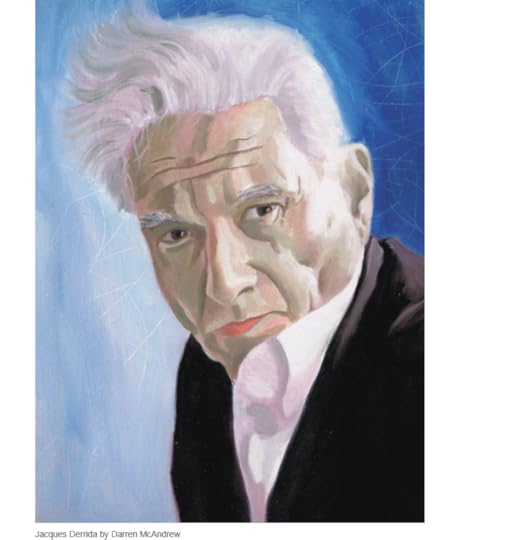
"The first writing is thus a painted image."
(Page 283)
True.
(AI-generated image)
"L'écriture alphabétique est en soi et pour soi la plus intelligente."
Hegel, Encyclopédie.
(In The New York Times, 2024/11/04)
🤔🤔
Grammatology, "science of writing". Not quite.
Had he written on the connection, say, between writing and certain areas of the brain, that would be science. Nonetheless, this has been a fountain of speculative thinking (hypotheses on writing), with all due respect for Derrida's work, I must say.
The idea that writing is (or has been) secondary to speech is just great. Derrida's merit to point that out. But I have my doubts on Derrida's idea that the alphabetic writing is superior to the hieroglyphic or ideographic writings.
"Derrida was, in short, the mad axeman of Western philosophy."
Johann Hari in "Why I Won’t be Mourning Derrida".
"The first writing is thus a painted image."
(Page 283)
True.

November 10, 2009
I enjoyed reading the other reviews on this book and empathized with those who found Derrida unnecessarily dense. His essay, "Structure, Sign, and Play in the Discourse of the Human Sciences," for example, though important, certainly lacks a riveting prose style.
In my own (possibly simplistic) interpretation, deconstruction works--impossibly, of course--at ground zero. It is an attempt to flatten preconceptions. Derrida explains in Of Grammatology, how Rousseau's writing subverts the nature/culture binary he tries to promote. In any work, a particular word or concept will be privileged. Rousseau favors the concept of nature and theorizes that natural man, free from the corruptive influences of nature, was basically good. Derrida, bringing in his theory of supplement demonstrates how culture "always already" inheres in nature, as writing does in speech.
In my own (possibly simplistic) interpretation, deconstruction works--impossibly, of course--at ground zero. It is an attempt to flatten preconceptions. Derrida explains in Of Grammatology, how Rousseau's writing subverts the nature/culture binary he tries to promote. In any work, a particular word or concept will be privileged. Rousseau favors the concept of nature and theorizes that natural man, free from the corruptive influences of nature, was basically good. Derrida, bringing in his theory of supplement demonstrates how culture "always already" inheres in nature, as writing does in speech.

May 12, 2013
I had to read this for a critical theory course in graduate school. The impenetrable prose made me want to pull out my hair, and I'm pretty sure the emperor is naked in this case. I only made it through with the help of Harry Potter--a chapter of Derrida and three chapters of The Prisoner of Azkaban.
January 28, 2008
I was beguiled by this book as an undergrad. Now I despise it for the license it gave people to write incoherent nonsense.

February 16, 2018
I've done a complete 180 on the review of this book. You can see my original review at the bottom, but I've had a total change of heart. I'm glad I struggled with this text so much. It's been so valuable!
The more “soaked” I am in the Derridean text, the more I start to understand that his project isn’t just one thing. I see how utterly complex deconstruction is and how elusive a project it is to try and define. Derrida’s project offers up, in a sense, a new way of thinking which seeks to disrupt the methodologies, structures, frameworks and ontologies that western thought is built upon. But even the term “new way of thinking” doesn’t quite capture what deconstruction is and what it’s for because he’s not necessarily ‘creating’ anything, rather his project is more of an unraveling of the ways we have bound ourselves up in the presumption that meaning is fixed and self-contained within language. Further, that philosophy is committed to the idea of a "metaphysics of presence" that necessarily, but inaccurately, precedes the ways in which we think.
On a simplified level, the Derridean project works by creating moments of disruption in the patterns of thought we have been saturated in. To say that his project works in a formulaic and linear sense, would be a misrepresentation of his work and, in a sense, reify the imbedded structure and ontology that western philosophy is already steeped in. On a more concrete and conventional level, however, deconstruction works by revealing the relationship between the self and language and in turn, exposes how meaning is constructed. These moments of disruption are made available to us by examining dualisms and hierarchies, both of which are predicated on the notion of separateness. In a way, hierarchies and dualisms are something of an access point in order for one to start pushing on the boundaries of language in order to see that the lines of demarcation and “joints of nature” aren’t as clear and distinguishable as western thought would assume.
Derrida’s project is different from the philosophical projects before him (in my opinion) because it addresses the presumptive starting place that western thought is built upon, which Derrida calls the metaphysics of presence. Part of the reason for illustrating the structure of hierarchy is to show that philosophy not only privileges speech over writing and reason over passion (logocentrism), among many other hierarchical structures, but that there’s an even more fundamental and insidious hierarchy within western thought which is privileging presence itself. If something is privileged than its opposite is necessarily subordinated but the problem for Derrida is that this binary creates an artificial division that infiltrates how meaning and value are assigned to language. If the foundation of western philosophical thought is unstable, then how are we able to trust the work and thought that emerges out of it? In other words, Derrida’s project illuminates that the meaning assigned to words and language is not just constructed by what is, but by what isn’t, thus subverting the structure of hierarchy itself. He shows that meaning is never created in a vacuum but that it’s constantly being interpreted and reinterpreted by both the presence and absence of the thing in question.
One of the limitations I see of Derrida’s project is also part of its genius. Because Derrida intentionally seeks to disturb text, writing, speech and language in order to show the slipperiness of meaning, it’s extraordinarily easy to get lost in the language. In fact, it's ALMOST impossible to read. For a discipline like philosophy that prides itself on clarity of thought, it’s easy to be critical of someone like Derrida because the writing is intentionally enigmatic. There’s great value in struggling with Derrida’s complex style of writing and language, that’s part of what makes it so worthwhile and genius. That’s why it’s a shame that Derrida’s project is so easily discarded because the very thing that makes it so valuable is the ambiguity. One of the wonderful things about philosophy is that it obsessively challenges the status-quo and tests assumptions about everything. If I thought Derrida’s contribution to philosophy was bogus and foolish it wouldn’t bother me that the writing was so dense. But because I think his project is so valuable in creating such a paradigm shift I see the abstruse language as a barrier that prevents those who would otherwise be interested, to easily throw in the towel. I almost did...as you can see by my original review, below :)
ORIGINAL REVIEW: This book was spirit crushing. Derrida has an allergy for anything resembling an origin and now I have an allergy to Derrida. Not because of his deconstruction theory (once I got my head around it I was somewhat
amenable to the idea) but because he made this book all but impossible to read. I have a particular distaste for philosophers who write in such an abstruse way that they end up excluding a large portion of their potential readership. Irigaray comes to mind as another such philosopher. For a discipline that prizes precise communication, it always disappoints me when a valuable philosophical theory gets lost in the veritable quick sand of cumbersome language.
The more “soaked” I am in the Derridean text, the more I start to understand that his project isn’t just one thing. I see how utterly complex deconstruction is and how elusive a project it is to try and define. Derrida’s project offers up, in a sense, a new way of thinking which seeks to disrupt the methodologies, structures, frameworks and ontologies that western thought is built upon. But even the term “new way of thinking” doesn’t quite capture what deconstruction is and what it’s for because he’s not necessarily ‘creating’ anything, rather his project is more of an unraveling of the ways we have bound ourselves up in the presumption that meaning is fixed and self-contained within language. Further, that philosophy is committed to the idea of a "metaphysics of presence" that necessarily, but inaccurately, precedes the ways in which we think.
On a simplified level, the Derridean project works by creating moments of disruption in the patterns of thought we have been saturated in. To say that his project works in a formulaic and linear sense, would be a misrepresentation of his work and, in a sense, reify the imbedded structure and ontology that western philosophy is already steeped in. On a more concrete and conventional level, however, deconstruction works by revealing the relationship between the self and language and in turn, exposes how meaning is constructed. These moments of disruption are made available to us by examining dualisms and hierarchies, both of which are predicated on the notion of separateness. In a way, hierarchies and dualisms are something of an access point in order for one to start pushing on the boundaries of language in order to see that the lines of demarcation and “joints of nature” aren’t as clear and distinguishable as western thought would assume.
Derrida’s project is different from the philosophical projects before him (in my opinion) because it addresses the presumptive starting place that western thought is built upon, which Derrida calls the metaphysics of presence. Part of the reason for illustrating the structure of hierarchy is to show that philosophy not only privileges speech over writing and reason over passion (logocentrism), among many other hierarchical structures, but that there’s an even more fundamental and insidious hierarchy within western thought which is privileging presence itself. If something is privileged than its opposite is necessarily subordinated but the problem for Derrida is that this binary creates an artificial division that infiltrates how meaning and value are assigned to language. If the foundation of western philosophical thought is unstable, then how are we able to trust the work and thought that emerges out of it? In other words, Derrida’s project illuminates that the meaning assigned to words and language is not just constructed by what is, but by what isn’t, thus subverting the structure of hierarchy itself. He shows that meaning is never created in a vacuum but that it’s constantly being interpreted and reinterpreted by both the presence and absence of the thing in question.
One of the limitations I see of Derrida’s project is also part of its genius. Because Derrida intentionally seeks to disturb text, writing, speech and language in order to show the slipperiness of meaning, it’s extraordinarily easy to get lost in the language. In fact, it's ALMOST impossible to read. For a discipline like philosophy that prides itself on clarity of thought, it’s easy to be critical of someone like Derrida because the writing is intentionally enigmatic. There’s great value in struggling with Derrida’s complex style of writing and language, that’s part of what makes it so worthwhile and genius. That’s why it’s a shame that Derrida’s project is so easily discarded because the very thing that makes it so valuable is the ambiguity. One of the wonderful things about philosophy is that it obsessively challenges the status-quo and tests assumptions about everything. If I thought Derrida’s contribution to philosophy was bogus and foolish it wouldn’t bother me that the writing was so dense. But because I think his project is so valuable in creating such a paradigm shift I see the abstruse language as a barrier that prevents those who would otherwise be interested, to easily throw in the towel. I almost did...as you can see by my original review, below :)
ORIGINAL REVIEW: This book was spirit crushing. Derrida has an allergy for anything resembling an origin and now I have an allergy to Derrida. Not because of his deconstruction theory (once I got my head around it I was somewhat
amenable to the idea) but because he made this book all but impossible to read. I have a particular distaste for philosophers who write in such an abstruse way that they end up excluding a large portion of their potential readership. Irigaray comes to mind as another such philosopher. For a discipline that prizes precise communication, it always disappoints me when a valuable philosophical theory gets lost in the veritable quick sand of cumbersome language.

November 13, 2015
This book is based on both deconstruction that Derrida expands and improves here and construction which he performs after untangling the ideas of both Ferdinand de Saussure and Jean Jacques Rousseau. Derrida reveals the paradoxes existing in both writers' works and the way how they stick to binary oppositions and resting everything upon the centre or origin, which, according to Derrida does not exist at all. Later he acquits that side of binary opposition which has always been othered or, as Derrida puts it, 'leper'. He suggests that there is no outside and inside, but there is a whole that is always in need of being broken into pieces and subject to repeated analysis. What is more surprising about the book is the fact that Derrida proposes concerning Saussure's views. He says that Saussure himself was aware that writing does not usurp but supports speech, however, as he was trying to adhere to traditional metaphysical approach, he did not betray his principles. It is like you can't help biting into the forbidden fruit knowing that you commit a sin. This is called 'deconstruction' that most traditional philosophers were afraid to utter before Derrida.
July 17, 2009
I didn't finish the book. I got to page 289--27 short of the end--and just couldn't go any further. So if there was a brilliant insight located in the last 27 pages, I missed it.
This book was an utter waste of my time. That's not necessarily a reflection on Derrida. It may be that I am an idiot. Either way, I got nothing of value from it, so there's not much more that I can say about it.
My guess is it's Derrida, though. I would suggest you stay away from this book unless 1) you're required to read it, or 2) you find similar but somewhat clearer thinkers (Baudrillard, Foucault, Barthes, Bataille) very stimulating. But start your postmodern adventure with those, not with big D.
This book was an utter waste of my time. That's not necessarily a reflection on Derrida. It may be that I am an idiot. Either way, I got nothing of value from it, so there's not much more that I can say about it.
My guess is it's Derrida, though. I would suggest you stay away from this book unless 1) you're required to read it, or 2) you find similar but somewhat clearer thinkers (Baudrillard, Foucault, Barthes, Bataille) very stimulating. But start your postmodern adventure with those, not with big D.
November 3, 2009
My claim to have read this MoFo is a flat-out lie. What HAS read ? Who indeed CAN read it ? I couldn't finish page one. Can you help me ?

August 20, 2022
This book is rewarding in a sense that it gives you something to take it back at the same time. Derrida–so misunderstood a philosopher–himself was playing to push us out of that “understanding” “misunderstanding” game. He reminds us to remember what we elide day by day in our discourse and life. It is not that he is trying to get us back to the realm of truth or reality,quite the contrary, he reminds us that there is none. GOING back to the things were phenomenological method,whose ruses are still functioning in our nerve. Not even that. Derrida, in this book, is going against that entire tradition of western philosophy, which for him were(is) always addicted to “metaphysics of presence” and if we for a little moment get out of that field called philosophy, we see that not only philosophy, but everything-including history-was submerged in this dream of “presence”. And Derrida is not saying that we have to get out of this metaphysical jargon. Not at all. He reminds us that we can't do this. Because metaphysics are not some discourse that only belong to a particular context. It is always already moving our very language. Language can never get out of its metaphysical norm. So,now we have to deconstruct this very tradition, by borrowing our contents from this tradition itself. So there is no end of horizon. We are always already grounded in this tradition.
I didn’t find this book difficult,according to so many claims that this book is almost impenetrable. But this is hardly the case. Derrida is always clearing the air,though sometimes it can get difficult to pinpoint whether he is commenting himself or paraphrasing other thinkers thought. What was more fun for me regarding this book is that i got to know more about Rousseau and that even in a very concise and entertaining manner. It felt as if i could grasp everything of Rousseau's writings. And that kind of powerful writer Derrida is–who can provide you with clear understanding of other writer's points as well as his own zigzagging deconstructive points. You understand that he is not just critiquing them; by making their argument weak Derrida sharpens his pen more to clarify the hidden contradiction and confusions in their text(Rousseau, Levi Straus, Husserl, Saussure etc). Or more precisely, you can say he finds out what those thinkers said without saying, their unconformable silence revealed more about their text.
If you still have fear to approach this humongous book of Derrida, i can assure you that even no other introductory book is necessary(but of course you have to know much about what he is talking about). Gayatri Spivak's Preface and afterword are the best you can get to understand Derrida. For me,Gayatri Spivak's Preface was enough to dive deep into this sea of sharks. Of course, i would recommend you to buy the fortieth edition. Besides, Spivak's translation was appreciated by Derrida himself. I am so so proud of her..much more because we speak the same language. And it must have been a hectic job for her to translate this dense book into English, as English is not her first language. Hats off to her.
I want to finish this review by saying that, Of Grammatology is a book that will never bore you. On the contrary, i was equally glued to every pages throughout my reading.
I didn’t find this book difficult,according to so many claims that this book is almost impenetrable. But this is hardly the case. Derrida is always clearing the air,though sometimes it can get difficult to pinpoint whether he is commenting himself or paraphrasing other thinkers thought. What was more fun for me regarding this book is that i got to know more about Rousseau and that even in a very concise and entertaining manner. It felt as if i could grasp everything of Rousseau's writings. And that kind of powerful writer Derrida is–who can provide you with clear understanding of other writer's points as well as his own zigzagging deconstructive points. You understand that he is not just critiquing them; by making their argument weak Derrida sharpens his pen more to clarify the hidden contradiction and confusions in their text(Rousseau, Levi Straus, Husserl, Saussure etc). Or more precisely, you can say he finds out what those thinkers said without saying, their unconformable silence revealed more about their text.
If you still have fear to approach this humongous book of Derrida, i can assure you that even no other introductory book is necessary(but of course you have to know much about what he is talking about). Gayatri Spivak's Preface and afterword are the best you can get to understand Derrida. For me,Gayatri Spivak's Preface was enough to dive deep into this sea of sharks. Of course, i would recommend you to buy the fortieth edition. Besides, Spivak's translation was appreciated by Derrida himself. I am so so proud of her..much more because we speak the same language. And it must have been a hectic job for her to translate this dense book into English, as English is not her first language. Hats off to her.
I want to finish this review by saying that, Of Grammatology is a book that will never bore you. On the contrary, i was equally glued to every pages throughout my reading.

February 12, 2020
One of the greatest achievement which you could gain from practicing this treatise is grasping the process of Deconstruction. By the way the idea behind the relationship between mind and logos fascinated me very specifically. Derrida unfolding the mediationary Role of Conventional-Symbolism in the process of relating mind to logos but he also declared that Grammatic itself is science of possibility and no longer have the form of Logic. From the secend chapter of Book you have to deal with the strange manner of Derrida for discussing about the issue.

January 17, 2012
First, what Derrida is not saying. He is not saying "Everything is relative." He is not saying, "There are no absolutes." That's what the American university professor believes, but that's not Derrida. So in one swoop 99% of Conservative Culture Warrior criticisms of "postmodernity" are false.
French Postmodernism is not as difficult as it may appear. Derrida does a good job in defining his terms, and as long as we keep those definitions present, much of what he says is not only coherent, but quite insightful:
The Holy Grail (or Pandora's Box) of philosophy is "being-as-pure-presence." What does that mean? It's hard to say. One helpful definition,
[It is a] transcendental signified” ... which transcends all signifiers, and is a meaning which transcends all signs.
In other words, a Gods-eye-point of view. As finite creatures, we can never have that. But presumably that is what we want. Or so Derrida says. Outside a few gnostic hyper-Calvinists at Puritanboard, I don't know anyone who wants that "being-as-presence."
So for all the danger of Derrida, we are on relatively solid ground. Indeed, much of it sounds like a robust Christian hermeneutics. Mediation goes all the way down. “il n’y a pas de hors-texte.” There is no aspect of our experience that escapes the play of signifiers. Instead of a metaphysics of presence we have an ontology of quasi-trace. Reference never gets to a “pure” outside that isn’t already touched by mediation and signifiers.
Indeed, throw in some Trinitarianism where each Person infinitely defers to the Others, and we have done a complete end-run around Western metaphysics.
But that's not what Derrida means and that's where he runs into problems. He knows we can't have pure presence, so any pure presence is always already supplemented with (x). And this fact of supplementation is an act of violence, for it posits nature as lacking.
Again, if we are looking at it from post-fall Christian theology, that's true. There is no pure, good nature (in the sense of Harambe and children playing with each other). But I don't think that is what he means.
The real villain is writing. Writing dislocates the subject that it constructs. Writing displaces speech and introduces “an economy of signs” (142). Writing means that the “representing” is the actual thing itself.
Criticisms
*Derrida says thought is “the blank part of a text…[meaning] nothing” (92). Presumably it functions as an empty set. But this is just not how thought and language work. Language, albeit not-yet-verbal, is what makes thought possible. Now if what he means by this is thought can never be a “transcendental signified,” fine. But I don’t think he means that.
**Let's pretend Derrida's analysis is correct for a moment. So what? I've never met a single human being who has ever thought that supplement = violence, or can even conceptualize that. Postmodernism will fail, not because it is wrong, but because no one cares whether it is right or wrong.
French Postmodernism is not as difficult as it may appear. Derrida does a good job in defining his terms, and as long as we keep those definitions present, much of what he says is not only coherent, but quite insightful:
The Holy Grail (or Pandora's Box) of philosophy is "being-as-pure-presence." What does that mean? It's hard to say. One helpful definition,
[It is a] transcendental signified” ... which transcends all signifiers, and is a meaning which transcends all signs.
In other words, a Gods-eye-point of view. As finite creatures, we can never have that. But presumably that is what we want. Or so Derrida says. Outside a few gnostic hyper-Calvinists at Puritanboard, I don't know anyone who wants that "being-as-presence."
So for all the danger of Derrida, we are on relatively solid ground. Indeed, much of it sounds like a robust Christian hermeneutics. Mediation goes all the way down. “il n’y a pas de hors-texte.” There is no aspect of our experience that escapes the play of signifiers. Instead of a metaphysics of presence we have an ontology of quasi-trace. Reference never gets to a “pure” outside that isn’t already touched by mediation and signifiers.
Indeed, throw in some Trinitarianism where each Person infinitely defers to the Others, and we have done a complete end-run around Western metaphysics.
But that's not what Derrida means and that's where he runs into problems. He knows we can't have pure presence, so any pure presence is always already supplemented with (x). And this fact of supplementation is an act of violence, for it posits nature as lacking.
Again, if we are looking at it from post-fall Christian theology, that's true. There is no pure, good nature (in the sense of Harambe and children playing with each other). But I don't think that is what he means.
The real villain is writing. Writing dislocates the subject that it constructs. Writing displaces speech and introduces “an economy of signs” (142). Writing means that the “representing” is the actual thing itself.
Criticisms
*Derrida says thought is “the blank part of a text…[meaning] nothing” (92). Presumably it functions as an empty set. But this is just not how thought and language work. Language, albeit not-yet-verbal, is what makes thought possible. Now if what he means by this is thought can never be a “transcendental signified,” fine. But I don’t think he means that.
**Let's pretend Derrida's analysis is correct for a moment. So what? I've never met a single human being who has ever thought that supplement = violence, or can even conceptualize that. Postmodernism will fail, not because it is wrong, but because no one cares whether it is right or wrong.

March 14, 2021
Gramatologia é um livro impressionante. Os caminhos que Derrida constrói para a desconstrução são os mais inusitados, e ao mesmo tempo, os mais decisivos.
Boa parte do livro se volta para o Ensaio sobre a Origem das Línguas de Rousseau. A análise de Derrida é brilhante, não apenas por destrinchar o que está e o que não está no texto, mas por traçar uma linha de tensão compartilhada por boa parte da história da filosofia. A metafísica da presença, o logos, a fala como primeira frente a escrita fria e morta: são esses os inimigos que Derrida desconstrói.
É difícil expôr as múltiplas vias da crítica de Derrida: de Sócrates a Hegel, de Heidegger a Levi-Strauss, Derrida vai em busca da brisura, da relação fora e dentro, da diferência, das origens (e da impossibilidade delas), do suplemento e da escritura. O que fica atravessa a crítica e que fica com mais força para mim é: a alteração pela escritura é uma exterioridade originária; ela é a origem da linguagem. Não há um antes do suplemento; nem presença nem ausência. A ontologia aqui é tensionada de uma forma brutal; me restam apenas perguntas sobre sua possibilidade.
Boa parte do livro se volta para o Ensaio sobre a Origem das Línguas de Rousseau. A análise de Derrida é brilhante, não apenas por destrinchar o que está e o que não está no texto, mas por traçar uma linha de tensão compartilhada por boa parte da história da filosofia. A metafísica da presença, o logos, a fala como primeira frente a escrita fria e morta: são esses os inimigos que Derrida desconstrói.
É difícil expôr as múltiplas vias da crítica de Derrida: de Sócrates a Hegel, de Heidegger a Levi-Strauss, Derrida vai em busca da brisura, da relação fora e dentro, da diferência, das origens (e da impossibilidade delas), do suplemento e da escritura. O que fica atravessa a crítica e que fica com mais força para mim é: a alteração pela escritura é uma exterioridade originária; ela é a origem da linguagem. Não há um antes do suplemento; nem presença nem ausência. A ontologia aqui é tensionada de uma forma brutal; me restam apenas perguntas sobre sua possibilidade.

March 15, 2015
If you were easily impressed by Socrates getting alot of cred simply for being a troll, you'll find alot to love here.
But otherwise, never before has so little of such small impact been said with so many words, expended from the text like the spore cloud of a dying mushroom.
'Postmodernists parade their relativism as a superior kind of humility — the modest acceptance that we cannot claim to have the truth. In fact, the postmodern denial of truth is the worst kind of arrogance. In denying that the natural world exists independently of our beliefs about it, postmodernists are implicitly rejecting any limit on human ambitions. By making human beliefs the final arbiter of reality, they are in effect claiming that nothing exists unless it appears in human consciousness.'
~John N Gray
But otherwise, never before has so little of such small impact been said with so many words, expended from the text like the spore cloud of a dying mushroom.
'Postmodernists parade their relativism as a superior kind of humility — the modest acceptance that we cannot claim to have the truth. In fact, the postmodern denial of truth is the worst kind of arrogance. In denying that the natural world exists independently of our beliefs about it, postmodernists are implicitly rejecting any limit on human ambitions. By making human beliefs the final arbiter of reality, they are in effect claiming that nothing exists unless it appears in human consciousness.'
~John N Gray

March 23, 2007
Derrida is difficult. I read this to write a paper on Aretxaga's Shattering Silence and found it to be quite illuminating once I read every sentence four times.

October 12, 2011
utter nonsense (deconstruct that sentence if you wish; however, I repeat this is nonsense).

Read
October 3, 2012Dear Derrida i must give up
Displaying 1 - 30 of 219 reviews