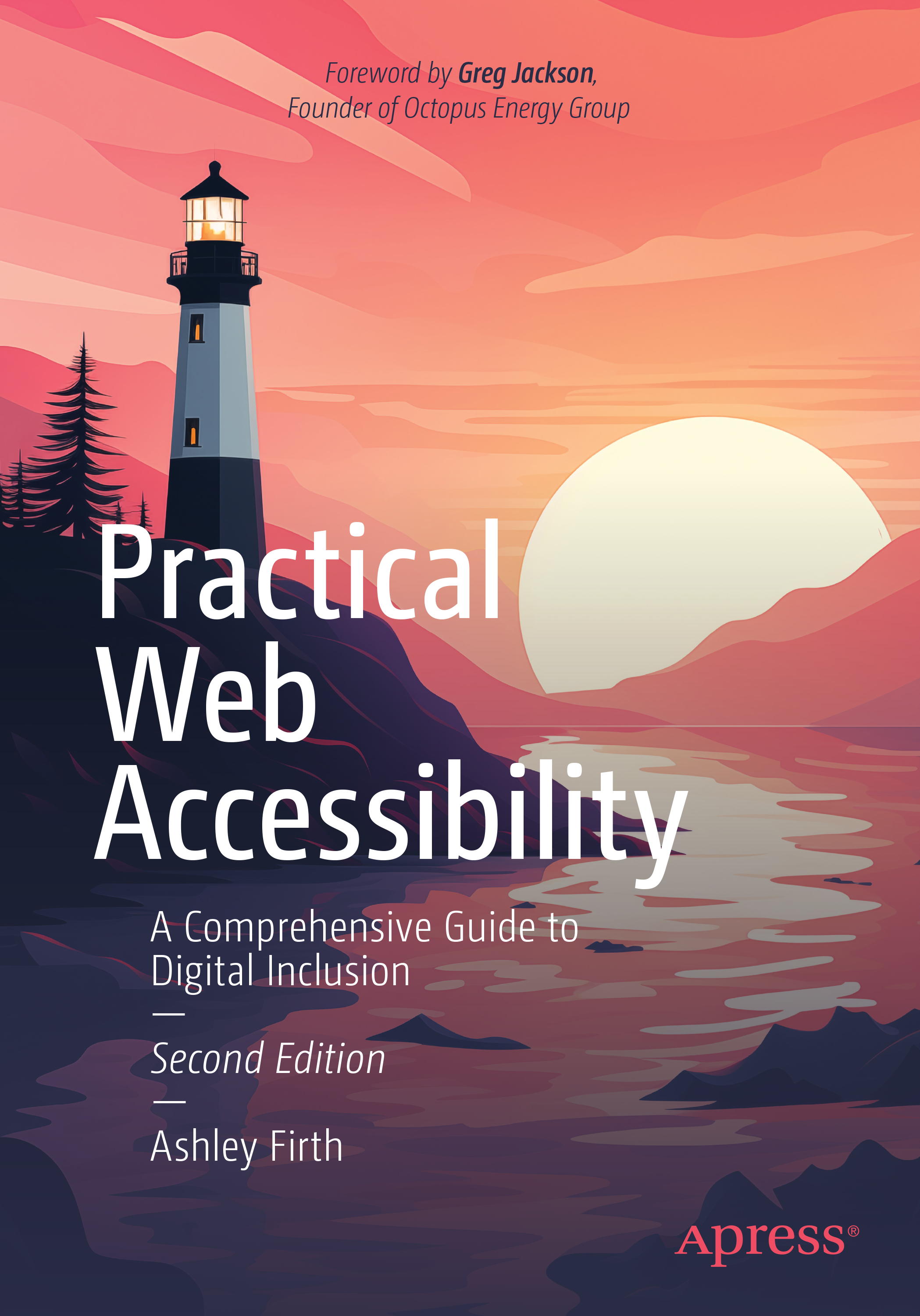
I did not get what I wanted from this book. You should read it.
Let me explain. When I came to this book, I was coming from another book (Web Accessibility Cookbook), which is a fine book, but I found it difficult to engage with. I didn't read the whole thing, so I won't give any criticism, I just found the format very list-y, and I just couldn't engage with it properly. Anyway, I came to Practical Web Accessibility kind of expecting to find the centerpiece to be a description of WAI-ARIA, and other related things like that. In point of fact, WAI-ARIA plays a very small role in this book. It does recommend roles and attributes now and then to address a particular problem, but there's no high level overview of WAI-ARIA as a whole.
What _is_ there: * a pretty comprehensive overview of the current state of accessibility, including some information about the legal and regulatory environment and consequences * a lot of references out to authoritative sources (WCAG gets a lot more love than WAI-ARIA, and many sections are cross-referenced to specific WCAG success criteria) * clear descriptions of who is affected by accessibility issues, how, and what can be done about it * a lot of recommendations for tools you can use to guide your own website on its accessibility journey * a structure framework you can use for evaluating and improving the accessibility of websites
This is not a book for "developers", although there is information in it that developers will find valuable. This is a book for stakeholders, particularly those on the ownership side who have a responsibility not to discriminate, deliberately or by omission. It has explanations of various accessibility concerns, organized by particular access needs (_e.g.,_ one chapter covers blindness, another cognitive disability, etc.), ways to identify and adress them, loads of good advice, and it's all written in a way that's going to be accessible to non-technical users. It covers a fair bit of ground that I would not have identified as a11y issues before reading the book (clear, concise writing, avoiding deceptive or manipulative design choices), but makes fair arguments to support these.
The book is organized in several sections. First an introductory chapter, then a series of chapters on particular accessibility needs, that roughly tends to proceed from more-concrete (blindness) to more-abstract (mental health). Then there's a chapter on the particular problems of email, a chapter with recommendations for outsourcing your accessibility (I can sum that chapter up for you quickly: "don't"), a chapter that gathers and expands on the tool recommendations scattered throughout earlier chapters, and finally a closing thoughts chapter which discusses current developments, like the next version of the WCAG standard and some legal precedents that matter.
This organized-by-access-needs structure does mean that there's a fair bit of repeated information, as solutions for one problem often overlap with solutions for another kind of problem, and this isn't great, if you're reading it from start to end like I did, but I suspect it's very good indeed if you're trying to solve a particular problem and don't want to have to cross-reference to a bunch of other chapters.
If I have one main criticism of this book, it is that I _really could have used_ a more detailed treatment of WAI-ARIA. But that's fine, I'm sure I can find that online and supplement my knowledge. I'm quite glad I read this book. Accessibility is a much bigger space than I imagined. Now I know it—and I feel ready to make immediate improvements in my own projects. This book has earned a permanent spot on my shelf.