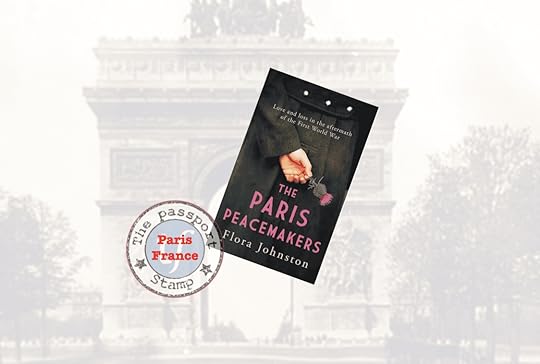
Thanks are due to NetGalley and Allison & Busby for an ARC of this book to read and review.
The Paris Peace Treaty of 1919 that followed upon the « war to end all wars » was put together in a none too peaceful fashion. Many participants, observers, and ordinary people thought it virtually guaranteed a future war. Historians generally agree. It is to Flora Johnston’s enormous credit that she manages to make a cohesive narrative of what was a near free-for-all of clashing interests, unclear objectives, hidden agendas, and difficult personalities. And she does this while sensitively exploring the lives of fictional characters, primarily the Scottish Rutherford family and their friends, who were forever marked by the war and its aftermath. A sub-set of characters are tied to the others through the historically-real Scottish rugby team, the majority of which enlisted in 1914, and suffered enormous casualties.
The author, for whom this is the second book of a planned trilogy, devoted part 1 to introducing the main characters, including the highly symbolic (as well as real) rugby team as the war begins. She then follows their separate but interconnected paths through the war itself, on the western front and on the home front, drawing some of the most evocative experiences of the horrors I’ve ever read, both in those who fought and those who waited, and prayed, for their return. She also sensitively renders the deep wounds sustained by those who lost their men, or who welcomed them back with terribly scarred minds and bodies, and those who would mourn their loss forever.
First-born Alex was already in the Royal Scottish navy when the war started, and the rare news from him causes much anxiety for his mother and sisters at home. Youngest brother Jack is a promising artist and rugby fan, in a country where rugby, before the war, is obsessively followed. He is a ghost in the story, but a very present one for all the main characters, especially his sisters.
Older sister Corran, an Oxford lecturer, is engaged to Rob Campbell, a gifted rugby player on the Scottish team and a gifted surgeon. Like most of his team, Rob enlists immediately. His war is spent at the brutally understaffed and under-supplied clearing stations on the front, where the unrelenting pressure and unimaginable horrors shake his core beliefs, as they will for many others. They have barely seen each other during the war. An Oxford trained classicist at a time when few women attained those heights, she takes a temporary leave from teaching fine young ladies at Cheltenham College to teach Latin, Greek, and English writing skills to soldiers and veterans at a special camp in Dieppe. Ar first shocked by the roughness of the camp, the men, and her fellow teachers, she is profoundly changed by the end of her brief service.
Younger sister Stella, idealistic like Corran but more pragmatic, finishes her arts degree at Edinburgh University and then opts to do a secretarial course in London. An excellent scholar herself, she has an eye to her family’s diminishing fortunes and the new opportunities for women that the war has opened. Working to pay her way while also perfecting her typing and shorthand, Stella keeps deliberately busy to block the unrelenting grief she feels about the death of her brother and twin spirit Jack. This pays off when her high grades grant her employment with the Imperial British delegation at the Paris conference that begins in January 1919. This is where most of the story takes place, and where Stella, the novel’s main character, begins to understand that everything has changed and that a new world has been born. Like so many others, she also understands that it will sadly retain many of the bitter elements of the pre-war world: class, race and gender inequality, colonial oppression, and war itself.
This is a beautifully written book that explores an important historical event dominated by the world’s male leaders, keen to ensure their power and influence in the post-war world more than a lasting peace. This is a well-known story, but the author offers the perspective of the mostly forgotten women who performed the critical and often exhausting labour to support their needs, demands, and egos, while setting their decisions on the record. Most of them did not even have the right to vote. It’s remarkable how different war and peace can look depending on whose perspective is seen—the ruling men or the humble female support team. Johnston makes it clear where her sympathies lie—and that is precisely where the top-down histories so often miss the mark.