Jump to ratings and reviews
Rate this book

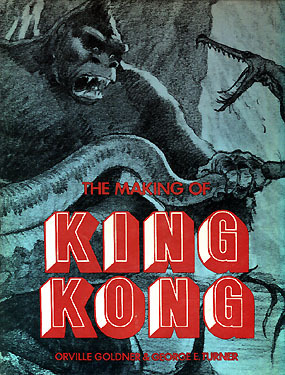
The Making of King Kong: The Story Behind a Film Classic

Rate this book
An account of the genesis, planning, and making of the still popular and inimitable 1933 movie and of the people involved, with full casts, credits, and synopses of King Kong and nine related films

271 pages, Hardcover

First published July 1, 1975

1 person is currently reading
89 people want to read

About the author

Orville Goldner

4 books1 follower

Ratings & Reviews

What do you think?
Rate this book

Friends & Following

Create a free account to discover what your friends think of this book!

Community Reviews

5 stars
27 (49%)
4 stars
18 (32%)
3 stars
9 (16%)
2 stars
1 (1%)
1 star
0 (0%)
Displaying 1 - 9 of 9 reviews
Profile Image for Charlie Grusin.
15 reviews2 followers
June 14, 2024
EDIT (06/14)

True rating: 4.5

Without going to great lengths about the film itself (Wild! Weird! Wonderful! The stuff of which movies are made!), it wouldn’t be considered hyperbolic to call the RKO monster spectacle epic King Kong a marvel of marvels - if anything, even that would more likely be an understatement. From a coalition of innovation, collaboration, ingenuity, mad fantasy and even madder determination, and thundering to existence through the restraints of the Great Depression and the incredible scraps pulled to its disposal (the massive Roman sets from Cecil B. DeMille’s The King of Kings, sets and dinosaurs designed for Willis O’Brien and Harry Hoyt’s spiritual successor to The Lost World, the mystically titled Creation), it not only became a huge game-changer in American filmmaking but has continued to startle the imaginations of many a mind since its initial 1933 release and its many subsequent re-releases, TV runs, remakes, spin-offs and multi-colored adaptations that have continued to solidify the great Kong story into a state of pure myth.

Published on the cusp of King Kong’s resurgence in the seventies, The Making of King Kong is the first ever (and seemingly the only) deep-dive chronicle into the production of this oddity of wonders, ranging from the early beginnings of Ernest Schoedsack’s expedition shoots and Merian C. Cooper’s Bolshevik-smashing days and leading up to the two producing a smack-dash follow-up to their adventurous magnum opus, spotlighting much of the cast and crew from the more familiar (master scream queen Fay Wray, comical lovable smuck Robert Armstrong and the oh-so-operatic Max Steiner) to the more worthy-of-note (the sharp-edged and awesome Ruth Rose who tackled the tremendous endeavor of reeling the film’s overwhelming yarn into a final script without a sweat, the talented Marcel Delgado recruited by effects god-wizard Willis O’Brien to create the flesh-and-bones of the many creatures who roam across the film’s relentless second-half, just to name a few) while covering nearly every nook-and-cranny of the technical field that composed nearly every single moment of early movie magic that King Kong still holds to this day like the jaws of an Allosaur (or is it T-Rex? - there’s some contention about that apparently (a contention you’re not gonna find here, unfortunately ☹)).

Being... well, young... I don’t know exactly how much of King Kong’s special effects techniques were common knowledge in Kong-related discussions prior to this publication, but I’d have to assume most of it was more-or-less reserved to rare interviews and/or monster magazine special write-ups and equally-oriented fanzines: as noted here (as well as the brilliant documentary RKO Production 601, which is the perfect companion piece for this book) there have been many a rumor and false-trail speculation on how the film’s effects were achieved since its release that ran the gauntlet from empty-handed fame-seekers and even back down to the marketing itself, the latter an outrageous attempt by RKO to secure and protect the “secret elixir” of Willis O’Brien and crew’s achievements. However common it may’ve been then, it is amazing nonetheless that this book goes as far as it does to detail every single aspect of its multi-layered stop-motion and matte-and-model creation (including a plethora of test shots courtesy of the book’s Kong technician and co-author Orville Goldner, which not only show these layers as they were developed over time on set but also include a few alternate shots which, as far as I know, have yet to be seen in any other light other than this book - and that includes the good ol’ web, folks!), especially considering how well much of Willis O’Brien’s work had been treated in the past: on The Ghost of Slumber Mountain his producer Herbert Dawley treated him like dirt and later tried to claim his work as his own, and even his crowning work on King Kong was only a result of his beloved project Creation (only one out of a million lost projects, sadly enough) being scrapped on its tracks by Merian C. Cooper to make way for his once-outlandish gorilla-vs.-komodo-dragon story. Even if much of O’Brien’s work following King Kong wasn’t as vast as those held by his more successful disciples such as Ray Harryhausen, at least there are pieces of film history such as this and RKO Production 601 that really give such insight, aspiration and even respect for the work he, Marcel Delgado, Mario Larrinaga, Bryon Crabbe, Orville Goldner and the many others involved in creating this other primordial lost world before the camera’s eyes.

That being said, however, nowadays this approach is admittedly not as in-depth or as “complete” of a history as, say, more recent non-fiction works such as Mark Seal’s Leave the Gun, Take the Cannoli (covering The Godfather) or W. K. Stratton’s excellent write-up on The Wild Bunch. It definitely touches more on aspects that were merely passed over in RKO Production 601 – the histories of its directors, writers and performers, for one thing – but even then they are given only a few smidgens of space on the page, text which is rarely seen solely on the page without an accompanying photo or two (sometimes more); the early chapters over Cooper, Schoedsack and Rose are an exception to this, covering so much information in one go with little to no illustrations attached that it’s perhaps the densest the book ever gets information- and text-wise (so much so there are even other books (one of them also co-written by George E. Turner) that further explore their many adventures and filmmaking antics), but it’s still an oddity that since this publication there have been many other books regarding the making of King Kong – whether they be Paul A. Woods’s King Kong Cometh! anthology, John LeMay’s Kong Unmade volumes or even Ray Morton’s then-comprehensive history of all things Kong – and yet (as far as I know) there hasn’t been a single one that promises and delivers the most definitive history of King Kong that could ever be mustered. This book, for its time, did just that – perhaps as well as other popular “behind-the-scenes” books back in the day such as The Jaws Log, The Making of Kubrick’s 2001 or even William Peter Blatty on The Exorcist – but even with this, even with the goldmine of special features instilled on the film since its primetime DVD and Blu-Ray releases here in the states, and even with the Ronald Haver commentary track (the very first!) created specifically for the Criterion LaserDisc release… it just doesn’t feel enough!

Is this the curse of becoming a born-again Konghead, of feeling there is never enough lore and background to learn about this film to ever really feel satisfied? Or is this merely a reflection on the state of deep blue fan obsessions that have made monsters and weirdos of us all, now forever doomed to be targeted by the parasitic hydras of our long-too-long-commercialized pop culture that threaten to turn any last remaining genuine article of feeling and insight into constantly regurgitated products for the future landfills of the nearest possible apocalyptic scenario that seems the most reasonable for the week, all of them variations on the same theme of flatlands being wasted away by culture war grifters riding on bikes and headgear not too unfamiliar from those adorned in the first Mad Max flick, riding on roads paved and left for decay by the corporate overlords of the land who will either grin in the greenest of glees or ponder in absolute blind stupidity at the mistakes of their own making playing out before them in strides before the heat-death makes all these things meaningless in the end – and if all this happens to be the case, would there be time yet to alter the course of our evil dumbassery?

Or maybe I’m just nuts. Yes. I’m nuts and I just lost the sauce… Sorry ‘bout that!

Anyone deeply interested in the circumstances and the know-hows that made King Kong the classic it is will not be disappointed in this book; it should be noted that the edition I’ve read is the first – more specifically the Ballantine paperback edition I was able to acquire from an Interlibrary Loan request (quick PSA here: try it out!!) - therefore meaning this review isn’t taking into account the later expanded and currently available edition of this work which promises to have more in store than what I’ve read here (well lookahdat, maybe there is a definitive Kong book out there after all!). Whichever edition, it’s sure to be a worthwhile eye-opener for the first greatest monster movie ever made, certain to make any appreciation originally held it to grow twofold.

POSTSCRIPT: My fellow Godzilla fans take heed – around pg. 159 and on, that dreaded and now hopefully antiquated “cheap-rubber-suits-and-cheap-cardboard-buildings-and-cheap-toy-cars” perspective of Godzilla disdain that nearly every American critic from the ‘50s to a little ways past the ‘90s seemed to have ready at their disposal like a cavalry on a buffalo rears its butt-ugly head here. It’s nothing that would strongly affect my overall feelings on a book – especially something that appears as slight and as late to the game as it does here – but it is without a doubt a bizarre discoloration. Why, in the effort of praising the efforts implemented in accomplishing one single method of art with such strong and certain authority, would one then decide to offhandedly dismiss a completely different method to that goal in the same breath? There are definitely reasons why suitmotion would be considered less desirable in depicting monsters compared to the flexibility of stop-motion and model armatures, but to decry the successful efforts of Eiji Tsuburaya and Ishiro Honda as merely cheap kid stuff would be like calling out the same to Willis O’Brien’s, Merian C. Cooper’s and Ernest B. Schoedsack’s own (“What’s this claymation shit? Are they seriously playing with dolls?”). What a weird aside (.…Hey!).
Profile Image for D..
717 reviews18 followers
June 23, 2013
It's strange to think that this book, written in 1975, is still the "go-to" book on the making of the original KING KONG. It's not a BAD book, to be sure, but the authors didn't go into the kind of depth that modern readers would expect in a book about the making of a film. For example, when the book was written, several of the cast members were still available for interviews, but the book only shares a few anecdotes, and nothing really earth-shattering. The SFX for the film, which were groundbreaking, are covered, but not into the detail that one would expect.

So, while there is a LOT of information here, I found the book strangely lacking color and life. It reads more like a dry textbook than an adventure or exploration of the making of the film.

On the plus side, there ARE several stories in it that I had not heard before, and several reproductions of rare production art and behind the scenes photographs that are very cool.

I'd echo the sentiments of the other reviewer -- this book is a good place to start, but I think there's still a better book to be written on the subject.
Profile Image for Pete Carrubba.
13 reviews
June 23, 2013
A revelation of just what a historic film the original KING KONG was. A must for anyone interested in filmmaking.
Profile Image for Brian Yatman.
78 reviews
March 2, 2020
I wore out my local library's copy of this. A wonderful book.
Profile Image for Jim.
18 reviews20 followers
March 21, 2016
I read this book when it published. It was available in a Department store. I was twelve.
It was a technically oriented book. The writers were not interested in the glam side, that could be had from interviews. They merely did research to create a Archaeology of the book.
So, the book works at several levels: its thorough in its presentation of gadgets and tricks.
Its thorough in its artwook and stills, in fact, both of these are presented copiously.

The text is breezy. The Edgar Rice Burroughs story of Cooper is not glossed over, and it covers briefly the rich collaboration between Shoedsack and Cooper, where they produced nature documentaries seeming to auto dare each other in getting footage...kind of like Mutual of Omaha without the darting and tagging, but certainly the running away from the bear footage.

This is contrasted with Willis OBrian work, equal in overview of earlier motion capture Obrian honed his craft.
Cooper is sometimes described as performing as the ape for Obrian. Which would be like Motion Capture today.

The techniques of Matte Painting, Dual Screen projection, forced atmospheric perspective, which including projections on rubber, and two kinds of compositing, one being the first use of the optical printer in such a composite demanding production>
And of course, the armature, skin and the painstaking frame by frame puppetry, and lastly the studious world design illustrations...pretty much the Roll Royce of Cinefex articles, and I am going to state I believe this book inspired if not actually copied, the format and presentation of early Cinefex articles.

Articles which have changed somewhat since the seventies.

From the book "The scene where Kong fights the snake-like dinosaur in his lair was likely the biggest achievement in the special effects of the film, because all of the elements in it work together at the same time. The scene was achieved through the use of a miniature set, stop-motion animation for Kong, background matte paintings, real water, foreground rocks with bubbling mud, smoke and two miniature rear screen projections of Driscoll and Ann."

There is no marginalizing of Cooper or O'Brian, though Shoedsack gets some coverage, he is a director working for a Producer who knows how to edit.

From the book The making of King Kong by Golder and Turner;
"Schoedsack and his crew filmed establishing shots in the harbor of New York City. Curtiss F8C-5/O2C-1 Helldiver war planes taking off and in flight were filmed at a U.S. Naval airfield on Long Island. Views of New York City were filmed from the Empire State Building for backgrounds in the final scenes and architectural plans for the mooring mast were secured from the building's owners for a mock-up to be constructed on the Hollywood soundstage."

Five stars, yet, one has to be able to tolerate the tone, which marginalizes, in the abundance of material data, the story of the human touch we have seen so much ending the nightly news.
Profile Image for Richard.
312 reviews5 followers
November 20, 2012
King Kong (the 1933 version, of course!) may not be the best movie I've ever seen, but it's the movie I love more than any other. When I was a kid WOR Channel 9 in New York showed King Kong every Thanksgiving (I don't know why) and I've kept the tradition alive by watching every year on VCR, DVD and now DVR. So I'm certainly going to appreciate a book that gives as much inside info about the making of King Kong as this book does.


Having said that, I think there's a better book to be written about this great movie. Unfortunately, whoever eventually writes that book won't be able to talk to living cast and crew members like Orville Goldner was able to do in the 1970s, so this book is a bit of a squandered opportunity. The book has kind of a detached tone; the anecdotes (and there aren't many) are told at arms' length. I wish there were clearer explanations of some of the effects techniques. I did get a bit of a better idea of what an optical printer is. (I had heard it discussed prior to a TCM showing of Citizen Kane.) And the description of the use of glass painting was interesting, but the description of the "Williams traveling matte process" left me baffled. Some illustrations explaining the process would have been very helpful.


Lack of technical illustrations aside, the book has a lot of great photos and production drawings. Definitely recommended for anyone who has as much affection for King Kong as I do.

479 reviews
January 2, 2022
Whilst I have read an account of the making of this classic film in the blog of Cooper this book goes into great detail with marvellous photos.I am not sure why it is necessary to have a46 page introduction telling you everything you are going to learn about in great detail in subsequent chapters. Also why they had to set out a chapter listing films featuring Gorillas. They missed out Swiss Miss
Profile Image for Andres Zen'In.
97 reviews
January 23, 2026
odio la ironía con la que se dice esa frase de "no, fue bella quien mató a la bestia: (depende de la traducción), cuando vemos como cada que se interactúa a con Kong era con un arma en la mano y se trata de romantizar el mayor acto de crueldad animal en la historia de la ficción
Displaying 1 - 9 of 9 reviews