Ichiro y Sachiko son artistas jóvenes, temperamentales y desanimados por lo que la vida tiene para ofrecerles. Se enamoran y desenamoran, celosos de los intereses del otro. Elegía en rojo es el relato de sus angustias, pasiones y disputas y es asimismo el retrato revelador de una tormentosa historia de amor. Piedra angular de la escena underground japonesa de su época, Elegía en rojo apareció por entregas en la revista Garo entre 1970 y 1971, tras una década políticamente turbulenta y culturalmente vibrante que prometía, pero no lograba, ofrecer nuevas posibilidades.
Hayashi captura maravillosamente la vida tranquila de una pareja joven que lucha por llegar a fin de mes y que espera algo mejor. No son revolucionarios; dedican su tiempo libre a beber, fumar, soñar despiertos y dormir juntos (y, en ocasiones, con otras personas).
Inspirada en la nouvelle vague francesa, Elegía en rojo representó un hito en la historia del manga y abrió camino a nuevas formas creativas. Morio Agata, cantautor japonés, debutó con un álbum de amor del mismo título inspirado en el manga.
Born in Manchuria in 1945, Seiichi Hayashi is a Japanese visual artist. Hayashi started his career in animation in the 60's, first working for Toei Animation, then co-founding the animation studio Knack Productions. From 1967 on, he published comics in the alternative manga magazine Garo. His breakthrough came in 1970 with the manga Red Colored Elegy. Hayashi was an influential figure in the Japanese avant-garde art scene of the 70's. A prolific artist, he has also worked as film and commercial director, children's book author, designer and illustrator.
I just finished Nate Powell's Swallow Me Whole which was a fantastic combination of comics experimentation and narrative, but Seiichi Hayashi's Red Colored Elegy takes experimentation in comics to another level. As such, the narrative is nearly completely lost, and the reader is forced to put far more work into filling the gaps and crafting a story. This is comics as mood and not as story; comics as odd juxtapositions and dramatic shifts. In a strong way, the book resembles a lot of the extremely experimental movies that were made in Japan at the same time (1970-71) which demanded a lot of attention and dedication from the viewer, forcing them to participate with the movie in a way that was new and unusual. Lots of people have compared this comic to the Nouvelle Vouge, and while the comparison is apt., Japan had it's own version of the Nouvelle Vogue, the Art Theater Guild.
The comic (like the movies and literature of the time) is obsessed with youth in its rebellion, anger, sexuality, capacity and drive for change, and ridiculousness. In this book the political shocks that were reverberating throughout Japan are in the background. The focus in the book is on the angsty characters and their dreams of self-fulfillment and self-actualization. The boy wants to write comics, damn it, and the girl wants... well, the girl wants the storybook romance, but is willing to settle with the relationship she has with the boy.
[image error]
But the narrative doesn't matter. What matters is the way the book is constructed. What matters are the jarring shifts in drawing styles and panels; shifts that form odd juxtapositions that sometimes establish mood and sometime establish digressions away from the narrative - sometimes non-diagetic meta-commentary, sometimes subjective flights of fantasy from the characters, sometimes metaphorical digressions that happen 'off-screen.' It's an impressive work, and as someone who is struggling to make comics, it's an eye-opener.
Even in a Japanese underground comic from 1970 the familiar story of inconstant and angst-ridden twenty-something lovers trying to "make it" as artists feels pedestrian. Nifty use of jump-cuts à la Nouvelle Vague and other free-wheeling forms of expressionistic hijinks. Recommended only for teenagers or you odd souls who have crossed the threshold of twenty and still think the anemic likes of Garden State, Donnie Darko and Requiem for a Dream are any good. (You should get out more.)
I am a person who would have read works of literature like this and seen films like this IN 1971, when Hayashi produced it, so I liked this a lot. I warn you, though: Almost everyone else on Goodreads doesn't seem to like it. Why? Because not much happens. Two vague people who are not sure what they want out of life kind of wander episodically throughout life, not sure how to communicate with each other. Lying around, smoking. Trying to decide what to do with their lives, with their relationship. Not political at all, just kind of lost. Ichiro, the guy, is an artist. She has a job. Sort of. I think.
We don't know why this black and white comic is called Red Colored Elegy. Ever. But we are led to speculate. But we wouldn't know any more than the two main characters would, really. But that's okay. We can all talk about it over espresso and cigarettes and wine. For hours.
These are all the things I'm reminded of in the reading: a bit of noir; Hiroshima, Mon Amour (Resnais film, 1959); ennui, angst; Beats; Marlon Brando's Last Tango in Paris; Existentialist despair/anxiety. I gotta use words when I talk with you! (Beckett). Ingmar Bergman films, like Persona, psychological edge of madness. There's something of German Expressionism in the artistic approach, but it is in fact a Japanese comic, with a highly "atmospheric" style.
This was a highly influential manga in Japan. Very popular, too. It's post WWII, when the world and japan in particular is still reeling from all that devastation, emotionally and spiritually. Captures a time, and in my view, is lovely. I was mainly kidding above in gently mocking it. I really did like it.
Seiichi Hayashi's Red Colored Elegy is one of the saddest and most beautiful comics I've read in a long time. The story is so simple that there's almost no story at all — in fact, the book is almost anti-narrative in form — but the basic 'plot' involves a young comic artist and his girlfriend, who is an animator. They're broke, living together, and trying to think about their future (as individuals, together), a future that's stuck through-and-through with the knives of family obligation, economic necessity, love and desire for others, and the need to have space alone to produce art.
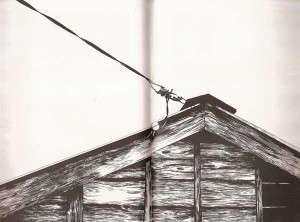
But the real story is about the representation of emotional states through a series of aesthetic techniques that cross manga conventions with the emotional violence and surreal force of German Expressionism: black lightning bolts attack from the sky while the scattered leaves of cherry blossoms drift through a rainstorm; the main character has a conversation with his umbrella, which speaks with the voice and face of Ebisu; a pointed finger poses as a gun and kills a lover, who lies in a pool of blood; there's a moth that may or may not have emerged during the act of vomiting. But the tone of the comic is also noirish and cinematic at times, and at other times touchingly intimate — pages of casual conversation as the lovers roll around their mostly empty apartment floor, or the detail of Sachiko warming herself over an electric burner while snow drifts through the night outside. Sad, surreal, beautiful, full of emotional violence and moments of dark quiet. Breaking glasses; ink splatters like blood, flies, and flowers; cigarette smoking, moths, despair; drawing comics and animation cells and coming home drunk with branches full of cherry blossoms. What's not to like?
Youth, love, and loss in late-60s Japan, gaining all its magic from cinematic intercuts, non-diegetic images, and shifts in style to capture emotional nuance. As anyone else observes, more in line with contemporary film work from the Art Theater Guild (Matsumoto, Terayama, et al) than with other manga of the era, besides perhaps the other works with which this shared the pages of Garo, the classic alt manga.
Update: Extra star added for the amazing Ryan Holmberg essay included in the paperback version. Lots of crucial context about Hayashi's career, avant garde manga and intersections with anime, film, literature, and more.
Totally worthwhile for Hayashi's style, which is both disjointed and expressive, hermetic one moment and bursting into pop lyricism the next. It's a cool evocation of '60s Japanese youth culture that recalls New Wave films by Wakamatsu and Hani. But beneath all the fabulous formalism, the teen angst romance feels stale.
„Red colored elegy” to jedna z najbardziej wpływowych mang lat 70-tych. Miała swoje odpowiedniki filmowe i musicalowe, a także inspirowała muzyczne przeboje. Zachodni odbiorca chyba nie do końca zdawał sobie z tego sprawę i w takim stricte czytelniczym (w sensie: nie recenzenckim) odbiorze raczej nadal brak tu jakiegoś powszechnego zachwytu. Głównie dlatego, że istotny jest kontekst powstania oraz intertekstualność dzieła Hayashiego, ale też ze względu na niełatwą stronę graficzną, która z pewnością nie schlebiała masowym gustom, a często miała proweniencję w sztuce filmowej i animacji.
Para kochanków mieszka razem i klepie biedę dorabiając w studiach animacji. Prosty fakt, ale dopiero po przeczytaniu ponad 60-stronicowego eseju zamieszczonego na końcu zdajesz sobie sprawę z czym się to wiązało. Mieszkanie razem na początku lat 70-tych w Japonii bez (często aranżowanego) ślubu to prawdziwy wyczyn i zerwanie z normami społecznymi, co mogło wiązać się z ostracyzmem. Zawód artysty, grafika, animatora to z kolei bardzo ciężki kawałek chleba, w którym znaczenie kobiet było bardzo marginalizowane. Dominował wyzysk młodych studentów i praca kontraktowa, nie zapewniająca minimum stabilizacji. To wszystko rodziło konsekwencje. Dochodziły dramaty rodzinne i - nie do końca tu w pełni wyjaśnione - relacje, których toksyczności tylko się domyślamy, a także dylematy twórcze będące często źródłem niemal fizycznego cierpienia.
Sama strona graficzna intryguje. Autor sięgaja po techniki filmowe, popkulturowe wzorce, motywy z Disneya i często gra metaforą. Całość raczej oszczędna i deformująca rzeczywistość, ale bardzo ekspresyjna. Dużo tu emocji, teatralnych gestów i poezji. „Red colored” nawiązuje do fascynacji Hayashiego, będącego pod wpływem ówczesnego japońskiego kina, ale również francuskiej nowej fali, z której wywodził się jeden z najsilniejszych bodźców - również istniejący na granicy poezji, dramatu i pastiszu - „Szalony Piotruś” Godarta. Cała ta egzaltacja wydaje się w efekcie zlepkiem inspiracji, cytatów i zamierzonej „umowności”, ale nic nie przeszkadza, by odczytywać ją też jako dosłowną relację dramatycznego romansu dwojga zagubionych kochanków. Ciekawe są również nawiązania do twórczości Yoshiharu Tsuge i w tym kontekście zapowiadana przez D&Q premiera „Nejishiki” tegoż autora wydaje się jeszcze bardziej emocjonująca.
To nie jest moje pierwsze czytanie tego komiksu i z pewnością nie ostatnie. To jest wyzwanie i dzieło, które momentami odbieram bardziej intuicyjnie niż racjonalnie. Wrażenie zawierania niewyczerpanych zasobów znaczeń i poczucie, że nigdy nie zbliżę się do zrozumienia „Red colored elegy” w pełni, czyni z niej lekturę pod wieloma względami fascynującą
Infrequent swaths of brilliant nothingness in the nighttime countryside frame the inconsolable and self-destructive tendencies of a pair of twentysomething illustrators with no practical sense of how adult relationships are supposed to function. And while this sounds aesthetically puerile and emotively resolute, the work of manga artist Seiichi Hayashi tends to embellish to the point of carelessness.
Immature line art and the perfunctory drunkenness of unmotivated characters make RED COLORED ELEGY less an experimental bark into the winds of narrative stricture than the craggy dumping ground of emotional listlessness and the occasional, scorching loneliness that comes with it. This is arthouse manga, if it ever existed, and it is surely only to be consumed and revered by those whose tastes can tolerate such exhaustive, wanton creativity.
Ichiro and Sachiko work as animators/illustrators. They're okay at their jobs, but it's backbreaking work, and the pleasures of a job well-done never last particularly long in a profession known for squeezing its part-timers dry. Ichiro toys with transitioning to manga work, but he's new to the craft, and it's obvious the young man doesn't have the creativity or the willpower to continue after he earns his first rejection.
The young couple fights and frets, never about money or work, really, but only about their own clinginess to one another, which one finds is equally terrifying and terrifyingly sad.
And that's about it. RED COLORED ELEGY plucks the silent tears and furtive gasps of its sentimental slackers like a pickpocket might tend to his daily wares.
Sachiko is starved for affection, and often charts her loneliness on a continuum between temptation and loneliness; the result of which begins with flirtations with other men at her job, and ends with her sobbing on the futon until her lover returns home to roll around in some sweaty fun. Ichiro, by contrast, is bored into indifference. The man's inferiority complex borderline's arrogance, which typically results in him shutting out everyone else as a consequence, including his family in a moment of crisis.
RED COLORED ELEGY is peculiar for how it articulates a stridently Japanese locus of emotive peril through increasingly detailed but aesthetically disjointed illustrative art. The elementary visual style constitutes the fair-minded wretchedness of minimalism run amok with an Ukiyo-e flourish. Conceptually, this is astounding. However, much is lost when consuming such works beyond their original context. And in Hayashi's RED COLORED ELEGY, such is the case.
Red Colored Elegy is a graphic novel about the anguish of twenty-somethings facing the modern (1970s) society. Set in Japan, the novel features a man who strives to make manga drawing his trade and his rather confused girlfriend. It could be a universal, timeless love story, made more earthly by the need to find money and the psychological drama of understanding one's self.
Overall, I was not particularly touched by this material. I did not find it graphically or dramatically appealing, or thought-provoking. IMO, there is much better manga on the topic (e.g., Inio Asano, Sahara Mizu]) and there is much better Japanese writ, even on similar topics (e.g., Haruki Murakami, Kenzaburo Oe, Kobo Abe).
The elegiac story focuses on an intense romance, interrupted by professional events and encounters with near-random people (even close families fall in this category, in this novel); there is also death and betrayal and violent words between the two. Seiichi Hayashi uses an interesting storytelling technique, with disparate graphical panels and little reference to the advancement of time. The characters could have made for more drama, but the author has decided to leave things unfinished, vague, ... elegiac.
The graphics are mostly confusing, surrealist, but not particularly novel. The graphical style of this work is not for everyone, in particular not for me.
The main character, the man, is detached and aloof, and for me does not make an interesting protagonist. He is not very talented, rather lazy, has disparate thoughts, feels sometimes suicidal, violent with the loved ones, and even in love he takes numerous detours. The girl is confused, avoids conflict, and somehow is in-love with the man.
So, it's just a story about a Japanese hipster couple in the 70s, being broke, fucking, fighting, breaking up and getting back together. Sometimes it's touching. Sometimes it makes me feel shitty about all of the awful things I've ever done in a relationship.
And then I turn the page, and I just can't do anything but bug out my eyes at how damned good Hayashi is. He moves in and out of different styles with a bewildering fluency. The bulk of the dialogs between the main characters are drawn in a weird hybrid style, cartoony, simplified profiles and vaguely articulated bodies cast against slightly more realistic backdrops. The characters only have noses when viewed from the side. Closeups are done in a more focused, sort of ligne-claire realism. And then turn the page and it's a black and white photorealist montage. And then a page will superimpose a simplified figure against a the bough of a cherry tree, carefully inked to evoke classical Japanese painting. As far as storytelling is concerned, Hayashi is one of THE masters of the form. I picked this up at the library, opened it to a random page, and knew that this was one of my favorite books without out seeing anything further.
didn't like it, even though Seiichi Hayashi is one of my favorite illustrators. but I gave it one more star for at least trying to do something different. I think it was a little outdated in its stylistic experimentation.. like it was trying to do early modernism all over again, but from the 1970s. I think that the piecemeal (parts looking silkscreened, some futurist-looking experiments) borrowing kept it from being aesthetically convincing. I wasn't moved by the story and I also didn't find it interesting. I think some people try to inject super emotional storylines into a cold modernist aesthetic to make the story seem epic, and I don't think it worked in this case.
Usually Hayashi's commercial illustrations are sort of "pretty-pretty" in a way that doesn't make you think. I'm not saying he has to draw in this style for this to have been a better comic. I think inherently the story and concept weren't unique enough to make this anything but a chore.
One tumultuous relationship gathered in a dizzying confluence of artistic, comic and and emotional modes.
What can two young artists do when they are unable to make their relationship work but don't know how to let go? They cry, they draw, they throw tantrums and a few other things. They act like children but must face the consequences as adults.
This is a coming of age story in which the coming of that age never comes, both in terms of character, form and era. We never were truly innocent and adulthood isn't something that definitively arrives to take our innocence away (just as one's art is never fully one's own).
As the pressure of internal and external forces that shape the lives of these characters builds, so does their desperation to leave the liminal spaces in which they find themselves trapped. (Sometimes the more desperately you try to untangle a chord, the more hopelessly tangled it becomes.)
Does the world really need another beautifully written graphic novel about a mildly privileged graphic novelist who is crippled by self-pity and depressive inaction to the point of alienating all those around him? WTF? It seems like every other graphic novel you find is like this - completely unsympathetic self-pitying protagonists who appear to be foils for the author himself. It's not a story I'm particularly interested in, and I wonder if it is a massive reaction to the history of comics being so rooted in the grandiosity of the superhero or if it is a reflection of the general affect of the graphic novelist. Either way, it seems to point to a genre that, despite having really flowered formally in the last twenty years, has yet to achieve its potential.
A very bitter-sweet book that is more about Tokyo circ. 1968 or the youth quake revolution seen through the eyes of a young couple and their up and downs. Very cool and the graphic style is very seductive.
ok so i didn't completely understand this graphic novel and the story it meant to tell. for me, a lot was said in what was unsaid, which made it difficult to fully grasp the implications of the sparse narrative in this very avant garde style. that being said, reading the graphic novel only, i was left feeling mostly indifferent to it yet still a little heartstruck due to the untimely ending of sachiko and ichiro. it felt like just a story of overworked, stressed out young adults (20 somethings) straddling the attempt to establish a career and still attend to family life with only having their partner (each other for the most part) as support. i thought the style of the novel was very visually interesting with the way hayashi played with dimension and plane and switched between this almost more traditional and detailed woodcut rendering and this "weirder" and ambiguous style often reserved for the figures in the panels. i won't lie the latter style didn't always rub me the right way, but i appreciate experimentation when i see it! the text contained within the graphic novel itself was sparse as i've already relayed and a lot of it carried heavy implication as well as a heavy tone.
luckily for me, and yes i do read the little extra bits if they seem interesting to me, was this essay by some guy (i forget his name, i'm sorry) at the end of the graphic novel itself in the edition i borrowed from the library. he got into hayashi's assent to prominence and influence in the world of animation and also literary publication (magazines, manga, anime, etc), who he worked with and for, as well as the life and influence red colored elegy took on after his publishing of it. additionally, and most importantly to me, he grounded its ability and hayashi's ability to become notable in the social, economic, and (kind of) political landscape it was borne out of and meant to represent. with this very valuable and indispensible (to me) context, i was better able to appreciate what hayashi was attempting to communicate and represent about young japanese adults and professionals practicing dosei (premartial domestic cohabitation for couples), breaking into a rapidly competitive and capitalist mode of production in the world of animation, and the mass movement of these young adults from countrysides to rapidly populating cities. with all of this explored by the author, i was able to think back on the graphic novel and see it for what it was and meant to do, and suddenly all those silences and implications became illuminated. also, it was cool to see how red colored elegy inspired other creatives and lives a life long after its creation, much like all art does, and which i will look further into :)
I've been wanting to get more into reading comics. I'm more of a gamer, but when I got a book called 1001 comics to read before you die, I flipped through it, and many caught my eye, the first one I searched for on Amazon was Red Colored Elegy. It stood out to me because the description, that being about a young couple starting a life together (to put it simply), seemed relevant to me, and the art seemed unique. I couldn't have predicted however, the essence of this graphic novel.
It's true, if you were to read its jacket description, that this book is one of few words, and conveys more than any number of words could describe. There's no plot, no message, it only expresses a feeling. And, for me, a feeling very relevant. If you want to enjoy a story, rather than read, watch, or play one, this is a graphic novel worth its weight in gold.
I gave this as much of a shot as I could, but man, I am not this book's audience. I read a bunch of reviews about how it's important and is informed by French New Wave & Japanese underground comics, but none of that clicks into a shape I can find any emotional resonance within. I don't actively dislike the drawing style but neither am I attracted to it, and tbh when I got to the rape I just skimmed the rest, no thank you Mr. Seiichi but good luck with your art, I guess people are into it.
Inscrutable... I think I liked it, though. Maybe I'm missing something because of a mistranslation or a lack of cultural context. Some of the artwork is wonderful: a seabird falling into the waves, a crying moon.
I probably need to read this a few more times to appreciate it. Not a book that lends itself to a casual skim-through.
Very innovative work which communicates ideas of sudden devastation, overwhelming joy, incredible joy, beautiful love, drunk love, nature postcard love, emotional violence, and spiritual melancholy with startling precision.
Oceniam te książkę na 5 gwiazdek. Czy moja opinia jest jakkolwiek obiektywna? Najprawdopodobniej nie, gdyż za bardzo lubię styl rysowania Hayashiego oraz była to moja pierwsza manga. Historia prosta, na pewno nie jest sednem całego dzieła. Ilustracje, chociaż często bardzo proste, idealnie przekazują dynamikę związku głównych bohaterów. Wątek cierpiącego artysty oraz amerykanizacja przemysłu kreskówkowego i wyzysk pracowników jak najbardziej wpisuje się w etos lewicowej tematyki, którą najzwyczajniej w świecie lubię. Planuję powrócić do tej książki i przeczytać ja kilka razy, aby móc się nią jeszcze nacieszyć i bardziej zrozumieć.
Меланхоличная (и, насколько я понимаю, важная на момент 70-х) классика, для которой приходится делать поправку на время создания. Все эти новельваговские приемы в рамках медиума достаточно эффектны, хоть и вторичны.