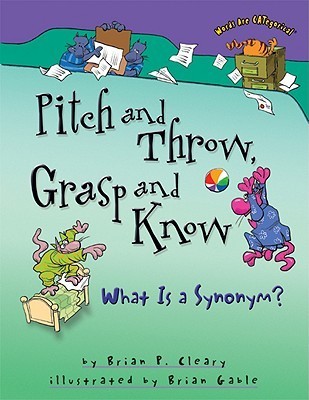
“Word-Nerd” Brian P. Cleary and highly-acclaimed illustrator Brian Gable collaborate to clarify the concept of synonyms for young readers with playful, lively, and whimsical rhymes and humorous, comical, and amusing illustrations. For easy identification, synonyms are printed in color, and key words are illustrated on each page. This funny, best-selling series shows, not tells, each part of speech.
Part of the Words Are CATegorical series. Excellent children's nonfiction picture book about synonyms. Defines the synonym and explains its functions. Provides a lot of examples in pairs and triplets.
The rhyming text makes learning fun and is surprisingly clear. The cartoon-like art style also adds to the kid appeal of the book and helps to make grammar education more interesting for children. The illustrations provide strong visual support for the concepts presented in the book.
This is an awesome book explaining what synonyms are. This books gives lots of examples and is a fun way to teach. I love that the book highlights the synonyms in the same color to show kids which words mean the same thing. The illustrations in the book are fun and silly.
This clever, rhyming story would be a great supplement to a language lesson about synonyms. The typeface, location of text, detailed illustrations, and variety of colors used may make this book feel slightly chaotic to some readers, but these elements may give other readers a feeling of excitement as they experience this book. Because excitement is not commonly associated with learning about synonyms, this could provide a positive learning experience for some student readers. The rhythm and rhyme used in this book also made it a fast-paced, quick read. If used to follow a lesson about synonyms, students could spend more time discussing the words used on each page and create a list of synonyms on their own. This book could be a valuable tool in the classroom in order to add a little fun and excitement to a grammar lesson.
Mission 2026: Binge reviewing (and rereading on occasion) all previous Reads, I was too slothful to review, back when I read them.
Here, I revisit books I had read earlier—works that had once compelled me to pause, annotate, and record my thoughts through field notes and footnotes. Much of my reading life, in fact, survives in those scattered notepad entries where memory and reflection quietly took shape. During the Board Examination period of 2026, I found myself in a rare sabbatical—a pause that allowed me to return to those notes with fresh eyes. It was then that I began crafting detailed reviews, drawing not only on the texts themselves but also on the layered impressions I had preserved at the time of reading.
Synonyms are words or expressions that share the same or nearly the same meaning, allowing speakers and writers to convey ideas with variety, precision, and nuance.
At a basic level, words like “happy,” “joyful,” and “content” may be treated as synonyms; yet each carries a slightly different shade of meaning, emotional tone, or contextual suitability. This subtle variation is what makes the study of synonyms not just a matter of vocabulary building, but an entry into the finer textures of language itself.
The concept of synonymy has deep historical roots. The term “synonym” comes from the Greek ‘syn’ (together) and ‘onyma’ (name), literally meaning “same name.”
In classical rhetoric, particularly in ancient Greece and Rome, the use of synonyms was considered an essential stylistic device. Orators and writers such as Aristotle and Quintilian recognized that varying word choice could enhance persuasion, avoid monotony, and adapt speech to different audiences. During the Renaissance, as English absorbed a vast number of words from Latin, French, and other languages, synonymy became even more prominent.
This influx created clusters of words with similar meanings but different origins—for instance, the native English “ask,” the French-derived “question,” and the Latin-derived “interrogate.” Each carries its own register and tone, enriching the expressive capacity of English.
In modern linguistics, synonyms are rarely regarded as perfectly interchangeable. Absolute synonyms—words that can replace each other in all contexts without any change in meaning—are extremely rare. Instead, most synonyms are partial or near synonyms, differing in connotation, formality, collocation, or usage. For example, “slim” and “skinny” both refer to a thin body type, but “slim” often has a positive connotation, while “skinny” may suggest something less flattering. Understanding these distinctions is crucial for effective communication.
The use of synonyms plays a vital role in both spoken and written language. In writing, they help avoid repetition, making the text more engaging and stylistically varied. In academic and professional contexts, choosing the right synonym can sharpen arguments and convey precise meanings.
In literature, synonyms contribute to tone, rhythm, and characterization, allowing writers to craft richer and more layered narratives. For language learners, mastering synonyms enhances fluency and comprehension, enabling them to interpret and produce language with greater sophistication.
Ultimately, synonyms are not merely interchangeable labels but tools of expression. They reflect the history, diversity, and adaptability of language, offering speakers a wide palette from which to choose the exact word that best captures their intended meaning.
What makes this book such a delightful and surprisingly effective, is the way it takes this dense, layered linguistic idea and turns it into something immediate, playful, and memorable. From the very first lines, the book doesn’t lecture—it performs. It begins with a simple, almost conversational question about feeling “tired,” “beat,” or “exhausted,” and in doing so, it enacts the very concept it seeks to explain.
Rather than defining synonyms in an abstract way, it immerses the reader in them. As an English instructor, I found this approach instantly engaging; instead of feeling like I was reading a lesson, You feel like you have stepped into a rhythm, a flow of language that gently guides you toward understanding.
The book’s structure is deceptively simple, moving through a series of short, rhyming lines, each introducing clusters of synonymous words. But beneath this simplicity lies a prudently constructed pedagogical strategy. Each page builds on the previous one, gradually expanding the reader’s awareness of how synonyms function. Early examples are concrete and accessible—words like “tired,” “beat,” and “exhausted”—but as the book progresses, the range of examples widens. We encounter synonyms for actions (“pitch,” “throw,” “toss”), states of being (“doze,” “sleep”), and even descriptive qualities (“nippy,” “chilly,” “freezing”).
This progression mirrors the learning process itself, moving from the familiar to the slightly more complex, reinforcing understanding through repetition and variation.
What struck me most while reading was how effectively the book balances repetition with novelty. It constantly revisits the core idea—words that are “practically, nearly the same”—but each time it does so through new examples, new rhythms, and new contexts. This keeps the reading experience lively while also ensuring that the concept is deeply internalized. The line explaining that synonyms help us be “less repetitious” is itself a clever meta-commentary; the book demonstrates this principle even as it states it.
The illustrations, though not described in detail in the text alone, play an essential role in shaping the reader’s experience. They provide visual reinforcement for the synonyms presented, grounding abstract linguistic relationships in concrete images. This combination of visual and verbal learning is particularly effective for younger readers, but even as an older reader, I found it added an extra layer of clarity and charm. The images don’t merely decorate the text—they participate in the teaching process, making the concept of synonymy feel tangible.
Another strength of the book lies in its attention to nuance. While it emphasizes similarity in meaning, it also subtly acknowledges variation. For instance, presenting words like “raid,” “storm,” and “attack” in relation to a fridge being emptied introduces the idea that synonyms can differ in intensity and tone. This is a crucial point, and the book handles it with admirable subtlety. It doesn’t overwhelm the reader with technical explanations, but it plants the seed of a more sophisticated understanding—that synonyms are not identical, but related.
I also appreciated how the book connects the concept of synonyms to the broader richness of language. It explicitly states that synonyms add “richness and depth” to sentences and phrases, and this is not just an abstract claim—it is something the reader experiences firsthand. The playful accumulation of words—“lovely,” “pretty,” “beautiful”—creates a sense of abundance, a feeling that language is full of possibilities. This is perhaps the book’s most important achievement: it doesn’t just teach a concept; it inspires a sense of wonder about language itself.
At the same time, the book is not without its limitations. Its focus on simplicity means that it inevitably glosses over some of the more complex aspects of synonymy. For example, it does not explicitly address issues of register, context, or cultural variation. Words like “car” and “auto” are presented as straightforward synonyms, but in reality, their usage can depend on regional or stylistic factors.
However, this is less a flaw than a reflection of the book’s intended audience. For young readers, the priority is clarity and engagement, and in this respect, the book succeeds admirably.
One of the most memorable aspects of the book is its rhythmic quality. The rhymes are not just decorative; they are integral to the learning process. They make the text easier to remember, turning the concept of synonyms into something almost musical.
I found myself unconsciously anticipating the next rhyme, the next pair or trio of words, and this anticipation made the reading experience more interactive. It’s a reminder that language learning can be joyful, that it doesn’t have to be confined to dry definitions and exercises.
The book also has a strong sense of closure. It circles back to its central question—what is a synonym?—and answers it not with a formal definition, but with a sense of mastery. By the end, the reader is told they are a “master,” a “whiz,” an “expert.” This is more than just encouragement; it reflects the book’s underlying philosophy. Learning is not just about acquiring knowledge; it is about gaining confidence. The book empowers its readers, giving them a sense that they have truly grasped the concept.
Personally, I found the book both charming and surprisingly profound. On the surface, it is a simple children’s book, but beneath that surface, it engages with fundamental questions about language and meaning. It made me reflect on how often we take synonyms for granted, how we use them instinctively without fully appreciating their complexity. Reading it felt like being reminded of something I already knew, but seeing it in a new light.
There is also something deeply democratic about the book’s approach to language. By presenting synonyms as choices—options that allow us to express ourselves more precisely—it emphasizes the agency of the speaker or writer. Language is not a fixed system imposed on us; it is a flexible tool that we can shape according to our needs and intentions. This idea resonates strongly in a world where communication is increasingly important, where the ability to choose the right word can make a significant difference.
If I were to critique the book more sharply, I might say that it occasionally leans too heavily on its playful tone, risking a slight loss of depth. Some readers might wish for a more explicit exploration of why certain synonyms are used in certain contexts. But again, this would be asking the book to be something it is not. Its strength lies precisely in its lightness, in its ability to introduce a complex idea without making it feel heavy.
In the end, what stays with me most is the book’s celebration of language. It presents synonyms not as a dry category to be memorized, but as a source of creativity and expression. It reminds us that words are not just tools for communication; they are instruments of imagination. The simple act of choosing between “grasp” and “know,” “pitch” and “throw,” becomes a small act of artistry.
Reading this book felt like rediscovering the joy of words. It took a concept I thought I understood and made it feel fresh again. It showed me that even the simplest aspects of language can be rich with meaning, that there is always more to explore beneath the surface. And perhaps most importantly, it made me appreciate the power of choice in language—the idea that there is always another word, another way of saying something, another nuance to uncover.
In that sense, the book achieves something remarkable. It doesn’t just teach synonyms; it embodies them. It becomes, in its own way, a synonym for learning itself—engaging, playful, and deeply rewarding.
I would unabashedly recommend it for teachers and students alike.
Part of an excellent series on English grammar for kids - I'm going to be doing lessons on synonyms in both First Language Lessons and in All About Reading, so this seemed an ideal introduction to the concept of synonyms (I had introduced the concept earlier, but we did not spend much time on it, unfortunately) . . .
Synonym..."The're words that are practically, nearly the same, like, gentle, subdued, or incredibly tame... They give us more options and make things precise, like, nippy or freezing or chilly as ice."
The books in this language/grammar series are fun reminders of all you learned in school English/literacy classes. It's good to have reminders of what words are called (nouns, verbs, etc) & their functions. This is about synonyms & there are several rhyming examples.
Synonyms! Wonderful illustrations, varied vocabulary with great rhythm and rhyme. We read this along with "Stop and Go, Yes and No: What is an Antonym?"
As with all the others in this series, I got these to share with my children as a fun and cute way to discuss language and have not been disappointed. They are cute and engaging for kids.
We really enjoy Brian P. Cleary's books. He makes learning fun, and this is a silly and humorous rhyming book about synonyms. His books really entertain children while teaching them basic concepts; our girls really like them. The illustrations by Brian Gable are cartoony and cute, too - we love the cats.
We've read several of the books in the Words are CATegorical series and we've really enjoyed them. We will certainly look for more books by this author/illustrator team at our local library.
From simple synonyms like tired, beat, and exhausted to slightly more complex words like grateful, thankful, and beholden, Brian P. Cleary's rhyming text shares some fun synonyms. I pair this with Stop And Go, Yes And No: What Is an Antonym? for a library lesson that is always a hit with students. My favorite line says: "Synonyms help us to be more exact, as in, our fridge was raided or stormed or attacked."
Synonyms could never be better described through a text than this book did. It would be very valuable to have children read after introducing to them what synonyms are. On every page, words which are synonyms of each other are highlighted in the same font color. This was a clever way the author used the font size and color for an educational purpose. Also, the illustrations in this book help describe the text hand in hand. However, some of the animals were confusing on what they were actually supposed to be.
This book was great when it came to teaching Synonyms to my class! It used a ton of creative words and showed the children how colorful writing can be! I would definitely add this to my library as a teacher! It all gave a very good definition of what a synonym is in a very child friendly way.
Really fun picture book demonstrating and talking about synonyms! Great for teaching kids about this element of language with fun, colorful illustrations. "Don't you agree that's it's pretty appealing, we have all these choices to say we're feeling?"
This book is a great way to begin a synonym lesson in fun an creative way. This book not only teaches synonym but it also contains a lot of rhyme. It's quirky illustrations make it an even more enjoyable book.