

What do you think?

Bite: An Incisive History of Teeth, from Hagfish to Humans
From three-inch fang blennies to thirty-foot prehistoric crocodiles, from gaboon vipers to Neanderthals, Bite is a fascinating journey through the natural, scientific, and cultural history of something right in front of—or in—our faces: teeth.
In Bite, zoologist Bill Schutt makes a surprising case: Teeth are responsible for the long-term success of vertebrates. The appearance of teeth, roughly half a billion years ago, was an adaptation that allowed animals with backbones, such as fish, amphibians, reptiles, birds, dinosaurs, and mammals to chow down in pretty much every conceivable environment.
But teeth are not just for food. Tusks and fangs have played crucial roles as defensive weapons—glimpsing the upper canines of snarling dogs is all it takes to know that teeth are an efficient means of aggression. Vampire bats use their razor-sharp teeth to obtain a widespread but generally untappable resource: blood. Early humans employed their teeth as tools to soften tough fibers and animal hides. Our teeth project information and social status—the ancient Etruscans were the first to wear tooth bling, and it’s doubtful that George Washington would have been elected president without the false teeth he wore.
So much of what we know about life on this planet has come from the study of fossilized teeth, which have provided information not only about evolution but also about famine, war, and disease. In his signature witty style, Schutt shows us how our continued understanding of teeth may help us humans through current and future crises, from Alzheimer’s disease to mental health issues.
In Bite, zoologist Bill Schutt makes a surprising case: Teeth are responsible for the long-term success of vertebrates. The appearance of teeth, roughly half a billion years ago, was an adaptation that allowed animals with backbones, such as fish, amphibians, reptiles, birds, dinosaurs, and mammals to chow down in pretty much every conceivable environment.
But teeth are not just for food. Tusks and fangs have played crucial roles as defensive weapons—glimpsing the upper canines of snarling dogs is all it takes to know that teeth are an efficient means of aggression. Vampire bats use their razor-sharp teeth to obtain a widespread but generally untappable resource: blood. Early humans employed their teeth as tools to soften tough fibers and animal hides. Our teeth project information and social status—the ancient Etruscans were the first to wear tooth bling, and it’s doubtful that George Washington would have been elected president without the false teeth he wore.
So much of what we know about life on this planet has come from the study of fossilized teeth, which have provided information not only about evolution but also about famine, war, and disease. In his signature witty style, Schutt shows us how our continued understanding of teeth may help us humans through current and future crises, from Alzheimer’s disease to mental health issues.
308 pages, Hardcover
Published August 13, 2024
About the author
Bill Schutt
8 books330 followersBill Schutt's latest nonfiction book "Bite: An Incisive History of Teeth, from Hagfish to Humans" received a rave review in The New York Times Books https://www.nytimes.com/2024/08/13/bo..., a starred review in Kirkus Reviews https://www.kirkusreviews.com/book-re... and raves from Publisher's Weekly (https://www.publishersweekly.com/9781...) and elsewhere. "Bite" debuted on August 13, 2024 and can be purchased or ordered anywhere books are sold.
Bill is currently working on "Desi the Vampire Bat" his first children's book, as well as a popular science book on the natural history of feet.
Bill Schutt is a long-time research associate at the American Museum of Natural History and Emeritus Professor of Biology at LIU-Post. Born in New York City and raised on Long Island, he received his B.A. in Biology at C.W. Post, his MA at SUNY Geneseo, and a Ph.D. in Zoology from Cornell University. He has published over two dozen peer-reviewed articles on topics ranging from terrestrial locomotion in vampire bats to the precarious, arboreal copulatory behavior of a marsupial mouse. Schutt has written for the New York Times and Natural History magazine and his research has also been featured in those publications, Newsday, the Economist, Discover, and others. He is a member of the North American Society for Bat Research.
"Pump: A Natural History of the Heart", published in 2021 was a critical success, with great reviews from Publisher's Weekly, The Wall Street Journal, Library Journal, Booklist, Kirk's Reviews and more.
Published in 2017, Cannibalism: A Perfectly Natural History garnered rave reviews from The New York Times, Boston Globe, Publishers Weekly (Starred Review), The New Yorker, Scientific American and many more. Cannibalism was also a 2017 Goodreads Choice Award Finalist (Science and Technology) and a Chicago Public Library "Best of the Best books of 2017".
Bill Schutt's first book, Dark Banquet: Blood and the Curious Lives of Blood-Feeding Creatures, was selected as a Best Book of 2008 by Library Journal and Amazon, and was chosen for the Barnes & Noble Discover Great New Writers program.
Schutt's co-authored WWII thriller Hell's Gate (R.J. MacCready novel #1) was published to widespread critical acclaim in 2016 (with starred reviews in Publishers Weekly and Library Journal), as was The Himalayan Codex, a year later. The Darwin Strain, the final book in the R.J. MacCready trilogy debuted in Aug. 2019.
Schutt’s TED-Ed video "Cannibalism in the Animal Kingdom" came as the 9th most viewed TED-Ed video of 2018 (and currently has over 3.3 million views). His followup, "A Brief History of Cannibalism", had 1.2 million views in the first two months and came in as the 5th most viewed TED-Ed video of 2019. Schutt's 3rd TED-Ed video, on blood transfusions, had a quarter million views in the first 10 days.
Schutt lives in New York with his wife.
For Interviews & Media, contact Katrina Tiktinsky - Publicity Assistant, Hachette Book Group, Katrina.Tiktinsky@hbgusa.com
For Speaking Engagements, contact Ashley Himes at Hachette Speakers Bureau, ashley.himes@hbgusa.com
Agent for nonfiction: Gillian MacKenzie - Gillian MacKenzie Agency - gmackenzie@gmalit.com
Agent for Fiction and Young Readers: Elizabeth Rudnick - Gillian MacKenzie Agency - erudnick@gmalit.com
Bill is currently working on "Desi the Vampire Bat" his first children's book, as well as a popular science book on the natural history of feet.
Bill Schutt is a long-time research associate at the American Museum of Natural History and Emeritus Professor of Biology at LIU-Post. Born in New York City and raised on Long Island, he received his B.A. in Biology at C.W. Post, his MA at SUNY Geneseo, and a Ph.D. in Zoology from Cornell University. He has published over two dozen peer-reviewed articles on topics ranging from terrestrial locomotion in vampire bats to the precarious, arboreal copulatory behavior of a marsupial mouse. Schutt has written for the New York Times and Natural History magazine and his research has also been featured in those publications, Newsday, the Economist, Discover, and others. He is a member of the North American Society for Bat Research.
"Pump: A Natural History of the Heart", published in 2021 was a critical success, with great reviews from Publisher's Weekly, The Wall Street Journal, Library Journal, Booklist, Kirk's Reviews and more.
Published in 2017, Cannibalism: A Perfectly Natural History garnered rave reviews from The New York Times, Boston Globe, Publishers Weekly (Starred Review), The New Yorker, Scientific American and many more. Cannibalism was also a 2017 Goodreads Choice Award Finalist (Science and Technology) and a Chicago Public Library "Best of the Best books of 2017".
Bill Schutt's first book, Dark Banquet: Blood and the Curious Lives of Blood-Feeding Creatures, was selected as a Best Book of 2008 by Library Journal and Amazon, and was chosen for the Barnes & Noble Discover Great New Writers program.
Schutt's co-authored WWII thriller Hell's Gate (R.J. MacCready novel #1) was published to widespread critical acclaim in 2016 (with starred reviews in Publishers Weekly and Library Journal), as was The Himalayan Codex, a year later. The Darwin Strain, the final book in the R.J. MacCready trilogy debuted in Aug. 2019.
Schutt’s TED-Ed video "Cannibalism in the Animal Kingdom" came as the 9th most viewed TED-Ed video of 2018 (and currently has over 3.3 million views). His followup, "A Brief History of Cannibalism", had 1.2 million views in the first two months and came in as the 5th most viewed TED-Ed video of 2019. Schutt's 3rd TED-Ed video, on blood transfusions, had a quarter million views in the first 10 days.
Schutt lives in New York with his wife.
For Interviews & Media, contact Katrina Tiktinsky - Publicity Assistant, Hachette Book Group, Katrina.Tiktinsky@hbgusa.com
For Speaking Engagements, contact Ashley Himes at Hachette Speakers Bureau, ashley.himes@hbgusa.com
Agent for nonfiction: Gillian MacKenzie - Gillian MacKenzie Agency - gmackenzie@gmalit.com
Agent for Fiction and Young Readers: Elizabeth Rudnick - Gillian MacKenzie Agency - erudnick@gmalit.com
Ratings & Reviews
Friends & Following
Create a free account to discover what your friends think of this book!
Community Reviews
Displaying 1 - 30 of 130 reviews

October 12, 2024
Entertaining as always! I'm a little confused by the decision to save a discussion about the evolution of teeth until halfway through the book, though.

June 2, 2024
I think “Bite” is the best book I’ve ever written. More importantly, so does Kirkus Reviews and The New York Times. https://www.kirkusreviews.com/book-re...
https://www.nytimes.com/2024/08/13/bo...
https://www.nytimes.com/2024/08/13/bo...

December 10, 2024
Teeth are, while visible, kinda gross. And apparently super weird.
I learned about dentures and the development of dentistry, tooth shapes and the ways in which they destroy or latch onto flesh, vestigial teeth and baby teeth, and those fish that swim up your urethra.
Recommended if the above, set against a backdrop of chuckle inducing jokes, sounds like a fun time. 3.75 stars
I learned about dentures and the development of dentistry, tooth shapes and the ways in which they destroy or latch onto flesh, vestigial teeth and baby teeth, and those fish that swim up your urethra.
Recommended if the above, set against a backdrop of chuckle inducing jokes, sounds like a fun time. 3.75 stars

October 13, 2024
In Bite, zoologist Bill Schutt writes extensively about teeth across vertebrates -- starting with extended stories about vampire bats (the organism he studied most closely), then various other animals, and then finally, around halfway through the book, moving to humans. This book is densely-written, jam-packed with factoids, and many attempts at humor. It wasn't to my personal taste -- I prefer centered deep-dives rather than broad, tangential surveys with as much information crammed in as possible -- but I think this book would hit the sweet spot (pun intended) for the right audience.
My statistics:
Book 240 for 2024
Book 1843 cumulatively
My statistics:
Book 240 for 2024
Book 1843 cumulatively

November 20, 2024
I LOVED this. something about an obscure non fiction gets me. I thought it was well written, I listened to the audiobook which was suuuper well done, and I learned a lot of weird little facts. what more do you need

August 15, 2024
Feed Your Information Appetite With Bite!
This was a fun book.
I found it really interesting and well written.
The writing, by Schutt, reminded me in a way of the writing of Mary Roach, especially how the book itself is very similarly-titled and geared towards a similar audience of Gulp: Adventures on the Alimentary Canal or Stiff: The Curious Lives of Human Cadavers.
Not 100% as hilarious as Roach's writing, but still a fun and interesting scientific read.
If this book sounds interesting to you! Give it a bite!
Check it out.
I liked it!
3.9/5
This was a fun book.
I found it really interesting and well written.
The writing, by Schutt, reminded me in a way of the writing of Mary Roach, especially how the book itself is very similarly-titled and geared towards a similar audience of Gulp: Adventures on the Alimentary Canal or Stiff: The Curious Lives of Human Cadavers.
Not 100% as hilarious as Roach's writing, but still a fun and interesting scientific read.
If this book sounds interesting to you! Give it a bite!
Check it out.
I liked it!
3.9/5

September 24, 2025
A wide-ranging, if not tightly organized, look at vertebrate teeth, told with lots of humor. Zoologist Bill Schutt first takes the reader on a tour of specialist teeth, from the sharp razors of vampire bats (his area of study), to the amount of bite force produced by crocodilians. Turns out they can grow new teeth to replace any broken ones, so they don't hold back on chomping down on hard measuring equipment, making their bite easier to research than mammals.
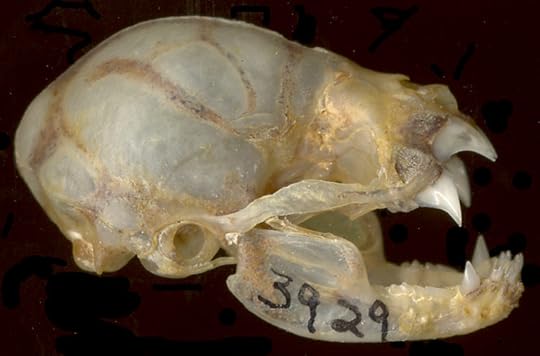
Skull of a common vampire bat (Desmodus rotundus), showing the sharp incisors used to cut the skin of its prey. Source.
Schutt then presents some basics about the general types of teeth and their features, and how paleontologists think teeth may have evolved. (I'm not sure why the book didn't start with this section.) This is followed by a look at animals that function fine without teeth, from frogs and birds, to anteaters and baleen whales. He concludes with a whirlwind tour of human teeth and dentistry, including some interesting, digressive history of George Washington's dentures. Contrary to legend, these were not wooden.
![nederlands]](https://i.gr-assets.com/images/S/compressed.photo.goodreads.com/hostedimages/1758584473i/37245757.jpg)
Mouth of a sea lamprey (Petromyzon marinus), showing the hooks of keratin they use to attach to prey, and the keratin denticles on the tongue used to feed. Lampreys have no jaws or bony teeth. Source.
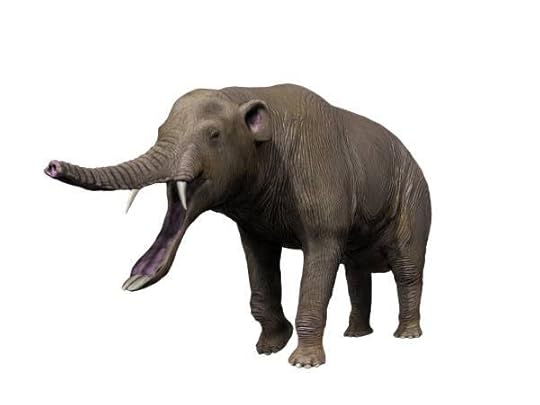
Illustration of Platybelodon, an extinct distant relative of the elephant. How scientists think the tusks and long lower jaw with shovel-like incisors were used for feeding has changed over time with new research and techniques. It's a great example of the scientific process, as Schutt says. Source.
In between, you'll learn why horses are long in the tooth; how the fangs of poisonous snakes work; how tusks differ between elephants, pigs and the narwhal; the huge number and range of teeth and orodonts among fish; and the disturbing eating habits of both hagfish and the northern short-tailed shrew. The illustrations throughout by Patricia Wynne are detailed, and complement the text well. It's a fun, and sometimes disgusting, look at the oddities of nature, much like his book Cannibalism: A Perfectly Natural History.
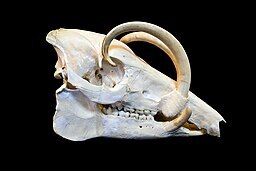
Skull of a male North Sulawesi babirusa (Babyrousa celebensis), a member of the swine family from Indonesia. In rare instances, these tusks can grow into the animal's skull, killing them. Source.

Skull of a common vampire bat (Desmodus rotundus), showing the sharp incisors used to cut the skin of its prey. Source.
Schutt then presents some basics about the general types of teeth and their features, and how paleontologists think teeth may have evolved. (I'm not sure why the book didn't start with this section.) This is followed by a look at animals that function fine without teeth, from frogs and birds, to anteaters and baleen whales. He concludes with a whirlwind tour of human teeth and dentistry, including some interesting, digressive history of George Washington's dentures. Contrary to legend, these were not wooden.
![nederlands]](https://commons.wikimedia.org/wiki/File:Petromyzon_marinus.004_-_Aquarium_Finisterrae.jpg)
Mouth of a sea lamprey (Petromyzon marinus), showing the hooks of keratin they use to attach to prey, and the keratin denticles on the tongue used to feed. Lampreys have no jaws or bony teeth. Source.

Illustration of Platybelodon, an extinct distant relative of the elephant. How scientists think the tusks and long lower jaw with shovel-like incisors were used for feeding has changed over time with new research and techniques. It's a great example of the scientific process, as Schutt says. Source.
In between, you'll learn why horses are long in the tooth; how the fangs of poisonous snakes work; how tusks differ between elephants, pigs and the narwhal; the huge number and range of teeth and orodonts among fish; and the disturbing eating habits of both hagfish and the northern short-tailed shrew. The illustrations throughout by Patricia Wynne are detailed, and complement the text well. It's a fun, and sometimes disgusting, look at the oddities of nature, much like his book Cannibalism: A Perfectly Natural History.

Skull of a male North Sulawesi babirusa (Babyrousa celebensis), a member of the swine family from Indonesia. In rare instances, these tusks can grow into the animal's skull, killing them. Source.

September 27, 2025
Interesting but I found myself zoning out at times. I liked learning about vampire bats a lot. Understandably it took awhile to get to history of human teeth, but I perked up once it did. My canine/feline dental knowledge came into play. Overall a niche read, which I tend to seek out.

July 30, 2024
This book about teeth will put a smile on your face! If all science professors peppered their lectures and reading with such humor, there would be a lot more scientists in the world. In Bite we take a trip back in time, learn about dental forensics, how baby bats' teeth are used more like hands to grasp onto a parent before they can fly on their own, and many other fascinating and often humorous scientific tidbits related to teeth - in bats, fish, birds, and mammals. And why it's critical to visit the dentist regularly.
Bite is as fascinating as Salt or Cod, both by the excellent Mark Kurlansky, with more dad jokes. Seriously, a lot of puns, jokes, and humorous asides liven up the material and make it quite an enjoyable and interesting non-fiction book.
My thanks to the author, publisher, audiobook producer, and #NetGalley for early access to the audiobook in exchange for a review. Bite will be published on August 13, 2024.
Bite is as fascinating as Salt or Cod, both by the excellent Mark Kurlansky, with more dad jokes. Seriously, a lot of puns, jokes, and humorous asides liven up the material and make it quite an enjoyable and interesting non-fiction book.
My thanks to the author, publisher, audiobook producer, and #NetGalley for early access to the audiobook in exchange for a review. Bite will be published on August 13, 2024.

January 21, 2026
First book club book! You know I only read this with external pressure because I hate, hate, hate thinking about teeth

August 18, 2024
Schutt's writing strikes once again the perfect balance between entertaining and informative. A delightful book by a delightful man.
April 9, 2025
loved 2/3 of this - the chapter on george w. was too long IMHO i got lost in the sauce
August 7, 2024
Thanks to NetGalley and Algonquin Books for the ARC.
Not only did I learn about teeth, but I also learned about the specifics of evolutionary biology by way of a specific feature of vertebrates. Bill Schutt covered all his bases, from the beginning of life to present-day animals, the variations of teeth and how they got them, and what that means for us. Personally, I feel like we shouldn't have to find a use for this information in order to appreciate it; nature doesn't exist solely for us to use it to our advantage, it just exists as it is. But Schutt says it a few times in the book: the people with the money to fund their research want a use for it. There are a few points where he and his fellow scientists lament this fact, and I kinda wish we got some information as to what we, as readers interested in this stuff, can do to help? Or is getting into science education and sharing this knowledge enough?
Not only did I learn about teeth, but I also learned about the specifics of evolutionary biology by way of a specific feature of vertebrates. Bill Schutt covered all his bases, from the beginning of life to present-day animals, the variations of teeth and how they got them, and what that means for us. Personally, I feel like we shouldn't have to find a use for this information in order to appreciate it; nature doesn't exist solely for us to use it to our advantage, it just exists as it is. But Schutt says it a few times in the book: the people with the money to fund their research want a use for it. There are a few points where he and his fellow scientists lament this fact, and I kinda wish we got some information as to what we, as readers interested in this stuff, can do to help? Or is getting into science education and sharing this knowledge enough?

March 27, 2025
As delightful as a book about teeth and bites and mouths can be! Reading this is like having a really excellent biology teacher, maybe not something that will bring you to tears (of sadness or joy) but will make you think and sometimes laugh and always learn. An excellent example of how great science can be.

November 16, 2025
Another great popular science/history book by Bill Schutt, again with wonderful black and white illustrations by Patricia J. Wynne. Like his other books, it is accessible, informative, witty, and interesting. This particular book is on teeth (and biting) in the animal kingdom and among humans, covering many things you might wonder about your own teeth such as tooth decay The first thirteen chapters are on teeth in animals as well as basics on teeth that often apply to humans and animals, with the last five chapters are on human teeth and related topics such as myths about tooth decay and the history of dentures and dentistry.
The first two chapters cover topics Schutt dealt with in his excellent _Dark Banquet: Blood and the Curious Lives of Blood-feeding Organisms_ (vampire bats in chapter one and the candiru in chapter two). Chapter three was a fascinating chapter on horse teeth and their evolution, introducing the reader to such concepts as brachydont dentition (low-crowned teeth, such as might be found in animals feeding on soft plants), hypsodont dentition (high-crowned teeth, better adapted for the wear-and-tear of abrasive silica-rich grass), and occlusal surface (the “bumps, points, and ridges on the surfaces of teeth that come into contact with those of the opposing jaw when the jaws occlude” or close). Chapter four was another great chapter, this one mainly on tusks; the first tusks in the fossil record (in dicynodonts), narwhal tusks (elongate left upper canine teeth), elephant tusks (modified upper incisors), homodont dentition versus heterodont dentition (teeth being the same shape and size versus containing up to four different types of teeth in a mouth), and how manatees and elephants go through molar replacement (up to six times in elephants) through a process called hind molar progression. Chapter five was on teeth in venomous snakes, discussing the differences between opisthoglyphous snakes (rear-fanged snakes like boomslangs, with two pairs of grooved, venomous fangs near the back of the mouth), proteroglyph snakes (smallish fangs at the front of a pair of upper jawbones, in family Elapidae, includes cobras, mambas, coral snakes, and sea snakes), and solenoglyphous snakes (the vipers, with much larger fangs; includes rattlesnakes, copperheads, and water moccasins). Chapter six looked at teeth in fish, such as the coral munching teeth of parrotfish, the more delicate teeth of surgeonfish, the dangers to Atlantic coral reef fish (and the reefs they interact with) due to invasive lionfish, the venomous spines of stonefish, and two genera of fish that have venomous bites, the “strange little deep-sea eel, Monognathus” and the “pint-sized reef denizen” commonly known as the fang blenny. Chapter seven was on shrews. Chapter eight covered teeth in alligators, crocodiles, gharials, and caimans and had interesting things to say about bite force in crocodilians as well as mammals (and the related concept of diphyodont dentition – having two sets of teeth over an animal’s lifetime – and polyphyodont dentition, which means a continuous supply of teeth).
Chapter nine looked at the overall origin of jaws and teeth in the fossil record particularly among early fish, the still living jawless fish the lamprey and hagfish (and what they have to use as “teeth”), the famous placoderm fish of the Paleozoic, the origins and structure of shark teeth, and revisits the concept of polyphyodonty or continual tooth replacement. Chapter ten “A Painless Guide to Tooth Basics” did indeed cover basics like the three basic ways teeth are attached to the upper and lower jawbones (acrodont dentition, pleurodont dentition, and thecodont dentition), revisited concepts like homodonty (when all the teeth have the same general shape) and heterodonty (incisors, canines, premolars, molars). Also concepts like the pharyngeal jaw. Chapter eleven looked at edentulism, basically when vertebrates whose ancestors had teeth, lost them. Much of the chapter is on frogs though fish such as seahorses get a little coverage. Chapter twelve continues the theme looking at tooth loss in turtles as well as well as gastroliths in sauropod fossils (to act as “teeth” of a sort to process plant material) and a little bit on the loss of teeth in early birds. Chapter thirteen looked at loss of teeth and the development of amazing tongues three different times in an anteater/termite eater niche (myrmecophages) in anteaters, pangolins, and echidnas and the evolution of toothless baleen whales.
Chapter fourteen and on are on humans. This chapter spends a lot of time on the story of George Washington’s dentures as well as dentures in general. Also looked at forensic odontology, the history of tooth pulling, barber-surgeons, the history of dentistry, French surgeon Pierre Fauchard (1678-1761, the Father of Modern Dentistry), the trade in teeth sold by living people to make money (including a trade in teeth from enslaved people), the history of dental implants, and how human teeth grow. Chapter fifteen covered Etruscan dental appliances (purely ornamental, the very first in world history), other ornamental dental appliances such as among the Maya, more on tooth pulling (such as the pelican, “the go-to instruments for tooth pullers”), how tooth infections can be fatal, the history of dental fillings (and controversies over amalgam fillings), and the story and science of fluoride as it relates to dental health. Chapter sixteen was all on tooth decay, covering the independent invention across multiple cultures of the idea tooth worms caused the decay, as well as a lot on the science of tooth decay including the bacteria involved and the different ecological niches in a person’s mouth. Chapter seventeen looked at wisdom teeth, the development of teeth in embryos, and deciduous precursors (baby teeth or milk teeth). Chapter eighteen was cutting edge things relating to teeth such as computer assisted techniques to produce crowns, research into links between the subgingival bacterium Porphyromonas gingivalis and Alzheimer’s disease, the use of fossil teeth to study Denisovans and Neanderthals, study of teeth to unravel the mystery of conodont fossils (ancient distant relatives of hagfish that were diverse and lived from the Late Cambrian period until the end of the Triassic), and how study of tooth regeneration in alligators might one day apply to humans. The epilogue was fun, with a great discussion of Platybelodon, an extinct elephant relative called a gomphothere that had a spectacular set of mandibular tusks that earned it the nickname shovel-tusker.
Has extensive notes and an index. I recommend _Bitten: True Medical Stories of Bites and Stings_ by Pamela Nagami for more on animal bites. Much of it is on insects, venom, and infectious disease, but bites from toothed vertebrates are definitely covered. Also _Skeleton Keys: The Secret Life of Bone_by Brian Switek has some good coverage of the origin and evolution of bone and of jaws that would nicely add to what _Bite_ has to say on the subject.
The first two chapters cover topics Schutt dealt with in his excellent _Dark Banquet: Blood and the Curious Lives of Blood-feeding Organisms_ (vampire bats in chapter one and the candiru in chapter two). Chapter three was a fascinating chapter on horse teeth and their evolution, introducing the reader to such concepts as brachydont dentition (low-crowned teeth, such as might be found in animals feeding on soft plants), hypsodont dentition (high-crowned teeth, better adapted for the wear-and-tear of abrasive silica-rich grass), and occlusal surface (the “bumps, points, and ridges on the surfaces of teeth that come into contact with those of the opposing jaw when the jaws occlude” or close). Chapter four was another great chapter, this one mainly on tusks; the first tusks in the fossil record (in dicynodonts), narwhal tusks (elongate left upper canine teeth), elephant tusks (modified upper incisors), homodont dentition versus heterodont dentition (teeth being the same shape and size versus containing up to four different types of teeth in a mouth), and how manatees and elephants go through molar replacement (up to six times in elephants) through a process called hind molar progression. Chapter five was on teeth in venomous snakes, discussing the differences between opisthoglyphous snakes (rear-fanged snakes like boomslangs, with two pairs of grooved, venomous fangs near the back of the mouth), proteroglyph snakes (smallish fangs at the front of a pair of upper jawbones, in family Elapidae, includes cobras, mambas, coral snakes, and sea snakes), and solenoglyphous snakes (the vipers, with much larger fangs; includes rattlesnakes, copperheads, and water moccasins). Chapter six looked at teeth in fish, such as the coral munching teeth of parrotfish, the more delicate teeth of surgeonfish, the dangers to Atlantic coral reef fish (and the reefs they interact with) due to invasive lionfish, the venomous spines of stonefish, and two genera of fish that have venomous bites, the “strange little deep-sea eel, Monognathus” and the “pint-sized reef denizen” commonly known as the fang blenny. Chapter seven was on shrews. Chapter eight covered teeth in alligators, crocodiles, gharials, and caimans and had interesting things to say about bite force in crocodilians as well as mammals (and the related concept of diphyodont dentition – having two sets of teeth over an animal’s lifetime – and polyphyodont dentition, which means a continuous supply of teeth).
Chapter nine looked at the overall origin of jaws and teeth in the fossil record particularly among early fish, the still living jawless fish the lamprey and hagfish (and what they have to use as “teeth”), the famous placoderm fish of the Paleozoic, the origins and structure of shark teeth, and revisits the concept of polyphyodonty or continual tooth replacement. Chapter ten “A Painless Guide to Tooth Basics” did indeed cover basics like the three basic ways teeth are attached to the upper and lower jawbones (acrodont dentition, pleurodont dentition, and thecodont dentition), revisited concepts like homodonty (when all the teeth have the same general shape) and heterodonty (incisors, canines, premolars, molars). Also concepts like the pharyngeal jaw. Chapter eleven looked at edentulism, basically when vertebrates whose ancestors had teeth, lost them. Much of the chapter is on frogs though fish such as seahorses get a little coverage. Chapter twelve continues the theme looking at tooth loss in turtles as well as well as gastroliths in sauropod fossils (to act as “teeth” of a sort to process plant material) and a little bit on the loss of teeth in early birds. Chapter thirteen looked at loss of teeth and the development of amazing tongues three different times in an anteater/termite eater niche (myrmecophages) in anteaters, pangolins, and echidnas and the evolution of toothless baleen whales.
Chapter fourteen and on are on humans. This chapter spends a lot of time on the story of George Washington’s dentures as well as dentures in general. Also looked at forensic odontology, the history of tooth pulling, barber-surgeons, the history of dentistry, French surgeon Pierre Fauchard (1678-1761, the Father of Modern Dentistry), the trade in teeth sold by living people to make money (including a trade in teeth from enslaved people), the history of dental implants, and how human teeth grow. Chapter fifteen covered Etruscan dental appliances (purely ornamental, the very first in world history), other ornamental dental appliances such as among the Maya, more on tooth pulling (such as the pelican, “the go-to instruments for tooth pullers”), how tooth infections can be fatal, the history of dental fillings (and controversies over amalgam fillings), and the story and science of fluoride as it relates to dental health. Chapter sixteen was all on tooth decay, covering the independent invention across multiple cultures of the idea tooth worms caused the decay, as well as a lot on the science of tooth decay including the bacteria involved and the different ecological niches in a person’s mouth. Chapter seventeen looked at wisdom teeth, the development of teeth in embryos, and deciduous precursors (baby teeth or milk teeth). Chapter eighteen was cutting edge things relating to teeth such as computer assisted techniques to produce crowns, research into links between the subgingival bacterium Porphyromonas gingivalis and Alzheimer’s disease, the use of fossil teeth to study Denisovans and Neanderthals, study of teeth to unravel the mystery of conodont fossils (ancient distant relatives of hagfish that were diverse and lived from the Late Cambrian period until the end of the Triassic), and how study of tooth regeneration in alligators might one day apply to humans. The epilogue was fun, with a great discussion of Platybelodon, an extinct elephant relative called a gomphothere that had a spectacular set of mandibular tusks that earned it the nickname shovel-tusker.
Has extensive notes and an index. I recommend _Bitten: True Medical Stories of Bites and Stings_ by Pamela Nagami for more on animal bites. Much of it is on insects, venom, and infectious disease, but bites from toothed vertebrates are definitely covered. Also _Skeleton Keys: The Secret Life of Bone_by Brian Switek has some good coverage of the origin and evolution of bone and of jaws that would nicely add to what _Bite_ has to say on the subject.

October 8, 2024
This is a fun and informative book that focuses on teeth in the animal world.
How teeth work, what they are made of, why some animals have the types of teeth they do, the current up to date theories on tooth evolution in some animals etc etc. It's all here.
It's delivered in a smooth somewhat informal cadence that comes equipped with jokes and side notes. That keep it from ever feeling too dry or clinical. Gives you that vibe that you are following along with a professor who likes to keep things fun.
but...
The author meanders. He is a bat expert so he starts on bats. Comes back to bats later. Doesn't really stay focused on teeth. Taking the time to discuss the tenants of evolutionary mechanisms. The colors of butterflies and more oddities. Parables about horses...
It never quite feels all inclusive. There isn't much discussion of insect chewing mechanisms, but a lengthy bit about animals that don't have teeth.
A whole chapter on frogs who lose their teeth.
A chapter about George Washington and his dentures.
It's fun. Just kinda feels like the author gets off track a bit and tells you what he is excited to share, rather than taking the time to compose a structured approach to delivering the material.
How teeth work, what they are made of, why some animals have the types of teeth they do, the current up to date theories on tooth evolution in some animals etc etc. It's all here.
It's delivered in a smooth somewhat informal cadence that comes equipped with jokes and side notes. That keep it from ever feeling too dry or clinical. Gives you that vibe that you are following along with a professor who likes to keep things fun.
but...
The author meanders. He is a bat expert so he starts on bats. Comes back to bats later. Doesn't really stay focused on teeth. Taking the time to discuss the tenants of evolutionary mechanisms. The colors of butterflies and more oddities. Parables about horses...
It never quite feels all inclusive. There isn't much discussion of insect chewing mechanisms, but a lengthy bit about animals that don't have teeth.
A whole chapter on frogs who lose their teeth.
A chapter about George Washington and his dentures.
It's fun. Just kinda feels like the author gets off track a bit and tells you what he is excited to share, rather than taking the time to compose a structured approach to delivering the material.

May 21, 2025
this is a fun nonfiction book that jumps around to different topics involving the history of teeth! i found a lot of this really interesting because even though i know a decent bit about human tooth adaptations and biology from courses on forensic anthropology, i still learned a lot of fun facts about humans and other species. this is one nonfiction that i actually wish i read instead of listened to because at the end of the audiobook there was mention of illustrations, which i would have absolutely loved to see. one thing that irked me though was that the author uses the word gender when he means sex, which is such a basic scientific blunder that it just seemed odd. i also wish that there was less repetition of certain topics–though this did string together the book’s various topics, it felt like it was unnecessary!

August 23, 2024
Disclaimer: Please note that I received and Audio ARC from NetGalley and Hachette Audio in exchange for an honest and unbiased review.
⭐⭐⭐⭐☆
“Bite” is a fascinating exploration of the evolutionary significance of teeth, making a compelling case for their crucial role in the survival and success of vertebrates. The book is well-written and engaging, blending scientific insight with Schutt’s signature wit, making it an unexpectedly captivating read. Schutt delves into the diverse functions of teeth beyond just eating, covering their roles in defense, aggression, and even social status, all while weaving in intriguing historical and cultural anecdotes. Schutt’s thorough exploration of evolutionary biology made this an enlightening and enjoyable read. This book is a must for anyone interested in natural history, though some sections might feel a bit dense for casual readers, which is why it’s a solid four-star read.
Get it at…
📗 - Hard Copy -📗
Your Local Canadian Book Seller
Indigo
Amazon Canada
📱 - Digital - 📱
Kobo
Kindle
🎧 - Audio - 🎧
Audible
Libro.FM
⭐⭐⭐⭐☆
“Bite” is a fascinating exploration of the evolutionary significance of teeth, making a compelling case for their crucial role in the survival and success of vertebrates. The book is well-written and engaging, blending scientific insight with Schutt’s signature wit, making it an unexpectedly captivating read. Schutt delves into the diverse functions of teeth beyond just eating, covering their roles in defense, aggression, and even social status, all while weaving in intriguing historical and cultural anecdotes. Schutt’s thorough exploration of evolutionary biology made this an enlightening and enjoyable read. This book is a must for anyone interested in natural history, though some sections might feel a bit dense for casual readers, which is why it’s a solid four-star read.
Get it at…
📗 - Hard Copy -📗
Your Local Canadian Book Seller
Indigo
Amazon Canada
📱 - Digital - 📱
Kobo
Kindle
🎧 - Audio - 🎧
Audible
Libro.FM

December 14, 2025
A great comprehensive look at the evolutionary and then anthropologic history of teeth. The author writes with a combi ation of authority and humour that keeps me waiting for more. At first the deadpanned delivery of the narrator made me worry that it would bore me, but it worked really well.
The only thing that lost me was I did feel the book lost momentum once we got to the human anthropology of teeth (a whole chapter on US founding fathers was not my favourite). I really only read this book for the analysis of different animal teeth so I was not expecting an exploration of dentistry, but that was still pretty interesting.
Overall I would highly recommend this book to anyone who is interested in evolutionary biology .
The only thing that lost me was I did feel the book lost momentum once we got to the human anthropology of teeth (a whole chapter on US founding fathers was not my favourite). I really only read this book for the analysis of different animal teeth so I was not expecting an exploration of dentistry, but that was still pretty interesting.
Overall I would highly recommend this book to anyone who is interested in evolutionary biology .

August 6, 2024
4.25 - An incredibly interesting look into the history of one of evolution's biggest wins - teeth. There's still a lot we don't know about teeth, but what we do know makes for quite a compelling read. From their initial appearance hundred of millions of years ago, all the way through to today, teeth have, and continue to, play a huge role in the success of vertebrates. Whether discussing dinosaurs or fish, bats or humans, teeth, as both weapons and tools, are critical when it comes to survival, and their fossilized remains have helped us learn so much about the inhabitants of the world we live in. Well written and wonderfully read, this book is humorous, educational, and thoroughly enjoyable!
Thank you to Hachette Audio, Algonquin Books, and NetGalley for the ARC in exchange for an honest review. Opinions expressed in this review are my own.
Thank you to Hachette Audio, Algonquin Books, and NetGalley for the ARC in exchange for an honest review. Opinions expressed in this review are my own.

December 27, 2025
So many interesting facts from this book! I listened to this as an audiobook, and the narrator is okay. some chapters were more exciting than others, and especially the human chapters were not as interesting to me personally... It was as such more of a slog to get through the second half but nonetheless, I'm glad I did finish this book. I have so many fun teeth facts, and no one to share them with...

August 26, 2024
Thank you, NetGalley for an advanced ALC of this book as an audiobook from Publisher @HachetteAudio
I do love Non-Fiction books where I can learn & this fascinated me to learn about animals and the importance of Teeth... I learnt about animals that I didn't even know had teeth etc. Each chapter concentrated on certain creatures.
The narration of this book was very well done with a Voice that was pleasant to listen to, making each moment go by fast and be very engaging
I do love Non-Fiction books where I can learn & this fascinated me to learn about animals and the importance of Teeth... I learnt about animals that I didn't even know had teeth etc. Each chapter concentrated on certain creatures.
The narration of this book was very well done with a Voice that was pleasant to listen to, making each moment go by fast and be very engaging
This entire review has been hidden because of spoilers.

May 22, 2026
A very interesting look at the history of teeth across different species! The dense content meant that I had to break the read up into chunks, but I especially loved the chapters on candirus and wisdom teeth.

October 11, 2024
A pretty thorough, although dry and dull at times, book about teeth.

June 24, 2025
very interesting and only dull sometimes. i think if i weren’t squeamish then dentistry would be a cool profession.
March 19, 2026
Informative and funny!

November 7, 2024
inch resting

January 17, 2026
This was a phenomenal book from start to finish. Would highly recommend for those who love a good fun-fact as well as really nitty-gritty science. I think this would make a fantastic addition to an Evolutionary Bio class curriculum and would give classes a lot of things to discuss in relation to their studies. All my science girlies need to read (or listen) to this one for sure!

February 26, 2025
“Bite” is one of the most enjoyable books i’ve ever encountered. It’s witty and informative, and explains specifics and jargon to the reader in a way that doesn’t feel like the subject matter is being overly dumbed-down. Charles Constant was a perfect narrator for the audiobook and captured the humor and love for life and all things living that was made so evident in this book. I’m looking forward to reading a few other works by this author.
August 25, 2025
As a dental professional, I found this book very interesting and well researched. Nothing new to me on the chapters about human dentition, but I learned quite a bit about other species.
Displaying 1 - 30 of 130 reviews