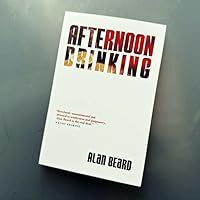
High up in the Conrad Flats that loom bleakly over Acton, two future stars of the literary scene – or so they assume – are hard at work, tapping out words of wit and brilliance between ill-paid jobs writing captions for the Cat Calendar 1985 and blurbs for trashy novels with titles like Brothel of the Vampire.
Just twenty-one but already well entrenched in a life eked out on dole payments, pints and dollops of porridge and pasta, Llewellyn and Cunningham don’t have it too bad: a pub on the corner, a misdirected parental allowance, and the delightful company of Aoife, Llewellyn’s model fiancée, mother of his young baby – and the woman of Cunningham’s increasingly vivid dreams.
Note: There is more than one Alan Warner, this is the page for the award-winning Scottish novelist. For books by other people bearing the same name see Alan Warner
Alan Warner (born 1964) is the author of six novels: the acclaimed Morvern Callar (1995), winner of a Somerset Maugham Award; These Demented Lands (1997), winner of the Encore Award; The Sopranos (1998), winner of the Saltire Society Scottish Book of the Year Award; The Man Who Walks (2002), an imaginative and surreal black comedy; The Worms Can Carry Me to Heaven (2006), and The Stars in the Bright Sky (2010), a sequel to The Sopranos. Morvern Callar has been adapted as a film, and The Sopranos is to follow shortly. His short story 'After the Vision' was included in the anthology Children of Albion Rovers (1997) and 'Bitter Salvage' was included in Disco Biscuits (1997). In 2003 he was nominated by Granta magazine as one of twenty 'Best of Young British Novelists'. In 2010, his novel The Stars in the Bright Sky was included in the longlist for the Man Booker Prize.
Alan Warner's novels are mostly set in "The Port", a place bearing some resemblance to Oban. He is known to appreciate 1970s Krautrock band Can; two of his books feature dedications to former band members (Morvern Callar to Holger Czukay and The Man Who Walks to Michael Karoli). Alan Warner currently splits his time between Dublin and Javea, Spain.
My favorite Alan Warner book is the heartbreaking Morvern Callar, actually probably one of my all time favorite books. Their lips talk mischief, is a very different book, a celebration of being young, drunk, and confused. Throw in liberal dashes of humor and you get close to Withnail and I. Getting close is good enough for me.
1st thirty pp of this is all but perfect. on p 31 a love triangle comes into play that by the end of the book has sucked all the air outta the room... withnail-ness drops in inverse proportion & i'm devastated to report that the narrator and llewellyn's work on the cat calendar occupies no more than a paragraph. (cunningham's unfounded belief in his own moral superiority got my goat somewhat also.) sopranos/stars in the bright sky/morvern callar are all higher prio for the warner-curious imo
well this barged its way up the waiting list. Was available at the library and couldn't resist having a peek, now I'm hooked. Looks like another great Warner book.. ..enjoying a lot, as someone has said a kind of 80s literary 'Withnail and I', and I like the characters, early 20s would be writers/shysters, but no, I definitely don't like this: 'Short Stories?' He shrugged. 'You can shoot off names: Delmore Schartz,. He's overrated.. Welshy Rhys Davies's Canute... so forget the bloody short story. It's like a pack of ten fags instead of 20, or a half pint. No point in them.' you want to jump in and say what about Poe, Stevenson, Mansfield, Pritchett etc. For God's sake Carver had his second collection (What we Talk About...) out two or three years before the time of this novel. I remember reading it then.
..excellent, but not quite as good as Deadman's Pedal, or The Stars in the Bright Sky or, of course, his best and first Morvern Callar.
Silence, exile and Cunningham: the name immediately given to the narrator by Llewellyn when they meet in A&E. The book like a dream, literary types in their twenties; Llewellyn has had his front ripped open and sewn back together and is the father of baby Lily, living with the mother, a model, Aoife, in a high rise flat in North London. Cunningham moves in, falls in love with Aoife. But it's not just a menage a trois, for Aoife's friend Abby is also a model, and closely 'intertwined' with them. They make an unlikely foursome living through a grimy, plummeting early-to-mid 80s. The miners' strike runs down and is crushed at the start, and the book ends around the time of the Brighton bomb just failing to kill Margaret Thatcher. Not long then. A drink and drug dream and fug they live in, money - what little there is - spent on booze rather than food, smoky pubs, spirits and Guinness, cannabis, and one memorable, hilarious acid trip, where Llewellyn has a religious conversion under a neon Lucozade sign. They're on their way to Harmondsworth when this happens, to find out why Penguin located there, and why their (non existent) masterpieces are not on the Penguin Classics list. So within a splintering country, suffering severe violence to its social fabric, these four live in a glowing, (hetero)sexual - although there are some hints at other with the two women being close, and the narrator admiring Loo’s scarred torso - ménage, the two men discussing books. Both awed by Aoife's beauty which shines and burns through the pages.
There is indulgence here, a whole scene in which a drunk lonely millionaire shows Aoife and Cunningham his home, and the ugliness of commerce, of money, bodies bought (Aoife is offered £30 to show her boobs) is supposed to contrast with the innocence of their flat-life, but Aoife also earns money from her body too, modelling, so there's ambiguity here.
Anyway despite a few puzzles, and for the marvellous indulgences and set pieces (the registry office marriage, followed by the restaurant meal where they all do a runner in their wedding finery); for all its gorgeousness, I love it.
I've never given up on a book until now. This was difficult to read and came across as so pretentious. I only managed 40 pages. It had a few times where characters were quoting literature and I feel that unless you've read all the referenced works these are lost on you. I've also been in conversations where people have conversations by bouncing films quotes of each other and it is a really annoying conversation to listen to. This book just mirrored this for me.
This book’s first page after the epigraph (which is from Proverbs 24:2 and also gives the novel its title) simply gives us the date. 1984. While the Thatcher government and the miners’ strike are an intermittent background concern they never impinge directly on proceedings. Narrator Douglas Cunningham, a Scot, has been thrown out of his rented flat in London, plus his course in English Lit at University College, and is surfing hospital A&E departments as places to spend the night. In one of them he meets Welshman Llewellyn Smith (Lou) whose stitches following a heart operation have burst. Learning of Douglas’s predicament Lou invites him to stay at his flat in Acton where he lives with his girlfriend Aoife McCrissican and their very young daughter, Lily. Lou is also well versed in literature and wants to be a novelist. On entering the flat Lou quotes “‘that Cyril Connolly bastard. The enemy of promise is the pram in the hallway,’” then adds, “‘Is it now? Our hallway is too narrow to fit the bloody pram in.’” His generous offer seems to be taken in her stride by Aoife, who accepts Douglas readily into their lives (helped initially by the bribe of an Indian carry-out.) However, even as he settles down to live with them for a while we suspect where this will all be going when Douglas tells us she is menacingly beautiful.
Theirs is a curious tripartite relationship. Lou, like Douglas, is fond of drink and the odd bit of financial finagling as the trio’s existence is one long round of trying to find money to live on and secure enough alcohol to get by. All take turns at looking after Lily. (She seems uncannily placid for a pre-toddler, though.) Slight monetary relief is secured when a publisher engages both men to write one-line puffs for schlocky horror novels. Aoife is a former model and hankers to get back to that, an aspiration on which Lou is less keen. Aoife’s best friend, Abingdon Barbour, also a model, acts as occasional foil to the others. At Lou and Aoife’s Register Office wedding Douglas and Abby are best man and bridesmaid.
Lou is a (somewhat lapsed) Catholic and refers to Douglas as an atheist because of his assumed Presbyterianism. Douglas’s narrative comment that, “Summer was agony for the idle Scot. It was September, and I had a natural right to some driving sleet, or at least a blessed frost,” takes homesickness a little too far though. Lou also sometimes ends a sentence addressed to Douglas with the word boyo. I have never personally heard a Welsh person say this. Is it a reflection of Warner’s experience with Welsh people or merely a lazy attempt at characterisation? If the latter it is misguided. Lou’s behaviour and speech are comprehensible enough and need no prop to give them verisimilitude. All the main characters - and the minor ones too - live and breathe as people with their own motivations and habits.
Lou is the most pass-remarkable of them. He describes a bunch of squaddies who tried to chat Aoife up while they were on their way to her parents’ house for Christmas as, “‘king’s shilling fascists, restless since the Falklands, I should guess. Itching to poke their Armalites into another country’s business. The English are never happy unless they are.’” Of his father-in-law he says, “‘Never trust a Catholic who doesn’t drink. They’re either converted, poxed or psychotic.’”
I have said before that Warner’s early novels left me cold but as in The Worms Can Carry Me To Heaven, The Deadman's Pedal and The Stars in the Bright Sky Warner has captured here a slice of life in convincing detail. One more novel to chronicle the perennial fascination of love and sex. (Death does occur here but it is a natural one, of Lou’s grandmother, Myrtle, who brought him up. Her funeral recharges his Catholicism though, which more or less leads to the novel’s final crisis.)
Humans can be bewilderingly complex creatures. Novels such as this give us the vicarious experience of knowing others, feeling their loves, betrayals and, on occasion, nobility, without having to live with them and the consequences of their actions.
I hold Alan Warner to a very high standard because he really is *that* good. When he’s on, he’s bloody brilliant. So it’s with some regret that I have to say Their Lips Talk of Mischief didn’t blow me away. That doesn’t mean it’s not a good book - but it’s not up to the standard set by his best works.
I see I’m not alone in finding a lot of resemblance between this book and the film Withnail & I: Two young men, close friends but with an undercurrent of resentment, living together in bohemian squalor. Here they’re aspiring writers instead of actors, and just scraping by in Acton instead of in Camden Town, but the parallels are very close. Our narrator in both works is the more talented and level-headed of the pair; Llewellyn/Withnail is all talk to hide his insecurity and potential mediocrity. It’s hard to avoid comparisons, especially as, like Withnail, Llewelyn spends most of the book pouring as much alcohol as possible down his throat. I wanted him to lay off the booze for just one second so that I could stop thinking I was reading a variant on Withnail & I...
At times I thought the book suffered for trying to be too clever, and the characters too literary, but there are far worse things a book can be.
The opening chapter is absolutely brilliant. I won’t spoil it, but it’s richly evocative, so easy to picture. Again, when Warner is good, he is very, very good. And his considerable skill infuses the entire book with richly evocative descriptions and characters for whom you feel a real tenderness.
Thank you to Allen & Unwin for providing this book in exchange for an honest review. This did not alter my review in any way.
I’m just going to state this straight up, no flowery sentences or beating around the bush: I really disliked these characters! Llewellyn and Cunningham, they’re only 21, but both are stuck up and pretentious, believing the world owes them everything though they have made no contribution to it whatsoever. They both live on government welfare, some of it ill begotten, along with Llewellyn’s young wife Aiofe and baby daughter Lily, the former who Cunningham is increasingly attracted to. They wax on and on about how they’re going to write the greatest novel of their time, yet all they do is drink beer or spirits or whatever they can find and talk about the great novels they’re going to write. They don’t work, they don’t help themselves. They are very easy to dislike.
To start with I was okay with this. The writing was really good and I was enjoying disliking them. But unfortunately by the time I was halfway through I felt pretty done with it. By the time the inevitable happened, which I could see coming a mile off, I was quite disinterested in the rest of the book and could put it down for a couple of days without thinking about it. I wasn’t excited about the book and I didn’t care what happened to the characters, which can happen when you don’t like them. Simply put, I wouldn’t like these guys if I met them. But they do sound like idealistic twenty-one year olds, not that I know much about what life was like in England in the 80s. I recognise their self-entitlement in some of the people I know, so Warner got that spot on.
I know some really smart people have talked about how great this book is, but I can’t find a whole lot more to say about it. I enjoyed the writing but the story itself couldn’t keep me interested and I didn’t feel invested. I would be curious to read Warner’s other works though and see what else he can do.
This book really took hold of me. I was awake until the early hours, unable to stop reading.
The setting was well-drawn and very familiar. It is London with no money in 1984. (I was young and impoverished and well-read in a tiny flat in London in 1987, then a student, and a few years later signing on and drinking too much, then on benefits with a baby less than 10 years after 1984). The A&E and the benefits system and the Catholic Church and the old pubs you could smoke in were accurately conjured with all sorts of great details.
The characters and story are realistic and beautiful and funny and sad in many ways. It's a story I've never read before. The yearnings and tensions and excitements between the characters are palpable and I got very involved. Llewelyn is one of those great, memorable central characters. The ending is just right.
I definitely recommend this book for an absorbing, involving, interesting read.
I really didn't like this book - the characters were, as others have said, pretentious. I hate giving up on books halfway through, but sad too say I couldn't even manage halfway with this one, I really just couldn't motivate myself to read any further. However, it has at leas prompted me to add another shelf - unfinished - where it will languish, and i hope it is some time before I need to add more books to that particular shelf
21 year old Glaswegian Douglas Cunningham has discovered that his English Lit major at University College London requires more than reading novels in pubs, and his grant money has been revoked. He has also been locked out of his apartment for dereliction of rent, so he's taken to sleeping in A & E waiting rooms in North London. As he is preparing to spend the night in a waiting room in Acton, he is dramatically introduced to Llewellyn Smith, who's stylish mac is opened to reveal a naked torso covered in blood from sutures which have opened on his chest. After Llewellyn is stitched back up, the two repair to The Five or Six Bells pub, where their friendship is cemented, and where Llewellyn offers Douglas use of the box room in the apartment on the fifth story of the apartment he shares with his girlfriend Aoife, a whilom fashion model, and their infant daughter Lily, in the Almayer House of the Conrad Flats. Douglas becomes the Marwood to Llewellyn's Withnail, and very much part of a very claustrophobic family, which also includes Aoife's best friend Abingdon, who is still a fashion model. While the scene here is set in Acton of 1984, as opposed to Camden of 1969, and the boys are aspiring novelists (without ever getting around to actually producing any fiction) as opposed to unemployed actors, there is a very strong kinship between this novel and "Withnail & I"; the two female leads lend an added layer of complexity and deepened betrayals, but the flavor is very similar. And again, Warner manages to land that characteristic emotional wallop right towards the end of the novel.
I found this book in our street library. What a find! The story is so picaresque and rattling and amusing it takes a long time to realise that you're reading a disaster. This from page 210 sums it up: 'I want to express nothing other than the perpetual motion of the book's own style.' 'What does that mean?' 'From the first word to the last, the book must be inevitable.' And so this book is. It is inevitable but remains ambiguous to the very end. I loved it. It is quite male. Our anti-heroes are a couple of grandiose piss pots. Are the female characters too compliant? Their Catholic guilt is well written into them, they are both models and so implied to some extent to be airheads, but they're certainly less dissolute than the male characters. I don't think they get what they 'deserve', whereas the males seem to skim through like the froth on the head of their many pints of Guinness. A great read. I now plan to read the rest of Warner's novels.
I think that will be me not reading any more by Alan Warner unless I read a few reviews that really appeal to me, and no bad ones that lift the lid. So far, the good reviews still look fairly appealing. Here is a bad one, to help others like me... I don't like books or films about slackers, particularly arty male drunk slackers (barring Withnail and I). While the subject matter put me off from (before) the start, there was no plot, or what was there rarely picked up, the characters were from central casting, the female characters never arrived with any convincingness at all, and I felt really, REALLY let down by the end.
Douglas Cunningham sits in an A &E department to escape the elements outside. He can’t go home because he is hiding from his landlord, who he owes rent money to. Llewellen comes into the emergency department and sits next to Douglas. They are both 21 and jobless but Llewellen has a flat that he shares with his girlfriend, Aoife and baby, Lily. The two strike up a friendship based on their love of literature and Llewellen offers Douglas his spare room. Their relationship develops over their love of drink but Douglas finds himself increasingly attracted to Aoife.
I always enjoy Alan Warner's books. Don't want to say too much but, despite describing a very different set of circumstances and a different environment, the book has (for me, anyway) some very Withnail and I elements (which was not a problem for me). I was going to say something about how it ends but I won't (as that would be a spoiler) other than to say it was unexpected.
A Welshman, a Scotsman and an Irishwoman… Two brilliant young slackers who dream of writing the perfect novel, but instead while away their time in the pub, At home there´s a Celtic love triangle and the life of shabby bohemians. Alan Warner’s new book is a lively, spirited portrait of 80s tower block London. Funny, with dark undertones and unforgettable characters, it’s a delight to read.
I’ve just finished this and although it’s a little hard going to start it’s well worth a read! Interesting point of view from a young not-so-working class wannabe writer as he shacks up, unexpectedly, with a couple and their young child.
I wasn't sure what to expect with this and even at the end I would find it hard to describe but in the middle I enjoyed it. The characters are flawed and frustrating, the world they live in (1980s benefits Britain) so different to what I know and the ending is really a question
I enjoyed this strange book of friendship and love. Two intellectual but hapless friends and the beautiful women they love. Cleverly observed and totally believable - a great tale.
“The only sorrow of the Brighton bombing,” Smiths’ singer Morrissey said about the IRA bombing of Brighton’s Grand Hotel, where members of the British Conservative Party were sequestered for its 1984 conference, “is that [Margaret] Thatcher escaped unscathed.” Alan Warner’s eighth novel Their Lips Talk of Mischief (the title is from the King James Bible Book of Proverbs) is projected against Thatcher’s societal fire curtain; in front of which two preposterously well-read young men set out to become “great novelists” — when not being detained by poverty, sirens and the need to order another pint before closing time.
Within six pages Warner has first-person protagonist Douglas Cunningham introduce himself to antagonist Llewellyn Smith. Already we know Cunningham is a lapsed English Lit student and soon learn Smith is recovering from heart surgery, quotes James Joyce and regards Dylan Thomas as a role model. It’s also eminently clear they’ll struggle to write “a cracking book in a year” – especially Smith, potentially the more talented but more fatally distracted of the two. His naivety is manifest every time he and Cunningham discuss literature: “Forget the bloody short story. It’s like a pack of ten fags instead of twenty, or a half pint. No point in them.” Cunningham is homeless and Smith offers him lodgings at his flat in London’s Acton Town, where he lives with his “menacingly beautiful” girlfriend Aoife and baby daughter Lily.
Smith and Cunningham appear mature enough to avoid citing little-known books out of mere one-upmanship and yet not quite mature enough to admit that literary fame was like winning the national lottery even before there was one (although of course this novel can be read as the meta-fictional product of Cunningham’s own experience).
The pubs teetering on the brink of extinction, upper-crust publishers and council slums are horribly authentic, but at times the characters’ behaviour appears arbitrary. Real people frequently make irrational choices but Warner’s cast — especially the women, who are little more than nymphs in Cunningham’s voyeuristic account — while capable of self-destructive action resemble sleepwalkers more than they do nihilists.
Warner seems compelled to remind us his narrator is a less-practised writer than he is, so we’re forced to excuse Cunningham’s irritating habit of using archaic st forms as a period anomaly, rather like sporting a mullet: “I was given the handset whilst I rocked Lil in one arm.”
Numerous passages act as set pieces, and yet at least one strand in each of these permanently changes the characters and their circumstances; so confident is Warner. And we follow him the way eighties’ youth followed the fashions.
Such a clear world-to-be-inhabited in this book: a tragedy in the classic sense. The microcosm of life that Douglas, Lou and Aoife inhabit - through every stage of their muddled relationship - is perfect in its separation from the world. You forgive each of them for not being perfect, just as they forgive one another.
My first Alan Warner novel & I can already sense a true gift of storytelling that offers so much more than the plot and the characters alone. For the hours I spent invested in the pages, I was transported from my life directly into the bleak 1984 'penthouse suite' of Conrad Flats.
With a definite touch of Withnail & I about it and pepperings of literary references, this is a smart novel. It was a fleeting reference but I find myself frequently thinking of 'Brideshead re-wallpapered' and smiling to myself - and I don't know why. It amused me greatly, testament to the wit within the pages that is often so difficult to pull off.
At points it lost it's magic a little for me in an 'oh, I've read this before' way. Although it was mostly made up for by the scenes, it felt a touch jarring to the otherwise interesting and cohesive narrative.
Throw in some seriously flawed characters, their questionable actions, and an ending with a touch of ambiguity that somehow still manages to offer enough closure, along with the heavy, bleak atmosphere that is described with such talent...well I'm glad the cover caught my eye one afternoon.
3.5
Re-read in December 2014 & it deserves the extra half star.
There is a skill to writing novels about writers without making the reader completely hate them. It’s something that against all odds Alan Warner achieves here. Lou and Douglas find themselves in Acton in the mid 1980s with its unemployment, Thatcherism and a literary world from which they, as two men with barely a university education between them, are excluded. They sit around in pubs discussing the classics in the dismissive and absolutist way only young men can. They vow to write great novels themselves yet never seem to get around to starting. Meanwhile the other points of a love rectangle move centre-stage. Lou’s wife Aioffe and her best friend Abby are the slightly dim girls who don’t understand literature but are grateful for the chance to go to bed with those who do. Lou is recovering from major heart surgery, while Douglas is Scottish. Rather than being offered advances for major novels, they are commissioned to write captions for calendar cat pictures. The period writing is pitch perfect and one is quickly drawn into the world of Lou and Douglas’s dingy flat even if you never quite want them to succeed.
I remember being told that you should sandwich criticism between two positive observations on some management course I went on years ago. So here you are:
Warner is a good, solid writer, who obviously knows his craft. His recreation of the early eighties feels just right, without overloading us with period details.
However, I didn't enjoy this novel or understand the point of it. It's a character driven book, but the characters are not very interesting. It was all quite humdrum - young people aimlessly shagging and drinking, as you tend to in your early twenties.
I don't get it.
Also, the main protagonist's relationship with Lou and Aoife is strangely parasitic, but written in a way that makes Douglas's intentions seem more noble than they appeared to me.
I liked the Christmas section best and could relate to the impoverished, scrabbling round to get a meal together when you've spent all your money on beer. Reminded me of my student days.