A book about a Tudor Queen and a contemporary heroine - linked through their affinity over 500 years. Flora Chapman is in her fifties when her dashing and infuriating husband, Edward, dies in a bizarre ballooning accident. Ever pragmatic, Flora seizes upon her new freedom and decides to finish Edward’s history of Hurcott Ducis, the village where they’ve spent their married life. A reference to Anna of Cleves, Henry VIII’s fourth wife, unkindly called ‘The Flanders Mare’, captures Flora’s attention and later her affection as she sets about her own research in the hope of elevating Anna’s place in history.
Meanwhile, in the Louvre, Holbein’s portrait of Anna senses the tug of a connection and she begins to tell the real story of how she survived her disastrous Tudor marriage.
This novel about two intelligent, accomplished women who lived in the shadow of the men they married, interweaves a fascinating and little-known part of history with a broader contemporary tale of love, marriage, self-preservation and motherhood with all their pains, pleasures and humour.
Born in Wimbledon, now part of London, Mavis left school at 16 to do office work with Editions Alecto, a Kensington publishing company. She later moved to the firm's gallery in Albemarle Street, where she met artists such as David Hockney, Allen Jones, Patrick Caulfield and Gillian Ayres. In 1969 she married a "childhood sweetheart", Chris Cheek, a physicist, whom she had met at a meeting of the Young Communist League in New Malden, but they separated three years later. Later she lived for eleven years with the artist Basil Beattie. She returned to education in 1976, doing a two-year arts course at Hillcroft College, a further education college for women.
Although Cheek had planned to take a degree course, she turned instead to fiction writing while her daughter, Bella Beattie, was a child. She moved from London to Aldbourne in the Wiltshire countryside in 2003, but as she explained to a newspaper, "Life in the city was a comparative breeze. Life in the country is tough, a little bit dangerous and not for wimps."
Cheek has been involved with the Marlborough LitFest, and also teaches creative writing. This has included voluntary work at Holloway and Erlstoke prisons. As she described in an article: "What I see [at Erlstoke] is reflected in my own experience. Bright, overlooked, unconfident men who are suddenly given the opportunity to learn grow wings, and dare to fail. It helps to be able to tell them that I, too, was once designated thick by a very silly [education] system. My prisoners have written some brilliant stuff, and perhaps it gives them back some self-esteem."
This is an interesting two tier novel – firstly about a newly widowed woman living in modern times, and secondly about Anne of Cleves, briefly Henry VIII’s fourth wife.
The modern-day widow – Flora Chapman - has much to come to terms with. We hear about her relationships with her dead husband, her daughter, and with various people in the small village she lives in. As time moves on, she decides to pick up and continue a history project started by her husband, and this turns into a major piece of research into Anne of Cleves.
And thus opens a whole new story. Even today, Anne is commonly referred to as ugly and stupid – notoriously known as “the Flander’s mare”. Henry was said to be so repelled by her that he couldn’t even stand the smell of her, and he divorced her within 6 months of their marriage.
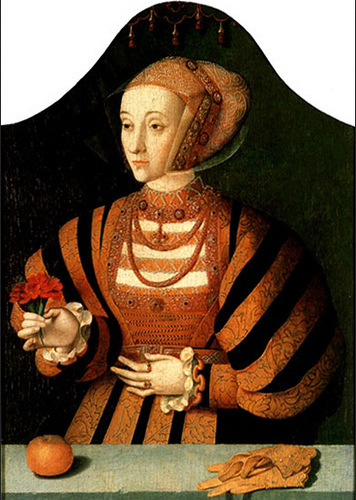
Anne as painted by the workshop of Barthal Bruyn the Elder in Cologne. Painted in the 1530s.
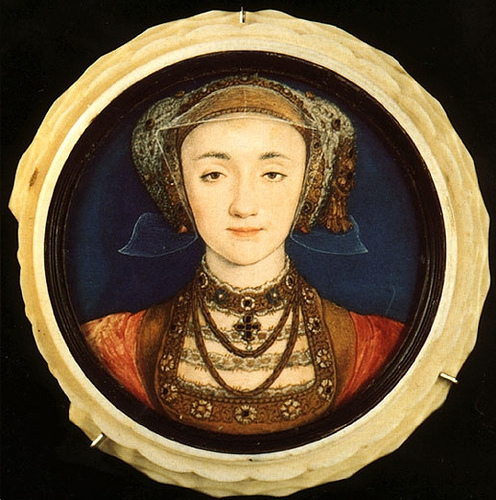
A miniature of Anne as painted by Holbein in 1538. This was the portrait shown to Henry VIII - which made him decide to marry her.
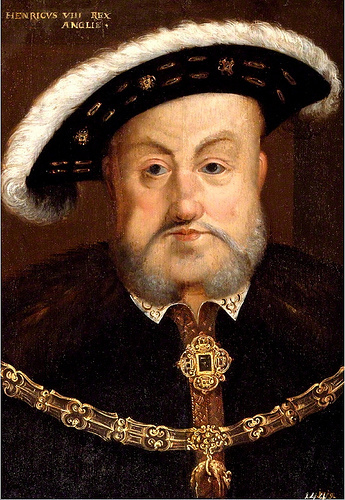
A painting of Henry VIII three years before he married Anne. There was a 21 year age gap between them. Painting after Hans Holbein the Younger.
Well, Flora was highly suspicious of the usual negative descriptions of Anne, and threaded throughout the book are her investigations into a wholly new and totally different Anne of Cleves...very different to the one commonly represented. Her research was fascinating, and I think entirely plausible. It made for very good reading.
I found the bits of the book dealing with Flora Chapman’s life in contemporary England less gripping.
I also found the ending of the book frustrating. The author seemed to be trying to wring out every inch of suspense from a situation that was not all that exciting. I was a bit irritated and underwhelmed.
Overall though I enjoyed the book, especially all the wonderful snips about people like Henry VIII, Bloody Mary, Elizabeth 1st and of course Anne of Cleves. The author writes from an oblique perspective. It is extremely interesting – and I thought what she said made a lot of sense.
----------------------------------------
Rough notes for myself from Amenable Women about Anna/Anne of Cleves....
I absolutely loved this book; I too am a plain woman so I really loved and understood Flora; I'm also very interested in the story of King Henry viii and Anna of Cleves in particular. I loved how the story was told both from Flora's point of view and Anna's...how the portraits of King Henry's wives and daughters were able to communicate with each other...really a brilliant way to tell a story. Hard to believe only a little more than 400 "Goodread-ers" have read this book. Find it, read it...you won't be disappointed!! Loved it just as much the second time :)
When I started this book I found it a little hard to get into, part one was about a marriage with an overbearing husband and a bored wife.
I kept on reading hoping that there would be more too it than that and I am pleased to say that my patience was rewarded. Part two was also about an overbearing husband and a bored and much-maligned wife, Henry VIII and Anna Of Cleves.
The author brings Anna to life in a unique way, makes her point of view so powerfully that I felt that I actually knew Anna and had a greater understanding of what it was to be a pawn in the political marriage game during Tudor times. So much depended upon the way that Anna behaved when Henry decided she was 'not to his liking'. She could have ended up as her predecessor had, without her head. Due to her tact in handling the situation, she managed to salvage her life and maintain quite a high standard, with several households, beautiful gowns, parties etc. Most importantly she stayed on the right side of Henry and became friends with both of his then illegitimate daughters, both of whom remembered her kindness when they became two of the most powerful women in history.
A good read and a really unique way of letting her characters tell their own tale, which I will not spoil for those of you who are hoping to read the book.
When Flora Chapman’s husband Edward, one of the town’s most popular men, suddenly dies during a balloon flight, she doesn’t seem to grieve. Flora has always been a plain woman who lived in the shadow of her perfect husband. Between the notes on his desk, she finds an unfinished history project on the manor where they live that leads to Anne Of Cleves. Huscott manor was one of her residences after her divorce from Henry VIII. Flora decides to travel to Paris on her own to visit Anna’s portrait in the Louvre.
I had hoped this book to be an entertaining dual time frame novel. But actually it’s not. The story focuses on Flora who recently became a widow and by accident takes a large interest in the life of Anne Of Cleves. At Huscott manor her husband had found a stone with her date of death carved into it. But no one knows who left this mark 40 years after Anna’s death and why. She decides to leave for Paris to see Anna’s famous Holbein portrait in the Louvre to see for herself if she really was a Flanders’ mare.
There’s a second perspective of Anna her portrait. Yes, at night she awakes and tells her story to other portraits, such as Elizabeth I and Mary De Guise. It says a lot about this book if I tell you that Anna’s perspective was the most interesting part of this book. Too bad, the author didn’t choose for a real 16th century perspective of Anne Of Cleves. The whole portrait thing was a bit too far fetched for my tastes.
The problem with this book is that although Flora is a witty main character, I just didn’t seem to care about her life and problems. I cared even less about all the people in the town. I did find the parallels between Flora’s life and Anna’s not at all that big. And at times Flora and the other characters behaved as toddlers. Flora desperately wants the town’s solicitor to like her and tries to achieve this by out-arguing a museum guide. Her daughter Hilary isn’t any better as she dotes on her deceased father and needs to put him on a display in every sentence she says.
The other thing that really bothered me was the fact that the story tries to contradict the fact that Anne was plain and ugly. That she wasn’t a Flanders’ mare. While at the time some other historical women such as Catherine Parr and Jane Seymour are being called ‘a nursemaid’ and ‘dull’. I’m fine with a bit of feminism, but I don’t like one-sided feminism.
This book is more about the grief of a woman who lived in her husband’s shadow and now tries to find her own place in the sunlight than a historical book. If you love chick-lit or a light novel and you don’t know a lot about The Tudors this book might be something for you. If you’re a history lover like me, I suggest you look elsewhere.
---
Dutch review:
Wanneer Flora's man Edward omkomt bij een ballonvaart, is ze niet verdrietig. Er was nog maar weinig genegenheid tussen haar en haar man. Maar plots wordt ze the talk of the town als blijkt dat Edward er een minnares op nahield. Tussen Edwards notities vindt ze een document over de geschiedenis van hun Hurcott huis en daarin wordt verwezen naar Anne Of Cleves, Henry VIII's vierde vrouw die de geschiedenis inging als de Flander's Mare. In een opwelling trekt Flora naar het Louvre om haar portret te gaan bekijken.
Ik had gehoopt dat dit een fijn twee tijdsframe boek zou zijn, maar dat is het niet. Het verhaal focust op Flora die net weduwe is geworden. Haar man was ontzettend populair in het dorp en plain Flora heeft altijd in zijn schaduw geleefd. Per toeval raakt ze gefascineerd in het levensverhaal van Anne Of Cleves en gaat ze op zoek naar het verhaal achter een steen met haar sterfdatum op die Edward had ontdekt aan hun huis.
Het tweede perspectief is dat van het portret van Anna, dat 's nachts ontwaakt en met andere portretten zoals Elizabeth I praat. Jep, dat klinkt ontzettend banaal en dat is ook. Maar ik vond dit dan nog de interessantste stukken aangezien Anna hier haar verhaal doet.
Want hoewel Flora ontzettend grappig en ironisch is, deed dit boek me niets. De schrijfstijl is gewoon niet goed. Ik kon amper volgen met de intriges in het dorp die me ook niet boeiden. En de parallellen tussen Flora en Anna vond ik met de haren getrokken. Eigenlijk gaat dit boek over rouw en jezelf terugvinden en wordt het historisch verhaal er maar bij getrokken.
Hetgene wat me het meest stoorde is dat Flora zo graag het verhaal van Anna wil rechtzetten, want ze is zo misbegrepen als Flander's Mare, maar tegelijk verwijst ze constant naar Catherine Parr als de verpleegster en ook Catherine Howard (wulps) en Jane Seymour (saai) moeten er aan geloven. Als je zo eenzijdig bent, werkt feminisme voor mij niet.
Ook de scène waarbij Flora absoluut haar gelijk moet halen tov van de museumgids. En dan de dochter Hilary die haar aanbeden vader in elke zin moet kunnen vermelden. Zucht. De kleuterklas was niet ver weg.
Geen aanrader, een soort verdoken chicklit met een plot dat alle kanten opgaat. De revelatie over de steen was ook echt niet de moeite. Jammer.
I invited a friend to recommend me a book by an author I didn’t know, and she proposed this, imaging I’d look down on it.
Not a bit. It was Very Funny and written with a sense of joie de vivre: this was a writer writing because she likes writing, and is not looking over her shoulder worrying about whether or not she has satisfied her creative writing tutor.
Moreover, the historical research Cheek has done into Anna of Cleves sits easily in the novel and never made me feel it was shoe-horned in because the writer was determined not to waste what he/she had sweated hard to learn. This is achieved in two ways: partly because Flora Chapman, the novel’s protagonist, is engaged in doing the research, so what she learns is incorporated naturally into the narrative as part of a character’s story; and partly because Anna of Cleves is given a place in the novel as a first person narrator, and this illusion of authenticity effectively disguises the fact that research data is being delivered.
And the novel, because it is comic, lacks the earnestness that I find cumbers a lot of creative-writing-issue-based stuff I’ve read. Now of course some topics require serious rather than comic presentation, but an earnest presentation of them makes me feel I’m being got at and I don’t read fiction to be got at or made to feel I’m being hectored: I read it to be illuminated through observing well depicted characters going through experiences described engagingly.
The protagonist of this entertainment is Flora Chapman, relict of the recently departed Edward Chapman, Estate Manager to Sir Randolph Heron, killed in a ballooning accident. They have a single child, Hilary, now grown up and living with her boyfriend in London. Flora, while sorting out Edward’s effects, comes across his monumentally dull and pretentiously pompous draft of ‘The History of Hurcott Ducis’. Only one item seizes her interest and that is a stone purported to memorialise the fact that Anna of Cleves had once lived in a manor house in the village. Flora’s researching the stone and Anna of Cleves provides the narrative thrust of the story, revealing a great deal about the Tudor queens - Anne Boleyn, Jane Seymour, Anna of Cleves, Mary I, Mary Queen of Scots, and Elizabeth I – as well as the workings of Hurcott Ducis.
Cheek is very good at depicting character and has a grasp of how to design a scene that will make for engaging drama. Three women in particular are ones we are allowed to love to loathe or laugh at and who make us cringe. One is Pauline Pike, self-appointed village siren, fond of sitting or sunbathing in her secluded garden ‘au naturelle’ and behind a barrier of briars, and encountered thus by Edward Chapman when seeking help with raising signatures on a petition. Her manner is one of false modesty betrayed by her delusionally styling herself as mid-thirties mutton dressed as hogget. She simpers and weeps copiously to present herself as a woman whose sensitivities have been carelessly cast aside or taken for granted; but she is not so cowed as to prevent her trying to seduce the village solicitor, Ewan Davies, with her ‘pert little bosom’, or joining the dreadful Hurcott Players to work her revenge on Flora for discovering her affair with Edward and for giving the hideous yellow sweater she knitted for him to Ewan Davies.
The second of these three women is Miss Murdoch. Miss Murdoch is a Brown Badge guide and prides herself on knowing all there is to know about country houses and their artefacts, especially their paintings. This knowledge extends, of course, to the collections of major galleries throughout the UK and the rest of Europe. She is stunningly peremptory and conceited, and the reader will enjoy the comeuppance she gets from Flora which is punctuated by Miss Murdoch’s mercenarily naked demands for her cheque. Flora’s repeated refusals to hand it over before delivering the full force of her knowledge - knowledge Miss Murdoch is not privy to - is very satisfying.
Then there is Hilary, she of the Electra complex, who is hopelessly tearful following her father’s death. He was such fun: as Flora notes, he wasn’t ever much better than a child himself, so he was always a good companion for his daughter. In order to improve relations with Hilary, Flora decides not to reveal just how much of the brilliant work she is doing researching Anna of Cleves is her own, allowing Hilary to believe it is all her father’s. A late climactic scene in an art gallery in London has Hilary interrupting Flora’s narrative with comments about how clever her daddy was, Flora being saved from humiliation only by her secret knowledge that it’s her who has been the clever one.
This is particularly gratifying as Hilary has consistently done her mother down as stupid, incompetent and without a spark of anything interesting. Her high-handedness makes you want to slap her. But this is an attitude her father has done nothing to discourage, if only because he has never noticed it, and because he inadvertently has encouraged it by offering Flora such terms of unthinking endearment as ‘bun-face’. It comes as no surprise, therefore, that one of the reasons Flora is attracted to Anna of Cleves is that Anna was christened by the Tudor propaganda machine as the Flanders Mare. In Flora’s view, Holbein’s famous portrait of her shows a woman who is nothing of the sort: perhaps not a stunner, but an intelligent, pretty, characterful and self-composed young woman, whom Henry simply took a dislike to – and, as Cheek’s narrative goes, she to him: he was, after all, obese, piggy-eyed, and smelt because of his ulcerated leg.
The Anna of Cleves element in the novel is presented in a way that avoids what I think of as the style that tries with too obvious artistry to incorporate the research that the novelist has done and is determined to include come hell or high water. Some of Anna’s history is narrated by Flora, often in the course of conversation which allows for at least a mild dramatic interplay between characters and thus avoids the dull delivery of information. It is often a-froth with Flora’s own excited pleasure in what she has done. But a lot of Anna is presented through a different sort of interplay: Cheek imagines the portraits of the abovementioned Tudor queens conversing and even emerging from their frames when the galleries they are hung in are closed. In this way, Cheek enables herself to explore her own take on what might have been the relationship between the sisters, Mary and Elizabeth, and Anna who, after her divorce from Henry VIII, was established as the King’s Sister and therefore Mary and Elizabeth’s aunt. These scenes have a drama focused on unresolved conflicts - personal, political and religious - and an occasional skirting hint at tendernesses never fully realised.
I enjoyed two other aspects of this novel. One was the portrait Cheek draws of a gentrified village, a comedy of middleclassness, parish pumpery, of the foibles and weaknesses of those who are fundamentally materially and socially secure. In particular she relishes the awfulness of the amateur dramatics. Perhaps, though, I have to reflect that the ability to laugh at her characters is in turn dependent on my good fortune, that I am, like her characters, also materially secure enough to laugh at my own familiarity with the world she depicts. After all, there but for the grace of God...
And I liked Cheek’s knowing chapter headings that wink at the reader who is familiar with Victorian adventure novels and their portentous chapter epigraphs: ‘In which our heroes capture a bull elephant’ or ‘The defeat of the Saracen champion’. Cheek’s mock epic tone is nicely ironic: ‘A Surprise Involving Pink Lips’, ‘The World’s a Stage’, ‘Pond Cottage Brings a Suitable Enlightenment’, or ‘Brown Guide in the Ring’. Even the opening chapter headed ‘Death Duties’ turns out to be a deeply comic undermining of a scene at a graveside in which the grieving widow, Flora, is clearly the least moved and least upset person there. Moreover, this comic practice sometimes allows Cheek to set the tone of a less comic chapter the more effectively - for example, ‘Three Queens United’ or ‘God Send Me to Keep Well’.
I really loved this book, as both a history student (who loves this time period in particular) and a lover of historical fiction.
Much like Flora, I have always thought that Anna of Cleves was the most interesting of all. I actually wouldn't have picked up this book if I hadn't seen the famous painting of her on the cover. Again, just like Flora, I think it's so dumb that she's gone down in history as The Ugly One. Why is she not known as The Survivor? She was the wife who Henry wanted to get rid of and didn't lose her head. She got herself out of there, got a good divorce settlement, and lived pretty well. Not many people who got on Henry's bad side could claim as much. The fact that she randomly comes in as a narrator of the story was delightful, though it threw me so much when it first happened.
I also loved Flora and how she learned from Anna. It was so frustrating, come the end and what happened. I was like 'no! Don't let him take the credit! Stand up to your freaking awful daughter!', but I got why. Much like Anna, she knew going quietly would work out for her in the long run. It sucked, but it made sense.
This is a fascinating story of a new widow Flora Chapman, who attempts to retake control and direction of her life and her destiny from out of the shadows of her husband's eccentricity that masked years of neglect and emotional abuse. She does this by re-exploring Anna of Cleaves, the supposedly ugly and stupid wife of Henry VIII. Anna of Cleaves is beautiful, smart and savvy enough to pretend to be dumb. She submits, flatters without flattery and thus wins Henry, Mary and Elizabeth's affections for her sensibility. She is a survivor in the vicious, immoral and dangerous Tudor Court. The contrast between the women and their similarities are beautifully explored. We have the historical investigations cleverly narrated via flashbacks and conversations between the portraits of the famous Tudors which adds a bit of whimsy to the storytelling. I loved it. A really good read. As my first foray into the work of Cheek I must admit that I am hooked and will be definitely reading more of her work.
Cheek sends up English country life. She mercilessly examines middle age and its ramifications. She describes relationships that should never have begun. I enjoyed this tale of Flora Chapman and the obscure Queen Anne. Flora Chapman is liberated when her horrible husband dies in an odd accident. His death uncovers infidelity and a half written history of their local village which was the home of Anne of Cleves, Henry’s fourth wife. Henry called her the Flanders Mare, and was soon rid of her. Flora sympathizes with the dead Queen Anne. She understands what it's like to be plain but she, like Anne, knows how to keep her head. Flora wants to uncover, and make public, the past. She knows what would happen if only the “daughter of Cleves” could talk. Mavis Cheek is the queen bee of the romantic comedy genre. She takes an obscure story from Tudor England and elevates the little known Anne of Cleves, through Flora, for a brief moment.
Another book read whilst getting a baby to sleep. I really enjoyed this book, the juxtaposition of contemporary Flora and Anna of Cleves from the past - both over looked women who had successfully and unsucessfully engineered their lives together with their husbands and as single women. It is a clever plotting device and a chance to explore the misunderstood fourth queen of Henry VIII, and to enjoy the sharp remarks on the ways of men, women and marriage in modern life. One of Mavis Cheek's best.
I am fond of Anna of Cleves, and I particularly enjoyed the conceit of having her portrait (and those of other royal women) able to hear and discuss the comments made about them by gallery-goers. Interesting, too, to see the very different stories authors can produce about historical figures, given identical sets of facts to work with(compare and contrast this version of Anna with that given by Philippa Gregory).
Read this havign recently been widowed myself. The start irritated me because of her attitude to her late husband - but that was because of my own personal grief. However, once I got over my own prejudice toward this, I found this a wonderful book, with a great interpretation of Anne of Cleves. I loved the portraits talking to each other. Fabulous author. Watch out for her.
Made me want to find out more about Anna of Cleves, who I too had thought of as the Flanders Mare - spin doctoring was even present in Henry VIII's day
This is an unusual book and I am sure it isn't for everyone. We begin learning about a British woman, Flora, who is in her 50's who has spent her life being plain looking. She married, had a child and was rather unhappy in her marriage and life. Her husband was an extroverted dilettante who was beloved by the other inhabitants of their village. When he dies in a freak ballooning accident she is far from the grieving widow but rather relieved that her 'life sentence' has been reduced. But she is left to deal with his fans who are much much sadder than this almost Merry widow.
While going through her husband's possessions Flora discovers he was working on a history of their village in his typical careless style. The Village's claim to fame is that is was the location of one of the homes Anne of Cleves received from Henry VIII upon their divorce. The more Flora learns about Anna, as she was called in Cleves, the more obsessed with she becomes in improving Anna's reputation. You see Henry VIII rejected this Teutonic Princess for not being what he wanted. He branded her, metaphorically, the Flanders Mare. He insulted her body type and implied that she 'wasn't a maiden' and divorced her, declaring her his sister.
Flora travels to Paris to see Holbein's portrait of Anne of Cleves, gets into a debate with tour guide and becomes more obsessed with the story. This is when the book gets weird, because we are treated to a POV from the portrait as if the essence of the woman was captured by it. We also hear from other portraits like Mary of Guise and Mary Queen of Scots. Like I said weird.
Flora continues her quest, harbors a secret tendre for her married solicitor, and tries to forge a relationship with her daughter. She and her daughter have been at odds since the daughter, who isn't plain, preferred her father. All the while planning a moment of triumph at a London showing of the Tudor portraits.
Honestly this was the weakest part of the book for me because it was unnecessarily drawn out and it was really rather stupid.
Flora is recently widowed. her husband Edward died in a ballooning accident. Their daughter Hilary is devastated, but Flora herself doesn’t seem that bothered. Edward was handsome and charming and popular, which Flora seems to resent. She also resents Hilary being so fond of him. Edward was working on a history of the village they live in, and Flora decides to complete it. In the course of her researches she becomes interested in Anne of Cleves, Henry VIII’s fourth wife, who owned property in the village. She goes to the Louvre to see Anne’s portrait and it all gets a bit whimsical when the portrait of Anne starts talking about herself. Flora feels Anne of Cleves has been unfairly treated by history and wants to show that she was a more interesting person than is usually supposed. She also tries to start a relationship with a married man. I did not find Flora a very appealing heroine, like most of Mavis Cheek’s heroines I found her rather unlikeable. This is one of her dullest books so far.
Did I enjoy AMENABLE WOMEN? Overall, yes. The writing was engaging and the pacing, while sedate, suited the characters' (Flora and Anna) story.
I particularly enjoyed dipping into the life of Anna of Cleves and learning about her from her own perspective. The author uses this wonderful technique of having Anna, and some of her contemporaries living in the picture frames that house their likeness. When in public view, they hear all that is said about them. When alone, they come alive and talk.
My frustration with this story lies with Flora and the choices she makes. 340-odd pages later, and I felt Flora had only convinced herself she had moved on and made peace with her life. The book refers to this a couple of times as displaying dignity. To me, there is no dignity in self-delusion.
And there's my conundrum: how to reconcile myself to a sympathetic character who I feel did not live up to potential. I do not regret reading this book but I am unsure if I would recommend it.
From Amazon - "Flora Chapman is in her fifties when her husband dies in a bizarre ballooning accident. Seizing upon her new found freedom, she decides to finish the history of their village that Edward had begun. A reference to Anne of Cleves, Henry VIII's fourth wife who he rejected for being ugly, captures her imagination as she begins to delve deeper into the life of this neglected figure. Meanwhile, in the Louvre, Holbein's portrait of Anne of Cleves senses the tug of a connection and she begins to tell the story of the injustices she suffered and just how she survived her marriage..."
My sister recommended ths book to me and I wasn't sure I would like it, but I did, an unusual and very enjoyable read.
Very different from Mavis Cheek's older work, which was all a little bit twee, though a good fun read, this beautifully intertwines historical fiction with the humorous account of modern village life that we are so used to from this author. I normally find historical fiction boring, but I was intrigued to learn about the relationship between Anne of Cleves and Henry VIII, of whom I really knew nothing. I've have been bored with a whole book on the latter topic, but the gentle introduction of the historical elements into the other story made the bite-size chunks of history much more manageable.
An odd mixture of fact and fiction but if you are passionate about the history of Anne of Cleves this would be a book for you. Flora, the focus of the fictional piece, was a great character with wit and charm and the supporting cast of villagers was well done but, while I like history, I seem not to enjoy it larded into a novel. I ended up reading (and enjoying) the fictional half and skimming through the historic content for the highlights but it was at the cost of feeling a lack of continuity in the story part.
What a joy to read. Flora is a very likeable character and she brings Anna of Cleves to life extremely well. both women are underrated by their peers and both have so much to offer. i enjoyed reading about Anna as i had never done any research on her despite have studied the late Plantagenet and Tudor periods. this book compares well to Wolf Hall in that new light is shed on minor characters. most enjoyable. i went and bought a book on Hans Holbein and agree that his Anna looks to be a calm and gentle soul and a beauty compared to his Jane Seymour!!
A delightful story of an 'amenable woman' whose life changes when her eccentric pompous somewhat idiotic husband dies (in a spectacular fashion). I really enjoyed following Flora's journey of discovery and having moments of being less amenable. I also enjoyed learning more about Anna of Cleves and how her very clever amen ability kept her alive after Henry VIII divorced her. And he really was a cruel spoils childish dangerous self centred tyrant. Wonderful reading.
Interesting read about woman widowed by her eccentric husband. After he had died she found out he had been having an affair. She is upset, not because of the affair but because she didn't know of it and was therefore denied opportunity to have an affair herself. Alongside this story runs the story of Anna of Cleves 4th wife of Henry V111
This lady was not amenable. She didn't seem to like anyone - her husband, daughter, cleaning lady etc but mostly she didn't like herself. I found her negativity (I know she was recently widowed but even so) rather wearing and I only made it through part one. Other reviewers said that part two got better but I was really past caring by then.
the premise of this book was a good one, but unfortunately fell a little short for me. The main character Flora has a quirky personality and I enjoyed learning more about her. It appears to have been a well researched book, but the great reveal of Anne Cleves as more than a “Flanders mare” was anti-climatic.
An easy read. A unique take on letting characters speak that I enjoyed. Poetic licence aside, and perhaps inaccuracie regarding the mother of Henry V11, an enjoyable story even if I couldn't quite get my head round the amenability of Flora. ,