

What do you think?

Kant’s Critical Philosophy: The Doctrine of the Faculties
This concise, systematic key to Kant's thought by noted philosopher Gilles Deleuze surveys the essential themes of all three Critiques (Critique of Pure Reason, Critique of Practical Reason, and Critique of Judgement), taking into account their interrelationships and revealing the structure of Kant's entire critical philosophy.
80 pages, Paperback
First published January 1, 1963
About the author
Gilles Deleuze
275 books2,813 followersDeleuze is a key figure in poststructuralist French philosophy. Considering himself an empiricist and a vitalist, his body of work, which rests upon concepts such as multiplicity, constructivism, difference and desire, stands at a substantial remove from the main traditions of 20th century Continental thought. His thought locates him as an influential figure in present-day considerations of society, creativity and subjectivity. Notably, within his metaphysics he favored a Spinozian concept of a plane of immanence with everything a mode of one substance, and thus on the same level of existence. He argued, then, that there is no good and evil, but rather only relationships which are beneficial or harmful to the particular individuals. This ethics influences his approach to society and politics, especially as he was so politically active in struggles for rights and freedoms. Later in his career he wrote some of the more infamous texts of the period, in particular, Anti-Oedipus and A Thousand Plateaus. These texts are collaborative works with the radical psychoanalyst Félix Guattari, and they exhibit Deleuze’s social and political commitment.
Gilles Deleuze began his career with a number of idiosyncratic yet rigorous historical studies of figures outside of the Continental tradition in vogue at the time. His first book, Empirisism and Subjectivity, is a study of Hume, interpreted by Deleuze to be a radical subjectivist. Deleuze became known for writing about other philosophers with new insights and different readings, interested as he was in liberating philosophical history from the hegemony of one perspective. He wrote on Spinoza, Nietzche, Kant, Leibniz and others, including literary authors and works, cinema, and art. Deleuze claimed that he did not write “about” art, literature, or cinema, but, rather, undertook philosophical “encounters” that led him to new concepts. As a constructivist, he was adamant that philosophers are creators, and that each reading of philosophy, or each philosophical encounter, ought to inspire new concepts. Additionally, according to Deleuze and his concepts of difference, there is no identity, and in repetition, nothing is ever the same. Rather, there is only difference: copies are something new, everything is constantly changing, and reality is a becoming, not a being.
He often collaborated with philosophers and artists as Félix Guattari, Michel Foucault, Guy Hocquenghem, René Schérer, Carmelo Bene, François Châtelet, Olivier Revault d'Allonnes, Jean-François Lyotard, Georges Lapassade, Kateb Yacine and many others.
Gilles Deleuze began his career with a number of idiosyncratic yet rigorous historical studies of figures outside of the Continental tradition in vogue at the time. His first book, Empirisism and Subjectivity, is a study of Hume, interpreted by Deleuze to be a radical subjectivist. Deleuze became known for writing about other philosophers with new insights and different readings, interested as he was in liberating philosophical history from the hegemony of one perspective. He wrote on Spinoza, Nietzche, Kant, Leibniz and others, including literary authors and works, cinema, and art. Deleuze claimed that he did not write “about” art, literature, or cinema, but, rather, undertook philosophical “encounters” that led him to new concepts. As a constructivist, he was adamant that philosophers are creators, and that each reading of philosophy, or each philosophical encounter, ought to inspire new concepts. Additionally, according to Deleuze and his concepts of difference, there is no identity, and in repetition, nothing is ever the same. Rather, there is only difference: copies are something new, everything is constantly changing, and reality is a becoming, not a being.
He often collaborated with philosophers and artists as Félix Guattari, Michel Foucault, Guy Hocquenghem, René Schérer, Carmelo Bene, François Châtelet, Olivier Revault d'Allonnes, Jean-François Lyotard, Georges Lapassade, Kateb Yacine and many others.
Ratings & Reviews
Friends & Following
Create a free account to discover what your friends think of this book!
Community Reviews
Displaying 1 - 30 of 72 reviews

March 3, 2013
Deleuze—ere he embarks upon an excellent and edifying exegesis of the three great Kantian Critiques over sixty-five dense and still difficult pages—sets the stage for the reader by proffering four poetic formulas which might summarize the Kantian philosophy that, in my opinion, manage quite nicely in doing just that:
The time is out of joint: Time undergoes a dramatic change as conceived in the Kantian revolution, reversing itself from its abstract theological perch as flatly perduring eternity or circular, periodic spiraling as a determiner hitched to motive objects; it becomes unraveled into a singular, forward stretched thread, straight and ominous in its simplistic linearity: time is no longer related to the movement which it measures, but movement is related to the time which conditions it. Time has become an a priori form of our inner sensible intuitions—but even more than that, everything is now subordinated under its determining suzerainty: permanence, succession, and simultaneity are modes and relationships of time. The Kantian revolution reveals a time flush with profound conundrums.
I is another: Another remarkable element of Kant's thought is that the subject is bifurcated with prejudice: we retain the I, the enactive self, performing under the past-present-future parceling syntheses of conditioning time—but it receives an antipodal twin in the ego, our passive and receptive selves aswim within the time that sees it ever changeable, changed and changing. It's a paradox in that the self has been split in twain by the form of time and yet conditioned by the latter such that it synthesizes into a unity: that inner form the thread that stitches the mirrored pairing together. Kant observes how time moves into the subject, that he might discern how the mind affects itself. In this endless dance of acting I and attributive ego—because time has neither beginning nor end—we are split from ourselves through an infinite modulation.
The Good is what the Law says: From Greek thought of old, the Law has come into existence because man might know not what the Good is and/or how to conform himself to it: it thus derives from the Good, and of which it serves us as secondary imitation. But as he so did with time and space, Kant inverts this relationship so that the Law stands revealed as the highest form and that from which the Good is derived. The Law does not tell us what we must do, it merely tells us You must!, leaving us to deduce from it the Good. The Law has no content and is not known, but reveals itself to us through its action—practical, not theoretical. We know it only through its imprint on our heart and our flesh: we are guilty, necessarily guilty.
A disorder of all the senses: Prior to Kant's Critiques, there was determined to be a harmony between the subject and object whose guarantor was God: and this harmony was maintained by Kant through his first two Critiques, wherein though different faculties were interactive in relation to each other, one was always dominant in imposing its legislative rule. However, by the time of The Critique of Judgement, Kant had determined that if the faculties were capable of entering into relationships where one was regulative, then all of them together could reach an accord that was yet unregulated: a harmony achieved at the highest level by the spontaneous, intertwined, mysterious accord reached under the conditions of a beautiful Nature—or, striving ever higher, under the Sublime. As such we have a maelstromic mélange in which reason, imagination, understanding and the inner sense engage to stir the other to ever higher limits that simultaneously urge them to reach above and beyond their own—it is a tempest in the depths of a chasm opened up in the subject, and which paradoxically allows an accord to emerge from discord: a music of disharmony that sources time with its own accord, a unity threaded from a falling away.
As for the meaty part of Deleuze's effort—it assisted me greatly in finally getting my head around the methodology of the Prussian genius, for Deleuze uses the master's own terminology (twice rendered though it be, first into French and then one step further to our Anglo-Saxon tongue) while unfolding its development at a level high enough to see the entirety of the ends whilst yet sufficiently leveled down that the means aren't lost in the heightened view. And Kant truly is a genius: the immensity of the task he set himself would be enough to fold one up like a cheap suit ere the most basic foundations had been attempted. Such overarching ambition perhaps required such hypertrophied language in daring its achievement; in any event, that the myriad enigmatic processes with which the waves of our oceanic interiority drive in towards and break upon the cognitive shore were systematized and ordered such that a coherent whole could be established from their complex ephemerality—well, I think that is just mighty fucking impressive, however much one's head might be hurt in trying to piece it all together direct from the horse's mouth.
What those four poetic formulas do not allude to is the focal importance of Kant's Copernican Revolution as delineated by Deleuze in toto: that is was the point at which philosophy made the full shift from a metaphysics of being towards one of will—particularly in the transcendental duality inscribed within the subject, and represented by such antipodes as intelligible vs. sensible, reason vs. experience, concept vs. intuition, and logical vs. aesthetic, as well as the inversion that saw the supra-sensible, the thing-in-itself and divine engenderer become dependent upon our reason's ability to determine their status. So it is that, with the above in mind, what I find most fascinating—and, in its grasping, comprehend as the theological and faith-form lethality it proved to be—is how Kant managed to configure man as the last end of sensible nature via the history achieved by his synthetic activity: the being who superseded God as the harmonizer of subject and object in how we legislate the latter in submission to the former, though we be but finite ourselves—and in this performed determination, are positioned as the bridge between the supra-sensible and the sensible wherein finality is found in the human foundation of theology. You gave 'em hell, Immanuel...
The time is out of joint: Time undergoes a dramatic change as conceived in the Kantian revolution, reversing itself from its abstract theological perch as flatly perduring eternity or circular, periodic spiraling as a determiner hitched to motive objects; it becomes unraveled into a singular, forward stretched thread, straight and ominous in its simplistic linearity: time is no longer related to the movement which it measures, but movement is related to the time which conditions it. Time has become an a priori form of our inner sensible intuitions—but even more than that, everything is now subordinated under its determining suzerainty: permanence, succession, and simultaneity are modes and relationships of time. The Kantian revolution reveals a time flush with profound conundrums.
I is another: Another remarkable element of Kant's thought is that the subject is bifurcated with prejudice: we retain the I, the enactive self, performing under the past-present-future parceling syntheses of conditioning time—but it receives an antipodal twin in the ego, our passive and receptive selves aswim within the time that sees it ever changeable, changed and changing. It's a paradox in that the self has been split in twain by the form of time and yet conditioned by the latter such that it synthesizes into a unity: that inner form the thread that stitches the mirrored pairing together. Kant observes how time moves into the subject, that he might discern how the mind affects itself. In this endless dance of acting I and attributive ego—because time has neither beginning nor end—we are split from ourselves through an infinite modulation.
The Good is what the Law says: From Greek thought of old, the Law has come into existence because man might know not what the Good is and/or how to conform himself to it: it thus derives from the Good, and of which it serves us as secondary imitation. But as he so did with time and space, Kant inverts this relationship so that the Law stands revealed as the highest form and that from which the Good is derived. The Law does not tell us what we must do, it merely tells us You must!, leaving us to deduce from it the Good. The Law has no content and is not known, but reveals itself to us through its action—practical, not theoretical. We know it only through its imprint on our heart and our flesh: we are guilty, necessarily guilty.
A disorder of all the senses: Prior to Kant's Critiques, there was determined to be a harmony between the subject and object whose guarantor was God: and this harmony was maintained by Kant through his first two Critiques, wherein though different faculties were interactive in relation to each other, one was always dominant in imposing its legislative rule. However, by the time of The Critique of Judgement, Kant had determined that if the faculties were capable of entering into relationships where one was regulative, then all of them together could reach an accord that was yet unregulated: a harmony achieved at the highest level by the spontaneous, intertwined, mysterious accord reached under the conditions of a beautiful Nature—or, striving ever higher, under the Sublime. As such we have a maelstromic mélange in which reason, imagination, understanding and the inner sense engage to stir the other to ever higher limits that simultaneously urge them to reach above and beyond their own—it is a tempest in the depths of a chasm opened up in the subject, and which paradoxically allows an accord to emerge from discord: a music of disharmony that sources time with its own accord, a unity threaded from a falling away.
As for the meaty part of Deleuze's effort—it assisted me greatly in finally getting my head around the methodology of the Prussian genius, for Deleuze uses the master's own terminology (twice rendered though it be, first into French and then one step further to our Anglo-Saxon tongue) while unfolding its development at a level high enough to see the entirety of the ends whilst yet sufficiently leveled down that the means aren't lost in the heightened view. And Kant truly is a genius: the immensity of the task he set himself would be enough to fold one up like a cheap suit ere the most basic foundations had been attempted. Such overarching ambition perhaps required such hypertrophied language in daring its achievement; in any event, that the myriad enigmatic processes with which the waves of our oceanic interiority drive in towards and break upon the cognitive shore were systematized and ordered such that a coherent whole could be established from their complex ephemerality—well, I think that is just mighty fucking impressive, however much one's head might be hurt in trying to piece it all together direct from the horse's mouth.
What those four poetic formulas do not allude to is the focal importance of Kant's Copernican Revolution as delineated by Deleuze in toto: that is was the point at which philosophy made the full shift from a metaphysics of being towards one of will—particularly in the transcendental duality inscribed within the subject, and represented by such antipodes as intelligible vs. sensible, reason vs. experience, concept vs. intuition, and logical vs. aesthetic, as well as the inversion that saw the supra-sensible, the thing-in-itself and divine engenderer become dependent upon our reason's ability to determine their status. So it is that, with the above in mind, what I find most fascinating—and, in its grasping, comprehend as the theological and faith-form lethality it proved to be—is how Kant managed to configure man as the last end of sensible nature via the history achieved by his synthetic activity: the being who superseded God as the harmonizer of subject and object in how we legislate the latter in submission to the former, though we be but finite ourselves—and in this performed determination, are positioned as the bridge between the supra-sensible and the sensible wherein finality is found in the human foundation of theology. You gave 'em hell, Immanuel...

June 3, 2014
2021 Review
This is the second time, maybe the third time I've read this book. I am impressed by how concise and spot on Deleuze is in summarizing Kant.
Despite Deleuze's great reading of Kant in some sense Deleuze did miss something. Later on Deleuze came to see Kant as being someone worthy of deeper elucidation, and I believe this to be the case still... in some sense, you could read Kant as being more general than Deleuze, that is, Deleuze's work "fits" within Kant's rubric to some degree, even if Deleuze is richer than Kant and more sophisticated in many ways. I kind of wished that Deleuze took this direction in his reading of Kant, to twist Kant around but even still, this more conservative reading of Kant is okay...
Still, 5 stars, because it's a tight tight book. Asking Deleuze to be able to read Kant against his own work is perhaps a little different than what Deleuze sought to do with Kant.
---
2014 Review
Deleuze is perhaps the best reader of texts that I know of. In this short work, he presents the immanent critique hidden within Kant's philosophical product.
In doing so, Deleuze shows both how Kant is not a rationalist or an empiricist, and how Kant is the anti-philosopher. Although Kant today is considered to be the epitome of modern philosophers, at that time Kant sought to break through the limits of Descartes' subjectivity to achieve a deeper understanding of the human condition one not founded on false or speculative reasoning.
As Deleuze points out, Kant's methodology works in this way by highlighting the structural points of inflection within his philosophy. These structural features exist immanent within each of the conditions Kant outlines within empirical reason -- ultimately to exist as a faculty that stands on its own. In other words, Kant notices what is the same within each relation despite empirical difference. Each of the three domains of experience (feeling, desiring and knowing) balance out the others to provide the higher immanent vehicles that together legislate human balance (judgement, understanding and reason). As Kant analyzes types of experiences encountered within empirical reason, Deleuze shows how Kant points to the suprasensible as the beyond that grounds Kant's philosophy (and humanity) as being that is both good and moral in the face of Law immanent within transcendental reasoning.
What makes Kant so difficult to approach is his rejection of speculative reason. Bad philosophy has a habit of legislating positions as filters for experience, using a top-down approach to the field of experience. Kant sticks strictly to the thinnest difference within each domain, using the form of language to describe immanent relations of their predicates within itself... in a sense noting the universal form inherent within each field as the criteria for what a faculty is, what is an immanent vehicle within human processing. In other words, Kant finds the universal arising within our navigation and arrangement of phenomena as a spontaneous law grounded within our consciousness, what is the same no matter what, and how those samenesses inter-relate.
The point of all this is to show the reason for reason, to show how the structure of reason itself from the immanent faculties that operate as transcendental reason becomes its own reason, the accord of which reveals for us our place in the world. We are made to be reasonable, and our reasonableness itself is what provides the grounds for our existence, and the meaning of our existence, which Kant insists is the natural product of our natural and good synthesis with nature... not for the goal of fulfilling instinct/nature but for incorporating the beyond, a limit we ourselves cannot understand:
Deleuze does all this in this breathtakingly short book. Deleuze places Kantian desire as the organizing feature, in the synthesis of feeling, rationality and understanding within the free 'accord' of the faculties and how pure relation forms the immanent critique of human experience; bringing to light the clear synthesis of the transcendental method and the three faculties... and in this sense, conjoins with Deleuze's own readings of philosophers, as Deleuze can rightly be said to be a philosopher who only practices immanent critiques.
The only thought I have; what I wished Deleuze focused on as well, was Kant's question of freedom. Towards the end of his life, Kant had an answer, an undesirable answer to how our freedom comes about, one which tortured him in his last days. This issue, was not brought up. But perhaps this was because Kant never wrote a specific work to outline this issue.
This is the second time, maybe the third time I've read this book. I am impressed by how concise and spot on Deleuze is in summarizing Kant.
Despite Deleuze's great reading of Kant in some sense Deleuze did miss something. Later on Deleuze came to see Kant as being someone worthy of deeper elucidation, and I believe this to be the case still... in some sense, you could read Kant as being more general than Deleuze, that is, Deleuze's work "fits" within Kant's rubric to some degree, even if Deleuze is richer than Kant and more sophisticated in many ways. I kind of wished that Deleuze took this direction in his reading of Kant, to twist Kant around but even still, this more conservative reading of Kant is okay...
Still, 5 stars, because it's a tight tight book. Asking Deleuze to be able to read Kant against his own work is perhaps a little different than what Deleuze sought to do with Kant.
---
2014 Review
Deleuze is perhaps the best reader of texts that I know of. In this short work, he presents the immanent critique hidden within Kant's philosophical product.
In doing so, Deleuze shows both how Kant is not a rationalist or an empiricist, and how Kant is the anti-philosopher. Although Kant today is considered to be the epitome of modern philosophers, at that time Kant sought to break through the limits of Descartes' subjectivity to achieve a deeper understanding of the human condition one not founded on false or speculative reasoning.
As Deleuze points out, Kant's methodology works in this way by highlighting the structural points of inflection within his philosophy. These structural features exist immanent within each of the conditions Kant outlines within empirical reason -- ultimately to exist as a faculty that stands on its own. In other words, Kant notices what is the same within each relation despite empirical difference. Each of the three domains of experience (feeling, desiring and knowing) balance out the others to provide the higher immanent vehicles that together legislate human balance (judgement, understanding and reason). As Kant analyzes types of experiences encountered within empirical reason, Deleuze shows how Kant points to the suprasensible as the beyond that grounds Kant's philosophy (and humanity) as being that is both good and moral in the face of Law immanent within transcendental reasoning.
What makes Kant so difficult to approach is his rejection of speculative reason. Bad philosophy has a habit of legislating positions as filters for experience, using a top-down approach to the field of experience. Kant sticks strictly to the thinnest difference within each domain, using the form of language to describe immanent relations of their predicates within itself... in a sense noting the universal form inherent within each field as the criteria for what a faculty is, what is an immanent vehicle within human processing. In other words, Kant finds the universal arising within our navigation and arrangement of phenomena as a spontaneous law grounded within our consciousness, what is the same no matter what, and how those samenesses inter-relate.
The point of all this is to show the reason for reason, to show how the structure of reason itself from the immanent faculties that operate as transcendental reason becomes its own reason, the accord of which reveals for us our place in the world. We are made to be reasonable, and our reasonableness itself is what provides the grounds for our existence, and the meaning of our existence, which Kant insists is the natural product of our natural and good synthesis with nature... not for the goal of fulfilling instinct/nature but for incorporating the beyond, a limit we ourselves cannot understand:
When imagination is confronted with its limit by something which goes beyond it in all respects it goes beyond its own limit itself, admittedly in a negative fashion, by representing to itself the inaccessibility of the rational Idea, and by making this very inaccessibility something which is present in sensible nature.For through the imagination, no doubt, finds nothing beyond the sensible world to which it can lay hold, still this thrusting aside of the sensible barriers gives it a feeling of being unbounded; and that removal is thus a presentation of the infinite. As such it can never be anything more than a negative presentation - but still it expands the soul.
Deleuze does all this in this breathtakingly short book. Deleuze places Kantian desire as the organizing feature, in the synthesis of feeling, rationality and understanding within the free 'accord' of the faculties and how pure relation forms the immanent critique of human experience; bringing to light the clear synthesis of the transcendental method and the three faculties... and in this sense, conjoins with Deleuze's own readings of philosophers, as Deleuze can rightly be said to be a philosopher who only practices immanent critiques.
The only thought I have; what I wished Deleuze focused on as well, was Kant's question of freedom. Towards the end of his life, Kant had an answer, an undesirable answer to how our freedom comes about, one which tortured him in his last days. This issue, was not brought up. But perhaps this was because Kant never wrote a specific work to outline this issue.

August 31, 2026
Easily the most challenging book since I tackled Jean-Luc Nancy last winter. What a lesson in humility. I recall reading Kant a few years ago and it was joyous. This was being punched in the face, repeatedly as I had to reread each page a few times. Everyone exclaims that Deleuze mentions Borges and Rimbaud in the introduction but what ensues is brutal. I think I read recently where a lecture by Deleuze was so well attended that there were a comparable number of people sitting outside the hall in a lobby and that Deleuze paced about while lecturing so that each group heard roughly half of what was being presented. I can relate.

April 24, 2025
Carne de TFM, lo siento.
Me ha horrorizado a partes porque juega a favor de Kant, pero a la vez este libro horrorizaría a cualquier kantiano, así que todo bien.
Me ha horrorizado a partes porque juega a favor de Kant, pero a la vez este libro horrorizaría a cualquier kantiano, así que todo bien.

December 14, 2017
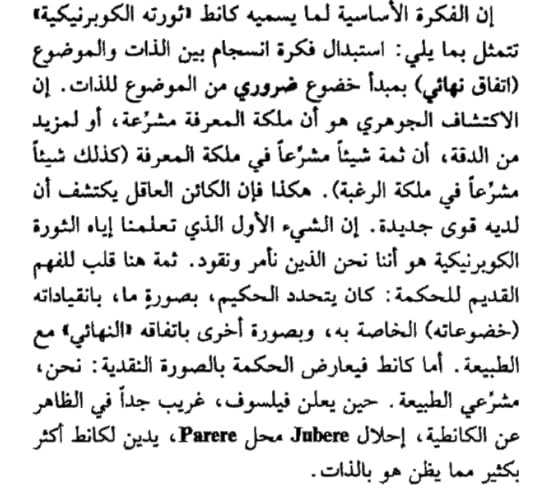
يريد جيل دولوز فى هذا الكتاب الموجز ان يعطى صورة نهائية او مثال نموذجى للنقد الكانطى .
وهو يعرضها من وجهة نظرة فى أعمق صورها حيث يعرضها فى صورة علاقات توافقية بين الملكات الثلاث ( الادراك والعقل والمخيلة ) حيث يقود العقل ويترك بعض المهام الاولية للادراك فى مجال المعرفة وللمخيلة فى مجال الفن ويتولى هو زمام الامور فى مجال الرغبة والارادة مشرعا لذاته قانونه الاخلاقى المطلق بعيدا عن كل ما هو تجريبى . مفسحا المجال لحرية الارادة التى بدورها تفسح مجالا لعلاقات معقدة وتأثيرات متبادلة بين العالم الحسي والمعقول . وينتهى بتطابق مصالح العقل التفكرية مع مصالحه العملية .
يظهر الكاتب فهما عميقا للفلسفة النقدية ويحاول عرضها عرضا محايدا الا انه يظهر فى بعض المواضيع او النقاط الملتبسه على الفهم فى الفلسفة الكانطية فهما ذاتيا خاصا به لكنه فى المجمل فهما منطقيا عميقا يساعد على اضفاء وحدة بنائية لكتيب صغير يعطى المثال النهائى للنقد .
وهو يعرضها من وجهة نظرة فى أعمق صورها حيث يعرضها فى صورة علاقات توافقية بين الملكات الثلاث ( الادراك والعقل والمخيلة ) حيث يقود العقل ويترك بعض المهام الاولية للادراك فى مجال المعرفة وللمخيلة فى مجال الفن ويتولى هو زمام الامور فى مجال الرغبة والارادة مشرعا لذاته قانونه الاخلاقى المطلق بعيدا عن كل ما هو تجريبى . مفسحا المجال لحرية الارادة التى بدورها تفسح مجالا لعلاقات معقدة وتأثيرات متبادلة بين العالم الحسي والمعقول . وينتهى بتطابق مصالح العقل التفكرية مع مصالحه العملية .
يظهر الكاتب فهما عميقا للفلسفة النقدية ويحاول عرضها عرضا محايدا الا انه يظهر فى بعض المواضيع او النقاط الملتبسه على الفهم فى الفلسفة الكانطية فهما ذاتيا خاصا به لكنه فى المجمل فهما منطقيا عميقا يساعد على اضفاء وحدة بنائية لكتيب صغير يعطى المثال النهائى للنقد .

September 12, 2017
"My book on Kant is different, I like it very much, I wrote it as a book on an enemy, in it I was trying to show how he works, what his mechanisms are - the court of Reason, measured use of the faculties, a submissiveness which is all the more hypocritical as we are called legislators"
-- Deleuze กล่าว, (Lettre à Michel Cressole, p. 110)
-- Deleuze กล่าว, (Lettre à Michel Cressole, p. 110)

April 1, 2017
I’m fond of these cute little pamphlets by Deleuze, almost as though they were primers he’s written for pedagogical purposes, or perhaps his book reports after studying up on the subject matter. Either way, they’re lucid and quick and curious in ways that the more baroque and theoretical texts are not.
Text opens with a clever summation of Kant via quotations from Shakespeare (“the time is out of joint”), Rimbaud (“I is another” and “a disorder of all the senses”), and Kafka (“the Good is what the Law says”) (vii ff). The second Rimbaud quotation leads to the inference of “terrible struggle” within the subject (xii), “a tempest in the depths of a chasm,” wherein “the faculties confront one another, each stretched to its own limit, and find their accord in a fundamental discord: a discordant accord is the great discovery” of the third critique (xii).
Introduction is an overview of the transcendental method, which is targeted contra rationalism and empiricism both. On the one hand, “only the cultural ends of reason can be described as absolutely final” (1), but on the other, “supreme ends are not only ends of reason” (2), as “in positing them, reason posits nothing other than itself.” The main thrust of the transcendental method is “an immanent critique—reason as the judge of reason” (3).
Kant’s critical philosophy introduces a number of diremptions into the mind (nothing new there: Plato and Aristotle cut the pneuma (or psuche?) into different parts, after all): Deleuze construes them as “faculties,” such as the ‘faculty of knowledge’ or the ‘faculty of desire.’ This is the first sense, wherein “‘faculty’ refers to the different relationships of a representation in general” (7); the second sense “denotes the specific source of representations” (id.), such as ‘intuitions’ from ‘sensibility,’ ‘concepts’ from the ‘understanding,’ and ‘ideas’ from ‘reason’ (8). Overall, “our constitution is such that we have one receptive faculty and three active faculties” (9)—I think intuitive sensibility is the receptive one, whereas the active ones are imagination, understanding, and reason.
Three basic sections—one for each critique. The reading of the Critique of Pure Reason starts with Kant’s Copernican Revolution—“Substituting the principle of a necessary submission of object to subject for the idea of a harmony between subject and object” (14). The engine of this is that “the faculty of knowledge is legislative,” which means that “the rational being discovers that he has new powers” (id.). The essay covers much of the Critique’s ideas, such as “phenomena are necessarily subject to the categories; so much so that, through the categories, we are the true legislators of Nature” (16). Whereas the legislative understanding ‘judges,’ the “imagination schematizes” (18). But “reason reasons” (id.). Plenty here about ‘common sense,’ the principle of intrasubjective accord, and so on. We see that “understanding and reason are deeply tormented by the ambition to make things in themselves known to us” and Kant notes that we suffer “internal illusions and illegitimate uses of the faculties,” such as when the imagination “dreams rather than schematizes” (24). This leads directly to the “speculative illusions of Reason” wherein “the transcendental employment of the understanding derives simply from the fact that it neglects its own limits, whilst the transcendent employment of reason enjoins us to exceed the bounds of the understanding” (25). One error is when “the understanding claims to know something in general,” which can only mean knowledge of the noumenon, though it is impossible for same to be “a positive object for our understanding” (26).
The Critique of Practical Reason lays out the position that “the moral law orders us to think the maxim of our will as ‘the principle of a universal legislation.’ An action which withstands this logical test, that is to say an action whose maxim can be thought without contradiction as universal law, is at least consistent with morality” (28). Reason’s role here in the faculty of desire is to legislate as ‘pure practical reason’ (I know, right!) (id.). Kant assumes a “free will,” and “the reciprocal implication is such that practical reason and freedom are, perhaps, one and the same” (29). But: if “everything is the effect of something else on to infinity, and each cause is connected to a preceding cause,” and freedom can only be “defined by its power to begin a state spontaneously,” then it follows more or less inexorably that “the concept of freedom cannot represent a phenomenon, but only a thing in itself, which is not given to intuition” (30). The salient conceptual diremption here is the “great gulf between the two domains” (32) of legislation by natural concepts (the understanding in the faculty of knowledge over phenomena regarding their sensible nature) and legislation by the concept of freedom (reason in the faculty of desire over noumena regarding their suprasensible nature) (31). So far, so good: however, pure practical reason gets adulterated with impurities--
The Critique of Judgment is to resolve the antimony. As “aesthetic pleasure is independent both of the speculative interest and the practical interest and indeed is itself defined as completely disinterested” (47), it is furthermore “powerless to legislate over objects”—“judgment can be only heautonomous, that is, it legislates over itself” (48). This ‘faculty of feeling’ “has no domain (neither phenomena nor things in themselves” (id.)). Because “there is an accord between the imagination as free and the understanding as indeterminate” (49), Kant has a problem: “the universality of aesthetic pleasure” is explained by “the free accord of the faculties,” but “is it sufficient to assume this free accord, to suppose it a priori?” i.e., “should aesthetic common sense not be the object of a genesis, of a properly transcendental genesis?” (50). This gets worked out, apparently, via the Beautiful/Sublime distinction. Whereas the former involves only understanding and imagination (no role for reason), in the latter “imagination surrenders itself to an activity quite distinct from that of formal reflection” (50):
The text concludes with a meditation on Kant’s notion of the “ends of reason,” which apparently is “the organization of rational beings under the moral law” (72)—which strikes me as completely deactivated by Horkheimer’s critique of instrumental reason in The Eclipse of Reason.
Recommended for those who cannot help but dream of a knowledge of things in themselves, readers who ought to be considered as ends-in-themselves, and persons who need to move from a natural teleology to a physical teleology.
Text opens with a clever summation of Kant via quotations from Shakespeare (“the time is out of joint”), Rimbaud (“I is another” and “a disorder of all the senses”), and Kafka (“the Good is what the Law says”) (vii ff). The second Rimbaud quotation leads to the inference of “terrible struggle” within the subject (xii), “a tempest in the depths of a chasm,” wherein “the faculties confront one another, each stretched to its own limit, and find their accord in a fundamental discord: a discordant accord is the great discovery” of the third critique (xii).
Introduction is an overview of the transcendental method, which is targeted contra rationalism and empiricism both. On the one hand, “only the cultural ends of reason can be described as absolutely final” (1), but on the other, “supreme ends are not only ends of reason” (2), as “in positing them, reason posits nothing other than itself.” The main thrust of the transcendental method is “an immanent critique—reason as the judge of reason” (3).
Kant’s critical philosophy introduces a number of diremptions into the mind (nothing new there: Plato and Aristotle cut the pneuma (or psuche?) into different parts, after all): Deleuze construes them as “faculties,” such as the ‘faculty of knowledge’ or the ‘faculty of desire.’ This is the first sense, wherein “‘faculty’ refers to the different relationships of a representation in general” (7); the second sense “denotes the specific source of representations” (id.), such as ‘intuitions’ from ‘sensibility,’ ‘concepts’ from the ‘understanding,’ and ‘ideas’ from ‘reason’ (8). Overall, “our constitution is such that we have one receptive faculty and three active faculties” (9)—I think intuitive sensibility is the receptive one, whereas the active ones are imagination, understanding, and reason.
Three basic sections—one for each critique. The reading of the Critique of Pure Reason starts with Kant’s Copernican Revolution—“Substituting the principle of a necessary submission of object to subject for the idea of a harmony between subject and object” (14). The engine of this is that “the faculty of knowledge is legislative,” which means that “the rational being discovers that he has new powers” (id.). The essay covers much of the Critique’s ideas, such as “phenomena are necessarily subject to the categories; so much so that, through the categories, we are the true legislators of Nature” (16). Whereas the legislative understanding ‘judges,’ the “imagination schematizes” (18). But “reason reasons” (id.). Plenty here about ‘common sense,’ the principle of intrasubjective accord, and so on. We see that “understanding and reason are deeply tormented by the ambition to make things in themselves known to us” and Kant notes that we suffer “internal illusions and illegitimate uses of the faculties,” such as when the imagination “dreams rather than schematizes” (24). This leads directly to the “speculative illusions of Reason” wherein “the transcendental employment of the understanding derives simply from the fact that it neglects its own limits, whilst the transcendent employment of reason enjoins us to exceed the bounds of the understanding” (25). One error is when “the understanding claims to know something in general,” which can only mean knowledge of the noumenon, though it is impossible for same to be “a positive object for our understanding” (26).
The Critique of Practical Reason lays out the position that “the moral law orders us to think the maxim of our will as ‘the principle of a universal legislation.’ An action which withstands this logical test, that is to say an action whose maxim can be thought without contradiction as universal law, is at least consistent with morality” (28). Reason’s role here in the faculty of desire is to legislate as ‘pure practical reason’ (I know, right!) (id.). Kant assumes a “free will,” and “the reciprocal implication is such that practical reason and freedom are, perhaps, one and the same” (29). But: if “everything is the effect of something else on to infinity, and each cause is connected to a preceding cause,” and freedom can only be “defined by its power to begin a state spontaneously,” then it follows more or less inexorably that “the concept of freedom cannot represent a phenomenon, but only a thing in itself, which is not given to intuition” (30). The salient conceptual diremption here is the “great gulf between the two domains” (32) of legislation by natural concepts (the understanding in the faculty of knowledge over phenomena regarding their sensible nature) and legislation by the concept of freedom (reason in the faculty of desire over noumena regarding their suprasensible nature) (31). So far, so good: however, pure practical reason gets adulterated with impurities--
The Critique of Pure Reason thus condemns the transcendent employment of a speculative reason which claims to legislate by itself; the Critique of Practical Reason condemns the transcendent employment of a practical reason which, instead of legislating by itself, lets itself be empirically conditioned. (36-37)The main danger regarding practical reason is “believing that Kantian morality remains indifferent to its own realization,” i.e., “the abyss between the sensible world and the suprasensible world exists only in order to be filled” (39): “we must realize that the same being is phenomenon and thing in itself” (40). The ‘realization’ aforesaid is possible in an “accord between sensible nature (following its laws) and suprasensible nature (following its law)” (41)—a “proportion between happiness and morality” (42). This produces an antimony: “the desire for happiness cannot be the motive of virtue [!]; but it also seems that the maxim of virtue cannot be the cause of happiness, since the moral law does not legislate over the sensible world” (42). Crazy! What now?
The Critique of Judgment is to resolve the antimony. As “aesthetic pleasure is independent both of the speculative interest and the practical interest and indeed is itself defined as completely disinterested” (47), it is furthermore “powerless to legislate over objects”—“judgment can be only heautonomous, that is, it legislates over itself” (48). This ‘faculty of feeling’ “has no domain (neither phenomena nor things in themselves” (id.)). Because “there is an accord between the imagination as free and the understanding as indeterminate” (49), Kant has a problem: “the universality of aesthetic pleasure” is explained by “the free accord of the faculties,” but “is it sufficient to assume this free accord, to suppose it a priori?” i.e., “should aesthetic common sense not be the object of a genesis, of a properly transcendental genesis?” (50). This gets worked out, apparently, via the Beautiful/Sublime distinction. Whereas the former involves only understanding and imagination (no role for reason), in the latter “imagination surrenders itself to an activity quite distinct from that of formal reflection” (50):
the feeling of the sublime is experienced when faced with the formless or the deformed (immensity or power). It is as though the imagination were confronted with its own limit, forced to strain to the utmost, experiencing a violence which stretches it to the extremity of its power […] Faced with immensity, the imagination experiences the inadequacy of this maximum, and ‘in its fruitless efforts to extend this limit, recoils upon itself.’” (50)The Beautiful is not exactly uncomplicated, however, such as in this “Kantian dictum”: “he who leaves a museum to turn toward the beauties of nature deserves respect” (56). Plenty more on taste, teleology, finality, and so on.
The text concludes with a meditation on Kant’s notion of the “ends of reason,” which apparently is “the organization of rational beings under the moral law” (72)—which strikes me as completely deactivated by Horkheimer’s critique of instrumental reason in The Eclipse of Reason.
Recommended for those who cannot help but dream of a knowledge of things in themselves, readers who ought to be considered as ends-in-themselves, and persons who need to move from a natural teleology to a physical teleology.

May 30, 2018
Definitely a sleeper in comparison to the books Deleuze is known for, or even to his other monographs. Not an outright attack on Kant, nor an endorsement, but an epistemological reconnaissance mission into the enemy camp. Should be read in conjunction with the Nietzsche book.
Highly recommend Deleuze’s lectures on Kant either before or after this text—it really consolidated what I took from the book. Available here: http://deleuzelectures.blogspot.com/2...
Highly recommend Deleuze’s lectures on Kant either before or after this text—it really consolidated what I took from the book. Available here: http://deleuzelectures.blogspot.com/2...

December 6, 2019
A brilliant exposition of Kant’s thought. It also gives a lot of insight into Deleuze’s own philosophy. I wish I had read Kant’s Critical Philosophy before Difference and Repetition . Deleuze’s arguments about “common sense,” “problematic Ideas” and “asynchronous synthesis of the sensible” would have made much more sense. Indeed, upon getting to know Kant better, it seems to me that he must be Deleuze’s single most important philosophical interlocutor. But you’d have to ask the experts about that!

November 21, 2025
La audacia de ser capaz de explicar de manera simple, limpia y completa teorías filosóficas turbo abstractas abordando sus puntos clave sin reducir, tochas y obtusas en lenguaje, en solo 100 lil paginicas, pero que no te de la gana explicarte así de clarito y conciso a ti mismo. Maldito francés con una meseta era suficiente, borra las otras 999

June 25, 2023
adding this months later because i forgot to add it in after reading, probably bc i was so surprised by it. really one of the best engagements of kant I’ve ever read, which was so shocking for that to come from deleuze, kant’s self-proclaimed enemy. i love that he prioritized the third critique, which is often misunderstood and slept on. first primary deleuze source, and hard to imagine a better way to dive in.

December 21, 2024
Texto que leo en paralelo a las críticas kantianas. Un Deleuze más cercano y accesible sin duda. Al menos accesible si ya tienes acceso a la construcción arquitectónica de Kant.

July 1, 2025
Obrigada homem por fazeres resumo das ideias do teu inimigo. É realmente um bom resumo, de 99 páginas densas que incluem até uns ataques e consequentes defesas das teorias de Kant. Ler isto após tantos anos afastada de filosofia foi como enfiar-me numa panela a ferver e vou ter de reler este livrinho mais umas vezes com calma se quero jus a ele.

June 1, 2022
a very charitable and crisp analysis of kant, surprisingly written by dear deleuze. it's insane how he successfully condenses (3) long critiques in such a little book, i dare say with greater clarity than kant ever achieved?
big excitement for the analogies pointed out between faculties and critiques. also, mentioning hamlet, borges, rimbaud, and king lear in (1) preface on kant is pretty legendary.
absolutely hate kant's argument for a final end of history in CJ. wishing that today's scholars would associate kant and not always hegel with such grim idea.
big excitement for the analogies pointed out between faculties and critiques. also, mentioning hamlet, borges, rimbaud, and king lear in (1) preface on kant is pretty legendary.
absolutely hate kant's argument for a final end of history in CJ. wishing that today's scholars would associate kant and not always hegel with such grim idea.

September 29, 2007
Deleuze lays Kant's project out beautifully in a fraction of what it takes Kant to do it. A must read for anyone trying to understand either of their thought.

July 16, 2024
Este librito condensa, explica y esquematiza perfectamente bien las tres Críticas de Kant aunque, para ser honesto, es mucho más un texto de repaso del alemán que una introducción, debido a que Deleuze presupone que estás relacionado con la filosofía crítica kantiana y que tienes la preparación para reconocer la síntesis que él mismo realiza. Lo que me lleva a preguntar: ¿por qué escribir un libro así? Se sabe que Deleuze tiene un trabajo monográfico de autores que a él lo nutrieron para su filosofía: Spinoza, Hume, Bergson, Leibniz, Foucault, pero ¿Kant? ¿Dónde entra él en los pliegues de su pensamiento? Y sólo después de haber leído el libro creo que la respuesta es que a pesar de la esquematización kantiana para fundamentar un sistema nuevo de la filosofía, los complejos matices que componen las Críticas se interconectan y se complementan a la vez que se disyuntan. Esa extracción de Deleuze del pensamiento kantiano es lo que, en figura, compondría una meseta y es ahí donde Kant tiene sentido que ocupe un espacio especial en la filosofía deleuziana. Asimismo, no es gratuito que haya dado un curso sobre él y el tiempo y se enfocase en la Crítica del Juicio, la más compleja de las Críticas y, sin embargo, indispensable para la estética y el romanticismo decimonónico. Ambos unos grandes, de verdad.

March 1, 2023
Cool as shit that Deleuze said about this book that he "wrote is as a book on an enemy, in it I was trying to show how he works, what his mechanism are..."
This was my first sustained engagement with Deleuze and I found it surprisingly concise, clear, and readable. For a book written "on an enemy" it's not polemical in the slightest and instead does a masterful job of explicating Kant's philosophy across all three Critiques. In particular, Deleuze succeeds in demonstrating that the aporias that arise in the first two Critiques are dealt with in the third and final critique, the Critique of Judgment (namely what grounds the harmony of the faculties). All in all a really enjoyable read.
This was my first sustained engagement with Deleuze and I found it surprisingly concise, clear, and readable. For a book written "on an enemy" it's not polemical in the slightest and instead does a masterful job of explicating Kant's philosophy across all three Critiques. In particular, Deleuze succeeds in demonstrating that the aporias that arise in the first two Critiques are dealt with in the third and final critique, the Critique of Judgment (namely what grounds the harmony of the faculties). All in all a really enjoyable read.

Read
May 27, 2026چهار قاعدهی شاعرانه که میتواند فلسفهی کانت را خلاصه کند:
- زمان از لولا دررفته است (شکسپیر)
- من، دیگریست (رِمبو)
- خیر آن چیزیست که قانون میگوید (کافکا)
- کاربرد نامنظم و آزادانهی همهی قوا (رِمبو)
- زمان از لولا دررفته است (شکسپیر)
- من، دیگریست (رِمبو)
- خیر آن چیزیست که قانون میگوید (کافکا)
- کاربرد نامنظم و آزادانهی همهی قوا (رِمبو)

February 17, 2021
Dense and Fun

Read
June 24, 2023Oeh je n’ai rien compris, C’était trop difficile smh😭

September 5, 2024
no reason to read unless you are really into kant or deleuze.
all credit to deleuze for finding a novel interpretation of kant but its so densely presented that i feel that i understand kant significantly less after reading this. it also just feels incredibly hard to read at times (especially the last 15 pages) and i say this as someone who gladly puts up with deleuzes bs writing.
to be honest, its clear deleuze doesn’t have much love for kant and so the wit and charm of his writing doesn’t really appear here.
all credit to deleuze for finding a novel interpretation of kant but its so densely presented that i feel that i understand kant significantly less after reading this. it also just feels incredibly hard to read at times (especially the last 15 pages) and i say this as someone who gladly puts up with deleuzes bs writing.
to be honest, its clear deleuze doesn’t have much love for kant and so the wit and charm of his writing doesn’t really appear here.

June 30, 2026
Deleuze is probably the best philosopher to go to if you want to begin to understand pivotal ideas in the history of philosophy. Speaking of history of philosophy, if you’re going to pursue that, Deleuze’s stuff on Kant is so important.

September 2, 2020
A rehash of the Kantian system - critical philosophy as the permutations of human faculties.
It's a convincing take and refreshing exegesis of Kant's work. Burrowing into the depths of the indeterminate free accord of the faculties, a subterranean subjectivity upon which any form of determinate psychology rests. And from such depths moving to the heights of absolute moral law as the necessary end of the human endeavor as the law of Freedom works itself out through history.
Judgment, imagination, understanding, reason, sublime, beautiful, morality, freedom, reflection, genius, necessity, determinacy, universality, and particularity are all wonderfully interlaced within Deleuze's adaptation to form a simple, cogent system of ends. Showing how transcendental philosophy grounds the theological not in the oddly pedantic mysticism of natural law theory, but theology grounded in the finality of the ultimate human end.
It's a convincing take and refreshing exegesis of Kant's work. Burrowing into the depths of the indeterminate free accord of the faculties, a subterranean subjectivity upon which any form of determinate psychology rests. And from such depths moving to the heights of absolute moral law as the necessary end of the human endeavor as the law of Freedom works itself out through history.
Judgment, imagination, understanding, reason, sublime, beautiful, morality, freedom, reflection, genius, necessity, determinacy, universality, and particularity are all wonderfully interlaced within Deleuze's adaptation to form a simple, cogent system of ends. Showing how transcendental philosophy grounds the theological not in the oddly pedantic mysticism of natural law theory, but theology grounded in the finality of the ultimate human end.

March 25, 2026
Really great work, pedagogically (it's good for auto-didacts), especially in following through with his subtitle of the preface, "On four poetic formulas which might summarize the Kantian philosophy." It is poetic yet succinct and explicates the basic concepts, organization, and their relationship in all three of Kant's famous Critiques. The poetic, "continental" style I found both enjoyable and a great refresher to buttress reading the actual Critiques, which can get pedantic and 'boring' as many may know about Kant already. Obviously, this can't replace the actual study of the Critiques, but it definitely helps, and it is a fascinating window into Deleuze's early thought, especially in relation to his subsequent appraisal and utilization of the third Critique (of Judgment) that is quite uncommon in the canon of post-Kantian philosophy.

September 6, 2008
My last year as an undergraduate, instead of taking a senior seminar for my philosophy major, I opted for a graduate course instead. I took a course on Foucault and Deleuze with Andrew Cutrofello; I had taken Andrew before and liked both his teaching style and the types of texts he had us read -- also, on my paper on Marcuse (who I loved), he had written that I should read Deleuze and Guattari's "Anti-Oedipus: Capitalism and Schizophrenia" and chat with him about it. Unfortunately, we didn't read that (but I did on my own). My final paper was on the condition for the possibility for aesthetic experiences and what I was writing was largely a paper tying Foucault and Deleuze to Kant's third critique. Unfortunately, my Kant wasn't that strong -- I had read his "Grounding for a Metaphysics of Morals" and his "Prolegomena to Any Future Metaphysics," as well as many parts of the first critique, and I had talked to Andrew about the tie-ins with Kant. I felt like I had a firm grasp of the Foucault and Deleuze necessary (in addition to the class readings, I had read Foucault's "This Is Not A Pipe" and several essays and Deleuze's work on Francis Bacon) to write the paper and told Andrew that I felt I needed more Kant. He said that I should read Deleuze's book on Kant, and that it was fairly accurate, well written, and much shorter than reading three critiques. So, I did, and enjoyed the book. Andrew's description was right on the money. After that, I spent much time contemplating the beautiful and the sublime. I have yet to finish the three critiques and have since lost my copy of this text, but one day hope that I'll finish them. I have a copy of the first critique still around and will get to that soon.

June 14, 2025
Probablement dels pitjors llibres de Deleuze. Ni són classes, ni és crítica: és, simplement, un resum sistemàtic i merament funcional de la filosofia kantiana a un nivell tan personal que resulta difícilment comprensible, en tant que no s’acaba de descobrir quin és el problema, ni de fer explícits els passos del desmuntatge del sistema kantià. En fi, de Deleuze sobre Kant una s’ha de quedar amb les quatre magnífiques classes ja recollides a Kant y el tiempo, i observar aquest llibre com un producte secundari destinat a un ús personal que, en tot cas, permet veure el pensament de Deleuze en la seva expressió més esquemàtica.



April 7, 2024
As is the case with all of Gilles Deleuze's essays on other philosopher, he manages to do a reading of said philosopher that no one else has ever done. And you're always wondering if that is for a good reason or not.
The thesis of the essay is that the contradictions found in Immanuel Kant's trilogy of critical philosophy, Critique of Pure Reason, Critique of Practical Reason, and Critique of Judgement aren't actually contradiction, but serve as an almost proto-Hegelian dialectic, with critique of Judgement being the synthesis of the two other works, placing the contradictions into an aesthetic framework, where each answers different aspects of the same question.
Although, one thing that will be obvious throughout the essay is that Deleuze isn't thrilled about Kant's philosophy as a whole. But as was the case with Friedrich Nietzsche and Socrates, often the most interesting takes on a philosopher is written by their ideological adversaries.
The thesis of the essay is that the contradictions found in Immanuel Kant's trilogy of critical philosophy, Critique of Pure Reason, Critique of Practical Reason, and Critique of Judgement aren't actually contradiction, but serve as an almost proto-Hegelian dialectic, with critique of Judgement being the synthesis of the two other works, placing the contradictions into an aesthetic framework, where each answers different aspects of the same question.
Although, one thing that will be obvious throughout the essay is that Deleuze isn't thrilled about Kant's philosophy as a whole. But as was the case with Friedrich Nietzsche and Socrates, often the most interesting takes on a philosopher is written by their ideological adversaries.

August 19, 2024
Although it started quite interesting as an overview of some of the key parts of Kant's critique of pure reason, it soon became overly expansive and like many other accounts, rather than taking a critical position on Kant, uses Kant as a vehicle to push one's own particular brand of dogmatic philosophy. Always with an anthropomorphic bias that allows the said philosophers to magically override scientific and factual reality. The lack of appreciation of how strongly Kant was motivated to be true to the science of his day, and how he was in many ways close to positivism in this regard, and also the lack of criticism of Kant's representational account of perception just means that you are led into no other option but some sort of anthropocentric relativism. Deleuze is quite close to conceptualist readings of Kant, that have become dominant in the field, because they are the most malleable and the least verifiable, and have an absolute minimum of content. In these approaches the typical tactic is an appeal to truisms, like concept use is concept mediated, which is like saying eating food requires an eating faculty, seeing things requires a seeing faculty, etc... any activity is mediated by some supporting and justifying faculty and the snake successfully eats its own tail. And the tail magically disgorges the snakes head.
Displaying 1 - 30 of 72 reviews