In his confident debut, Greg Bechtel offers ten magnetically charged stories about the impossible-turned-possible — secrets, paranoia, sex, conspiracies, and magic — as he effortlessly shatters the boundaries between speculative and literary fiction.
Boundary Problems vibrates on the edge of meaning, as carjackers, accidental gunrunners, and small-town cabbies struggle to wring meaning from the strange events that overtake them. Bechtel’s worlds of mystery and magic constantly challenge his characters’ pursuit of logical explanations. These compelling tales blur lines and push boundaries — into the surreal, into the playful, into the irresistible energy of uncertainty.
“Each of Greg Bechtel’s stories is a perfect little puzzle-box: one marvels at their perfect geometries while anticipating that dazzling moment where every piece slots flush. These finely-crafted, emotionally resonant tales will stay with me a long, long time.” — Craig Davidson, author of Cataract City
“Here is beauty and strangeness on every page. In these finely written stories, people meet, connect for a moment in time, then vanish like quantum particles. Sometimes, in the best tradition of Philip K. Dick, reality itself seems to be unraveling. But Bechtel is too canny to restrict himself to any genre conventions—these are stories about how we live now, and he’s figured out that we’re all leading science fictional lives.” —Daryl Gregory, author of Pandemonium
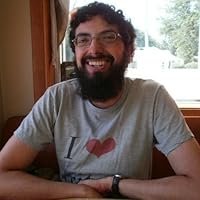
Greg Bechtel’s prize-winning stories have appeared in several journals and anthologies, including The Fiddlehead, Prairie Fire, On Spec, Qwerty, and the Tesseracts anthologies of Canadian speculative fiction. Originally from Kitchener-Waterloo, Ontario, Greg has lived at various times in Toronto, Deep River, Jamaica, Ottawa, Quebec City, and Fredericton while working (among other things) as a lifeguard, technical writer, mover, visual basic programmer, camp counsellor, semiconductor laser labtech, cab driver, tutor, and teacher. Currently, he lives and writes in Edmonton, where he teaches English Literature and (occasionally) Creative Writing at the University of Alberta.
I must be finally getting over my summer cold (its been kicking my butt for about a month now), because I felt the lure of reading something better and more complex than the fluff that I’ve been filling my summer with to date. This book has been sitting on my shelves for almost a year and the time had arrived—I picked it up with anticipation.
What a perfectly titled collection of short stories! All of them poke at boundaries of some sort—between physics and magic, mental health/illness, male/female, reality/illusion, self/others, past/present/future. How accurate is anyone’s assessment of the world? We each view it through our own lenses. The characters are ordinary people, made extraordinary by the author’s attention to their existence.
The writing is beautiful. The stories are a pleasure to read, but I hesitate to say that I fully understand them. They don’t spill their secrets too easily and I can see where I will likely read them again, more slowly and with more attention. Though each stands on its own, they also support one another, each providing a window into their creator’s imagination. The varied topics reveal an unexpected mix of experience and knowledge.
I will definitely be interested to see what Mr. Bechtel publishes next.
We tend to think of boundaries as stable, fixed, unchangeable, but boundaries are inherently permeable, and any boundary that is created is created because someone or something is able to slip trough it. Greg Bechtel writes on these borderlands whether they be of genre (realism, science fiction, fantasy), gender (male, female, intersexed, trans, genderqueer) temporal (past, present, future), he shows a fascination with those luminal spaces and situations, heightened periods of intensity when things are shifting, because the reality is that everything is constantly in flux and stability is a fiction. And fiction, the stories that create us, constitute us, and shape our experience of the world, can be very much real.
Boundary Problems delves into a polyphonic mix of characters speaking themselves into the world from the margins, announcing their complexity and unwillingness to be captured in a single voice. Bechtel recognizes the inherent slipperiness of stories, the sense that writing a story down attempts to, but will never succeed in, fixing a story in one voice. Every reader will inherently read a story with their own voice, their own set of expectations and symbolic understandings. His characters fluctuate throughout the story, in some cases fluidly moving between gendered, racial, and sexual identities. He recognizes the permeability of story and personhood – that each filters into the other and that we are constituted by stories, tales that shape our identities. The uncertainty of his story endings speaks to this idea that he is only capturing a snapshot of a wider story and that the character has an existence separate from and larger than the story. He speaks to the continuity of all stories and that the stories that we write are fragments building a feeling, a state of being and an aesthetic for the reader but that no story is ever complete or done, but perpetually in progress. He reminds readers that writing endings is an artificial process, and that it limits the complexity of the notion of The Story itself.
Boundary Problems provides snapshots of the human experience, moments of people trying to make sense of the world around them. Bechtel shows an interest in going voice to people who have been expelled from the hegemony of “The Normal”, inserting those pushed to the fringes into a position of centrality. He reminds readers that those stories pushed to the fringes and devoiced are often the most complex, fascinating, and thought-provoking.
Bechtel’s collection explores that permeable place between speculative fiction and realist fiction, not shying away from either, but interweaving them – because reality IS speculative, and good speculative fiction should evoke questions and speculations about reality. Bechtel deals with real world issues like violence against women, place and selfhood, the policing and control of sexuality, surveillance and losses of freedoms, and the danger of hegemonic power structures silencing the voices of dissent, the voices who speak up against systemic violence and the erasure of their stories, their histories. Boundary Problems delves equally into quantum physics, magic, and the everyday experience of a coffee shop book reading… but all of these stories evoke something of the human experience, tell us about our relationships to each other, to our perceptions of ourselves, and to the world around us.
To read some reviews of individual short stories in this collection, check out my website:
An astonishingly accomplished collection of stories, stories which effortlessly took me to ... yes, I'll be trite, to liminal boundaries. Despite years of reading and the utter predictability stories I read I found myself among a set of stories from a familiar place I have never before been. Not in reality and not in fantasy.
I cannot wait to read what Bechtel writes next. I would especially love to see his cut-crystal technique used in a novel-length work.
I found the stories to be somewhat confusing - the order of the chapters to wanting to know more to get a better picture. The paranoia was evident but in some stories, I felt lost. Who are the characters and what were they looking for? The reader definitely is the outsider to the musings of the charaters - on the outside looking in but not fully understanding what is taking place.
Short stories can be predictable but Bechtel's are not. He brings suspense, innovation and intellect to his characters and to his structures in a way that creates a rewarding reading experience. I use the word "rewarding" specifically here because some stories are a challenge, but they're so worth staying with as the puzzle pieces come together. The first story messes with your perspective (initial thought: who the heck is the narrator?!) and once you settle into the rhythm of the narrative shifts, the emotional peaks are your guide. Story-placement within the collection is also satisfying.
Favourite moments: I began looking for patterns in the short stories and became fascinated by the several characters who are immersed in finding patterns in their worlds. The taxi driver's musings about the dispatcher are poetic and detailed. The sad-or-strong woman pouring expensive scotch on a perfectly white carpet because she's deciding not to move. The three-part "Smut" story, built into the near-future (timely, humorous, and possible).
Perfectly sized stories, an interesting thread between them, and a really great read. It was a fantastic introduction to Bechtel’s work, and I can’t wait to read more from him.
If I had taken science past the required grade 11 in high school, I'm pretty sure I would have failed it. And reading books like this, books that reference physics and other sciency-things of a similar nature remind me of this sad fact. Good thing I stuck to what I knew-English literature. If I had focused on a more useful and concrete topic such as science, I wouldn't have the pleasure of writing book reviews for free like I do now! For those of you who aren't familiar with sarcasm, the previous sentence was a perfect example of it-enjoy.
Anyway, back to the book. Boundary Problems by Greg Bechtel is a collection of short stories, and the stories themselves are all inextricably linked by the notion of the unknown-not the supernatural, but the tiny little molecules and patterns that make up the world around us. In fact, one of the characters in "The Everett-Wheeler Hypothesis" becomes obsessed by the idea of trying to find patterns within the crazy circumstances he finds himself in, and the reader is torn between believing there is truly meaning behind all the strange coincidences, or if they are simply just coincidences. index
One of my favorite stories in the collection is "The Smut Story". It's actually split into three different parts, all very different from each other, and distributed among the other stories in the book. There is a narrative told from three different perspectives and from three different points in time, all about a famous 'smut story' that has a mysterious effect on people. It's a brilliant story, and although no character development really takes place, the unknowable once again rears its head much to the reader's delight.
Bechtel is adept at creating an interesting and well-thought out plot line. However, his character development could use a bit of work. His female characters are all predictably damaged, and struggle with boundary issues in their sex life. The men all blur a bit together for me as well, even though they are typically the protagonists in each story, while women are usually the ones circling around the periphery. The imbalance of gender isn't a detractor from the stories or the writing, but the strange behavior of all his female characters does lend itself to the question: has Bechtel been surrounded by hysterical women all his life? On behalf of women everywhere, I'd like him to know that we don't all have wild mood swings, at least, not on a regular basis.
Despite the lack of character diversity, I'd still recommend this book because it's a great example of how a collection of short stories can push the boundaries of a genre. Boundary Problems explores the limits of sci-fi, speculative fiction, and even fantasy, but all with a literary touch. Here's another reason why you should read this book-Greg Bechtel is going to be making an appearance in Calgary on April 26 with Griffin Poetry Prize Winner, Christian Bök at the Spur Festival. Oh, and he's an Alberta writer published by an Alberta publisher, so for that reason alone you should buy this book.
I was lucky enough to win a copy through Goodreads First Reads. I'll start by saying that the author writes very well. The stories flow well for the most part and the writing is easy - and a pleasure- to read. However, I found the stories difficult mainly because I was left not understanding most of them. Perhaps that's a fault on my part, but I have seen a few other reviews about lack of accessibility and so on, and have to agree. I really wanted to like these more, but since I couldn't fully grasp them I struggled to enjoy them as much as I should have.
However, as one other reviewer says, what doesn't work for one reader may well work for another. So do give these stories a try.
Some folks in the Edmonton Writers Group would like this book: it has a line of speculative fiction and fantasy in all of its stories, with some physics thrown in.
The first half of this book was frankly pedestrian, but the stories in the second half are excellent. Overall the book is good enough that I would read another book by Bechtel.