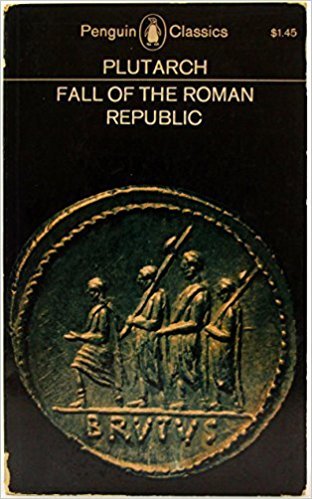
Plutarch (later named, upon becoming a Roman citizen, Lucius Mestrius Plutarchus; AD 46–AD 120) was a Greek historian, biographer, and essayist, known primarily for his Parallel Lives and Moralia. He is classified as a Middle Platonist. Plutarch's surviving works were written in Greek, but intended for both Greek and Roman readers.
This Penguin Classic covers six Roman lives - Marius, Sulla, Crassus, Pompey, Caesar, Cicero - written by Platonist philosopher Plutarch (AD 46-Ad 120), the great biographer from the ancient world.
These were chaotic, bloody times when, fueled by treachery and ruthless violence, the Roman republic fell and was replaced by the Roman Empire. To share a taste of Plutarch, I will focus on one of my all-time favorite people from the ancient world, illustrious Roman philosopher/rhetorician/orator, Marcus Tullius Cicero. Here are quotes from the text along with my comments:
"His natural abilities made him altogether remarkable and won him such a name and reputation among the other boys that their fathers used often to go to the schools to see Cicero with their own eyes and to observe the quickness and intelligence which he showed." --------- To be such a virtuoso of language, adults flock to your school to listen to you speak. So telling about the Greco-Roman world: a supreme value on intelligence and verbal acumen. In our modern world, our most immediate association with a youngster having virtuoso talent would be playing a musical instrument, usually violin or piano. The implications of the difference are worth pondering.
"Elocution and delivery were an important element in his powers of persuasion. He used to ridicule those who were given to shouting out their speeches and said that, just as lame men rode on horseback because they could not walk, so these orators shouted because they could not speak." --------- Ha! Think about this the next time you witness a politician or public figure shouting at the top of their lungs. Would the person speak with more subtlety and eloquence if they really had something insightful to say?
"In Rome itself there were most alarming revolutionary tendencies - the result of the unequal distribution of wealth." -------- Ah, the bane of the "civilized" world since we as a human species left hunter-gatherer communities and began agriculture and started accumulating wealth: the haves and the have nots. It was only a matter of time before a thinker like Marx came along.
"Cicero, more than anyone, made the Romans see how great is the charm which eloquence confers on what is good, how invincible justice is if it is well expressed in words, and how the good and efficient statesman should always in his actions prefer what is right to what will win popularity, and in his words should express the public interest in a manner that will please rather than provide offensive." --------- The dream of having a philosopher as a political leader goes back to Plato. Occasionally, as in the case of Cicero, this much heralded combination was actualized.
"The conspirators, however, were unbalanced characters who seldom met together without wine and women, while Cicero was following their schemes with patient care, with sober judgment, and with exceptional intelligence." --------- Plutarch is a philosopher and his chapter on Cicero serves as a shining example of what a wise person in the political sphere can achieve.
"At this time, Cicero was the most powerful man in Rome. However, he made himself obnoxious to a number of people, not because of anything which he did wrong, but because people grew tired of hearing him continually praising himself and magnifying his achievements." -------- Alas, one with great intellect and strength of character can still have shortcomings; for Cicero it was his habit of continually patting himself on the back. Some things never change: people don't want to hear it. (Plutarch includes a couple dozen of such comebacks - one of the prime reasons to read his life of Cicero).
"His ability to put things cleverly would often lead him to forget good manners. . . . Wanting to underscore Cicero's humble family origins, an aristocrat by the name of Nepos asked Cicero repeatedly, "Who is your father?" Cicero replied, "I can scarcely ask you the same question since your mother has made it rather a difficult one to answer." - Nepos's mother being a lady whose reputation for chastity was not high." --------- It's one thing having a Jonathan Winters/Robin Williams-like sharp wit, but if you don't want a gaggle of enemies, you would be well to employ your tongue with discrimination.
"He occupied himself also in writing and translating philosophical dialogues and in rendering into Latin the various terms used in logic and in natural science." --------- Not only was Cicero a leader and hero of his country, dedicating a huge portion of his life as a public figure, but he had the ability to render Greek philosophy into Latin and thereby make the wisdom of the Greeks accessible to his countrymen for generations.
And how, you may ask, did Cicero's life end? Sorry to say, the Romans periodically turned their country into a bloodbath and poor Cicero was caught up in a political crossfire.
Possibly not the best selection of Plutarch's lives. Although the six lives here are united thematically and cast an interesting light on the history of the period, they are uneven in quality and strongly biased.
I didn't anticipate that Plutarch's lives would be a model of good history even by the standards of other classical history writers. He was famous as a moralist and perhaps we see him as a precursor to the essayist. A Greek of a high social class who worked eventually as a priest for the Oracle of Delphi, he was a student during the reign of Nero and was active in the time of the Emperor Hadrian. His lives contrasted a famous Greek with a famous Roman who Plutarch considered to be a counterpoint. Modern translations seem on the whole to break up his original project and publish groups of related lives instead, such as this one which includes Marius, Sulla, Crassus, Pompey, Julius Caesar, and Cicero.
There is no interest in any of these lives in the formation of the character of the individual. So there is none of the interest in ancestry, upbringing and education such as you find in Suetonius' The Twelve Caesars. The personality is fully formed, and Plutarch is not much interested in it, there are a few passages that we might read as showing some interest in the psychology of his subjects - why they behaved the way that they did, but they might total a page and a half or maybe two pages of the 360 odd pages of printed text here. These are overwhelmingly lives of actions, with barely any interiority, but many omens, signs, symbols and witticisms. Many of the lives feature someone, not necessarily the subject of the life, saying something along the lines of; there are laws but we have swords - these lives are all from a time when possibly might did not make right, but plenty of people thought it could do; provided that you killed, disinherited, and disbarred enough people (and their descendants) from political life.
A general theme to the collection might be the idea of a Thucydides trap. In this case not between states but among them, that one was obliged to seek military power and to execute the supporters of your rivals, purely to stop them from gaining power and executing your supporters. The surprise reading these lives is not that the Republic ended in an empire, but that the Republic tottered on as long as it did. This made for very sobering reading at a time when many countries claim to be democracies, but elections seem to be a long way from being free or fair competitions with the practise of opposition politics hindered by various direct or indirect means.
Something that interested me was that in the fighting between Marius and Sulla, Plutarch quite often mentions soldiers from opposing armies talking to each other before a battle, followed by units or even on one occasion an entire army changing sides (leaving it's general feeling a bit lonely and outnumbered in his tent. This doesn't seem to be the case in the fighting between Pompey and Caesar though.
The lives here have a strong thematic unity, the fatal flaw, or apple of discord in Plutarch's telling is the rivalry between Marius and Sulla which develops because something about Sulla rubs Marius up the wrong way, Sulla's innocent Roman desire to claim credit for victories and be acknowledged as a great soldier and statesman is somehow completely misinterpreted by Marius and a grave rivalry develops between the two. Still I feel it fair to mention that Plutarch's main source for both lives seems to be Sulla's memoirs (he mentions this several times). Pompey and Crassus were both beneficiaries from Sulla's period as Dictator, while Caesar was a relative of Marius'. Only Cicero is the odd man out as somebody trying to make a career in the aftermath of Sulla within the political system that he left behind.
For this reason Plutarch sees the period of collaboration (and inter-marriage) between Pompey, Crassus, and Caesar as the factor that led to the breakdown of the political system.
Plutarch is certain that Caesar was determined to overthrow the Republic and establish a monarchy, possibly from when he was in his mother's womb, or maybe even earlier, which colours that biography distinctively. There is not enough material for a life of Crassus, so it is padded out with an account of the Spartacus war, which Crassus did bring to an end, but which he was otherwise uninvolved in, it is from this life that we have the story that the Partian king and his court were enjoying a performance of Euripedes' The Bacchae when Crassus' head was brought to them - and then used as a prop in the performance, possibly too neat a story to be true.
It is easy to imagine that Plutarch didn't completely understand the politics and society that he is writing about, he was writing several hundred years later, but he does at least mention in his text some of the sources that he used; like Sulla's memoirs, or the history of Juba of Numidia (a son of the King held hostage in Rome and educated there) both of which haven't survived to the present.
It’s hard to give someone like Plutarch a Goodreads rating, so I’m going with 5 given the importance and readability of this 2000 year old text. I read the Penguin Classics translation, and I found it engaging and interesting throughout, and very readable.
This is only a small snippet of Plutach’s Lives though, and I’d love to have my hands on the whole thing. The stories of the character in this book; Gaius Marius, Sulla, Caesar, Cicero, etc. are jaw droppingly interesting. Marius and Sulla are two of the absolute most interesting people of the Late Republic, and reading this alongside Colleen McCullough’s First Man in Rome has been an absolute joy. I’ve read lots of historical fiction, and some modern non-fiction, but there’s something about being able to read (translations of) these stories as they were told to and known by residents of the Empire. Endlessly fascinating, and I am excited to check out Appian’s take on these events now. I don’t stand a chance with Greek, but if only I had paid more attention in Latin class…might be time to dig out some of those old textbooks as well!
A must read for anyone with an interest in Ancient Rome.
I think these six Roman Lives can be regarded as the best ancient biographies I've ever read since Plutarch, as a second to none biographer, wrote the Lives vividly, lively and professionally. In other words, few could surpass him. In fact I started with his Caesar first because I would like to know more about his life and deeds militarily and politically, and his version doesn't disappoint me. For instance,
"The reported size of the island (i.e. Britain) had appeared incredible and it had become a great matter of controversy among writers and scholars, many of whom asserted that the place did not exist at all and that both its name and the reports about it were pure inventions. So, in his attempts to occupy it, Caersar was carrying the Roman empire beyond the limits of the known world. He twice crossed to the island from the coast of Gaul opposite and fought a number of battles in which he did more harm to the enemy than good to his own men; ... With the final result of the war he was not wholly satisfied; nevertheless, before he sailed away from the island, he had taken hostages from the king and had imposed a tribute." (p. 278)
And I kept wondering why not Caesar the Great, since what Caesar did and achieved was great. One of the obstacles concerned, I think, was politics.
Moreover, I enjoyed reading Pompey in more detail, that is, from my previous obscure knowledge from reading on his life and his name added by 'the Great' surprised me till I wondered if he was a king. His readers would know more information related to such a query. I read about him and knew he was murdered somewhere in Africa while on the run, it was definitely sad to read how he confronted his fate.
A brilliant look at the main players of the fall of the Roman Republic. Particularly fascinating were the politics involving the first triumvirate of Crassus, Pompey and Caesar - Crassus had the money, Pompey had the military prestige, and Caesar was the conqueror of Gaul. Plutarch details how the death of Crassus in Parthia unbalanced the triumvirate, leading to a civil war that caused the ignoble death of Pompey and the rise of Julius Caesar, before meeting his fate on the ides of March.
This is a must read for anyone interested in Roman history, as it's a great guide to the political situation at the time and should further anyone's understanding of the era. There's a reason Shakespeare took so much inspiration from Plutarch.
It's probably not possible to add much of anything significant to what's been written about Plutarch, but while reading this a several things really hit home with me.
First is the nature of, and reason for the disaster that befell the Roman Republic. It basically tore itself to pieces because individual men were allowed to maintain their own personal armies to promote their careers by brute force, and the resulting disaster was so profound that the population of Rome was only half of what it was before the civil wars started. Julius Caesar alone killed over a million people - a significant portion of the population of Europe, at that time. It's no wonder that the Romans abandoned the Republic and were willing to try almost any other form of Government by that time.
Second, you can see how those events informed our Founding Fathers in their attempt to create a lasting Republic - doubting the possibility of success to the very end - and in how they struggled to create safeguards against the same sort of disaster: "the Military must be subordinate to the Civilian power", the obsession with checks and balances, the creation of a strong judiciary... It's still not at all certain that they succeeded, and won't be for several hundred years even if our Republic does survive past our lifetimes, but the footprint of the disaster reaches all the way across the centuries into our own lives.
Finally... it's only now, after much reading and later on in life, that I've been able to make use of anything like Plutarch. Absent at least a rudimentary understanding on the part of the reader of the history of the period, he doesn't make a lot of sense (and in fact is rather boring), but given such an understanding he's just terrific at tying the events together from the viewpoint of a contemporary of them. The college I went to tried to convey a "classical" education comprising all this, but failed miserably, its mediocre professors bogging the curriculum down in ther personal obsessions with the minutiae of Roman and Greek art, philosophy, civics, etc. - and I really wish they'd instead conveyed what was really important: the lessons for our time of the rise and fall of the Roman, and to a lesser extent the Greek civilizations. That would have given me a useful understanding a lot earlier in life of what our Founders were thinking, of world history during the 20th century, and of what we're facing now, instead of having had to acquire such on my own, in a piecemeal and haphazard fashion.
I studied Roman history about 15 years ago so had this book from then. I don't think I actually read it at the time though. Not having studied Roman history in awhile, it was a good refresher. Plutarch wrote several "lives" or biographies of Greek and Roman men. This volume contains the lives of Marius, Sulla, Crassus, Pompey, Caesar and Cicero. I struggled through Marius and Sulla. I never really understood that period in Roman history. However, the last four lives brought back a lot of what I remember from University. I like the way that Plutarch is essentially telling the same story but from different perspectives. I think Julius Caesar was the most intriguing and made me want to read more. Did he, as Plutarch suggests, have a plan for gaining ultimate power or was Caesar just as much shaped by events as everyone else? And there are some interesting parallels to modern day discussions on how well democracy works and does it serve the needs of a few or the needs of everyone. I only gave this three stars though because sometimes Plutarch drifts and I struggle to follow where he is going. I also struggle with the detailed descriptions of battles, especially the Jugurthine War and Crassus' death in Syria. Otherwise, I felt it was worth reading.
Plutarch is a mid-biographer but we can forgive him since he was kind of inventing the genre. Interesting from a historical perspective but not actually that enjoyable to read.
These biographies are fun to read, and the best ones are of Caesar and Cicero. The language in the Penguin Classics edition is easy to read and informal. With Cicero in particular, Plutarch gives you a sense of the man's personality and sense of humor. Still, as these were written 2,000 years ago, they lack the context that would be helpful from today's perspective - such as, what was the relationship between the civil and military roles of these leaders? But interesting in and of themselves and worth the read.
Read in the gazebo during some hot days and finished after run today with daughter. 6 lives of great Romans. Really enjoyed reading. Now finished as my Cicero by Anthony Everitt has arrived.
Vivid, if a little biased, account of the fall of the Roman Republic and rise of the Roman Empire through the lens of the great men of the era. Prescient for our day.
I mainly disliked this book because this Penguin edition had virtually no footnotes, and the footnotes it had were useless (usually noting the full names of random Romans). The actual biographies were entertaining.
Marius and Sulla - avarice, ambition, and violence are the defining characteristics of these two Lives and the war that these two nasty men fought. It's interesting to see how the patriotic and moralistic culture of the early and mid-Roman Republic devolved into the violently crazed power grabs of the late Republic.
Marius - if I had to sum up Marius in one word, it would be scrappy. He first distinguished himself while fighting for Scipio Aemilianus Africanus in Spain, becoming a favorite of Scipio. He became a tribune and proposed a populist law - the consul reprimanded him and overturned the law, and this newbie tribune "threatened to drag Cotta off to prison unless he had his decree rescinded." Then Metellus, Marius's political sponsor, voiced his support of Cotta. And Marius PERSISTED in calling for Cotta to be taken to prison. (His law was allowed to stand). Marius next ran for the aedileship. He ran for two different aedileships and lost both elections - "He was thus in the unprecedented position of having lost two elections in one day; but this had no effect whatever on his own opinion of himself. Soon afterwards he stood for the praetorship and very nearly failed again." Later his sponsor Metellus fought a war against Jugurtha, king of the Numidians, and brought Marius along. Marius distinguished himself in the war but also constantly antagonized Metellus, eventually resulting in Marius leaving Africa and running for consul against Metellus's wishes. (Marius won the consulship and created a new type of army - one made up of poor, landless men instead of the traditional landowners who made up the army. This type of army would become the death of the Republic as the soldiers' post-war livelihoods were dependent on their generals rather than on their state.)(Lots of stuff then happened... Marius finished the Jugurthine War but Sulla took credit for capturing Jugurtha. After this he reached the peak of his achievements and popularity when he defeated the Cimbri and Teutoni. He really saved Rome from a sacking thanks to his good generalship. I think this little exchange captures the essence of good generalship: ‘If you really are a great general, Marius, come down and fight it out.’ To which Marius replied: ‘If you are a great general, make me fight against my will.’ After this Marius and Sulla both fought in the Social War to subdue Rome's rebellious Italian neighbors; and then they sparred for command of the war against Mithridates. Then there was a bunch of squabbling and dueling between Marius and Sulla over the Mithridatic command which I couldn't fully keep track of. But at one point it resulted in Marius being supreme in Rome and then being chased out of the city. At this point he was old and fat, but he was as scrappy as ever. He and a few companions sailed down the coast of Italy but we forced ashore by lack of water and food. They scrounged around but we chased by Sulla's men. At a certain point Marius found a fisherman living in a marsh and got the man to hide him under some reeds in a muddy hole. But then Marius could hear Sulla's men interrogating the fisherman, so Marius jumped into the marsh to try to hide under the water but he was found, naked and muddy. It's pretty incredible that someone who had been essentially ruler of Rome was reduced to that state. He was put under house arrest and a soldier was sent to kill him - but "out of the darkness came a great voice: ‘My man, do you dare to make an end of Gaius Marius?’ At this the foreigner threw down his sword and rushed straight out of the room. He ran out of doors crying out simply: ‘I cannot kill Gaius Marius.’" Anyway more shenanigans happened, Marius got control of Rome again, instituted a reign of terror, and died.
Sulla - Sulla was a weird/creepy mixture of theater-loving hedonist and disciplined military genius (and brutal tyrant). He gained prominence it seems mainly as being the natural anti-Marius leader. He was an important general during the Social War and made war against Mithridates, but he mainly limited his campaigning to Greece unfortunately. He completely wrecked Athens and also despoiled many of the most famous Greek sanctuaries, including Delphi, to fund his siege of Athens. I felt emotional pain reading about this. He eventually stormed Athens: "Sulla himself entered the city at midnight, after having thrown down and levelled with the ground the fortifications between the Piraic and the Sacred Gate. It was a moment made the more terrible by the blowing of trumpets, the blasts of bugles and the shouting and yelling of his troops who were now let loose by him to pillage and to slaughter and who poured down the narrow alleyways with drawn swords in their hands. There was thus no counting of the slain; to this day their numbers are estimated simply by the area of ground that was covered with blood." I think that this event probably marks the final end of any notion of an independent Greece. Sad. Boycott Sulla! No more summary of his life! He doesn't deserve it!
Caesar and Pompey - I really enjoyed these lives. I liked the Life of Caesar because it consisted mostly of anecdotes that I've heard before, but always in the context of "Plutarch says in his Life of Caesar that..." and then it's some awesome story like the one where Caesar got captured by pirates and when they told him they were going to ransom him, he told them to up the ransom because he was worth more than that. And he bossed them around, recited speeches and poetry to them, and told them he would make them pay for what they'd done. And when he was released he raised a private force, captured them and crucified them. Caesar - I like the portents which Plutarch describes in this life. A lot of them were used by Shakespeare. For example, "the great comet, which shone very brightly for seven nights after Caesar's murder and then disappeared; and also the dimming of the sun. For the whole of that year the sun's orb rose dull and pale; the heat which came down from it was feeble and ineffective, so that the atmosphere, with insufficient warmth to penetrate it, lay dark and heavy on the earth and fruits and vegetables never properly ripened, withering away and falling off before they were mature because of the coldness of the air." And Brutus's phantom: "He fancied that he heard a noise at the entrance to the tent and, looking towards the light of the lamp which was almost out, he saw a terrible figure, like a man, though unnaturally large and with a very severe expression. He was frightened at first, but, finding that this apparition just stood silently by his bed without doing or saying anything, he said: ‘Who are you?’ Then the phantom replied: ‘Brutus, I am your evil genius. You shall see me at Philippi.’ On this occasion Brutus answered courageously: ‘Then I shall see you,’ and the supernatural visitor at once went away." And the old man who warned Caesar to beware the Ides of March. Plutarch also records Caesar's famous phrases "I came, I saw, I conquered" after defeating Pharnaces at Zela, and "The die have been cast", after he decided to cross the Rubicon. He records how Caesar shed tears when he received Pompey's head from the Egyptians, and he also records how Cleopatra had herself bundled into a carpet in order to meet Caesar.
Pompey - it's easy to forget that Pompey was just as much as military genius as Caesar. He just lacked Caesar's political cunning. "In front of the procession were carried placards with the names of the countries over which he was triumphing. These were: Pontus, Armenia, Cappadocia, Paphlagonia, Media, Colchis, Iberia, Albania, Syria, Cilicia, Mesopotamia, Phoenicia, Palestine, Judaea and Arabia; there was also the power of the pirates, overthrown both by sea and on land. In the course of these campaigns it was shown that he had captured no less than 1,000 fortified places, nearly 900 cities and 800 pirate ships; he had founded 39 cities. The inscriptions also showed that whereas in the past the public revenue from taxation used to be 50 million drachmas, they were now receiving from the additions to the empire made by Pompey a total of 85 million; and that he was bringing into the public treasury in coined money and in gold and silver plate 20,000 talents, apart altogether from the money which had been given to his soldiers, none of whom had received less than 1,500 drachmas." "Others before him had celebrated three triumphs; but his first had been over Africa, his second over Europe, and now this last one was over Asia, so that in his three triumphs he seemed in a sense to have led the whole world captive." You get the feeling that Pompey may have been (justifiably) arrogant and aloof, but overall he wasn't a bad guy, especially compared to his contemporaries. However, he made many political mistakes that looked bad, for example when he abandoned Cicero, his former ally. And most seriously when he abandoned Italy to Caesar and allowed the Senate to accompany him in his camp (since he then allowed the senators to influence him to attack Caesar prematurely at Pharsalus).
Crassus - Crassus was a consummate businessmen with few principles other than to make more money. He was famous for profiting from Sulla's proscriptions and for being the first at the scene of a fire in order to buy the property at a discount (he had a private fire brigade which would then put out the fire). Interestingly, I think that his businessman's attitude also led him to be good at compromise. He often would ally with former enemies when it suited his needs, most notably in the case of Pompey. Unfortunately for him, his life's final exploit, his campaign against the Parthians, was a complete disaster of his own making. Although he at first met with success, he delayed his progress in order to set the accounts of his cities in order rather than press his advantage. Next, he was fooled by multiple 'allies' into marching into a desert plain where his troops lacked water and the Parthian cavalry had a significant advantage over the heavily armed Roman legionnaires. The Parthians then utterly destroyed his army.
Cicero - Cicero stands out from the other Romans of this time by making his name not as a warrior but as an orator. He "naturally inclined to laughter and mockery" and was very quick-witted. However, he "not only lacked courage at the sight of armed men, but was always timid at the beginning of a speech and in many trials scarcely stopped quivering and trembling even when he had really got going and was at the height of his eloquence." The high point of his career was when he thwarted the Catilinarian conspiracy. He dealt with the conspiracy in proactive yet principled manner, although his opponents would eventually use his final act of ordering the conspirators to death without trial against him. One interesting anecdote on the power of Cicero's oratory: "It is said too that when Quintus Ligarius was being prosecuted as one of Caesar's enemies and Cicero was defending him, Caesar said to his friends: ‘Why should we not hear a speech from Cicero after all this time? As for Ligarius we have long known him to be guilty and an enemy.’ But when Cicero began to speak his words were incredibly moving; and as his speech proceeded, ranging in the most wonderfully charming language from one emotion to another, the colour came and went on Caesar's face and it was evident that every passion of his soul was being stirred. And finally, when the orator touched on the battle at Pharsalus, Caesar was so deeply affected that his whole body shook and some of the papers that he was holding dropped from his hand. So he was, as it were, overpowered and acquitted Ligarius." Unfortunately, later in life Octavian totally got the better of Cicero: "Here, certainly Cicero in his old age allowed himself to be carried away by the words of a youth and was utterly taken in by him. He helped Caesar in the canvassing and procured for him the goodwill of the senate. For this he was blamed by his friends at the time, and soon afterwards he too realized that he had ruined himself and betrayed the liberty of his country. Once the young man had established himself and secured the consulship, he paid no further attention to Cicero. Instead he made friends with Antony and Lepidus, joined forces with them and divided the government with them as though it were a piece of property. A list was drawn up of the names of more than 200 men who were to be put to death. But what caused most trouble at their discussions was the question of including Cicero's name in this list." Octavian agreed to put Cicero on the proscription list in exchange for Lepidus giving up his brother Paulus and Antony giving up his uncle Lucius Caesar. (Cicero was a ferocious opponent of Antony). Cicero was eventually chased down and his severed head and hands were brought to Antony.
An excellent collection of biographies that, taken together, explain how Rome ceased to be a republic. Plutarch’s writing is lively and fun at time. Better notes for a modern reader could make this an even more compelling read.
Knew you not Pompey? (Do not attempt to write on both sides of the paper at once.)
Sadly this is not a joke from Sellar and Yeatman’s comic history book, 1066 and All That, and yet somehow I thought it was. I checked my copy, and the quote is alas, not there.
If you do not know Pompey, then you have obviously never read Plutarch who wrote a biography of the Roman statesman. In fact Plutarch wrote many biographies relating to Roman and Greek politicians of the past. He also wrote about the Emperors, but sadly this work is missing. The biographies that did survive are remarkable works though.
My copy of this book has a preface before each biography criticising Plutarch’s shortcomings as a historian. This is fair enough, but the historical thinking of any age is contradicted by the writers of the next age. History is constantly revised and rewritten, based on findings and theories.
In any case, Plutarch wrote from the limited primary and secondary sources available to him, and was nor purely concerned with historical fact. The biographies collect an impressive amount of information, but their purpose is to point a moral. Plutarch wishes to discuss the problems of power, to contrast good and bad governance, and to show the effects that ruling has on the character of the leaders, and that the character of the leaders has on their rule.
This particular volume is not presented in the way that Plutarch wrote it. Plutarch put his biographies in a volume called Parallel Lives that attempted to match Greek and Roman politicians to find tenuous areas of similarity. Nowadays his translators are less interested with this structure, and choose instead to present all the biographies from one particular age.
In the case of The Fall of the Roman Republic, Rex Warner has assembled six prominent Romans who played their part in undermining the Roman Republic in a manner that paved the way for the Emperors. These are Gaius Marius, Sulla, Crassus, Pompey, Caesar and Cicero.
My Sellar and Yeatman quote may have been only in my head, but there is a real quote from that book, which runs, “Which do you consider were the more alike, Caesar or Pompey, or vice versa? (Be brief.)” There is something in this. What is notable about Plutarch’s biographies is the similarity in the personalities and behaviour of the six figures. Certainly five of them. Cicero seems the less power-hungry of them.
To summarise, while the men have individual foibles, they share the following qualities. They are great (or fortunate) military leaders who achieve triumphs that make them hard to resist when they wish to take control. They are scheming and fiercely ambitious, wanting to have as much control in Rome as possible.
When they obtain that power, they generally abuse it. Their enemies are executed, and the democratic institutions of Rome are threatened. However new leaders with few scruples are always around the corner, and their power is fleeting.
Pompey was comparatively likeable, and Caesar, for all his cold ambitiousness, was surprisingly merciful. However it is clear that Rome was a dangerous place to be, a city where everyone might find their lives at risk as the power structures constantly changed, with leaders rising and falling when challenged by rivals.
What Plutarch’s work reminds us is that it is dangerous to put too much power into any leader’s hands. It has a corrupting effect on the individual, and it puts everyone’s safety at risk. This is a lesson that we need today.
It would seem, after the horrors of the twentieth century, that people would have had enough of the cult of the strong leader, but sadly that is not the case. There is still an admiration for any ruler who is seen as strong, no matter how awful their agenda, or how personally unpleasant they are. The messy business of coalitions, compromises and shared power is unglamorous and irritating by comparison.
Anyone who had learned the lessons of Ancient Rome would know that allowing one man or clique too much power to run a country will inevitably result in disaster. The person who wishes to rise to such a position of unchecked power is generally the kind of person who should be kept farthest from it.
The effects in Roman times were minimal compared to today. Without the state apparatus to apply brutal controls across the whole Empire, it was mainly Rome and its environs that suffered. This is no longer the case.
The current ruler can apply a reign of terror across an entire country. We need to pay attention to what Plutarch, Tacitus and Suetonius warned us about many years ago if we are to prevent another Stalin or Hitler.
This is an entry into another world. I last picked up this book forty years ago, when living in Turkey, and I'm not sure if I read all six lives: Gaius Marius, Sulla, Crassus, Pompey, Caesar, and Cicero. This time I certainly read all six, and they are well worth reading. For one thing, the way in which their lives overlapped gives one something of the effect of one of those novels in which the same incident is told from different points of view. Here is the Roman Republic from the late Second Century BCE until the death of Cicero in 43. At the beginning we see the gaping social divisions beginning to be manifested in political violence, and at the end the Republic is gone.
One way of looking at this is as a losing struggle on the part of many Romans, notably Cicero, to save the Republic. The others, in seeking their own selfish aims, and sometimes in self-preservation, end by establishing a monarchy.
Plutarch's Lives was one of the sources for William Shakespeare's plays. Read Plutarch's Life of Caesar, and you see where the playwright obtained not only the action, but the characters that drive his plays. The famous "lean and hungry look" of Cassius is not taken word-for-word from Plutarch, but you can see where Shakespeare derived that description of the man.
There is a general introduction by Rex Warner, and short introductions and notes by Robin Seager. These are, usually, informative and not intrusive.
One thing that makes the world of the late Roman Republic so fascinating is that the time feels similar to our own. Are we, too, living through the end of our Republic?
The story of Julius Caesar has always been popular, and yet it has to be seen in the context which Plutarch provides. The Roman Republic had functioned for seven hundred years, as an oligarchy, not as a democracy. Ultimately the power struggles between famous rivals became too great and, as so often happens, strong individuals usurped the power of the state.
The Fall of the Roman Republic by Plutarch is a collection of biographies about six men important in the fall of the Roman Republic. These men are Gaius Marius (Marius), Lucius Cornelius Sulla Felix (Sulla), Marcus Licinius Crassus (Crassus), Gnaeus Pompeius Magnus (Pompey), Gaius Julius Caesar (Caesar), and Marcus Tullius Cicero (Cicero). Plutarch's belief is that history is mainly concerned with a few individuals, so instead of writing generally about the time period with important characters, he writes the history of the time period through these six men's lives.
First off, the good. Plutarch writes in a very straightforward manner, so you get a good history of the men and the period they lived in. Beside that, there's not much to say, Plutarch does a good job of writing the history and that's the only reason you would (and should) read this book, is the history, which can be interesting, but only if you are interested in it.
Now, some criticism of the book. First off, the prose is not what you'd expect from a modern author, and a fair amount of sections can be very dry and be a bit of a slog to get through. Also, not really Plutarch's fault since he probably wouldn't have expected his book the read almost two thousand years in the future, but there are some confusing place names (eg. Iberia was a kingdom in the Southern Caucasus's, Albania was another kingdom there) so that be quite confusing. Along with the constant references to various Roman political offices which were lost on me makes it a bit confusing. So, you may need to look up place names if confused, and knowing a bit about the Roman political system would be useful.
Overall, as I said earlier I think if you are interested in the declining years of the Roman Republic (not Empire) and want to read about it from the source this is a good book, but I would say there are probably better contemporary books about the subjects, such as Tom Holland's Rubicon: The Last Years of the Roman Republic, though I haven't read it.
Having been a student of Latin and Ancient Rome I’d often encountered Plutarch and read a few sections of his work, but never delved too deeply into his writings. Seeing this book on the shelf of a second-hand bookshop I knew it was time. He writes well and concisely, with many interesting insights into Roman society and the historical times – the end of the republic – while focusing on the chief characters of the changes that brought the empire. I don’t fully agree with his insistence, so common amongst Romans, that the Great Man is a bigger influence than historical forces, but it does give the book a good structure by focusing on individuals such as Marius, Sulla and Julius Caesar. The collection itself is a modern construction, selecting only the biographies of relevant characters and one day I hope to read the rest of the surviving works of Plutarch, although I always feel guilty reading books from Ancient Rome in English. A good analogue for the chaos of Jakarta.
Plutarch's grasp of politics is grand instead of minute. His emphasis on warfare and personality no doubt does not endear him to contemporary historians. Some of his contentions are flat out wrong. Yet he is the master of the fair biography, good at pointing out a man's strengths and weaknesses, and giving it all a dramatic and even tragic touch. Sympathy is given when warranted as is condemnation. In this volume the best lives presented are Sulla and Pompey. Cicero is a bit dull, hurt by Plutarch's lack of political insight. Crassus and Caesar are solid. Marius less so, but at least his military abilities are made clear.
Nor did he ever allow the enemy to get a hold over him. Even when he was surrounded by their entrenchments he bided his time, quite unmoved by challenges or by insults. They say that once Publius Silo, the most powerful of the enemy commanders and the one with the greatest reputation, said to him: 'If you really are a great general, Marius, come down and fight it out.' To which Marius replied: 'If you are, make me.'
I would recommend Plutarch to anyone who loves characters. Even if you don't enjoy history, you can enjoy Plutarch for his wonderfully crafted portraits of characters. It is the little things that make up a personality that Plutarch cares about; kindnesses, cruelties, strengths and flaws that he writes about, not dates and battles.
Plutarch was a very enlightened historian who had a good grasp at just what events shape men, from the tiny anecdotes to the witticisms to the grandiose achievements— Plutarch knew how to best paint a portrait. I believe this is why he has lasted through the ages, a great read which puts you in the arena with a series of interesting, ambitious Men of Rome.
Between 3 & 4. I like this kind of book. It is interesting how you can read two different authors who address the same subject and get totally different accounts of the subject matter. Hmmm. I think I would probably go with Plutarch this time. But, who knows. This was a college text.
Man, this guy spits hotter than Dante Allighieri. Just mad shit talk. And keeps it Hella real with "also he was pretty or smart, etc" so it seems like the shit talk is Hella real.
I) GAIAS MARIUS
His action being considered illegal, he was called to account for it, he replied that the din of warfare had drowned the voice of the law.
Fucking became leader 7 times like he wanted and then died 17 days later after being given the position.
Dirtbag. But also let landless civilians serve in the Marian reforms. This was thought to have created a semi-professional class of soldiers motivated by land grants; these soldiers in turn became clients of their generals, who then used them to overthrow the republic.
2. Sulla Was a crybaby bitch, I guess. So no one expected him to do shit. Archers so pressed they grabbed arrows and used them like swords
"When a man is in power the evil that has been latent reveals itself" ---killed 6000 soldiers that he had swear fealty to him and then he killed them in the circus at Rome.
Was asked who he was going to kill, published 80 names, next day 220 names, next day, same 220 names. He get asked if that's all. He's like "fuck no, I probably forgot some bitches. And get this, if anyone kills a bitch, I'll give them like 10 g's. And they can have all their land. Also, obviously, I'm now a dictator."
Anyway so people just were killing people for their land after awhile and they'd say "my estate is hunting me."
But then he got super into sex and was fucking hoes (named specifically in the text) and he got worms and was devoured by them. And people had to like, try to get the worms out of his butthole for a hot minute but there were simply too many worms.
But before he died he was like "jk I'm making rules no one can ever rule like this again."
Truly democratic.
3. Crassus (essentially Elon musk)
Went into battle even thought he sucked at it. His parents owned like every silver mine. Him and P didn't like each other but helped get Ceasar elected. His biggest contribution in the downfall was just giving bitches a fuck ton of money.
Dies in battle because he doesn't listen.
4. Pompey Actually really good at war. People loved him because he didn't want power and was fair. Ceasar fucking HATED HIM.
5. Ceasar He burned the library of Alexandria because he burned his ships so other people wouldn't get them. 48 BCE, Caesar was besieged in Alexandria by the Egyptian fleet during his civil war with Pompey. To break the siege, Caesar ordered the ships to be set on fire, which spread to the city and the library. However, Caesar's account of the event doesn't mention the library's destruction, which may be because he often left out damaging facts about himself. Cassius killed himself with the same dagger he killed ceasar with. Brutus stabbed ceasar in the balls Casca was the first to stab him. His will left everything to the people and when they found out they burned the houses of the murderers. Brutus and Cassius dipped out.
After he was killed the sun didn't shine very well for a year and crops didn't grow and a comet was seen for 7 days. He fucked up because he wanted to be king over the whole fucking thing and no one wanted that. Brutus was a descendant of the person who made that illegal in the first place. 6. Cicero "Inability to resist the temptation to make smart remarks, regardless of the consequences."
I love him. He is me.
Plato said he had the quality that ought to be present in nature's that are fitted for scholarship and the pursuit of wisdom; gladly taking to every branch of learning and who rejects no aspect of literature or education. Told by the oracle to not trust popular opinion but to trust his own nature. Was just a badass at school.
Divorced his wife and married a much younger woman for her money. What a bro.
Killed while looking out of his litter. They slit his throat and then took his hands and head and displayed them on the great warships.
Later, Ceasars grandchild had Cicero's book and tried to hide it and Ceasar was like "he was smart af and loved his country."
CAESAR, CICERO, AND FOUR OTHER "ROMAN LIVES" BY CICERO
Plutarch (46-120 CE) was a Greek historian, biographer, essayist, and Platonist. This book contains six of the "Roman Lives" that Plutarch wrote: covering Gaius Marius; Sulla; Crassus; Pompey; Caesar; and Cicero.
He comments, "Thoughtless and forgetful people... let everything that happens to them slip away as time passes. And so, laying hold and retaining nothing, real good always eludes them; instead they fill themselves with hopes, and neglect the present while they fix their eyes on the future. Yet what happens in the future is subject to fortune, whereas the present is here and cannot be taken away." (Pg. 62)
About Sulla, he observes, "I should have to write another essay altogether to determine the point whether this is a real change and revolution in man's nature, brought about by fortune, or whether it is rather the case that when a man is in power the evil that has been latent in him reveals itself openly." (Pg. 104)
He notes, "Here were opposed armies of the same kin, ranks of brothers, identical standards; here the whole manhood and might of a single state was involved in self-destruction---a clear enough lesson of how blind and how mad a thing human nature is when under the sway of passion. Had they only been content quietly to govern and enjoy their conquests, the greatest and best part of earth and sea was theirs to control." (Pg. 231-232)
About Cleopatra's meeting with Caesar, he records, "Since there seemed to be no other way of getting in unobserved, she stretched herself out at full length inside a sleeping bag, and Apollodorus... carried it indoors to Caesar. This little trick of Cleopatra's... is said to have been the first thing about her which captivated Caesar, and... he was overcome by her charm and arranged that she and her brother should be reconciled and arranged that she and her brother should be reconciled and should share the throne of Egypt together." (Pg. 290)
About Caesar, he wrote, "a soothsayer warned Caesar to be on his guard against a great danger on the day of the month of March which the Romans call the Ides..." (Pg. 303) Of his death, "The first blow was struck by Casca, who wounded Caesar in the neck... those who were not in the conspiracy were so horror-struck and amazed at what was being done that they were afraid to run away and afraid to come to Caesar's help... those who had come prepared for murder all bared their daggers and hemmed Caesar in on every side... (he) had to suffer from the hands of each one of them; for it had been agreed that they must all take part in this sacrifice..." (Pg. 306)
Plutarch's works are essential parts of any library of ancient history.
Fall of the Roman Republic tells of one of the most dramatic periods of Roman history marking Rome’s change from republic to monarchy. This story is told through of the biographies of Marius, Sulla, Crassus, Pompey, Caesar, Cicero, men who headed various factions in the numerous civil wars and revolutions that shook Rome during this period. Plutarch, the Greek author of these works, made no attempt to explain how and why these events took place. Rather he was far more interested in the men themselves and their various failings and achievements. Never the less Plutarch is generally reliable. He gets some minor dates and names wrong and he clearly falls into the Sulla and Pompey camps, but this does not mean to say he glamorizes them. He drew upon a variety of contemporary sources, mainly letters, memoirs, and previous histories, in an effort to tell the lives in a balanced way. This accuracy, as well his attempt to show the character of these men, has made Plutarch a go to source for many historians studying the period. In addition to his reliability, the biographies themselves are pleasures to read. Plutarch had a knack for spotting and giving extra attention to an exciting event. It is no wonder why Shakespeare used him as a main source for his famous tragedies Julius Caesar and Antony and Cleopatra. The histories of the Romans have long captivated both scholars and every day knowledge seekers. Combining the classical Roman and the medieval Byzantine periods no other state in history can claim such a continuous existence. The reflections of the power, culture, and intellect of the ancient Romans has, for better or worse, been one of the most enduring features of Western culture. As such the sources on ancient Rome are most worthy for either a casual reading or for academic research. Among these stands the biographies and philosophies of Plutarch. Born around 46 A.D, in the Greek region of Boeotia, he studied and became a philosopher in Athens and wrote a large corpus of works on a variety of subjects before his death in around the year 120 A.D. His history comes in the form of his large body of biographies title Parallel Lives, written towards the end of his life. The work pairs the lives of great Romans with great Greeks, and focuses on the subjects breeding, education, achievements, and morality. However, the pairings at times make little sense and can confuse the reading if they were constantly flipping between a Roman and Greek. As such the translator, Rex Warner, has done us the service of selecting six of these lives to illustrate the history of the event.