A new and ancient story about perennial nut trees, our ecological role as humans, and the future of food
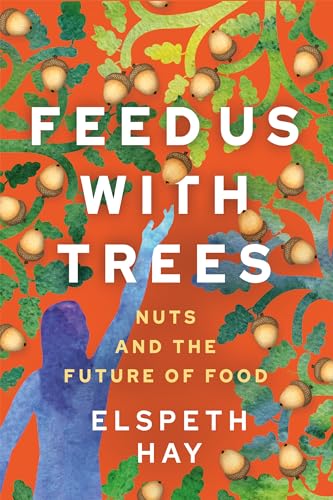
The day Elspeth Hay learned that we can eat acorns, stories she’d believed her whole life began to unravel.
Until then she'd always believed we must grow our staple foods in farmed fields―the same fields wreaking havoc on our land, air, and water. But all over the Northern Hemisphere, Hay learned, humans once grew our staple foods in forest gardens centered on perennial nut trees: oaks, chestnuts, and hazelnuts. In Feed Us with Trees, Hay brings us along as she gets to know dozens of nut growers, scientists, Indigenous knowledge-keepers, researchers, and food professionals―and discovers that in tending these staple trees, we once played a vital environmental role as one of Earth’s keystone species.
Feed Us with Trees is Hay’s hopeful manifesto about a brighter, more abundant future―and a critical look at the long-held stories we’ll need to rewrite to build it. It will appeal to environmentalists, regenerative farmers, permaculture enthusiasts, agroforesters, locavores, and anyone hungry for a more holistic, nutrient-dense diet rooted in wild foods and ancient knowledge.
Elspeth Hay is the creator and host of the Local Food Report, a weekly feature that has aired on the Cape and Islands NPR station since 2008, and the author of the forthcoming book Feed Us with Trees: Nuts and the Future of Food. Deeply immersed in her own local-food system, she writes and reports for print, radio, and online media with a focus on food, the environment, and the people, places, and ideas that feed us. You can learn more about her work at elspethhay.com.
I loved this well-researched book, which blends rigorous ideas with a warm, memoir-style voice that makes complex, brain-altering material engaging rather than dry. Coming to it as a forester, I especially appreciated how it reframed humans not as a blight on the environment, but as an integral part of it. The book challenged some of the foundational principles I had been taught—like the “tragedy of the commons,” a cornerstone of wildlife management, and familiar slogans such as “no farms, no food.” Seeing these ideas unpacked as deeply ingrained propaganda, and replaced with a more hopeful, evidence-based vision for the future, was both surprising and inspiring. This is the kind of book that shifts your perspective—and I’ll be recommending it widely.
Saying this with the caveat that I am the exact target audience for this book: I LOVED this whole book and learned a ton from it. This book makes an extremely convincing case for the importance of tree-crop permaculture, and especially native nuts grown in non-monoculture settings, as being hugely beneficial on a number of fronts: nutrition, indigenous food sovereignty, biodiversity, climate, and farming as a whole. This is a book that’ll leave you wanting to eat and grow more nuts in North America. (Acorns included, for anybody who knows my whole deal!)
A compelling examination of how nut trees could transform some of the worst aspects of our current food system. I found Hay's engagement with indigenous thinkers to be especially valuable.
Fantastic book!! I was itching to read this for a while after learning about it from the Good Food Jobs newsletter. It was informative, fun, and gives me a lot of hope. I learned so much and my brain gears are still turning. I appreciate Elspeth Hay’s work at educating us about nut trees, commons, and the evolution and steps involved with making so many of our systems the way they are. I will continue to carry the hope and spread kernels of change.
The definition of an NPR book. Well researched and sourced, though the author clearly decided their point of view before they started, even if there is interesting information there and it's very hard to get past the writing style, which is best described as "podcast/radio script lite."
Wow - stupendous! Powerfully written and world-changing. Feed Us With Trees brings together a rich variety of histories, geographies and perspectives to explore where our food comes from. Vast industrial monocultures of a few grains like wheat, rice, and corn are the staples of modern diets, causing great harm to the earth and our health. But it hasn't been this way for very long, and it doesn't have to be now, even with 8 billion people to feed.
In this easy-to-read, inspiring, and thoroughly researched book, Elspeth Hay examines how we got here and what we might do differently, focusing on several perennial nut-bearing trees and shrubs - chestnut, oak, and hazelnut - that have long been the staff of life for various cultures around the world. Delving into traditional tending practices with fire and coppicing; soil-building with biochar; nutrition; and cuisine, this book is a comprehensive introduction to the world of nut trees and their culture. Equally important, Hay examines and questions the myths that tell us that industrial agriculture is the only way we can feed ourselves, from the enclosure of the commons and the beginnings of the Industrial Revolution to the externalized costs of yield increases. This book is revolutionary. I intend to keep returning to it, and am enthused to share and discuss it with my friends and family. For everyone who is a gardener, cook, eater of food, forager, hunter, and/or biologist, this book has something for you.
This was an unusual book for me to read, since much of it was devoted to topics I am not normally interested in. However, I did enjoy it. The main thrusts of the book are that our diet would be more healthy if we ate more nuts from our local habitat, we should think of our species as a keystone species that has long modified our environment via fire into a food tree-populated savanna, and act on that knowledge. The author spends a lot of time on food preparation, and the main flaw I see in the book is that she is advocating for changes that would be beneficial, but very hard to scale up and are suitable either for very rich or very poor communities, but not as practical for the vast middle. I do like the fact that she accepts that humans have always modified the environment we live in, just as all creatures do. I would like to see humans leave a very large percentage of the world’s habitats untouched and free to evolve without interference. However, I also think we should accept that there is nothing wrong with modifying our local environment in a thoughtful way to be ideal for us.
If you didn’t know that acorns are edible, you’re not alone. In Feed Us with Trees, Elspeth Hay invites us along for a journey to learn why most modern people don’t recognize acorns as food. More broadly, she delves into the bigger questions of how our current food systems came about and how they could be changed for the better. Tree nuts like acorns, chestnuts, and hazelnuts are abundant and nutritious, but are not currently major components of our diet. Hay makes a compelling case that incorporating these and other tree foods into our food system can help transform agriculture into something more sustainable for a better environment. She introduces us to sustainable farmers, indigenous traditions that managed ecosystems for acorn production, Appalachian food economies based on chestnuts, and to agricultural commons in England. I thoroughly enjoyed reading this book and learning to reframe our modern narratives about farms and food.
I absolutely loved this book and have been recommending it to everyone I know. I was aware of the author before reading the book because she is the creator and host of the Local Food Report on WCAI, the Cape and Islands NPR station.
The book is an engaging personal story of her investigation into nut trees as a food source. It starts from a depressing observation as a child, that continued to be born out, that all animals besides humans seem to have a habitat with food sources to which they are uniquely suited. Humans, on the other hand, in an effort to sustain ourselves, cause harm to the environment and the habits of other plants and animals. And even then hunger is a pervasive problem. This book is a journey of discovery in which she find that it IS possible for humans to grow enough food without destroying the environment.
What a wonderful exploration of our past relationship with both the trees that fed us and the landscape that nourished us, and an insightful and eye-opening look at the ways in which we've been (quite intentionally) separated from the natural world which used to sustain us all. Hay's thoughtful analysis of the question of yields (nuts vs. corn) provide much-needed fodder for the argument that we should be incorporating more trees and perennials (and diversity in general) into our agricultural landscapes. And in the end, this book provides a powerful case for cultivating a deeper connection with nature, and with the trees that sustain us along with all life. An essential read for those who want to build a better world.
Elspeth Hay is a wonderful storyteller, and Feed Us With Trees is packed with revelations. She weaves memoir, history, science, and personal discovery into something that’s entertaining, educating, enlightening, and inspiring. I came away seeing the forests around me differently—and questioning how we lost such a sustainable, nourishing way of feeding ourselves. Hay doesn’t preach; she invites. Through her curiosity and joy, you’ll find yourself rooting for nut trees and wondering what’s edible right outside your door. A beautiful, important book that shifts your mindset in the best way.
This is a remarkable book! Incredibly well researched with a wonderful narrative woven in to keep the reader engaged. I've been reading a lot on sustainability, seeds, etc. and this book took me to a whole new level. A great follow up to Robin Wall Kimmerer's work - especially Braiding Sweetgrass... Congratulations Elsbeth!
This book has a lot to offer without insisting on providing THE answers. It chronicles a learning process both about the problems we have to day being part of the natural world, its historic methods and transformation, and directions for positive change. Hay offers a lot of information with a healthy dose of humility. While you may not find answers here, you will be given food for thought.
Fascinating book. For hundreds of years, nut trees in North America were the staple food, sustaining the populations of native americans and settlers in the South for generations, until private landownership began to be enforced, forcing people off the common lands, and making subsistence foraging illegal.
This really should have been advertised more along the lines of "personal journey". There is nothing new here if reading/doing permaculture is your thing. Nothing.
Big points off for her nutty cultural guilt and shame. None of us are responsible for our ancestor's actions. We can only course correct the timeline we live in.
Really important book I think would benefit a wide variety of people. Made me rethink what agriculture is, and how fire can be used beneficially on the landscape, among many other belief-challenging thoughts. I am growing nuts, and this book helped me understand even more why this is a good idea.
Extraordinary and revelatory look at traditional food sources and current food production means. I had no idea acorns (oil!!) were edible by humans. Lots of food for thought in this little nugget.
This is a good introduction to the idea of turning our food production system from what it is today to one that will make both us and the world we live on healthier.