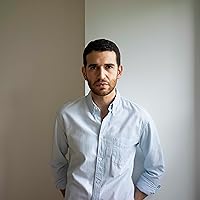
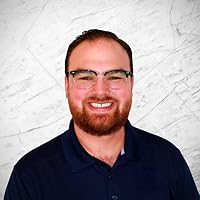
Matthew Buckley Smith was born in Atlanta, Georgia. He is the winner of the Able Muse Book Award, 2011, for his Manuscript, Dirge for an Imaginary World, forthcoming from Able Muse Press, Spring 2012. He earned his MFA in poetry at the Johns Hopkins University. His poems have appeared in various magazines, including Beloit Poetry Journal, Commonweal, Iron Horse Literary Review, Measure, The Alabama Literary Review, Think Journal, and Best American Poetry 2011. His poetry has been nominated for a Pushcart Prize. He lives in Baltimore with his wife, Joanna.
This is a mostly-mainstream/literary poetry collection, though it contains several works that would fit comfortably in a speculative poetry publication, such as the excellent long poem "Another Achilles," about an alternate path Achilles's life could have taken.
I bought the collection because I encountered and loved the author's poem "Poem Without Metaphors." And while I very much liked more than a dozen other poems in the collection, I don't think I liked any of them quite as much. "Another Achilles" came close.
These poems are written by someone with more knowledge of poetic forms than I have, but I recognized and liked a triolet (Philomela), and in general considerably admired the poetry of the poems.
I thought I understood most of the works, but not all. This doesn't mean the exceptions would necessarily be cryptic to a more literary soul, but I am a fairly straightforward reader.
A very good collection.
About my reviews: I try to review every book I read, including those that I don't end up enjoying. The reviews are not scholarly, but just indicate my reaction as a reader, reading being my addiction. In the case of poetry books, for various reasons, I often omit an overall star rating.
2024 has already been quite a good year for poetry (especially for formal and formal-adjacent poetry) and is continuing to be, with excellent new releases from Peter Vertacnik (whose debut I will also be reviewing soon), James Matthew Wilson, J.C. Scharl, Dan Rattelle, A.M. Juster, Chris Childers, and many others! However, by far, my favorite, so far, is Matthew Buckley Smith's 'Midlife.'
'Midlife' won the final Richard Wilbur Award for a book of poetry (one of formal poetry's very best prizes), chosen by David Yezzi, but the prize and publisher sadly went under before they could release it. Measure Press then rode in to the rescue and published the collection instead.
I came to Matthew Buckley Smith via his great podcast Sleerickets (seriously, everyone should subscribe!), and Smith's poetic goals, as heard often on that show, are clearly reflected in ‘Midlife’: Don’t be boring or pretentious, communicate a credible human voice with real experience (though it doesn't necessarily have to be your own), be urgent, be clear, look for beauty, get skill, be honest, tell the truth, individual poems are more important than books of poems, etc. These priorities can be seen, unusually well, in both the poems and the book’s design. Poetry books have a bad tendency to look like fake books, we must be honest, but 'Midlife' is well-designed, with elegant image, color, and type choices on the cover and a classy layout inside, aided by the choice of font--Sorts Mill Goudy, designed by Barry Schwartz as a revival of a classic font (and a favorite of mine), Goudy Old Style (the text typeface of Harper's Magazine for instance).
‘Midlife’ especially emphasizes Matthew’s skill in writing finely crafted lyrics and insightful blank verse monologues. Some of my favorite poems from the book include: “Object Permanence,” “Egg and Dart,” "Lullaby Before Birth," "The Quick," "Natural Prosody," "Survey of Love," "Poem without Metaphors," "Last Call at the Conference Hotel," “Lines on Evolutionary Psychology,” "Trees at Night," "Ankou," and “The Dark Woods” (which successfully pulls off, as Matthew often has, the juxtaposition of ancient and contemporary imagery, which I usually balk at in other poets—I even complained about it in my (highly positive) Literary Matters review of A.E. Stallings' recent selected). I don't want to add too many excerpts of Matthew's poems here, because they are the kind that need to be taken in as a whole, but I will quote the beginning of "Object Permanence" so you can get a feel for his style, formalist without being stuffy:
"Because you haven't yet developed faith That what you see at nightfall will return At dawn, when time begins again, it's death You nightly learn."
Here, too, is the entirety of the shortest of my favorites above:
"The Quick"
"Today you amount to little more than names, Lois and Bertha Clark, here in the world you waited for, on which you hardly left a mark, just two plots settled in the shade of a cypress, where you still await parents who twice in one year paid for a slab with a single name and date."
Listening to Sleerickets has truly bolstered me over the last three years, and Matthew, his co-hosts (Australian poet Alice Allan, New York novelist and essayist Brian Platzer, and British poet Cameron Clark), and associated podcasts (Alice's Poetry Says, Elijah Blumov's Versecraft, and Matt Wall's IHMW) have helped me find real literary friends and kinship that I never could seem to find satisfactorily before. So perhaps I am too biased, but I do not think that is too much the case. I came to love Matthew's work because of its quality, which is borne out in both his podcast and this new book. So, yes, I think everyone should check out Sleerickets, as well as the other podcasts in Matthew's sphere that I mentioned above, and, importantly, buy 'Midlife.' His last book, 'Dirge for an Imaginary World' (also very good), came out twelve years ago, so it's not like we are being inundated with his releases here!
Midlife is criminally good. MBS manages to fuse impeccable formal technique with a distinctive, almost addictive voice. To quote Stefan from Saturday Night Live, "This book has everything!" MBS writes odes, sestinas, rhyming couplets, and more as if he could do so in his sleep; still, he doesn't rely on his formal prowess to do the heavy lifting. He's an excellent storyteller, too. The poems made me think and feel but they never felt melodramatic or heavy- handed. Pay attention to Matthew Buckley Smith. I can't think of anyone else who writes the way he does.