

What do you think?

The Alamo Story From Earl History to Current conflicts
Tells of events leading up to the Alamo; details of several of the main characters such as Bowie, Travis, Crockett, Santa Anna
- GenresHistoryNonfiction
439 pages, paper back
First published January 1, 2000
Ratings & Reviews
Friends & Following
Create a free account to discover what your friends think of this book!
Community Reviews
Displaying 1 - 8 of 8 reviews

April 4, 2018
“I call on you in the name of Liberty, of patriotism & everything dear to the American character, to come to our aid, with all dispatch…If this call is neglected, I am determined to sustain myself as long as possible & die like a soldier who never forgets what is due to his own honor & that of his country – Victory or Death.”
- Lt. Col. William Barret Travis, Commander of the Alamo, letter of February 24, 1836.
“It was but a small affair.”
- General Antonio Lopez de Santa Anna, Commander of the Army of Operations besieging the Alamo, commenting on the final battle.
I don’t think I’m exaggerating when I say that the Alamo has haunted my dreams since I was a child. It probably had something to do with seeing John Wayne (as David Crockett) getting bloodily lanced to death at the end of the climatic assault in the 1960 film The Alamo. I was pretty young to see the Duke getting slaughtered, especially by lance. Or maybe it had something to do with watching Fess Parker (again, as Crockett) swinging his rifle into eternity as dozens of Mexican soldados assailed him at the climax of Davy Crockett, King of the Wild Frontier.
For whatever reason, seeing the Alamo for the first time meant a lot to me. It was in 2010, in the middle of my honeymoon-road trip of American history. My wife and I pulled into San Antonio just at dusk, and headed straight to our hotel.
“There it is!” she shouted, nearly causing me to drive onto the sidewalk.
“I don’t want to see it yet!” I shouted back, gripping the wheel.
We parked our car, checked into the hotel, and then headed out. But I wasn’t ready to see it yet. I wanted to prepare myself. So we went to the River Walk and sat down at the Republic of Texas Restaurant, which appeared to be the most touristy establishment of a fairly touristy location. (Something you should know about me: When I am a tourist, I embrace it). Immediately, we ordered two 42 ounce margaritas. And I drank one and a half of them.
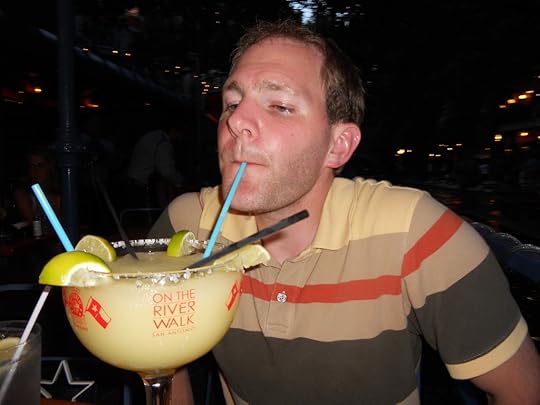
Alamo prep, August 2010.
Then we went to the Alamo.
It was simultaneously everything I’d hoped it would be, and also a colossal disappointment. It is absolutely tiny, making it at once intimate and embraceable, but also a reminder that most of the historical mission has been destroyed, part of it by the victorious Mexican Army, most of it by the unrelenting creep of progress. The Alamo site is a mass of contradictions. The church, with its famous (though not contemporary) bell-shaped façade, is referred to as a “Shrine”. You can’t wear a hat inside, or take pictures, meaning I don’t recall any of the random exhibits they had on display. However, despite the veneration required of visitors to the church, you can still buy an overpriced coonskin cap in the massive souvenir shop, or a snow cone from the vendor out front, and it’s hard to imagine the west wall when it has been taken up by a Ripley’s Believe it or Not.
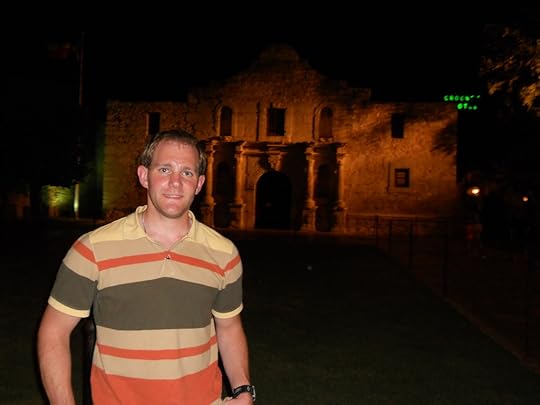
First time at the Alamo, August 2010. Note the margarita-flush, courtesy of the Republic of Texas (Restaurant).
The present-state of the Alamo, run by the Daughters of the Texas Revolution, is covered in the concluding pages of J.R. Edmondson’s The Alamo Story: From Early History to Current Conflicts. It is an appropriate conclusion to his thorough look at the Alamo’s tumultuous existence, demonstrating that the centuries-old struggle for the former Spanish mission encompassed not only its physical being, but also a fight to define its meaning. The Alamo is a powerful symbol, not of one thing, but many things, depending on who you are, and what you believe.
Edmonson is very upfront about what he believes, and he explains himself in the first couple pages. For him, the Alamo defenders were “heroes” who gave a “magnificent sacrifice” in their 13-day defense of the beleaguered fortress in 1836. What follows, then, is a labor of love, almost a paean to chivalric notions such as death before dishonor. Yet, Edmondson is also careful about interpreting historical sources, recognizing time and again the fact that many of the Alamo legends lack veracity. The result is a book in conflict with itself, a tug-of-war between hero worship and primary documents; between what likely happened, and what the author wished happened. This does not make for a bad read. To the contrary, I found the tension to be interesting, if at times frustrating.
At 424 pages of text, this is a fairly decent-sized chunk of history. Edmondson divides his story into four parts. The first part covers the founding of the Alamo mission by Spain, as well as Mexico’s War of Independence. The second part is devoted to Mexico’s struggle to form a lasting government (with Santa Anna hopping daintily between federalism and centralism), and to keep Texas – swarming with Anglo immigrants – part of the fold. Part three deals with the Texas Revolution, and introduces key players such as Alamo commander William B. Travis (Edmondson’s mini-bio is great, since it relies heavily on Travis’s extremely saucy diary entries; the poor guy likely died with a venereal disease), Alamo defender David Crockett (you might have heard of him), and failed savior James Fannin (the unfortunate Fannin, who admitted his own incompetence to anyone who’d listen, eventually surrendered his army and was executed, along with most of his troops, on Palm Sunday, 1836). The final section is the grand finale, the Alamo siege and battle, lasting from February 23 to March 6. Edmondson has a chapter for each day, letting you know what happened not only at the Alamo, but at other parts of Texas as well. I found this approach super helpful in keeping events straight, and in showing all the moving pieces in concert.
Probably the coolest thing about The Alamo Story is how Edmondson ends each of his four major sections with a chapter called Myths, Mysteries, and Misconceptions. In what could pass for an Alamo FAQ, Edmondson discusses the truth behind various legends, as well as answering burning questions. For example, following the chapter on the battle, Edmondson discusses certain hot-button topics such as Mexican casualties, Crockett’s death, and whether or not certain defenders attempted to escape.
While the first three parts of The Alamo Story were helpful, I have found better-written accounts elsewhere. (T.R. Fehrenbach and Stephen Hardin have tilled this soil). Edmondson’s denouement, though, is astounding. His narrative of the final battle, in the dark and cold dawn on March 6, is among the best I’ve read. It is exciting, gripping, and presents an extremely plausible flow of battle.
I do have a bit of hesitation with a full endorsement. First, there are no notes. Any Alamo story worth its salt has to have citations to the primary sources from which the narrative is drawn. This is indispensable, because of the intrusion of so many exaggerations, lies, and wishful thinking into the drama.
I don’t know enough about Edmondson to blindly trust him. His back-cover bio says simply that he authored a “pageant” that is performed annually at the Alamo. A little web-sleuthing revealed that he has written a lot of articles for niche publications, that he is a re-enactor, and that he looks a bit like Jim Bowie (who Edmondson obviously adores, and refers to as “Big Jim” for much of the book). I also know, based on an inscription, that on February 24, 2002, my dad purchased a copy of this book from him at the Alamo, which he signed. (I have no good explanation of why this sat unread for 16 years).
Reading between the lines, and going off the sources that Edmondson cites within the text, he seems to have researched this very deeply. But I’d rather verify than take things on faith. There were many things he mentioned, especially in the battle sequence, that I wanted citations for. Moreover, his Myths, Mysteries, etc. chapters really lose some punch without the source notes to back them up.
My other problem, which I mentioned above, is Edmondson’s inability to decide whether he is a Bowie-Booster or a Serious Historian. In other words, Edmondson has a hard time stripping away myths that he clearly loves. For instance, there is the story of Travis drawing a line in the sand. The only source for this is a dubious account by William Zuber written long after the event, and that came to him as third-hand hearsay. Edmondson knows this, and explains it. But then he can’t help but insert the scene into his narrative anyway, with the excuse that “it can’t be disproved.” I sort of threw up my hands at this. What’s the point of having Myths, Mysteries, and Misconceptions at the end of each section if you keep choosing the myths?
Compare that to Edmondson’s handling of Crockett’s execution and the De La Pena “Diary.” Edmondson believes the “Diary” is a forgery (even though he draws from it constantly; also, it’s not a forgery) and that it cannot be proved that Crockett was taken prisoner before being killed. His reasoning is a lack of hard evidence. “The case,” he writes, “simply would not stand up in any court of law.” Oh, so that’s the standard now. When we’re talking about Travis’s mythical line, we should believe it, because it can’t be disproved. But when we’re talking about the death of a Texas hero, the standard of proof is suddenly much higher. (Speaking as a lawyer, I can say with some confidence that none of the Alamo story would hold up in court, for myriad reasons).
The reason this bothered me is that I’m not interested in things that didn't happen at the Alamo. Similarly, I’m not interested in things that probably didn't happen, even though it would’ve been neat if it had. I know I can’t disprove Travis’s line, in the same way that I can’t disprove that aliens took part in the final assault. That’s not the historical standard. When Edmondson gives into this side, the side that wants to believe, it made me doubt the veracity of everything else.
There is much to like here. There is also much to be wary about. Edmondson warns the reader many times about the “modern historian,” that fun-hating, Crockett-doubting, ivory-tower snob who keeps wanting to talk about pesky things like slavery, and who rely on documentary evidence, not hopeful thinking. I suppose my warning would be about the person who grew up loving the Alamo, and the men who defended it, and who can’t see beyond those childhood conceptions.
Of course, this just proves Edmondson’s ultimate point. The Battle of the Alamo continues.
- Lt. Col. William Barret Travis, Commander of the Alamo, letter of February 24, 1836.
“It was but a small affair.”
- General Antonio Lopez de Santa Anna, Commander of the Army of Operations besieging the Alamo, commenting on the final battle.
I don’t think I’m exaggerating when I say that the Alamo has haunted my dreams since I was a child. It probably had something to do with seeing John Wayne (as David Crockett) getting bloodily lanced to death at the end of the climatic assault in the 1960 film The Alamo. I was pretty young to see the Duke getting slaughtered, especially by lance. Or maybe it had something to do with watching Fess Parker (again, as Crockett) swinging his rifle into eternity as dozens of Mexican soldados assailed him at the climax of Davy Crockett, King of the Wild Frontier.
For whatever reason, seeing the Alamo for the first time meant a lot to me. It was in 2010, in the middle of my honeymoon-road trip of American history. My wife and I pulled into San Antonio just at dusk, and headed straight to our hotel.
“There it is!” she shouted, nearly causing me to drive onto the sidewalk.
“I don’t want to see it yet!” I shouted back, gripping the wheel.
We parked our car, checked into the hotel, and then headed out. But I wasn’t ready to see it yet. I wanted to prepare myself. So we went to the River Walk and sat down at the Republic of Texas Restaurant, which appeared to be the most touristy establishment of a fairly touristy location. (Something you should know about me: When I am a tourist, I embrace it). Immediately, we ordered two 42 ounce margaritas. And I drank one and a half of them.
Alamo prep, August 2010.
Then we went to the Alamo.
It was simultaneously everything I’d hoped it would be, and also a colossal disappointment. It is absolutely tiny, making it at once intimate and embraceable, but also a reminder that most of the historical mission has been destroyed, part of it by the victorious Mexican Army, most of it by the unrelenting creep of progress. The Alamo site is a mass of contradictions. The church, with its famous (though not contemporary) bell-shaped façade, is referred to as a “Shrine”. You can’t wear a hat inside, or take pictures, meaning I don’t recall any of the random exhibits they had on display. However, despite the veneration required of visitors to the church, you can still buy an overpriced coonskin cap in the massive souvenir shop, or a snow cone from the vendor out front, and it’s hard to imagine the west wall when it has been taken up by a Ripley’s Believe it or Not.
First time at the Alamo, August 2010. Note the margarita-flush, courtesy of the Republic of Texas (Restaurant).
The present-state of the Alamo, run by the Daughters of the Texas Revolution, is covered in the concluding pages of J.R. Edmondson’s The Alamo Story: From Early History to Current Conflicts. It is an appropriate conclusion to his thorough look at the Alamo’s tumultuous existence, demonstrating that the centuries-old struggle for the former Spanish mission encompassed not only its physical being, but also a fight to define its meaning. The Alamo is a powerful symbol, not of one thing, but many things, depending on who you are, and what you believe.
Edmonson is very upfront about what he believes, and he explains himself in the first couple pages. For him, the Alamo defenders were “heroes” who gave a “magnificent sacrifice” in their 13-day defense of the beleaguered fortress in 1836. What follows, then, is a labor of love, almost a paean to chivalric notions such as death before dishonor. Yet, Edmondson is also careful about interpreting historical sources, recognizing time and again the fact that many of the Alamo legends lack veracity. The result is a book in conflict with itself, a tug-of-war between hero worship and primary documents; between what likely happened, and what the author wished happened. This does not make for a bad read. To the contrary, I found the tension to be interesting, if at times frustrating.
At 424 pages of text, this is a fairly decent-sized chunk of history. Edmondson divides his story into four parts. The first part covers the founding of the Alamo mission by Spain, as well as Mexico’s War of Independence. The second part is devoted to Mexico’s struggle to form a lasting government (with Santa Anna hopping daintily between federalism and centralism), and to keep Texas – swarming with Anglo immigrants – part of the fold. Part three deals with the Texas Revolution, and introduces key players such as Alamo commander William B. Travis (Edmondson’s mini-bio is great, since it relies heavily on Travis’s extremely saucy diary entries; the poor guy likely died with a venereal disease), Alamo defender David Crockett (you might have heard of him), and failed savior James Fannin (the unfortunate Fannin, who admitted his own incompetence to anyone who’d listen, eventually surrendered his army and was executed, along with most of his troops, on Palm Sunday, 1836). The final section is the grand finale, the Alamo siege and battle, lasting from February 23 to March 6. Edmondson has a chapter for each day, letting you know what happened not only at the Alamo, but at other parts of Texas as well. I found this approach super helpful in keeping events straight, and in showing all the moving pieces in concert.
Probably the coolest thing about The Alamo Story is how Edmondson ends each of his four major sections with a chapter called Myths, Mysteries, and Misconceptions. In what could pass for an Alamo FAQ, Edmondson discusses the truth behind various legends, as well as answering burning questions. For example, following the chapter on the battle, Edmondson discusses certain hot-button topics such as Mexican casualties, Crockett’s death, and whether or not certain defenders attempted to escape.
While the first three parts of The Alamo Story were helpful, I have found better-written accounts elsewhere. (T.R. Fehrenbach and Stephen Hardin have tilled this soil). Edmondson’s denouement, though, is astounding. His narrative of the final battle, in the dark and cold dawn on March 6, is among the best I’ve read. It is exciting, gripping, and presents an extremely plausible flow of battle.
I do have a bit of hesitation with a full endorsement. First, there are no notes. Any Alamo story worth its salt has to have citations to the primary sources from which the narrative is drawn. This is indispensable, because of the intrusion of so many exaggerations, lies, and wishful thinking into the drama.
I don’t know enough about Edmondson to blindly trust him. His back-cover bio says simply that he authored a “pageant” that is performed annually at the Alamo. A little web-sleuthing revealed that he has written a lot of articles for niche publications, that he is a re-enactor, and that he looks a bit like Jim Bowie (who Edmondson obviously adores, and refers to as “Big Jim” for much of the book). I also know, based on an inscription, that on February 24, 2002, my dad purchased a copy of this book from him at the Alamo, which he signed. (I have no good explanation of why this sat unread for 16 years).
Reading between the lines, and going off the sources that Edmondson cites within the text, he seems to have researched this very deeply. But I’d rather verify than take things on faith. There were many things he mentioned, especially in the battle sequence, that I wanted citations for. Moreover, his Myths, Mysteries, etc. chapters really lose some punch without the source notes to back them up.
My other problem, which I mentioned above, is Edmondson’s inability to decide whether he is a Bowie-Booster or a Serious Historian. In other words, Edmondson has a hard time stripping away myths that he clearly loves. For instance, there is the story of Travis drawing a line in the sand. The only source for this is a dubious account by William Zuber written long after the event, and that came to him as third-hand hearsay. Edmondson knows this, and explains it. But then he can’t help but insert the scene into his narrative anyway, with the excuse that “it can’t be disproved.” I sort of threw up my hands at this. What’s the point of having Myths, Mysteries, and Misconceptions at the end of each section if you keep choosing the myths?
Compare that to Edmondson’s handling of Crockett’s execution and the De La Pena “Diary.” Edmondson believes the “Diary” is a forgery (even though he draws from it constantly; also, it’s not a forgery) and that it cannot be proved that Crockett was taken prisoner before being killed. His reasoning is a lack of hard evidence. “The case,” he writes, “simply would not stand up in any court of law.” Oh, so that’s the standard now. When we’re talking about Travis’s mythical line, we should believe it, because it can’t be disproved. But when we’re talking about the death of a Texas hero, the standard of proof is suddenly much higher. (Speaking as a lawyer, I can say with some confidence that none of the Alamo story would hold up in court, for myriad reasons).
The reason this bothered me is that I’m not interested in things that didn't happen at the Alamo. Similarly, I’m not interested in things that probably didn't happen, even though it would’ve been neat if it had. I know I can’t disprove Travis’s line, in the same way that I can’t disprove that aliens took part in the final assault. That’s not the historical standard. When Edmondson gives into this side, the side that wants to believe, it made me doubt the veracity of everything else.
There is much to like here. There is also much to be wary about. Edmondson warns the reader many times about the “modern historian,” that fun-hating, Crockett-doubting, ivory-tower snob who keeps wanting to talk about pesky things like slavery, and who rely on documentary evidence, not hopeful thinking. I suppose my warning would be about the person who grew up loving the Alamo, and the men who defended it, and who can’t see beyond those childhood conceptions.
Of course, this just proves Edmondson’s ultimate point. The Battle of the Alamo continues.
May 3, 2020
The author also does a rousing historical presentation of Jim Bowie in full costume that I've been fortunate enough to witness a couple of times. His passion for the subject flows throughout this book.

August 11, 2020
An interesting blend between historical non-fiction and conjecture to bring to life the Alamo and its inhabitants.

December 20, 2014
For the most part, I found this a very readable book. The author takes the history of the Alamo from the time of it's building as a mission, through modern day. I found the beginning much harder to read than the part about the Revolution. He talked about a lot of people that I'd never heard of, which made it hard to keep them all straight. However, I found myself almost as wrapped up in the siege days as I have in many novels. I LOVED the sections that he does on myths, mysteries and misconceptions. On some of the legends, he presents all sides of the story. He never draws his own conclusions -- he leaves that to the reader. He just presents why different people said different things about the battle and its participants. I recommend this book to anyone wanting to learn more about the Alamo.
October 14, 2007
This is ah historical book written by a historian of Texas. The Alamo surrendered once on April 1, 1813 without a shot being fired, to a rebel Mexican army under a flag of freedom led by Governor Manuel Maria de Salcedo.
On December 10, 1835, Mexican forces under General Martin Perfecto de Cos (brother-in-law to Santa Anna) relinquished the position to another rebel force Americanos who settled in Austin's colonies.
This time there would be no surrender.
Bowie was ill and confined to bed. Travis was thrust into
the role of commander. He kept sending out riders to request help, which never came. There were about 250 men against twenty-four thousand Mexican soldiers.
On December 10, 1835, Mexican forces under General Martin Perfecto de Cos (brother-in-law to Santa Anna) relinquished the position to another rebel force Americanos who settled in Austin's colonies.
This time there would be no surrender.
Bowie was ill and confined to bed. Travis was thrust into
the role of commander. He kept sending out riders to request help, which never came. There were about 250 men against twenty-four thousand Mexican soldiers.

April 18, 2010
This book is readable and entertaining history.
I wept with emotion when I read the chapter, Sunday, March 6, 1836: The Last Day.
I appreciate the sections titled, Myths, Mysteries, and Misconceptions at the end of the four sections of the book for the author explained how undocumented information was introduced to the public and repeated until we believe it to be true. He also explains how some authors devalued these heroes with cynicsm. "In that cynical new age, publishers encouraged controversy, and writers wanted to be published."
This book contains a 7-page bibliography.
I wept with emotion when I read the chapter, Sunday, March 6, 1836: The Last Day.
I appreciate the sections titled, Myths, Mysteries, and Misconceptions at the end of the four sections of the book for the author explained how undocumented information was introduced to the public and repeated until we believe it to be true. He also explains how some authors devalued these heroes with cynicsm. "In that cynical new age, publishers encouraged controversy, and writers wanted to be published."
This book contains a 7-page bibliography.

July 26, 2009
Good book with lots of smaller facts and events that occured at the hallowed place in Texas history.

January 12, 2014
If you can only have one book on the Alamo, this is the one to have.
Displaying 1 - 8 of 8 reviews