

What do you think?
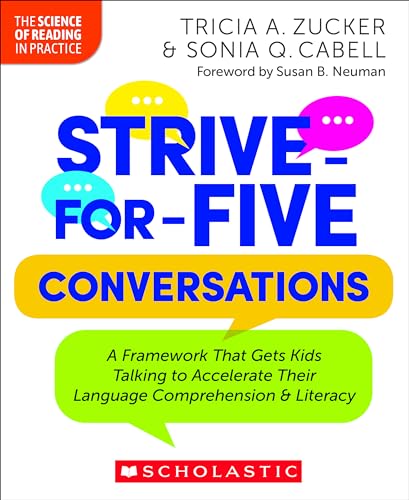
Strive-for-Five Conversations: A Framework That Gets Kids Talking to Accelerate Their Language Comprehension and Literacy
Teachers know that encouraging young children to talk and listen improves their ability to communicate. This book gives them a power tool aligned with the science of the “Strive-for-Five” framework. These responsive conversations start with what children say and continue as the teacher listens and responds over five turns—with the goal of stretching their talking and thinking, knowledge, vocabulary, reasoning, and other skills that underpin reading success.
In an accessible format that contains audio and video clips, along with classroom anecdotes and model conversations, Zucker and Cabell show why Strive-for-Five conversations are important and how teachers can use them to engage children and develop their language comprehension. As teachers use the framework to build students’ knowledge, vocabulary, reasoning, and other skills that underpin reading success, they'll also see students’ confidence grow as they share their individual stories, ideas, and questions.
In an accessible format that contains audio and video clips, along with classroom anecdotes and model conversations, Zucker and Cabell show why Strive-for-Five conversations are important and how teachers can use them to engage children and develop their language comprehension. As teachers use the framework to build students’ knowledge, vocabulary, reasoning, and other skills that underpin reading success, they'll also see students’ confidence grow as they share their individual stories, ideas, and questions.
265 pages, Kindle Edition
Ratings & Reviews
Friends & Following
Create a free account to discover what your friends think of this book!
Community Reviews
Displaying 1 - 11 of 11 reviews

February 21, 2024
I really liked this book. It was short and sweet - with very actionable applications to the simple premise. Even though the title seems pretty self-explanatory, the chapters were valuable with the practical explanations of how your small actions can increase student oral language proficiency.

August 12, 2025
Thought provoking but I wish it had a few more strategies specific to upper grades!

January 15, 2024
Highly recommend this book for Pre-K through first grade teachers! Easy to follow framework with examples as to how to scaffold thinking using the Strive for Five Framework to support language development.

April 14, 2026
Informative! I wasn’t exactly the target audience as I feel like this is for educators and professionals that work with children but I learned a lot and will enact in my parenting!
Some key learning points from the book for me- some new and some just reinforcing previous learning:
-trying to hit 5 conversation turns to build for more meaningful conversations and finding the right ways to extend conversations by building on what they said and adding a question
-it is better to model than to correct
-having a mix of narrative and informational books is key while trying to also include dual purpose
Oral language helps build literacy and comprehension so it gave me a new lens on why talking is learning!
Some key learning points from the book for me- some new and some just reinforcing previous learning:
-trying to hit 5 conversation turns to build for more meaningful conversations and finding the right ways to extend conversations by building on what they said and adding a question
-it is better to model than to correct
-having a mix of narrative and informational books is key while trying to also include dual purpose
Oral language helps build literacy and comprehension so it gave me a new lens on why talking is learning!
May 6, 2026
3.5
I found the best tips to be the handout created for parents and the data collecting tool. Most seemed like common sense information but could likely be useful for a beginning teacher or a teacher in a district that does not have a strong ELA curriculum that builds questioning in to read alouds.
I found the best tips to be the handout created for parents and the data collecting tool. Most seemed like common sense information but could likely be useful for a beginning teacher or a teacher in a district that does not have a strong ELA curriculum that builds questioning in to read alouds.

January 28, 2025
Geared toward younger classrooms, but I still found the reminder of being very intentional about taking kids to a deeper level (more abstract or more vocabulary rich, for example) a good reminder. Our work in the classroom needs so much intention behind it to be most effective.

June 12, 2026
This book is geared towards PreK-1st grade educators. I did find a lot of things applicable to the upper grades. A lot if the points on language acquisition don’t stop being important as children get older.
December 24, 2024
This book gives excellent strategies for vocabulary building with all students even though it is geared towards early childhood!

April 17, 2025
Fascinating as an SLP student hoping to work with this age group

Read
April 26, 2026I love this series

August 25, 2025
A great practical resource for early childhood teachers (PreK-3) and parents.
Displaying 1 - 11 of 11 reviews