

What do you think?
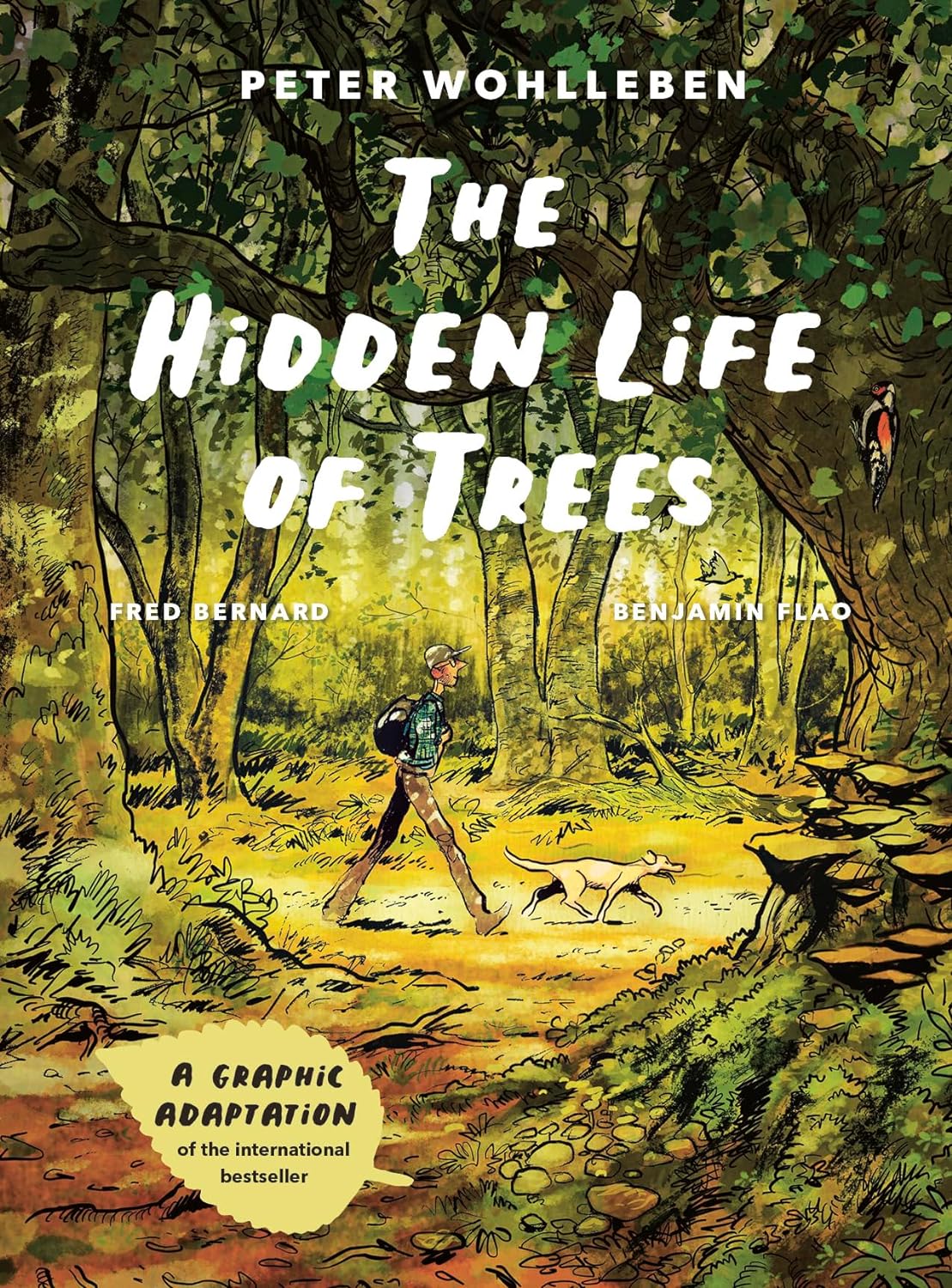
The Hidden Life of Trees: A Graphic Adaptation
The graphic novel adaptation of Peter Wohlleben’s international bestseller, with breathtaking illustrations and easy-to-follow text that will delight readers young and old.
Are trees social beings? For forester Peter Wohlleben, the answer has always been yes, the forest is a social network. Trees live like human families: tree parents live together with their children, support them as they grow, share nutrients with those who are sick and struggling, and even warn each other of impending dangers.
This vibrantly illustrated graphic novel follows Peter as its loveable main character, revealing the secret network of the forest and sharing struggles and triumphs from his career protecting trees. Told in Peter’s warm, conversational voice, not unlike that of a beloved grandfather chatting fireside, this visually stunning book offers scientific insights and pearls of wisdom gained from Peter’s decades of observing forests, including how trees impact weather and climate, how they communicate with each other, and how they interact with fungal networks deep within the ground. It also offers poignant memories from Peter’s personal life.
Featuring 240 pages of full-color illustrations and text covering the entirety of The Hidden Life of Trees, this adaptation honors the spirit of the original book by seeking to change the way the world looks at trees, and will inspire generations of readers to celebrate the natural world and protect our last remaining forests before it’s too late.
Are trees social beings? For forester Peter Wohlleben, the answer has always been yes, the forest is a social network. Trees live like human families: tree parents live together with their children, support them as they grow, share nutrients with those who are sick and struggling, and even warn each other of impending dangers.
This vibrantly illustrated graphic novel follows Peter as its loveable main character, revealing the secret network of the forest and sharing struggles and triumphs from his career protecting trees. Told in Peter’s warm, conversational voice, not unlike that of a beloved grandfather chatting fireside, this visually stunning book offers scientific insights and pearls of wisdom gained from Peter’s decades of observing forests, including how trees impact weather and climate, how they communicate with each other, and how they interact with fungal networks deep within the ground. It also offers poignant memories from Peter’s personal life.
Featuring 240 pages of full-color illustrations and text covering the entirety of The Hidden Life of Trees, this adaptation honors the spirit of the original book by seeking to change the way the world looks at trees, and will inspire generations of readers to celebrate the natural world and protect our last remaining forests before it’s too late.
240 pages, Hardcover
First published May 25, 2015
Ratings & Reviews
Friends & Following
Create a free account to discover what your friends think of this book!
Community Reviews
Displaying 1 - 30 of 308 reviews

January 19, 2025
6 out of 5 stars. Touching, beautiful, moving. Must read. I need to go sit in a forest now.

June 18, 2025
Buckets of interesting. I learned many tree facts and forest facts here. And I don't know how to express my extreme reticence at reading The Hidden Life of Trees; I know it's a book that's been recommended to me by many people, but it's hard to learn about nature from a book. I don't like it. I like learning about nature from nature, informational plaques, documentaries, NPR, and anything else is hard to focus on. I'll take a graphic novel but it was still a bit of a slog. Peter's personal narrative interrupted the stuff about trees: he grew up with the freedom to run around in the forest, and then he became a forester and informed himself on less destructive forest methods. Massive respect, but it's pretty obvious that anyone who was going to become the international expert on trees and their feelings was going to have that kind of background, and it's not a terribly interesting background. In the graphic novel, the memoir bits did give him the opportunity to stand at various times and look into the forest and illustrate different points. It's important, but it's all so sad to know when you've just spent a week hiking through sandy, second growth Wisconsin forest knowing that it's all been destroyed and what you're looking at is the spoils of late nineteenth century capitalism as landscape. That said, trees are fucking cool. We should respect trees. And plant diverse trees. And reintroduce beavers and bison and be sustainable and learn more about forest snacks. I liked this book, and I'm glad I was able to introduce myself to Mr. Wohlleben's ideas without reading the real book, although maybe I should try it on audio. Great illustrations. Sweeping landscapes. Very European and specifically his region of Germany- centric for obvious reasons.

July 9, 2024
Quelle belle oeuvre! On en apprend beaucoup sur les arbres, et surtout, on comprend combien ils sont importants.

Read
May 9, 2025My biggest dislike is that they made it into an oversized book so it's a bit difficult to hold to read. It allowed them to include large artwork for more details but also allowed them to cram a ton of stuff in. I definitely prefer the actual book over the graphic novel.
May 1, 2025
THE HIDDEN LIFE OF TREES was a five-star read for me. It was one of those books that I thought of often, even when not reading, and I am eager to share it with others.
It doesn’t just answer any question you could possibly have about trees and forests—it also answers questions you’d never think to ask! From the symbiotic relationship trees have with fungi, to the ways trees nourish their “families” growing around them, expect to be wowed with each turn of the page.
I learned so much and you will too! And don't be surprised if you are eager to go on a wilderness hike and observe some of this phenomena for yourself.
I also appreciated that the author had the bravery to raise certain issues, despite the potential for controversy. Yes, large herbivores such as deer can be hard on trees. However, human hunting makes the problems worse, as the practices associated with it both encourage the animals to breed more rapidly and change their movements and feeding behavior. Since tree damage is often used as an excuse for expanding hunting, it was refreshing to see this claim debunked.
FURTHER THOUGHTS:
A page near the book’s conclusion, however, stands as an unintentional warning about seeing things as we wish they were, rather than as they are.
Wohlleben posits that the way we relate to animals has changed since he was a child, claiming that intensive farming practices are “nowhere near as widespread as they once were.” This is simply wrong. In the U.S., factory farming has grown exponentially. We are now at the point in which 99% of animals raised for food in this country are intensively farmed.
The author then claims that that “people are eating less meat than they used to, and they’re being more mindful of animal welfare with the choices they make.” This also goes against the factual data. Americans are currently eating more animals than ever before. Due in large part to the huge rise in chicken consumption, more animals than ever also live lives no sentient being should ever endure.
However, Wohlleben is German, so perhaps he is speaking from that perspective? Germany seems to be having the same problem as the U.S. in that the number of farms overall is decreasing, while the number of animals kept on industrial farms continues to grow. Some of the most extreme levels of confinement that are commonplace in the U.S. have been phased out in Europe, but there are still significant animal welfare concerns. Meanwhile, while German meat consumption has been in flux in recent years, production and slaughter is once again on the rise.
I don’t say these things to be a naysayer; simply rather to note that we cannot let our hopes get in the way of our reality. Only by acknowledging the facts can we hope to make changes.
It doesn’t just answer any question you could possibly have about trees and forests—it also answers questions you’d never think to ask! From the symbiotic relationship trees have with fungi, to the ways trees nourish their “families” growing around them, expect to be wowed with each turn of the page.
I learned so much and you will too! And don't be surprised if you are eager to go on a wilderness hike and observe some of this phenomena for yourself.
I also appreciated that the author had the bravery to raise certain issues, despite the potential for controversy. Yes, large herbivores such as deer can be hard on trees. However, human hunting makes the problems worse, as the practices associated with it both encourage the animals to breed more rapidly and change their movements and feeding behavior. Since tree damage is often used as an excuse for expanding hunting, it was refreshing to see this claim debunked.
FURTHER THOUGHTS:
A page near the book’s conclusion, however, stands as an unintentional warning about seeing things as we wish they were, rather than as they are.
Wohlleben posits that the way we relate to animals has changed since he was a child, claiming that intensive farming practices are “nowhere near as widespread as they once were.” This is simply wrong. In the U.S., factory farming has grown exponentially. We are now at the point in which 99% of animals raised for food in this country are intensively farmed.
The author then claims that that “people are eating less meat than they used to, and they’re being more mindful of animal welfare with the choices they make.” This also goes against the factual data. Americans are currently eating more animals than ever before. Due in large part to the huge rise in chicken consumption, more animals than ever also live lives no sentient being should ever endure.
However, Wohlleben is German, so perhaps he is speaking from that perspective? Germany seems to be having the same problem as the U.S. in that the number of farms overall is decreasing, while the number of animals kept on industrial farms continues to grow. Some of the most extreme levels of confinement that are commonplace in the U.S. have been phased out in Europe, but there are still significant animal welfare concerns. Meanwhile, while German meat consumption has been in flux in recent years, production and slaughter is once again on the rise.
I don’t say these things to be a naysayer; simply rather to note that we cannot let our hopes get in the way of our reality. Only by acknowledging the facts can we hope to make changes.

July 29, 2025
Se árvores pudessem falar, o que nos contariam? Em A Vida Secreta das Árvores – Novela Gráfica, essa pergunta ganha forma com uma sensibilidade poética e um visual de tirar o impressionante. A obra é uma adaptação lindíssima e acessível do best-seller de Peter Wohlleben, e consegue transformar ciência em magia.
Acompanhamos o próprio Wohlleben como personagem-narrador, caminhando pela floresta e partilhando descobertas fascinantes sobre a vida vegetal: árvores que se comunicam, cuidam umas das outras, sentem dor e até dormem. Tudo isso traduzido em ilustrações lindas, expressivas e cheias de vida, que tornam a leitura ainda mais envolvente.
O que mais gostei foi a forma como o livro equilibra informação científica com emoção. A linguagem é acessível, sem perder profundidade, e faz-nos olhar para a natureza com mais respeito e empatia. A floresta deixa de ser apenas um cenário e passa a ser uma comunidade viva – com dramas, conexões e memórias.
Visualmente, é uma novela gráfica espetacular. O traço é muito bonito e a paleta de cores varia conforme o tom de cada capítulo.
Leitura perfeita para todas as idades e que não vai deixar ninguém indiferente.
Acompanhamos o próprio Wohlleben como personagem-narrador, caminhando pela floresta e partilhando descobertas fascinantes sobre a vida vegetal: árvores que se comunicam, cuidam umas das outras, sentem dor e até dormem. Tudo isso traduzido em ilustrações lindas, expressivas e cheias de vida, que tornam a leitura ainda mais envolvente.
O que mais gostei foi a forma como o livro equilibra informação científica com emoção. A linguagem é acessível, sem perder profundidade, e faz-nos olhar para a natureza com mais respeito e empatia. A floresta deixa de ser apenas um cenário e passa a ser uma comunidade viva – com dramas, conexões e memórias.
Visualmente, é uma novela gráfica espetacular. O traço é muito bonito e a paleta de cores varia conforme o tom de cada capítulo.
Leitura perfeita para todas as idades e que não vai deixar ninguém indiferente.


December 30, 2024
I wanted to read this because I started listening to the band Trees Speak.
Really good! I wouldn't mind a few footnotes (fruit flies dream???)... tons of amazing facts and useful info.
Really good! I wouldn't mind a few footnotes (fruit flies dream???)... tons of amazing facts and useful info.

March 5, 2025
I saw this beautiful book sitting on a counter in a bookstore I frequent when I need inspiration. I opened it to find a gorgeous green spread depicting a forest and felt my heart fill with joy and calm. An exhalation.
Needless to say, it came home with me, and I cuddled up on the sofa, reading, while winter ended and spring emerged, letting the nerdy tree facts calm my biologist soul.
Peter has written from his heart, in a way one writes, when one doesn't expect many people to read the outcome. An honest and true story about his life, his work with forests, and his hope for our collective future.
I know the names and the peculiarities of the trees in my neighbourhood now. Which helps when I'm hugging and chatting with them. Yes, I'm one of those.
The book is mostly about flora and fauna in the temperate region. So if you're interested in other regions, this may not be the book for you.
Needless to say, it came home with me, and I cuddled up on the sofa, reading, while winter ended and spring emerged, letting the nerdy tree facts calm my biologist soul.
Peter has written from his heart, in a way one writes, when one doesn't expect many people to read the outcome. An honest and true story about his life, his work with forests, and his hope for our collective future.
I know the names and the peculiarities of the trees in my neighbourhood now. Which helps when I'm hugging and chatting with them. Yes, I'm one of those.
The book is mostly about flora and fauna in the temperate region. So if you're interested in other regions, this may not be the book for you.
July 6, 2024
Wow
Un super livre graphique qui nous fait prendre conscience de la fragilité de notre Terre.
A lire absolument
Un super livre graphique qui nous fait prendre conscience de la fragilité de notre Terre.
A lire absolument

July 30, 2024
Ideaal voor bomenknuffelaars. A.k.a me.

January 31, 2025
Magnifique et tellement intéressant 🫶🏻🌲🌳🪵🌱Je pense le « relire » une deuxième fois juste pour prendre le temps d’observer les illustrations avec plus d’attention
July 26, 2024
C’était l’un des livres que j’avais envie de lire, mais la version complète me semblait un peu intimidante. La bande dessinée, que je ne peux pas comparer à l’œuvre originale car je ne l’ai pas lue, m’a apporté de belles connaissances.
Certains éléments étaient assez poussés, mais les illustrations aidaient vraiment à la compréhension.
Le texte est bien écrit, et on sent que l’auteur s’adresse directement au lecteur, avec un langage parlé qui rend la lecture agréable.
L’auteur partage aussi des aspects personnels de sa vie, ce qui est intéressant, même si certains moments semblaient superflus.
Dans l’ensemble, j’ai vraiment apprécié cette lecture.
***
Certaines réflexions m’ont profondément touchée, notamment le passage sur le bruit de la pluie sur les arbres, où chaque arbre émet un son distinct.
***
Pour moi, qui aime la nature, c’était particulièrement émouvant. Cela dit, ce livre n’est pas pour tout le monde, car il vise surtout l’apprentissage.
Certains éléments étaient assez poussés, mais les illustrations aidaient vraiment à la compréhension.
Le texte est bien écrit, et on sent que l’auteur s’adresse directement au lecteur, avec un langage parlé qui rend la lecture agréable.
L’auteur partage aussi des aspects personnels de sa vie, ce qui est intéressant, même si certains moments semblaient superflus.
Dans l’ensemble, j’ai vraiment apprécié cette lecture.
***
Certaines réflexions m’ont profondément touchée, notamment le passage sur le bruit de la pluie sur les arbres, où chaque arbre émet un son distinct.
***
Pour moi, qui aime la nature, c’était particulièrement émouvant. Cela dit, ce livre n’est pas pour tout le monde, car il vise surtout l’apprentissage.

October 16, 2023
C’est très beau et émouvant l’amour de cet homme pour la nature ! Je l’ai lu en plusieurs fois car ce n’est pas le genre de lecture que l’on fait d’une traite, c’est à la fois assez pointu et aussi on commence par les bases de comment fonctionne la nature. Pas vraiment ma tasse de thé habituelle mais contente d’avoir jeté un œil !

February 28, 2026
I tried reading the actual book, and couldn’t get very far in before I lost interest. It was a bit dense, but had very interesting tidbits mixed in. So I read the graphic novel. Which had lovely illustrations and much science and much environmentalism and was still dense (but less so) with some still very interesting tidbits mixed in. Here are my favorites:
- trees can keep neighboring stumps alive by feeding them nutrients through their roots! Wow! But then I wonder, what are the conditions under which this happens? Because it’s definitely not an all the time event!
- When you walk in a forest, you only see 1/3 of the trees! The rest is under ground
- There are more organisms living in one handful of soil than there are humans on earth. Whoa!
- trees need “sleep” - if they are under artificial light and warm temps 24/7 they die (example given was an oak, specifically)
- trees release phytoncides that repel parasites and microbes. People with some types allergies or asthma can feel immediate benefits from a forest walk! And walks in the forest can improve blood pressure and decrease anxiety for humans
- trees with both make and female cones ripen days apart to prevent self fertilization (which would diminish diversity). Cherry blossoms somehow know if its own pollen was used for fertilization, and will abort.
- certain trees like beeches and oaks will have scarce seed production for a few years, which means the animals who subsist on those will have a population decline, and then after 5 years or so the tree will have a bumper crop and there will be many seeds yet won’t be as many animals to eat them (better chance of survival for those tree seeds)
- trees in cities don’t live as long. They are over pruned, cut off from their tree networks, have condensed roots, and are in compacted soil. The urban ground areas release heat at night, which is when the trees need coolness. And they are absorbing a lot of soot, etc.
- young trees in a forest will leaf out before the larger trees in spring, and will hold onto their leaves longer in the fall, to absorb as much light as possible
- a small “sapling” tree by a much larger tree in the forest could be a lot older than it looks, 80 years is the example of one he aged, staying small as it awaits its turn to take over when a large tree falls
- I loved the idea of a forest cemetery, (like in Switzerland and Germany) where ashes are buried at the bases of various trees and you visit your loved ones by strolling through the forest
- the “roots” of fungi (mycelium) connect to 90% of terrestrial plant life. Some fungi will only pair with certain species, whereas some trees are connected to upwards of 100 different fungi species!
- one type of fungi will release a toxin if the pine it is symbiotic with needs nitrogen. This kills the insects in the ground in the area and provides nitrogen through the bug “fertilizer”
- a tree that is hit by lightning can transfer that jolt to other trees through the network of the roots, and they both get zapped
- some trees of the same species will appear more weathered than their companions of a same age (just like people)
- Beech trees still get hit by lightning, they just don’t show the scars as well on their smooth bark
- acacia trees send chemicals out when they are being munched on. This makes their leaves taste bad, and warns other acacias down wind
- I found the two experiments on pg 178 and 179 about plant “memory” (sensitive plant learning to not close up when water droplets were applied at recurring intervals) and “problem solving” (passion flower where stake kept getting moved 2 inches ahead just before the plant reached it learned to overshoot and grow to where the stake would be after 4 or 5 repetitions) very interesting
- trees can recognize their own seedlings, and offer them nutritional support through their roots but will not do this to a seedling of the same species that isn’t theirs
- trees of the same species will give neighbors a small amount of space, so they all get light in the canopy. They will not do that for other species
- trees can release chemicals that attract predators of their parasites
- trees can identify different species of predator by their saliva
- planted tree farms (and cultivated farmland) do not communicate the way their wild relatives do
- an Australian study found that roots of grain crops emit a faint clicking sound. And roots of seedlings who weren’t in the experiment turned toward the sound.
- even ringed trees (where a wide swath of bark is removed from the circumference of a tree to kill it by preventing transfer of nutrients and water) can survive with the help of their root networks
- all living things on Earth are made of the same atoms throughout history that keep getting re-used.
- Fruit flies dream
- Switzerland has dignity for living beings (plants and animals) in its constitution (even mowing grass by the roadside is frowned upon
- some trees produce their own insecticide
- and, of course, I loved his dog’s name (Max ❤️). The author had panic attacks etc along his journey of being a forester and realizing how we are harming the environment
- trees can keep neighboring stumps alive by feeding them nutrients through their roots! Wow! But then I wonder, what are the conditions under which this happens? Because it’s definitely not an all the time event!
- When you walk in a forest, you only see 1/3 of the trees! The rest is under ground
- There are more organisms living in one handful of soil than there are humans on earth. Whoa!
- trees need “sleep” - if they are under artificial light and warm temps 24/7 they die (example given was an oak, specifically)
- trees release phytoncides that repel parasites and microbes. People with some types allergies or asthma can feel immediate benefits from a forest walk! And walks in the forest can improve blood pressure and decrease anxiety for humans
- trees with both make and female cones ripen days apart to prevent self fertilization (which would diminish diversity). Cherry blossoms somehow know if its own pollen was used for fertilization, and will abort.
- certain trees like beeches and oaks will have scarce seed production for a few years, which means the animals who subsist on those will have a population decline, and then after 5 years or so the tree will have a bumper crop and there will be many seeds yet won’t be as many animals to eat them (better chance of survival for those tree seeds)
- trees in cities don’t live as long. They are over pruned, cut off from their tree networks, have condensed roots, and are in compacted soil. The urban ground areas release heat at night, which is when the trees need coolness. And they are absorbing a lot of soot, etc.
- young trees in a forest will leaf out before the larger trees in spring, and will hold onto their leaves longer in the fall, to absorb as much light as possible
- a small “sapling” tree by a much larger tree in the forest could be a lot older than it looks, 80 years is the example of one he aged, staying small as it awaits its turn to take over when a large tree falls
- I loved the idea of a forest cemetery, (like in Switzerland and Germany) where ashes are buried at the bases of various trees and you visit your loved ones by strolling through the forest
- the “roots” of fungi (mycelium) connect to 90% of terrestrial plant life. Some fungi will only pair with certain species, whereas some trees are connected to upwards of 100 different fungi species!
- one type of fungi will release a toxin if the pine it is symbiotic with needs nitrogen. This kills the insects in the ground in the area and provides nitrogen through the bug “fertilizer”
- a tree that is hit by lightning can transfer that jolt to other trees through the network of the roots, and they both get zapped
- some trees of the same species will appear more weathered than their companions of a same age (just like people)
- Beech trees still get hit by lightning, they just don’t show the scars as well on their smooth bark
- acacia trees send chemicals out when they are being munched on. This makes their leaves taste bad, and warns other acacias down wind
- I found the two experiments on pg 178 and 179 about plant “memory” (sensitive plant learning to not close up when water droplets were applied at recurring intervals) and “problem solving” (passion flower where stake kept getting moved 2 inches ahead just before the plant reached it learned to overshoot and grow to where the stake would be after 4 or 5 repetitions) very interesting
- trees can recognize their own seedlings, and offer them nutritional support through their roots but will not do this to a seedling of the same species that isn’t theirs
- trees of the same species will give neighbors a small amount of space, so they all get light in the canopy. They will not do that for other species
- trees can release chemicals that attract predators of their parasites
- trees can identify different species of predator by their saliva
- planted tree farms (and cultivated farmland) do not communicate the way their wild relatives do
- an Australian study found that roots of grain crops emit a faint clicking sound. And roots of seedlings who weren’t in the experiment turned toward the sound.
- even ringed trees (where a wide swath of bark is removed from the circumference of a tree to kill it by preventing transfer of nutrients and water) can survive with the help of their root networks
- all living things on Earth are made of the same atoms throughout history that keep getting re-used.
- Fruit flies dream
- Switzerland has dignity for living beings (plants and animals) in its constitution (even mowing grass by the roadside is frowned upon
- some trees produce their own insecticide
- and, of course, I loved his dog’s name (Max ❤️). The author had panic attacks etc along his journey of being a forester and realizing how we are harming the environment

May 29, 2025
4.5 STARS Part memoir and part interesting tree facts, it is clear that German environmentalist Peter Wohlleben loves trees.
I'm not a big non-fiction or graphic novel reader but this blend of the two genres was a good pick for me. Wohlleben keeps the natural science to a laymen's level for the everyday reader and the artwork by Benjamin Flao helped to clarify some of the more 'sciency' ideas for me.
A bit preachy at times (but honestly, rightful so), this book taught me a lot about trees, their impact on the environment and humans' negative impact. I learned quite a few interesting facts - like the cool relationship between trees and fungi and other interesting tidbits - that will, no doubt, pop into my head at the oddest of times.
You will finish this book marveling at what nature has given us. Wohlleben's hope is that humans will gravitate towards conservation and appreciate trees and natural forests to ensure that generations to come can enjoy and understand the importance of trees in all of our lives. Hopefully before it's too late.
August 18, 2025
Dit boek is een ontdekkingstocht en ode aan bomen/het bos en het hele ecosysteem. Niet eerder heb ik een graphic novel gelezen die zó bomvol informatie stond, dus ik heb het boek in kleine stukjes gelezen. Hoewel Wohlleben ons aan het einde meegeeft: 'het is een absolute noodzaak om zorgvuldig te werk te gaan, samen met alles wat leeft, als we geen getuige willen zijn van het einde van de mensheid', staan verwondering en onderzoek naar de werking van alle flora en fauna in het bos centraal. Bijvoorbeeld naar de rol van van mycelium en de bondgenootschappen die bomen met dit netwerk aan schimmeldraden sluiten of de rol van de specht als beschermer van een boom tegen schorskevers. Hoe cool!
Toen ik vorige week in Londen door verschillende parken liep, keek ik, door het lezen van dit boek, opeens heel anders naar de eiken, beuken en elzen om me heen. En ook als ik door Utrecht fiets vind ik de aangeplante boompjes aan de ASW opeens heel zielig. Door het lezen van dit boek kan ik bomen in elk geval niet meer zien als losstaande organismes.
Toen ik vorige week in Londen door verschillende parken liep, keek ik, door het lezen van dit boek, opeens heel anders naar de eiken, beuken en elzen om me heen. En ook als ik door Utrecht fiets vind ik de aangeplante boompjes aan de ASW opeens heel zielig. Door het lezen van dit boek kan ik bomen in elk geval niet meer zien als losstaande organismes.
June 9, 2024
Un livre magnifique, très instructif et qui m’a fait beaucoup réfléchir. J’y ai fait plusieurs parallèles entre les arbres et les humains!

November 6, 2024
Une BD que j’ai lue lentement, en la savourant pleinement. Comme un bon bourgogne.

November 28, 2024
Love the bits of memoir scattered throughout this gorgeous and mind blowing informational graphic novel. Gagged by trees at this point, honestly.
January 28, 2025
La crise climatique est réelle. Il y a une urgence d'action. Les êtres humains oublient parfois trop vite leur connexion à la nature. Sans osmose, sans vivre-ensemble, sans empathie ni prise de conscience, c'est tout un univers que nous faisons couler avec nous.
Cette BD met en image la complexité du rôle des forêts pour la vie sur Terre et encourage à la réflexion sur notre propre rôle. Face à la vie secrète des arbres, il y a de quoi redevenir humble.
Cette BD met en image la complexité du rôle des forêts pour la vie sur Terre et encourage à la réflexion sur notre propre rôle. Face à la vie secrète des arbres, il y a de quoi redevenir humble.
December 27, 2025
sehr schön illustriert, bewegend und informativ, aber für mehr details werde ich glaub ich doch irgendwann noch das richtige buch dazu lesen

May 7, 2026
Gorgeous illustrations! I enjoyed learning about trees. How they communicate, nurture each other…even protect themselves.
August 4, 2026
Phénomène graphique exceptionnel avec en son coeur un texte forestement ingénieux.
August 12, 2024
J’ai adoré en apprendre plus sur les arbres et l’importance des forêts… les images sont détaillées et les textes simples et compréhensibles… belle petite bd enrichissante sur l’environnement ☺️

November 9, 2025
Peter, you are a Druid, or a Beech Dryad or both. 😍my fave book ever—Germany & Her trees in Her Natural Beauty. Wonderful book.

September 20, 2026
Beautiful and immersive version of Peter Wohlleben's fascinating understanding of trees. So enjoyable!
June 15, 2025
Wat een schat aan informatie en mooie tekeningen. Een inspirerend boek dat je met andere ogen doet kijken naar de wereld om je heen. Op naar het bos!

November 23, 2025
Com este livro vem uma visão lindíssima das florestas, que, por norma, já adoro!
Sem dúvida vou ler mais livros do autor!
Sem dúvida vou ler mais livros do autor!

December 8, 2024
I had wanted to read this and was delighted when it was released as a graphic novel. The illustrations are gorgeous and help to emphasize the message about the importance of trees.
Displaying 1 - 30 of 308 reviews