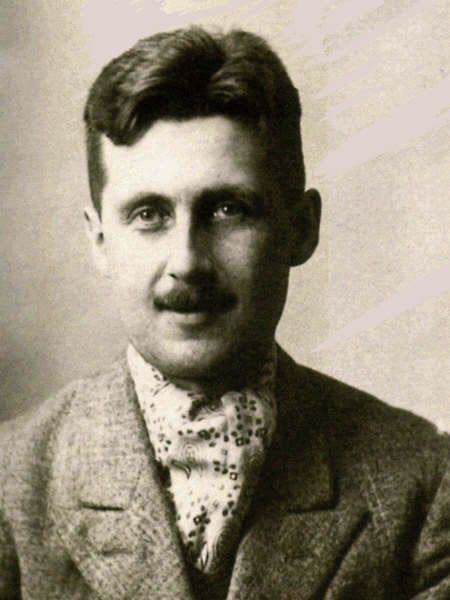
George Orwell is a damn good writer. Sure, he whipped out 1984 and Animal Farm, but it's from his essays and nonfiction that I'm learning Orwellian tricks--and by that I mean, the very best sort of craft points.
Yes, I know that his first book, Down and Out in Paris and London (1933) is characterized as a novel--usually with some qualifier like "semi-autobiographical" or "thinly-veiled." But given that Orwell saves several chapters for his personal commentary about, among others, the life of a Paris plongeur, London slang and swearing, tramps, sleeping options for the homeless in London, and the Salvation Army, it seems a stretch to me to use the word "novel." I understand his book to, at most, have about as much inevitable fudging as a memoir.
DOPL is about exactly that--Orwell mired in poverty, looking for work or working 17-hour shifts in hellfire hot hotel kitchens, begging, pawning, banding together with others in the same state, starving, and generally fighting to survive.
The temptation would be to lay it all out there--"This happened, and then this happened, and then this happened....." Orwell doesn't fall for it. Rather, he uses anecdotes proportionally: the shorter ones add scope and breadth to what might otherwise be read as an individualized experience; longer ones push the narrative forward; still longer ones fundamentally shape Orwell's experiences and opinions. With narrative intention for each sub-story, Orwell keeps the book from being a diary-esque dumping ground for every interesting thing that happened to him. He allows each story only as much it needs to serve its textual purpose. Given proper weight, the story of the weeping cook in the bad restaurant is as compelling as that of Boris, the former Russian army captain now sleeping in bug-infested sheets in the slums--even though we spend significantly more time with Boris than the cook.
What's the point? Why wouldn't a diary-esque series of observations be just as compelling? If DOPL took this travelogue route, it'd still have worth. But because Orwell takes pains to shape a narrative, one with continuity even when he leaps into another country and set of characters midway through, readers are prepared for the chapters when Orwell's first-person narrator turns discursive.
Why don't we resent the narrator for getting all political on us in the midst of a good story? Orwell refrains from opining in scene, saving it up for discursive chapters placed at natural pauses. The first discourse doesn't appear until the narrator is transitioning between Paris and London. We readers want to reflect before we make that leap; otherwise, it'd be too abrupt. The discourse actually builds tension, because while we know the narrator is steaming towards London, with one chance to pull himself out of dire straights, he's not there yet. The discursive chapter delays the resolution and heightens suspense.
And finally, Orwell's plain-language voice is a stay against the resentment we might feel for a pontificating narrator. "For what they are worth I want to give my opinions on the Paris plongeur. ..." Nothing high and mighty in that tone; our guard drops. Rather than riddiling his commentary with adjectives, adverbs, and other grammatical efforts towards artificial emphasis, Orwell puts his money on nouns: facts, observations, and general good sense.
Which means he's following his own advice, from the essay he'd later write titled "Politics and the English Language." Not that I'm one for artifical emphasis, but it's only one of the best essays ever written, ever.