

What do you think?

The People, Yes
A long poem that makes brilliant use of the legends and myths, the tall tales and sayings of America.
300 pages, Hardcover
First published January 1, 1936
About the author
Carl Sandburg
779 books350 followersFree verse poems of known American writer Carl August Sandburg celebrated American people, geography, and industry; alongside his six-volume biography
Abraham Lincoln
(1926-1939), his collections of poetry include
Smoke and Steel
(1920).
This best editor won Pulitzer Prizes. Henry Louis Mencken called Carl Sandburg "indubitably an American in every pulse-beat."
http://en.wikipedia.org/wiki/Carl_San...
This best editor won Pulitzer Prizes. Henry Louis Mencken called Carl Sandburg "indubitably an American in every pulse-beat."
http://en.wikipedia.org/wiki/Carl_San...
Ratings & Reviews
Friends & Following
Create a free account to discover what your friends think of this book!
Community Reviews
Displaying 1 - 25 of 25 reviews

November 13, 2012
Hog-butcher for the World,
Tool-maker, Stacker of Wheat,
Player with Railroads and the Nation's Freight-handler,
Stormy, husky, brawling,
City of the Big Shoulders...
Sandburg's most famous poem was published in Poetry in 1914, and in his first book in 1916, twenty years before this collection. CS writes with a shotgun rather than, like Dickinson, a marksman's telescopic rifle--the "Loaded Gun that stood in Corners, till the day..." Like Steinbeck, Sandburg is a great writer without being a particularly good writer: both, because their subjects are unprecedented and necessary. In Sandburg's case, "Hope is a tattered flag...the shimmer...the blue hills...an echo...." He does run on, but in the midst of it, wonderful gems, often colloquial: "I got some poles to hold it on the east side / and the wind holds it up on the west."
Even colloquial insults: "Wouldn't you just as soon sing as make that noise?"
Then Sandburg evokes deaths in war, and suicides like Mr Eastman (of the Kodak Co) who apparently committed suicide to guarantee his many cultural bequests that he feared a second stroke might diminish, as he had seen others rewrite wills, narrowing their scope. Sandburg collects details of daily life, the life of the shopper, the farmer, the home-maker and the seamstress, etc. One would have to be as encyclopedic and discursive as the poet to summarize his catalogs of details.
I am coming to see this as an essential read that I missed, that was never emphasized in my own fine education--mostly in English and European literatures. I read some Sandburg nearly a decade ago, but I did not take on his long poem; I guess I left the best for last. For example, as the political windbags pretend to discuss budget in DC, the bloated military (which Eisenhower warned us against) is untouched.
Section 82, The People, Yes:
I pledge my allegiance,
say the munitions makers and the international bankers,
I pledge my allegiance to this flag, that flag,
any flag at all, of any country anywhere
paying its bills and meeting interest on loans,
one and indivisible,
coming through with cash in payment as stipulated
with liberty and justice for all,
say the munitions makers and the international bankers.
--Complete Poems, p 569
One of his poems, incidentally, addresses my future teacher, Archibald MacLeish, on his leaving his Cummington farm to support the war effort in 1940. MacLeish helped my Ph.D. advisor Leonard Unger get me a yearlong postdoc grant to study 17C lunar mapping. When I sent him the result of my year's study, he said it was "better than academic"--which I quote on the backcover of my recent book that addends my lunar piece. It has enraged many of my colleagues who have refused to review my book, The Worlds of Giordano Bruno, UK:Cortex Design (see also Facebook).
Tool-maker, Stacker of Wheat,
Player with Railroads and the Nation's Freight-handler,
Stormy, husky, brawling,
City of the Big Shoulders...
Sandburg's most famous poem was published in Poetry in 1914, and in his first book in 1916, twenty years before this collection. CS writes with a shotgun rather than, like Dickinson, a marksman's telescopic rifle--the "Loaded Gun that stood in Corners, till the day..." Like Steinbeck, Sandburg is a great writer without being a particularly good writer: both, because their subjects are unprecedented and necessary. In Sandburg's case, "Hope is a tattered flag...the shimmer...the blue hills...an echo...." He does run on, but in the midst of it, wonderful gems, often colloquial: "I got some poles to hold it on the east side / and the wind holds it up on the west."
Even colloquial insults: "Wouldn't you just as soon sing as make that noise?"
Then Sandburg evokes deaths in war, and suicides like Mr Eastman (of the Kodak Co) who apparently committed suicide to guarantee his many cultural bequests that he feared a second stroke might diminish, as he had seen others rewrite wills, narrowing their scope. Sandburg collects details of daily life, the life of the shopper, the farmer, the home-maker and the seamstress, etc. One would have to be as encyclopedic and discursive as the poet to summarize his catalogs of details.
I am coming to see this as an essential read that I missed, that was never emphasized in my own fine education--mostly in English and European literatures. I read some Sandburg nearly a decade ago, but I did not take on his long poem; I guess I left the best for last. For example, as the political windbags pretend to discuss budget in DC, the bloated military (which Eisenhower warned us against) is untouched.
Section 82, The People, Yes:
I pledge my allegiance,
say the munitions makers and the international bankers,
I pledge my allegiance to this flag, that flag,
any flag at all, of any country anywhere
paying its bills and meeting interest on loans,
one and indivisible,
coming through with cash in payment as stipulated
with liberty and justice for all,
say the munitions makers and the international bankers.
--Complete Poems, p 569
One of his poems, incidentally, addresses my future teacher, Archibald MacLeish, on his leaving his Cummington farm to support the war effort in 1940. MacLeish helped my Ph.D. advisor Leonard Unger get me a yearlong postdoc grant to study 17C lunar mapping. When I sent him the result of my year's study, he said it was "better than academic"--which I quote on the backcover of my recent book that addends my lunar piece. It has enraged many of my colleagues who have refused to review my book, The Worlds of Giordano Bruno, UK:Cortex Design (see also Facebook).

September 26, 2013
I'm not sure how I got through all those American lit classes without ever hearing about this. When it came to Sandburg, I can only remember the Chicago Poems getting mentioned, which are good, but not as good as this. I had to wait for a visit to Sandburg's last home, Connemara in western North Carolina which led me to seek out the PBS American Masters special on Sandburg, which highlighted this book as the work Sandburg was perhaps most proud of.
I have to agree in that estimation. Of what I've read, only Whitman's Song of Myself and Ginsberg's Howl rival this as the great American epic poem. Sandburg wrote this during the Great Depression as a sort of hymn to the resilience of the human spirit. I love the way it mixes the American vernacular of the time--slang, country sayings, bits of tall tale--with sections that highlight human accomplishment in many different areas. Sandburg's is a progressive voice that emphasizes humanism over institutions. There's a little of something for everyone in here, and with 107 sections, it's a poem you may want to parcel out over an extended period of time, but give it a try. It's a poem I'll look forward to re-reading in the future.
I have to agree in that estimation. Of what I've read, only Whitman's Song of Myself and Ginsberg's Howl rival this as the great American epic poem. Sandburg wrote this during the Great Depression as a sort of hymn to the resilience of the human spirit. I love the way it mixes the American vernacular of the time--slang, country sayings, bits of tall tale--with sections that highlight human accomplishment in many different areas. Sandburg's is a progressive voice that emphasizes humanism over institutions. There's a little of something for everyone in here, and with 107 sections, it's a poem you may want to parcel out over an extended period of time, but give it a try. It's a poem I'll look forward to re-reading in the future.

July 29, 2020
Sandburg was a Modern liberal, writing at the time when religious postmillienialism was losing its religiousness and settling into the starry-eyed secular idealism that has characterized the Left ever since. In 1936, when this book of poetry was published, the First World War was less than a generation in the past, and the United States was still mucking around in severe economic depression; but, despite that, America had escaped the most devastating consequences of the War—among which the total disintegration of faith in God and cultural institutions was key. Sandburg's writing is actually hopeful, not cynical or nihilistic as the poetry after the '60s would be. It's hopeful because its foundation is an optimistic view of human nature. Sandburg may acknowledge hardship, corruption, and injustice—indeed, these comprise a significant emphasis in his work—but it's clear that Sandburg regards himself as one voice in a relentless hymn of progress that will swell on and on till the whole globe is belting out the chorus. For him, of course, this means socialism.
And so on. Glorious stuff, I suppose, if you deny depravity and ignore the Bolshevik Revolution. Easy—even now, nearly a century later—to get swept away by the sheer power of the image, a renewed Beethovenian ode to human progress. But when you keep a steady eye on the track record of leftist totalitarianism—something like 200 million civilians killed by their own governments during the 20th century—it's hard to judge this as anything but misguided and naive fantasy.
The book itself is one long poem divided into 107 sections, most of which occupy two pages. All of it is done in free verse—usually an elevated prose, rich in imagery as in the example above. Almost all of the 107 sections contain some internal cohesive theme (e.g. Babel, motherhood, fatherhood, suicide, property rights, advertising, nature, universal brotherhood, flower names, Lincoln, courtrooms, advertising), while also supporting, if only at right angles, Sandburg's main topic of "the people." After all, "the people" is a subject too vast and profound to face head-on. One needs to move constantly to different vantage points, to circle it as one would a complex statue. The poet summarizes this orbital approach in this way:
I'm no expert, but I think you'll find in Sandburg's poetry the pastoral lyricism of Walt Whitman, the political idealism of Woodrow Wilson, the passionate socialism of Upton Sinclair, and the keen appreciation for American folk cultures shared by such artists as Aaron Copland and Grant Wood.

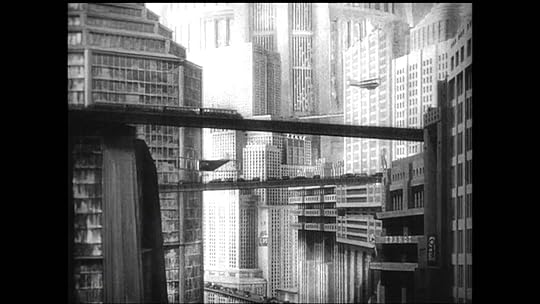
Also in Sandburg is a mystic fascination with skyscrapers—not, to be clear, the alien glass-and-steel behemoths of postmodernism, but rather the window-pocked towers of the Art Deco style, tapering to neo-Gothic pinnacles exemplified best by the Chrysler and Empire State buildings in New York.

Sandburg is haunted by these buildings and the industrial progress they represent. In what may be a direct tribute to Fritz Lang's 1927 movie Metropolis, which features a New Tower of Babel, Sandburg begins The People, Yes with a treatment of the Tower of Babel.
In the end, just three stars for this one. I'm not an expert at judging poetry, but Sandburg's idealism and longwindedness wear me down.
The people will live on.
The learning and blundering people will live on.
They will be tricked and sold and again sold
And go back to the nourishing earth for rootholds,
The people so peculiar in renewal and comeback,
You can't laugh off their capacity to take it.
The mammoth rests between his cyclonic dreams...
The steel mill sky is alive.
The fire breaks white and zigzag
shot on a gun-metal gloaming.
Man is a long time coming.
Man will yet win.
Brother may yet line up with brother.
And so on. Glorious stuff, I suppose, if you deny depravity and ignore the Bolshevik Revolution. Easy—even now, nearly a century later—to get swept away by the sheer power of the image, a renewed Beethovenian ode to human progress. But when you keep a steady eye on the track record of leftist totalitarianism—something like 200 million civilians killed by their own governments during the 20th century—it's hard to judge this as anything but misguided and naive fantasy.
The book itself is one long poem divided into 107 sections, most of which occupy two pages. All of it is done in free verse—usually an elevated prose, rich in imagery as in the example above. Almost all of the 107 sections contain some internal cohesive theme (e.g. Babel, motherhood, fatherhood, suicide, property rights, advertising, nature, universal brotherhood, flower names, Lincoln, courtrooms, advertising), while also supporting, if only at right angles, Sandburg's main topic of "the people." After all, "the people" is a subject too vast and profound to face head-on. One needs to move constantly to different vantage points, to circle it as one would a complex statue. The poet summarizes this orbital approach in this way:
THE PEOPLE, YES
Being several stories and psalms nobody would want to laugh at
interspersed with memoranda variations worth a second look
along with sayings and yarns traveling on grief and laughter
running sometimes as a fugitive air in the classic manner
breaking into jig time and tap dancing nohow classical
and further broken by plain and irregular sounds and echoes from
the roar and whirl of street crowds, work gangs, sidewalk clamor,
with interludes of midnight cool blue and inviolable stars
over the phantom frames of skyscrapers.
I'm no expert, but I think you'll find in Sandburg's poetry the pastoral lyricism of Walt Whitman, the political idealism of Woodrow Wilson, the passionate socialism of Upton Sinclair, and the keen appreciation for American folk cultures shared by such artists as Aaron Copland and Grant Wood.
Also in Sandburg is a mystic fascination with skyscrapers—not, to be clear, the alien glass-and-steel behemoths of postmodernism, but rather the window-pocked towers of the Art Deco style, tapering to neo-Gothic pinnacles exemplified best by the Chrysler and Empire State buildings in New York.
Sandburg is haunted by these buildings and the industrial progress they represent. In what may be a direct tribute to Fritz Lang's 1927 movie Metropolis, which features a New Tower of Babel, Sandburg begins The People, Yes with a treatment of the Tower of Babel.
In the end, just three stars for this one. I'm not an expert at judging poetry, but Sandburg's idealism and longwindedness wear me down.

July 28, 2019
I came across this title watching the documentary The Day Carl Sandburg Died, which was powerful for its own reasons, and took an interest in the optimism of the title and repetitious line, “The People, Yes.” (I also laughed out loud at Terkel’s line ‘But I have to add a proviso: The People, Perhaps or The People, Maybe.’”)
This is a masterpiece of American literature. It’s part philosophical, part tall-tale/myth (I appreciated the Paul Bunyan references), and part religious (but in a more spiritual sense). I really am shocked I never heard of this throughout my schooling, especially being in Sandburg’s Illinois, and ashamed that I haven’t used any lines from it in my own teaching yet. I will.
A literary element that he employs at length and successfully is the use of dichotomies. From “56” he writes, “The mask of ‘What do I care?’ to cover ‘What else can I do?’” Other wisdom comes in the form of the oft-quoted sentiment from Fight Club in “67”: “‘Broadway is a street,’ typed the colyumist, ‘where people spend money they haven’t earned to buy things they don’t need to impress people they don’t like.’”
Poem 37 has the best stanza and the one most quoted for good reason:
“Get off this estate.”
“What for?”
“Because it’s mine.”
“Where did you get it?”
“From my father.”
“Where did he get it?”
“From his father.”
“And where did he get it?”
“He fought for it.”
“Well, I’ll fight you for it.”
Some of the poems are dated. There is some choice language that I definitely cringed when I came across, but understanding his life I believe he meant well, even if the collection could use some footnotes and knowledge of cultural context.
This has nothing to do with Sandburg, but I also was reminded about the fun of using the library for books like this one while reading. Stamps in the copy I read date from 1966, and someone with a purple pen underlined and drew triangles with exclamation marks throughout for parts they deemed important. I found it interesting to consider what that person found worthy of study, but I also became really curious about Anna, whose full phone number was written at the top of page 105 in that same faded purple ink. I restrained my curiosity to call and see how her name ended up written in this library book, especially since the handwriting looks decades old, but I appreciated the story within a story in this book.
This is a masterpiece of American literature. It’s part philosophical, part tall-tale/myth (I appreciated the Paul Bunyan references), and part religious (but in a more spiritual sense). I really am shocked I never heard of this throughout my schooling, especially being in Sandburg’s Illinois, and ashamed that I haven’t used any lines from it in my own teaching yet. I will.
A literary element that he employs at length and successfully is the use of dichotomies. From “56” he writes, “The mask of ‘What do I care?’ to cover ‘What else can I do?’” Other wisdom comes in the form of the oft-quoted sentiment from Fight Club in “67”: “‘Broadway is a street,’ typed the colyumist, ‘where people spend money they haven’t earned to buy things they don’t need to impress people they don’t like.’”
Poem 37 has the best stanza and the one most quoted for good reason:
“Get off this estate.”
“What for?”
“Because it’s mine.”
“Where did you get it?”
“From my father.”
“Where did he get it?”
“From his father.”
“And where did he get it?”
“He fought for it.”
“Well, I’ll fight you for it.”
Some of the poems are dated. There is some choice language that I definitely cringed when I came across, but understanding his life I believe he meant well, even if the collection could use some footnotes and knowledge of cultural context.
This has nothing to do with Sandburg, but I also was reminded about the fun of using the library for books like this one while reading. Stamps in the copy I read date from 1966, and someone with a purple pen underlined and drew triangles with exclamation marks throughout for parts they deemed important. I found it interesting to consider what that person found worthy of study, but I also became really curious about Anna, whose full phone number was written at the top of page 105 in that same faded purple ink. I restrained my curiosity to call and see how her name ended up written in this library book, especially since the handwriting looks decades old, but I appreciated the story within a story in this book.

March 28, 2021
Everything I love about Sandburg packed into a long-form poem which combines myth, history, adages, anecdotes, wit, speeches, conversation, and poetic musing. Sandburg is usually a hit or miss for me, but I enjoyed this one start to finish. Absolutely excellent.
From #62:
In the daily labor of the people
by and through which life goes on
the people must laugh or go down
...
The people laugh, yes, the people laugh.
They have to in order to live and survive...
From #62:
In the daily labor of the people
by and through which life goes on
the people must laugh or go down
...
The people laugh, yes, the people laugh.
They have to in order to live and survive...

May 6, 2008
Lyrical with muscle - an uneven, but grabbing poem of us.

July 24, 2018
Non tutti i mali vengono per nuocere. Lo sappiamo e per consolarci ce lo diciamo spesso. Se la vecchiaia è considerata un "male", non credo si possa negare che questa inevitabile condizione umana possa essere considerata un "nocumento", sostantivo del verbo "nuocere".
Infatti, secondo molti, si pensa che soltanto con la vecchiaia si possa conquistare la "saggezza". Una volta acquisita - non tutti ci riescono, anche se invecchiati - si pensa che, tutto sommato, la vita possa essere considerata un viaggio, un percorso, ed anche una corsa, tra pianure, montagne e colline, mari ed oceani. Si spera che si possa arrivare alla fine, sani di corpo e di mente, in cima ad un monte abbastanza alto, per rivedere quello che abbiamo lasciato dietro alle nostre spalle.
Un'aspirazione abbastanza legittima nella speranza di rivedere con l'occhio della mente i primi giorni di vita, quando il palcoscenico del mondo ci ha visti diventare attori della rappresentazione dello spettacolo che si chiama "vita". Soltanto in questo modo, scrutando il vasto orizzonte che ci appare davanti con scene ed episodi che ci hanno visto protagonisti, possiamo capire davvero cosa e come abbiamo vissuto i giorni che ci sono stati concessi di vivere.
Potremo renderci conto che il tempo è passato come scorre una pellicola nella macchina del proiettore della vita, fuggevole, transitoria, effimera. In gioventù si tende a pensare che la vita sia fatta per sempre. Man mano che gli anni passano, ci si accorge che non sono gli anni a passare, ma decenni. Come palle che rotolano, alternando tempi belli e brutti. E' cambiata anche la percezione del tempo. La catena dei ricordi si è allungata e la memoria li raccoglie proponendoli continuamente al tempo presente che sembra restringersi e stare per finire da un momento all'altro.
Il poeta americano Carl Sandburg (1878-1967) fu molto attento e consapevole di questi momenti della vita. Cercò di affrontare il problema in un suo libro intitolato, "The People, Yes", pubblicato nel 1936. Era il periodo della "grande depressione", il crollo di Wall Street, una grave crisi economica e finanziaria che sconvolse l'economia mondiale e che ebbe forti ripercussioni nel decennio successivo.
Nel poema, lungo trecento pagine, il poeta voleva dare un aiuto alla gente comune, incitandoli a reagire, rinnovarsi e ricostruire. Attraverso il recupero di storie, leggende e miti percorre le praterie del suo sterminato Paese di adozione. Figlio di poveri ed incolti emigranti svedesi, già a tredici anni incominciò a lavorare, diventando una delle voci più importanti del cosiddetto gruppo di Chicago.
Si fece promotore di un rinnovamento della poesia nel senso di una diretta ricerca delle manifestazioni più autentiche della nuova realtà americana e di un linguaggio affrancato dagli schemi stilistici tradizionali, spoglio e quotidiano. La sintesi del suo lungo poema va vista in pochi versi del poema quando racconta la storia di un re che voleva una iscrizione sotto il suo nome in maniera da sfidare il passare del tempo. Ecco i versi che ho tradotto in maniera libera:
"And the king wanted an inscription
good for a thousand years and after
that to the end of the world?"
"E il re voleva una iscrizione
che durasse per migliaia di anni e più
sino alla fine del mondo?"
“Yes, precisely so.”
“Something so true and awful that no
matter what happened it would stand?”
“Yes, exactly that.”
"Si, esattamente".
" Qualcosa che fosse vera e terribile che
affrontasse qualunque cosa potesse accadere?"
"Si esattamente."
“Something no matter who spit on it or
Laughed at it there it would stand
And nothing would change it?”
"Qualcosa su cui anche sputarci
o riderci su senza che
nulla potesse farla cambiare?"
“Yes, that was what the king ordered
his wise men to write.”
"Si, questo ordinò il re
ordinò ai suoi saggi di fare."
“And what did they write?”
“Five words: This too shall pass away.”
"E cosa scrissero?
"Cinque parole: Anche questo dovrà passare."
Cinque semplici parole in un inglese biblico. Potranno accompagnarci nelle difficoltà del cammino nella valle della nostra vita.
Infatti, secondo molti, si pensa che soltanto con la vecchiaia si possa conquistare la "saggezza". Una volta acquisita - non tutti ci riescono, anche se invecchiati - si pensa che, tutto sommato, la vita possa essere considerata un viaggio, un percorso, ed anche una corsa, tra pianure, montagne e colline, mari ed oceani. Si spera che si possa arrivare alla fine, sani di corpo e di mente, in cima ad un monte abbastanza alto, per rivedere quello che abbiamo lasciato dietro alle nostre spalle.
Un'aspirazione abbastanza legittima nella speranza di rivedere con l'occhio della mente i primi giorni di vita, quando il palcoscenico del mondo ci ha visti diventare attori della rappresentazione dello spettacolo che si chiama "vita". Soltanto in questo modo, scrutando il vasto orizzonte che ci appare davanti con scene ed episodi che ci hanno visto protagonisti, possiamo capire davvero cosa e come abbiamo vissuto i giorni che ci sono stati concessi di vivere.
Potremo renderci conto che il tempo è passato come scorre una pellicola nella macchina del proiettore della vita, fuggevole, transitoria, effimera. In gioventù si tende a pensare che la vita sia fatta per sempre. Man mano che gli anni passano, ci si accorge che non sono gli anni a passare, ma decenni. Come palle che rotolano, alternando tempi belli e brutti. E' cambiata anche la percezione del tempo. La catena dei ricordi si è allungata e la memoria li raccoglie proponendoli continuamente al tempo presente che sembra restringersi e stare per finire da un momento all'altro.
Il poeta americano Carl Sandburg (1878-1967) fu molto attento e consapevole di questi momenti della vita. Cercò di affrontare il problema in un suo libro intitolato, "The People, Yes", pubblicato nel 1936. Era il periodo della "grande depressione", il crollo di Wall Street, una grave crisi economica e finanziaria che sconvolse l'economia mondiale e che ebbe forti ripercussioni nel decennio successivo.
Nel poema, lungo trecento pagine, il poeta voleva dare un aiuto alla gente comune, incitandoli a reagire, rinnovarsi e ricostruire. Attraverso il recupero di storie, leggende e miti percorre le praterie del suo sterminato Paese di adozione. Figlio di poveri ed incolti emigranti svedesi, già a tredici anni incominciò a lavorare, diventando una delle voci più importanti del cosiddetto gruppo di Chicago.
Si fece promotore di un rinnovamento della poesia nel senso di una diretta ricerca delle manifestazioni più autentiche della nuova realtà americana e di un linguaggio affrancato dagli schemi stilistici tradizionali, spoglio e quotidiano. La sintesi del suo lungo poema va vista in pochi versi del poema quando racconta la storia di un re che voleva una iscrizione sotto il suo nome in maniera da sfidare il passare del tempo. Ecco i versi che ho tradotto in maniera libera:
"And the king wanted an inscription
good for a thousand years and after
that to the end of the world?"
"E il re voleva una iscrizione
che durasse per migliaia di anni e più
sino alla fine del mondo?"
“Yes, precisely so.”
“Something so true and awful that no
matter what happened it would stand?”
“Yes, exactly that.”
"Si, esattamente".
" Qualcosa che fosse vera e terribile che
affrontasse qualunque cosa potesse accadere?"
"Si esattamente."
“Something no matter who spit on it or
Laughed at it there it would stand
And nothing would change it?”
"Qualcosa su cui anche sputarci
o riderci su senza che
nulla potesse farla cambiare?"
“Yes, that was what the king ordered
his wise men to write.”
"Si, questo ordinò il re
ordinò ai suoi saggi di fare."
“And what did they write?”
“Five words: This too shall pass away.”
"E cosa scrissero?
"Cinque parole: Anche questo dovrà passare."
Cinque semplici parole in un inglese biblico. Potranno accompagnarci nelle difficoltà del cammino nella valle della nostra vita.

July 13, 2020
Again just like the Chicago Poems this collection by Sandburg is just okay. It’s main subject is, well, people. The masses that make the earth and who he sees as the primary movers and shakers of history and the ones to whom much is owed. Especially in the period when he was writing. A lot of his poems deal with themes that I am sympathetic towards, but his style grates on me. It isn’t so much poetry as flowery prose, and to me it is too long winded. Here is an excerpt that I liked from the 100th poem:
“The Great Sphinx and the Pyramids say: ‘Man passed this way and saw a lot of ignorant besotted pharaohs.’ The pink pagodas, jade rams and marble elephants of China say: ‘Man came along here too and met suave and cruel mandarins.’ The temples and forums of Greece and Rome say: ‘Man owned man here where man bought and sold man in the open slave auctions; by these chattels stone was piled on stone to make these now crumbled pavilions.’ The medieval Gothic cathedrals allege: ‘Mankind said prayers here for itself and for stiff necked drunken robber barons.’’ And the skyscrapers of Manhattan, Detroit, Chicago, London, Paris, Berlin—what will they say when the hoarse and roaring years of their origin have sunk to a soft whispering?”
Now I thought that was beautiful and interesting, but then he continues on for five pages in a rambling and less poetic manner and that was essentially the content of this collection. It’s unfortunate because sections of poems are quite good, but ultimately most of it can be forgotten except those few that are good enough and short enough to be taught in high school English classes.
“The Great Sphinx and the Pyramids say: ‘Man passed this way and saw a lot of ignorant besotted pharaohs.’ The pink pagodas, jade rams and marble elephants of China say: ‘Man came along here too and met suave and cruel mandarins.’ The temples and forums of Greece and Rome say: ‘Man owned man here where man bought and sold man in the open slave auctions; by these chattels stone was piled on stone to make these now crumbled pavilions.’ The medieval Gothic cathedrals allege: ‘Mankind said prayers here for itself and for stiff necked drunken robber barons.’’ And the skyscrapers of Manhattan, Detroit, Chicago, London, Paris, Berlin—what will they say when the hoarse and roaring years of their origin have sunk to a soft whispering?”
Now I thought that was beautiful and interesting, but then he continues on for five pages in a rambling and less poetic manner and that was essentially the content of this collection. It’s unfortunate because sections of poems are quite good, but ultimately most of it can be forgotten except those few that are good enough and short enough to be taught in high school English classes.

February 8, 2026
Carl Sandburg was a poet of the American heartland. He paid tribute to it in many of his writings. Most notably Sandburg wrote admiringly about the life of Abraham Lincoln in a multi-volume Pulitzer Prize winning biography that praised Lincoln, and shaped many Americans views of the man, his presidency and his legacy during the middle of the twentieth century.
This book length poem was written in 1936 in the midst of the Great Depression. It is the perfect poem to read to commemorate America’s 250th Birthday because it celebrates, and pays tribute to the many people and cultures that comprise the United States. It speaks eloquently of the diversity of the working classes, and their strengths that make the country strong. It also describes America’s flaws and shortcomings related to wealth, class, politics, and authoritarian beliefs. It alludes to race in a manner consistent with the beliefs and prejudices of that period in time.
The poem is grounded in a populist social democratic worldview that would be anathema to those currently in power who are seeking to whitewash American history, and remove any records mentioning, or alluding to unpleasant, distasteful and distressing practices and events, and blackguards.
This book length poem was written in 1936 in the midst of the Great Depression. It is the perfect poem to read to commemorate America’s 250th Birthday because it celebrates, and pays tribute to the many people and cultures that comprise the United States. It speaks eloquently of the diversity of the working classes, and their strengths that make the country strong. It also describes America’s flaws and shortcomings related to wealth, class, politics, and authoritarian beliefs. It alludes to race in a manner consistent with the beliefs and prejudices of that period in time.
The poem is grounded in a populist social democratic worldview that would be anathema to those currently in power who are seeking to whitewash American history, and remove any records mentioning, or alluding to unpleasant, distasteful and distressing practices and events, and blackguards.
January 12, 2021
Very glad to have read this.
I find the comparisons to Leaves of Grass hard to avoid; many sections read like an updated Whitman for the early modern era, singing the song of skyscrapers and factory workers instead of pecan trees and raftsmen (and meeting in the middle with Lincoln). Not that there's anything wrong with that.
Favorite sections include 30 (gathering colloquial sayings; "fine words butter no parsnips"), 47 (on Paul Bunyan), 48, 81 (on Chicago) and 98 (on Skyscrapers; "Hold down the skylines now with your themes, Proud marching oblongs of floodlighted walls. Your bottom rocks and caissons rest In money and dreams, in blood and wishes.")
I took this line to be a good summary:
I find the comparisons to Leaves of Grass hard to avoid; many sections read like an updated Whitman for the early modern era, singing the song of skyscrapers and factory workers instead of pecan trees and raftsmen (and meeting in the middle with Lincoln). Not that there's anything wrong with that.
Favorite sections include 30 (gathering colloquial sayings; "fine words butter no parsnips"), 47 (on Paul Bunyan), 48, 81 (on Chicago) and 98 (on Skyscrapers; "Hold down the skylines now with your themes, Proud marching oblongs of floodlighted walls. Your bottom rocks and caissons rest In money and dreams, in blood and wishes.")
I took this line to be a good summary:
The ingenuity of the human mind and what passes the time of day for the millions who keep their serenity amid the relentless processes of wresting their provender from the clutch of tongs organized against them--this is always interesting and sometimes marvelous

July 26, 2020
Love this collection! I have had the honor of visiting the home of the Author. A peaceful lovely property of the great Carl Sandburg. His love for literature and American history goes deep into my soul. The words from his works drive deep into my thoughts on a daily basis. His love for Abraham Lincoln shines in many of his writings and poetry, I think Sandburg felt within himself the sufferings president Lincoln had endured throughout his life. Sandburg was one of America's greatest poets of his time and this book presents it in every way. I stood in his yard and looked up at the very window of his home were he wrote his poetry. If you know Carl Sandburg you must get this book!
Many truths lie deep within his words.
Many truths lie deep within his words.

March 26, 2022
It took me awhile to get used to reading an epic 286 page poem that is broken up in different sections. This epic poem was published in 1936 and focuses on themes of poverty, inequality, wealth and technology. It's a hard poem or collection of poems to review, but I did really enjoy it, though it did feel a little long for me. I prefer the length of poetry collections in the 70 to 90 page range. It would be interesting if a poet tried to write something similar to commentate on today's issues. I was surprised how a lot of the themes of the poem are kind of universal and still big points of discussion today.
xx-dnf-skim-reference
November 6, 2022My 'waiting in line' book is a selection of Sandburg's works. Maybe if I ever get through that enough times to feel that I've mastered it, I'll borrow this again. Or maybe I'll just reread Whitman's Song of Myself, or read more of Whitman. Or reread Winesburg, Ohio. Or finish Spoon River Anthology. Not that they're interchangeable... but that there's only so much about people I can put up with.
dnf Nov. 2022
dnf Nov. 2022

December 27, 2019
“give me something to remember you by /
be my easy rider /
kiss me once before you go a long one /
flash eyes testaments in a rush /
underhums of plain love with rye bread sandwiches /
and grief and laughter: where to? what next?”
be my easy rider /
kiss me once before you go a long one /
flash eyes testaments in a rush /
underhums of plain love with rye bread sandwiches /
and grief and laughter: where to? what next?”
April 23, 2020
It captures the sound and feeling of the first half of the twentieth century in the U.S., my grandparents adulthood. Reading this reminds me of their voices.
August 22, 2014
So I have to say that I actually did not like this book very much at all. I'm giving it three stars because I do see how it might be appreciated; it is an impressive work that really captures the thought and tone of the Great Depression and manages to give support to the people of the time. I read the library's copy, and I think the book might be about as old as the text, so I can really imagine it in the hands of someone down on his luck, or desperately trying to stay employed. At the time, I think this hymn to perseverance and the strength of "the people", all of the people, would have been very powerful.
Stylistically, this book reminds me of Walt Whitman; this is quite possibly intentional, given that Sandburg's American almost-epic of The People, Yes echoes Whitman in terms of subject matter and tone. It reminds me specifically of "I Hear America Singing," if that helps. Now, while I appreciate Whitman, I am not a Whitman person. I have found that people who love poetry either love Emily Dickinson, and are nearly indifferent to positively unfavorable to Whitman, or they love Whitman and are not fans of Dickinson. I am a Dickinson person. This means that Sandburg's Whitman-esque style (and topic, given that I'm really not a huge fan of Whitman's "American" work) was a serious drawback. I also thought that while the poetry was often pretty good,, and flowed well or decently, for example:"Letting others organize and gather the shekels and progress from boom to crash to boom to crash?" or "And man the stumbler and finder, goes on,/ man the dreamer of deep dreams,/ man the shaper and maker/ man the answerer," it didn't always flow even as well as some of Whitman's less-flowing pieces. Sometimes the thoughts were just choppy, or the ideas were so long they lost all cadence and rhythm and practically became bad prose (and I love modern free verse, and I know a lot of people find no poetry in that.)
Overall, not terrible, but certainly not great. I won't be reading it again, but would recommend it to fans of Whitman and to people who are a little more "pull-yourself-up-by-your-bootstraps" and patriotic than I am. It has some good points and lots and lots of great opportunity for study and scholarship and analysis, but I did not enjoy it as a read.
Stylistically, this book reminds me of Walt Whitman; this is quite possibly intentional, given that Sandburg's American almost-epic of The People, Yes echoes Whitman in terms of subject matter and tone. It reminds me specifically of "I Hear America Singing," if that helps. Now, while I appreciate Whitman, I am not a Whitman person. I have found that people who love poetry either love Emily Dickinson, and are nearly indifferent to positively unfavorable to Whitman, or they love Whitman and are not fans of Dickinson. I am a Dickinson person. This means that Sandburg's Whitman-esque style (and topic, given that I'm really not a huge fan of Whitman's "American" work) was a serious drawback. I also thought that while the poetry was often pretty good,, and flowed well or decently, for example:"Letting others organize and gather the shekels and progress from boom to crash to boom to crash?" or "And man the stumbler and finder, goes on,/ man the dreamer of deep dreams,/ man the shaper and maker/ man the answerer," it didn't always flow even as well as some of Whitman's less-flowing pieces. Sometimes the thoughts were just choppy, or the ideas were so long they lost all cadence and rhythm and practically became bad prose (and I love modern free verse, and I know a lot of people find no poetry in that.)
Overall, not terrible, but certainly not great. I won't be reading it again, but would recommend it to fans of Whitman and to people who are a little more "pull-yourself-up-by-your-bootstraps" and patriotic than I am. It has some good points and lots and lots of great opportunity for study and scholarship and analysis, but I did not enjoy it as a read.
October 2, 2008
I loved so much of this book. It has many varieties of poems in it. I can't get some of the word images out of my head, fifty years after I first read them.
"If your Mother asks if you wnt one egg for breakfast or two, and you say one, but she makes two, then you eat them both, WHO is better at math, you or your Mother?"
ok, so I may have missed a word or two, but it stuck in this cranium in that form for half a century. In fact, I could relate a number of other slices of poems from this book, each as poignant, wise, astute as the other.
"If your Mother asks if you wnt one egg for breakfast or two, and you say one, but she makes two, then you eat them both, WHO is better at math, you or your Mother?"
ok, so I may have missed a word or two, but it stuck in this cranium in that form for half a century. In fact, I could relate a number of other slices of poems from this book, each as poignant, wise, astute as the other.
May 17, 2022
I have not read a poem that captures so assuredly the essence of "the people"
The pain and joy and folly of us all.
It culminates with a final "section" that should raise the hair on your neck. "where to, what next"
The pain and joy and folly of us all.
It culminates with a final "section" that should raise the hair on your neck. "where to, what next"
This entire review has been hidden because of spoilers.

November 17, 2010
Though Sandburg is what many have said, a poet who aspired to keep his language as simple as possible, I love this book. Sometimes, simple is better.

Read
September 1, 2011Is this kitsch or is it art? Is it profound or is it pop?
July 28, 2013
Made up of slang, cliches, and aphorisms. Carl Sandburg catches the myth of America through the voices of its people.

May 23, 2015
classic. a little abstract, depressing.

July 18, 2022
Pretty funny, sometimes moving folk poetry.

September 16, 2007
this one will raise some hairs on the ol' neck. mmphareeeeeee.

April 23, 2010
dude, for real...
Displaying 1 - 25 of 25 reviews