Jump to ratings and reviews
Rate this book

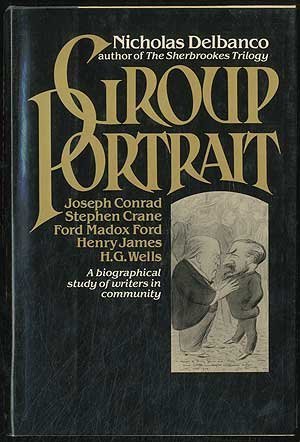
Group portrait: Joseph Conrad, Stephen Crane, Ford Madox Ford, Henry James, and H.G. Wells

Rate this book
book

224 pages, Hardcover

First published January 1, 1982

13 people want to read

About the author

Nicholas Delbanco

98 books18 followers
Nicholas Delbanco is the Robert Frost Distinguished University Professor of English Language and Literature at the University of Michigan and Chair of the Hopwood Committee. He has published twenty-five books of fiction and non-fiction. His most recent novels are The Count of Concord and Spring and Fall; his most recent works of non-fiction are The Countess of Stanlein Restored and The Lost Suitcase: Reflections on the Literary Life. As editor he has compiled the work of, among others, John Gardner and Bernard Malamud. The long-term Director of the MFA Program as well as the Hopwood Awards Program at the University of Michigan, he has served as Chair of the Fiction Panel for the National Book Awards, received a Guggenheim Fellowship and, twice, a National Endowment for the Arts Writing Fellowship. Professor Delbanco has just completed a teaching text for McGraw-Hill entitled Literature: Craft and Voice, a three-volume Introduction to Literature of which he is the co-editor with Alan Cheuse; in 2004 he published The Sincerest Form: Writiing Fiction by Imitation. His new non-fiction book, Lastingness: The Art of Old Age will be published by Grand Central Publishing in 2011.
Full Biography

NOTE: The following biography was composed in 2000 by Jon Manchip White and reflects information only up to and including that year.

Nationality: American. Born: London, England, 1942. Education: Harvard University, B.A. 1963; Columbia University, M.A. 1966. Career: Member of Department of Language and Literature, Bennington College, Bennington, Vermont, 1966-84, writing workshop director, 1977-84; professor of English, Skidmore College, Saratoga Springs, New York, 1984-85; Robert Frost Professor of English Language and Literature, University of Michigan, Ann Arbor, 1985—. Awards: National Endowment for the Arts creative writing award, 1973, 1982; National Endowment of Composers and Librettists fellowship, 1976; Guggenheim fellowship, 1980; Woodrow Wilson fellowship; Edward John Noble fellowship; New York State CAPS Award; Vermont Council of the Arts Award; Michigan Council of the Arts Award. Agent: Brandt & Brandt Literary Agents, Inc., 1501 Broadway, New York, New York 10036, U.S.A.

As a novelist, Nicholas Delbanco can be considered doubly fortunate in that he has always been able to draw inspiration and sustenance from two continents and two cultures.

Of Italian and German descent, he was born in London at the height of the German Blitz, and his family did not depart for America until he was six, and he was not naturalized as an American citizen until he was eleven. It is not surprising that, though later he would anchor himself firmly in New England and particularly in Vermont, and more recently in Michigan as the Robert Frost Professor of English Language and Literature, the influence of his European origins would play a consistent part in his fiction and non-fiction alike.

The cultural ambivalence, if such it may be called, manifested itself early. At Harvard, his B.A. thesis was devoted to a joint study of Rilke and Heredia, two noteworthy wanderers, and the subject of his M.A. thesis was that tragic outcast, Malcolm Lowry. Examining the numerous novels Delbanco has published to date, one finds that only five are set exclusively in the United States and that the majority are set, either in whole or part, in Provence, Tuscany, Greece, Switzerland, or as far afield as Barbados and Mexico. Several of his non-fiction books are concerned with Europe, one of them a study of that remarkable group of literary exiles, including Conrad, Crane, and James, who lived and worked together in a small corner of England at the turn of the last century. Indeed, one of the courses Delbanco has taught over the years is specifically entitled “Exiles,” and is devoted to Becket, Conrad, and Nabokov, while other courses have featured a gallery of roving and displaced novelists such as Joyce, Lawrence, Forster, Ford, Mann, Fitzgerald, and He

Ratings & Reviews

What do you think?
Rate this book

Friends & Following

Create a free account to discover what your friends think of this book!

Community Reviews

5 stars
1 (8%)
4 stars
5 (41%)
3 stars
5 (41%)
2 stars
1 (8%)
1 star
0 (0%)
Displaying 1 of 1 review
Profile Image for John Pistelli.
Author 9 books361 followers
May 6, 2020
This 1982 book—now mostly unheard of and out of print, but cheaply available online—is a curiosity. Subtitled "a biographical study of writers in community," it argues two theses:

1. that the five titular writers' confluence in the neighborhood of Kent and East Sussex, England, around 1900 is a literary convocation as momentous as Bloomsbury or expatriate Paris in the '20s;

2. that collaboration of various sorts is as important to literature as lone and competitive creation—that "[t]hough writing is a solitary business, it need not be a hermit's; though authors hunt and court success, it need not come at each other's expense."

But "argues two theses" misrepresents the text. This is not an academic treatise, but a belletristic series of exploratory essays. The first and fifth chapters read almost like travel literature, as Delbanco, better known as a novelist, rhapsodizes on the storied history—it's where the Battle of Hastings was fought—and present landscape of Kent and East Sussex:
The Gulf Stream runs sufficiently near to allow this region escape from the forbidding chill that grips the north of England. Fig trees grow, and mimosa, and the occasional palm. It is a fertile landscape and well-farmed; apple orchards and fields of hop abound. Vegetables grow in Romney Marsh; the hillsides are close-cropped by sheep. The pastures are ample for cows. Potatoes can be harvested in August. Oasthouses rise from every farm, and larger farms have several, their conical brick shapes topped by a white wooden cap. White weatherboard is characteristic of Kent; the villages are gaily variegated. A Georgian brick house will abut an Elizabethan half-timbered pub; behind them rises the stone vaulting of a medieval church. It is a democratic muddle, a gallimaufry, a place where foreigners have felt at home since Hastings.
At the end of the Victorian age and the dawning of the 20th century came the literal and figurative foreigners-conquerers Delbanco studies: the American adventurer Crane and expatriate James, the self-exiled Polish mariner Conrad, the Pre-Raphaelite scion Ford (then still going by his given name, Hueffer), and the upwardly mobile shopkeeper's-son-turned-prophet Wells. They came to work, and, fortified by Continental standards, to transform the English novel from mere entertainment or instruction to high art.

The second chapter focuses on Crane. He spent his last year, only his 28th, at Brede Place, where at a Christmas party at the turn of the century he put on a farce in jokey collaboration with James, Conrad, and Wells among others. Delbanco dwells on how—perhaps inspired by his new neighbors—Crane tried amid illness to bring his prose to a new standard of artistry. (Though Delbanco arguably underemphasizes how accomplished the writing, from The Red Badge of Courage to "The Open Boat," already was.)

The rugged American was outré by English standards of propriety: his consort Cora, who called herself "Mrs. Crane," was a still-married woman from Florida who would go on to manage a bordello. But his neighbors—even the proper Henry James, whom Cora served doughnuts at Brede—were solicitous. Delbanco, with his genius for quotation, documents Crane's increasing impatience with commercial fiction through his obviously exhausted and bemused wife's report:
According to Cora's notebook, when she suggested that he write for pure plain cash, "He turned on me & said: 'I will write for one man & banging his fist on writing table & that man shall be myself etc. etc.'"
Skilled not only in quotation but also in summation, Delbanco captions Crane's legend:
The recklessness so characteristic of Crane—the devil-may-care bravery that is the stuff of anecdote—seems an elected stance. It is the attitude of one who nerves and schools himself to manhood, as if war (and, at its farthest limit, suicide) were an initiation rite.

If Poe preceded him, Hemingway succeeded him. The latter's motto of "grace under pressure" applies in retrospect.
The next chapter narrates the unusual collaboration between Conrad and Ford. The younger Ford was sometimes Conrad's idea man, sometimes his amanuensis, sometimes his ghostwriter. The elder writer struggled with his third and adopted language, and he struggled as well with his self-imposed Flaubertian standards. At times debilitated by gout and depression, he needed his more facile young friend to verbally solicit his dictated memoirs and even to fill in for a serialized chapter of his masterpiece, Nostromo. Ford in turn became more the self-conscious artist, less the rambling amateur, under Conrad's exacting influence. Delbanco, promoting collaboration to the fractious artistic temperament, summarizes:
And I submit that Ford released the elder man to create profound scenarios by helping him to realize the surface of his texts. [...] That Ford profited from the collaboration is beyond question; he says so himself and at length. A dilettante to start with, he became professional; the young and mannered dabbler grew to be "an old man mad about writing."
The fourth chapter is probably the most interesting to the general reader. It dramatizes the famous argument over the nature and purpose of fiction between Henry James and H. G. Wells. James championed the aesthetic position, what would become the watchword of modernism: a novel should be a rigorously designed and finished work of art, as deliberate and complete as a painting, made as much by excluding inapposite subject matter as by patterning its essential contents. Wells, on the other hand, saw the novel as a subset of journalism and as a tool of social thought and political advocacy. For Wells, James's work was tediously ponderous and socially quiescent; for James, Wells's work was indiscriminate, unrealized, and vulgar. In this chapter, Delbanco mostly lets his principals have their dialogue as their friendship dissolves (they had once thought of collaborating) under the pressure of their ideological tussle.

For my part, I've always found the Wells/James conflict frustrating. I am in theory on James's side. Wells said, "I had rather be called a journalist than an artist, that is the essence of it," while James rightly replied to Wells, who thought of art only as dispensable ornament, "It is art that makes life, makes interest, makes importance." Yet these two men represent their respective positions in such exaggerated forms that I often find it hard to sympathize with either. James's late work—as opposed to the peerless middle-period masterpieces—often does disappear into its own excruciating mannerism; Wells had a point about that. Yet to define the novel simply as a propaganda vehicle is, to my mind, grotesque. I find the later iteration of the same dispute—Arnold Bennett vs. Virginia Woolf—more edifying, as the judicious Woolf seems to me more clearly in the right.

Other than this contretemps, Delbanco tends to neglect the historical and political element of his protagonists' oeuvres, ideas, and experiences, though he does give one tantalizing glimpse of the conservative Conrad vs. the progressivist Wells that implies the political meaning of the aesthete vs. ideologue squabble:
No matter how uncertain in his early period, Wells's art was didactic—and, later, explicitly so. The assumption of the didact (particularly, perhaps, if he has been, as was Wells, an autodidact and a success story) is meliorist: things can get better and do. Conrad put it succinctly. He told Wells, "The difference between us is fundamental. You don't care for humanity but think they are to be improved. I love humanity but know they are not."
In conclusion, we might ask: why is the Kentish convocation of the turn-of-the-century's major Anglophone writers less heralded than later modernist enclaves? Delbanco allows for one that this was a male preserve; as I've already discussed here, the period from roughly 1880-1910 in English letters was highly and willfully masculinist, more so than the periods that preceded and succeeded it. Kent and East Sussex did not have the presiding female geniuses of Bloomsbury or expat Paris—no Woolfs or Steins, only the wives and domestic servants that made the men's writing possible (though Woolf and Stein, it should be said, relied on similar support).

Another reason is the ambiguity of the achievement resulting from these writers' neighborhood co-habitation. Crane did his best work before he arrived; if you don't count Nostromo, Conrad's and Ford's collaboration didn't issue in a masterwork; and James and Wells produced a quarrel, not an opus. Add to that the lack of sexual tension and soap opera—this despite the the complicated love life of Wells and the homoeroticism that, in different ways, adheres to the lives and/or works of Crane, Conrad, and James—and you have a less immediately exciting story than Hemingway sparring in cafés or Lytton Strachey pointing out the spot of semen on Vanessa Bell's dress.

Group Portrait is still an enjoyable book, though—maybe less for the reader seeking biographical or historical information than for a budding writer in search of inspiration in the struggles of past masters.

But I described this book as "curious" at the beginning. What makes it curious is how conversant Delbanco expects his readers already to be with his subject. This is not an introduction to these writers; if you're not at least loosely familiar with their lives and works, Delbanco will not help. Moreover, the book assumes a readerly patience with essayistic speculation (and a readerly vocabulary) that would by no means be taken for granted today, anymore than a critic writing for mainstream publication would assume that the public has already read Nostromo or The Wings of the Dove. It's hard to imagine a mainstream house—Group Portrait was published by William Morrow—putting a book like this out today.

I read Group Portrait after finishing Maya Jasanoff's The Dawn Watch: Joseph Conrad in a Global World (2017) and couldn't help but contrast the two. Jasanoff's book is in most ways richer than Delbanco's. A historian's rather than a novelist's book, The Dawn Watch provocatively situates Conrad at the beginning of globalization in its contemporary form. Brilliantly structured according to his literal habitations and mental sojourns around the planet—in Poland and England, in Asia, in Africa, in Latin America—and the four great novels he painfully wrested from them—The Secret Agent, Lord Jim, Heart of Darkness, Nostromo—its narrative is as clear and brisk as Conrad's are mystified and tortuous. To dismiss Jasanoff's enviable achievement would be ingratitude—it's hard to write clearly, not that I've ever tried.

Still, in Jasanoff's magazine-profile idiom, I miss Delbanco's searching stateliness of prose, obviously written for a more literate popular audience. On the other hand, Jasanoff shows us so much more of the earth than Delbanco, who finds the world in—if not a grain of sand—then a small corner of England.
Displaying 1 of 1 review

Can't find what you're looking for?

Get help and learn more about the design.