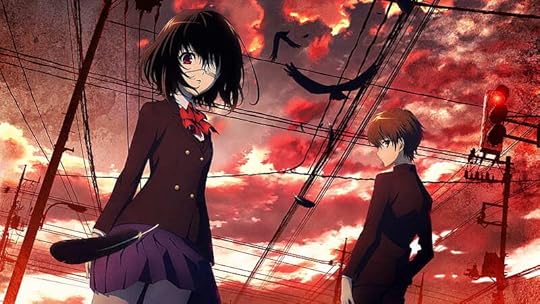
In the spring of 1998, Kouichi Sakakibara transfers to Yomiyama North Middle School. In class, he develops a sense of unease as he notices that the people around him act like they're walking on eggshells, and students and teachers alike seem frightened. As a chain of horrific deaths begin to unfold around him, he comes to discover that he has been placed in the cursed Class 3 in which the student body head count is always one more than expected. Class 3 is haunted by a vengeful spirit responsible for gruesome deaths in an effort to satisfy its spite. To stop the vicious cycle gripping his new school, Kouichi decides to get to the bottom of the curse, but is he prepared for the horror that lies ahead...?
'Yukito Ayatsuji' is the original creator of Another. He is a famous writer of mystery and Japanese detective fiction. He is also one of the writers that demands restoration of the classic rules of detective fiction and the use of more self reflective elements. He is married to Fuyumi Ono, author of The Twelve Kingdoms and creator of Ghost Hunt, Juuni Kokuki, and the author for a few other manga.
OMG!! The book version is more creepy than the anime version 😱😱😱 Gue merasa ngeri-ngeri sedap habis baca ini pas tengah malam 😨😨. Volume 1 ini lebih banyak pembahasan tokoh-tokoh yg terlibat dan pemaparan konflik utama dari keseluruhan cerita. Can't wait to find out the mystery in class 3-3 of Nourt Yomi. Who's the dead person? 😱😶
(*review sekalian mencakup Another, volume 2. Pada dasarnya, ini memang novel dua volume yang ceritanya langsung menyambung dari jilid 1 ke 2).
Another adalah novel misteri/horor yang terkenal, dengan adaptasi anime yang juga terkenal. Tiga hal yang paling mencolok dari novel ini: tema berupa mitos mistis ala SMA Jepang, sosok sang deuteragonis cewek (*Mei Misaki) dengan penutup sebelah matanya yang khas, dan . Penyelesaian dan kunci jawaban misterinya juga akan lama membekas di benak banyak pembaca.
Ada dua perasaan yang sering ditimbulkan oleh Another: penasaran dan geregetan. Penasaran, karena inti plotnya adalah untuk menjawab rentetan pertanyaan atas berbagai keanehan yang muncul; geregetan, karena penulisnya AMAT SANGAT pelit memberi informasi. Serius, si tokoh utamanya (*dan pembaca) menghabiskan mayoritas buku pertama dengan celingukan dan bertanya-tanya "eh ini sebenarnya ada apa sih??", sementara semua tokoh lainnya bersikap sok misterius.
Di sisi lain, harus saya akui kalau cara Yukito Ayatsuji 'menyiksa' pembaca terbilang efektif. Rasa ketidaktahuan itu membuat atmosfernya tambah mencekam. Buat saya, nuansa horor di Another justru paling terasa bukan sewaktu terjadi sesuatu, melainkan saat momen-momen di sela-selanya yang sarat nuansa "ada sesuatu yang tidak beres" dan impending doom.... perasaan bahwa ada hal mengerikan yang akan terjadi, sementara para karakternya tak berdaya menghadapi sesuatu yang tak bisa dijelaskan akal sehat.
Keseruan Another terletak pada misteri/teka-tekinya: dari pertanyaan berupa 'kenapa', yang kemudian berubah jadi 'siapa'. Namun ini bukan novel detektif dan jelas bukan misteri yang fair play, walau rasanya tetap seru untuk main tebak-tebak manggis dan mengendus petunjuk sebenarnya di tumpukan 'pengecoh' yang disebar si penulis. Pada akhirnya, walau tebakan saya amat sangat meleset, saya bisa puas dengan koherensi logika internalnya. Semua keanehan di awal berhasil dijelaskan dengan baik, dan tidak ada hal yang kontradiktif atau memunculkan plot hole *ini penting karena saya bawel soal beginian*
Kalau bicara kekurangan.... saya rasa ini bukan novel yang menarik untuk dibaca ulang, ataupun punya banyak nilai tambah di luar plotnya sendiri. Selain Misaki, bisa dibilang tidak ada tokoh yang menarik--mungkin karena terlalu fokus pada plot, karakter-karakternya terasa kurang tergali lebih dalam. Tokoh utamanya juga kurang berkesan; tipikal protagonis pemuda di novel Jepang yang banyak mikir/ngomong sendiri, serta melakukan refleksi yang tidak penting-penting amat. Kalau saya bandingkan, novelnya Stephen King (*berhubung tokoh utamanya adalah penggemar King hehe) lebih kuat & seimbang dalam hal membangun plot sekaligus mengembangkan karakter melalui momen-momen 'sampingan'. Biar begitu, keunikan dan kecerdikan plot Another sendiri rasanya cukup kuat jadi alasan untuk dibaca paling tidak sekali oleh penikmat horor yang senang dibuat penasaran bin geregetan~
(*catatan tambahan mengenai perbandingan dengan versi animenya: nyaris tidak ada perbedaan signifikan. Kalau lebih suka nonton, akan lebih suka animenya; kalau lebih suka baca, akan lebih suka bukunya. Rasanya seperti itu).
Mungkin inilah yang bikin genre horor bukan favoritku. Bukan masalah bikin takut atau ngga, tapi kepalaku terus-terusan mempertanyakan banyak hal /lah 😂
Emang bisa? Apa ngga aneh? Loh, bisa kayak gitu? Terus orang-orang apa ngga blablabla? Kenapa ya mereka kan udah tau kalau blablabla, kenapa pada blablabla? Dan seterusnya, dan seterusnya....
Well, terlepas dari keanehan-keanehan itu, aku suka cara penulis menggiring pembacanya. Buku ini berhasil bikin kepo mulai dari tengah sampai akhir. Seremnya tipe serem yang mencuci otak gitu. Menggiring opini. Twistnya dapet, padahal baru buku pertama 👏
I saw the anime version (and really enjoyed it) and somehow I didn't think to read the manga? I'm missing out. T___T Nonetheless, this will be read at some point.
Bagian awal terasa sangat lambat walaupun misteri mulai dibangun dengan cukup baik untuk memancing rasa penasaran pembaca. Namun, hal ini malah justru membuatku hampir menyerah untuk menyelesaikan buku ini karena bagian awal dengan misteri yang benar-benar misteri menghilangkan ketertarikanku. Syukurlah mulai pertengahan sampai akhir mulai ada perkembangan yang semakin menarik dan membuatku penasaran untuk mencari tahu lebih lanjut mengenai misteri di kelas 3-3 ini.
I read this book in Indonesian edition and really disappointed with the translation, especially when it came to dialogue. The translation made me confuse which character was talking in those dialogues.
For the story itself, i kinda enjoyed it, even though not that much. It's interesting and also there are one or two scenes that made me goosebump! But, the plot twist is not really that mindblowing as i expected.
Well, i'm gonna lower my expectation and hope the 2nd book is better.
Το «Another» ήταν ένα βιβλίο που ήθελα να διαβάσω εδώ και πάρα πολύ καιρό. Το κακό ήταν ότι στα Αγγλικά υπήρχε μόνο σε ηλεκτρονική μορφή. Όταν αγόρασα λοιπόν το kindle ήταν από τα πρώτα βιβλία που είχα στο μυαλό μου ότι ήθελα να διαβάσω.
Το «Another» θεωρείται ένα βιβλίο τρόμου με πολύ μυστήριο και αγωνία. Χωρίζεται σε δύο τόμους και οι δύο μαζί αποτελούν ένα αρκετά μεγάλο βιβλίο. Παρόλα αυτά, το μέγεθός του δεν κουράζει καθόλου. Επίσης, η ίδια ιστορία έχει εκδοθεί και σε manga, αλλά έχει βγει και σε σειρά anime. Πλέον μπορώ να πω με σιγουριά ότι και τα τρία είναι εξίσου αξιόλογα. Εξάλλου οι Ιάπωνες τα πάνε πολύ καλά με τον τρόμο.
Για την υπόθεση δεν θα πω πολλά για να μην σου το χαλάσω αν θελήσεις να το διαβάσεις. Τα γεγονότα διαδραματίζονται σε μία πόλη της Ιαπωνίας τη Yomiyama και ξεκινάει ότι ο πρωταγωνιστής, Koichi Sakakibara μετακομίζει στο σπίτι της γιαγιάς του και ξεκινά το σχολείο πηγαίνοντας στην 3η γυμνασίου. Εκεί βλέπει κάποια πράγματα που του φαίνονται περίεργα και στη συνέχεια μαθαίνει για μία κατάρα που υπάρχει εδώ και χρόνια στην πόλη. Πιο συγκεκριμένα η κατάρα στοιχειώνει την 3η τάξη του γυμνασίου. Τότε ο Koichi αποφασίσει να φτάσει μέχρι το τέλος και να σπάσει αυτόν τον κύκλο που τρομάζει όλους εδώ και πολλά χρόνια. Το θέμα είναι να είναι ο ίδιος έτοιμος να ζήσει τον πραγματικό τρόμο.
Το «Another» είναι ένα βιβλίο που πραγματικά θα σε ανατριχιάσει πολλές φορές όσο το διαβάζεις. Έχει μία πολύ ενδιαφέρουσα πλοκή με πάρα πολλές ανατροπές. Κατά τη διάρκεια της ανάγνωσης θα σε βάλει κι εσένα στη διαδικασία να ψάξεις μαζί με τον πρωταγωνιστή να ξεκαθαρίσεις τα πράγματα. Να δεις τι τελικά έχει συμβεί. Πίστεψέ με, πολλά έχουν συμβεί που δεν τα περιμένεις. Νομίζω όμως ότι αυτό είναι το ωραίο σε αυτό το βιβλίο, ότι συνεχώς έχει ανατροπές που σε αφήνουν με το στόμα ανοιχτό και σε συνδυασμό με τη σκοτεινή του ατμόσφαιρα θα σε συνεπάρει.
Η γραφή του είναι πολύ απλή και θεωρώ ότι τα Αγγλικά του δε θα σε δυσκολέψουν καθόλου, σε περίπτωση που δεν έχεις συνηθίσει να διαβάζεις Αγγλικά βιβλία.
Αν σου αρέσουν λοιπόν τα βιβλία τρόμου με πολύ μυστήριο σίγουρα θα το λατρέψεις και θα σε κάνει να ψάχνεις κι άλλα βιβλία του είδους μετά από αυτό.
«Half my body is waiting there,
the poor thing.»
Mei Misaki.
This entire review has been hidden because of spoilers.
Another adalah novel yang diadaptasi dari anime dengan judul yang sama. Bercerita tentang siswa pindahan bernama Sakikabara Kouichi yang pindah ke kota Yamiyama demi terapi kesahatan yang sedang dia jalani. Pindah tinggal juga berarti pindah sekolah. Di kota barunya tinggal, ada dua SMP yaitu SMP YamiYama Utara dan SMP Yamiyama Selatan. Sekolah baru Kouichi adalah SMP Yamiyama Utara atau yang lebih dikenal dengan nama Yami Utara.
Di sekolahnya itu Kouichi menempati kelas 3-3. Hanya saja banyak rumon yang beredar tentang kelas itu. orang-orang bilang kelas 3-3 adalah kelas yang dikutuk. Awalnya Kouichi tidak percaya, tapi pertemuannya dengan Misaki Mei membuatnya penasaran dan justru membawa serentetan teror mengerikan yang terjadi pada penghuni kelas 3-3. Sejak itu sedikit demi sedikit, kisah kelas 3-3 yang penuh misteri itu mulai terkuak.
Novel ini itu mengambil genre misteri-thriller seperti animenya. jadi jangan heran kalau bakalan banak adegan gore di dalamnya. Dari segi cerita, novel ini cukup menarik. Misterinya itu kerasa kayak fenomena supernatural gitu saking nggak bisa ketebaknya. Tapi di situlah yang bikin penasaran. dibandingkan animenya, efek gelap dan mencekamnya rasanya lebih terasa di versi novel ini.
I was a big fan of the anime adaption of this novel back in the day, it's about time I read the original novel! This is part 1 of 2, so I'll review this novel properly after I finish both parts. This 'review' will just consist of weeb rambling from me.
I've been rewatching the anime along with the novel and I'm surprised by how faithful of an adaption it is so far, down to even some minute details, other than a few things: - I find it funny how Akazawa is only occasionally mentioned in the novel, but the anime made her one of the most prominent characters, adding her into many scenes that she otherwise shouldn't be part of. Can't have a school setting anime without a tsundere twintail love interest character, can you? I'm glad she's barely in the novel, I didn't care for her character in the anime. - Sakakibara's grandparents are more prominent in the novel. In the anime, their scenes are mostly cut, and they're even removed from some scenes where they should be present. I suspect that this was due to budgeting/animation reasons. Conversely, more focus is given to scenes with the students, which I guess was done to appeal to the audience. - The deaths so far are largely offscreen in the novel but shown in graphic detail in the anime (probably where all the budget went). As a total gorehound, I gotta say, right on!
I watched a review of the anime a while back which points out a particular issue with its pacing, and this same issue exists in the novel. That being said, whether or not this 'issue' is actually a drawback will depend on the reader. The story is essentially split into multiple story arcs, where a mystery is introduced at the start of each arc and solved by the end of it, and then a new mystery is introduced to build upon it. Personally, I don't mind this sort of story structure, I actually quite like it, but as the reviewer stated, it can feel a bit mood whiplash-y. Some readers many only be a fan of one particular section of the story.
Up to the end of this volume, the anime has closely followed the original story. However, I vaguely remember people mentioning that the final act of the anime was changed significantly, so I'm really excited to see how things were originally written!
Teismelisena vaatasin ma samanimelist animesarja ning sellest sai kiiresti üks minu lemmikuid. See oli just parasjagu õudne ja verine, et ma teadsin kohe, et pean raamatu ka läbi lugema. See läks minu to-read nimekirja, kus see püsis puutumatult järgmised kümme aastat. Aga lõpuks oli mul raamat käepärast võtta ning tegin algust!
Kouichi Sakakibara kolib Tokyost Yomiyama linnakesse, mille pisikeses koolis peaks ta lõpetama üheksanda klassi. Õppeaasta alguses satub ta aga haiglasse, nii et ta jääb kõrvale tervest esimesest kuust. Kui ta lõpuks kooli läheb, saab ta kohe aru, et midagi on väga valesti. Sakakibarat tõmbab kohe ühe tüdruku poole - see on Mei Misaki, kelle üht silma katab valge klapp. Ja keegi teine nende klassist ei näe teda.
Aeglaselt, aga põnevalt hakkab lahti hargnema kooli ja terve linna suurim saladus, mille keskmes on 26 aastat tagasi varem aset leidnud sündmused. Sakakibara saab teada klassi 9-3 needusest ja sellest, kuidas selle numbriga klassis, on alati veel üks õpilane.
Minu arust oli see väga huvitav, tahaks kohe järgmise osa ka ette võtta, sest lugu jääb muidu poolikuks. Ma küll tänu animele lõppu tean ette, aga mis siis! Ma saan täiesti aru, miks Ayatsuji saavutas suurema tuntuse just sellele raamatule, kuigi kui ma päris aus olen, siis tema "The Decagon House Murders" meeldis mulle raamatuna palju rohkem.
Pensaba que sería algo "meh" leerlo después de obsesionarme con el anime y el manga hace casi diez años. Sin embargo, tengo que decir que me devoré el libro, que supera con creces a sus adaptaciones. Considero que el manga es una simple adaptación de la novela, y el anime, a pesar de ser de culto, se adapta demasiado a lo que se espera de un anime para adolescentes/jóvenes. En ese orden ideas, la novela, o al menos esta primera parte, tiene un tinte mucho más maduro y siniestro. Hubo escenas en las que sentí escalofríos. Creo que mi único problema es Koichi, el protagonista, porque se la pasa diciendo que tiene daddy issues cada que puede y es estresante. Supongo que esa frustración es normal en un niño de 15 años perooooo, bueno, ese es mi problema. Además, siento que hay veces en las que sus reacciones son muy frías con lo que pasa. Quiero agregar que, no sé si sea la traducción o qué, pero tenía la constante impresión de que estaba leyendo en un sub reddit, lo cual no es m-a-l-o, pero sí extraño. Me gusta mucho la forma en la que los japoneses entienden el terror.
Tardo medio libro para que ocurriera el primer evento mortal, al principio uno puede estar muy tranquilo leyendo la descripción, pero mientras más piensas que son “accidentes” que pueden ocurrir en cualquier momento es justo cuando empieza el terror psicológico. Es una lástima que haya visto el anime antes, igual lo disfrute.
“Why do they do that? Everyone in class, and even the teachers. It’s like you’re not…” Without letting me finish my question, Mei replied in a murmur, “Because I don’t exist.” 👀 💛 “If you really want to go for it, there’s no reason to be afraid. I think it’s very unbecoming to give up before you even try, whatever it is you’re doing.” Reiko 🌻 “There’s a time for finding out about some things. And maybe once you miss your chance, sometimes you’re better off not knowing. At least, until the next chance comes along.” Reiko 💛 “If we go through listing every single thing, I don’t think we’re ever going to finish.”
At first when I got a review copy of this, I thought it was he first volume of the manga, and after having watched and enjoyed the anime, I was thrilled. Then I discovered that it was a translation of the light novel, and I was even more excited! Even aside from the fact that I have a minor love affair with Japan and its culture, I do firmly believe that more foreign literature needs to be translated and shipped to these shores. There was no way this could go wrong!
Unfortunately, I have to say that this didn’t quite live up to my expectations.
The story itself was interesting, and I was impressed to note just how closely the anime followed the events of the novel. In many ways, though, thought it was a good thing that I’d watched the anime first, as it allowed a clearer picture in my mind of characters and settings. Description was very often lacking here, tossed out in favour of circular thought patterns and a great deal of repetition, which made sections of the book tedious to get through. I do admit that the curse is quite a complex one, and occasionally a little bit of a recap isn’t a bad thing, but it was taken to extremes. Even if I hadn’t known the plot in advance (again, thanks to having watched the anime based on the book), I still would have gotten frustrated.
I do have to praise the author for such clever curse, though, and the execution of it from the main character’s point of view. As a transfer student, Kouichi had no idea what was actually going on for most of the novel, and characters around him would only make vague hints, or try and dissuade him from prying too deeply, hoping that in the end there wouldn’t be a need to tell him anything if the curse wasn’t active that year. And when it became obvious this wasn’t the case, the deaths of the students were suitably shocking and occasionally quite gruesome, and I think that as occasionally annoying as it was to read, the characters did act quite realistically given the situation they were in. So I can’t find fault with the realism of it all.
What I can find fault with, however, is the actual translation of the novel. Now, I’m not fluent in Japanese, so I’m not going to say something stupid like how I could have done a better job. However, there were many things that needed improvement, phrases that came across very awkwardly in English that I know wouldn’t have been so in Japanese. The best example I can think of for this is how one character was referred to: he was the younger brother of another character, and so was on multiple occasions referred to as “Mizuno/Little Brother.” Really, that’s exactly what the text said. Now, Mizuno-onii-chan is exactly what that would have translated as (referring to the little brother of the character known as Mizuno), but Mizuno/Little Brother is just awkward. Especially as that character had an established name. I would make the excuse that the translator was trying to make the thing feel more Japanese there, alluding to the actual term that may have been used, but given that there were countless examples of giving names in Western order (given name then family name, as opposed to the Japanese style of family name then given name), I don’t hold that as a good enough reason. Ultimately the translation needed work, and I really hope it improves for volume 2.
One other thing that deserves to be pointed out here is that the novel also assumes that the reader is familiar with what a Japanese person in 1998 would be familiar with, right down to recent crimes. When it’s known that the protagonist’s family name is Kouichi Sakakibara, mentions are made of a Seito Sakakibara, referencing “childish characters used to write his name,” and how people would make fun of Kouchi for having that surname. No explanation is given of why this is. It took me doing research online to find out about the Kobe child murders of 1997. Didn’t know that? Too bad, no context for you.
And this wasn’t just a brief passing mention. It was brought up a few times over the course of the novel. Without context, even a small footnote, the reader is left wondering what’s going on, whether this is a dangling plot thread or a bit of bad translation or whether they’re actually expected to know about 15 year old Japanese crimes.
So between multiple translation and contextual issues, plus far too much repetition and circular thought patterns that go on for pages, I have to confess myself a bit disappointed by the first volume of this story. The plot itself is quite interesting, if you can get to it through all the other issues. The characters are bare-bones at best, some of them rather forgettable in spite of playing a large role in the story. Some things could be improved with better translation, but others are flaws inherent to the novel itself. It was interesting to me primarily because I had watched the anime, but without that to pique my interest, had I just read the novel on its own, I don’t think it would have gotten as high a rating as I gave it.
If you do want to read this, I recommend doing so after watching the anime for yourself, as it will give you a very good grounding in the characters and the imagery that the novel itself is actually lacking. It’s worth reading if you want a bit of supplementary material, to know what the really good anime came from, but as a standalone reading experience, I don’t recommend it very highly.
Ended on a cliffhanger. Kind of slow--maybe because I read a big chunk of it almost 6 months ago?--yet intriguing. Volume 2 is a little low on my priority list, but if it comes up for a group read or buddy read, I'd do it. I always pump up the priority for group or buddy reads on books on my TBRs. ^_^
Kayaknya emang bener harus langsung lanjut ke buku yang kedua.. Jujur sih kesel banget sama temen2nya Sakakibara, dia kan murid baru yang gak tau apa2 😤