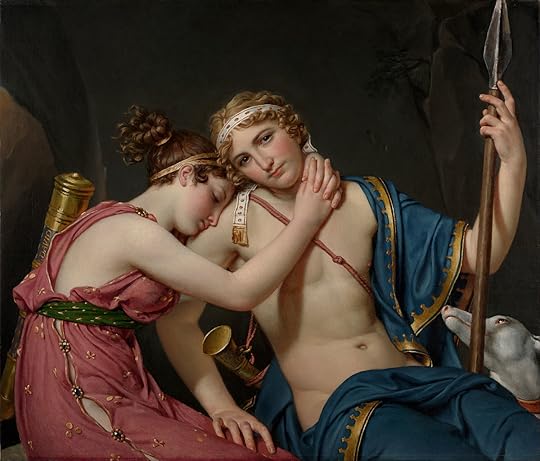
Jacques-Louis David's brilliant painting of the young lovers Telemachus and Eucharis was created during the artist's last years, when the defeat of Napoleon and the return of the monarchy in France forced him into exile in Brussels. Several of his paintings from this period show his preoccupation with the psychology of love, but none depicts the emotions of parting more tenderly than this painting from 1818.
Dorothy Johnson discusses how David's political involvement affected his personal life and career, taking him from history painter to revolutionary to living in exile. The effects of these experiences came together at the end of his life in the creation of some of his richest and most complex works.
Drawn during his exile to Brussels (for voting for the death of Louis XVI during the French Resolution and swearing fidelity to Napoleon by signing the Acte additionnel aux Constitutions de VEmpire), in which he was freed from the political, social, and aesthetic constraints of Paris, Jacques-Louis David painted "The Farewell of Telemachus and Eucharis".
The resurgence of myth was linked to their perceived ability to express the human condition, revealing universal truths about human psychology and development, and containing relevant messages for individuals and society. Furthermore, the new direction of the late 18th Century allowed for the purge of frivolous and lasciviousness of mythological themes, and especially the depiction of love between gods and goddesses, which were associated with the "degenerative" tastes of the elite ruling class.
Initially beginning with representing heroic deeds from antiquity, for example "The Oath of the Horatii", David embodied 'the ideals of self-sacrifice and civic virtue but also created powerful figures whose compelling corporal presences exerted an immediate, visceral impact on the spectator; critics of the time acclaimed the painting for its remarkable "truth" in the depiction of the body, for an anatomical naturalism and convincing representation of volumes and forms through the expression of powerful contours that had not been seen in French painting earlier in the century.'
However, paintings such as these were politically linked to Napoleon/French Revolution, with David having less artistic freedom.
After the exile to Brussels, David wrote to his aunt and uncle:
'We are living in a very hospitable city in which, as far as I can see, I will find all the amenities of society. But I will abstain from them as much as I can. As you know, I like the contemplative life, and I want to give myself up to it here more than elsewhere.'
David enjoyed the artistic freedom that exile gave him, allowing his intellectual and psychological perspective to run free. The range and variety of works created in Brussels reveals the intensity of David's mind and imagination, as well as his technical and stylistic experimentation. In addition, David wrote to his son: 'I am very busy with my art, health favors my successes, and if I believe what everyone constantly tells me, I have never created works that are better and more decidedly made in the simple and energetic taste of ancient Greece.' His works show a daring experimentation, with a pronounced interest in psychology intensity and effects.
His Brussels paintings are all concerned with the psychology of love, revealing the exchanges of tender affection, of the bonds of true friendship and desire, devoid of lust, instead feeling compassion for the star-crossed lovers, allowing us to wonder at the innocence and purity of love. From this, David created a new type of interpretation of mythical subjects, reinstating the depiction of amatory mythological theme and launched a completely new direction in the development of such themes in French painting.
The harmonious forms of Telemachus and Eucharis; the tender, heartfelt love, affection, and sorrow that they share for one another; and the absence of a predatory male or female sexuality. David revealed the psychological problematics of sexual rapport. A critic commented that only one thing was missing from the painting was a Raphael and a Rubens to admire it.
On the Book and Author * An excellent historiography on Jacques Louis David, academic art in 19th Century France, mythology and it's uses, and depictions of love.
* Dorothy Johnson is a master at describing artworks. Her language is incredibly descriptive, informative, and seductive.
"The nymph Eucharis must stay on her island, and Telemachus must leave with his guide, Mentor, in quest of his father, Ulysses, who had not yet returned from the Trojan War. The comely Telemachus, represented in partial heroic nudity, is slender but strong, with clearly defined pectoral muscles, a taut abdomen, and powerful arms. He inclines his head and torso toward Eucharis and partially supports the weight of his body by bracing himself with his right hand placed firmly on her left thigh. His literal inclination toward his lover is expressive of his longing, love, and desire, which are manifest in the very subtle and sad melancholic expression of his face. He has realized that his love for Eucharis will not come to fruition, for he will shortly be called upon to leave Calypso's island. Telemachus looks directly out at us, imploringly as though to appeal to our compassion and understanding. His face, so filled with sorrow and regret, is beautiful and flawless."