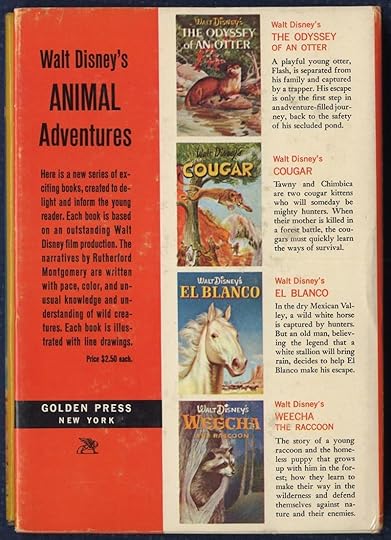
"It is true!" cries the old man. "The legend is true, El Blanco, the white one, has come at last, and brought rain to our dry valley." But the wild-horse hunters have also come... the white colt is in danger. Can the old man save him?'
Montgomery was born in Straubville, Sargent County, North Dakota, "a true ghost town" as of 2005. to George Y. and Matilda Proctor Montgomery. He studied at Colorado Agricultural College, Western State College of Colorado, and University of Nebraska; taught elementary school in Hot Springs, Wyoming; and from 1917 to 1919 served in the United States Air Corps. During the 1920s, he worked as a teacher and principal at junior and senior high schools in Montrose County, Colorado.
Montgomery married Eunice Opal Kirks in 1930; they had three children. He served Gunnison County, Colorado, as a judge from 1931 to 1936 and as county commissioner from 1932 to 1938, then became a freelance writer.
While still at school, Montgomery began writing stories about the wild animals that lived around his family's farm. He went on to write books about aviation and the people, landscapes and animals of the American West, particularly horses. In all, he wrote more than 100 books.
From 1941 to 1946, Montgomery was a writer for Dick Tracy. He worked as a creative writing teacher 1955–57 and as a scriptwriter for Walt Disney Studios 1958–1962.
Rutherford Montgomery's legacy is Kildee House, which won a 1950 Newbery Honor, but El Blanco—The Legend of the White Stallion isn't a bad garnish for that legacy. It tells of a Mexican legend that began when Hernando Cortez arrived to claim that part of the New World for Spain. The Mexican Indians had never seen a horse, and Cortez rode a white stallion they came to revere as a god. Feeding the horse their human food, it died, but the Indians erected a temple to honor Cortez's pure white mount, an animal they were convinced had ended a long local drought. Even after converting to Christianity, the Indians never forgot the white horse. In times of drought, a part of them believed another stallion like Cortez's could bring rain to save them.
Years later an old man, now the lone resident of the area near the discarded temple, loves watching wild horses in the valley. He doesn't love the horse hunters that set traps to nab the horses for profit. One day a gang of trappers captures an entire herd except a mare and her newborn colt, who by luck escaped into the remains of the old temple. The colt is a rare white one, like Cortez's original. Could he end the drought that has settled over the land? Not wanting the horse trappers to find El Blanco and his mother, the old man misdirects them, but the horses can't stay in the temple permanently. Lopez, leader of the trappers, is sure to return. With a heavy heart the old man watches El Blanco and his mother depart, hoping the colt will someday return with rain to soothe the parched land.
El Blanco and the mare have quite an adventure ahead. She can take care of herself but is hindered by the fully dependent colt. The mare guides him across various terrains, into the jungle where exotic animals such as jaguars and monkeys make their home. El Blanco eventually loses his mother, but by then he's almost a stallion, capable of outrunning predators or beating them back with his powerful hoofs. Horses aren't suited for the jungle, and surviving there teaches El Blanco unorthodox tactics that will serve him later. A return to the valley of his birth seems fated, and though the old man is overjoyed by the stallion's homecoming, not all is perfect. Lopez is now destitute, desperate to capture a valuable horse like El Blanco, and will stop at nothing to conquer the magnificent white stallion. Who will triumph in the showdown of alpha males?
I'm not sure I see the work of an award-winning author in El Blanco—The Legend of the White Stallion, but the story moves at a decent pace. There are also bits of wisdom, such as the old man's philosophy regarding worry. "(He) slept soundly that night. When he was a young man, he had formed the habit of not worrying about his troubles. Worry never solved anything, and a man had to face each day as it came." We may feel helpless against anxiety, as though we have no choice but to be tossed about in its tempest, but deliberately forming good mental health habits is possible. Gloria Stevens's black-and-white drawings (reminiscent of Wesley Dennis's style) are lovely, probably the highlight of this book; I wish I knew more about her, but information was scarce when I looked. I'd rate El Blanco—The Legend of the White Stallion one and a half stars, but it's not a bad read, simple and functional. Fans of Marguerite Henry might enjoy it.
I love reading this book when I was young I read my mother's copying out so badly that I went and got another one at the book sale today in Cheyenne Wyoming this is a good story to read it is a classic 📖📚💘🪞🌌
By keeping it on the simple level, some events seemed sketchy, and undeveloped. The level of understanding was for a lower elementary grade. (So maybe sketchy was acceptable?) My boys still enjoyed it.
This is one of those books that I read over and over again throughout my childhood, and I'm still very fond of it, despite it's flaws. The flaws aren't big ones, mainly just that the book is very short and packs a lot of action in very quickly, but it's still a good quick read.
This book was a favorite from my childhood and I have not read it for a very long time but kept it for many years. It was a selection from a school program...I was in love with horses at a very young age. I decided to read it again.
Montgomery #1 Average yarn about a horse, some moments of interest, it did feel quite dated, which may have just been thee edition I had, but if you enjoy yarns about nags you may get excited by this one, otherwise I would say neigh!
I normally like horse and other animal books but this one wasn't for me. The story about this horse just didnt hold my attention. I wouldn't recommend this one.
This is a book where the horse is the main character. Despite that, it is a really fun adventure story, with a happy ending. Meant for ages 6 through 12, probably.
El Blanco – the Legend of the White Stallion is like another book I have read by Rutherford Montgomery. It seems this author likes to express things from the horse’s point of view. Though in El Blanco, the story is told from the point of view of an elderly gentleman as well as the wild horses in the area.
I received this book as a Christmas present from my parents the December when I was in elementary school. I wish I still had my copy but somehow life got in the way. I may buy a replacement copy someday. However, the book is still vivid in my mind nearly 40 years after first reading it, which is unique for a book that I only merely liked but did not have any strong emotional reaction to. Somehow, it made an impression.
Later on in the school year that I received El Blanco I struggled to read another wild horse book by Rutherford G. Montgomery, Midnight. Although they both centered on the same subject matter (a magnificent wild stallion) they both might have been written from a different writer. El Blanco is easy to follow and picture in your head (even without the copious illustrations) and has a completely different upbeat tone than Midnight.
El Blanco has many things to recommend it (including a good story and a memorable horse), but it also has positive non-white human characters (an oddity for that time period in American kids' literature featuring horses, which is usually white as vanilla ice cream.) If you've never read a book about a wild stallion before, then you'll probably love this. For me, it suffers only in comparison to the many other books I've read abut wild stallions.
I'm not entirely sure what Walt Disney had to do with this book (as I do not think a movie or TV show was made from it) but apparently Montgomery wrote a series about animals for Disney.
Hands down one of my favorite horsey books growing up.
An old Mexican farmer believes that the newly born white foal is El Blanco, the white stallion of legend, who brings much needed rain to the valley. When a horse hunter appears in the valley to round up the wild herd the old farmer leads the mare and her white foal away so that they will remain free. El Blanco grows up in the jungle wilderness and returns to the valley to face a wily old stallion and the same horse hunter.
This book was a favorite because it was different. It showed me jungles and stony ruins, rather than grassy plains and London cobblestones. It introduced me to tapirs, peccaries, and spider monkeys. The horse was the main character but he was definitely a horse not a horse with human feelings and motivations of any kind. I read this countless times as a kid and parts of it have stayed with me ever since, crystal clear. Specifically the jungle swamp and the jaguar. Also: the illustrations by Gloria Stevens are fantastic.
I had forgotten the conclusion to the horse hunter's part of the story. It's very non-standard, non-stereotypical and I like it very much.
As much as I want to promote hope in children, I don't like giving them the idea that living off a superstition is a good thing. I like the fact that the horse hunter learned his lesson in the end, but most of the story wasn't based on that. A good read for horse loving children, but as I've said, I don't like how they've based the story on a superstition.
This is one of my favorite books. I've read it over and over again since elementary school and still love it! I love the story, the morals, the happy ending... Sure, at this point the writing's a little "young" for me, but I still love the book and would recommend it to any horse lover of any age.