

What do you think?

Monumenta
Olga Pavic's house has been requisitioned.
The council will bulldoze it.
Her home will become a monument to a massacre.
But Olga cannot ascertain which massacre. Three different architects visit, each with a proposal to construct a different monument, to memorialise a different horror.
Olga can't allow them to unearth the secrets held in this space, not until she reunites with her children for a final dinner. Her aspirational, distant daughter, Hilde, and her secretly queer son, Danilo, both reluctantly agree to fly back to Belgrade.
Within an atmosphere of razor-sharp political surreality, Lara Haworth spins a tender, magical story of familial love and loss. Via a panoply of perspectives Monumenta compellingly and playfully explores remembrance and how tragedy can be the catalyst for remarkable transformation.
The council will bulldoze it.
Her home will become a monument to a massacre.
But Olga cannot ascertain which massacre. Three different architects visit, each with a proposal to construct a different monument, to memorialise a different horror.
Olga can't allow them to unearth the secrets held in this space, not until she reunites with her children for a final dinner. Her aspirational, distant daughter, Hilde, and her secretly queer son, Danilo, both reluctantly agree to fly back to Belgrade.
Within an atmosphere of razor-sharp political surreality, Lara Haworth spins a tender, magical story of familial love and loss. Via a panoply of perspectives Monumenta compellingly and playfully explores remembrance and how tragedy can be the catalyst for remarkable transformation.
145 pages, Kindle Edition
Published July 4, 2024
Ratings & Reviews
Friends & Following
Create a free account to discover what your friends think of this book!
Community Reviews
Displaying 1 - 30 of 104 reviews

January 3, 2025
“ Monumenta” is a brief novel that is centered on communication, memory and interpretation. It is cryptic and spare in its delivery and is laced with political symbolism and metaphor. It begins with offhanded simplicity and develops levels of complexity as it proceeds.
“ The letter arrived on a Tuesday.Olga made a face at her own name printed on the envelope.Olga Pavic. When she noticed the official stamp on the top left handed corner, Belgrade City Municipality, she felt the sudden violent nerves when opening a letter…She read the letter.Read it again.’ What massacre?’ She said eventually, to the empty house.’ Which one?’ “
This passage opens the book. We soon discover that the letter is a request to appropriate Olga’s house to memorialize a massacre. The request is delivered casually and without clarification. Olga unquestioningly accedes to the request yet is confused about which of many massacres is being memorialized.The ensuing narrative veers into a capricious exploration of time and remembrance. The thematic threads are developed through the interactions between Olga, her children and three architects competing to erect the memorial.
Olga’s meetings with the architects reveal the political and emotional dilemmas inherent in the desire to remember the past. Each of the competitors has a wildly divergent vision of what should be remembered. One architect wants to create a crater that is a memorial to the 1903 death of the Serbian King and Queen. The second proposal keeps the house intact while surrounding it with the highest shopping mall in the world. The third option posits removing all the city’s statues and relocating them surrounding Olga’s requisitioned house.
Each of these visions is rooted in a different understanding of history and culture. The variances of the concepts underscore the difficulties of memorializing the past when a nation or entity encompasses differing historical and cultural touchstones.Additionally, Olga’s house harbors family secrets.The memories of daughter Hilde and son Danilo are tinged with trauma and conflict that add a haunted, dissociative aura to the discussions.
Olga’s home serves as a metaphor that raises questions about conflicting political narratives, personal memories and societal agreement. One begins to ponder what aspects of history we remember and what parts we choose to forget. Additionally, we must consider which shibboleths and images we embrace in order to justify our memories of history and events. These issues are relevant in our current geopolitical world as many nations are currently assessing the political correctness of their historical heroes and imagery. There is an ongoing struggle to answer the question of which entity gets to write history.
“ Monumenta “ is a slim novel that percolates with weighty questions that will be relevant well into the future.
“ The letter arrived on a Tuesday.Olga made a face at her own name printed on the envelope.Olga Pavic. When she noticed the official stamp on the top left handed corner, Belgrade City Municipality, she felt the sudden violent nerves when opening a letter…She read the letter.Read it again.’ What massacre?’ She said eventually, to the empty house.’ Which one?’ “
This passage opens the book. We soon discover that the letter is a request to appropriate Olga’s house to memorialize a massacre. The request is delivered casually and without clarification. Olga unquestioningly accedes to the request yet is confused about which of many massacres is being memorialized.The ensuing narrative veers into a capricious exploration of time and remembrance. The thematic threads are developed through the interactions between Olga, her children and three architects competing to erect the memorial.
Olga’s meetings with the architects reveal the political and emotional dilemmas inherent in the desire to remember the past. Each of the competitors has a wildly divergent vision of what should be remembered. One architect wants to create a crater that is a memorial to the 1903 death of the Serbian King and Queen. The second proposal keeps the house intact while surrounding it with the highest shopping mall in the world. The third option posits removing all the city’s statues and relocating them surrounding Olga’s requisitioned house.
Each of these visions is rooted in a different understanding of history and culture. The variances of the concepts underscore the difficulties of memorializing the past when a nation or entity encompasses differing historical and cultural touchstones.Additionally, Olga’s house harbors family secrets.The memories of daughter Hilde and son Danilo are tinged with trauma and conflict that add a haunted, dissociative aura to the discussions.
Olga’s home serves as a metaphor that raises questions about conflicting political narratives, personal memories and societal agreement. One begins to ponder what aspects of history we remember and what parts we choose to forget. Additionally, we must consider which shibboleths and images we embrace in order to justify our memories of history and events. These issues are relevant in our current geopolitical world as many nations are currently assessing the political correctness of their historical heroes and imagery. There is an ongoing struggle to answer the question of which entity gets to write history.
“ Monumenta “ is a slim novel that percolates with weighty questions that will be relevant well into the future.

December 9, 2024
What massacre?
How many must die for it to be a massacre? Does the method of killing count? Does who is killed matter?
The purpose of memorials is to honour and remember what has happened. Do memorials help to heal trauma?
Haworth’s Olga receives a letter advising that her house is being requisitioned, in order for a memorial to be built in its stead. A memorial to a massacre – which massacre is not defined, as if there are so many massacres to choose from that it is difficult to choose one. And that is comically, tragically true. Which shall we commemorate? How shall we commemorate? By choosing a particular memorial and not another, we might be leaving something out..... Are we saying that what is not commemorated, the ones left out, have no value?
We know how the victors commemorate their victories, but how do the defeated commemorate? What should they commemorate? Do these memorials help to heal the traumas? And who are the defeated? Are they only the ones who lose a battle? Or are we all defeated by acts of war, both the ‘victors’ and the ‘defeated’. In one way or another, we all hurt. Even the ones who hurt others are bringing hurt on themselves and their children. If this is true then our whole Earth is one big memorial, just open the news and you will see one such story after another and another so the idea of a memorial feels rather like a sticking plaster stuck with spit.
As you can see from the above, this little novel raised more questions for me than it answered. So yes, a good book.........................
How many must die for it to be a massacre? Does the method of killing count? Does who is killed matter?
The purpose of memorials is to honour and remember what has happened. Do memorials help to heal trauma?
Haworth’s Olga receives a letter advising that her house is being requisitioned, in order for a memorial to be built in its stead. A memorial to a massacre – which massacre is not defined, as if there are so many massacres to choose from that it is difficult to choose one. And that is comically, tragically true. Which shall we commemorate? How shall we commemorate? By choosing a particular memorial and not another, we might be leaving something out..... Are we saying that what is not commemorated, the ones left out, have no value?
We know how the victors commemorate their victories, but how do the defeated commemorate? What should they commemorate? Do these memorials help to heal the traumas? And who are the defeated? Are they only the ones who lose a battle? Or are we all defeated by acts of war, both the ‘victors’ and the ‘defeated’. In one way or another, we all hurt. Even the ones who hurt others are bringing hurt on themselves and their children. If this is true then our whole Earth is one big memorial, just open the news and you will see one such story after another and another so the idea of a memorial feels rather like a sticking plaster stuck with spit.
As you can see from the above, this little novel raised more questions for me than it answered. So yes, a good book.........................

June 27, 2024
A curious but intriguing novella that deals with the strange desire there seems to be to build monuments and statues to increasingly random people and events.
Olga Pavic is a widow who has lived in her home for over 40 years. Her children have flown the nest and her husband, Branko, died seven years previously. Olga expects to remain in her home but is surprised one day to receive a letter from the city council informing her that it is going to be demolished to make way for a monument to remember the massacre. But what massacre? Which one?
Within days Olga meets with 3 architects who all have very definite ideas about which massacre and how the monument should look. Olga decides that a goodbye dinner is in order and calls her children to attend a last party to say farewell to their childhood home.
There are some exceptional touches in this debut fiction. Olga, for example, who hates her name because it reminds her of Pavlov has a wonderful Pavlovian reaction to seeing her name on envelopes. The actual monuments are all slightly insane and the reasons for it are no less so. The characters in the novella are all lightly sketched but all clearly defined.
I found it almost hypnotic and read it in just over an hour. Some novellas try too hard but this really spoke to me. Highly recommended.
Thanks to Netgalley and Canongate for the advance review copy.
Olga Pavic is a widow who has lived in her home for over 40 years. Her children have flown the nest and her husband, Branko, died seven years previously. Olga expects to remain in her home but is surprised one day to receive a letter from the city council informing her that it is going to be demolished to make way for a monument to remember the massacre. But what massacre? Which one?
Within days Olga meets with 3 architects who all have very definite ideas about which massacre and how the monument should look. Olga decides that a goodbye dinner is in order and calls her children to attend a last party to say farewell to their childhood home.
There are some exceptional touches in this debut fiction. Olga, for example, who hates her name because it reminds her of Pavlov has a wonderful Pavlovian reaction to seeing her name on envelopes. The actual monuments are all slightly insane and the reasons for it are no less so. The characters in the novella are all lightly sketched but all clearly defined.
I found it almost hypnotic and read it in just over an hour. Some novellas try too hard but this really spoke to me. Highly recommended.
Thanks to Netgalley and Canongate for the advance review copy.

June 9, 2024
Shortlisted for the 2024 Nero Awards for Debut Fiction
‘There is a fine line,’ said Misha, ‘a very fine line. Between memorialisation and erasure.’
The debut novel by filmaker, political researcher, installation artist and author Lara Haworth, Monumenta is a highly original work, combining an off-beat tone, somewhat remiscent of a Helen Oyeyemi novel, with a profound meditation on the nature of memorials and monuments in both civic and family life - as Haworth has said:
Set in Belgrade in 2018, the story centres around the family home of the widowed Olga Pavić, in the upmarket Dedijne district (Olga remarks sardonically at one point that's its closeness to the US embassy spared the area from Nato bombimg). Olga, originally with her late husband, has lived in the house for 43 years but receives a letter from the City authorities, which, as she explains by phone to her daughter (a construction form CEO, living in Germany) informs Olga that:
‘The house has been requisitioned by the city. Our house. The one where you grew up.’
Her daughter did not so much get on her nerves as make her nervous, like a child; somewhere along the line of her mothering the dynamic had been twisted, reversed. Her words came too fast, too desperate.
‘It is going to be turned into a monument. To the massacre.’ There was a long silence
[...]
She read the letter. Read it again. ‘What massacre?’ she said, eventually, to the empty house. ‘Which one?’
Three international architects are invited to propose exactly what massacre should be commerated and how.
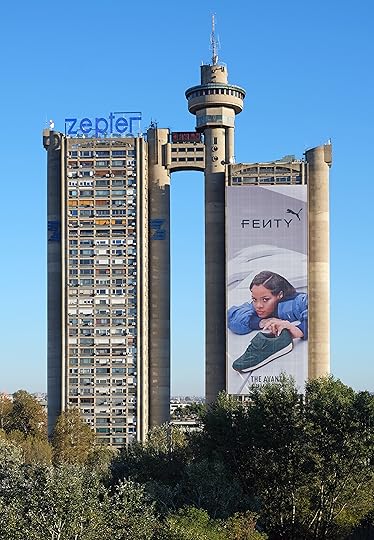
The first to arrive is taken aback by his first sight of the Western City Gate, and the taxi driver playing Turbofolk music:
An enormous structure loomed into view: two tall, thin tower blocks connected by a space needle crowned by the blue letters ZEPTER. Such beautiful ugliness! How did they do it? They did it so well; he could never dream of something so ugly, but he would try; he would learn; all the fantastic complexity … like this music … what was it, it was terrible, it was wonderful, emotional, electronic, desperate …
‘You like this?’ shouted the taxi driver, holding Karl’s gaze in the rear-view mirror as he pushed his wraparound sunglasses up onto his head. Were his eyes filled with tears? Or was that the smoke from their cigarettes? Oh, dear man, tender soul. Tell me everything you know. ‘Yes,’ Karl shouted back, instead. ‘Yes!’ ‘This is our music. Turbofolk. It used to be associated with gangsters and nationalists. Now it provides a welcome release for the young, women and LGTBQ communities across the ex-Yugoslav diaspora. This is Nikolija. I love this song. “Plavo More”. Very good lyrics. I’ll translate.’ The taxi driver turned the volume even higher and started to sing, in English, two fingers raised, stabbing the air in time with the beat. ‘You’re inside me like a bullet in a gun barrel, everything is dark except for your dark eyes …’
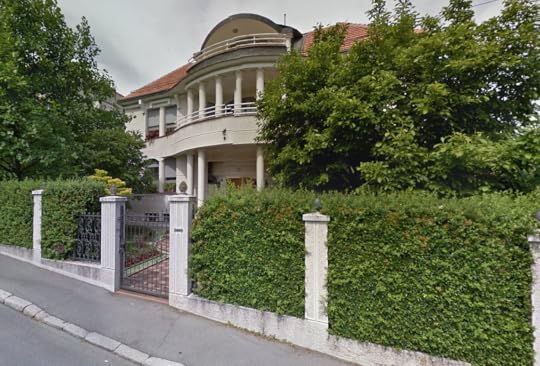
Although Olga's house, dating back to 1936 (and in the 1970s requestioned from the original family owners and given to Olga's family), gives off a very different vibe:
Karl hesitated halfway up the concrete steps. He held on to the municipal steel handrail for support. Strange, the presence of this railing, out of place with the house, which he had seen in the photographs, but, looking up at it now–early twentieth-century, neoclassical Italianate style, limestone, three storeys, six free-standing Tuscan order columns planted evenly across its width, wooden canopy shouldering wisteria, wrought-iron balcony above the front door, first-floor parapet with balusters–it seemed to radiate a withering disappointment. In him, and in everything it had seen.
Picture of another property in Dedijne:
Olga summons both of her ex-pat children, each with their own hidden trauma, and her friends for a final party at her soon-to-be requestioned house, and her own vivid dreams/visions/hallucinations (although ones that seem to have physical manifestations) reveal some of her own. And motifs such as lilacs, winger hussars and sausages run through the text.
In the meantime, each of the three architects has a very different proposal, the third in part drawing on the work of Milica Tomić and Aleksandra Domanović on the fascinating "turbo-culture" trend (which began with the aforementioed turbo-folk).
And this is all done in almost novella length.
See Gumble's Yard's review, which alerted me to the book, for more insights, and thanks to the published via Netgalley for the ARC.
‘There is a fine line,’ said Misha, ‘a very fine line. Between memorialisation and erasure.’
The debut novel by filmaker, political researcher, installation artist and author Lara Haworth, Monumenta is a highly original work, combining an off-beat tone, somewhat remiscent of a Helen Oyeyemi novel, with a profound meditation on the nature of memorials and monuments in both civic and family life - as Haworth has said:
When I started to write Monumenta in 2020, everyone was fighting over monuments. This conflict and confusion runs through the novel, but on a smaller, domestic scale I wanted to show a family engaged in a similar struggle over their story, truth, secrets, and the past. At its heart, Monumenta asks if all family homes are in fact monuments to their own griefs, joys, sorrows and emotional massacres – and what these homes, these monuments, do to us when we live with them and when we let them go.
Set in Belgrade in 2018, the story centres around the family home of the widowed Olga Pavić, in the upmarket Dedijne district (Olga remarks sardonically at one point that's its closeness to the US embassy spared the area from Nato bombimg). Olga, originally with her late husband, has lived in the house for 43 years but receives a letter from the City authorities, which, as she explains by phone to her daughter (a construction form CEO, living in Germany) informs Olga that:
‘The house has been requisitioned by the city. Our house. The one where you grew up.’
Her daughter did not so much get on her nerves as make her nervous, like a child; somewhere along the line of her mothering the dynamic had been twisted, reversed. Her words came too fast, too desperate.
‘It is going to be turned into a monument. To the massacre.’ There was a long silence
[...]
She read the letter. Read it again. ‘What massacre?’ she said, eventually, to the empty house. ‘Which one?’
Three international architects are invited to propose exactly what massacre should be commerated and how.
The first to arrive is taken aback by his first sight of the Western City Gate, and the taxi driver playing Turbofolk music:
An enormous structure loomed into view: two tall, thin tower blocks connected by a space needle crowned by the blue letters ZEPTER. Such beautiful ugliness! How did they do it? They did it so well; he could never dream of something so ugly, but he would try; he would learn; all the fantastic complexity … like this music … what was it, it was terrible, it was wonderful, emotional, electronic, desperate …
‘You like this?’ shouted the taxi driver, holding Karl’s gaze in the rear-view mirror as he pushed his wraparound sunglasses up onto his head. Were his eyes filled with tears? Or was that the smoke from their cigarettes? Oh, dear man, tender soul. Tell me everything you know. ‘Yes,’ Karl shouted back, instead. ‘Yes!’ ‘This is our music. Turbofolk. It used to be associated with gangsters and nationalists. Now it provides a welcome release for the young, women and LGTBQ communities across the ex-Yugoslav diaspora. This is Nikolija. I love this song. “Plavo More”. Very good lyrics. I’ll translate.’ The taxi driver turned the volume even higher and started to sing, in English, two fingers raised, stabbing the air in time with the beat. ‘You’re inside me like a bullet in a gun barrel, everything is dark except for your dark eyes …’
Although Olga's house, dating back to 1936 (and in the 1970s requestioned from the original family owners and given to Olga's family), gives off a very different vibe:
Karl hesitated halfway up the concrete steps. He held on to the municipal steel handrail for support. Strange, the presence of this railing, out of place with the house, which he had seen in the photographs, but, looking up at it now–early twentieth-century, neoclassical Italianate style, limestone, three storeys, six free-standing Tuscan order columns planted evenly across its width, wooden canopy shouldering wisteria, wrought-iron balcony above the front door, first-floor parapet with balusters–it seemed to radiate a withering disappointment. In him, and in everything it had seen.
Picture of another property in Dedijne:
Olga summons both of her ex-pat children, each with their own hidden trauma, and her friends for a final party at her soon-to-be requestioned house, and her own vivid dreams/visions/hallucinations (although ones that seem to have physical manifestations) reveal some of her own. And motifs such as lilacs, winger hussars and sausages run through the text.
In the meantime, each of the three architects has a very different proposal, the third in part drawing on the work of Milica Tomić and Aleksandra Domanović on the fascinating "turbo-culture" trend (which began with the aforementioed turbo-folk).
And this is all done in almost novella length.
See Gumble's Yard's review, which alerted me to the book, for more insights, and thanks to the published via Netgalley for the ARC.

September 11, 2024
A somewhat strange but rather impactful book.

June 1, 2024
Lara Haworth's Monumenta is a wonderfully curious and thought-provoking novel.
Rather like watching a Wes Anderson or Jean-Pierre Jeunet movie, Monumenta challenges your initial perceptions and understandings; quirky and often with the feel of some type of hallucinogenic experience the reader is taken to Belgrade where Olga Pavić receives a letter to say her home is to be demolished in order to build a monument.
What the monument fully commemorates is never truly defined but it is to acknowledge a massacre- which /what one? ; however against the backdrop of Serbian and Yugoslavian history potential reasons for a monument are explored.
Olga calls her two children home to have one final meal - Danilo and Hilda. Both have different feelings about returning home. Three architects. are selected to create the potential design...and so follows a curious array of characters who emotionally are challenged by the circumstances and their own lives.
This is a clever novel that truly makes us reflect upon the purpose of statures, memorials , monuments... what do they truly tell us and what do they make us actually forget- the truth behind the image .
This a relevant and important novel especially in times where statues/memorials/ monuments erected in the past to celebrate colonialism /imperialism are sitting uncomfortably within communities/society today .
A short novella but with a big punch
Quote from the novel-
"The monument I am proposing is specific to Belgrade but in many ways could apply to any city in the world, because the massacre I wish to remember is the failure of memorialisation itself. The massacre of the memory in favour of statuary."
Rather like watching a Wes Anderson or Jean-Pierre Jeunet movie, Monumenta challenges your initial perceptions and understandings; quirky and often with the feel of some type of hallucinogenic experience the reader is taken to Belgrade where Olga Pavić receives a letter to say her home is to be demolished in order to build a monument.
What the monument fully commemorates is never truly defined but it is to acknowledge a massacre- which /what one? ; however against the backdrop of Serbian and Yugoslavian history potential reasons for a monument are explored.
Olga calls her two children home to have one final meal - Danilo and Hilda. Both have different feelings about returning home. Three architects. are selected to create the potential design...and so follows a curious array of characters who emotionally are challenged by the circumstances and their own lives.
This is a clever novel that truly makes us reflect upon the purpose of statures, memorials , monuments... what do they truly tell us and what do they make us actually forget- the truth behind the image .
This a relevant and important novel especially in times where statues/memorials/ monuments erected in the past to celebrate colonialism /imperialism are sitting uncomfortably within communities/society today .
A short novella but with a big punch
Quote from the novel-
"The monument I am proposing is specific to Belgrade but in many ways could apply to any city in the world, because the massacre I wish to remember is the failure of memorialisation itself. The massacre of the memory in favour of statuary."

August 7, 2024
Olga lives in the wealthy part of town in modern day Serbia, in a big house close to the US embassy. The novel begins as she is notified by post that the house is to be repossessed and used as the location for a monument to the memory of a massacre.
The uncertainty surrounding the massacre is significant: in a part of the world with such a turbulent and tragic past how can it be decided which is the massacre to commemorate, or is it just the one that the current government decide.
Olga decides on a family reunion, a last chance to gather her now adult children at their childhood home.
Haworth explores themes of memories and life events, family, as well as politics with an absurdist hue, and a pinch of magic realism. The real strength though is in creating a palpable sense of the house itself being a character, with its experiences and memories gathered in every nook over the years.
The uncertainty surrounding the massacre is significant: in a part of the world with such a turbulent and tragic past how can it be decided which is the massacre to commemorate, or is it just the one that the current government decide.
Olga decides on a family reunion, a last chance to gather her now adult children at their childhood home.
Haworth explores themes of memories and life events, family, as well as politics with an absurdist hue, and a pinch of magic realism. The real strength though is in creating a palpable sense of the house itself being a character, with its experiences and memories gathered in every nook over the years.
August 29, 2024
I liked it at first but the further this book progressed the less I understood wtf it was about

August 18, 2024
Weird but brilliant.

Read
July 24, 2024Sometimes short/er stories can do so much more than long/er stories. In the case of Monumenta’s 122 pages I felt transported into my imagination over and over again, not really caring whether some scenes were dreams or were actually happening. We’re asked to imagine a series of conceptual monuments to a terrible massacre. So much of the novel’s drama happens in the reader’s head while the action doesn’t venture far from a house and garden (the site where this proposed monument is to be placed).
What this odd, funny, beautiful novel did was make me question the very nature of commemoration.
How do you begin to create a monument to a massacre? It’s too big a task to even contemplate. And yet people do. And these monuments get made. And they mean things to people. But life also goes on and on in the eternal present.
What this odd, funny, beautiful novel did was make me question the very nature of commemoration.
How do you begin to create a monument to a massacre? It’s too big a task to even contemplate. And yet people do. And these monuments get made. And they mean things to people. But life also goes on and on in the eternal present.

March 31, 2026
Liest sich ein bisschen wie ein Wes Anderson Film, lustig, absurd und philosophisch. Musste mehrfach laut lachen, habe ganz viel gelernt und konnte es nicht aus der Hand legen.

June 27, 2024
For a moment there, I was afraid it wouldn't work. The Serbian memoryscape is so littered with landmines (even literally) that it's very easy to slip and hurt yourself and everyone else. This novel navigates deftly between the dangers, making point after point about the impossibility of memorialization, the culture industry, the general absurdity of just about everything except the passage of time. While memory studies isn't exactly my field, except when it comes to how queerness is historically remembered (or rather erased from collective cishet memory), I found the novel a minor success, especially since it was written by someone who wasn't directly involved in what the book is about.

May 21, 2024
Behind the fantastic psychedelic and hallucinogenic story, this book explores some serious themes around how we memorialise challenging histories and how we approach the past. Despite being a short volume it packs in a raft of complex characters and beautiful storytelling.

April 23, 2025
Braids satire, magic realism, and metafiction into a compact and surprising meditation on how we seek to memorialise the tragedies of history. (From our McKitterick Prize shortlist this past year.)

October 23, 2025
Erinnerungskultur ist nicht gerade die Stärke osteuropäischer Länder. Man besinnt sich lieber auf den gegenwärtigen Stolz und die großen Errungenschaften, denn weniger auf die Aufarbeitung, teils großer historischer Verbrechen.
Schon allein deshalb wundert sich Olga, als sie ein Schreiben erreicht. Das Haus, in dem sie wohnt, soll beschlagnahmt, abgerissen und als symbolisches Loch in eine Gedenkstätte verwandelt werden. Es gilt an ein Massaker zu erinnern bei dem König Alexander I. Obrenović und seiner Frau, Königin Draga, durch serbische Offiziere, umgebracht wurde.
Olga kontaktiert ihren Sohn Danilo, der weit ab von zu Hause ein einsames Leben zwischen Ballett und Coming out führt und ihre Tochter Hilde, die in Deutschland als CEO einer Baufirma Probleme zu bewältigen hat und der die Muttersprache langsam abhanden kommt. Sie sollen nach Hause kommen und mit einem großen Festmahl Abschied von ihrem Zuhause nehmen.
Es entwickelt sich nun ein Kabinettstück, bei dem ich mir nicht sicher bin, wie viel Slapstick gewollt war. Ich hatte den Eindruck, jemand läuft mit einer Super 8 Kamera zwischen Bestandspersonal und wechselnden Nebendarstellern hin und her, nimmt Gesprächsfetzen, Aktionen und Momentaufnahmen auf und versucht, diese miteinander zu verknüpfen. Hauptthema scheint der Umgang mit Erinnerungskultur zu sein, die hier auf verschiedenen Ebenen Raum bekommt.
Wie so oft In diesem Jahr habe ich einen Text gelesen, der durch seine skurrile Konstruktion überzeugen möchte, mich damit aber nicht einfängt. Die kurzen Blicke auf serbische Geschichte und die geschäftige Olga, die kocht, kommandiert und alles irgendwie zusammenhält, sind zwar solides Plotmaterial, doch legt sich viel zu viel Geplänkel über familiäre Tiefgründigkeit oder den eigentlichen Anlass der Zusammenkunft. Mir war das einfach zu nervös. Das hat dann auch Branko zum Schluss nicht mehr rausgerissen, obwohl er mir ein Grinsen ins Gesicht gezaubert hat.
Da der Text insgesamt recht kurz gehalten ist, kann man das natürlich trotzdem relativ schnell lesen. Wenn ihr also auf verrückte Zusammenkünfte steht und vielleicht szenische Absurditäten mögt, dann sei euch dieses Debüt empfohlen. Vielleicht holt es euch ab. Mir können ja schließlich nicht alle Bücher gefallen.
Schon allein deshalb wundert sich Olga, als sie ein Schreiben erreicht. Das Haus, in dem sie wohnt, soll beschlagnahmt, abgerissen und als symbolisches Loch in eine Gedenkstätte verwandelt werden. Es gilt an ein Massaker zu erinnern bei dem König Alexander I. Obrenović und seiner Frau, Königin Draga, durch serbische Offiziere, umgebracht wurde.
Olga kontaktiert ihren Sohn Danilo, der weit ab von zu Hause ein einsames Leben zwischen Ballett und Coming out führt und ihre Tochter Hilde, die in Deutschland als CEO einer Baufirma Probleme zu bewältigen hat und der die Muttersprache langsam abhanden kommt. Sie sollen nach Hause kommen und mit einem großen Festmahl Abschied von ihrem Zuhause nehmen.
Es entwickelt sich nun ein Kabinettstück, bei dem ich mir nicht sicher bin, wie viel Slapstick gewollt war. Ich hatte den Eindruck, jemand läuft mit einer Super 8 Kamera zwischen Bestandspersonal und wechselnden Nebendarstellern hin und her, nimmt Gesprächsfetzen, Aktionen und Momentaufnahmen auf und versucht, diese miteinander zu verknüpfen. Hauptthema scheint der Umgang mit Erinnerungskultur zu sein, die hier auf verschiedenen Ebenen Raum bekommt.
Wie so oft In diesem Jahr habe ich einen Text gelesen, der durch seine skurrile Konstruktion überzeugen möchte, mich damit aber nicht einfängt. Die kurzen Blicke auf serbische Geschichte und die geschäftige Olga, die kocht, kommandiert und alles irgendwie zusammenhält, sind zwar solides Plotmaterial, doch legt sich viel zu viel Geplänkel über familiäre Tiefgründigkeit oder den eigentlichen Anlass der Zusammenkunft. Mir war das einfach zu nervös. Das hat dann auch Branko zum Schluss nicht mehr rausgerissen, obwohl er mir ein Grinsen ins Gesicht gezaubert hat.
Da der Text insgesamt recht kurz gehalten ist, kann man das natürlich trotzdem relativ schnell lesen. Wenn ihr also auf verrückte Zusammenkünfte steht und vielleicht szenische Absurditäten mögt, dann sei euch dieses Debüt empfohlen. Vielleicht holt es euch ab. Mir können ja schließlich nicht alle Bücher gefallen.

November 18, 2025
This is such a hynoptic little book--it is about one handsome house in Belgrade which may (or may not) have the site of on or more massacres. it is soon to be demolished or somehow completely altered to make way for a monument to one of these massacres. The resident (who is mourning her husband) is visited by three architects with three very different visions for the home she herself does not know quite how she came by. The three architects visit a la three ghosts, each offering some sort of truth. The owner summons her two adult children for a final dinner and they must each try to make peace with their very different pasts. A slim book that is full of big ideas about history and memory and which I now want to see as a play.

June 23, 2024
Monumenta is the debut novel by Lara Haworth that explores themes of memory, life events, politics, and family. The novel has touches of magical realism, with a dreamlike quality, woven into a beautiful narrative that kept me engaged from the very first page. The author describes a world that feels both vividly real and eerily surreal. I greatly enjoyed Haworth’s prose and could hardly believe this is a debut novel. This story will stay in your mind.
The novel is about a family reunion at Olga’s house in post-war Serbia. The house has been requisitioned by the government to be transformed into a monument, and Olga decides she wants to have a last gathering with her children at their childhood home. It opens with a scene in Olga’s daughter's old room, immediately setting the tone for the thought-provoking storytelling that follows. Olga's meticulous care in preparing the room, the characteristic old furniture, and the scent of mothballs all contribute to a sense of nostalgia and foreboding. The writing creates an almost palpable sense that the house is its own character, making the reader feel the weight of history and memory that permeates every corner of the house.
In only 144 pages, the author showcases her ability to craft complex, multi-layered characters that are extremely relatable. Olga, with her quiet strength and hawk eyes, is a compelling protagonist. Her interactions with the environment around her are laden with symbolic significance. The introduction of these unrecognizable flowers, drooping strangely, hints at underlying mysteries and sets the stage for the unfolding drama.
Haworth’s narrative is not just about the physical world but delves deeply into the psychological and emotional landscapes of her characters. The themes explored in "Monumenta" are profound and thought-provoking. The interplay between past and present, memory and reality, is handled with subtlety and skilfully. The descriptions are vivid and sensory, making the reader feel as though they are walking alongside the characters. This immersive quality is one of the novel’s greatest strengths, drawing readers into its world completely (you might find me dining with Olga!).
In conclusion, I found "Monumenta" by Lara Haworth beautifully written, that offers a rich and immersive reading experience. Its lyrical prose, complex characters, and evocative imagery make it a superb piece of literary fiction. Highly recommended for readers who enjoy thoughtful, character-driven stories with a touch of surrealism.
My thanks to Canongate for providing me with an ARC via Netgalley.
The novel is about a family reunion at Olga’s house in post-war Serbia. The house has been requisitioned by the government to be transformed into a monument, and Olga decides she wants to have a last gathering with her children at their childhood home. It opens with a scene in Olga’s daughter's old room, immediately setting the tone for the thought-provoking storytelling that follows. Olga's meticulous care in preparing the room, the characteristic old furniture, and the scent of mothballs all contribute to a sense of nostalgia and foreboding. The writing creates an almost palpable sense that the house is its own character, making the reader feel the weight of history and memory that permeates every corner of the house.
In only 144 pages, the author showcases her ability to craft complex, multi-layered characters that are extremely relatable. Olga, with her quiet strength and hawk eyes, is a compelling protagonist. Her interactions with the environment around her are laden with symbolic significance. The introduction of these unrecognizable flowers, drooping strangely, hints at underlying mysteries and sets the stage for the unfolding drama.
Haworth’s narrative is not just about the physical world but delves deeply into the psychological and emotional landscapes of her characters. The themes explored in "Monumenta" are profound and thought-provoking. The interplay between past and present, memory and reality, is handled with subtlety and skilfully. The descriptions are vivid and sensory, making the reader feel as though they are walking alongside the characters. This immersive quality is one of the novel’s greatest strengths, drawing readers into its world completely (you might find me dining with Olga!).
In conclusion, I found "Monumenta" by Lara Haworth beautifully written, that offers a rich and immersive reading experience. Its lyrical prose, complex characters, and evocative imagery make it a superb piece of literary fiction. Highly recommended for readers who enjoy thoughtful, character-driven stories with a touch of surrealism.
My thanks to Canongate for providing me with an ARC via Netgalley.

June 25, 2024
A bit kafkaesque, a bit absurd, a dusting of magical realism, all in all a novella that sure gives one food for thought!
Books set in Eastern Europe are a big YES PLEASE! Now when they are written by a Western author, I am a bit hesitant, but I'd risk saying the Haworth does justice to the story! She either has a good knowledge of the area or she had good advisers!
Olga lives in a very nice house, in a very posh area, just down the road from the American(meaning USA) embassy. That very much suggest they were part of the political apparatus. Yet now, the house is being repossessed to be used as the location for a monument in the memory of a massacre: the political tableau has changed and it may be time for retributions! The uncertainty surrounding the massacre is also significant: with such a tumultuous history how do you decide which massacre to commemorate, which one is in line with the current political perspective?!
And then we have the architects: Karl showing the West perspective on historical events impacting Serbia's history, Misha who seems to be the darling of the political party, who covets the house himself, but at least understand how things are and how they work; and then Chara who is very much a product of her personal history but also the currents shaping where she has grown up: she's seen some monuments, tasted some items that are not even Serbian(btw: Kinder eggs and Cornetto are not Serbian, Doncafe is not a Romanian brand, it is produced in Romania, but very much an Italian brand, duh!!)and now presumably she has "inside knowledge" and pretends that the western voices calling for monuments to be abolished will mean something to someone who always adored the grandeur of monuments...
But obviously the true massacres, those that have a real impact are the personal ones. Those happening in the middle of a family and who shatters lives. How can one recover from one?!
*Book from NetGalley with many thanks to the publisher for the opportunity!
Books set in Eastern Europe are a big YES PLEASE! Now when they are written by a Western author, I am a bit hesitant, but I'd risk saying the Haworth does justice to the story! She either has a good knowledge of the area or she had good advisers!
Olga lives in a very nice house, in a very posh area, just down the road from the American(meaning USA) embassy. That very much suggest they were part of the political apparatus. Yet now, the house is being repossessed to be used as the location for a monument in the memory of a massacre: the political tableau has changed and it may be time for retributions! The uncertainty surrounding the massacre is also significant: with such a tumultuous history how do you decide which massacre to commemorate, which one is in line with the current political perspective?!
And then we have the architects: Karl showing the West perspective on historical events impacting Serbia's history, Misha who seems to be the darling of the political party, who covets the house himself, but at least understand how things are and how they work; and then Chara who is very much a product of her personal history but also the currents shaping where she has grown up: she's seen some monuments, tasted some items that are not even Serbian(btw: Kinder eggs and Cornetto are not Serbian, Doncafe is not a Romanian brand, it is produced in Romania, but very much an Italian brand, duh!!)and now presumably she has "inside knowledge" and pretends that the western voices calling for monuments to be abolished will mean something to someone who always adored the grandeur of monuments...
But obviously the true massacres, those that have a real impact are the personal ones. Those happening in the middle of a family and who shatters lives. How can one recover from one?!
*Book from NetGalley with many thanks to the publisher for the opportunity!

January 11, 2025
3.5⭐️
Intriguing, cryptic novella about a house in Belgrade that is to be requisitioned and repurposed as a memorial.
Olga, widowed mother or two, summons her two children Hilde and Danilo back to their family home as three architects arrive to present their ideas (each as bizarre as the book as a whole) on the monument they propose for the house.
The book speaks to the different versions of history there are depending on who the victor is, the vagaries of time as the spoils of war are distributed and redistributed among those who emerge on top at a given point in time, and the complications this gives rise to in places riven with conflict for generations.
An interesting novel that will appeal to those who like quirky, thought-provoking novels and Eastern European fiction. 3.5 ⭐️
Many thanks to the publisher Canongate Books for the arc via @netgalley.
Intriguing, cryptic novella about a house in Belgrade that is to be requisitioned and repurposed as a memorial.
Olga, widowed mother or two, summons her two children Hilde and Danilo back to their family home as three architects arrive to present their ideas (each as bizarre as the book as a whole) on the monument they propose for the house.
The book speaks to the different versions of history there are depending on who the victor is, the vagaries of time as the spoils of war are distributed and redistributed among those who emerge on top at a given point in time, and the complications this gives rise to in places riven with conflict for generations.
An interesting novel that will appeal to those who like quirky, thought-provoking novels and Eastern European fiction. 3.5 ⭐️
Many thanks to the publisher Canongate Books for the arc via @netgalley.
September 29, 2025
Monumenta is a short, thought-provoking novel. It is set in Belgrade in 2018 and centres around themes of memory and connection. It’s one of those books where there’s not so much of a plot as a set of interactions and characters’ reflections, which I love.
The book opens with Olga receiving a letter, stating that the council are to take her house to make it into a memorial to a (currently undefined) massacre. The book then takes us through the various architect pitches, in a kind of trippy, hypnotic way, while we get to learn more about Olga and her two grown up children and the challenges they face.
The book opens with Olga receiving a letter, stating that the council are to take her house to make it into a memorial to a (currently undefined) massacre. The book then takes us through the various architect pitches, in a kind of trippy, hypnotic way, while we get to learn more about Olga and her two grown up children and the challenges they face.

April 25, 2025
an odd little book, but a good one at that

July 6, 2026
About halfway through I thought this book was trying much too hard, but it mostly won me over by the end. Oddly compelling, despite also being cryptic and a little affected.
January 13, 2025
A sprawling exploration of memory, family, and history despite its short length—122 pages. The characters are sparely sketched yet deeply drawn in broad but also fine strokes. The plot—the city requisitioning a house as a site for a monument—is a clever rendering of the personal and political surrealness of post-war Serbia.

October 5, 2024
A short novella that was a strange story, but encompassed a wide range of history and culture. Unique…

September 17, 2025
A breathtakingly inventive novel that uses black humor and Eastern European magical realism to unravel how personal history becomes co-opted into national narrative, or how the private is drafted into public service. As someone who’s studied placemaking and civic design, I found this absurdist meditation on civil religion via architectural commemoration both wickedly smart and emotionally resonant: an excavation of how experience is formalized, erased, or enshrined—royal, queer, gendered, domestic, or otherwise.
Tendrils of family lore and individual recollection weave together the sacred and the mundane, the collective and the intimate, with a deadpan wit reminiscent of “Catch-22.” Entire inner lives simmer beneath the surface of bureaucratic farce. Think “Catch-22” meets “The Safekeep,” truly.
Against the official record, the story casts a woman whose home is being requisitioned, seven dead construction workers, and a ghost collapsing in a kitchen. What counts as history, and who decides? Is commemoration a metaphor, a performance, a displacement, a reimagining, a fiction of authority? In one scene, a woman wears a florid crucifix and cannot even articulate its meaning—a perfect synecdoche for the novel’s sly interrogation of meaning itself.
With warmth and sharp precision, Haworth explores the absurd gap between intention and reception. The result is both a theoretical provocation and a genuinely pleasurable read, one that suggests fleeting closure might be possible when collaboration bridges the internal and the collective. Even the title implies incompleteness, drawing attention to the messy, negotiated work of remembrance.
And perhaps, through the recurring lilacs, Haworth proposes that what truly lingers is something softer still:
“My countrywoman, whose country is pain. Fountains.”
Tendrils of family lore and individual recollection weave together the sacred and the mundane, the collective and the intimate, with a deadpan wit reminiscent of “Catch-22.” Entire inner lives simmer beneath the surface of bureaucratic farce. Think “Catch-22” meets “The Safekeep,” truly.
Against the official record, the story casts a woman whose home is being requisitioned, seven dead construction workers, and a ghost collapsing in a kitchen. What counts as history, and who decides? Is commemoration a metaphor, a performance, a displacement, a reimagining, a fiction of authority? In one scene, a woman wears a florid crucifix and cannot even articulate its meaning—a perfect synecdoche for the novel’s sly interrogation of meaning itself.
With warmth and sharp precision, Haworth explores the absurd gap between intention and reception. The result is both a theoretical provocation and a genuinely pleasurable read, one that suggests fleeting closure might be possible when collaboration bridges the internal and the collective. Even the title implies incompleteness, drawing attention to the messy, negotiated work of remembrance.
And perhaps, through the recurring lilacs, Haworth proposes that what truly lingers is something softer still:
“My countrywoman, whose country is pain. Fountains.”

June 20, 2024
While the prose was beautiful, I struggled a little with the plot and pacing of this book. The commentary on religion, family and sense of home was incredibly interesting and well written. I also really enjoyed the little glimpses into characters’ lives that we got, I just wish there was a bit more!
Thank you to NetGalley and the publishers for kindly providing an ARC in exchange for an honest review. #Monumenta #NetGalley. All opinions are my own.
Thank you to NetGalley and the publishers for kindly providing an ARC in exchange for an honest review. #Monumenta #NetGalley. All opinions are my own.
August 9, 2025
weird and smart
June 24, 2024
Reading this is like being let in on a joke. Having received an official notice that her house will be repurposed as a monument to “the massacre”, three architects arrive not only with building proposals but with separate massacres to memorialise. Olga Pavic, fantastically distant from the image of Eastern European degeneration which the foreign architects expect, reacts sardonically to their pitches, only really attentive to final family reunion she has planned.
When her son arrives, he cannot understand the municipality’s directive either as, he comments, “[t]his house is already a monument”. Private memory seems outmoded, ready to be replaced by a grand commemoration, signed off by large firms. While Olga is exiled from the drama of her own life, the architects bring their own weighty pasts: failed relationships, dead relatives, political homelessness. The family too, finally reconstituted, is stuck in their own fight over perspective.
The first architect is a representative from a Dutch firm who, squinting at his iPad, announces their plans to excavate a crater in honour of a massacred king whose death, as Olga intervenes, made possible the reign of King Peter the Liberator. Thrown off by the blasé stance with which she comments on so meagre a massacre, Karl struggles to even finish pitching his memorial hole: “’And so, we intend to remember him…’ ‘And the five others.’ ‘And the five others, by … by…’” Without remembering the precise date and lauding the wrong side of progress, the project of historical memory becomes a damaged Western export.
Once employed in service of the new Yugoslavia, the second architect, Misha, is an old colleague and admirer of Olga’s. Finally invited into her house, he “felt his dormant ego yawn, stretch its arms”. As his early designs quickly turn into malls and nightclubs, and family homes become luxury flats and airports, Olga reasons that it must be common, too, for houses to make way for monuments. Misha, however, changes his mind on the massacre he wants to commemorate, instead suggesting that the house should be cut off from the rest of the world. There, encased in the ugliest shopping mall in the world, Serbian family life will continue undisturbed, only glimpsed when your nose is pressed against the glass. This is the casual way in which Olga’s late husband haunts the house, happy to score diamonds into baklava and lick the honey off his fingers.
The final pitch is equally an anti-memorial, bringing all of Belgrade’s statues into this small space. She persuades the family of her approach, that “the massacre I wish to remember is the failure of memorialisation itself”. Here, the same old family argument re-emerges: “His father could be, and would fight to the death to be, both antagonists at once, arguing each side of radically conflicting cases so convincingly that he could make you believe he was each conflicting case. Orthodox Christian and atheist; a fanatic vegetarian and spit-roaster of pig; collectivist famer and investment banker. His mother, embedded in the opposite trench, would fight to the death for the right to pick a side.”
When her son arrives, he cannot understand the municipality’s directive either as, he comments, “[t]his house is already a monument”. Private memory seems outmoded, ready to be replaced by a grand commemoration, signed off by large firms. While Olga is exiled from the drama of her own life, the architects bring their own weighty pasts: failed relationships, dead relatives, political homelessness. The family too, finally reconstituted, is stuck in their own fight over perspective.
The first architect is a representative from a Dutch firm who, squinting at his iPad, announces their plans to excavate a crater in honour of a massacred king whose death, as Olga intervenes, made possible the reign of King Peter the Liberator. Thrown off by the blasé stance with which she comments on so meagre a massacre, Karl struggles to even finish pitching his memorial hole: “’And so, we intend to remember him…’ ‘And the five others.’ ‘And the five others, by … by…’” Without remembering the precise date and lauding the wrong side of progress, the project of historical memory becomes a damaged Western export.
Once employed in service of the new Yugoslavia, the second architect, Misha, is an old colleague and admirer of Olga’s. Finally invited into her house, he “felt his dormant ego yawn, stretch its arms”. As his early designs quickly turn into malls and nightclubs, and family homes become luxury flats and airports, Olga reasons that it must be common, too, for houses to make way for monuments. Misha, however, changes his mind on the massacre he wants to commemorate, instead suggesting that the house should be cut off from the rest of the world. There, encased in the ugliest shopping mall in the world, Serbian family life will continue undisturbed, only glimpsed when your nose is pressed against the glass. This is the casual way in which Olga’s late husband haunts the house, happy to score diamonds into baklava and lick the honey off his fingers.
The final pitch is equally an anti-memorial, bringing all of Belgrade’s statues into this small space. She persuades the family of her approach, that “the massacre I wish to remember is the failure of memorialisation itself”. Here, the same old family argument re-emerges: “His father could be, and would fight to the death to be, both antagonists at once, arguing each side of radically conflicting cases so convincingly that he could make you believe he was each conflicting case. Orthodox Christian and atheist; a fanatic vegetarian and spit-roaster of pig; collectivist famer and investment banker. His mother, embedded in the opposite trench, would fight to the death for the right to pick a side.”

February 2, 2025
Lara Haworth’s Monumenta is the kind of novel that reads like a fever dream—hypnotic, unsettling, absurd, and yet startlingly profound. I picked it up because of its place on the NERO shortlist and, admittedly, because the protagonist shares a name with one of my favourite literary monikers: Olga. But what I found within its pages was an experience that defies easy categorisation. This is a book that burrows into the psyche, posing weighty existential and political questions while cloaked in a surreal, almost hallucinatory atmosphere.
At its heart, Monumenta is about memory—what we choose to enshrine and what we conveniently forget. Olga Pavic, our beleaguered yet oddly detached protagonist, receives a letter informing her that her house will be demolished to make way for a monument commemorating a massacre. Which massacre? No one seems to know. Three architects arrive, each with a wildly different proposal: a crater to honour the assassination of the Serbian monarchy, a skyscraping shopping mall that swallows the house whole, and a grotesque accumulation of displaced statues. Each vision is equally plausible, equally absurd. Through these encounters, Haworth skewers the performative nature of remembrance, the politics of grief, and the sheer arbitrariness of what is deemed worthy of public mourning.
The novel oscillates between the personal and the political, never fully settling in either realm. Olga’s children, Hilde and Danilo, are summoned home for a final dinner in the house that raised them, their individual traumas hovering just beneath the surface. There are hints of old wounds—estrangement, queerness, disappointments that remain unspoken. Haworth never over-explains, trusting the reader to navigate the undercurrents of emotion and implication.
Stylistically, Monumenta is an acid trip in literary form—fluid and disorienting, laced with mordant humour and moments of piercing insight. It is at once deeply rooted in Serbian history and untethered from any single place or time, its themes rippling outward to resonate with our collective, global failure to reckon with history in any meaningful way. The novel reminds us that memory is malleable, that monuments are as much about erasure as they are about commemoration, and that sometimes, the act of remembering is just another way of forgetting.
This is not a novel that offers answers—it is a novel that revels in its own uncertainty. It reads like a riddle, a puzzle without a solution. And perhaps that’s the point. Some books linger not for their clarity, but for their ability to disorient. Monumenta is one of those books. Odd in the best possible way, it is both a satire and a lament, a playful intellectual exercise and an unsettling meditation on loss. It is brief but vast, confounding but rewarding—a minor miracle of ambiguity and wit.
3.25 / 5
At its heart, Monumenta is about memory—what we choose to enshrine and what we conveniently forget. Olga Pavic, our beleaguered yet oddly detached protagonist, receives a letter informing her that her house will be demolished to make way for a monument commemorating a massacre. Which massacre? No one seems to know. Three architects arrive, each with a wildly different proposal: a crater to honour the assassination of the Serbian monarchy, a skyscraping shopping mall that swallows the house whole, and a grotesque accumulation of displaced statues. Each vision is equally plausible, equally absurd. Through these encounters, Haworth skewers the performative nature of remembrance, the politics of grief, and the sheer arbitrariness of what is deemed worthy of public mourning.
The novel oscillates between the personal and the political, never fully settling in either realm. Olga’s children, Hilde and Danilo, are summoned home for a final dinner in the house that raised them, their individual traumas hovering just beneath the surface. There are hints of old wounds—estrangement, queerness, disappointments that remain unspoken. Haworth never over-explains, trusting the reader to navigate the undercurrents of emotion and implication.
Stylistically, Monumenta is an acid trip in literary form—fluid and disorienting, laced with mordant humour and moments of piercing insight. It is at once deeply rooted in Serbian history and untethered from any single place or time, its themes rippling outward to resonate with our collective, global failure to reckon with history in any meaningful way. The novel reminds us that memory is malleable, that monuments are as much about erasure as they are about commemoration, and that sometimes, the act of remembering is just another way of forgetting.
This is not a novel that offers answers—it is a novel that revels in its own uncertainty. It reads like a riddle, a puzzle without a solution. And perhaps that’s the point. Some books linger not for their clarity, but for their ability to disorient. Monumenta is one of those books. Odd in the best possible way, it is both a satire and a lament, a playful intellectual exercise and an unsettling meditation on loss. It is brief but vast, confounding but rewarding—a minor miracle of ambiguity and wit.
3.25 / 5
February 6, 2025
A novella focusing on monuments and the way we try to remember the past. Our recent history has shared the pulling down of monuments the world over. From the ancient past in Syria to dictators and those linked to slavery and many many more, it is a trend in society where we realise that those we memorialise no longer fit into the view we want of ourselves.
In Serbia, Olga is served a letter by the council who are requisitioning her house and replacing it with a monument to the massacre. The problem in a country like Serbia is that no one knows which massacre and why it needs to be memorialised. Olga responds by asking her children to return home and meets the three architects who are bidding to design and build it.
It is the third bidder who succeeds by suggesting that all the monuments from the city are brought to the house and placed around and inside it creating a graveyard or theme park of monuments. The key questions are what should we do with our monuments nowadays and who should we build them for?
Towards the end, I enjoyed the synonyms for monuments - monoliths, mounds, statue, temple, triumphal arches, obelisks, palaces, gravestones, mausoleums, fountains, eternal flames, columns, cenotaphs and benches. All for remembering someone.
The penultimate chapter’s heading - This family home is a monument - shows us that everything we remember is a monument to our family, locality and history and that it probably won’t stand the test of time. The home is a monument to Branko, the now dead husband of Olga, not always a well-loved man. So Haworth is suggesting that we are all flawed no matter who we build a monument for. In fact the family home is more like a museum with smells that remind younger people of their grandparents.
We no longer have statue blindness.
In Serbia, Olga is served a letter by the council who are requisitioning her house and replacing it with a monument to the massacre. The problem in a country like Serbia is that no one knows which massacre and why it needs to be memorialised. Olga responds by asking her children to return home and meets the three architects who are bidding to design and build it.
It is the third bidder who succeeds by suggesting that all the monuments from the city are brought to the house and placed around and inside it creating a graveyard or theme park of monuments. The key questions are what should we do with our monuments nowadays and who should we build them for?
Towards the end, I enjoyed the synonyms for monuments - monoliths, mounds, statue, temple, triumphal arches, obelisks, palaces, gravestones, mausoleums, fountains, eternal flames, columns, cenotaphs and benches. All for remembering someone.
The penultimate chapter’s heading - This family home is a monument - shows us that everything we remember is a monument to our family, locality and history and that it probably won’t stand the test of time. The home is a monument to Branko, the now dead husband of Olga, not always a well-loved man. So Haworth is suggesting that we are all flawed no matter who we build a monument for. In fact the family home is more like a museum with smells that remind younger people of their grandparents.
We no longer have statue blindness.
Displaying 1 - 30 of 104 reviews