

What do you think?

Jeeves #3
Carry On, Jeeves
"Carry On, Jeeves" is a classic collection of humorous stories that feature the beloved characters Jeeves and Wooster.
P.G. Wodehouse's wit and clever storytelling shine as Bertie Wooster, an affable but often clueless aristocrat, relies on his ever-resourceful valet, Jeeves, to extricate him from various comical predicaments. In this collection, readers are treated to a series of uproarious misadventures and clever solutions, all delivered with the author's trademark humor and wordplay.
Whether it's navigating the complexities of romantic entanglements or finding ingenious ways out of sticky situations, Jeeves and Wooster are a dynamic duo that will leave you in stitches. "Carry On, Jeeves" is a delightful read for both fans of the series and newcomers to the world of Wodehouse, offering a generous dose of laughter, entertainment, and insight into the foibles of human nature, all delivered with a touch of British wit.
P.G. Wodehouse's wit and clever storytelling shine as Bertie Wooster, an affable but often clueless aristocrat, relies on his ever-resourceful valet, Jeeves, to extricate him from various comical predicaments. In this collection, readers are treated to a series of uproarious misadventures and clever solutions, all delivered with the author's trademark humor and wordplay.
Whether it's navigating the complexities of romantic entanglements or finding ingenious ways out of sticky situations, Jeeves and Wooster are a dynamic duo that will leave you in stitches. "Carry On, Jeeves" is a delightful read for both fans of the series and newcomers to the world of Wodehouse, offering a generous dose of laughter, entertainment, and insight into the foibles of human nature, all delivered with a touch of British wit.
150 pages, Kindle Edition
First published January 1, 1925
About the author
P.G. Wodehouse
1,715 books7,139 followersSir Pelham Grenville Wodehouse, KBE, was a comic writer who enjoyed enormous popular success during a career of more than seventy years and continues to be widely read over 40 years after his death. Despite the political and social upheavals that occurred during his life, much of which was spent in France and the United States, Wodehouse's main canvas remained that of prewar English upper-class society, reflecting his birth, education, and youthful writing career.
An acknowledged master of English prose, Wodehouse has been admired both by contemporaries such as Hilaire Belloc, Evelyn Waugh and Rudyard Kipling and by more recent writers such as Douglas Adams, Salman Rushdie and Terry Pratchett. Sean O'Casey famously called him "English literature's performing flea", a description that Wodehouse used as the title of a collection of his letters to a friend, Bill Townend.
Best known today for the Jeeves and Blandings Castle novels and short stories, Wodehouse was also a talented playwright and lyricist who was part author and writer of fifteen plays and of 250 lyrics for some thirty musical comedies. He worked with Cole Porter on the musical Anything Goes (1934) and frequently collaborated with Jerome Kern and Guy Bolton. He wrote the lyrics for the hit song Bill in Kern's Show Boat (1927), wrote the lyrics for the Gershwin/Romberg musical Rosalie (1928), and collaborated with Rudolf Friml on a musical version of The Three Musketeers (1928).
An acknowledged master of English prose, Wodehouse has been admired both by contemporaries such as Hilaire Belloc, Evelyn Waugh and Rudyard Kipling and by more recent writers such as Douglas Adams, Salman Rushdie and Terry Pratchett. Sean O'Casey famously called him "English literature's performing flea", a description that Wodehouse used as the title of a collection of his letters to a friend, Bill Townend.
Best known today for the Jeeves and Blandings Castle novels and short stories, Wodehouse was also a talented playwright and lyricist who was part author and writer of fifteen plays and of 250 lyrics for some thirty musical comedies. He worked with Cole Porter on the musical Anything Goes (1934) and frequently collaborated with Jerome Kern and Guy Bolton. He wrote the lyrics for the hit song Bill in Kern's Show Boat (1927), wrote the lyrics for the Gershwin/Romberg musical Rosalie (1928), and collaborated with Rudolf Friml on a musical version of The Three Musketeers (1928).
Ratings & Reviews
Friends & Following
Create a free account to discover what your friends think of this book!
Community Reviews
Displaying 1 - 30 of 2,052 reviews

August 4, 2015
After slogging through Words of Radiance (perhaps “slogging” is too strong a word (of radiance), seeing as how I liked it), Jeeves and Wooster made an excellent literary palate cleanser (though I will note that books, even cookbooks, generally make terrible actual palate cleansers).
For those unfamiliar with Wodehouse’s signature characters, Bertram (Bertie) Wooster is an itinerant (and not particularly intelligent) man about town, who is often, along with his indolent friends, bailed out of shenanigans by the uncanny intellect and preternatural poise of his valet, Jeeves (not to be confused with the infamous website AskJeeves.com, which was, as Tom Haverford so brilliantly described, “a company where you ask[ed] a fake butler to Google things for you”).
The premise is simple and the stories are formulaic—Wooster or one of his pals gets into a pickle (trouble with an ill-tempered aunt or reluctant lover, perhaps), and Jeeves inevitably comes up with an ingenious solution to the problem. The joy in reading Jeeves and Wooster stories, then, comes not from the inventiveness of the plots, but from Wodehouse’s incandescently funny prose, which mixes humor dryer than a woman forced into conversation with yours truly with absurdist slapstick hijinks.
The best part of Wodehouse’s writing is the slang that comes out of Wooster’s mouth. I haven’t the faintest clue what he’s saying half the time, but it’s all amazeballs. All of it.
That said, this stuff isn’t for everyone. Here’s a good litmus test as to whether nor not you’ll enjoy these tales: if you find the following random exchange funny, you should check it out. If you’re scratching your head going, “Sean is an idiot who dries out lady nethers”…well, this probably isn’t for you.
Wooster: ‘Jeeves,’ I said, when he came back, ‘you don’t read a paper called Milady’s Boudoir by any chance, do you?’
Jeeves: ‘No, sir. The periodical has not come to my notice.’
For those unfamiliar with Wodehouse’s signature characters, Bertram (Bertie) Wooster is an itinerant (and not particularly intelligent) man about town, who is often, along with his indolent friends, bailed out of shenanigans by the uncanny intellect and preternatural poise of his valet, Jeeves (not to be confused with the infamous website AskJeeves.com, which was, as Tom Haverford so brilliantly described, “a company where you ask[ed] a fake butler to Google things for you”).
The premise is simple and the stories are formulaic—Wooster or one of his pals gets into a pickle (trouble with an ill-tempered aunt or reluctant lover, perhaps), and Jeeves inevitably comes up with an ingenious solution to the problem. The joy in reading Jeeves and Wooster stories, then, comes not from the inventiveness of the plots, but from Wodehouse’s incandescently funny prose, which mixes humor dryer than a woman forced into conversation with yours truly with absurdist slapstick hijinks.
The best part of Wodehouse’s writing is the slang that comes out of Wooster’s mouth. I haven’t the faintest clue what he’s saying half the time, but it’s all amazeballs. All of it.
That said, this stuff isn’t for everyone. Here’s a good litmus test as to whether nor not you’ll enjoy these tales: if you find the following random exchange funny, you should check it out. If you’re scratching your head going, “Sean is an idiot who dries out lady nethers”…well, this probably isn’t for you.
Wooster: ‘Jeeves,’ I said, when he came back, ‘you don’t read a paper called Milady’s Boudoir by any chance, do you?’
Jeeves: ‘No, sir. The periodical has not come to my notice.’

December 22, 2023
This is currently my favourite reading, for these 2023 Christmas Holidays!
I have enjoyed It inordinately. My gales of laughter this past week have often disturbed my sleeping family. It's that good.
It is a matter of no little pride to enlightened members of my own family that the paternal line of our progenitors' ranking in society many years ago brought with it a host of responsibilities.
Noblesse oblige, as they say!
Some of those responsibilities were duly delegated to such folks as Bertie Wooster's divinely inspired retainer in these stories: servants like the obliging Jeeves.
Obliging? With a caveat.
The catch is that one must accede EVERY responsibility to Jeeves, or pay for it through the nose! Jeeves has the first right to Advise and Consent, to use the words of a bestseller.
We're used to a valet consenting, but ADVISING!? And every offer you get is one you can't refuse, under peril of inviting his subtle wrath. Remember Puzo's scene of the horse head in the target's bed?
Jeeves always gets even. Why not?
He's only human, like us.
That's what I like most about Wodehouse: his joyful sense of humanity. Before reading it, I read most of P.G. Wodehouse in his Own Words, a delightful and inexpensive survey of his creations - his stories - and his life (peripherally). You might find it a good place to test the water, as they say!
His books are always discrete with no cusswords or raunchiness. Wodehouse suggests, rather than expressing, his meanings. His books are perfect for a family picnic on a warm, halcyon day.
It is rare that I'm swayed to give five stars to a merely funny book!
But this one takes the CAKE for polite laughs.
I have enjoyed It inordinately. My gales of laughter this past week have often disturbed my sleeping family. It's that good.
It is a matter of no little pride to enlightened members of my own family that the paternal line of our progenitors' ranking in society many years ago brought with it a host of responsibilities.
Noblesse oblige, as they say!
Some of those responsibilities were duly delegated to such folks as Bertie Wooster's divinely inspired retainer in these stories: servants like the obliging Jeeves.
Obliging? With a caveat.
The catch is that one must accede EVERY responsibility to Jeeves, or pay for it through the nose! Jeeves has the first right to Advise and Consent, to use the words of a bestseller.
We're used to a valet consenting, but ADVISING!? And every offer you get is one you can't refuse, under peril of inviting his subtle wrath. Remember Puzo's scene of the horse head in the target's bed?
Jeeves always gets even. Why not?
He's only human, like us.
That's what I like most about Wodehouse: his joyful sense of humanity. Before reading it, I read most of P.G. Wodehouse in his Own Words, a delightful and inexpensive survey of his creations - his stories - and his life (peripherally). You might find it a good place to test the water, as they say!
His books are always discrete with no cusswords or raunchiness. Wodehouse suggests, rather than expressing, his meanings. His books are perfect for a family picnic on a warm, halcyon day.
It is rare that I'm swayed to give five stars to a merely funny book!
But this one takes the CAKE for polite laughs.

December 19, 2024
The only classical book\series this year that didn't annoy me in a least. It's perfectly short and funny.

April 18, 2020
I haven't read a bad Jeeves book yet.
This one is a collection of loosely related short stories mostly dealing with Bertie's time in the United States. <--because he's hiding from his Aunt Agatha after he did something Bertie-like to piss her off.

Most of the problems (as always) are caused by the parade of Bertie's weird, obnoxious, but ultimately lovable friends who manage to pull him from one hilarious crisis to another. Fortunately, there's always Jeeves to fall back on when their plans run off the rails.

Definitely a good choice if you're looking for something light and fun.
Recommended for fans of Bertie, Jeeves, & Wodehouse.
Publisher: Canongate Books
Edition: Unabridged
Martin Jarvis - Narrator
This one is a collection of loosely related short stories mostly dealing with Bertie's time in the United States. <--because he's hiding from his Aunt Agatha after he did something Bertie-like to piss her off.
Most of the problems (as always) are caused by the parade of Bertie's weird, obnoxious, but ultimately lovable friends who manage to pull him from one hilarious crisis to another. Fortunately, there's always Jeeves to fall back on when their plans run off the rails.
Definitely a good choice if you're looking for something light and fun.
Recommended for fans of Bertie, Jeeves, & Wodehouse.
Publisher: Canongate Books
Edition: Unabridged
Martin Jarvis - Narrator


November 23, 2008
Only 3 stars? So did I like it? Oh I say, rather! And yet...
Carry on, Jeeves has all of the wonderful Wodehouseisms I've come to know and love: bumbling Bertie Wooster and his genius of a gentleman's gentleman Jeeves; colorful characters galore like Bingo Little and Sir Roderick Glossop; poor sods getting themselves in a fix with the put-upon Bertie having to extract them time and again.
So what's wrong?
Well, this is a collection of stories as opposed to the one, cohesive novella-sized story that my favorite Jeeves & Woosters have previously been served up. Sure, these one-off short stories deliver a punch, but to watch the long-haul battle of epic misunderstandings that the Wooster/Jeeves team endure is to see Wodehouse float like a butterfly and sting like a bee...while Bertie hilariously flounders about like a half-drowned fish.
With the long distance runners, the humor has a chance to work up a good sweat and stretch its legs. That sort of marathon hilarity always jiggles my giggle-bone.
Carry on, Jeeves has all of the wonderful Wodehouseisms I've come to know and love: bumbling Bertie Wooster and his genius of a gentleman's gentleman Jeeves; colorful characters galore like Bingo Little and Sir Roderick Glossop; poor sods getting themselves in a fix with the put-upon Bertie having to extract them time and again.
So what's wrong?
Well, this is a collection of stories as opposed to the one, cohesive novella-sized story that my favorite Jeeves & Woosters have previously been served up. Sure, these one-off short stories deliver a punch, but to watch the long-haul battle of epic misunderstandings that the Wooster/Jeeves team endure is to see Wodehouse float like a butterfly and sting like a bee...while Bertie hilariously flounders about like a half-drowned fish.
With the long distance runners, the humor has a chance to work up a good sweat and stretch its legs. That sort of marathon hilarity always jiggles my giggle-bone.

April 10, 2014
three stars upgraded to four after writing the review, because:
The ‘deja-vu’ is strong in this one. For the first three or four stories in the collection I was convinced I’ve read them before, recently enough to remember all the jokes and the plot twists. There are two main reasons for the feeling:
- much as I admire P G. Wodehouse, I know he recycles characters and plots frequently, his charm relying more on style than originality.
- I believe all the stories included in Carry on, Jeeves! have been filmed by the B.B.C. for their excellent T.V. show ‘Jeeves and Wooster’, a series that is also responsible for fixing in my imagination the faces of Stephen Fry and Hugh Laurie as the title characters.
I mentioned this aspect of ‘been there, done that!’ in explanation of my initial disappointment with the book. I am convinced though that, if ‘Carry On, Jeeves!’ had been my first reading experience about the lackadaisical Wooster and his brainy, resourceful gentlemen’s gentleman, I would easily have rated it the whole five stars for excellence.
Without further ado, let us carry on with a recap of the particular ghastly affairs of Bertie that only the magic touch of Jeeves can untangle:
(1) Jeeves Takes Charge has the merit of describing the very first encounter between master and servant, courtesy of the famous remedy for alcohol induced migraines that makes Jeeves such a welcome sight in the morning.
The rummy business Betie needs rescue from involves his fiancee Florence Craye, ‘a girl with a wonderful profile, but steeped to the gills in serious purpose’ , her uncle Willoughby who has just finished writing down the scandalous account of his youth as a rake and the inquisitive Edwin the Boyscout whose good deeds are the bane of Bertie’s existence. The setting is the usual posh country manor in Shropshire.
Bertie conclusion at the end of this first story will be repeated in every subsequent iteration of the plot: “A great respect for this bloke’s judgement began to soak through me.”
(2) The Artistic Career of Corky marks a change of venue, Bertie’s home away from home, or the place that is as far away as possible from the wrath of his Aunt Agatha, incurred in a previous mishap.
Namely, New York, where Bertie is coming to the rescue of Corky, a young painter with little commercial success, who relies on handouts from his rich but tight-fisted uncle to make ends meet.
The catch about portrait-painting is that you can’t start painting portraits till people come along and ask you to, and they won’t come to ask you to until you’ve painted a lot first. This makes it kind of difficult, not to say tough, for the ambitious youngster.
The complication comes in the form of the alluring Muriel Singer, a chorus girl in a Broadway show, and the eventual solution will require some knowledge of ornithology. All’s well that ends well, even if some adjustments will need to be made to the initial goals.
(3) Jeeves and the Unbidden Guest starts with my favorite quote in the collection: I’m not absolutely certain of my facts, but I rather fancy it’s Shakespeare – or, if not, some equally brainy bird – who says that it’s always just when a fellow is feeling particularly braced with things in general that Fate sneakes up behind him with a bit of lead piping.
The uninvited guest who disturbs Bertie’s amiable wasting of time in New York is sent by his Aunt Agatha – Wilmot, soon to be referred to as Motty. He is freshly arrived in the big city from a boring life in Much Middleford, Shropshire. As soon as he escapes from under the stern gaze of his mother, Lady Malvern, who relies on Bertie to keep him in line as she explores the country, Motty starts with cheerful abandon his own forays into the nightlife temptations of the metropolis: What’s the use of a great city having temptations if fellows don’t yield to them? As Motty embarks on a series of wild parties, drunkenness and white nights, even Jeeves will be hard-pressed to come up with a solution for cutting short the young man’s debauchery before his mother’s return.
Before I start on the next story, I believe this is a good place to remark on the two favorite running gags Wodehouse deploys in most of his Jeeves yarns:
- the neverending fashion war between Bertie’ risque taste in modern and daring costumes (hats, socks, shirts, shoes, moustaches, etc) and Jeeves’ stern conservative opinions about what a gentleman should wear. Every story starts with Wooster trying to assert his will and ends with Jeeves getting the final word in the matter. Wooster admits defeat more or less gracefully:
I felt like one of those chappies in the novels who calls off the fight with the wife in the last chapter and decides to forget and forgive.
- the ability of Jeeves to move silently and very fast around the house. Wodehouse never gets tired of the game of finding new similes for describing the valet’s gliding movements:
“In this matter of shimmering into rooms the man is rummy to a degree.”
“Jeeves had projected himself in from the dining-room and materialized on the rug.”
“Then he streamed imperceptibly towards the door and flowed silently out.”
“Jeeves filtered in.”
Also he “shimmered” , “flickered”, “floated noiselessly”, “streamed in”
(4) Jeeves and the Hard-Boiled Egg introduces Mr. Bickersteth, aka Bicky, as the next friend to be “knee-deep in the bouillon” and to come to Bertie’s New York apartment for assistance. Bicky has difficulties in extracting a stipend from his hard-boiled uncle, His Grace the Duke of Chiswick. Among the dubious solutions attempted here are exiling Bertie from his luxury home, the establishment of an egg farm and a method to monetize the hunger of Americans for shaking hands with celebrities. Good fun!
(5) The Aunt and the Sluggard presents Rockmetteler Todd, the laziest young devil in America, who prefers the quiet life in the countryside writing poetry to the clamor and bustle of New York. He is forced though to reverse his lifestyle when his rich aunt demands that he entertain her with accounts of the city nightlife if he wants to continue to receive his monthly allowance.
I will use this occasion to remark that the most pertinent criticism that could be leveled at Wodehouse is that he always portrays in his stories the life of the rich and carefree, creating a rosy coloured alternative reality where nobody works for a living:
It’s a curious thing how many of my pals seem to have aunts and uncles who are their main source of supply. exclaims Bertie candidly, while I am forced to admit that the appeal of the stories is escapist and frivolous in nature more often than not, with few, if any, moments of existential anxiety.
(6) The Rummy Affair of Old Biffy takes us away from New York for a brief interlude in Paris, there to make the acquaintance of Biffen, an old school pal of Bertie plagued by an extremely feeble memory. He forgets even the name of the hotel he is staying in, but his real problem is that he somehow managed to misplace the love of his life, another case of lost address.
Notable about this episode is the fierce aversion for marriage displayed by Bertie, who describes it in terms of being caught in the jaws of a hungry, slavering tigress who drags you unwillingly in her den to serve you as the main course at dinner.
In the role of the tigress we meet an old flame of Bertie, the infamous Honoria Glossop, accompanied by her scary psychologist father, Roderick. Bertie’s girl phobia is hard to miss as he comisserates over Biffy’s engagement: “You know as well as I do that Honoria Glossop is an Act of God. You might just as well blame a fellow for getting run over by a truck.”
Only Jeeves intervention can prevent a march down the aisle for the unlucky fellow.
(7) Without the Option is the story of how Oliver Randolph Sipperley became a jailbird. Because Bertie was the drunken instigator of Sippy’s assault on a policeman, he must now make amends by impersonating his friend during a visit to a Cambridge mansion. There he meets Heloise Pringle, a girl who ressembles ‘in a ghastly way’ the same old flame from the previous episode. It turns out Heloise is the cousin of Honoria Glossop, and like her, she immediately has designs on improving Bertie’s mind and ensnaring him into an engagement. Hide and run provide only temporary relief for Bertie, and once again Jeeves is required to save the day.
(8) Fixing it for Freddie has Bertie involved once again in the romantic affairs of one of his old friends. Fred Bullivant has just received his pink slip from his fiancee Elizabeth Vickers, so Bertie invites him to a seaside resort in Dorsetshire to help forget the whole affair. Unfortunately the girl also visits Marvis Bay, so Bertie improvises a new solution that involves kidnapping an obnoxious child and training him with sugary treats to play the role of Cupid.
(9) Clustering Round Young Bingo is probably my favorite episode, and it involves a lot of recurring characters. Bertie’s aunt Dahlia comissions him to write an article for ‘Milady’s Boudoir’ on the subject of “What the Well Dressed Man Is Wearing” . While Wooster experiences what it means to be a writer ( I don’t wonder now that all those author blokes have bald heads and faces like birds who have suffered. ) Jeeves is as usual peeved about his master’s fashion sense ( Soft silk shirts with evening costume are not worn, sir!). The central character of the story is neither Bertie, nor Aunt Agatha, nor even Biffy who is threatened by intimate revelations from an article penned by his wife Rosie M Banks. No, here we meet for the first time the celebrated Anatole, the French artist of the cooking range.
Jeeves sums up the plot thus: “I fear sir, than when it comes to a matter of cooks, ladies have but a rudimentary sense of morality.”
(10) Bertie Changes His Mind is atypical in the sense that the narrator here is Jeeves, instead of the usual Wooster perspective. Also known as the episode of the School for Young Ladies near Brighton.
The catalyst of the mishaps is to be found in a conversation on the subject of children: ‘Jeeves, I wish I had a daughter. I wonder what the procedure is?’
If Bertie has an aversion to marriage, Jeeves manifest a reluctance to work with children, and feels his solid position in the household is threatened. Something must be done, and Jeeves puts in practice his declared motto : Resource and Tact in order to finesse his master out of his fancy.
Employers are like horses. They require managing. Some gentlemen’s personal gentlemen have the knack of managing them, some have not. I, I am happy to say, have no cause for complaint.
Remembering that in his younger days he worked as a page-boy in a school for young ladies, Jeeves decides to demonstrate to his master that instead of little angels with pattering feet and lovely smiles, girls are “More deadly than the male, sir!” , especially if you encounter them en masse .
This concludes our programme for tonight, folks.
Hope you enjoyed the show, and you’ll be back soon for another collection of Jeeves and Wooster.
The ‘deja-vu’ is strong in this one. For the first three or four stories in the collection I was convinced I’ve read them before, recently enough to remember all the jokes and the plot twists. There are two main reasons for the feeling:
- much as I admire P G. Wodehouse, I know he recycles characters and plots frequently, his charm relying more on style than originality.
- I believe all the stories included in Carry on, Jeeves! have been filmed by the B.B.C. for their excellent T.V. show ‘Jeeves and Wooster’, a series that is also responsible for fixing in my imagination the faces of Stephen Fry and Hugh Laurie as the title characters.
I mentioned this aspect of ‘been there, done that!’ in explanation of my initial disappointment with the book. I am convinced though that, if ‘Carry On, Jeeves!’ had been my first reading experience about the lackadaisical Wooster and his brainy, resourceful gentlemen’s gentleman, I would easily have rated it the whole five stars for excellence.
Without further ado, let us carry on with a recap of the particular ghastly affairs of Bertie that only the magic touch of Jeeves can untangle:
(1) Jeeves Takes Charge has the merit of describing the very first encounter between master and servant, courtesy of the famous remedy for alcohol induced migraines that makes Jeeves such a welcome sight in the morning.
The rummy business Betie needs rescue from involves his fiancee Florence Craye, ‘a girl with a wonderful profile, but steeped to the gills in serious purpose’ , her uncle Willoughby who has just finished writing down the scandalous account of his youth as a rake and the inquisitive Edwin the Boyscout whose good deeds are the bane of Bertie’s existence. The setting is the usual posh country manor in Shropshire.
Bertie conclusion at the end of this first story will be repeated in every subsequent iteration of the plot: “A great respect for this bloke’s judgement began to soak through me.”
(2) The Artistic Career of Corky marks a change of venue, Bertie’s home away from home, or the place that is as far away as possible from the wrath of his Aunt Agatha, incurred in a previous mishap.
Namely, New York, where Bertie is coming to the rescue of Corky, a young painter with little commercial success, who relies on handouts from his rich but tight-fisted uncle to make ends meet.
The catch about portrait-painting is that you can’t start painting portraits till people come along and ask you to, and they won’t come to ask you to until you’ve painted a lot first. This makes it kind of difficult, not to say tough, for the ambitious youngster.
The complication comes in the form of the alluring Muriel Singer, a chorus girl in a Broadway show, and the eventual solution will require some knowledge of ornithology. All’s well that ends well, even if some adjustments will need to be made to the initial goals.
(3) Jeeves and the Unbidden Guest starts with my favorite quote in the collection: I’m not absolutely certain of my facts, but I rather fancy it’s Shakespeare – or, if not, some equally brainy bird – who says that it’s always just when a fellow is feeling particularly braced with things in general that Fate sneakes up behind him with a bit of lead piping.
The uninvited guest who disturbs Bertie’s amiable wasting of time in New York is sent by his Aunt Agatha – Wilmot, soon to be referred to as Motty. He is freshly arrived in the big city from a boring life in Much Middleford, Shropshire. As soon as he escapes from under the stern gaze of his mother, Lady Malvern, who relies on Bertie to keep him in line as she explores the country, Motty starts with cheerful abandon his own forays into the nightlife temptations of the metropolis: What’s the use of a great city having temptations if fellows don’t yield to them? As Motty embarks on a series of wild parties, drunkenness and white nights, even Jeeves will be hard-pressed to come up with a solution for cutting short the young man’s debauchery before his mother’s return.
Before I start on the next story, I believe this is a good place to remark on the two favorite running gags Wodehouse deploys in most of his Jeeves yarns:
- the neverending fashion war between Bertie’ risque taste in modern and daring costumes (hats, socks, shirts, shoes, moustaches, etc) and Jeeves’ stern conservative opinions about what a gentleman should wear. Every story starts with Wooster trying to assert his will and ends with Jeeves getting the final word in the matter. Wooster admits defeat more or less gracefully:
I felt like one of those chappies in the novels who calls off the fight with the wife in the last chapter and decides to forget and forgive.
- the ability of Jeeves to move silently and very fast around the house. Wodehouse never gets tired of the game of finding new similes for describing the valet’s gliding movements:
“In this matter of shimmering into rooms the man is rummy to a degree.”
“Jeeves had projected himself in from the dining-room and materialized on the rug.”
“Then he streamed imperceptibly towards the door and flowed silently out.”
“Jeeves filtered in.”
Also he “shimmered” , “flickered”, “floated noiselessly”, “streamed in”
(4) Jeeves and the Hard-Boiled Egg introduces Mr. Bickersteth, aka Bicky, as the next friend to be “knee-deep in the bouillon” and to come to Bertie’s New York apartment for assistance. Bicky has difficulties in extracting a stipend from his hard-boiled uncle, His Grace the Duke of Chiswick. Among the dubious solutions attempted here are exiling Bertie from his luxury home, the establishment of an egg farm and a method to monetize the hunger of Americans for shaking hands with celebrities. Good fun!
(5) The Aunt and the Sluggard presents Rockmetteler Todd, the laziest young devil in America, who prefers the quiet life in the countryside writing poetry to the clamor and bustle of New York. He is forced though to reverse his lifestyle when his rich aunt demands that he entertain her with accounts of the city nightlife if he wants to continue to receive his monthly allowance.
I will use this occasion to remark that the most pertinent criticism that could be leveled at Wodehouse is that he always portrays in his stories the life of the rich and carefree, creating a rosy coloured alternative reality where nobody works for a living:
It’s a curious thing how many of my pals seem to have aunts and uncles who are their main source of supply. exclaims Bertie candidly, while I am forced to admit that the appeal of the stories is escapist and frivolous in nature more often than not, with few, if any, moments of existential anxiety.
(6) The Rummy Affair of Old Biffy takes us away from New York for a brief interlude in Paris, there to make the acquaintance of Biffen, an old school pal of Bertie plagued by an extremely feeble memory. He forgets even the name of the hotel he is staying in, but his real problem is that he somehow managed to misplace the love of his life, another case of lost address.
Notable about this episode is the fierce aversion for marriage displayed by Bertie, who describes it in terms of being caught in the jaws of a hungry, slavering tigress who drags you unwillingly in her den to serve you as the main course at dinner.
In the role of the tigress we meet an old flame of Bertie, the infamous Honoria Glossop, accompanied by her scary psychologist father, Roderick. Bertie’s girl phobia is hard to miss as he comisserates over Biffy’s engagement: “You know as well as I do that Honoria Glossop is an Act of God. You might just as well blame a fellow for getting run over by a truck.”
Only Jeeves intervention can prevent a march down the aisle for the unlucky fellow.
(7) Without the Option is the story of how Oliver Randolph Sipperley became a jailbird. Because Bertie was the drunken instigator of Sippy’s assault on a policeman, he must now make amends by impersonating his friend during a visit to a Cambridge mansion. There he meets Heloise Pringle, a girl who ressembles ‘in a ghastly way’ the same old flame from the previous episode. It turns out Heloise is the cousin of Honoria Glossop, and like her, she immediately has designs on improving Bertie’s mind and ensnaring him into an engagement. Hide and run provide only temporary relief for Bertie, and once again Jeeves is required to save the day.
(8) Fixing it for Freddie has Bertie involved once again in the romantic affairs of one of his old friends. Fred Bullivant has just received his pink slip from his fiancee Elizabeth Vickers, so Bertie invites him to a seaside resort in Dorsetshire to help forget the whole affair. Unfortunately the girl also visits Marvis Bay, so Bertie improvises a new solution that involves kidnapping an obnoxious child and training him with sugary treats to play the role of Cupid.
(9) Clustering Round Young Bingo is probably my favorite episode, and it involves a lot of recurring characters. Bertie’s aunt Dahlia comissions him to write an article for ‘Milady’s Boudoir’ on the subject of “What the Well Dressed Man Is Wearing” . While Wooster experiences what it means to be a writer ( I don’t wonder now that all those author blokes have bald heads and faces like birds who have suffered. ) Jeeves is as usual peeved about his master’s fashion sense ( Soft silk shirts with evening costume are not worn, sir!). The central character of the story is neither Bertie, nor Aunt Agatha, nor even Biffy who is threatened by intimate revelations from an article penned by his wife Rosie M Banks. No, here we meet for the first time the celebrated Anatole, the French artist of the cooking range.
Jeeves sums up the plot thus: “I fear sir, than when it comes to a matter of cooks, ladies have but a rudimentary sense of morality.”
(10) Bertie Changes His Mind is atypical in the sense that the narrator here is Jeeves, instead of the usual Wooster perspective. Also known as the episode of the School for Young Ladies near Brighton.
The catalyst of the mishaps is to be found in a conversation on the subject of children: ‘Jeeves, I wish I had a daughter. I wonder what the procedure is?’
If Bertie has an aversion to marriage, Jeeves manifest a reluctance to work with children, and feels his solid position in the household is threatened. Something must be done, and Jeeves puts in practice his declared motto : Resource and Tact in order to finesse his master out of his fancy.
Employers are like horses. They require managing. Some gentlemen’s personal gentlemen have the knack of managing them, some have not. I, I am happy to say, have no cause for complaint.
Remembering that in his younger days he worked as a page-boy in a school for young ladies, Jeeves decides to demonstrate to his master that instead of little angels with pattering feet and lovely smiles, girls are “More deadly than the male, sir!” , especially if you encounter them en masse .
This concludes our programme for tonight, folks.
Hope you enjoyed the show, and you’ll be back soon for another collection of Jeeves and Wooster.

December 15, 2022
“Good Lord Jeeves, is there anything you don’t know?” “I cannot say, sir.“
“There’s only one thing to do,” I said. “Leave it to Jeeves.”
“Again there was that kind of rummy something in his manner. It was in the way he said it, don’t you know — he didn’t like the suit. I pulled myself together to assert myself. Something seemed to tell me, unless I was jolly careful and nipped this in the bud, he would be starting to boss me. Well I wasn’t going to have any sort of that thing, by Jove! I’d seen so many cases of chappies who had become perfect slaves to their valets.”
“I was especially bucked just then because the day before I asserted myself with Jeeves — absolutely asserted myself, don’t you know. You see, the way things were going on I was rapidly becoming a dashed serf. The man had jolly well oppressed me! I didn’t so much mind it when he made me give up one of my new suits, but I rebelled when he wouldn’t let me wear a pair of boots which I loved. And when he tried to tread on me in the matter of a hat, I jolly well put my foot down and showed him who was who!”
“I rather think I agree with those poet-philosopher johnnies who insist a fellow ought to be devilishly pleased if he has a bit of trouble. All that stuff about being refined by suffering, you know, does give a chap a broader outlook. It helps you understand other people’s misfortunes if you’ve been through the same thing yourself.”
“I’ve always thought of Jeeves as a kind of natural phenomenon — but by Jove! Of course when you come to think of it there must be a lot of fellows who have to press their own clothes and haven’t anybody to bring them tea in the morning. It’s a rather solemn thought, don’t you know. I mean to say, ever since then I’ve been able to appreciate the frightful privations the poor have to stick.”
************
“Carry on Jeeves” is a third collection of stories that were originally published in the Strand magazine in Britain and the Saturday Evening Post in America beginning in WWI. It contains the fateful meeting of gentlemen’s gentleman and manservant Jeeves and his young employer Bertie Wooster. Bertie is portrayed by author and humorist P G Wodehouse as well meaning but empty headed and useless, an Oxford educated upperclass twit and foil for Jeeves cool handed and effortless competence. Bertie is often pressured by his peers who live on allowances from wealthy aunts and uncles to sort out their romantic relationships and financial affairs. Jeeves typically invents an ingenious plan which Bertie bungles, requiring the valet to provide a creative solution. The social scene is frozen in an Edwardian time capsule unencumbered by worldly worries or serious setbacks.
Bertie hires Jeeves and discovers that he is quick witted and trustworthy, soon proving himself with a hangover cure, his anticipation of every need, rejection of bad wardrobe choices and dismissal of a domineering fiancé. Her uncle plans to publish family memoirs she doesn’t approve of and pushes Bertie to destroy them. Jeeves saves the manuscript and his employer’s reputation. Bertie’s new friend Corky wants to be a portrait artist but his rich uncle disapproves. Jeeves advises Corky’s prospective wife to pose as an ornithology expert to soften up the old bird watcher and she leaves Corky for the uncle. His first commission is to paint his newborn cousin. The image turns out to be so grotesque that he sells it to the newspapers and becomes a successful comic strip writer.
Bertie is enjoying his reaffirmed bachelorhood in New York when his aunt’s friend arrives from London with her socially stunted son. She announces she is leaving him in their care while she tours America collecting data for a forthcoming book. After she departs the son begins to drink heavily and party all night until he winds up in prison for an assault on a policeman, engineered by Jeeves. His mother finds him in Sing Sing breaking rocks and Jeeves explains it as research into the American penal system. Bertie’s friend Bicky is supported by his uncle Lord Chiswick who has cut off his allowance. Jeeves devises a plan to sell royal audiences without his consent. The ruse is discovered but threats to publish the story secure Bicky a sinecure as royal secretary.
Bertie helps Rocky, a poet and recluse from Long Island adverse to the city and nightlife, with a request from his aunt for weekly reports on socialite affairs in New York. Jeeves provides the letters, which are so interesting that she comes for an extended visit. Led to believe Rocky lives in Manhattan Bertie is forced to move to a hotel. Jeeves brings her to a revival meeting where the city is condemned as a pit of sin and she leaves with Rocky the next day. Bertie visits Paris and bumps into his old friend Biffy, distraught because he lost his fiancé at customs in New York. He returns to London and becomes engaged with Bertie’s ex-fiancé but soon realizes he’s made a mistake. Jeeves locates the missing girl in the Palace of Beauty at the British Empire Exhibition.
Bertie’s friend Sippy is in the slammer for stealing a bobby’s helmet at the annual Oxford-Cambridge Boat Race Night. Having encouraged the act Bertie feels obliged to set things straight and visits Sippy’s aunt to explain, leaving Jeeves to smooth things over with his cousin the constable. Bertie’s pal Freddie is pining over a break with a proposed soul mate and joins him and Jeeves for a summer at the seashore. He mopes around the house making a spectacle of himself until his betrothed shows up on the same stretch of beach. Bertie hatches a plan to win her back with a daring rescue of her baby cousin involving a faked kidnapping that goes awry. Jeeves concocts a scheme to save the day by staging a romantic scene that he has stolen from a movie script.
Bertie is writing an article for a women’s magazine on men’s fashion by request of his aunt. Her neighbor is married to Bingo, and is writing an expose of their marriage for the aunt. Jeeves has been tasked to lure away Bingo’s chef for the aunt which would prompt his wife to kill the story, but the chef is in love with the maid and won’t leave. Bingo asks Bertie to break into his house to steal the manuscript and he is caught. Jeeves whisks Bertie away to a health spa while securing the exchange of household help. In a last chapter Jeeves shares his secrets of managing the gentlemen who employ him in terms of resource and tact. When Bertie is considering adopting a little girl Jeeves arranges a visit to a girls school where the reality of raising children sinks in.
The Jeeves stories were published for sixty years between 1915 and 1975 in thirty five short stories and eleven novels, a truly remarkable literary run. The lives of Jeeves and Bertie are sleepy and reassuring. The greatest challenges needed to be met are self inflicted and petty in contrast to the violent upheavals of the period. Stories in this book provide a release from worldly troubles, now as they did then. In romance and fantasy there is a similar escape from everyday stress. With Wodehouse plots unfold within a humorous context, the follies and foibles of the rich and irrelevant. Like Bertie, Wodehouse doesn’t have a mean bone in his body as he makes fun of the Biffs, Bingos and Bickies of the British gentility. Jeeves loyalty to Bertie is a feudal instinct as his boss muddles through life. Wodehouse shared some aspects of Bertie’s upbringing, bringing a sense of authenticity.
“There’s only one thing to do,” I said. “Leave it to Jeeves.”
“Again there was that kind of rummy something in his manner. It was in the way he said it, don’t you know — he didn’t like the suit. I pulled myself together to assert myself. Something seemed to tell me, unless I was jolly careful and nipped this in the bud, he would be starting to boss me. Well I wasn’t going to have any sort of that thing, by Jove! I’d seen so many cases of chappies who had become perfect slaves to their valets.”
“I was especially bucked just then because the day before I asserted myself with Jeeves — absolutely asserted myself, don’t you know. You see, the way things were going on I was rapidly becoming a dashed serf. The man had jolly well oppressed me! I didn’t so much mind it when he made me give up one of my new suits, but I rebelled when he wouldn’t let me wear a pair of boots which I loved. And when he tried to tread on me in the matter of a hat, I jolly well put my foot down and showed him who was who!”
“I rather think I agree with those poet-philosopher johnnies who insist a fellow ought to be devilishly pleased if he has a bit of trouble. All that stuff about being refined by suffering, you know, does give a chap a broader outlook. It helps you understand other people’s misfortunes if you’ve been through the same thing yourself.”
“I’ve always thought of Jeeves as a kind of natural phenomenon — but by Jove! Of course when you come to think of it there must be a lot of fellows who have to press their own clothes and haven’t anybody to bring them tea in the morning. It’s a rather solemn thought, don’t you know. I mean to say, ever since then I’ve been able to appreciate the frightful privations the poor have to stick.”
************
“Carry on Jeeves” is a third collection of stories that were originally published in the Strand magazine in Britain and the Saturday Evening Post in America beginning in WWI. It contains the fateful meeting of gentlemen’s gentleman and manservant Jeeves and his young employer Bertie Wooster. Bertie is portrayed by author and humorist P G Wodehouse as well meaning but empty headed and useless, an Oxford educated upperclass twit and foil for Jeeves cool handed and effortless competence. Bertie is often pressured by his peers who live on allowances from wealthy aunts and uncles to sort out their romantic relationships and financial affairs. Jeeves typically invents an ingenious plan which Bertie bungles, requiring the valet to provide a creative solution. The social scene is frozen in an Edwardian time capsule unencumbered by worldly worries or serious setbacks.
Bertie hires Jeeves and discovers that he is quick witted and trustworthy, soon proving himself with a hangover cure, his anticipation of every need, rejection of bad wardrobe choices and dismissal of a domineering fiancé. Her uncle plans to publish family memoirs she doesn’t approve of and pushes Bertie to destroy them. Jeeves saves the manuscript and his employer’s reputation. Bertie’s new friend Corky wants to be a portrait artist but his rich uncle disapproves. Jeeves advises Corky’s prospective wife to pose as an ornithology expert to soften up the old bird watcher and she leaves Corky for the uncle. His first commission is to paint his newborn cousin. The image turns out to be so grotesque that he sells it to the newspapers and becomes a successful comic strip writer.
Bertie is enjoying his reaffirmed bachelorhood in New York when his aunt’s friend arrives from London with her socially stunted son. She announces she is leaving him in their care while she tours America collecting data for a forthcoming book. After she departs the son begins to drink heavily and party all night until he winds up in prison for an assault on a policeman, engineered by Jeeves. His mother finds him in Sing Sing breaking rocks and Jeeves explains it as research into the American penal system. Bertie’s friend Bicky is supported by his uncle Lord Chiswick who has cut off his allowance. Jeeves devises a plan to sell royal audiences without his consent. The ruse is discovered but threats to publish the story secure Bicky a sinecure as royal secretary.
Bertie helps Rocky, a poet and recluse from Long Island adverse to the city and nightlife, with a request from his aunt for weekly reports on socialite affairs in New York. Jeeves provides the letters, which are so interesting that she comes for an extended visit. Led to believe Rocky lives in Manhattan Bertie is forced to move to a hotel. Jeeves brings her to a revival meeting where the city is condemned as a pit of sin and she leaves with Rocky the next day. Bertie visits Paris and bumps into his old friend Biffy, distraught because he lost his fiancé at customs in New York. He returns to London and becomes engaged with Bertie’s ex-fiancé but soon realizes he’s made a mistake. Jeeves locates the missing girl in the Palace of Beauty at the British Empire Exhibition.
Bertie’s friend Sippy is in the slammer for stealing a bobby’s helmet at the annual Oxford-Cambridge Boat Race Night. Having encouraged the act Bertie feels obliged to set things straight and visits Sippy’s aunt to explain, leaving Jeeves to smooth things over with his cousin the constable. Bertie’s pal Freddie is pining over a break with a proposed soul mate and joins him and Jeeves for a summer at the seashore. He mopes around the house making a spectacle of himself until his betrothed shows up on the same stretch of beach. Bertie hatches a plan to win her back with a daring rescue of her baby cousin involving a faked kidnapping that goes awry. Jeeves concocts a scheme to save the day by staging a romantic scene that he has stolen from a movie script.
Bertie is writing an article for a women’s magazine on men’s fashion by request of his aunt. Her neighbor is married to Bingo, and is writing an expose of their marriage for the aunt. Jeeves has been tasked to lure away Bingo’s chef for the aunt which would prompt his wife to kill the story, but the chef is in love with the maid and won’t leave. Bingo asks Bertie to break into his house to steal the manuscript and he is caught. Jeeves whisks Bertie away to a health spa while securing the exchange of household help. In a last chapter Jeeves shares his secrets of managing the gentlemen who employ him in terms of resource and tact. When Bertie is considering adopting a little girl Jeeves arranges a visit to a girls school where the reality of raising children sinks in.
The Jeeves stories were published for sixty years between 1915 and 1975 in thirty five short stories and eleven novels, a truly remarkable literary run. The lives of Jeeves and Bertie are sleepy and reassuring. The greatest challenges needed to be met are self inflicted and petty in contrast to the violent upheavals of the period. Stories in this book provide a release from worldly troubles, now as they did then. In romance and fantasy there is a similar escape from everyday stress. With Wodehouse plots unfold within a humorous context, the follies and foibles of the rich and irrelevant. Like Bertie, Wodehouse doesn’t have a mean bone in his body as he makes fun of the Biffs, Bingos and Bickies of the British gentility. Jeeves loyalty to Bertie is a feudal instinct as his boss muddles through life. Wodehouse shared some aspects of Bertie’s upbringing, bringing a sense of authenticity.

February 11, 2019
A hilarious collection about the antics of Bertie Wooster, who is saved by the clever manipulations of Jeeves, his man-servant.

After a night of heavy drinking Bertie Wooster meets Jeeves
I crawled off the sofa and opened the door. A kind of darkish sort of respectful Johnnie stood without.
‘I was sent by the agency, sir,’ he said. ‘I was given to understand that you required a valet.’
I’d have preferred an undertaker; but I told him to stagger in, and he floated noiselessly through the doorway like a healing zephyr. That impressed me from the start. He just streamed in. He had a grave, sympathetic face, as if he, too, knew what it was to sup with the lads.
‘Excuse me, sir,’ he said gently.
Then he seemed to flicker, and wasn’t there any longer. I heard him moving about in the kitchen, and presently he came back with a glass on a tray.
‘If you would drink this, sir,’ he said, with a kind of bedside manner, rather like the royal doctor shooting the bracer into the sick prince. ‘It is a little preparation of my own invention. It is the Worcester Sauce that gives it its colour. The raw egg makes it nutritious. The red pepper gives it its bite. Gentlemen have told me they have found it extremely invigorating after a late evening.’
I would have clutched at anything that looked like a life-line that morning. I swallowed the stuff. For a moment I felt as if somebody had touched off a bomb inside the old bean and was strolling down my throat with a lighted torch, and then everything seemed suddenly to get all right. The sun shone in through the window; birds twittered in the tree-tops; and, generally speaking, hope dawned once more.
‘You’re engaged!’ I said, as soon as I could say anything.
I perceived clearly that this cove was one of the world’s workers, the sort no home should be without.
‘Thank you, sir. My name is Jeeves.’

How can Bertie look after a baby when he needs a man-servant to select his own clothes?
Freddie stood looking at the pile of clothes on the floor with a sort of careworn wrinkle between his eyes, and I knew what he was thinking. To get the kid undressed had been simple – a mere matter of muscle. But how were we to get him into his clothes again? I stirred the heap with my foot. There was a long linen arrangement which might have been anything. Also a strip of pink flannel which was like nothing on earth. All most unpleasant.
But in the morning I remembered that there were children in the next bungalow but one, and I went there before breakfast and borrowed their nurse. Women are wonderful, by Jove they are! This nurse had all the spare parts assembled and in the right places in about eight minutes, and there was the kid dressed and looking fit to go to a garden party at Buckingham Palace. I showered wealth upon her, and she promised to come in morning and evening. I sat down to breakfast almost cheerful again. It was the first bit of silver lining that had presented itself to date.
‘And, after all,’ I said, ‘there’s lots to be argued in favour of having a child about the place, if you know what I mean. Kind of cosy and domestic, what?’
Just then the kid upset the milk over Freddie’s trousers, and when he had come back after changing he lacked sparkle.

Life below stairs can be so deliciously complicated
‘But look here, Bingo,’ I said, ‘this is all rot. I see the solution right off. I’m surprised that a bloke of Jeeves’s mentality overlooked it. Aunt Dahlia must engage the parlourmaid as well as Anatole. Then they won’t be parted.’
‘I thought of that, too. Naturally.’
‘I bet you didn’t.’
‘I certainly did.’
‘Well, what’s wrong with the scheme?’
‘It can’t be worked. If your aunt engaged our parlourmaid she would have to sack her own, wouldn’t she?’
‘Well?’
‘Well, if she sacks her parlourmaid, it will mean that the chauffeur will quit. He’s in love with her.’
‘With my aunt?’
‘No, with the parlourmaid. And apparently he’s the only chauffeur your uncle has ever found who drives carefully enough for him.’
I gave it up. I had never imagined before that life below stairs was so frightfully mixed up with what these coves call the sex complex. The personnel of domestic staffs seemed to pair off like characters in a musical comedy.
Jeeves must disentangle the hopeless Bertie from formidable aunts, madcap girls and unbidden guests. Which he does without looking at all out of place.
Plus one story from the viewpoint of Jeeves as Bertie makes an ass of himself - again.
Enjoy!
After a night of heavy drinking Bertie Wooster meets Jeeves
I crawled off the sofa and opened the door. A kind of darkish sort of respectful Johnnie stood without.
‘I was sent by the agency, sir,’ he said. ‘I was given to understand that you required a valet.’
I’d have preferred an undertaker; but I told him to stagger in, and he floated noiselessly through the doorway like a healing zephyr. That impressed me from the start. He just streamed in. He had a grave, sympathetic face, as if he, too, knew what it was to sup with the lads.
‘Excuse me, sir,’ he said gently.
Then he seemed to flicker, and wasn’t there any longer. I heard him moving about in the kitchen, and presently he came back with a glass on a tray.
‘If you would drink this, sir,’ he said, with a kind of bedside manner, rather like the royal doctor shooting the bracer into the sick prince. ‘It is a little preparation of my own invention. It is the Worcester Sauce that gives it its colour. The raw egg makes it nutritious. The red pepper gives it its bite. Gentlemen have told me they have found it extremely invigorating after a late evening.’
I would have clutched at anything that looked like a life-line that morning. I swallowed the stuff. For a moment I felt as if somebody had touched off a bomb inside the old bean and was strolling down my throat with a lighted torch, and then everything seemed suddenly to get all right. The sun shone in through the window; birds twittered in the tree-tops; and, generally speaking, hope dawned once more.
‘You’re engaged!’ I said, as soon as I could say anything.
I perceived clearly that this cove was one of the world’s workers, the sort no home should be without.
‘Thank you, sir. My name is Jeeves.’
How can Bertie look after a baby when he needs a man-servant to select his own clothes?
Freddie stood looking at the pile of clothes on the floor with a sort of careworn wrinkle between his eyes, and I knew what he was thinking. To get the kid undressed had been simple – a mere matter of muscle. But how were we to get him into his clothes again? I stirred the heap with my foot. There was a long linen arrangement which might have been anything. Also a strip of pink flannel which was like nothing on earth. All most unpleasant.
But in the morning I remembered that there were children in the next bungalow but one, and I went there before breakfast and borrowed their nurse. Women are wonderful, by Jove they are! This nurse had all the spare parts assembled and in the right places in about eight minutes, and there was the kid dressed and looking fit to go to a garden party at Buckingham Palace. I showered wealth upon her, and she promised to come in morning and evening. I sat down to breakfast almost cheerful again. It was the first bit of silver lining that had presented itself to date.
‘And, after all,’ I said, ‘there’s lots to be argued in favour of having a child about the place, if you know what I mean. Kind of cosy and domestic, what?’
Just then the kid upset the milk over Freddie’s trousers, and when he had come back after changing he lacked sparkle.
Life below stairs can be so deliciously complicated
‘But look here, Bingo,’ I said, ‘this is all rot. I see the solution right off. I’m surprised that a bloke of Jeeves’s mentality overlooked it. Aunt Dahlia must engage the parlourmaid as well as Anatole. Then they won’t be parted.’
‘I thought of that, too. Naturally.’
‘I bet you didn’t.’
‘I certainly did.’
‘Well, what’s wrong with the scheme?’
‘It can’t be worked. If your aunt engaged our parlourmaid she would have to sack her own, wouldn’t she?’
‘Well?’
‘Well, if she sacks her parlourmaid, it will mean that the chauffeur will quit. He’s in love with her.’
‘With my aunt?’
‘No, with the parlourmaid. And apparently he’s the only chauffeur your uncle has ever found who drives carefully enough for him.’
I gave it up. I had never imagined before that life below stairs was so frightfully mixed up with what these coves call the sex complex. The personnel of domestic staffs seemed to pair off like characters in a musical comedy.
Jeeves must disentangle the hopeless Bertie from formidable aunts, madcap girls and unbidden guests. Which he does without looking at all out of place.
Plus one story from the viewpoint of Jeeves as Bertie makes an ass of himself - again.
Enjoy!

April 10, 2020
A partnership that has strode the decades and simply because the writing is funny and so well put together. What better to cheer a chap during Covid-19 Lockdown than Bertie and Jeeves what?

October 21, 2021
I was thinking about giving up this book about 100 pages in, but I was determined to keep going and I'm glad I did.
The writing is so good that it made me despise the vacant, idle rich person who's the main protagonist in most of these stories.
In the end, I thought it was quite funny in places, but I'm not sure I'll read another Jeeves / Wooster book, but will almost certainly read another Wodehouse book.
Of course, all the short stories in this book are based on very contrived plots and situations only the rich can find themselves in...apartments in central London and New York, being driven around by a manservant, friends living from the allowances of rich aunts.
The writing is so good that it made me despise the vacant, idle rich person who's the main protagonist in most of these stories.
In the end, I thought it was quite funny in places, but I'm not sure I'll read another Jeeves / Wooster book, but will almost certainly read another Wodehouse book.
Of course, all the short stories in this book are based on very contrived plots and situations only the rich can find themselves in...apartments in central London and New York, being driven around by a manservant, friends living from the allowances of rich aunts.

August 12, 2010
Is there anything better then the diversion created by Bertrum Wooster's hijinx? Probably... but whatever it is seems to be aluding me at this particular point.
If you're new to Wodehouse then this volume might be good place to start. Carry On, Jeeves is full of all the usual misunderstandings as well as a refreshing 'from Jeeves point of few' tale to end it all.
I adored every page of this but to be honestly I have yet to find a Wodehouse volume that has anything but that effect, whether it be a Jeeves or Blandings Castle tale.
If you're new to Wodehouse then this volume might be good place to start. Carry On, Jeeves is full of all the usual misunderstandings as well as a refreshing 'from Jeeves point of few' tale to end it all.
I adored every page of this but to be honestly I have yet to find a Wodehouse volume that has anything but that effect, whether it be a Jeeves or Blandings Castle tale.

February 5, 2015
Reading Wodehouse is always a pleasant experience, which always fills the reader with much gaiety & happiness. ‘Carry On, Jeeves’, is a compilation of ten short stories featuring Bertie Wooster and his gentleman's gentleman Jeeves with the usual assortment of charming characters like Aunt Dahlia, her French chef Anatole, Aunt Agatha, Sir Roderick Glossop and Richard P. Little a.k.a 'Bingo Little ', and is an easy to read and enjoy volume.
In these tales of delightful humor Bertie seeks the counsel of his trusted man Jeeves, whenever his or his friend’s affairs get topsy-turvy and always Jeeves saves the day with the usual tact and the resourceful mind he possess. Like other tales in the Bertie & Jeeves Canon these stories are full of hilarious scenarios; comic timing; delightful characters and funny dialogs with period slang. Each of these tales begins with trivial misfortunes staring at Bertie or one of his friends, which Wodehouse - with his supreme mastery over plot and language - turns into a gallery of absolute pandemonium which will make the reader laughing out loud.
In Jeeves Takes Charge, the first story of the volume Bertie recounts how he came to take on Jeeves as his butler and tells the reader all about the incident in which Jeeves saves Bertie from a rather tight spot for the first time and becomes an indispensable companion of his life.
In ‘Jeeves and the Unbidden Guest’, Bertie & Jeeves are in New York. Lady Malvern a friend of Bertie’s Aunt Agatha entrusts Bertie with the safe keeping of her son Lord Pershore a.k.a Motty for a few weeks while she is exploring the country. Bertie has no choice but to agree and soon finds that given freedom for first time in his life the seemingly docile Motty plunges right into the nightlife charms of the city. Now it is for Jeeves to save Bertie from the wrath of his Aunt’s friend by stopping the drunken decadence of Motty, which leads to more merriment.
In ‘Bertie Changes His Mind’ Bertie Wooster along with Jeeves visits his Aunt Dahlia at Brinkley Manor and things go really bad for Bertie when he is entrusted with the task of giving a talk at a girl’s school. The events that unfold will surely leave you in splits. Curiously this is the only story in the entire Jeeve’s Series that is narrated by Jeeves himself and it is the only story in the entire canon, which mentions a sister of Bertie named ‘Mrs. Scholfield’, who spent a lot of time in India. ‘Bertie Changes His Mind’ was later augmented into the brilliant full-length Jeeves and Bertie novel, ‘Right Ho, Jeeves’.
Other stories in this volume like 'The Aunt and the Sluggard', 'The Artistic Career of Corky', 'Clustering Round Young Bingo' are all quite charming and pleasant to read. Although many of plots and characters that the reader encounter in Wodehouse books may seem familiar and often repeating in his other books, the style and quality of side-splitting narration makes all of them really fresh & entertaining for me.
In these tales of delightful humor Bertie seeks the counsel of his trusted man Jeeves, whenever his or his friend’s affairs get topsy-turvy and always Jeeves saves the day with the usual tact and the resourceful mind he possess. Like other tales in the Bertie & Jeeves Canon these stories are full of hilarious scenarios; comic timing; delightful characters and funny dialogs with period slang. Each of these tales begins with trivial misfortunes staring at Bertie or one of his friends, which Wodehouse - with his supreme mastery over plot and language - turns into a gallery of absolute pandemonium which will make the reader laughing out loud.
In Jeeves Takes Charge, the first story of the volume Bertie recounts how he came to take on Jeeves as his butler and tells the reader all about the incident in which Jeeves saves Bertie from a rather tight spot for the first time and becomes an indispensable companion of his life.
In ‘Jeeves and the Unbidden Guest’, Bertie & Jeeves are in New York. Lady Malvern a friend of Bertie’s Aunt Agatha entrusts Bertie with the safe keeping of her son Lord Pershore a.k.a Motty for a few weeks while she is exploring the country. Bertie has no choice but to agree and soon finds that given freedom for first time in his life the seemingly docile Motty plunges right into the nightlife charms of the city. Now it is for Jeeves to save Bertie from the wrath of his Aunt’s friend by stopping the drunken decadence of Motty, which leads to more merriment.
In ‘Bertie Changes His Mind’ Bertie Wooster along with Jeeves visits his Aunt Dahlia at Brinkley Manor and things go really bad for Bertie when he is entrusted with the task of giving a talk at a girl’s school. The events that unfold will surely leave you in splits. Curiously this is the only story in the entire Jeeve’s Series that is narrated by Jeeves himself and it is the only story in the entire canon, which mentions a sister of Bertie named ‘Mrs. Scholfield’, who spent a lot of time in India. ‘Bertie Changes His Mind’ was later augmented into the brilliant full-length Jeeves and Bertie novel, ‘Right Ho, Jeeves’.
Other stories in this volume like 'The Aunt and the Sluggard', 'The Artistic Career of Corky', 'Clustering Round Young Bingo' are all quite charming and pleasant to read. Although many of plots and characters that the reader encounter in Wodehouse books may seem familiar and often repeating in his other books, the style and quality of side-splitting narration makes all of them really fresh & entertaining for me.

May 10, 2020
Thoroughly good fun.

April 15, 2021
A collection of stories about the hapless (yet always stylish!) Wooster and his sublime gentleman's gentleman, Jeeves. I didn't like the reader for this as much as I liked the one who did Thank You, Jeeves, but he still did a great job. Particularly hilarious are the stories about Motty, the 30 year old mama's boy left with Bertie for a few weeks, who goes on an endless binge. And the sad tale of Freddy, whose fiancee has quarreled with him, leaving him to mope about Bertie's seaside house.

January 16, 2019
Carry on, Jeeves (1925) is a very jolly collection of early Jeeves and Wooster short stories. I reread this collection in November 2025 - as enjoyable as ever.
It's interesting to read these early J&W stories as it's so early in the duo's development and regular readers can observe how P.G. Wodehouse is starting to get ideas about their respective characters which become more pronounced as the years roll by. His descriptive writing is also not quite fully formed yet either. That said, there are plenty of glorious and wonderful examples of Wodehouse's peerless art to enjoy. Guileless but well intentioned Bertie, or one of his pals, finds himself in the soup and thus effortlessly efficient Jeeves appears with a wheeze to extricate Bertie or his pal. Some of the recurring series characters also appear, not least Bertie's nemesis Sir Roderick Glossop in the two best stories: "The Rummy Affair of Old Biffy" and "Without the Option".
Some of these stories also appear in My Man Jeeves (1919)* albeit in a slightly different form. he stories from My Man Jeeves were amended for Carry On, Jeeves primarily to feature Bertie Wooster as the narrator and main character consistently throughout the collection, as he had become the established and popular protagonist of the series.
In the earlier collection, My Man Jeeves (1919), only half of the eight stories featured Jeeves and Bertie Wooster. The other stories centred on an earlier proto Bertie character called Reggie Pepper.
By the time Carry On, Jeeves was published in 1925 (and the stories had appeared in magazines like The Saturday Evening Post and The Strand), Bertie had been firmly established as the narrator in the widely popular The Inimitable Jeeves (1923).
Wodehouse revised the Reggie Pepper stories (and the existing Jeeves and Wooster stories) to integrate them more cohesively into the developing "Jeeves canon" ensuring all ten stories in Carry On, Jeeves focused exclusively on the dynamic between Bertie and Jeeves.
Also Wodehouse was still refining his writing style and the characters' voices in the earlier stories. For example, in the original magazine version of one story, Jeeves refers to Bertie as "the guv'nor," a term he doesn't use in the revised, more formal Carry On, Jeeves version, where he consistently uses "Mr. Wooster".
The character of Reggie Pepper was entirely replaced by Bertie Wooster in the revised tales, such as "Helping Freddie" which became "Fixing It for Freddie".
Many of the stories had appeared in magazines first and were subsequently touched up or revised by Wodehouse for book publication. This practice of rewriting and reusing plots was common for Wodehouse to meet the demands of both British and American publishers for distinct book collections.
But the main reason for the revisions was to create a more consistent, polished, and characteristic Jeeves and Wooster experience that aligned with the successful formula Wodehouse had developed by the mid-1920s.
These are the stories contained within Carry on, Jeeves (1925)....
"Jeeves Takes Charge" — Bertie hires Jeeves for the first time, and Bertie's fiancée Florence Craye wants Bertie to destroy his uncle's memoirs.
*"The Artistic Career of Corky" — Corky, a struggling artist who relies on his uncle, is afraid his uncle won't approve of his fiancée. Jeeves suggests a plan involving books about birds.
*"Jeeves and the Unbidden Guest" — Bertie is told to look after Motty, the sheltered son of a friend of Aunt Agatha's, and keep him out of trouble. Motty, however, wants to make the most of his time in New York.
*"Jeeves and the Hard-boiled Egg" — Bicky, one of Bertie's friends, has lied to his uncle about his wealth and is in trouble when his miserly uncle comes to visit. Jeeves suggests a plan involving a convention of gentlemen from Birdsburg, Missouri.
"The Aunt and the Sluggard" — Bertie's friend Rocky, a poet who lives quietly in the country, is troubled when his aunt tells him to go to parties and clubs in New York and write her letters about it.
"The Rummy Affair of Old Biffy" — Biffy, who is forgetful, can't remember the surname or address of the woman he loves. After he ends up unhappily engaged to Honoria Glossop instead, he goes to Bertie for help.
"Without the Option" — Sippy, who is financially dependent on his aunt, is expected to stay with his aunt's ghastly friends. After Bertie inadvertently gets Sippy stuck in prison, Bertie must take Sippy's place.
*"Fixing it for Freddie" — After Freddie Bullivant is rejected by his fiancée Elizabeth Vickers, Bertie invites him to Marvis Bay. Bertie gets an idea to reconcile the two when he sees Elizabeth playing with a child on the beach.
"Clustering Round Young Bingo" — Bingo Little's wife wants a new housemaid, Aunt Dahlia wants a new cook, and Bingo Little wants his wife's article suppressed. Bertie tries to sort everything out with help from Jeeves.
"Bertie Changes His Mind" — After Bertie expresses interest in taking in his three nieces, Jeeves, who is against this idea, arranges for Bertie to give a speech to an audience of young girls.
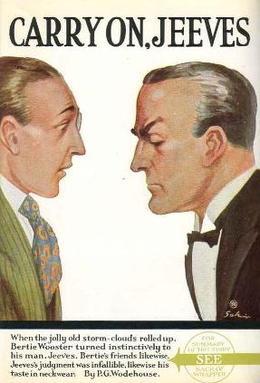
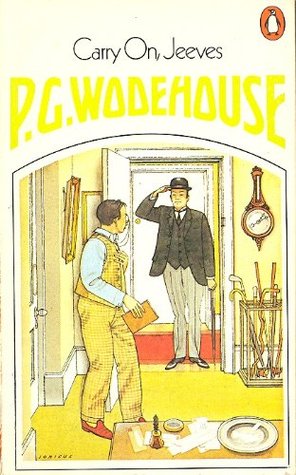

It's interesting to read these early J&W stories as it's so early in the duo's development and regular readers can observe how P.G. Wodehouse is starting to get ideas about their respective characters which become more pronounced as the years roll by. His descriptive writing is also not quite fully formed yet either. That said, there are plenty of glorious and wonderful examples of Wodehouse's peerless art to enjoy. Guileless but well intentioned Bertie, or one of his pals, finds himself in the soup and thus effortlessly efficient Jeeves appears with a wheeze to extricate Bertie or his pal. Some of the recurring series characters also appear, not least Bertie's nemesis Sir Roderick Glossop in the two best stories: "The Rummy Affair of Old Biffy" and "Without the Option".
Some of these stories also appear in My Man Jeeves (1919)* albeit in a slightly different form. he stories from My Man Jeeves were amended for Carry On, Jeeves primarily to feature Bertie Wooster as the narrator and main character consistently throughout the collection, as he had become the established and popular protagonist of the series.
In the earlier collection, My Man Jeeves (1919), only half of the eight stories featured Jeeves and Bertie Wooster. The other stories centred on an earlier proto Bertie character called Reggie Pepper.
By the time Carry On, Jeeves was published in 1925 (and the stories had appeared in magazines like The Saturday Evening Post and The Strand), Bertie had been firmly established as the narrator in the widely popular The Inimitable Jeeves (1923).
Wodehouse revised the Reggie Pepper stories (and the existing Jeeves and Wooster stories) to integrate them more cohesively into the developing "Jeeves canon" ensuring all ten stories in Carry On, Jeeves focused exclusively on the dynamic between Bertie and Jeeves.
Also Wodehouse was still refining his writing style and the characters' voices in the earlier stories. For example, in the original magazine version of one story, Jeeves refers to Bertie as "the guv'nor," a term he doesn't use in the revised, more formal Carry On, Jeeves version, where he consistently uses "Mr. Wooster".
The character of Reggie Pepper was entirely replaced by Bertie Wooster in the revised tales, such as "Helping Freddie" which became "Fixing It for Freddie".
Many of the stories had appeared in magazines first and were subsequently touched up or revised by Wodehouse for book publication. This practice of rewriting and reusing plots was common for Wodehouse to meet the demands of both British and American publishers for distinct book collections.
But the main reason for the revisions was to create a more consistent, polished, and characteristic Jeeves and Wooster experience that aligned with the successful formula Wodehouse had developed by the mid-1920s.
These are the stories contained within Carry on, Jeeves (1925)....
"Jeeves Takes Charge" — Bertie hires Jeeves for the first time, and Bertie's fiancée Florence Craye wants Bertie to destroy his uncle's memoirs.
*"The Artistic Career of Corky" — Corky, a struggling artist who relies on his uncle, is afraid his uncle won't approve of his fiancée. Jeeves suggests a plan involving books about birds.
*"Jeeves and the Unbidden Guest" — Bertie is told to look after Motty, the sheltered son of a friend of Aunt Agatha's, and keep him out of trouble. Motty, however, wants to make the most of his time in New York.
*"Jeeves and the Hard-boiled Egg" — Bicky, one of Bertie's friends, has lied to his uncle about his wealth and is in trouble when his miserly uncle comes to visit. Jeeves suggests a plan involving a convention of gentlemen from Birdsburg, Missouri.
"The Aunt and the Sluggard" — Bertie's friend Rocky, a poet who lives quietly in the country, is troubled when his aunt tells him to go to parties and clubs in New York and write her letters about it.
"The Rummy Affair of Old Biffy" — Biffy, who is forgetful, can't remember the surname or address of the woman he loves. After he ends up unhappily engaged to Honoria Glossop instead, he goes to Bertie for help.
"Without the Option" — Sippy, who is financially dependent on his aunt, is expected to stay with his aunt's ghastly friends. After Bertie inadvertently gets Sippy stuck in prison, Bertie must take Sippy's place.
*"Fixing it for Freddie" — After Freddie Bullivant is rejected by his fiancée Elizabeth Vickers, Bertie invites him to Marvis Bay. Bertie gets an idea to reconcile the two when he sees Elizabeth playing with a child on the beach.
"Clustering Round Young Bingo" — Bingo Little's wife wants a new housemaid, Aunt Dahlia wants a new cook, and Bingo Little wants his wife's article suppressed. Bertie tries to sort everything out with help from Jeeves.
"Bertie Changes His Mind" — After Bertie expresses interest in taking in his three nieces, Jeeves, who is against this idea, arranges for Bertie to give a speech to an audience of young girls.

May 5, 2016
I can never tire of Wodehouse. I can never tire of his books that are filled with characters like a friend who is 'As vague and woollen-headed a blighter as ever bit a sandwich', and a fiance who is 'one of those robust, dynamic girls with the muscles of a welter-weight and a laugh like a squadron of cavalry charging over a tin bridge' and an aunt who 'fitted into the biggest arm-chair in the house as if it had been built round her by someone who knew they were wearing arm-chairs tight about the hips that season'.
If beyond all this, I needed any incentive for picking up this book, it was the fact that it contains the only ever story narrated by Jeeves. The story really cleared some air about what really goes on inside Jeeves's massive coconut.Another magical read!
If beyond all this, I needed any incentive for picking up this book, it was the fact that it contains the only ever story narrated by Jeeves. The story really cleared some air about what really goes on inside Jeeves's massive coconut.Another magical read!

February 11, 2025
О, цей тонкий британський (чи мабуть все ж англійський) гумор. Ці нюанси смаку. Дживс і Вустер це така солодка парочка.
Можете казати що завгодно, але оці всі жжжж по тексту незпроста.
На другій книзі прийшло порівняння із Залишком дня Ішіґуро. І хоч обидва дворецькі піддакують, але це два абсолютно протилежні характери. І Дживс однозначно виграє.
Можете казати що завгодно, але оці всі жжжж по тексту незпроста.
На другій книзі прийшло порівняння із Залишком дня Ішіґуро. І хоч обидва дворецькі піддакують, але це два абсолютно протилежні характери. І Дживс однозначно виграє.

April 6, 2021
Absolutely delightful!

June 23, 2019
In the right mood Wodehouse can satisfy one's craving for the down-right silly, and for that his books are simply perfect.

January 29, 2026
Perfectly good fun as always. Loved the audio of this--even walking around town it made me laugh! I could swear that there are some of the same stories in here as in My Man Jeeves, though? Just me being goofy, perhaps? Unsure. Wish I had a Jeeves to sort it out.

December 3, 2019
I just love Bertie and Jeeves! This excellent collection is the third one I have read, and like the others it had me often giggling like an idiot. I'm pretty sure I have read a few of these, or at least a version of them, before but that doesn't make them any less entertaining. The last story was told from Jeeves point of view, a definite first in my experience.
Irrelevant note: I found the original receipt tucked in the pages and used it as a bookmark. I think it's cool that someone bought this book at LaGuardia Airport in 1989, and almost exactly 30 years later I bought it at a used book store while on vacation in Wildwood, New Jersey. (less)
0 minutes ago · delete
Irrelevant note: I found the original receipt tucked in the pages and used it as a bookmark. I think it's cool that someone bought this book at LaGuardia Airport in 1989, and almost exactly 30 years later I bought it at a used book store while on vacation in Wildwood, New Jersey. (less)
0 minutes ago · delete

December 26, 2018
This is another delightful collection of stories involving Bertie and his impressive valet, Jeeves. I listened to this on audio and it was a gem.

May 26, 2020
I’d never read any P.G. Wodehouse before, but of course I was familiar with his two most famous creations, empty-headed aristocrat Bertie Wooster and his omniscient manservant, Jeeves. Many people are turning to cheerful, witty reads during lockdown, so this seemed like a perfect time to give one of the books a try. The bio in my secondhand paperback calls this the first set of Jeeves and Wooster tales, while Goodreads lists it as the third book in a 14-strong series. I didn’t realize when I bought this or picked it up to read that it was a collection of 10 short stories, but that makes sense – these are such silly, inconsequential plots that they couldn’t possibly be sustained for more than about 20 pages each.
It doesn’t take long to get the hang of a Jeeves and Wooster story. Bertie or one of his rich, vapid pals will get into a spot of trouble, usually because of an aunt’s expectations, and a madcap plan – swapping places, impersonation, kidnapping or the like – is required to get out of it and/or get the girl. Jeeves has a brilliant idea and saves the day, all while commenting disapprovingly on Bertie’s fashion choices. Most of the stories are set in London and its environs, but a few also have the pair transplanted to New York City, where Bertie seems to have nothing better to do than lend his chums money. The first nine tales are narrated by Bertie, while the final one has Jeeves as narrator – on a visit to a girls’ school he plays a rather wicked prank to disabuse Bertie of the notion that he might like to adopt a daughter.
These stories were amusing enough, yet quickly blended into one. Pretty much as soon as I finished a story, I forgot what it was about. Looking back, not even the story titles can spark a memory. I made the mistake of not taking notes, so I’ve retained only general impressions. I enjoyed Bertie’s voice and the period slang as well as the dynamic between master and servant – it’s clear who’s really in charge here. “[T]his was obviously a cove of rare intelligence, and it would be a comfort in a lot of ways to have him doing the thinking for me,” Bertie says. “It’s a rummy thing, but when you come down to it Jeeves is always right.” Though I’ve never seen the adaptations, I couldn’t get the faces of Hugh Laurie and Stephen Fry out of my head. That’s no problem, though, as the casting couldn’t be more perfect.
I’m not sure if I’ll bother picking up another Wodehouse book, as I expect that his work is all of a piece. However, you could certainly do worse if you’re after a lighthearted read.
Originally published on my blog, Bookish Beck.
It doesn’t take long to get the hang of a Jeeves and Wooster story. Bertie or one of his rich, vapid pals will get into a spot of trouble, usually because of an aunt’s expectations, and a madcap plan – swapping places, impersonation, kidnapping or the like – is required to get out of it and/or get the girl. Jeeves has a brilliant idea and saves the day, all while commenting disapprovingly on Bertie’s fashion choices. Most of the stories are set in London and its environs, but a few also have the pair transplanted to New York City, where Bertie seems to have nothing better to do than lend his chums money. The first nine tales are narrated by Bertie, while the final one has Jeeves as narrator – on a visit to a girls’ school he plays a rather wicked prank to disabuse Bertie of the notion that he might like to adopt a daughter.
These stories were amusing enough, yet quickly blended into one. Pretty much as soon as I finished a story, I forgot what it was about. Looking back, not even the story titles can spark a memory. I made the mistake of not taking notes, so I’ve retained only general impressions. I enjoyed Bertie’s voice and the period slang as well as the dynamic between master and servant – it’s clear who’s really in charge here. “[T]his was obviously a cove of rare intelligence, and it would be a comfort in a lot of ways to have him doing the thinking for me,” Bertie says. “It’s a rummy thing, but when you come down to it Jeeves is always right.” Though I’ve never seen the adaptations, I couldn’t get the faces of Hugh Laurie and Stephen Fry out of my head. That’s no problem, though, as the casting couldn’t be more perfect.
I’m not sure if I’ll bother picking up another Wodehouse book, as I expect that his work is all of a piece. However, you could certainly do worse if you’re after a lighthearted read.
Originally published on my blog, Bookish Beck.

November 6, 2016
After reading a string of books by authors who took themselves too seriously and satisfied inadequately, it was a pleasure to return to Wodehouse. I really needed a good laugh. This book of witty and sometimes hilarious short stories about Bertie and Jeeves was read with great relish by Frederick Davidson.

February 4, 2017
Well that was rummy & plum, if a bit repetitive between some stories. I was going to give it 4 stars, but had to up it to 5 because of the smiles & laughs I had while reading.
A charming bit of British humor.
A charming bit of British humor.

June 8, 2019
Since discovering Frederick Davidson's narration, I find his reading of Wodehouse brilliant, and have been collecting his recordings. I love the Martin Jarvis ones, too.
Perfect joy, in the morning, afternoon, or evening.
Perfect joy, in the morning, afternoon, or evening.
October 27, 2022
If you appreciate dry humor, you’ll love this one! Rather comical darlings!

April 8, 2009
This was my 3rd Jeeves book (the 3rd in The Jeeves Omnibus). I can't say enough good things about Wodehouse. I have systematically been trying to get loved ones and friends to read these books, or at least become familiar with the characters, because I have fallen in love with them. Also, I have found a Wodehouse Fanatic and I imagine a long friendship with them, involving (among many other things) borrowing all their Jeeves books and movies.
Highlights to Carry On, Jeeves:
1. It's hilarious and hardly includes the character Bingo Little.
2. You learn how Jeeves came into Wooster's employ in the first place.
3. The last chapter is written by Jeeves! Delightful!
I hope some day I will own nearly all Wodehouse's works, too.
Highlights to Carry On, Jeeves:
1. It's hilarious and hardly includes the character Bingo Little.
2. You learn how Jeeves came into Wooster's employ in the first place.
3. The last chapter is written by Jeeves! Delightful!
I hope some day I will own nearly all Wodehouse's works, too.

July 5, 2022
I can't believe I've never read this Jeeves and Wooster! It was a lot of fun. Most of the stories in this were already familiar to me from the brilliant Fry & Laurie TV series. It was fun to see what small tweaks the TV series had compared to the original. The last story is a bit of a shocker! It's narrated by Jeeves instead of Bertie! Somehow, I didn't find it as effective. I'm so used to Bertie's narrative voice and how his cluelessness plays into the delight of the reading experience. It was interesting, of course, to see things from Jeeves' perspective, but I think it works better when Jeeves whips out his solution at the last minute.
Displaying 1 - 30 of 2,052 reviews