Jump to ratings and reviews
Rate this book

Miss Marple #SS 6

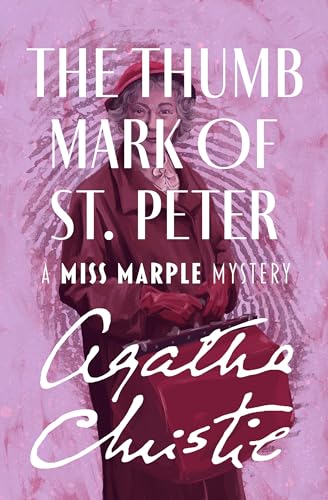
The Thumb Mark of St. Peter

Rate this book
In this classic short story, Miss Marple steps in to investigate when her niece is accused of murdering her violent husband.

During the first meeting of the Tuesday Night Club at Miss Jane Marple’s home, her guests present real tales of mystery. Miss Marple is the first to share a story . . .

Fifteen years ago, Miss Marple’s niece, Mabel Denman, was married to an abusive and hot-tempered man—until he suddenly died. Was it the mushrooms he ate? Or the arsenic Mabel had recently purchased? While the village gossips were ready to declare Mabel guilty, Miss Marple was determined to clear her niece’s name and set everything straight . . .

Originally published in the United States in Detective StoryMagazine in 1928, “The Thumb Mark of St. Peter” appeared in Christie’s short story collection, The Thirteen Problems, in 1932.

21 pages, Kindle Edition

First published January 1, 1928

96 people are currently reading
702 people want to read

About the author

Agatha Christie

5,789 books76.1k followers
Agatha Christie also wrote romance novels under the pseudonym Mary Westmacott, and was occasionally published under the name Agatha Christie Mallowan.

Dame Agatha Mary Clarissa Christie, Lady Mallowan, DBE (née Miller) was an English writer known for her 66 detective novels and 14 short story collections, particularly those revolving around fictional detectives Hercule Poirot and Miss Marple. She also wrote the world's longest-running play, the murder mystery The Mousetrap, which has been performed in the West End of London since 1952. A writer during the "Golden Age of Detective Fiction", Christie has been called the "Queen of Crime". She also wrote six novels under the pseudonym Mary Westmacott. In 1971, she was made a Dame (DBE) by Queen Elizabeth II for her contributions to literature. Guinness World Records lists Christie as the best-selling fiction writer of all time, her novels having sold more than two billion copies.

This best-selling author of all time wrote 66 crime novels and story collections, fourteen plays, and six novels under a pseudonym in romance. Her books sold more than a billion copies in the English language and a billion in translation. According to Index Translationum, people translated her works into 103 languages at least, the most for an individual author. Of the most enduring figures in crime literature, she created Hercule Poirot and Miss Jane Marple. She atuhored The Mousetrap, the longest-running play in the history of modern theater.

Associated Names:
Agata Christie
Agata Kristi
Агата Кристи (Russian)
Агата Крісті (Ukrainian)
Αγκάθα Κρίστι (Greek)
アガサ クリスティ (Japanese)
阿嘉莎·克莉絲蒂 (Chinese)

Ratings & Reviews

What do you think?
Rate this book

Friends & Following

Create a free account to discover what your friends think of this book!

Community Reviews

5 stars
394 (35%)
4 stars
359 (31%)
3 stars
308 (27%)
2 stars
54 (4%)
1 star
8 (<1%)
Displaying 1 - 30 of 68 reviews
Profile Image for EveStar91.
268 reviews283 followers
August 5, 2025
‘Now, you are laughing at me, my dears,’ said Miss Marple placidly. ‘You think that because I have lived in this out-of-the-way spot all my life I am not likely to have had any very interesting experiences.’

The Thumb Mark of St. Peter finally features Miss Marple's turn to share her own strange almost-unsolveable story with the Tuesday Night Club. This story has extra personal relevance to Miss Marple, as she helps her niece prove her innocence after a suspicious death. A quick fun read, highlighting her lateral thinking, and a great setting to remind the readers again of what she always says of people and village life.

‘That is where you make a mistake, dear,’ said Miss Marple. ‘Everybody is very much alike, really. But fortunately, perhaps, they don’t realize it.’

🌟🌟🌟🌟
[One star for the premise; 3/4 star for the characters; 3/4 star for the story; 3/4 star for the description; 3/4 star for the writing - Four stars in total.]
Profile Image for Rosh (on a short break).
2,417 reviews5,114 followers
November 21, 2022
An interesting mystery but doesn’t suit Miss Marple.

Finally it is Miss Marple who narrates an unsolved mystery for the Tuesday Night Club. I sat up straight in my seat, expecting a cracker of a mystery. Alas, the cracker turned out to be damp and squishy.

The story concerns Miss Marple’s niece Mabel Denman who is being shunned after the sudden death of her husband. The word around is that Mabel poisoned him. The problem is that no one, including the doctor who was called, knows exactly how Mr. Denman died. His last words too seem weird to everyone. Except Miss Marple, but of course.

There’s not much deduction or discussion from the club members this time as Miss Marple narrates the whole story almost in one go. The rest are mostly passive listeners.

If this had been a story featuring Sherlock or Poirot, I would have marvelled at the deduction. But it doesn’t suit Miss Marple’s personality. Miss Marple constantly claims herself to be the observer of human nature and uses this skill to resolve the mystery. But sometimes, it isn’t human nature but intricate knowledge that she seems to possess without any justification. This is one such example. How would an old lady in a small town know something as specific as the main component of a medical solution and even the name of the element that works as its antidote? This knowledge coming from Sherlock’s or Poirot’s lips would have been plausible. Not from Miss Marple. (Unless there is something to her background that I haven’t discovered yet. Time will tell) Moreover, a part of the suspense comes through the dead man’s last words. However, it is tough to believe that an ordinary man would know what the story says he knew.

On the positive side, the culprit wasn’t that easy to figure out, and after the revelation, their role in the proceedings seems logical. But again, the whole scenario is tough to accept.

2.5 stars, mostly for the development of the backstory and for the resolution of the mystery. You will enjoy it more if you want to appreciate Agatha Christie’s knowledge of poisons than to focus on Miss Marple’s deducing skills. This might have worked better as a Poirot story.


All six members of the Tuesday Night Club have now narrated a story each. I wonder where things will go next. A second round per person? There are twenty stories in this collection, so Christie would have to incorporate some modifications for sure. Let's see what the next story brings.

This story is part of the Miss Marple short story collection, The Thirteen Problems.


———————————————
Connect with me through:
My Blog | The StoryGraph | Facebook | Twitter
Profile Image for Zain.
1,895 reviews281 followers
February 26, 2024
I Didn’t See It Coming.

I didn’t see it coming. I didn’t see the ending. I listened to Miss Marple tell a story about her niece who was once married.

The niece and her husband didn’t get on. They fought often and a lot. One day the husband died and the niece was okay with it.

Then the day came when the niece called on Miss Marple for help. So Miss Marple is telling a group of people the story of what happened.

And she tells a top story.

Five fantastic stars. ✨✨✨✨✨
Profile Image for Anne.
4,771 reviews71.3k followers
April 23, 2025
This is a good one for 2 reasons.
1) Miss Marple takes her turn and tells the Tuesday Night Club of a murder that she helped solve.
2) In an adorable twist, Ramond West teases his Aunt Jane that there is at least one thing she doesn't know. But she pops back and shocks him by telling him that she does know he proposed to Joyce (the artist in the group) that very evening.

description

Jane's story has to do with a niece who married a not very nice man, then was suspected by the villagers of having poisoned him. However, with no conclusive evidence one way or another, there was no way to prove her innocence. A little divine intervention, a fishmonger, and one determined aunt later, the murder is solved.
The mystery stuff wasn't all that great, but it's a must-read for Marple fans.

Originally published in 1928 in The Royal Magazine.
Read as part of the short story collection The Thirteen Problems .
Profile Image for Julie.
2,017 reviews631 followers
November 2, 2020
Agatha Christie has been my favorite author since I read my first Hercule Poirot story at age 9. In all those years though I never read any of Christie's short stories. Earlier this year I read though the first short cases of Hercule Poirot....and now I'm reading the first cases of Miss Marple. The stories are quite short, most ranging from 14-20 pages. These tales were printed in fiction and detective magazines before Christie published her first books featuring her classic characters.

The first few tales feature Miss Marple and five friends gathering on Tuesday nights to share tales of unsolved or strange mysteries. One member of the Tuesday Night Club shares a story, and the others try to figure out the truth. The members are Miss Marple, her nephew, a lawyer, an artist, a clergyman and a writer. In this 6th story, it's finally Miss Marple's turn to tell a story! She tells a tale about a woman suspected of poisoning her husband. The evidence is pretty damning....but did her niece Mabel kill her husband or was she only guilty of marrying the wrong man?

This story was first published in The Royal Magazine in May 1928 (UK) and Detective Story Magazine that July (US). It was later included in the story collection The Thirteen Problems, published in 1932. This story was not adapted for television on its own, but the show Agatha Christie's Marple had an episode based on another story, Greenshaw's Folly, and the plot for this short tale was also included in the episode.

Interesting story....and I had to smile as Christie went into a discussion about poisons and their effects. I love golden age mysteries....someone always slipping arsenic or some chemical into people's tea or dinner. :) Many of the murders in Christie's books (In her 66 novels, 30 characters met their doom via poison) involve poison, chemicals or an overdose of some sort. Christie worked as an apothecary's assistant during World War I, so I'm sure she picked up quite a bit of knowledge about chemicals, poisons and various drugs.

This is the sixth and final story that happens at a regular meeting of the Tuesday night club. The characters appear in several more stories...so I'm anxious to find out what other mysteries they try to work out!

I had to look up the reference used in the title: Thumb Mark of St Peter. It refers to a black mark above the fin of a haddock fish (and other fish as well that have dark spots on their sides like the John Dory fish). Legend has it that the fish got that mark from St Peter. As Peter was fishing and touched the fish, it left the mark of his thumbprint on the sides of them all. Cool story!

I usually listen to audio while reading these stories. I like a proper accent (narrators do a much better job of an English accent than I can concoct in my imagination), and I get the proper pronunciation of names, places and any foreign words. But unfortunately I could not find audio for this story....I read it myself from my old hardback copy of Miss Marple: The Complete Short Stories (Putnam, 1985). Moving on to the next story -- The Blue Geranium. I do have audio for this one!
5,747 reviews147 followers
January 24, 2026
3 Stars. It's next week and the Tuesday Night Club is gathered again at the house of Raymond West's aunt in St. Mary Mead. "And now, Aunt Jane, it is up to you," he says. Joyce adds, "Yes, we are expecting something really spicy." It first appeared in Royal Magazine in 1928. I caught it in a compilation of all 20, Miss Marple: the Complete Short Stories, from 2011. Sixteen pages. Miss Marple thinks a story about the husband of her niece Mabel would suit. While knitting, she notes that it happened years back. Despite advice to the contrary, the young woman, who Jane calls "silly," married Geoffrey Denman. He was known to be abusive and there was insanity in the family but she was obstinate. A decade later he died suddenly under mysterious circumstances. Rumours about buying arsenic engulfed Mabel. The servants recount that Denman rambled about "a heap of fish" just before he died. Did Miss Marple find a resolution? Did one of the club offer guidance? What's does the concept of St. Peter's thumb mark on the side of a John Dory fish have to do with this? The answers are, Yes, No, and For you to find out. (Se2020/Ja2026)
Profile Image for Meg.
2,520 reviews32 followers
January 7, 2021
And now we come to Miss Marple’s turn to wow The Tuesday Night Club. It is the story of her niece, Mabel, who had trouble when her husband died suddenly and the village all thought she poisoned him. The only other suspects were the cook, the maid, the nurse and Mabel’s father in law who was is bad health. As he lay dying, the cook and maid both say that he was delirious and talking about a pile of fish. Miss Marple figured out that he was saying “pilocarpine” which is an antidote for atropine poisoning. Atropine is used in eye drops, which the old man had for his poor eye sight. Turns out the old man killed his son because he wanted to put him in an asylum. While it was a clever bit of detecting on Miss Marple’s part, I knocked a star off for the meandering way the story unfolded due to Mabel’s inability to explain anything and reveal the truth events of the fateful day.
This entire review has been hidden because of spoilers.
Profile Image for Richard.
2,349 reviews195 followers
October 17, 2024
Finally it is Miss Marple’s turn to share a problem with her friends of The Tuesday Night Club. However, unlike the others that she invariably solved there was none among them who could manage to work it out. Indeed even for Miss Marple it was an insurmountable mystery which she had to resort to less conventional methods to solve.

When someone dies suddenly there can be gossip and speculation. This happened to poor Mable when her husband passed due to “poisonous” mushrooms. Her situation was made worse as she had purchased some arsenic the same day; having had a heated argument with the deceased earlier that morning.

Fortunately Miss Marple knew the girl since her childhood and although she disapproved of the marriage she would never accept that her niece was a poisoner.

The evidence remained unclear, no post mortem was initially done, everyone accepting the doctor’s view of mushroom poisoning until the local speculation began.

I liked the insights into Miss Marple’s thinking and approach to solving a difficult problem. It was quite a surprise to see her returning to the text above her bed as a young girl. Her faith was rewarded, but in a convoluted way. which throws more light on her thought processes.

Surprising solution and quite satisfying to read that her efforts were rewarded. The standout feature of this story is Agatha Christie’s knowledge and use of a variety of poisons that get a mention here.
Profile Image for A.M..
Author 7 books57 followers
August 18, 2019
After her husband died suddenly, Miss Marple’s niece, Mabel is ostracised by the village who assume that she murdered him. Aunt Jane is clearly not a big fan of Mabel.
A nice girl, really a very nice girl, but just a trifle what one might call silly. Rather fond of being melodramatic and of saying a great deal more than she meant whenever she was upset.

Yes, they had many arguments; yes, she locked herself in her room rather than help the dying man; and yes, she had bought arsenic from the local pharmacy the day before his death. She’s also been happier lately, living as a widow and looking after her husband’s aging father.
Exhumation is the first step, and then they need to decipher the dying man’s garbled sentence about fish.
Too clever. 3 stars
Profile Image for Cathy Cole.
2,245 reviews60 followers
August 30, 2017
When Miss Marple gets an SOS from her niece, off she goes...but not before taking care of her maid and sending the plate and the King Charles tankard to the bank. She tells the tale of how she caught the killer to her nephew and others while she tries not to drop any stitches in her knitting. I can understand why her nephew thinks cities are safer to live in than villages after finding out how she tracked yet another poisoner. A delightful tale about my favorite knitting detective.
279 reviews5 followers
March 17, 2014
Short and sweet

Short and sweet as usual. It always sounds so logical when Miss Marple explains it. Short is right. Human nature is the same everywhere.
88 reviews1 follower
June 2, 2014
Great

Great

Though a short story, Agatha Christi manages to clasp the reader into mystery and intrigue. This is well worth reading.
206 reviews1 follower
January 28, 2015
Interesting plot and characters. Short story-quick read.
Profile Image for James.
1,822 reviews18 followers
June 15, 2020
A rather nice Agatha Christine. Short and too the point. What made this story stand out was that it was told from the point of view from Miss Marple herself.
236 reviews1 follower
April 5, 2021
Miss Marple at her best

Agatha Christie is the greatestest exponent of crime literature. What can you add except I love her books and short stories.
Profile Image for Michael.
176 reviews
May 10, 2021
This time, Miss Marple tells a story at the Tuesday Night Club.

The best story since the opening one, with a clever solution.
Profile Image for Ann.
1,600 reviews44 followers
July 3, 2024
Probably the most action Ms. Marple has ever done, and the solution was a stretch, but she was motivated to do so due to her family.
Profile Image for Octavia Cade.
Author 94 books136 followers
December 8, 2022
I've never actually felt sorry for Miss Marple before, but she's stuck with the whiniest, most annoying niece here, so all credit to the old lady that she didn't just smother Mabel or, you know, leave her to her suspicious neighbours. Then again, Mabel didn't actually murder her husband, so her far-too-patient aunt very likely felt a duty.

That being said, while I enjoyed this mystery, it feels a little out of place compared to some of the others in this collection. The majority of the ones I've read have been solved because Miss Marple has a domestic perspective not often considered by the other sleuths, and while that's on show here a little, the solution relies more upon a rather sophisticated knowledge of medicine and chemistry. I don't mean to say that Miss Marple shouldn't know these things; it's more that her knowledge of them is not the central appeal of her character for me.
Profile Image for Pamela Fernandes.
Author 36 books107 followers
June 24, 2022
Short story where Miss Marple is telling a story how she helped her niece clear her name when accused of murdering her husband. I learned a bit about atropine poisoning. uite unusual but straightforward story.
Profile Image for Mike Lisanke.
1,622 reviews34 followers
December 21, 2025
Who among mystery readers doesn't like a great poisons story! This one was esoteric!
Profile Image for Omar .
135 reviews4 followers
December 27, 2025
القصة الخامسة التي قرأتها من سلسلة نادي الجريمة لأغاثا كريستي كانت بعنوان The Thumb Mark of St. Peter، وهي من القصص التي يمكن وصفها بالمثيرة والمشدّة للانتباه رغم بساطتها الظاهرة. تعتمد القصة على لغز يقوم في جوهره على تفصيلة صغيرة جدًا، أثر يبدو عاديًا في البداية، لكنه يتحول مع تقدّم السرد إلى مفتاح أساسي لفهم ما حدث بالفعل. كريستي هنا لا تراهن على التعقيد، بل على دقة الملاحظة، وتضع القارئ في حالة شك مستمر، يجعله يعيد التفكير في كل استنتاج يصل إليه.

أسلوب النقاش داخل نادي الجريمة يمنح القصة طابعًا ذهنيًا ممتعًا، حيث تتعدد ��جهات النظر وتتقاطع التفسيرات، قبل أن يتضح أن الحقيقة كانت أقرب مما نتخيل، لكنها مخفية خلف افتراضات خاطئة. ما يميز هذه القصة أنها تشد القارئ بهدوء، دون إثارة مفتعلة، وتثبت مرة أخرى أن أغاثا كريستي قادرة على صناعة التشويق من أبسط الأدلة وأكثرها تواضعًا.


The fifth story I read from Agatha Christie’s Tuesday Night Club series was titled The Thumb Mark of St. Peter, and it is one of those quietly gripping stories that manages to hold the reader’s attention despite its apparent simplicity. The mystery revolves around a very small detail—an ordinary mark that initially seems insignificant, but gradually becomes the key to understanding what truly happened. Christie does not rely on complexity here, but on sharp observation, keeping the reader in a constant state of doubt, rethinking every conclusion they reach.

The discussion-based structure of the Crime Club gives the story an engaging intellectual tone, as multiple viewpoints intersect and interpretations clash, before it becomes clear that the truth was closer than expected, hidden behind false assumptions. What makes this story stand out is its subtle tension; it draws the reader in without forced drama, once again proving Christie’s ability to create suspense from the simplest and most unassuming clues.
Displaying 1 - 30 of 68 reviews

Can't find what you're looking for?

Get help and learn more about the design.