

What do you think?
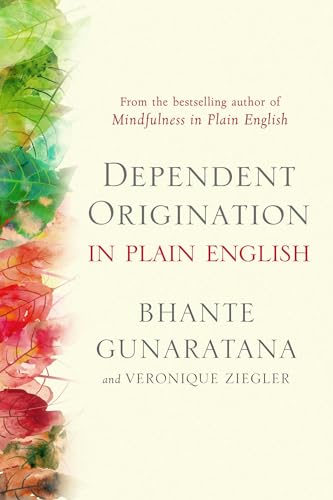
Dependent Origination in Plain English
In his famously accessible language, the author of Mindfulness in Plain English unpacks the foundational Buddhist theory of dependent origination, showing the reader how by eliminating ignorance we can eliminate suffering.
Nothing happens by accident. All things, no matter how mundane or meaningful, arise based on causes and conditions. And without those causes and conditions they would not arise at all. This, in short, is the Buddha’s teaching of dependent origination. Embedded in this fundamental theory are central teachings such as nonself, impermanence, and the four noble truths. And from it we can see for ourselves how suffering and rebirth, the great problems lying at the heart of the dhamma, arise—and how they pass away.
In Dependent Origination in Plain English, the venerable scholar-monk Bhante Gunaratana and his student Veronique Ziegler break down this keystone Buddhist teaching from the Pali canon into its core components, guiding the reader step by step from ignorance to suffering and its end. The process leading to future rebirths may seem far off, but it’s not some distant event. It’s happening now, with every breath you take.
Nothing happens by accident. All things, no matter how mundane or meaningful, arise based on causes and conditions. And without those causes and conditions they would not arise at all. This, in short, is the Buddha’s teaching of dependent origination. Embedded in this fundamental theory are central teachings such as nonself, impermanence, and the four noble truths. And from it we can see for ourselves how suffering and rebirth, the great problems lying at the heart of the dhamma, arise—and how they pass away.
In Dependent Origination in Plain English, the venerable scholar-monk Bhante Gunaratana and his student Veronique Ziegler break down this keystone Buddhist teaching from the Pali canon into its core components, guiding the reader step by step from ignorance to suffering and its end. The process leading to future rebirths may seem far off, but it’s not some distant event. It’s happening now, with every breath you take.
- GenresBuddhismSpirituality
182 pages, Kindle Edition
Published June 11, 2024
Ratings & Reviews
Friends & Following
Create a free account to discover what your friends think of this book!
Community Reviews
Displaying 1 - 1 of 1 review

July 8, 2026
3.5 stars. Thorough exposition based on the orthodox Theravada commentarial tradition and a selective reading of the suttas. Ignores interpretations that are based on the earliest suttas and may be closer to what the Buddha taught. Maybe the later tradition is right, but he doesn't explain why.
More important, unlike Bhante G's other books, the last half of this one consists of dogmatic exposition. It is not at all in plain English. It's like trying to explain the Apostles' Creed by slowly and emphatically repeating the Athanasian Creed.
I recommend it for accuracy in presenting the author's own tradition. The first half of the book is useful because it's based on experience. But I suspect that most readers will find dependent origination, as he presents it, almost as puzzling when they finish this book as before they started.
More important, unlike Bhante G's other books, the last half of this one consists of dogmatic exposition. It is not at all in plain English. It's like trying to explain the Apostles' Creed by slowly and emphatically repeating the Athanasian Creed.
I recommend it for accuracy in presenting the author's own tradition. The first half of the book is useful because it's based on experience. But I suspect that most readers will find dependent origination, as he presents it, almost as puzzling when they finish this book as before they started.
Displaying 1 - 1 of 1 review