The Stoic Prologue by an Epicurean
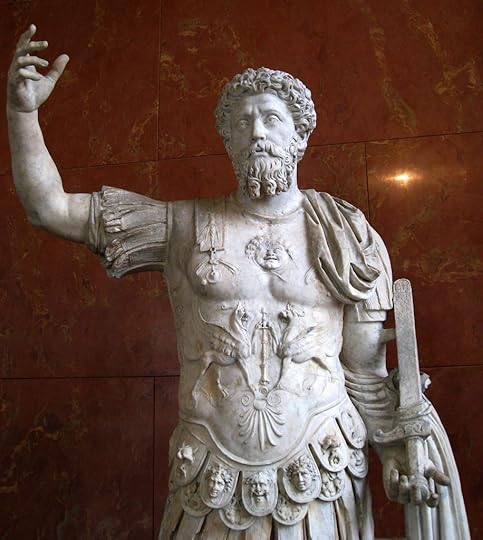
Since this is a book about Marcus Aurelius, not Stoicism, I thought it might be helpful to add a Stoic prologue.
Like its great post classical Hellenistic ‘competitor’, Epicureanism (to which I am more partial), it is a philosophy for living, not writing and debating. Classic Stoicism is about acknowledging and healing difficult emotions and painful feelings, not simply about tolerating them, baring them, or eliminating them. Modern cognitive psychology takes its cue from classic Stoicism in this respect. The Greeks had a medical model of philosophy; it was medicine for the soul (psyche), starting with the Socratic pharmaceuticals. Stoicism is about both morality and therapy in the face of mortality. Stoicism is about being rational about the things that bother us, not their suppression. Stoicism tames the men made mad by the madness of the world and shows that true manliness is found in love and natural affection, not in aggressive transgression. Stoicism also consoles gentleness and freedom from anger as well as nobility of character. The modern idea of “being stoic”, as being unemotional to better cope with adversity is not the same as Classic Stoicism which accommodates natural human emotions, it does not deny them or try to suppress them as evidence of inner strength. In terms of materiality, Stoicism is not about ascetism, it is about using material resources wisely. This is part of living in agreement with nature, both with the natural environment as well as the nature one’s inner emotional nature. This is all to say that Stoic philosophy was seen as a way of life and a test of character with the most important test being of one’s character coming in politics and leadership. This is obviously a test failed in the U.S. as we are now governed by fools, fanatics and fascists.
The Bridge is Out
I am writing here to tear down the much-touted Stoic bridge to Christianity. The alleged bridge is the claim that Stoicism serves as an intellectual foundation and transition point for early Christianity. I say nonsense. Fortunately, Marcus Aurelius learned early on to be skeptical of self-proclaimed miracle workers, sorcerers, and exorcists, anyone sound familiar? In Meditations (Book 1.6), Marcus explicitly credits his tutor Diognetus for teaching him "not to give credit to what is said by miracle-workers and jugglers about incantations and the driving away of demons and such things." Then as now the warning is against the superstitious fanatics known as Christians. This much has not changed. But at least the Christians were just a cultish minority in the time of Marcus Aurelius. Today, these wildly eccentric people are the majority and in the halls of government.
The stoicism of Marcus Aurelius emphasis reason and choice over accident and force but Christianity is the result of historical accident and employs force to spread, granted it is no longer physical force, but social and psychological force is still brought to bear on people. Christianity undermines the wisdom taught by Stoicism by preventing interest in the past from where wisdom is found based on experience. Instead, Christianity focuses the mind on wishful thinking for an untried utopian future. This makes people rootless as Hannah Arendt put it. Christianity is the madness of the world the makes men mad while Stoicism tames this man-made madness. The so-called bridge is really just a superficial scaffolding used by early theologians to rebrand what was, at its core, a radically different message. If there was any bridge at all, it was a one-way street built entirely by Christians moving backward, not by Stoics moving forward. In Stoic physics, the universe operates by immutable, rational, and natural laws (Logos); the Christian reliance on miracles, bodily resurrection, and divine intervention looks less like philosophy and more like superstition. Marcus Aurelius viewed the Christians not as intellectual peers, but as a stubborn, theatrical sect. When he famously mentions them in Book 11.3, he criticizes their readiness to die as a matter of "mere obstinacy" and tragic showmanship rather than a reasoned, calculated choice. Christianity hijacked Stoic vocabulary to teach something fundamentally opposite.
The More Likely Bridge to Christianity
The plague of Christianity was most likely spread by the Antonine Plague. That is, the overwhelming devastation of the plague (most likely smallpox) shook public faith in the traditional Roman gods and created social space for the spread of new spiritual movements. With physicians unable to cure the disease and leaders unable to contain the disease, the people began turning toward religion and superstition. The plague created boom times for religious con artists, charlatans, and fanatics. Marcus Aurelius took a tolerant stance toward all religious sects and was not a persecutor of Christians as it sometimes claimed. It was not in his Stoic nature to be the persecutor of anyone. He interpreted all religions as expressing various aspects of a single, divine, universal nature. There is of course the pesky case of Justin Martyr. But this was a case of a willing martyr knowingly seeking martyrdom rather than a case of overt persecution. Of course, Christians tried to have it both ways, one the hand Marcus Aurelius persecuted Christians but on the other hand his army was saved by a miracle because Christians were in his army. A foreshadowing of Constantine at the Milvian Bridge in 312.
Morality without God
Marcus Aurelius and Stoicism proves that one does not need Christianity or any religion to be moral, ethical, and noble. In the Meditations, he tells himself that Nature intended for people to work together, rather than fight, i.e., to cooperate rather than compete. He tells himself that ungrateful, arrogant and deceitful people are merely misguided; that his own frustration, anger, and hate are irrational. All rational beings are viewed by the wise as their brothers and sisters. Further, those who wrong him are still his brothers who have the capacity for reason and to whom he shares a fundamental bond – who needs Christianity? But this is why Christians think Stoicism is a bridge to Christianity. But Christianity is about dogma and belief, not about ethics, morality, or human wellbeing in the world where they actually live, it is about the afterlife where no one lives. In the current material world, Christianity leads to a more mystical, more tribal and more autocratic society as seen in the U.S. today with political tyranny is steeped in fear, envy, deception, and hypocrisy. In another example, the New Testament does not explicitly or universally condemn slavery, but slavery was an absolute moral wrong in the school of Stoic philosophy.
I guess I should be more Stoic and accept the fact that we will always have a substantial number of irrational and superstitious people with us, the advancement of science and technology, notwithstanding.
So, the bridge is out. My work here is done.