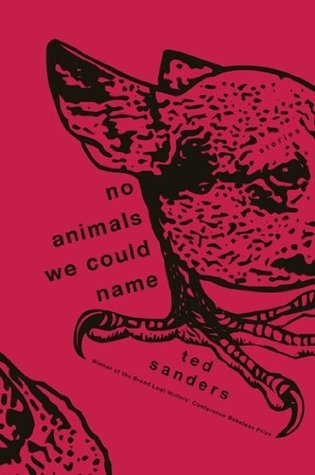
The winner of the Bakeless Prize for Fiction, a bold debut collection The animals (human or otherwise) in Ted Sanders's inventive, wistful stories are oddly familiar, yet unlike anyone you've met before. A lion made of bedsheets, with chicken bones for teeth, is brought to life by a grieving mother. When Raphael the pet lizard mysteriously loses his tail, his owners find themselves ever more desperate to keep him alive, in one sense or another. A pensive tug-of-war between an amateur angler and a halibut unfolds through the eyes of both fisherman and fish. And in the collection's unifying novella, an unusual guest's arrival at a party sets idle gears turning in startling new ways.
Ted Sanders is the author of The Box and the Dragonfly, the first book in the new middle grade series The Keepers, coming in 2015 from HarperCollins Children's. His first book, the short story collection No Animals We Could Name (Graywolf 2012), was the winner of the 2011 Bakeless Prize for Fiction. His stories and essays have appeared in publications The Southern Review, Cincinnati Review, Georgia Review, and the O. Henry Prize Stories anthology. A recipient of a 2012 National Endowment for the Arts literature fellowship, he lives with his family in Urbana, Illinois, and teaches at the University of Illinois, Urbana-Champaign.
About twice a year there is a description of a book in The New Yorker's "briefly noted" section that sounds like something I would enjoy reading. (The small amount isn't b/c I don't read a lot - it's b/c what they choose isn't attractive to me.) So I requested this book from the library, and the first thing I noticed (besides the pages still being stuck together, making me the first reader of this copy), was the PARAGRAPH-LONG list of funding this book got, complete with multiple logos from various companies and government agencies.
This made me want to not like the book. I thought, "Seriously, how much does it cost to print a couple thousand of these? It's on Graywolf Press for crying out loud." So I didn't want to like the book. But I started reading, and wasn't dead-bored by a lack of imagination (which is common for me when I read so-called contemporary fiction). And by the time I finished "Flounder" (it was the fourth story I read, not reading them in order), I was convinced. There is true skill and imagination on display in these stories.
What I found the most unique about Sanders' style is that, in contrast to most fiction writers - who have their characters or narrators make some insightful observation about life, death, families, love, whatever - his insights are written so specifically to the scenes he has created that they are not extractable as life lesson quotes, which is what so many writers seem to really be trying to come up with: contexts for (supposed) insights. Sanders' best moments aren't extractable from their context, and thus can't become generic truisms or philosophical nuggets. He creates situations and rhythms that are unique to each story, and when an insight does occur - or even just a moment of stupendously beautiful description - you get the pleasure of living with it as is. Not really quotable, not really extractable. It makes for impressive writing, and juicily pleasurable reading.
Now that I've said the book isn't quotable, here are what I'l call 'tastes':
a cat "smoked around my ankles"
at a trying time at the vet's office: "I thought of sailors trapped in the stomachs of broken ships"
"voices knife up briefly" - from other rooms at a party
Now, I think William Gass is the best living fiction writer we have in America, and a lot of that is because of his skill with analogy. Sanders is genuinely the only American writer I've read that comes close to Gass' talent in that department.
"fingers are the dreams of toes"
"hopeful homemade dips"
"magazines full of deeply shining pictures"
"smells climbing into nose"
"argument of sparks" and then 3 pages later: "the fire exhales its great long breath and throws glitter at the stars"
I also like that Sanders repeatedly compares the sound that something emits to its size. Here is a passage that is not an example of that:
"Shad turned his head, kept his eyes on the TV. 'Opinion of person,' he called down the hall. Julie's voice came back, singsongy and muffled, unintelligible."
describing a buzz: feeling "sludgy and wide, something in the neighborhood of - but not - happy."
Often what passes for good fiction writing is just detailed description, but the kind of stuff the New Yorker applauds is detailed descriptions of things no one cares about, things the author is trying to make us care about, while really just being too hyper-involved in the act of displaying writerly skills. (And the fact that the NYer seems to be obsessed with writers who provide long-winded, mildly titillating accounts of some illicit or first time affair.)
Sanders writing, in contrast, displays actual imagination. That's pretty much the highest compliment I can give.
It's not philosophy, and it doesn't advance the possibilities of writing as Art, but it's not trying to do that. And if you judge this collection based on what it is trying to do - tell stories while loving the language of storytelling- it does that exceeding well. Better than anything I've read from a contemporary author.
Read 6/27/12 - 7/5/12 3.5 Stars - Recommended to fans of the short story and those who don't mind the deaths of animals Pgs: 234 Publisher: Graywolf Press Released: July 3, 2012
So, my good friend Tara over at BookSexyReview has a theory. And in my experience, it's a pretty accurate one. If an animal is introduced into a story, that animal will surely die.
If the story is about an animal, you can bet the farm the poor thing will be dead by the end of the book. Look at books like Old Yeller, Cujo, and Marley and Me - the classic "dog as man's best friend" pull-at-your-heart-strings-because-you-have-to-put-them-down tear jerkers or the scare-the-shit-out-of-you-because-it-wanted-to-eat-your-face-off-so-you-had-to-kill-it variety. Even beyond the usual, there are authors out there who find death for stuffed animals, as S.D. Foster does in his collection A Hollow Cube is a Lonely Place.
I know, I know, there are plenty of books to argue the other side, where the animals never meet their maker - such as Seabiscuit and Boleto - but we're going to ignore those so I can continue writing this review... I need you to work with me here.
The animals found in Ted Sanders' short story collection No Animals We Could Name - a motley grouping of dog, lizard, octopus, and deer - simply never see it coming. Well, hang on, that's not actually true, because the lizard wasn't exactly alive anymore at the start of his story, and we never really know what happened to the deer though we do get full treatment to the aftermath of the driver of the car that was headed towards the deer... (though if the driver of that car had the same kind of luck I do, he smashed the shit out of that thing before veering off the road)...
Now, the dog and octopus... their stories are bit more certain. I can pretty much guarantee they didn't see their ends coming. And what ends they get!
No, no, don't worry. I'm not about to spoil the entire book for you. But I do want to warn you away if you're anything like Tara and me, and hate to read books that involve unfair and sometimes messy endings to our furry (and in one case, slimy) friends.
That's not to say that all of Sanders' stories involve animals. Because they don't. Quite a few of them are about humans. And the strange, animal-like, and irreversible things they do to themselves and those around them.
There's a growing sense of sadness in some of Sander's stories. It's dark and festering. It puckers at the seams. Sometimes it smells of disease and not nice things. As you read them, you begin to experience this strange, slow growing hesitancy with each turning page - something akin to that crazy music that starts to creep up in the background of a film, as the main character reaches for the doorknob with a shaking hand - but you read on, knowing something is coming. Not something outwardly horrific, nothing scary. This is not a hack-em-up-and-hide-em-in-the-basement kind of book. You know it's going to be something much more subtle and strange, something that's just sitting there sadly, crouching, watching and waiting... something that will crawl out of the pages and sit with you much later on... when you would least like it to.
It's a book that you experience emotionally. Some stories will make you smile slyly. Some will make you pout. Most will make you wonder....
If I could sit down with Ted Sanders, author of “No Animals We Could Name!”, it would probably go like this:
Me: Ted, I was probably the wrong guy to review your short story collection. I read for recreation; I read for escapism. I don't mind a subtle message through the work; I don't mind a little challenge in tracking plot – but I do not like having to think too hard. “On the surface, this is sparse, but it's obvious there's a lot more hiding underneath. I HATE having to dig for it!”
Mr. Sanders: Those are the stories I wanted to tell, in the manner I wanted to tell them.
Me: I realize that, and I'm OK with it. BUT not every style appeals to every reader, and a lot of your book simply didn't register with me.
Mr. Sanders: For example?
Me: Well, let's take the stories that begin and end the book – not just because they bookend the rest of the book, but because they both share some specialized formatting. “Obit” wraps itself around in a circle, but I'm not sure if the place I jumped in was where I should have jumped in, and the same is true for the ending. I felt I should have started reading it again from the “beginning”, almost like a Moebius strip. And “Assembly” - Peter Lumley's constant building and rebuilding of various fantastic machines … I was tempted to sit and reread and try to figure out just what you were REALLY trying to tell me, but I did not want to invest the time, especially since I wasn't sure a reread would make it any clearer to me.
Mr. Sanders: But, with just a little effort, you would have seen it was about …
Me: NO!! I haven't earned it! Don't just give it to me!
Mr. Sanders: Well, was there anything about it that you DID like?
Me: Well … the novella “Airbag” kept my attention. I'm not sure why you split it into 3 pieces for the book instead of including the whole thing as one unified piece. “Flounder”, telling the story of fishing from both ends of the line was an interesting look at the sport. And I liked “Putting the Lizard to Sleep”. But these were the most traditional stories in the collection – probably not a coincidence.
Mr. Sanders: Then why did you keep reading it?
Me: Well, I felt I owed it to you, and to the folks at Greywolf Press who gave me a copy of the book without condition (but I'm sure were hoping for an honest review, especially a favorable one.) Plus, it wasn't like it was torture to read the stories … I LIKED some of it, and I didn't DISLIKE most of it. Besides, I felt like a hypocrite. I think authors should challenge themselves and convention; that's how the craft evolves. I just find I don't like most of the “creative” styles of storytelling.
Mr. Sanders: Is that why you're writing this review in a nontraditional format like this??
Well, it is not as if the stories were bad, but they just didn't touch or captivate me. A few were pretty good, but I could barely finish some, which is rare for short stories. They seemed to need more humor; they seemed to just plod along. I thought about just deleting it from my lists, but I thought, "No. I read it, I should say something, even if not glowing." No doubt some readers will enjoy them, though I suspect some of the reviewers were being too kind in their praise. Still, writers with a lot more experience and literary talent touted it and awarded it a prize, so maybe I was missing something. You be the judge.
Creo que llegué a un punto en que ya no puedo dejar pasar ciertos temas en lo que leo sólo porque este bien escrito. No digo que el libro sea malo ni que la temática en sí sea mala, pero mi corazoncito ya no aguanta leer sobre muerte de animales. Dicho eso, los cuentos tienen puntos bastante fuertes que podrían ser disfrutados por alguien más.
Overall, this collection of stories is haunting. Most are spent entirely in the head of a character, experiencing their thoughts and feelings, but there is still quite a bit of action in most of the stories. In many cases, extended metaphors are used, particularly ones with animals, and these are especially effective.
For example, in the opening story, obit, a bear helps a woman fish and sings her to sleep at night. In exchange, she feeds him peppermint. In the end this sacrifice on the bear's part is clear and is equated with the sacrifices of the teller of this story, a boy's mother. The story culminates with the well-known realization we all have at some point - that great things and bad things will happen (ex. "Lovers will share breath, possessed by moments of unassailable faith."), but ultimately everything ends.
Another story, The Lion, describes the grief of a woman who has lost her daughter and is now paralyzed. Her energy goes into creating a stuffed lion that soon has a life of its own.
Airbag, a story in three parts, lacked the clarity of the shorter stories. That said, I love this line, spoken by Triti: "There's going to be me wherever I go."
There are also several very short pieces and most of them didn't do much for me (The Whale Dream, The Heart as a Fist). I was intrigued by the very short story Jane, though: "Slowly you learn that possession is the sinew of ghosts."
It's clear that 10-15 pages is when Sanders is at his best. The most haunting story for me was Momentary, in which the main character James takes the intrusive thoughts we all get sometimes to extremes. As he says, "I imagine things could happen. I believe they can, if only for moments. It's a fear I can't live without."
Putting the Lizard to Sleep was also great and Opinion of Person decent. The final story, Assembly, is a bit of a conundrum for me. I was charmed by it, the repetition, the imagination, the magical realism, but it didn't leave me with much. There's a sense that people are like machines, or interchangeable with machines, but the animal metaphors were more effective for me.
It is sometimes said of a book of fiction that it teaches its reader how to read on its terms. Such books are often reflexive, hintingly aware of what’s happening between reader and text. The stories in Ted Sanders’ varied, fascinating collection, No Animals We Could Name — winner of the 2011 Bakeless Prize, out in July from Graywolf — take on their own such awareness, teaching the reader to read their intricate language.
The opening story, “Obit,” appears as its namesake might in a newspaper, in a 1¾-inch column on the page. From there it splits like a family tree — the boy’s column bifurcates into the woman’s and the man’s — and the reader must choose a way forward into the similetic, image-rich world of Sanders’ fiction. In the left column, Sanders writes that the woman “will die . . . senseless and mute on morphine,” but she “once lay…wishboned around the man, watching a basket-colored sun make urchin shapes through the spruce tree.” Human sex, animal bone, man-made object, celestial body, sea creature, tree. All of these will reoccur in the collection. As will death. To die, in Sanders’ world, is to be drugged senseless; to live is to be drugged by the senses. The drug of sex on a sunny bed: the woman’s “carved arms around her head like a harp’s arms as if the delicate gesture unfolding through them were being sung wordlessly into sight in her face. The woman will survive this understanding.” Whose understanding? Her own? The man’s (he’s doing the looking)? The reader’s? Yes.
I received this book in a giveaway from Graywolf Press (thank you!). I was very interested in this book, as it is a collection of short stories by a new author for my shelves. The descriptions I had initially read told me I would definitely like this book.
The bookend stories of "Obit" and "Assembly" are daring and experimental, which thrilled me, although I felt a little unfulfilled hope that some elements would develop more. Several of the stories were interesting but also somewhat incomplete in their delivery of my satisfaction. There is a weightless feel to some of the stories, and I suppose I wanted a bit more concreteness. My favorite story, however, was intentionally and effectively weightless. This was "Deer in the Road." I also really enjoyed "Momentary," for which a fleeting sense of solid ground is necessary.
I would definitely read more work by Ted Sanders. I look forward to seeing his name out there on the shelves again in the future.
Man this guy can write prose. Ive rarely read sentences that make you see an image as well as these do. And he gets at powerful images very subtlely. I had to put the book down and revel in an image more than once. Ive read some other reviews and none seem to mention that this book is really just a novella broken into three parts and surrounded by lesser stories. The novella, called airbag, is amazing. The characters are relatable and mythic at the same time. They are larger than his language. Its a fabulous story thats painted delicately. Its haunting. Many of the other stories dont have characters that outshine their language, and sanders makes it worse at times with over-alliteration and artfulness. I found it much harder to connect with the shorter and midrange stuff. Im excited to read his stuff in the future and I hope his next book Is a novel
I don't think I have ever read a book like this before. It seemed to take forever for me to finish reading. But that is not a bad thing at all!!! The author has a way of writing in such that after almost each of the short stories I had to put the book down and walk away for awhile. I was sent into complete sensory overload. His writing draws you completely in, allowing you to see, smell, taste, touch...all of it. Superb!
Awesome work!!! I truly enjoyed reading.....Thank you!! Looking forward to seeing what you come out with in the future.
Solid recommendation; most of these stories are quite good. Not all of them, but most of them. The "Airbag" trilogy, with tiny Dorlene, is intense and strange and particularly good. It'll stick with you for a long time.
Another reviewer expressed concerns that these short stories, with "Animals" in the title, might be something like "Old Yeller" and "Bambi" -- that is, too sad to read comfortably. Trust me: have no worries. Not even remotely similar.
Wondering where the title, No Animals We Could Name, comes from. Any goodreaders know?
I got this book as a first read. The book, as a whole is well written, some of the stories are disconnected and very difficult to follow along with the little development of characters which in turn make them feel distant and unrelateable to the reader.
If you like abstract reading, then this is the book for you if you can't tell I'm not that into.
I don't think I have ever read a book like this before. It seemed to take forever for me to finish reading.
While the book, as a whole is well written, some of the stories are disconnected and very difficult to follow. There is little development of characters which makes some (okay most) of them feel distant and unrelateable If you enjoy abstract reading, then this is the book for you. I, however, enjoy plots, characters and relationships too much to be able to savor the uniqueness of this collection of short stories.
As with all collections, some of the stories were better than others. But the overall effect was pretty great. In the introduction, Stacey D'Erasmo says, "This is the music I have been waiting for," and that's a pretty good way to sum things up. The prose in this book is magical at times. Story-wise, the highlights for me were "Obit," "Momentary," "Flounder," and "Jane," which is the kind of a ghost story I've been thinking about a lot lately.
A lot of reviews say to not read it if you love animals. I can kinda sorta agree. Every chapter involves a creature of sorts and have a sad ending. Each chapter has a very different style in itself. Some have more parts as in continuation. Very unique book I can say, never read something like this. Overall is a great book to read and of course to have.
I won this book in one of the Goodreads Giveaways.
This book was incredibly bizarre. The first story was completely confusing, as the paragraphs were placed randomly on the page, not really in sequential order. After that, the book was okay. Some of the stories were interesting, others left me scratching my head, wondering what on earth I had just read. Overall, it was an okay book.
This unusual collection of stories was arresting when the author could rein in his penchant for meandering. A story about a family's decision to euthanize their injured pet lizard was entirely too long, in my view.
God damn, this was good. In an attempt to inject a little spontaneity in my life, I try to pick a book randomly from shelves every time I hit the library. Last time, this was it. This book has won several awards, was backed by a whole grab-bag of arts organizatons, and was worth every penny.
These stories were, at times, difficult to read due to tone and content, but in the end, his writing (the moments and details he selects to give voice to, and the way he does so) kept bringing me back. Poignant and sincere.