Jump to ratings and reviews
Rate this book

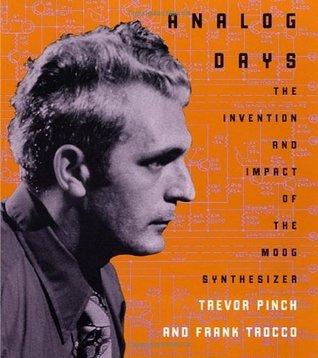
Analog Days: The Invention and Impact of the Moog Synthesizer

Rate this book

Though ubiquitous today, available as a single microchip and found in any electronic device requiring sound, the synthesizer when it first appeared was truly revolutionary. Something radically new--an extraordinary rarity in musical culture--it was an instrument that used a genuinely new source of sound: electronics. How this came to be--how an engineering student at Cornell and an avant-garde musician working out of a storefront in California set this revolution in motion--is the story told for the first time in Analog Days, a book that explores the invention of the synthesizer and its impact on popular culture.

The authors take us back to the heady days of the 1960s and early 1970s, when the technology was analog, the synthesizer was an experimental instrument, and synthesizer concerts could and did turn into happenings. Interviews with the pioneers who determined what the synthesizer would be and how it would be used--from inventors Robert Moog and Don Buchla to musicians like Brian Eno, Pete Townshend, and Keith Emerson--recapture their visions of the future of electronic music and a new world of sound.

Tracing the development of the Moog synthesizer from its initial conception to its ascension to stardom in Switched-On Bach, from its contribution to the San Francisco psychedelic sound, to its wholesale adoption by the worlds of film and advertising, Analog Days conveys the excitement, uncertainties, and unexpected consequences of a new technology that would provide the soundtrack for a critical chapter of our cultural history.

(20021114)

384 pages, Paperback

First published January 1, 2002

29 people are currently reading
490 people want to read

About the author

Trevor Pinch

26 books4 followers

Ratings & Reviews

What do you think?
Rate this book

Friends & Following

Create a free account to discover what your friends think of this book!

Community Reviews

5 stars
78 (31%)
4 stars
116 (47%)
3 stars
40 (16%)
2 stars
10 (4%)
1 star
0 (0%)
Displaying 1 - 30 of 30 reviews
Profile Image for James.
11 reviews
June 22, 2013
A must read for synth-nerds. Partially responsible for the continuing delusion that I can accomplish a fraction of what this man did.
Profile Image for Mike.
51 reviews2 followers
May 9, 2022
The writing in this is embarrassingly bad in like a college freshman meets old professor trying to be cool by talking about how he lived through the "radical" 60s kind of way. There are better ways to write cultural histories of music, however I think this is the only major publication about American synthesizer music and the two major people interviewed for this book, Bob Moog and Don Buchla, are now dead so we are stuck with this disorganized mess written by people who somehow got Ph.Ds. Some interesting tidbits, nonetheless, but I think the wrong people took this job.

*Addendum: I had written this before I had even got to the part where the authors discuss Wendy Carlos and "suggest" (i.e. not actually talking to her about this or citing any kind of previously existing statement) that the synthesizer played a role in her gender transition. Absolutely cringey speculation about someone's personal life that seems out of place even for 2002 when this book was published.
Profile Image for Steven.
Author 8 books34 followers
January 21, 2015
A bit more lightweight than might be expected, given its origins, but still an interesting look at the history of modern synthesizers. There are a few inaccuracies, mind you, and a few missing points (in their discussion of Hawkwind the authors fail to note that not only did Del Dettmar and Dik-Mik use the EMS VCS3, but they also built their own synthesizer gear; likewise they don't mention that Kraftwek built much of their own equipment. Also absent is the connection between EMS and the BBC Radiophonic Workshop.) It's an easy read that does suggest some avenues for additional exploration, although it may also leave the reader wanting more -- they tell you little about Moog after Norlin bought the company in 1973, for instance.
Profile Image for Evan.
191 reviews3 followers
April 13, 2024
Unless I'm missing something, this is the most comprehensive history of this topic that focuses more on the context, culture, and personalities than on the electronics and product design (for which we have the more recent Patch & Tweak series). I'm more interested in this approach than in a pure bio of Bob Moog, which also exists.

I'm a bit disappointed that there wasn't more detail, or more depth to the interviews, especially during the early chapters where things were just getting started. The "San Francisco Tape Music Center" oral history compilation (Bernstein) is maybe too much for casual readers, but has an immediacy in the interview transcriptions that is missing in the grade-school prose here. You'd assume the audience for this could handle some technical descriptions of signal paths or module types, for instance. If this is not the place for that, then perhaps more probing questions could reveal depths of the relationships portrayed.

All in all it falls flat as a documentary work, but as the best and only book on the topic, I can still recommend.

All books should include a discography.
Profile Image for John.
18 reviews
February 26, 2022
This is a storybook about the development of the synthesizer in the 1960s and beyond. It's good reading, not technical at all, giving a good background to the people and the inventions.
Profile Image for Matt Lanka.
244 reviews3 followers
October 10, 2019
Analog Days has a bit of a misleading title. While the book does focus a lot on the history of Moog, there are large sections about the history and technical design of other famous synthesizers from the same period, such as Buchla, EMS, and ARP. The book essentially ends in the mid 1970s when most of these early pioneering companies were going bankrupt or being sold and absorbed into larger media companies. Here in the year 2019, it feels like this is just the introduction, and I would have liked for the book (published in 2002) to have at least continued the history of the synthesizer into the 1980s and talked about Roland, Yamaha, and Sequential Circuits. Still, perhaps this book is long enough at 324 pages and there should be an "Analog Days 2" that focuses more on analog polyphony, digital synthesizers, the analog-digital hybrids of today, the resurgence of modular synths, and even the endless software plugins that can either mimic classic analog synths or even do things impossible in the analog world. There's lots more to learn about, but this book is a great introduction to the world of electronic music.
57 reviews2 followers
February 4, 2020
I'm from the tiny little town of Jacksonville NY and attended school in nearby Trumansburg, a sleepy little podunk town about 20 miles from Cornell University. Unbeknown to me at that young age, a former resident from Queens named Robert Moog (rhymes with 'rogue' not with 'fugue') had established a shop on main street "T-burg" building theremin kits, all while pursing a doctorate in engineering physics at Cornell. A musical revolution was in progress just minutes away from where I was growing up. At last I've found a very accessible & informative account of just what the luminaries of the R.A. Moog Co were up to.

As a composer using modern modular synths derived from the designs both of Moog and his hippie doppelganger Don Buchla, I'm grateful for the time travel opportunity, to get a taste of that rarified atmosphere of innocence and innovation, a hopeful time when anything seemed possible.

Interesting anecdotes include Keith Emerson's surprising personal dissatisfaction with his ground-breaking 1970 'Lucky Man' solo, and the tragedy of Walter Carlos losing extraordinary performance opportunities after releasing the seminal & Grammy winning "Switched On Bach", the first classical recording ever to go Platinum, because of various complications associated with her recent gender transformation. There's also an amusing description of David Borden of "Mother Mallard's Portable Masterpiece Company", an otherwise forgettable composer, who as studio klutz became an indispensable part of Moog's quality control process as 'idiot-proofer.'

The parallel American bi-coastal developments which gave rise to the Buchla vs Moog "East/West coast synthesis" debate is amply discussed - was the modern synthesizer meant to be a keyboard driven instrument in vein of S.O.B that emulated familiar instruments, or was it meant to be a kind of spaceship into a universe of unheard sound and new emotional territories? There's also a good coverage of ARP and EMS, but it's the personal portrait of Moog in particular which carries the day here - an engineer hours late to his PH. D defense because he trapped himself in an elevator after an ill-advised jumping experiment trying to establish the resonant frequency of the elevator car.
3 reviews
January 29, 2018
This book focuses specifically on the earliest days of analog synthesis as we know it today, from about 1963 to 1970. It follows the evolution of the synthesizer as an instrument from the relatively modest theremin to the engineering masterpiece that was the Minimoog Model D. It does touch on the activity of other synth manufacturers during this time, but in terms of era, that's the bulk of the book's scope. So, if you're looking for a history on the development of later synths (like the Prodigy, Prophet-600, etc), you won't find it here.

That said, the story of those early days in synthesis is a fascinating one, IF you already have an interest in synthesizer technology. If you don't, you'll probably find that there isn't much of a clear narrative that will hold your interest. But then again, if you're reading reviews of this book, chances are your a synth nerd to some degree.

Much of the first half of the book deals with the simultaneous evolution of Buchla and Moog as instrument designers, and how their design approaches were influenced by their cultural contexts and interactions with very different types of end-users. Pretty interesting stuff. The book then goes on to document the runaway success of Moog and its subsequent crash. Trocco details a few other episodes of synthesizer evolution - the rise of ARP and their rivalry with Moog, Tom Oberheim's invention of the polyphonic synthesizer, and the influence of Switched-On Bach.

If this book changed my thinking in any way, it's in how it opened my mind to atonal, unconventional music. Recorded material from someone like Buchla-user Morton Sunotnick is a challenging listen, but this book gives some context to his approach, and has helped me to "get" this early experimental music in a way that I wasn't able to before. I still tap out after three minutes, though.
Profile Image for Kevin.
370 reviews4 followers
June 17, 2017
My daughter recently attended Moogfest and chatting with her sparked an interest in learning more about Robert Moog and his synthesizer. I love music and am an electrical engineer by training, so my interest is both musical and technical. This is a great overview and history of not only Moog and his company's devices, but also other analog music devices leading up to and following the hay days of Moog modular and Minimoog synthesizers. I enjoyed the story and the facts, and the especially the account of the interplay between musicians, engineers, and sales people in the development of these devices. I also found very interesting the popular and famous artists who used the various synthesizers in their recorded and performance music. This is a great read for a musically oriented techie like me. I highly recommend it!
Profile Image for Michael.
39 reviews
June 4, 2017
Even though it is about Moog, this book changed the way I thought of the Buchla.
Profile Image for Joshua.
12 reviews
January 6, 2021
This book covers a broad range of synthesizer history. Really interesting read.
The end could use a more modern update, and perhaps expanded to include things like Eurorack
Profile Image for Sam.
Author 3 books8 followers
August 20, 2021
Really excellent book. Wonderful first-hand accounts of synth history from fascinating people.
Profile Image for Sue Dounim.
175 reviews
October 8, 2024
Fun to read, well documented narrative of the early days of music synthesizers, once they escaped academia and found their way into the workshops of Bob Moog, Don Buchla, and others.
A few minor annoying typos: Bill Ham/Bill Hamm -- Joel Chodabe/Chadabe -- Just nitpicking but unfortunately when I find these in nonfiction books, I always worry what else got missed in editing/proofreading.
Profile Image for Johnny.
7 reviews
September 19, 2011
If you're looking for a technical book about analog synthesis, this is not the book you're looking for. If you're looking for perhaps the only book I've read that really tells the story of the musicians, designers, and communities that were a part of the development of the Moog and Buchla synthesizers, then this book is for you.

This book was far more enjoyable and readable than I expected it to be; it was much more about the people and the regional music cultures and community than it was about the technical aspects of analog synthesis or circuit design.

Highly recommended for anyone with an interest in early electronic music or synthesizers in general.
734 reviews16 followers
September 9, 2007
I'm completely into old analogue synthesizers and this is the most detailed and comprehensive book I've seen on the early days of the musical instrument. I can't imagine anything being more detailed as this looks into the early days of both Robert Moog and Bob Buchla as they break sonic boundaries with their creations while combining sound + electricity to create the modern "synthesizer". Tons of terrific photos of wall sized systems, patches everywhere and people playing and turning knobs. Wonderful. Makes me wish I had all these old synths.
Profile Image for Maciek.
43 reviews5 followers
September 12, 2007
An excellent history of the birth of the Moog synthesizer, complete with technical overviews of the basic concepts of a synthesizer (a little hand-wavy, but most people with an understanding of the physics of sounds should have no trouble following it), the people involved, some background on Bob Moog's earliest competitors, and how synthesizers were seen both by serious avant-garde classical musicians and the hippy and rock star crowds. Really interesting, with a ton of endnotes and a discography.
Profile Image for Brandon James.
142 reviews
March 25, 2013
One of my favorite subjects is analog synthesizers. How these authors managed to butcher not only parts of analog synthesist history as well as write such a poor book is beyond me. I fought my way though it hoping to glean some new information here and there, but ultimately came away very, very, dissatisfied.

Not even the discography is worth it.

For those who may know nothing about Moog, Buchla, ARP, EMS, etc, this might be a good read. For anyone else that has a basic knowledge of the history of synthesists and synthesizers, look elsewhere (where? you tell me!)
3 reviews
April 22, 2012
Nice overview of the early days of analog synthesizers. I would have liked more pictures, especially since the writing doesn't go too deep in to any one subject. I'm reminded of how much I can't stand Wendy Carlos' disgusting evil musical opinions. Also, it was a lot of fun to think about the difference in apprach between those first moog and buchla synths. It's kind of fun to imagine how things would have gone differently if moog had not started working on theremins.
Profile Image for Fabio.
52 reviews5 followers
May 14, 2008
If you love synthesizers this is a must to read - the whole story, told by those who made it. Full of details and anedoctes on people, factories and models. Some of the stories are so funny, like Rick Wakeman buying his Minimoog from a guy who thought his instrument was broken because it could play only one note at a time!
Profile Image for penelope s-f.
23 reviews6 followers
February 10, 2011
I thought it was excellent overall. My more knowledgeable friends have told me that some of the emphasis is flawed to the extent that it can't be called factually accurate, but for me this book is just the first bit of research, not the last, so it isn't a big problem. When I find out more I'll report back.
Profile Image for John.
168 reviews15 followers
November 26, 2012
An extremely interesting story about the origins of the synth in the 60s and early 70s; does a nice job of letting you know about the people involved, and the weirdly intersecting influences they all had. Unfortunately, the book is marred by clunky writing and in places, dodgy editing. Harvard U Press, I am surprised by this!
Profile Image for Oli Freke.
41 reviews2 followers
June 17, 2016
Great stuff - more than just an account of Robert Moog sticking transistors to circuit boards, this is a fully rounded account of the scenes that built up around the development of the synth in the late 60s and early 70s. Focussed mainly on the 'head' scene of San Francisco, the academic music guys, and the London rock and prog scene.

Really, really interesting.
Profile Image for Roland.
Author 3 books15 followers
February 3, 2017
An interesting history of synthesizers, with a focus on Moog. Coming from no knowledge on how these things were built, all of this information was new to me. A great entry into this subject since even with zero technical knowledge I was able to understand what the authors were talking about when discussing the tech involved in building these instruments.
Profile Image for Thomas Herlofsen.
38 reviews
September 1, 2011
A good story competently told. A bit esoteric for most, not technical enough for some. I especially liked the analysis at the end, but I can't help feeling that a better writer would have made this material indispensible rather than diverting.
Profile Image for Jeff Summers.
7 reviews2 followers
July 5, 2014
nice history of early machines for making synthesized sounds, many of which became iconic, known for things like the coke fizz, and their marketing. Also how it pertains to early experimental music,
Profile Image for Genevieve.
10 reviews15 followers
November 12, 2007
last night i dreampt i bought a mini moog. reminded me of this book.
Profile Image for Jeff.
28 reviews1 follower
November 12, 2009
I devoured this book. If you're into music of the late 60s and early 70s, I can't recommend it enough.
Profile Image for ThePagemaster.
135 reviews7 followers
March 27, 2016
Informative, but still manages to keep your attention. Gives a good history of the analog synthesizer and what came in its wake.
Displaying 1 - 30 of 30 reviews

Can't find what you're looking for?

Get help and learn more about the design.