

What do you think?

Les contradictions
Sophie, une jeune Américaine queer et militante, débarque à Paris dans le cadre d’un programme d’échange étudiant. La semaine de relâche arrive et, avec une nouvelle amie anarchiste, elle décide de faire du pouce jusqu’à Berlin en faisant un crochet par Amsterdam. Elle est bientôt confrontée aux limites de son engagement politique, à ses propres contradictions, mais aussi à celles des autres.
Dans un style minimaliste, tantôt poétique, tantôt grinçant, Sophie Yanow aborde avec lucidité l’incohérence qui oppose parfois nos discours à nos actions.
Dans un style minimaliste, tantôt poétique, tantôt grinçant, Sophie Yanow aborde avec lucidité l’incohérence qui oppose parfois nos discours à nos actions.
208 pages, Paperback
First published September 8, 2020
Ratings & Reviews
Friends & Following
Create a free account to discover what your friends think of this book!
Community Reviews
Displaying 1 - 30 of 199 reviews

October 28, 2020
I will start this off with a 1-Star review disclaimer. There are probably some who will enjoy this book. I am sure the author/artist is an awesome person and she has published a graphic novel and I have not, so she has had more success in the genre than I have. Maybe this just wasn’t written for someone with interests like mine. So, this review is simply my experience with the book and may not match your own. But, I have to review how it honestly made me feel.
Have you read a book or seen a movie where the focus of the story is a romp across Europe? Seems like there have been a series of comedies and romances over the past 20 years with the many countries of Europe as their setting. Imagine those stories, but with no humor or interesting dialogue and you have The Contradictions. Seriously, it is just two or three characters wandering about Europe looking for something to do and not having much success. The main characters are blah, the people they meet are blah. I kept figuring there would be some big climax to make it all worth it, but (SPOILER ALERT) there is not.
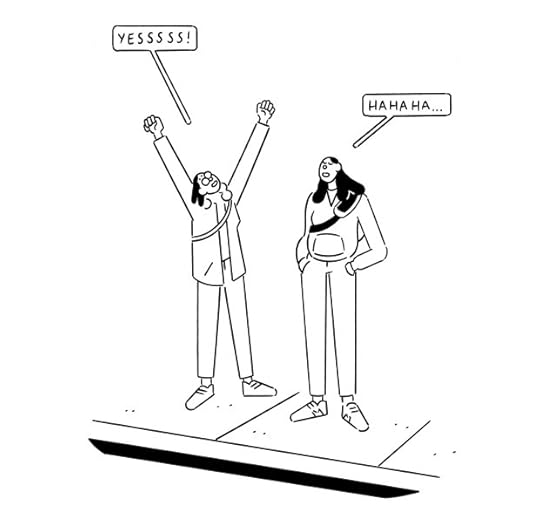
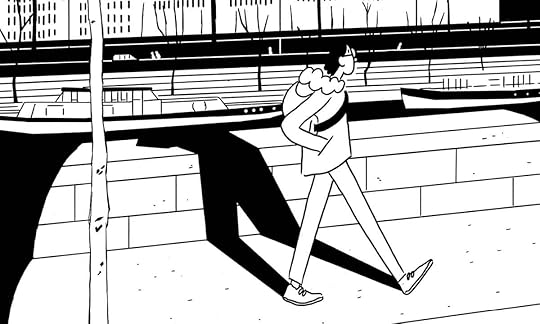
For me, the art was not much better than the story. Not very much dialogue and the images don’t do that great of a job conveying a story without words. Each of the characters kind of look the same, so it was a bit hard to tell who was who. You have to look for subtle clues – slightly different hairstyle/hair color, glasses, black dots for freckles/pimples, etc. Sometimes I have read blah graphic novels but the cool imagery made up for it. That did not happen here.
[image error]
Unfortunately, I cannot recommend this to anyone simply for the same reason I would not tell you to go and sit and wait for a bus if you have nowhere to go: it would be boring and pointless.
Have you read a book or seen a movie where the focus of the story is a romp across Europe? Seems like there have been a series of comedies and romances over the past 20 years with the many countries of Europe as their setting. Imagine those stories, but with no humor or interesting dialogue and you have The Contradictions. Seriously, it is just two or three characters wandering about Europe looking for something to do and not having much success. The main characters are blah, the people they meet are blah. I kept figuring there would be some big climax to make it all worth it, but (SPOILER ALERT) there is not.
For me, the art was not much better than the story. Not very much dialogue and the images don’t do that great of a job conveying a story without words. Each of the characters kind of look the same, so it was a bit hard to tell who was who. You have to look for subtle clues – slightly different hairstyle/hair color, glasses, black dots for freckles/pimples, etc. Sometimes I have read blah graphic novels but the cool imagery made up for it. That did not happen here.
[image error]
Unfortunately, I cannot recommend this to anyone simply for the same reason I would not tell you to go and sit and wait for a bus if you have nowhere to go: it would be boring and pointless.

May 3, 2022
Sophie goes to Europe and is seduced by an anarchist/shoplifting poser. Hey, I also went to Europe with a backpack, Europe on $10 a Day, and a Eurail Pass. If we see this as poking a bit of fun at her younger self, this is likeable, but it is not "a masterpiece" as someone who writes masterpieces herself, Alison Bechdel, proclaims it. It is a mildly entertaining tale with characters we can't relate to, really, though the artwork is really terrific, better by far than I have seen from her. Now I await her using these art chops to apply to a truly engaging tale she really needs to tell.

January 28, 2022
The Contradictions is Sophie Yanow's memoir-in-comics about a semester she spent in Paris when she was twenty years old. There she meets Zena, a fellow student and an "anarchist" whose political beliefs seem to manifest mostly in shoplifting and sponging off other people for everything she needs in life. Sophie and Zena decide to go to Berlin for their school break, but because they don't have any money and Zena is an "anarchist," they hitchhike rather than traveling by train or plane. In addition to dealing with the hazards of hitchhiking, Sophie, who seems to have a crush on Zena, has to deal with the fact that although the two young women have ostensibly similar political views, the ways those views play out in their lives and personalities are very different.
Sounds interesting, no? It sounded interesting to me, and it took me a while to figure out why I was underwhelmed. Oftentimes in memoirs-in-comics, the author is not just a character in the book but also the narrator, filling in the blanks and explaining, with the value of hindsight, what she was thinking and feeling at the time. If done well, this can be both effective and affecting. The Contradictions employs no such narrative technique, which means all the work of the story must be done by the characters' words and actions as well as the art. The problem is, a lot is left unsaid in this book, and the art just isn't very expressive. Sophie in particular wears glasses that hide much of her face, and her eyes are just pinpricks hovering above them, so as a reader you're constantly trying to guess what she truly thinks and feels. Ultimately, it's very hard to feel a connection to her. The end result is that I was entertained by The Contradictions but I just don't really feel much about it.
Sounds interesting, no? It sounded interesting to me, and it took me a while to figure out why I was underwhelmed. Oftentimes in memoirs-in-comics, the author is not just a character in the book but also the narrator, filling in the blanks and explaining, with the value of hindsight, what she was thinking and feeling at the time. If done well, this can be both effective and affecting. The Contradictions employs no such narrative technique, which means all the work of the story must be done by the characters' words and actions as well as the art. The problem is, a lot is left unsaid in this book, and the art just isn't very expressive. Sophie in particular wears glasses that hide much of her face, and her eyes are just pinpricks hovering above them, so as a reader you're constantly trying to guess what she truly thinks and feels. Ultimately, it's very hard to feel a connection to her. The end result is that I was entertained by The Contradictions but I just don't really feel much about it.

June 15, 2024
At age twenty, after a bad breakup, the author signed up for a study abroad program in Paris. Lonely and soul searching in a foreign country, Yanow spots a girl riding a fixed gear bike. Yanow is a committed bicyclist and chases the girl down to learn she is also an exchange student, also recently broken up with, a committed anarchist and a shoplifter. Yanow and her new friend decide to take a poorly planned trip to Amsterdam, intending to hitchhike the whole way. About as many things go wrong as you might expect. In beautifully minimalist black and white panels, Yanow perfectly captures the naivete and first political awakenings of a young college student trying to seem cool and so taking risks and hiding passions in order to impress someone new. A quick read and a master class in understatement.

July 9, 2021
The premise of this book, which is what got me to pick it up from my local library is:
"The Eisner awards-winning story about a student figuring out radical politics in a messy world full of contradictions"
They had me at radical politics and contradictions, however it lacks SO MUCH of that. The radical politics were only found in two characters that shared they were anarchist and vegan and one who said he was a communist. Wow, SO RADICAL! I honestly read it because I wanted to see if it could deliver the "award-winning" content. However, the only thing this book accomplished was to remind me that if people can publish trash like this, I can publish ANYTHING.
The authors takes 4 pages to tell me she woke up, used a bike that broke and went back to sleep. TAHT'S ALL. There are also many other pages wasted on showing the characters with signs waiting to be picked up and given a ride across Europe. We are already know you are hitchhiking, you don't need to spend multiple pages of your characters just standing there with a sign. This book could have been at least 80 pages shorter and saved us a lot of time - and paper.
In terms of the story line, I find it very difficult to connect with Sophie. I felt as she was very entitled and yet expect to remove herself from capitalism by being vegan and shoplifting (?) She has parents who support her dreams of traveling and going abroad to the point she didn't even know if she was studying abroad ON A LOAN OR OUT OF HER OWN POCKET! It is mind-blowing to me that at your 20s you aren't even aware of your own financial aid, but you want to so desperately disconnect from a capitalistic society while your parents handle all your finances...
The story line is boring, there's no reason why anyone should read this book, unless they want to waste their time. At some point Sophie decides to eat mushrooms and I was expecting the author to take this on another level an experiment with her art, instead she just draws a plant growing a little and shaking here and there. It was such a waste of a mushroom trip if that's all you were able to draw.
I will end it here as I feel like at this point I am bashing this book, but honestly... I finished it hoping to see where the award winning material was going to make an entrance and it never did.
"The Eisner awards-winning story about a student figuring out radical politics in a messy world full of contradictions"
They had me at radical politics and contradictions, however it lacks SO MUCH of that. The radical politics were only found in two characters that shared they were anarchist and vegan and one who said he was a communist. Wow, SO RADICAL! I honestly read it because I wanted to see if it could deliver the "award-winning" content. However, the only thing this book accomplished was to remind me that if people can publish trash like this, I can publish ANYTHING.
The authors takes 4 pages to tell me she woke up, used a bike that broke and went back to sleep. TAHT'S ALL. There are also many other pages wasted on showing the characters with signs waiting to be picked up and given a ride across Europe. We are already know you are hitchhiking, you don't need to spend multiple pages of your characters just standing there with a sign. This book could have been at least 80 pages shorter and saved us a lot of time - and paper.
In terms of the story line, I find it very difficult to connect with Sophie. I felt as she was very entitled and yet expect to remove herself from capitalism by being vegan and shoplifting (?) She has parents who support her dreams of traveling and going abroad to the point she didn't even know if she was studying abroad ON A LOAN OR OUT OF HER OWN POCKET! It is mind-blowing to me that at your 20s you aren't even aware of your own financial aid, but you want to so desperately disconnect from a capitalistic society while your parents handle all your finances...
The story line is boring, there's no reason why anyone should read this book, unless they want to waste their time. At some point Sophie decides to eat mushrooms and I was expecting the author to take this on another level an experiment with her art, instead she just draws a plant growing a little and shaking here and there. It was such a waste of a mushroom trip if that's all you were able to draw.
I will end it here as I feel like at this point I am bashing this book, but honestly... I finished it hoping to see where the award winning material was going to make an entrance and it never did.

January 4, 2021
A feckless American college student studying abroad in Paris finds herself crushing on an anarchist poser and ditches her friend to follow the hot girl on a hitchhiking adventure across Europe. I found myself disliking the book for quite a while, until I realized I was looking at it through the disapproving lens of a father with a daughter the same age as the author. Once I reflected on how I felt at 20, her actions become more understandable. The ending helped solidify my turnaround.

September 7, 2020
I loved the art in this graphic memoir, with its stark black and white, clean lines, and tendency to zoom in on only the details necessary for that moment. It's about the author's time in western Europe hitchhiking around with a new anarchist friend Zena. She's just learning about radical politics and is drawn into this often sulky but charismatic woman's passion.
There were a few moments that really struck me, and brought me back to that time in my life, when I first really learned about and felt viscerally the injustices in the world. High on mushrooms in Amsterdam, Sophie wonders "Is anyone really happy again once they realize how messed up the world is? Are my parents happy? How do you forget about all the bad stuff?"
Overall, though, I wanted a bit more meaning and emotional resonance brought to the events. I felt like Sophie's perspective on what was happening and the sometimes fundamentalist things her new friend said needed to be more explicit, so it would help me orient my own point of virw.
Admittedly, my perspective was sometimes a middle class 35-year-old who did some eyerolling at the judgemental, preachy vegan and anarchist stuff coming out of Zena's mouth, especially when she did selfish things that negatively impacted others, like trying to skip out on rent that she shared with a roommate. At the same time, I remember how feeling so self-righteous and sure comes from a place of youthful ignorance and truly believing this is the best way to fight injustice. This book made me think about that stuff, but didn't really address it itself, which is what I wanted it to do!
There were a few moments that really struck me, and brought me back to that time in my life, when I first really learned about and felt viscerally the injustices in the world. High on mushrooms in Amsterdam, Sophie wonders "Is anyone really happy again once they realize how messed up the world is? Are my parents happy? How do you forget about all the bad stuff?"
Overall, though, I wanted a bit more meaning and emotional resonance brought to the events. I felt like Sophie's perspective on what was happening and the sometimes fundamentalist things her new friend said needed to be more explicit, so it would help me orient my own point of virw.
Admittedly, my perspective was sometimes a middle class 35-year-old who did some eyerolling at the judgemental, preachy vegan and anarchist stuff coming out of Zena's mouth, especially when she did selfish things that negatively impacted others, like trying to skip out on rent that she shared with a roommate. At the same time, I remember how feeling so self-righteous and sure comes from a place of youthful ignorance and truly believing this is the best way to fight injustice. This book made me think about that stuff, but didn't really address it itself, which is what I wanted it to do!

September 24, 2021
Very simple drawings in black and white; very realistic depictions of the struggles of youth grappling with idealism in the real world. The writing has depth, capturing moments of conflict, indecision, anxiety. There was not much of a story, unless the journey itself —the aimlessness— is the story.
The last graphic novel I read (American Terrorist) was over-the-top thriller/drama, whereas this one was very realistic, yet their themes overlapped, as books tend to do when read back to back. The plight of activists and idealists, the betrayal of capitalism, the pursuit of ethical purity — all these issues are very much in the forefront of youth exploring the boundary between being naive and becoming cynical.
The Contradictions, as announced by the title, raises questions about ethics: for example, one of the characters is a compulsive shoplifter. Education is "good" but the crippling burden of massive student loans is "bad." Is beer vegan? What are the acceptable limits of anarchy?
So—moments rather than story. Characters hard to tell apart. Frustrating stupidity mixed with charming optimism. Issues raised and left hanging in the air, because . . . because perhaps there are no real answers. Maybe when high, for a moment, on magic mushrooms, clarity does achieve perfection, but it doesn't last.
3.5 rounded up because Alison Bechdel says it is a masterpiece.
The last graphic novel I read (American Terrorist) was over-the-top thriller/drama, whereas this one was very realistic, yet their themes overlapped, as books tend to do when read back to back. The plight of activists and idealists, the betrayal of capitalism, the pursuit of ethical purity — all these issues are very much in the forefront of youth exploring the boundary between being naive and becoming cynical.
The Contradictions, as announced by the title, raises questions about ethics: for example, one of the characters is a compulsive shoplifter. Education is "good" but the crippling burden of massive student loans is "bad." Is beer vegan? What are the acceptable limits of anarchy?
So—moments rather than story. Characters hard to tell apart. Frustrating stupidity mixed with charming optimism. Issues raised and left hanging in the air, because . . . because perhaps there are no real answers. Maybe when high, for a moment, on magic mushrooms, clarity does achieve perfection, but it doesn't last.
3.5 rounded up because Alison Bechdel says it is a masterpiece.

June 6, 2021
Book blurb: The Eisner Award–winning story about a student figuring out radical politics in a messy world. Sophie is young and queer and into feminist theory. She decides to study abroad, choosing Paris for no firm reason beyond liking French comics. Feeling a bit lonely and out of place, she’s desperate for community and a sense of belonging.
I liked the sketchy illustration style, and how well it evoked the sense of rootlessness it conveyed. However, I simply could not get into this graphic memoir, and DNFed it. It's probably a function of my age - sometimes New Adult books grate on my nerves. I found myself not caring, and finally bailed.
I liked the sketchy illustration style, and how well it evoked the sense of rootlessness it conveyed. However, I simply could not get into this graphic memoir, and DNFed it. It's probably a function of my age - sometimes New Adult books grate on my nerves. I found myself not caring, and finally bailed.

June 20, 2020
Excellent coming-of-age fictionalized auto-bio from this uniquely smart and talented creator. My little Q&A with her is now up on Publisher's Weekly: https://bit.ly/300AiBO

October 16, 2020
Painful cause it real
Read
November 20, 2020Slightly mixed feelings on this one - while I was reading it, I found it fairly dull, and the stark/minimalist artwork was challenging (it took me a few pages to get the hang of the lines over the main character's glasses being her eyes rather than eyebrows, which was a first for me in reading graphic novels). A lot of the attitudes of the characters felt juvenile as they encountered anarchism, Marxism, veganism, and other theories and practices. While it felt like nothing really happened, as the book sits with me, I think more about the subtle introduction of themes, including theft (and a personal vs corporate level), ownership, gender, and privilege. Also, the penultimate scene where she was genius and hilarious. So may I liked this book more than I thought?

December 16, 2021
Art student abroad in Paris graphic memoir. Does not follow the stereotypical trajectory of an “artist in Paris” memoir. Describes hitchhiking as a very boring, but when someone stops for you “it feels like you’re winning a game.” Explores the limits of individual acts of rebellion against capitalism, especially in the context of hitchhiking during a school break. Towards the end, Yanow says (while hungry) “if individual acts of rebellion are the path to revolution, then we suck at revolution” to which her anarchist travelling companion says “even if that were true, I don’t think every act can be an act of rebellion.” I like the art style, especially the characters.
December 26, 2020
I really liked this book, the drawings are really crisp and the page formatting was clever.
Feels like a perfect journal, I really love the quiet moments in here as well. There's something really nice about seeing a character drawing in a drawn piece of media that grounds the work really well for me.
all in all really big fan of this!
Feels like a perfect journal, I really love the quiet moments in here as well. There's something really nice about seeing a character drawing in a drawn piece of media that grounds the work really well for me.
all in all really big fan of this!

October 15, 2024
I liked the art and I can't decide if I didn't enjoy this because it's too painfully relatable or not? I think there should have been more of why the main character was attracted to the anarchist to understand why she'd like her? Because the anarchist was so obviously not cool from the start...

December 6, 2024
Zena est insupp

April 12, 2025
I have so many questions about this book. First of all, some highlights: i love the anarchist vegan year abroad vibes and really relate to hitchhiking around Europe. I’ve wanted to read Yanow’s work since I understood she was in charge of consignment books at a comic book store in berkeley. I forget which one. I love the clean line bandee designee Tin Tin or Joost Swarte style. I love the consistency of the figures. Anyway questions: how did Yanow repeat the backgrounds so consistently? Did they use tracing paper or a photocopier or move more modern technology like photoshop? It creates such a powerful non-compressed sense of time in the story, such as pauses between responses in a conversation. Characters almost never speak and respond in the same panel. It’s pretty amazing how much this slows the reader down and forces a realistic sense of time. It’s not all about compressing the most information into the least space, but about art and time and space and life and awkward foreign exchange vibes, new friends and language barriers. Lastly, is the band Japanther?
April 1, 2021
I really liked this! The art is lovely, and hoo boy did I feel really seen with a lot of the main character's behaviors. Really fun read about growth as a young person.

February 9, 2021
In this short, perhaps semi-autobiographical comic, cartoonist Sophie Yanow focuses on an aimless few weeks in the undergraduate Parisian study abroad experience of twenty-year-old Sophie, as she follows Zena, a fellow American anarchist on a hitchhiking tour of Europe. Based on the lack of smartphones, obsession with fixies, and references to the economy, it seems to be sometime around 2008. Yanow’s art, spare and stark, really fits the mood of the piece, an uncertain but distinct time and place.
Nothing really happens throughout the comic aside from pretentious conversations about how shoplifting subverts capitalism, some mild drug use, and standing around waiting for rides by convenience stores, so all in all, it felt really true to life to me. Though the political elements are left understated, I feel that Yanow really captures that feeling of not really knowing what to believe yet, but being sure that it is something new and radical and that you have to prove your commitment to your peers without really knowing how.
Most of all, Sophie’s feelings of being an “other” even before her European voyage, her isolation and self-doubt as she attaches herself to the rather unpleasant Zena, who it feels unclear even likes Sophie or is simply letting her tag along because no one else really tolerates her came through really strongly. Something about Z’s blase confidence draws in Sophie, if only as a way to challenge herself to become more adventurous, more spontaneous. The Contradictions is just such a powerful slice of that distinct, privileged college student experience I felt as if I knew some of these characters, and felt jealous that I never was able to do the whole study abroad thing.
Nothing really happens throughout the comic aside from pretentious conversations about how shoplifting subverts capitalism, some mild drug use, and standing around waiting for rides by convenience stores, so all in all, it felt really true to life to me. Though the political elements are left understated, I feel that Yanow really captures that feeling of not really knowing what to believe yet, but being sure that it is something new and radical and that you have to prove your commitment to your peers without really knowing how.
Most of all, Sophie’s feelings of being an “other” even before her European voyage, her isolation and self-doubt as she attaches herself to the rather unpleasant Zena, who it feels unclear even likes Sophie or is simply letting her tag along because no one else really tolerates her came through really strongly. Something about Z’s blase confidence draws in Sophie, if only as a way to challenge herself to become more adventurous, more spontaneous. The Contradictions is just such a powerful slice of that distinct, privileged college student experience I felt as if I knew some of these characters, and felt jealous that I never was able to do the whole study abroad thing.

September 20, 2020
I finished Sophie Yanow’s graphic novel _The Contradictions_ yesterday. It’s a story about a twenty year old American woman in Paris on in a study abroad context. She meets a woman who’s an anarchist, and they have an adventure. It’s so carefully understated, so simply phrased, and similarly drawn, so that nothing extraneous distracts from the pregnancy of interpretation. Each statement could be read a few ways, and the hints from facial expressions guide but a little. I like this. The page fades and you fall into the scenarios, the little unstated tensions playing themselves out here and there. The frustration of being young and newly aware of your place in a society you did not shape or opt into, the nascent hope of a better world even while you haven’t fully grappled with the complexities those possible worlds bring, all piled into the newness of a different place and the endless possibility of a new friendship, or something more. Negotiating norms alongside desire, plumbing comfort and stress side by side. All this comes through in simple black and white drawings of gangly folks whose understated facial expressions provide just enough of a glimpse into the oceans beneath that it seems more real than photographs. I liked it and recommend it.

March 27, 2021
Semi-biographical twenty-year-old meanderings in Europe. Plenty of angst. Plenty of "am I a communist? or an anarchist? or something else?" Plenty of vague longing. If any of that sounds appealing, you'll love The Contradictions.
I was never quite enamored, but was interested enough to read it in one sitting. Yanow is the main and most interesting character, wrestling with her desire for an anarchist girl and her interest in actually taking in Europe's sights. The anarchist girl's only interest is disinterest, which is deeply unappealing. At least the series of dangerous/bad decisions that the two girls make never truly turn out poorly. But that might also be why the book is lacking any spice.
I was never quite enamored, but was interested enough to read it in one sitting. Yanow is the main and most interesting character, wrestling with her desire for an anarchist girl and her interest in actually taking in Europe's sights. The anarchist girl's only interest is disinterest, which is deeply unappealing. At least the series of dangerous/bad decisions that the two girls make never truly turn out poorly. But that might also be why the book is lacking any spice.

January 31, 2021
The moment I read about the book, I desperately wanted a copy. I knew I would be able to relate. And after reading it, Sophie did remind me of what it felt like to be young and lost and eager to take on the world. Wish I could have read this around the time I discovered graphic novels thru Ghost World back in college. If only it had been written then. 💖✨ 🤣 And yes, there’s never enough time for Berlin! I would love to live there.

October 12, 2020
a book about that specific kind of person who just discovered anarchism and now thinks they're like, super radical, so they start shoplifting and hitchhike around europe and go vegan for a week, but also they're studying abroad in paris and can ask their parents for money when their wallet is stolen

February 15, 2023
Seldom do I give 1 star to books here. I give a lot of thought to what I choose to read and try to be generous with my consideration. But this comic just wasn't for me. I wasn't a big fan of the sparse art style with indistinguishable characters and little authorial voice. More than a little bland. Even now, two days later, I can't think of a single thing I liked about it!
September 19, 2020
So so so soooo good and relevant
January 12, 2021
I almost didn't pick this one back up after I first sat down with it; the end made me like it more in retrospect than I did on first read.
As an adult human with my life experience, I enjoyed this book and would recommend it to others because it's kind of novel. I've honestly never seen in a mass-published graphic that has a character like Zena. Reading about hitchhiking across Europe in a time that I can't even leave my house to go for a walk without a mask was pretty exhilarating. I was in Europe during the same time period as this (autobiographical?) vignette, and the dialogue between Americans and Europeans or expats at that time was SPOT ON.
As a school librarian ... I think this one may be a tough sell. Is there a contingency of kids out there that want to hang on for a slowburn exploration of the implications and contradictions of anarchism long enough to see that the author is showing them that holding onto particular ideals too steadfast can be blinding and they were mayyybe supposed to think it was funny? Maybe after the year they've had, but I doubt it. A lot of HS readers will struggle to connect with the story just due to unfamiliarity with anarchism, veganism, and that weird period of life between 18 and 23 where you're dipping your toes into different identities and being briefly infatuated with humans because of a first impression that turns out to have been a carefully constructed pitch. The narrative structure is more of an ambling journey than an arc which I really enjoyed in this particular instance, but may not appeal to many kids, especially since it starts off verrrrry slowly to make space for a lot of character development. There is no big moment that the story moves toward; the moment you think will be the climax is actually a huge disappointment for Sophie. Again, feeling true to form for the 19-23 experience, IMHO. Intriguing JLG pick ...
As an adult human with my life experience, I enjoyed this book and would recommend it to others because it's kind of novel. I've honestly never seen in a mass-published graphic that has a character like Zena. Reading about hitchhiking across Europe in a time that I can't even leave my house to go for a walk without a mask was pretty exhilarating. I was in Europe during the same time period as this (autobiographical?) vignette, and the dialogue between Americans and Europeans or expats at that time was SPOT ON.
As a school librarian ... I think this one may be a tough sell. Is there a contingency of kids out there that want to hang on for a slowburn exploration of the implications and contradictions of anarchism long enough to see that the author is showing them that holding onto particular ideals too steadfast can be blinding and they were mayyybe supposed to think it was funny? Maybe after the year they've had, but I doubt it. A lot of HS readers will struggle to connect with the story just due to unfamiliarity with anarchism, veganism, and that weird period of life between 18 and 23 where you're dipping your toes into different identities and being briefly infatuated with humans because of a first impression that turns out to have been a carefully constructed pitch. The narrative structure is more of an ambling journey than an arc which I really enjoyed in this particular instance, but may not appeal to many kids, especially since it starts off verrrrry slowly to make space for a lot of character development. There is no big moment that the story moves toward; the moment you think will be the climax is actually a huge disappointment for Sophie. Again, feeling true to form for the 19-23 experience, IMHO. Intriguing JLG pick ...

Read
September 9, 2024I dont know how to rate comic/ graphic novel. Too new for me. To make sense of something through such little words, only dialogue, ah. But i feel i feel. I feel about all the things i think and how life is so hard to figure out and live in a way that adds up to your values. And then to know what even are your values? And then i feel about all the things i think and how life is so beautiful and loving the changing and growing and contradictions are maybe precisely your values. Yeah this rlly is how life is. Sometimes u have to eat the cheeseburger at mcdonalds and sometimes u will steal from the french walmart and in between you will see the plants glow and dance and pass notes to your friends that say i love you.
Against all odds, this kind of made me want to travel. Or...start to think about it.
Against all odds, this kind of made me want to travel. Or...start to think about it.
Read
November 8, 2023I can't quite endorse all the superb blurbs and summaries of the text, though I understand their motives and sources. I found the book interesting enough to finish, but not as 'marvelous' as others have seemed to experience it. Maybe I'm too old, too conservative, too male to "get it." But the story of hitchhiking around Europe stealing when necessary, often motivated by "I don't know," just didn't rise to masterpiece level for me.

February 7, 2025
Oh man this was so uncomfortable! Insufferable assholes trying to impress each other while simultaneously doubting everything they do. Very white person coming of age. The art was very well suited to the text, very simplistic.

March 14, 2025
"Sophie, une Américaine queer et militante" euhhh... bah non pas militante du tout, sauf si le militantisme c'est être vaguement de gauche en école d'art ptdrr
et sinon vraiment pas ouf, g rien compris à la relation entre elles, c'est d'une froideur et d'un ennui sans nom
et sinon vraiment pas ouf, g rien compris à la relation entre elles, c'est d'une froideur et d'un ennui sans nom
Displaying 1 - 30 of 199 reviews