Jump to ratings and reviews
Rate this book

Our Enemies Will Vanish

Rate this book
A revelatory eyewitness account of Russia's invasion of Ukraine and heroism of the Ukrainian people in their resistance by Yaroslav Trofimov, the Ukrainian chief foreign-affairs correspondent for The Wall Street Journal.
"Our Enemies Will Vanish achieves the highest level of war reporting: a tough, detailed account that nevertheless reads like a great novel. One is reminded of Michael Herr's Dispatches... Frankly, it's what we have all aspired to. I did not really understand Ukraine until I read Trofimov's account." --Sebastian Junger

Since Russia invaded Ukraine in February 2022, Yaroslav Trofimov has spent months on end at the heart of the conflict, very often on its front lines. In this authoritative account, he traces the war's decisive moments--from the battle for Kyiv to more recently the gruelling and bloody arm wrestle involving the Wagner group over Bakhmut--to show how Ukraine and its allies have turned the tide against Russia, one of the world's great military powers, in a modern-day battle of David and Goliath. Putin had intended to conquer and annex Ukraine with a vicious blitzkrieg, redrawing the map of Europe in a few short weeks with seismic geopolitical consequences. But in the face of this existential threat, the Ukrainian people fought back, turning what looked like certain defeat into a great moral victory, even as the territorial battle continues to seesaw to this day. This is the story of the epic bravery of the Ukrainian people--people Trofimov knows very well.

For Trofimov, this war is deeply personal. He grew up in Kyiv and his family has lived there for generations. With deep empathy and local understanding, Trofimov tells the story of how everyday Ukrainian citizens--doctors, computer programmers, businesspeople, and schoolteachers--risked their lives and lost loved ones. He blends their brave and tragic stories with expert military analysis, providing unique insight into the thinking of Ukrainian leadership and mapping out the decisive stages of what has become a perilous war for Ukraine, the Putin regime, and indeed, the world.

This brutal, catastrophic struggle is unfolding on another continent, but the United States and its NATO allies have become deeply implicated. As the war drags on, it threatens to engulf the world. We cannot look away. At once heart-breaking and inspiring, Our Enemies Will Vanish is a riveting, vivid, and first-hand account of the Ukrainian refusal to surrender. It is the story of ordinary people fighting not just for their homes and their families but for justice and democracy itself.

Audible Audio

First published January 9, 2024

230 people are currently reading
3022 people want to read

About the author

Yaroslav Trofimov

4 books103 followers
Yaroslav Trofimov is the chief foreign-affairs correspondent of The Wall Street Journal and was a finalist for the Pulitzer Prize in international reporting for two consecutive years, in 2022 and 2023. Before covering the Russian war on Ukraine, he reported on most major conflicts of the past two decades, serving as the Journal’s bureau chief in Afghanistan and Pakistan and as a correspondent in Iraq. He holds an MA from New York University and is the author of two critically acclaimed books, Faith at War and The Siege of Mecca.

Ratings & Reviews

What do you think?
Rate this book

Friends & Following

Create a free account to discover what your friends think of this book!

Community Reviews

5 stars
528 (51%)
4 stars
395 (38%)
3 stars
96 (9%)
2 stars
5 (<1%)
1 star
6 (<1%)
Displaying 1 - 30 of 139 reviews
Profile Image for Matt.
1,052 reviews31.1k followers
March 1, 2024
“Cocky and confident, [Vladimir Putin] announced what he called a ‘special miliary operation.’ He declared his goal to ‘denazify and demilitarize’ Ukraine – denazification being a ludicrous euphemism for replacing the country’s elected Jewish president with a puppet of the Kremlin’s choosing. Ukraine and Russia, Putin added, should be a ‘common whole,’ and Ukrainian soldiers should lay down their arms instead of following orders of the criminal ‘junta’ in Kyiv. As for the West, any attempt to interfere and create obstacles for Russia, he threatened, would provoke an immediate response with ‘consequences you have never encountered in your history.’ Listening to Putin, I thought of the fallen capital cities I had seen over the past two decades: the innards of government buildings spilling onto sidewalks for everyone to see, portraits of rulers and cherished flags trampled in the dirt, as new masters pulled won hallowed statues and rode triumphantly through the streets. Would Kyiv, the city where I was born and had grown up, meet the same fate as Baghdad in 2003, as Tripoli in 2011? As Kabul in the summer of 2021, where I watched the American-trained Afghan National Army dissolve without much of a fight and go home? Putin’s entire invasion plan was premised on expectations that most Ukrainian soldiers would do just that…”
- Yaroslav Trofimov, Our Enemies Will Vanish: The Russian Invasion and Ukraine’s War of Independence

The twenty-first century has not – to put it mildly – gone according to plan. There has been terrorism and war, a worldwide recession, and a global pandemic. Each time it seems like things can’t get worse, they get worse.

And then, on the morning of February 24, 2022, Russian President Vladimir Putin launched the largest war in Europe since the largest war in history. Somehow, in this cursedly “interesting” period, nonexistent weapons of mass destruction are now only the second worst reason to start a war in the last twenty years.

***

Someday, the Russo-Ukrainian War will be a distant historical event people will read about in books gifted with the considered solemnity of time. Right now, though, it is still happening. As these words are typed and read, someone, somewhere in Ukraine, is facing the most consequential – or perhaps final – moment of their lives.

It is for this reason, the exposed-nerve rawness of it all, that I typically wait for the dust to settle before reading about the tumults of history. But I couldn’t resist. Like many others, I’ve been following the war online, via articles, videos, and tweets. Eventually, as my low-grade obsession deepened, I needed to know more.

That’s when I picked up Yaroslav Trofimov’s Our Enemies Will Vanish.

With a title taken from Ukraine’s national anthem, Our Enemies Will Vanish is a tale both dark and triumphant, told from the perspective of an underdog country facing off against a much larger invader. Ultimately, it is a very good book that suffers much from the lack of a satisfying ending.

***

In terms of scope, Our Enemies Will Vanish covers in some detail the period from the war’s first moments, to the 2022 Kharkiv offensive. After that, Trofimov closes with a wrap-up that brings us a bit closer to the present. Nevertheless, as discussed below, the war has changed a great deal since the final words of this volume were written.

***

Trofimov starts things off with an irresistible hook, taking us into Kyvi on the eve of destructions, a short, effective section that gives off strong Paris-in-the-Summer-of-1914 vibes. He then circles back to provide background on a war that actually started in 2014, but has roots that go back even further. While not super deep, it is enough to provide the necessary context, and to give interested readers a jumping off point for further study.

***

Once war commences, Trofimov tackles it in hybrid fashion.

Partly, this is a work of journalism spiced with memoir. Trofimov is a reporter and war correspondent employed by The Wall Street Journal. He also happens to be Ukrainian born, which gives him a special kind of access. Throughout, he provides first-person accounts of what he’s seen and experienced. This includes moving through dead cities; talking with soldiers both amateur and professional; living through cruise missile attacks; seeing the corpses scattered in roads and fields; and accompanying the Ukrainian resistance on their missions, at times coming under fire.

There are also a lot of gas station hotdogs.

Of course, Trofimov could not be everywhere, and so Our Enemies Will Vanish is also partly a standard history told from the third person, narrating the battles at the Kyvi airports, the famous standoff on Snake Island, the initial Russian failures, followed by meat-grinder battles such as in Bakhmut.

Throughout, we are introduced to political leaders, fighting men and women, and the civilians caught in the middle. Especially impressive is his evocation of the contested regions of Ukraine, with their sharply divided loyalties.

***

Trofimov is not quite as good a writer as Rick Atkinson, who wrote about the First Gulf War in Crusade, or Mark Bowden, who gave us the modern war classic Black Hawk Down. Still, there are some gripping sequences that capture the speed, arbitrariness, and lethality of high-tech conflicts. There is an especially good chapter on the introduction of the M142 High Mobility Artillery Rocket System – the now-famous HIMARS – and how that changed the battlefield. If anything, I wish that Trofimov had spent more time on the various capabilities of the weapons being deployed, especially since Ukraine – which is badly outnumbered – will have to fight smarter in order to survive.

***

This is not a military history, but Trofimov gives you some sense of the competing strategies at play, from both the Russian and Ukrainian sides. With regard to Ukraine, you see the first inkling of what has become a larger problem: a refusal to trade space for time, which had led to Ukrainian forces defending indefensible positions, an attritional tactic that seems unsustainable.

Obviously, given Trofimov’s national origin, this is not a strictly objective book. That said, objectivity itself is subjective. Stories have many sides, but not all sides have equal value or factual support. In this instance, Russia is clearly the aggressor, and thousands of milbloggers can’t change this immutable truth simply by saying otherwise. It is woven into the fabric of the universe.

To his credit, though, Trofimov is willing to show the visible seams in Ukraine’s defense. There is an affecting scene at a training camp in which he talks to a couple Ukrainian’s conscripted for service who just want to go home. He also empathizes with ordinary Russian soldiers far from home. Like most soldiers in most wars, their only true victory is to escape death.

***

For as good as it is, Our Enemies Will Vanish faces a unique challenge.

The Russo-Ukrainian War is probably the most thoroughly documented event ever. If you were able to collect all the cellphone pictures and videos, drone footage, gun camera captures, and news reportage, you could probably provide moving images for every hour of the war.

As part of my extra-credit for this book, I watched the Frontline documentary 20 Days in Mariupol. It is – as many critics have noted – almost too potent. At one point, during an unforgettable few minutes, its unflinching camera follows a little girl into a hospital operating room. Doctors start cutting off her clothes, and giving her oxygen, but she dies right there, on the screen, while the doctor screams at the cameraman to keep filming. Before you can start to fathom what you’ve just seen, a little boy is wheeled in. This time you see his tiny arms flop as the defibrillator paddles try to jolt his heart back. They don’t, and he – too – dies before your eyes.

This act of witness cannot possibly be matched by a book, no matter how well executed. It will therefore be interesting, in the future, to see how histories rely on, integrate, and compete with this new evidence.

***

As I mentioned up top, Our Enemies Will Vanish cannot give us the catharsis of an ending. This is not a first draft of history; it is an unfinished manuscript. The thing is still happening, and trying to capture it in book-form is like attempting to make an oil painting of a puppy that has just ingested methamphetamines.

When Trofimov closes, he is rather sanguine, even though he notes the failure of the much publicized 2023 offensive. Since then, things have gotten much worse for Ukraine, such that comparisons to the Russo-Finnish War start to feel uncomfortably apt.

In the United States, for instance, the two major political parties have flip-flopped so dramatically that it is unclear whether Ukraine will get any further support. Republicans – who spent decades during the Cold War hunting Soviet sympathizers, and another decade trying to out-Ronald Reagan each other – have suddenly found sympathy, even admiration, for Russia and its leader. Meanwhile, Democrats – who have mostly ceded foreign policy to their opponents since the catastrophe of Vietnam – are suddenly trying to project power in ways not seen in the party since Franklin Roosevelt. It is all super confusing, and future generations will have a lot to unpack. Here, however, it goes undiscussed.

Beyond that, the military situation has deteriorated for Ukraine. Russia has regrouped and is on the offensive. A hero of Our Enemies Will Vanish – General Valerii Zaluzhnyi – has been replaced, and it is not entirely clear it was for sound reasons. There is also the ongoing debate about Ukrainian operational objectives, and whether they’re better served on the offensive or defensive.

This is not to say the war is lost, because it is no small thing to simply conquer and occupy an entire nation. Ask the Americans. In fact, ask the Russians. It didn’t work out in Afghanistan – for either country – and the Afghanis did not have HIMARS, M1A1 Abrams tanks, or cheap commercial drones that have turned out to be really good at destroying far more expensive pieces of hardware.

Still, we just don’t know, and the not knowing makes for a frustrating experience, even though that is not the fault of the book itself.

***

There is a widely known saying: A wide road leads to war; a narrow path goes back home. That’s about where we’re at with the Russo-Ukrainian War. With every drop of blood spilled, that path washes away a little bit more.
Profile Image for Ярослава.
971 reviews927 followers
Read
February 28, 2024
This is a good overview of roughly the first year of the full-scale invasion. If you've spent this time glued to the news, you probably won't find much new information here, but it's thorough, with a nice balance between bird's-eye and frog's-eye view of the events, and a good sense of the absurd to balance out the tragic. Take, for example, this description of the aftermath of HIMARS strikes on the Antonov bridge in the then-occupied Kherson:

Kirill Stremousov, the former antivaccine blogger who now served as deputy head of the Russian occupation administration, visited the site to record the damage for Russia’s TASS news agency. “The bridge is intact for now. It’s not really a problem, we will fix it soon,” he said, walking by the burning grass as panicked Russian soldiers ran behind him.
In fact, it was going to become a very big problem.

What the book doesn't aim to do is provide a historical context for the events, so if that's what you are after, this probably shouldn't be your first pick.

(If you speak Ukrainian, don't get the audiobook: the reader, the poor soul, cannot pronounce a Ukrainian name to save his life. Святослав becomes ЗвайОдослав, Білогорівка turns into БілорІвка, etc., etc., and in many cases, I just couldn't recognize the name at all.)
24 reviews7 followers
January 16, 2024
Over the last week I was reliving 2022 with Yaroslav Trofimov’s latest book Our Enemies Will Vanish @yarotrof.

My grandfather, a man who only briefly saw combat in the World War Two (he was a forced laborer in Germany for most of it before briefly joining French resistance), would only read books about the war. He had a high stack of Soviet military memoirs on his night stand. My other grandfather, a veteran who fought at Stalingrad, had no such urge. I haven’t been in Ukraine in 2022. I think I am destined to forever read about this year in Ukraine.

2022 was a very traumatic experience for me, my family, most of my friends. Twenty minutes after Putin speech I was on a phone planning next morning rally in NYU with my @razom.for.ukraine crowd, two days later we were staying late in the office, answering news organizations, donors, thinking of ways to help while also calling our friends and relatives (in my case it was 95 year old grandmother still living in Kyiv). For months after, we processed donations, bought tacmed, equipment, developed a grant program supporting people in the front lines, etc etc. And during all of this we constantly scrolled through telegram channels reading the news. We were entrenched without being there physically. There was not that much new information for me in Yaroslav Trofimov’s book, but somehow reliving it through his eyes, celebrating resilience and victories of the first year of the war, had been very therapeutic. 2023 was in some ways a much harder year when we learned to live with this war present, finally saw apathy and resistance from Americans who were just so supportive and enthusiastic a year before, and, for me personally, it was also a year of the first personal loss of this war. The mood right now is rather grim. But his book makes me remember that the war is already won. Russia lost. Ukraine survived and russia was thoroughly humiliated. If only someone on the russian side was brave enough to accept this truth and to stop this madness. If only…

@yarotrof is WSJ chief foreign correspondent who previously covered Middle East, including America’s retreat from Afghanistan. He was also born in Kyiv, so this war was far more personal. This is a great book. It is detailed without being overly embellished, it chronicles what happened while also providing a lot of personal perspectives. Trofimov criss crossed the country and visited the most important battles and the hardest areas. He was in Kyiv in February, he was in areas shortly after liberation, he was in Bahmut. There are episodes of sheer madness of this war that he personally encountered.

20 days in Mariupol, a documentary movie by Mstislav Chernov is a similarly direct journalistic account of what happened in just one city. I have watched it twice already. Watching these accounts, reading them, helps us to keep our anger (лють) alive. Our enemies will indeed vanish, if we never forget.
Profile Image for Jolanta (knygupė).
1,271 reviews232 followers
January 27, 2024
Puiki dokumentika apie karą vykstantį Ukrainoj. Asmeniškai aš nesužinojau beveik nieko naujo, bet ir ne man ši knyga skirta. Ji tiems - kas pastoviai neseka žinių.
4,5*
Profile Image for Cav.
907 reviews205 followers
February 29, 2024
"On the sunny afternoon of February 23, 2022, Kyiv was still a city at peace... "

Our Enemies Will Vanish was an excellent albeit sobering look into the horrors of the modern-day war in Ukraine. The book gets its namesake - Our Enemies Will Vanish - from the lyrics of the Ukrainian National Anthem, which continues: "...Like dew at sunrise, And we, oh brothers, will become the masters once again, Of our own land..."

To avoid the absolute shitstorm around the politics of this war, and for the scope of this review, I will avoid any personal commentary about the war, and foreign involvement or funding of it; in general.

Author Yaroslav Trofimov is a Ukrainian-born Italian writer and journalist who serves as chief foreign-affairs correspondent at The Wall Street Journal.

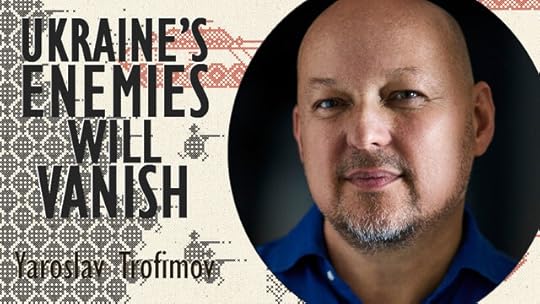
Yaroslav Trofimov:
maxresdefault

Trofimov writes the book from a first-hand perspective, as he was in Ukraine when the war broke out. He has an excellent writing style, and the book is very readable. He mentions that leading up to the war, most Ukrainians went about their daily lives; seemingly oblivious to the impending storm.

The author also manages to introduce the reader to all the relevant players in a very effective fashion. He did a great overall job of telling the big picture here. Along the way, he intersplices ground-level stories from his time spent in the war zone. The end of the book includes a dozen or so photos from the author, which really helped bring some context to the story told here. I'm including a few of them here, for anyone else interested.

The book gets off on a good foot, with a lively intro that provided a lot of historical context.
I also felt that it had great formatting. The narrative proceeds in a chronological from the start of hostilities. The writing is also broken up into well-defined chapters, and the book has an excellent flow. I am admittedly super-picky about how engaging the book I read are, and this one really nailed it here. Bonus points added for this super-effective communication.

The book opens with the quote at the start of this review, which continues below:
"...As I walked up the steep hill into the Pechersk government quarter, municipal workers put up billboards advertising upcoming concerts. Cherry-liquor bars, a favorite of young Kyivites, were already full, with folk-rock music blasting. Parents took photos of their children enjoying pony rides around the park. In the domed parliament building, Ukrainian lawmakers gathered to debate emergency wartime legislation.
A few blocks away, I was meeting with President Volodymyr Zelensky’s predecessor and one of the main leaders of the Ukrainian opposition, Petro Poroshenko. A chocolate-industry tycoon who had badly lost the 2019 election, Poroshenko was battling corruption charges that he decried as politically motivated. He had just been barred by the courts from traveling outside the Kyiv region. Our meeting had originally been scheduled for later in the week, but I had received a call: “Come right away.”
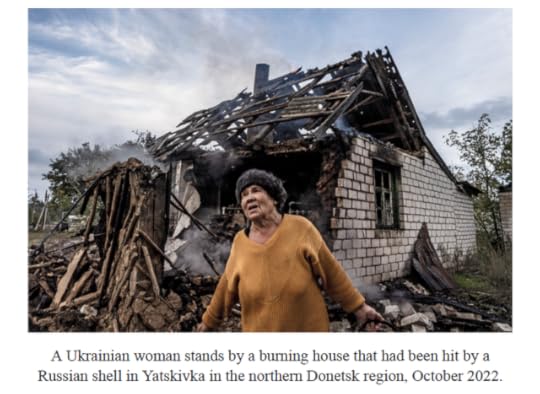
Although the book was a real page-turner, make no mistake; the subject matter is absolutely brutal and terrible. War is hell. Many of the stories told in these pages lie well beyond the imagination of the average pampered Western reader, most of whom have likely never even missed a meal in their lives. Accordingly, I would bet that many (even most?) people who read this book will be downright horrified at some of the first-hand stories recounted here. Some of them were completely gut-wrenching, TBH.
Screenshot-2024-02-28-145207

Tensions between Ukraine and Russia have deep roots. Stalin famously starved the country in 1932-33 in one of the worst man-made famines in history, resulting in some ~5 million deaths. The history between these two nations is incredibly complex. At the heart of the war is Putin's view of Ukraine as part of Russia.
Trofimov writes:
"...The same month, Putin published a lengthy treatise called “On the Historical Unity of the Russians and Ukrainians,” in which he argued that Ukraine is an artificial country that could only be sovereign in partnership with Russia. He had the article read out to every member of the Russian Armed Forces. Weeks later, Putin started complaining about the imaginary “genocide” of Russian-speakers in Donbas and ordered troops to start deploying along Ukraine’s borders.
Central Intelligence Agency Director William Burns, who flew to Moscow to meet Putin in November 2021, came home convinced that an invasion was inevitable. “Don’t you know that Ukraine is not even a real country?” Putin had told Burns all the way back in 2008, when the future CIA chief served as the American ambassador to Moscow. This conviction, at the core of Putin’s worldview, had now crystallized into a determination that Russia faced a unique window of opportunity, tactically and strategically, to eliminate Ukrainian statehood. At their meeting, Putin told Burns that Ukraine was too weak and divided to resist, and the Europeans were too risk-averse to interfere. As for Biden’s America, Putin had decided that it was impotent after the Taliban takeover of Afghanistan. As the year drew to a close, the Russian president was certain that his modernized and upgraded Russian army would score a quick and decisive victory, at a minimal cost."

Screenshot-2024-02-28-145346
Trofimov mentions that Putin originally thought this war would be over in a matter of days, with the Ukrainians capitulating to his demands:
"Putin’s war plan to capture Kyiv in a speedy blitzkrieg was premised on an obsessive idea, fueled by reading the wrong history books during months of self-isolation during the COVID pandemic. He believed that Ukraine was an artificial state, and that its people—and soldiers—wouldn’t fight when faced with the overwhelming strength of the Russian military. Documents later found on dead and captured Russian officers showed that Moscow expected the whole war to wrap up in ten days, with a new collaborations regime installed in Kyiv and most of the country pacified under Russian control."

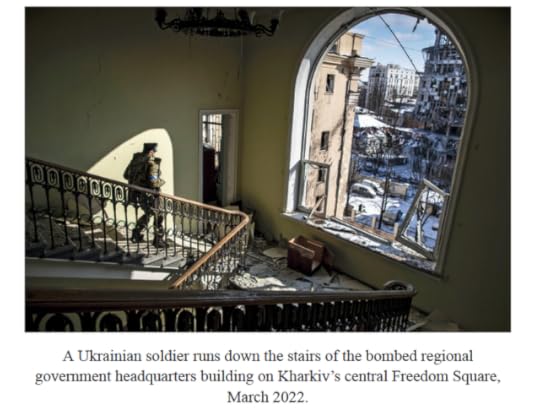
Screenshot-2024-02-28-145523

The war has now been going on for a little over 2 years as I write this review; with no end in sight. If anything, it is escalating. The Ukrainians are losing ground, while the Russians are becoming more savvy to their opponent's tactics and advancing. It has become a hellish war of attrition. As it drags on, the meat grinder eats more and more. How much longer it will go on, how many more lives it will consume, and how many more billions of dollars of foreign aid will be sent to continue it remains to be seen, and only time will tell...
Screenshot-2024-02-28-210849
********************

Our Enemies Will Vanish is a very comprehensive look at the 2022- ongoing (circa Feb 2024) invasion of Ukraine by Russia. The author did a great job putting this one together.
I'm not aware of any other books that cover the war in such detail.
I would definitely recommend it to anyone interested.
5 stars.
Profile Image for Henry Schmaltz.
101 reviews3 followers
March 26, 2024
A great and recent account of the Russian-Ukraine war. Recaps to the familiar and brings up-to-speed for those not well versed. I enjoyed it and look forward to seeing a part two someday when the war is over.
Profile Image for Simone.
18 reviews
March 26, 2025
I think this is a great book which is well written and gives a lot of detailed information about Russia's full scale invasion of Ukraine in 2022. It covers primarily the time from a few days before 24 February 2022 until the first anniversary of the invasion, but gives in particular in Part 1 "Dignity" also background information starting with the independence of Ukraine in 1991 and then the "Revolution of Dignity" in 2014 which was followed by Russia's invasion and annexation of Crimea and aggression in the Donbas. In the Epilogue the author touches on some of the events of the rest of 2023, in particular the Prigozhin mutiny and his assassination as well as the burst of the Kakhovka Dam in June 2023.

I followed the full scale invasion quite closely by reading newspapers and in particular on social media. I found in the book many things I remember, because I read about it at the time. Maybe more interesting were a number things which I was not aware of or of which I had lost sight in the meantime. I want to mention a few of them in this review.

1. In Part 2 "Invasion" it becomes evident how close Russian troops were to invade Kyiv and then probable also topple Zelensky and the Ukrainian government - or do worse than that and kill them. Trofimov reminds the reader that Zelensky said in these first days to several Western governments and the European Union, that this conversation might be the last one and that he might not survive. Reading this now, I remember how I and probably also others checked in the morning social media to see whether Kyiv still stands and Zelensky is still alive. Gaby Hinsleff captured this feeling in my opinion perfectly in this article in the Guardian three years ago: https://amp.theguardian.com/commentis...

Trofimov also highlights that immediatly before the full scale invasion and the first hours and days afterwards there were several officials in UK, US and in other Western countries who urged Zelensky to leave Ukraine or at least leave Kyiv to be safe. He refused all offers.
The phrase "The fight is here. I need ammo, not a ride", became a symbol for this refusal. Trofimov says:
"Zelensky didn't utter these words at the time, his spokesman told me, but it was the mindset in Kyiv."

2. I was not aware how general the opinion in the West seemed to have been that Ukraine would fall within days. I knew about statements by some Western politicians who did not want to provide Ukraine with heavy weapons, because they feared that "Russia would role through" Ukraine and the weapons would then fall into Russian hands. According to Trofimov this seems to have been the universal Western assumption that the Ukrainian army would not be able to stop Russia and the Ukrainians could only resist in the following guerrilla campaigns in occupied Ukraine. As a consequence it tooks at least 2-3 weeks until the Western countries finally provided Ukraine with meaningful military support. Ukraine's foreign minster at this time Kuleba summarized the situation as follows:
"If everyone gives us a week or ten days, ... it means that we have to survive by all means, whatever it takes".
When they decided to provide weapons, it seems that it was always too little, too late.
"Every day of Western hesitation, Ukrainian officials said, was measured in hundreds of Ukrainian lives".

3. Part 3 of the book is called "Résistance". I think it is fascinating how Trofimov describes how different cities reacted to the invasion. It seems there were broadly two options: to resist or to give in. In those cases in which the cities resisted and the local government stayed and organised the resistance, they were often successful. If the local government fled or collaborated, they were quickly occupied by Russia. A particular fascinating example is Kryvyi Rih, Zelensky's home town. Russia was hopeful to have an easy game, because the mayor of Kryvyi Rih, Oleksander Vilkul, was expected to be Russia-friendly and run in 2019 even on a pro-Russian opposition in the presidential election against Zelensky. However, he showed his loyalty with Ukraine, when his hometown was threatened by invasion. He organised the defence of the city and they were able to fight back the invasion of the city.
He commented later as follows:
"The Russians and their imperial mania of greatness ... They thought that everyone who speaks Russian is awaiting Russia here. But it turned out that the Russian-speaking Ukrainian patriotism is no weaker than the Ukrainian-speaking Ukrainian patriotism".

4. This attitude towards Russia is shared by many Ukrainians. Kharkiv is geographically close to the Russian border. Before 2014 there were a lot of connection between the people in Kharkiv and the neighbour regions in Russia. Like Kryvyi Rih, also Kharkiv resisted and is since the first days after full scale invasion a constant target of Russian aggression. The mayor of Kharkiv summarises the current attitude as follows:
"Nobody wants the Russians here; we did not invite them. In Kharkiv, we used to see Russians - and I am not exaggerating - as our brothers. Every forth person here either hails from Russia or has family there. But not even in our worst nightmares could we imagine that they would bomb our residential areas, destroy our city's infrastructure. Our people are in shock. The mindset has reversed completely. The attitude to Russia is very negative now. There will probably be several generations before that changes.".

5. Trofimov describes the impetus for Western countries to help Ukraine and also the motivation for Russia's war. He said that governments usually do not act out of sympathy or moral outrage, but rather because of calculated realpolitics. He quotes former Foreign Minister Kuleba who highlights that for once morality became part of the real decision-making process.
"Sympathy based on moral arguments was a game changer. Some governments acted the way they did not merely based on their practical considerations, but under enormous pressure of public opinion.".
The public opinion supported Ukraine, not at least because Zelensky used every available occasion to speak directly to Western audiences and to urge them to pressure their governments to support his country.

Trofimov also gives details about Russia's arguments for the war. He quotes in particular a long article published by Russia's RIA state news agency in April which outlined Moscow's intentions. Here are a few quotes from this article:
"Denazification will inevitably be de-Ukranization. ... The very name Ukraine would be abolished because "Ukraine is an artificial anti-Russian construct without its own civilizational content."
The article continues and explains that this de-Ukranisation will mean the
"physical liquidation of Ukrainian elites whose reeducation was deemed impossible. The rest of the population "must suffer the hardships of the war and internalize the experience as a historic lesson and atonement for their crime." The Ukrainian crime of course, consisted of refusing to self-identify as Russians."

6. The book describes in several chapters the fight about Mariupol and Avostal. It points out that the civilians who were allowed to leave, were transferred "in the presence of the Red Cross and the UN, and the Russian military" in buses and were not brought to Ukraine, but rather to Russian occupied areas and ended up in filtration camps. I find it quite devastating how useless international institutions like Red Cross and UN seem to have been, when it mattered.

7. One other aspect which I found fascinating is on which basis Ukraine granted citizenship past independence. Trofimov mentions that - unlike Estonia or Latvia - they granted citizenship to all residents. They eliminated the Soviet-era ethnicity clause from identity documents, which had applied during Soviet time also to Zelensky himself. Because of his Jewish origin he was not considered Ukrainian.

The following quote from the first president of Ukraine Kravchuk is remarkable:
"We decided that ethnicity should not become part of the creation of the state ... What is important is how the person relates to Ukraine as a state, whether he builds it or destroys it."

8. I remember the attacks on civilian infrastructure throughout the war very well. They are also mentioned several times in the book. Trofimov gives some background about these attacks. He points out, that when Russia realised that they could not win on the battlefield, they decided to hit peaceful civilians instead.

He reports about the celebrations of this attacks in Russian TV shows where the host was anticipating "how Ukraine would be pushed into a preindustrial age, freezing without electricity and heating in the winter months ahead".

Sergei Markov, the former Putin advisor, made similar predictions:
"Logistics will be disrupted, conditions will become maximally unfavorable, which will cause a new exodus of citizens. Ukrainian cities will turn into an environment in which there are no chances for survival. It's the lack of communications, infrastructure, heating, electricity, and food"
Luckily these predictions were wrong. The government operated "Resilience Centres" throughout Ukraine with electricity, heating, Wi-Fi and free food. Support came also from Western partners.

I want to finish this review with a few lines from the Ukrainian national anthem. I am doing this, because the title of the book "Our enemies will vanish" is a line from it and Trofimov quotes it also twice during the book:

Our enemies will vanish,
like dew at sunrise,
And we, oh brothers, will become the masters once again
Of our own land.


I hope these words will eventually come true.
Profile Image for Jarrett Bell.
239 reviews7 followers
June 24, 2024
A well-reported, mesmerizing recounting of the first year of the Ukraine War, Trofimov captures Ukraine’s surprising endurance and fortitude, as well as Putin’s delusions and their consequences not only for Ukraine but for his own soldiers. In the process, Trofimov shows how Ukraine managed to turn back the largest military in the world and, thanks to Western hesitancy to deliver weapons, missed an opportunity to rout Russian forces at the end of the year, giving Russia the time it needed to dig in and prepare to hold onto their slender gains. Trofimov effectively combines first-person reporting with the broader strategic picture, producing a strong first draft of history.
1 review
January 22, 2024
Great book that portrays the first year of the Russian full scale invasion to Ukraine

Great book that portrays the first year of the Russian full scale invasion of Ukraine with views from the frontline and stories of Ukrainian
Profile Image for Dmitry.
1,272 reviews99 followers
February 10, 2024
(The English review is placed beneath the Russian one)

Мы крови выпили три моря,
Мы все пожрали, что могли,
Победа пела на просторе
Лихие песенки свои.
Победа вкусно побеждала,
Беда солила, как могла.
Нас за Победу столько пало,
Нас за Победу сдохла тьма.


Я прочитал много книг написанных американцами или англичанами про российско-украинский конфликт. В таких книгах центральной темой всегда была одна тема – горе. О чём бы зарубежный автор ни писал, всегда чувствовалась несправедливость войны и никогда – залихватский угар. Я думаю, эта традиция берёт начало в уроках Первой и Второй мировых войнах. Любая война, всегда и прежде всего, это трагедия. «Играть в войнушку» могут только дети, а для взрослых, условных взрослых, это всегда боль, потери, страдания. Как писал Камю, «Для большинства людей война означает конец одиночества. Для меня она — окончательное одиночество». Однако Советский Союз, а позже Российская Федерация, придерживались строго противоположных взглядов. Если посмотреть сегодняшние фильмы про Вторую мировую войну, которые снимаются в РФ, можно увидеть радость победы. В нынешних фильмах ничего или почти ничего не говорится о горе, но всегда – о радости победы. Почему я вспомнил тему WW2 в контексте этой книги? А она есть чистый аналог российских фильмов о Второй Мировой войне.

Книги, написанные славянами, даже если они живут и работают в США (как тот же Serhii Plokhy), всегда разительно отличаются от книг написанных американцами или англичанами. Возможно дело в том, что для не славян, это «не их война». Вполне возможно. Но на сегодняшний момент, книги тех украинцев, которые читал я, и которые были изданы на английском языке, всегда следуют одному неписаному правилу – никогда не осуждать украинское правительство, оно же – государство. Это сильно отличается от российского стиля написания политических книг, ибо российская интеллектуальная элита считает за правило всегда и при любых условиях что есть мочи критиковать государство а иногда и народ в придачу. Любая попытка отойти от намеченной цели рассматривается как коллегами, так и самим народом, как гнусная попытка понравится начальству и всегда осуждается всеми думающими россиянами. Российский интеллектуал может занимать любую позицию, но в итоге он всегда должен быть критиком своего государства. Так Герцен ещё завещал, так сказать. Я, кстати, полностью разделяю такой мнение и такой подход. Именно поэтому я всегда с неким обалдением читаю книги украинцев написанных на английском языке. И не понимаю одного – зачем?

В книге нет горя. В книгах всех или почти всех украинцев, что я читал до сего момента, я не встречал горя. Я встречал ненависть и злобу, встречал отчаяние, ужас, но вот горя я там не видел. Может быть, я просто не заметил? Может быть. Но если настрой таких книг как «War Diary» Yevgenia Belorusets и «Escape from Mariupol» Adoriana Marik, я могу понять, то настрой этой книги – нет. Настрой этой книги понятен из самого названия - «Our Enemies Will Vanish», т.е. наши враги исчезнут, что они буду разбиты, бросятся наутёк и пр. Вся книга состоит из множества историй как доблестные украинские хлопцы били гнусных и отвратительных орков. Да, автор именно это слово любит использовать. Конечно, он оформляет это в форму цитаты, типа, это не я, так выражаются украинские солдаты. И я бы принял такое объяснение, если бы не весь настрой книги, а он, как я обозначил в самом начале, точно такой же, как в современных российских фильмах о Второй Мировой войне. Дело, конечно, не в слове «орк» или в том, как автор рисует российских солдат, а в настрое всей книги, ибо книга рассказывает о самых первых днях начала военного конфликта и заканчивается подрывом плотины Каховской ГЭС. Т.е. автор описывает самые удачные дни, когда всему миру казалось что ещё немного и русские бросят оружие и побегут. Но даже в таком случаи мне совершенно не понятен такой залихватский задор автора. Похоже автор на полном серьёзе считает, что в этой войне могут быть победители. Были ли победители в Первой Мировой войне? Как мы знаем, победители были весьма условные и победа была Пиррова, особенно на фоне того что Вторая мировая была результатом как раз Первой мировой. Именно поэтому, как я считаю, иностранцы к любой войне подходят, в первую очередь, как к трагедии и поэтому на Западе не празднуют победу во Второй мировой, а вспоминают её жертв. Эта небольшая разница в понимании Второй мировой, между людьми с Запада и людьми, условно говоря, бывшего соцблока, я считаю фундаментальной.

Обсуждать или осуждать книгу, смысла нет никакого. Мне кажется, автор даже не живёт в Украине, а является этническим украинцем который, как тот же Serhii Plokhy, «любит родину из-за рубежа». Это вообще любимая славянская привычка - любить родину, живя максимально далеко от её длинных рук. Ведь какое дело автору до выжженной земли, до разрушенных городов и заводов, которые не понятно кто и когда будет восстанавливать, если он живёт в США и работает в престижной американской газете The Wall Street Journal (так же как Serhii Plokhy, который живёт и работает не в Киеве и не в Киевском Университете, а в США и работает в Harvard University)? Поэтому автор может позволить себе писать такие залихватские книги из серии не сегодня-завтра, погоним русских с нашей земли, прям до самой Московии, т.е. Our Enemies Will Vanish. Да даже если бы такое было возможно, даже в этом случаи нужно в первую очередь думать и писать о трагедии собственной страны и собственного народа, а не когда и кого вы там погоните. Залихватская удаль хорош�� смотрится только тогда, когда человек на собственном примере показывает как он гонит русских к границе, т.е. когда автор сам, с автоматом наперевес сидит в траншеях Донбасса, а не в комфортном кресле около камина в каком-нибудь Нью-Йорке. Так что главная претензия и главная причина в отрицательной оценке, это неуместная радость и не понимание горя, которое испытают жители восточной и центральной Украины. Я не предлагаю давить на жалость и выдавливать из читателей слёзы, я говорю о такте. Ни один из иностранных авторов, который писал про украинский кризис 2014-2022, не выдавливал из читателей слёз, но они писали так, что любой человек понимал весь ужас и несправедливость войны. Кто её начал – вопрос, который может дебатироваться людьми (в разных точках мира, за пределами РФ и Украины, существуют разные точки зрения), но всегда в таких книгах видна несправедливость и ошибочность войны, её бессмысленность и её ущербность. Кроме этой книги. Впрочем, Serhii Plokhy тоже написал плохую книгу, но в ней хотя бы нет того залихватского угара что есть в этой книге.

Я понимаю, что я крайне мало написала о самой книге. Просто я не вижу смысла разбирать что-то конкретно. Да и заниматься анализом можно только когда конфликт будет хотя бы заморожен. Но меня всё же больше всего в этой книге поразил именно стиль. Чуть ли не через каждую страницу автор пишет как тот или иной отряд украинской армии разбил то там русских, то там, а потом вон там, и далее ещё вот тут нанёс сокрушительное поражение. Это напоминает российскую оппозицию, которая говорила, что чуть ли не пол армии уже разбежалась, других расстреливают заградотряды, третьих держат в подвалах, четвёртых постоянно бьют и унижают, да и в целом весь военный российский контингент состоит либо из зэков, либо из наёмников, которые только и делают, что пьют водку. Но уже скоро третий год, и я всё никак не пойму: с кем же украинцы воюют, если зэков не осталось, заградотряд всех кто был, уже расстрелял, а те, кто не был расстрелян, валяются пьяными? Кто тот единственный российский солдат, который сдерживает натиск ВСУ? Ну, вы понимаете, что пропаганда хороша, когда она выглядит достоверно, но сейчас мы понимаем, что ВСУ сражается отнюдь не с алкоголиками и наркоманами и зэками, не так ли? Это напоминает советские фильмы про немцев, которых показывали придурковатыми и лишь много лет позже вышел фильм «Семнадцать мгновений весны». Я хочу сказать, что когда ты показываешь врагов идиотами, ты тем самым принижаешь достижения своих собственных солдат (какие вы герои, вы же с алкашами и зэками все эти годы воевали?!), но автору это, конечно, не понять.

Последний момент, который меня поразил, это сравнение украинцев с 300 спартанцев, да и в целом, автор постоянно говорит чуть ли не о киборгах в ВСУ. Но есть два важных момента. Первый момент, это солдаты с острова Змеиный и второй, это азовцы которые удерживали Азовсталь. В обоих случаях солдаты сдались. Второй момент:

“So what happened to the two Russians in the basement?”
“They didn’t want to surrender, and so they shot themselves, with these guns,” he said, pointing to the two propped-up Kalashnikovs.

Возникает вопрос: насколько легко выиграть у противника, чьи солдаты готовы застрелиться, лишь бы не попасть в плен и солдаты, которые не стали играть роль 300 спартанцев и сдались в плен? Это не значит, что я хочу их смерти, это значит, что когда ты пишешь о войне, ты должен понимать и понимать очень хорошо, о чём ты на самом деле пишешь.

I have read many books written by Americans or Englishmen about the Russian-Ukrainian conflict. In such books, the central theme was always the same: grief. No matter what a foreign author wrote about, there was always a sense of the injustice of the war and never a joyful exuberance. I think this tradition has its origins in the lessons of the First and Second World Wars. Any war, always and above all, is a tragedy. Only children can "play war," but for adults, conventional adults, it is always pain, loss, and suffering. As Camus wrote, "For most people, war means the end of loneliness. For me she is the ultimate loneliness". However, the Soviet Union, and later the Russian Federation, held strictly opposite views. If you watch today's World War II movies, which are filmed in the Russian Federation, you can see the joy of victory. Current movies say little or nothing about grief but always about the joy of victory. Why did I bring up the topic of WW2 in the context of this book? It is a pure analog of Russian films about World War II.

Books written by Slavs, even if they live and work in the USA (like Serhii Plokhy), are always strikingly different from books written by Americans or Englishmen. Perhaps the point is that, for non-Slavs, this is "not their war." Quite possibly. But to date, the books of those Ukrainians I have read, which were published in English, always follow one unwritten rule - never condemn the Ukrainian government, aka the state. This is very different from the Russian style of writing political books because the Russian intellectual elite considers it a rule to criticize the state and sometimes the people as well. Any attempt to deviate from the intended goal is regarded by both colleagues and the people themselves as a nefarious attempt to please superiors and is always condemned by all-thinking Russians. A Russian intellectual can take any position, but in the end, he must always be a critic of his state. This is what Herzen bequeathed, so to speak. I, by the way, fully share this opinion and approach. That is why I always read books by Ukrainians written in English with a kind of amazement. And I don't understand one thing - why?

There is no grief in the book. In the books of all or almost all Ukrainians that I have read so far, I have not seen grief. I have met hatred and anger, I have met despair and horror, but I have not seen grief there. Maybe I just didn't notice? Maybe. But if I can understand the mood of such books as "War Diary" by Yevgenia Belorusets and "Escape from Mariupol" by Adoriana Marik, I can't understand the mood of this book. The mood of this book is clear from the title itself - "Our Enemies Will Vanish", i.e., our enemies will disappear, will be defeated, will rush away, etc. The whole book consists of many stories of how the brave Ukrainian boys beat the vile and disgusting orcs. Yes, that's the word the author likes to use. Of course, he puts it in the form of a quote, like, it's not me, that's how Ukrainian soldiers express themselves. I would accept such an explanation if it were not for the whole mood of the book, and it is, as I indicated at the beginning, the same as in modern Russian films about World War II. The point, of course, is not in the word "orc" or in the way the author draws Russian soldiers, but in the mood of the whole book because the book tells about the very first days of the beginning of the military conflict and ends with the undermining of the dam of the Kakhovskaya hydroelectric power station. I.e., the author describes the most successful days when it seemed to the whole world that just a little more and the Russians would drop their weapons and run away. But even in such a case, I do not understand the boisterous enthusiasm of the author. The author seems to think, in all seriousness, that there can be winners in this war. Were there winners in World War I? As we know, the winners were very tentative, and the victory was Pyrrhic, especially since the Second World War was the result of the First World War. That is why I believe that foreigners approach any war as a tragedy in the first place, and that is why, in the West, they do not celebrate the victory of the Second World War but remember its victims. This small difference in the understanding of the Second World War between people from the West and people from, let's say, the former socialist bloc, I think, is fundamental.

There is no point in discussing or condemning the book. It seems that the author does not even live in Ukraine but is an ethnic Ukrainian who, like Serhii Plokhy, "loves the motherland from abroad." This is a favorite Slavic habit - to love the motherland, living as far away from its long arms as possible. What does the author care about a scorched earth, about destroyed cities and factories, which it is not clear who and when will rebuild if he lives in the United States and works in the prestigious American newspaper The Wall Street Journal (just like Serhii Plokhy, who lives and works not in Kiev and not in Kiev University, but in the United States and works at Harvard University)? Therefore, the author can afford to write such braggadocious books from the series of "Not today-tomorrow, let's chase the Russians from our land, right up to Moscovia," i.e., Our Enemies Will Vanish. Even if such a thing were possible, even in this case, you should first think and write about the tragedy of your country and people, not when and whom you will chase. The boastful prowess looks good only when a person shows by example how he drives the Russians to the border, i.e., when the author himself is sitting in the trenches of Donbass with a machine gun, not in a comfortable chair near a fireplace in some New York. So, the main complaint and reason for the negative assessment is the misplaced joy and lack of understanding of the grief that the residents of eastern and central Ukraine experience. I'm not suggesting pushing pity and squeezing tears out of readers; I'm talking about tact. None of the foreign authors who wrote about the Ukrainian crisis of 2014-2022 squeezed tears out of their readers, but they wrote in such a way that anyone could understand the horror and injustice of the war. Who started it is a question that can be debated by people (there are different points of view in different parts of the world outside of Russia and Ukraine), but always such books show the injustice and wrongness of the war, its senselessness, and its inferiority. Except for this book. However, Serhii Plokhy also wrote a bad book, but at least it doesn't have the joyful exuberance that this book has.

I realize that I've written very little about the book itself. I just don't see the point in analyzing anything in particular. You can analyze a situation when the conflict is at least frozen. But what struck me most of all in this book was the style. On almost every page, the author writes how this or that detachment of the Ukrainian army defeated the Russians there, then there, and then there, and then there, and then there, and then here he inflicted a crushing defeat. This is reminiscent of the Russian opposition, which said that almost half of the army has already run away, others are shot by barrier troops, others are kept in cellars, others are constantly beaten and humiliated, and in general, the entire Russian military contingent consists of either convicts or mercenaries who do nothing but drink vodka. But it's already the third year, and I still don't understand: who are the Ukrainians fighting with if there are no convicts left, the barrier troops have already shot everyone who was there, and those who weren't shot are lying drunk. Who is the only Russian soldier who is holding back the onslaught of the AFU? Well, you realize that propaganda is good when it looks credible, but now we realize that the AFU is not fighting with alcoholics, drug addicts, and convicts, right? It reminds me of Soviet movies about Germans, who were shown as morons, and only many years later, the movie "Seventeen Moments of Spring" came out. I want to say that when you show your enemies as idiots, you belittle the achievements of your own soldiers (what kind of heroes are you if you fought with alcoholics and convicts all these years?!), but of course, the author can't understand this.

The last point that struck me was the comparison of Ukrainians with 300 Spartans, and in general, the author constantly talks about cyborgs in the AFU. But there are two important points. The first point is the soldiers from Snake Island, and the second is the Azov soldiers who held Azovstal. In both cases, the soldiers surrendered. The second point:

“So what happened to the two Russians in the basement?”
“They didn’t want to surrender, and so they shot themselves, with these guns,” he said, pointing to the two propped-up Kalashnikovs.


It begs the question: how easy is it to win against an enemy whose soldiers are willing to shoot themselves just to avoid being captured and soldiers who didn't play the part of the 300 Spartans and surrendered? That doesn't mean I want them dead; it means that when you write about war, you have to realize and understand very well what you're actually writing about.
Profile Image for Nick.
286 reviews16 followers
March 27, 2025
On February 23, 2022, Ukraine was still at peace, even as Russian forces began coalescing at its border. The Ukrainian government was in-session, preparing for imminent war while the world presumed a "Russian triumph within days was a foregone conclusion."

On February 24th, the Russians invaded. After over three years, the war rages on and the Ukrainian people continue to fight.

"If soldiers try to advance, if someone tries to take away our country and our freedom, our lives and the lives of our children, we will defend ourselves. If you advance, you will see our faces, not our backs." -Volodymyr Zelenskyy, President of Ukraine

The Soviet Union dissolved in 1991. At the time, Russia recognized Ukraine's sovereignty, even while some of its land (if not most of it, especially today) Russia considered to be rightfully their own (e.g., Kharkiv, Crimea, Odesa). Moscow hadn't envisioned that Ukraine would steer towards the West. The prospect that Ukraine might pursue member state status with the European Union enraged those in Moscow, who several times attempted to install a pro-Russian government in Kyiv.

In 2014, Russia invaded Crimea. At the end of its campaign, with Crimea and a portion of the Donbas region in eastern Ukraine occupied, Russia annexed and laid claim to 7% of Ukraine's territory.

Russia will never be satisfied with anything less than the entirety of Ukraine.

Volodymyr Zelensky, a 40-something former comedian, ran for President as an uncompromised outsider who vowed peace with Russia. He won in a landslide victory in 2019. As part of his political platform, Zelensky vowed to pursue NATO membership, and to never relinquish even one square inch of Russian-occupied Ukraine. While a ceasefire was later signed in parallel with a prisoner exchange, Zelensky maintained his NATO aspirations.

Russian President Vladimir Putin would never stand for that. Putin argued that Ukraine was an artificial country. Putin made his plans very clear, and well before the invasion in 2022 - telling the Director of the CIA, William Burrows, that Ukraine was too weak to resist and Europe too risk-averse to interfere.

Moscow anticipated taking Ukraine in 10 days. Western allies thought the same and even offered Zelensky the option of establishing a government-in-exile abroad - an offer he promptly refused.

"We need, together, to save Ukraine and the entire democratic world." -Volodymyr Zelensky

What Russia has done to Ukraine, and what it continues to do, demonstrates the kind of people that they are.

The Russians, having murdered innocent civilians, have demanded cash in exchange for the return of Ukrainian corpses to their families.

The Russians have intentionally shelled civilians attempting to flee Ukraine. They've bombed hospitals, schools, and military family housing units. They've deliberately strafed high rise apartment buildings with gunfire and shelled nuclear power blocks.

The Russians mobilized their own citizens, telling them they'd undergo thorough military training. Many of them ended up on the front lines in a matter of days.

The Russians, through the Wagner Campaign, conscripted thousands of violent criminals, amongst them rapists and murders, as a military reserve - 6 months of service to Russia in exchange for a full pardon.

The Russians sought to break the will of the Ukrainian people by making their cities - in which more than two-thirds of Ukrainians live - utterly uninhabitable. They've done so in the depths of winter, attacking Ukraine's electrical grid, disrupting their heat, their water, and their sewage systems.

"Our enemies will vanish,
Like dew at sunrise,
And we, oh brothers, will become the masters once again
Of our own land."
From Ukraine's National Anthem

If journalism is considered "the first rough draft of history," Our Enemies Will Vanish is one hell of a draft, documenting the first year of the war in Ukraine. As an American who is incredibly troubled by the rise of wanton disregard for the people of Ukraine and a federal government openly embracing totalitarians abroad, I picked up this book to educate myself. The Ukrainian spirit left me in awe. They're a proud people with a lot of fight, a people who even against the odds, surrounded and outnumbered, would openly tell their Russian counterparts, "Go fuck yourself."

As someone rather unfamiliar with the layout of Ukraine, my only criticism of Our Enemies Will Vanish was that it could've used more graphical representation of the battlefield as it quickly evolved.

A worthy read for anyone seeking to learn more about the beginnings of the war in Ukraine, now in its third year.

3.75 out of 5
Profile Image for Suzannah Rowntree.
Author 34 books595 followers
May 24, 2025
I don't know that I can say much that is coherent about this book. Yaroslav Trofimov, born and raised in Kyiv and by 2022 a reporter with the Washington Post, chronicles the first year of the full-scale Russo-Ukrainian war in this vivid, gripping, and intense account. I was there following the news as it happened, often on a daily basis, yet Trofimov brings to the story a fabulous blend of measured hindsight, eyewitness on-the-ground reporting, and insider information from interviews conducted with protagonists like Zelensky, Zaluzhny, and Budanov - thereby converting news into history.

The book is pretty intense, particularly the chapters detailing the brutal destruction of Mariupol and the last stand at Azovstal, and there is some fairly grisly reporting from frontlines all over Ukraine. It's not as bad as Timothy Snyder's BLOODLANDS or William Dalrymple's RETURN OF A KING, but it perhaps hits harder because this is something that is happening now.

All the same, I'm so pleased to have read it at this particular moment, when I'm working on a non-fiction project for authors on basic military tactics. If you want a glimpse at how wars are fought in the 21st century - particularly useful for fantasy authors who may use magical elements to evoke elements of modern warfare - this would be a fantastic starting point.

In terms of the history, one of the things that struck me listening to this book is how kinetic and - for the uninvolved onlooker - exciting the full-scale war was in its first year. With large amounts of land changing hands, brilliant strikes like the sinking of the Moskva and the bombing of the Kerch Bridge, and new weapon supplies being announced every few months, there was drama aplenty. 2023 was a more difficult year for Ukraine, with the contentious defence of Bakhmut involving them in a fight on Russia's terms and the big southern offensive fizzling out with very few gains. (Had Prigozhin actually had the nous to complete his coup in June 2023, rather than seeming to lose his nerve at the prospect of ousting Putin entirely, I wonder how it might have changed the course of the war and the perception of the battle for Bakhmut). 2024, of course, saw the beloved General Zaluzhny retired in favour of Syrski, and since then it seems that Ukraine has settled down to a determined campaign of attrition against the Russian army, focusing less on recovering territory than on comfortably mowing down as many Russian soldiers as possible, while conducting devastating strikes against military targets on Russian soil. Interestingly, the Kursk offensive provided a showcase for Ukrainian innovation and learning as it effortlessly avoided many of the problems that had bogged down the 2023 counteroffensive. By early 2025, Ukraine might not have generated many stunning battlefield successes in a while, but it does seem to be holding its own, gathering strength, and grinding Russia down. It will be very interesting to see what happens over the next 12 months.
Profile Image for Sandris Sabajevs.
40 reviews4 followers
May 19, 2025
Yaroslav Trofimov, a Ukrainian-born journalist and chief foreign-affairs correspondent at The Wall Street Journal, offers a powerful first-hand account of the first year of Russia's full-scale invasion of Ukraine. His book brought me back to that morning on February 24, 2022—when I first heard the news. Like many, I felt disbelief, shock, and a deep empathy for Ukrainians facing the brutal war machine of Putin’s Russia.
The author weaves together personal wartime experiences—his and those of his reporting crew—with insights from meetings with Ukrainian soldiers, civilians, and officials. He also provides broader geopolitical context, sharing the thinking and decisions of high-level political leaders behind the scenes. One moment that stood out to me as a Latvian was his encounter with Juris Jurašs, a Latvian politician who traded his seat in parliament for the military fatigues of the Carpathian Sich Battalion in Ukraine.
I was also struck by the title of the book—Our Enemies Will Vanish—a line from the Ukrainian national anthem. I truly hope those words come true for the Ukrainian people:

Our enemies will vanish,
Like dew at sunrise,
And we, oh brothers, will become the masters once again
Of our own land.

Sláva Ukrayíni!🇺🇦
Profile Image for Sofia.
19 reviews10 followers
August 12, 2025
Excellent summary of the first ~2 years of war that also provides insight to the historical background of Ukr/russian relations. Reads like a story with funny and characters and vignettes about people and the places impacted by russia. Really nuanced view describing social opposition vs acceptance of russian invasion and the political landscape in Ukraine - giving credit to Zelensky without exalting him as the savior of Ukraine. Very well written, highly recommend, makes me proud to be Ukrainian 💛💙
Profile Image for Emerson Stokes.
106 reviews
August 11, 2025
I was at school in grade 11 when I saw my first footage from the Ukrainian War. Two unknown fighter jets flew low over Kyiv, flying past the camera. I checked news sites and the war was on.

Columns of tanks, infantry vehicles and ad-hoc civilian vans rushed towards the capital. Hostomel Airport was on the verge of capture, while Russia was taking territory in the east. I thought at the time that Ukraine would soon collapse but could inflict some losses on the Russians in the meantime.

After a few days of confusion where nobody seemed to know what was happening on the ground, videos began to emerge on western social media. Columns of tanks, infantry vehicles and ad-hoc civilian vans were being shown strewn about on roads and in forests, abandoned and on fire. Hostomel Airport was abandoned by the VDV and the whole northern invasion force had withdrawn. I thought at that time that Ukraine could at least then seriously injure the Russian army but would soon lose in the east.

However, and despite Russian advances, Ukraine pushed back. The Russians were repulsed from Kharkiv and Kherson. Regions that could not get supplies through gained access to running water, electricity and foreign imports when Russian artillery striking distance was pushed far enough. Ukraine was able to ship its own grain imports out of Odesa again. I thought that maybe Ukraine had something going for it after all.

Looking at the first year of the war in the year of 2025, it is interesting to think of all the things that so busily occupied the minds of westerners that feels so meaningless now. Azov? Ukrainian biolabs? Minsk? It is easier now than it was then to look at some of these things and see how they did not really matter to the war's causes and processes (as I am sure some subversives knew when promoting them). Two of the primary causes (though not the only) were the Russian leadership and its patriots believing that it still had a right to empire, and the Russian leadership's belief that Ukrainian culture did not exist.

When the Soviet Union collapsed, Bill Clinton is reported to have said that Russia could still hold onto its regional influence without NATO encroachment. However, political and cultural movements are not constrained by the assurances of one American president. Poor and defenseless, much of the old Soviet blocs and republics were without security, and Russia was not in a position to give it to them (it can be argued that the USSR did not either in its later years). As such, many of them started to slowly drift towards the west which was still prospering at that time. This affronted Russian leadership as the regions and territories it had always controlled started to float away from its centre of gravity and into another. Those which it still had some sway over were halted from swaying any farther, one of them being Ukraine.

This leads into the second issue, that being that Russian leadership and many ordinary Russians did not see Ukraine as its own identity. Russian media channels and many of its highest figures referred to Ukraine as a fake culture and a fake nation generated by the west. Ukraine used to be closer to Russia, many Ukrainians lived and worked in Russia, many were Russian and spoke Russian, and there were of course the old ties of Soviet friendship. These ties were abused by Russia when it originally intervened in 2014 as many Ukrainians were confused or did not want to fight Russian soldiers. The Russian military partly counted on many in the Ukrainian government and military turning to the Russian side. But since 2014, hardship and conflict helped to iron out a more distinct and resolute Ukrainian identity, one that started to become increasingly more defined by its historical conflicts against Russia.

I am not going to say that Ukraine is going to "win" this war, that may not be likely. The window to end the war quickly passed, when western leaders acted with both indecisiveness and incompetence and gave neither Ukraine the ability to fight decisively nor Russia the ability to honourably back off. Those sorts that occupied the seats of power in the west at the time (who shall not be named) did and do not think of dealing with crises but "managing" them, lacking the creativity or intelligence to create a world that was not set out by parameters beforehand. Because of this, Ukraine and Russia continued without them.

This review has been more of a soapbox for my own thoughts on the Ukrainian War than a review of the book, but the work helped me think about the war along with its clear narrative of those chaotic days in 2022 where a mix of fog-of-war and media obfuscation/propaganda made it difficult to follow what was going on at times. The best narratives of the conflict are yet to be written, but this serves as a good start.
361 reviews4 followers
March 5, 2024
Based on his eyewitness observations and interviews with hundreds of Ukrainian officials, soldiers and civilians, Trofimov (a native of Kyiv) begins the story of what will prove to be one of the most consequential events of the 21st century. From Kyiv through Donbas to Odesa, Trofimov, in telling vignettes, presents the horrors and honor of a people determined to repel a barbaric invasion intended to obliterate them and their national identity. Of course, as Trofimov finished his book, the war in Ukraine continued. Let's hope that Trofimov's next book about Ukraine's war for independence is one with a happy ending.
Profile Image for Peg.
44 reviews49 followers
February 2, 2025
I hoped this book would help me better understand the war in Ukraine—the origins of Russia’s aggression, the context of the two countries’ relations, how the military conflict was progressing—and it delivered on all counts. The author was born and raised in Ukraine and covered the country as a correspondent for the Wall Street Journal from before the war’s outbreak through at least early 2023, when the narrative ends. This author spent months documenting not just the progression of the military engagements but also the impact of the war on the daily lives of individual civilians and soldiers. It must take so much judgment and journalistic skill to see everything that this writer has observed and be able to curate it so cogently. This book is compelling, engaging, important, and very readable. Highly recommend.
67 reviews
January 13, 2025
This is a well-written and helpful account of the first year of the full-scale invasion of Ukraine. Even for someone who followed closely, who was in Ukraine for two of these twelve months, and wrote fairly extensively on the topic, there were interesting bits of information. I'm grateful for Trofimov's bravery and first-hand account from the very front lines.

Згинуть наші вороженьки, як роса на сонці.

Слава Україні!
Profile Image for Peyton Stich.
107 reviews
June 18, 2025
This is one of the most impressive books I’ve ever read in terms of distinct reporting of contemporary wartime. If I were to highlight every piece of solid evidence in this book, it would nearly be all yellow. This just comes to show how misunderstood the Ukrainian war is, and how liberated peoples and their distinguished identities are a hell of a powerful fighting force. I hope Ukraine pulls through as the war continues today.
Profile Image for Yuliya Yurchuk.
Author 9 books68 followers
February 28, 2024
If you want to read only one book about Russia’s war against Ukraine, read this one. It covers mainly the first year of the full-scale invasion. The author is a very talented narrator who approaches the events with attention to the details.
The book focuses on the events, not on the underlying causes or history. So if you look for a historical account of the war, read Plokhy’s book in addition.
Profile Image for Cian Moran.
30 reviews1 follower
February 15, 2024
Outstanding book on the Ukraine war. Especially interesting as Trofimov (a Ukrainian as well as the foreign affairs chief correspondent for the Wall Street Journal) spends so much time on the war's frontline rather than just reporting on the causes.
Profile Image for Kyle Brewer.
18 reviews2 followers
Read
March 26, 2024
A sober and heartbreaking yet somehow hopeful report of the first year of the war in Ukraine. Ukrainian bravery shines in the face of evil. I pray we learn the lessons of this war and Western indecision does not necessitate the writing of similar accounts in the Baltics, Georgia, and Taiwan.
Profile Image for Wells Benjamin.
11 reviews
June 12, 2024
Very well written account of the first year and a half of the war, contains a lot of information I have not seen anywhere else. The author is able to utilize pretty incredible connections eg Budanov to get insider information. Contains chilling accounts of the destruction sown by Putins invasion.
Profile Image for Vaidas Balys.
18 reviews
February 28, 2024
A book about country and nation that are fighting for their independence and, frankly, survival against ruzzia. This in itself means that book gets 5 stars of 5.

The events are rather well known to me, so it does not bring anything super new. But it adds some colours, nuances, and a sprinkle of personal touch.

I believe it is a must read, especially for those that do not follow events or check latest news 25 times a day.
71 reviews
April 25, 2024
This is a very impressive, very well written book on the first year of the war. Short, focused chapters based on both on the ground reporting and birds eye view overviews.
Profile Image for Lukas Kivita.
26 reviews4 followers
October 3, 2024
Gerai aprašyta pirmųjų karo metų kronika. Žiūrint iš šių dienų perspektyvos, kai gerų žinių iš fronto ne tiek daug, netgi šiek tiek nostalgiška.

Detaliai sekantieji karo naujienas naujo ir pernelyg stulbinančio neras, bet daug ką prisimins ir su šiek tiek daugiau įdomių detalių nei nei buvo žinoma tuo metu klostantis įvykiams.
Profile Image for Darren Pauli.
21 reviews2 followers
January 30, 2024
An excellent telling of the war, its valour, tragedies, and human faces from a fearless correspondent.

I came to Our Enemies Will Vanish from Geopolitics Decanted where Trofimov spoke with Alperovitch on his book. That podcast dives into the technical nuts and bolts of the war and as a regular listener I've been exposed to plenty of analysis on Ukraine's shortcomings including an inability to pull off combined arms, a feature the show's various experts finger as a key contributor to the limited success of the counter-offensive.

That level of analysis isn't in these pages, but it is touched on in something of a passing narrative. The overall view from this is one of Ukrainian strength, which while undoubtedly true, struck me as a little rose-tinted.

Hey, it's a book written on an active conflict where one can receive daily updates on Reddit, Telegram, and regular mastheads. This is a wonderful telling of the war from a cracking correspondent with deep ties to the country. He's brave and unyielding in his reporting and I thank him for this contribution.

Thank you, Trofimov.

Salva ukraini.
Profile Image for Roman Brock.
3 reviews
April 11, 2024
This book was incredibly difficult to read, emotionally. War is a terrible, disgusting thing. This book really puts that into perspective and doesn’t shy away from that reality. That being said, this book also highlights that war and weapons are necessary to defend oneself from oppression, subjugation, and evil.

I’m incredibly grateful that the West stepped in to help, even if it was consistently too little and too late. I fear for the day when we fail to support our allies against evil, both on the right of the political spectrum (eroding support for Ukraine) and on the left (eroding support for Israel). It’s a shame that we need the biggest stick in order to keep ourselves safe, but it is the world we live in and we must not forget that.

Thank you to all of the brave Ukrainians fighting and dying for freedoms in this world. Your sacrifices have already altered the course of history and will never be forgotten.
Displaying 1 - 30 of 139 reviews

Can't find what you're looking for?

Get help and learn more about the design.