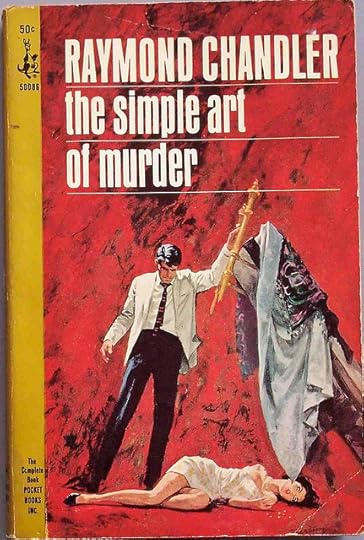
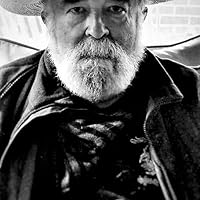
Raymond Thornton Chandler was an American-British novelist and screenwriter. In 1932, at the age of forty-four, Chandler became a detective fiction writer after losing his job as an oil company executive during the Great Depression. His first short story, "Blackmailers Don't Shoot", was published in 1933 in Black Mask, a popular pulp magazine. His first novel, The Big Sleep, was published in 1939. In addition to his short stories, Chandler published seven novels during his lifetime (an eighth, in progress at the time of his death, was completed by Robert B. Parker). All but Playback have been made into motion pictures, some more than once. In the year before his death, he was elected president of the Mystery Writers of America.
Chandler had an immense stylistic influence on American popular literature. He is a founder of the hardboiled school of detective fiction, along with Dashiell Hammett, James M. Cain and other Black Mask writers. The protagonist of his novels, Philip Marlowe, like Hammett's Sam Spade, is considered by some to be synonymous with "private detective". Both were played in films by Humphrey Bogart, whom many consider to be the quintessential Marlowe.
The Big Sleep placed second on the Crime Writers Association poll of the 100 best crime novels; Farewell, My Lovely (1940), The Lady in the Lake (1943) and The Long Goodbye (1953) also made the list. The latter novel was praised in an anthology of American crime stories as "arguably the first book since Hammett's The Glass Key, published more than twenty years earlier, to qualify as a serious and significant mainstream novel that just happened to possess elements of mystery". Chandler was also a perceptive critic of detective fiction; his "The Simple Art of Murder" is the canonical essay in the field. In it he wrote: "Down these mean streets a man must go who is not himself mean, who is neither tarnished nor afraid. The detective must be a complete man and a common man and yet an unusual man. He must be, to use a rather weathered phrase, a man of honor—by instinct, by inevitability, without thought of it, and certainly without saying it. He must be the best man in his world and a good enough man for any world." Parker wrote that, with Marlowe, "Chandler seems to have created the culminating American hero: wised up, hopeful, thoughtful, adventurous, sentimental, cynical and rebellious—an innocent who knows better, a Romantic who is tough enough to sustain Romanticism in a world that has seen the eternal footman hold its coat and snicker. Living at the end of the Far West, where the American dream ran out of room, no hero has ever been more congruent with his landscape. Chandler had the right hero in the right place, and engaged him in the consideration of good and evil at precisely the time when our central certainty of good no longer held."
This is a collection of early Raymond Chandler tales, including the amusing, non-fiction title piece, where Chandler states that the British murder mysteries are unrealistic, dull and are basically ass. The fiction stuff, which don’t include his signature character, Phillip Marlowe, is okay. The highlights include a tale about a sleazy band leader and something about yellow jammies and the one titled “Spanish Blood”, which is the best of the bunch.
The title is the same as Chandler's classic essay that redefined the detective novel, taking it out of the mannered parlors of English cozy mysteries and out of the hands of amateurs and slapping it in the middle of mean American streets where violence is a bloody but everyday affair and the detective is a loner with a code, but not necessarily a nice guy. Chandler, along with Hammett and Cain, invented the hard-boiled detective genre, which I consider an American art form.
“I merely say that all reading for pleasure is escape, whether it be Greek, mathematics, astronomy, Benedetto Croce, or The Diary of the Forgotten Man. To say otherwise is to be an intellectual snob, and a juvenile at the art of living.”
Four short stories of varying quality and an interesting, if grouchy, essay on the state of crime fiction in the 1930s.
The titular essay is a very interesting read, Chandler discusses the popular British (and British styled) crime writers of the day and their failings compared to himself and Dashiell Hammett. He criticises the plotting rather than the writing whilst stating an obvious preference for the more realistic prose of Hemmingway (and himself.) I was astounded to read that The Red House Mystery was an incredibly popular bestseller and yet despite being written by the creator of Winnie The Pooh faded in to obscurity.
The short stories do not feature Marlowe and are a mixed bag but all interesting in parts. The final story is something quite remarkable considering the source and not something you would ever expect knowing what Chandler is famous for. Pearls Are a Nuisance is about an upper class detective in LA, who talks like he's out of a Jane Austen novel and is seemingly terrible at what he does. As a counterpoint to the opening essay it's a wonderful parody but it's also a highly enjoyable read on its own merits.
A collection of non Marlowe stories from pulps in the 1930s, starring an assortment of police officers, hotel dicks and I forget who. They are just okay. His 1950 Atlantic essay is pretty good. He basically puts down all genre and literature too. He makes fun of everyone who imitates him, but admits he imitates Hammett, and does have nice things to say about him.
5 Stars. I've met an author or two, read interviews, but never have I found such interesting comments as Chandler's 18-page analysis of detective fiction. Where does it stand in the pantheon of English literature? Which practitioners are better at it, and which are not? It's seven decades old. One wonders what he would say about today's crop? It opens with an attack on the "critical fraternity," those who exclude mystery writing from great literature. He states, "Good specimens of the art are much rarer than good serious novels." He then soars to unimagined heights! On Doyle, "Holmes after all is mostly an attitude and a few dozen lines of unforgettable dialogue." Chandler is an advocate of realism in mystery writing; his hard-boiled fiction demonstrates that. He takes on A.A. Milne and his run-away best seller 'The Red House,' and uses words like "fraud." He hasn't time for the detectives of Christie and Sayer, nor their English country-house settings. But for Dashiell Hammett, he changes to "first-class" and "original," with favourable comparisons to Ernest Hemingway. The essay is in Chandler's short story collection of 1950 of the same name. (No2020/Mar2025)
Based on all the middling reviews, I only tried a few of these. Yet, I found the titular essay quite interesting. Well, the last bit of it. It starts as a rant, extolling the virtues of "realistic" American detective fiction (and Dashiell Hammett in particular) vs traditional English murder mysteries that Chandler blasts as being stiff, formulaic and divorced from reality. The really interesting bit is at the very end where he lays out the essence of the protagonist of (successful) American detective fiction, and which I think captures the nature of Chandler's own Philip Marlowe so perfectly - the everyday man, with a toughness of character and a sense of honor and purpose, with no tolerance for pretense or pettiness.
"But down these mean streets a man must go who is not himself mean, who is neither tarnished nor afraid. The detective in this kind of story must be such a man. He is the hero; he is everything. He must be a complete man and a common man and yet an unusual man. He must be, to use a rather weathered phrase, a man of honor—by instinct, by inevitability, without thought of it, and certainly without saying it. He must be the best man in his world and a good enough man for any world. I do not care much about his private life; he is neither a eunuch nor a satyr; I think he might seduce a duchess and I am quite sure he would not spoil a virgin; if he is a man of honor in one thing, he is that in all things. He is a relatively poor man, or he would not be a detective at all. He is a common man or he could not go among common people. He has a sense of character, or he would not know his job. He will take no man’s money dishonestly and no man’s insolence without a due and dispassionate revenge. He is a lonely man and his pride is that you will treat him as a proud man or be very sorry you ever saw him. He talks as the man of his age talks—that is, with rude wit, a lively sense of the grotesque, a disgust for sham, and a contempt for pettiness."
I'll be Waiting (3.0) - Chandler's writing is in fine form in this very short piece about a hotel detective on the graveyard shift that manages to get caught up in some late night trouble.
The King in Yellow (4.0) - Flashes of Chandler's brilliance here, with a hotel detective sniffing around a situation that just smells funny and draws him in with every turn. The detective could just as easily have been Philip Marlowe. There is scant detectable difference. Cheeky, wisecracking, hardboiled, stubborn as all hell and driven to sniff out the truth for himself if nobody else. Includes some real seedy characters, and an especially brash and loathsome musician as the titular "King".
"The Simple Art of Murder" is an essay written by the American crime author, Raymond Chandler, in 1950 and it is a rather important piece of crime fiction scholarship, a cornerstone article that even today is held as classic. It is a short, though dense, and full of insights as well as information text that focuses on a heavy criticism on the English mystery/detective fiction and the -many- British cozy mysteries. Chandler thought that this school of crime writing was saturated and a new kind of crime novel is begging to be born. He castigates some famous English authors such as Dorothy Sayers who famously said that detective fiction is a "literature of escape" and retorts that "all reading for pleasure is escape". Chandler doesn't seem to bother with the popular dilemma of whether or not detective fiction books are second-rate novels or full-fledged literary works with the same potential as the great products of this art.
There is also an extended number of pages dedicated to another American hard-boiled writer, Dashiell Hammett. Chandler seems to hold a deep respect for Hammett for whom he writes that: "He was the one -the only one who achieved critical recognition- who wrote, or tried to write realistic mystery fiction". Chandler's overall critique on the English crime fiction tradition is built on his main argument that there is a lack of realism in those novels, a problem that the American authors tried to alleviate by writing more down-to-earth and plausible dialogue while creating characters who resemble those that we encounter in our everyday life. This new wave of American crime writers would win the audiences around the world in the years to come and the hard-boiled fiction became a, relatively, autonomous (sub)genre.
If you are a crime fiction scholar you have already read this classic essay, but it is also a wonderful, instructive read for anyone who enjoys quality crime fiction. It also has a certain historical value as it kind of marks a transition point between English cozy mysteries and American hard-boiled novels. The edition I purchased here in Amazon features also, apart from the essay, a few short stories written by Chandler.
As I had mentioned before, I DNF-ed more Raymond Chandler's novels than managing to finish them. Unluckily this is one of the DNF experiences.
The writing and how Mr. Chandler described his characters and the harsh world of shady business deals, gangsters, corrupted cops and junkies are still brilliant, but the stories...............are just so boring. Perhaps I wasn't in the mood but I just couldn't focus on what is going on in the stories, so...2 stars only.
Cuando empecé a leer “El simple arte de matar” de Raymond Chandler pensaba que iba a ser una especie de manual sobre la escritura del autor y, en principio, lo era porque comienza con un ensayo sobre las novelas de detectives. Pero es una introducción a la colección de relatos cortos que engloba este libro. Podría parecer que el autor nos ha engañado y que no quiere contarnos sobre su labor de creación de este tipo de novelas. Sin embargo, cuando se termina la última página vemos que ha sido mejor que el autor nos mostrase esa técnica en lugar de explicárnosla. Si lo hubiera hecho, tal vez hubiera sido, como lo es, un breve ensayo porque realmente parece muy sencillo escribir una novela de detectives. Sigues a un personaje y vas viendo paso a paso todo lo que ocurre, como si en lugar de leerlo lo estuvieses viendo, como si fuera una película que pasa ante tus ojos. No hay sorpresas inmediatas. Vemos como los personajes preparan sus armas y las utilizan, y el resultado es previsible. Con esto no estoy diciendo que no haya tensión; al contrario. Sabes las posibilidades y las esperas, aunque no sabes cómo serán. Lo único que tienes claro es que serán coherentes, no se sacará nada de la manga. Te dejará pistas suficientes para que tú veas las posibilidades.
Según lo anteriormente dicho, se podría pensar que el estilo de Chandler sería pobre, pero es todo lo contario. Hay imágenes y comparaciones tan ricas como los ojos del color del humo; expresiones que nos hacen esbozar una sonrisa por su lógica y su evocación visual. No tiene que contarnos nada más para imaginarnos la situación. Y los diálogos. Esos diálogos maravillosos que no puedes evitar leer dos y tres veces. Además de los diálogos, lo que más me ha llamado la atención es ese detallismo en las descripciones. Sería fácil reconstruir cada escenario siguiendo las descripciones detalladas y muy expresivas que llegan incluso a hacernos oler el ambiente de una habitación o el perfume de una mujer. Descripciones que te incitan a tomar un mapa y seguir el itinerario de los personajes calle por calle.
Al ser un conjunto de relatos cortos, podríamos pensar que no tienen nada en común y así nos sorprendemos con la aparición de personajes de los que habíamos leído en relatos anteriores, con lo que podríamos considerar la obra como un relato extenso en el cual el hilo conductor no es los personajes o las historias, sino el ambiente e incluso podríamos afinar todavía más diciendo que la protagonista es la ciudad con sus aspectos oscuros y peligrosos, en la que los personajes se mueven y entrecruzan, viven y mueren. Y, sobre todo, interactúan.
Un libro para aquellos que alguna vez disfrutamos viendo a Bogart y Bacal mirándose a los ojos y diciendo esas frases que se nos han quedado grabadas: “No tienes que decir nada ni hacer nada. Sólo silba. ¿Sabes silbar, no? Juntas los labios y soplas”.
I'm not usually a fan of short story collections, preferring instead, something i can immerse myself in. Still i wanted to read this collection of 7 short stories by Raymond Chandler, partly because i adore Chandler's prose, but also because i wanted to see how he had arrived at the Marlowe character. Marlowe doesn't feature in any of these stories, though he seems to lurk around every corner.
The sense i got from these stories, is that Chandler was trying out a number of characters & the sum of these & a number of other shorts printed in Black Mask Magazine, provided him with the character who would eventually morph into Phillip Marlowe.
If you read this collection & you have read several of the Marlowe novels, you will notice several similarities to scenarios in the Marlowe oeuvre. It is well known Chandler cannibalized his short stories & cobbled them together for the Marlowe novels. There is, for instance, one story where a set of pearls are stolen. Reminiscent of the emerald theft in 'Farewell, My Lovely'. This in no way diminished my enjoyment of this collection. It's what i was expecting & in a way, i was gratified to find my expectations realized.
There is, if anything, a little more wry humor in the shorts than found in the Marlowe novels. There is the same attention to detail we expect from Chandler, lending a cinematic feel to these stories, as indeed do the Marlowe novels. By the second story, i realized this collection would make an excellent movie in itself. Maybe not all 7 stories, but several of them at least. A number of vaguely connected vignettes. Not with the same actors, but with common minor roles; a newsboy on a corner; a beat cop, swinging his truncheon; a hot-dog vendor; a stuttering neon sign over a bar. There's something about Chandler's prose that makes me think of these things. I think it is the attention to detail. He does it so effortlessly. With any other writer it might be annoying, but Chandler pulls it off with aplomb. The fact he is writing in his own era helps. There's an authenticity to his stories that is really wonderful. A window into a distant past, not possible to duplicate today, when all we have is hindsight, our own era & the ability to look to the future.
This book is worth reading for Chandler's introduction at the beginning of the book alone. Here's an extract from the end of his introduction:
"In everything that can be called art there is a quality of redemption. It may be pure tragedy, if it is high tragedy, and it may be pity and irony, and it may be the raucous laughter of the strong man. But down these mean streets a man must go who is not himself mean, who is neither tarnished nor afraid. The detective in this kind of story must be such a man. He is the hero; he is everything. He must be a complete man and a common man and yet an unusual man. He must be, to use a rather weathered phrase, a man of honorable instinct, by inevitability, without thought of it, and certainly without saying it. He must be the best man in his world and a good enough man for any world. I do not care much about his private life; he is neither a eunuch nor a satyr; I think he might seduce a duchess and I am quite sure he would not spoil a virgin; if he is a man of honor in one thing, he is that in all things.
He is a relatively poor man, or he would not be a detective at all. He is a common man or he could not go among common people. He has a sense of character, or he would not know his job. He will take no man's money dishonestly and no man's insolence without a due and dispassionate revenge. He is a lonely man and his pride is that you will treat him as a proud man or be very sorry you ever saw him. He talks as the man of his age talks, that is, with rude wit, a lively sense of the grotesque, a disgust for sham, and a contempt for pettiness.
The story is this man's adventure in search of a hidden truth, and it would be no adventure if it did not happen to a man fit for adventure. He has a range of awareness that startles you, but it belongs to him by right, because it belongs to the world he lives in. If there were enough like him, the world would be a very safe place to live in, without becoming too dull to be worth living in."
For anyone who has not read Raymond Chandler, this is an ideal introduction. And for those familiar with his work, but perhaps not so familiar with his short stories, the same applies. For anyone else i've not mentioned, just talk amongst yourselves.
Here is a list of the stories in this collection:
Spanish Blood I'll Be Waiting The King in Yellow Pearls Are a Nuisance Pickup on Noon Street Smart-Aleck Kill Guns at Cyrano's Nevada Gas
Love it or hate it, Chandler's writing has shaped the modern mystery genre more than any other writer. If you have any intention of writing mystery you have to read Chandler and the 1944 essay, The Simple Art of Murder, which opens this collection of his eight longish short stories, is a must-read for anyone who writes crime. You could quibble about Chandler's hardboiled style getting in the way of his precious "realistic" approach to writing detective stories (how absurd now it seems for his characters to be downing quart after quart of rye whisky before driving off to confront some corrupt city councillor and beat them in a shoot-out). His use of now-dated street slang (detectives are "dicks", guns are "irons" women are "dames") gets quite comical to the modern ear, as does his odd, occasionally distracting observations, such as a blonde with smoky green eyes having very small pupils. What? So? But if his lexicon seems dated, his approach to writing about the people who commit crimes, and making the crimes more believable than arcane puzzles of logic to be solved by geniuses with schoolboy French, is with us to this day, alive and kicking. His stories are good, but his essay is sublime. Read it. He outlines exactly the archetypal action hero in the final three paragraphs, and those alone are worth coughing up the dough for.
Download my starter library for free here - http://eepurl.com/bFkt0X - and receive my monthly newsletter with book recommendations galore for the Japanophile/crime fiction/English teacher in all of us.
An excerpt from the short story "I'll Be Waiting".....
At one o'clock in the morning, Carl, the night porter, turned down the last of three table lamps in the main lobby of the Windermere Hotel. The blue carpet darkened a shade or two and the walls drew back into remoteness. The chairs filled with shadowy loungers. In the corners were memories like cobwebs.
Tony Reseck yawned. He put his head on one side and listened to the frail, twittery music from the radio room beyond a dim arch at the far side of the lobby. He frowned. That should be his radio room after one A.M. Nobody should be in it. That red-haired girl was spoiling his nights.
The frown passed and a miniature of a smile quirked at the corners of his lips. He sat relaxed, a short, pale, paunchy, middle-aged man with long, delicate fingers clasped on the elk's tooth on his watch chain; the long delicate fingers of a sleightof-hand artist, fingers with shiny, molded nails and tapering first joints, fingers a little spatulate at the ends. Handsome fingers. Tony Reseck rubbed them gently together and there was peace in his quiet sea-gray eyes.
The frown came back on his face. The music annoyed him. He got up with a curious litheness, all in one piece, without moving his clasped hands from the watch chain. At one moment he was leaning back relaxed, and the next he was standing balanced on his feet, perfectly still, so that the movement of rising seemed to be a thing perfectly perceived, an error of vision.
He walked with small, polished shoes delicately across the blue carpet and under the arch. The music was louder. It contained the hot, acid blare, the frenetic, jittering runs of a jam session. It was too loud. The red-haired girl sat there and stared silently at the fretted part of the big radio cabinet as though she could see the band with its fixed professional grin and the sweat running down its back. She was curled up with her feet under her on a davenport which seemed to contain most of the cushions in the room. She was tucked among them carefully, like a corsage in the florist's tissue paper.
She didn't turn her head. She leaned there, one hand in a small fist on her peach-colored knee. She was wearing lounging pajamas of heavy ribbed silk embroidered with black lotus buds.
"You like Goodman, Miss Cressy?" Tony Reseck asked.
The girl moved her eyes slowly. The light in there was dim, but the violet of her eyes almost hurt. They were large, deep eyes without a trace of thought in them. Her face was classical and without expression.
She said nothing.
Tony smiled and moved his fingers at his sides, one by one, feeling them move. "You like Goodman, Miss Cressy?" he repeated gently.
"Not to cry over," the girl said tonelessly.
Tony rocked back on his heels and looked at her eyes. Large, deep, empty eyes. Or were they? He reached down and muted the radio.
"Don't get me wrong," the girl said. "Goodman makes money, and a lad that makes legitimate money these days is a lad you have to respect. But this jitterbug music gives me the backdrop of a beer flat. I like something with roses in it."
"Maybe you like Mozart," Tony said.
"Go on, kid me," the girl said.
"I wasn't kidding you, Miss Cressy. I think Mozart was the greatest man that ever lived-and Toscanini is his prophet."
"I thought you were the house dick." She put her head back on a pillow and stared at him through her lashes.
"Make me some of that Mozart," she added.
"It's too late," Tony sighed. "You can't get it now."
She gave him another long lucid glance. "Got the eye on me, haven't you, flatfoot?" She laughed a little, almost under her breath. "What did I do wrong?"
Tony smiled his toy smile. "Nothing, Miss Cressy. Nothing at all. But you need some fresh air. You've been five days in this hotel and you haven't been outdoors. And you have a tower room."
She laughed again. "Make me a story about it. I'm bored."
"There was a girl here once had your suite. She stayed in the hotel a whole week, like you. Without going out at all, I mean. She didn't speak to anybody hardly. What do you think she did then?"
The girl eyed him gravely. "She jumped her bill."
He put his long delicate hand out and turned it slowly, fluttering the fingers, with an effect almost like a lazy wave breaking. "Unh-uh. She sent down for her bill and paid it. Then she told the hop to be back in half an hour for her suitcases. Then she went out on her balcony."
Let's break it down : A guy has a shitty night job, but keeps a keen eye out for what's going on; walks across lobby and has a chat with a feisty broad. That's all.
But that's all that's necessary. Sense of place, nearly instantaneous character development, and then quickly, Conflict. All kept very close to the bone and the pace never falters; that's just how it's done, fast, tactile, no distraction, like surgery.
"Raymond" and "Chandler". When taken separately these words have a myriad of uses and meanings, but when taken together in the strict ordering "Raymond Chandler" they only mean one thing: excellence in storytelling.
If you like any of his work whether in film or written form, then pick this up and get your little heart going pit-a-pat. Am I exaggerating? Perhaps a little, but the man was a master of detective fiction, a craftsman who created characters and plots that are so good, so iconic, and so fulfilling that Hollywood has remade "The Big Sleep" as often as it has any book of Hammett's ("The Maltese Falcon" was also filmed twice).
In some ways, I think that Chandler's work is more seductive, more flowing than Hammett's. Sam Spade is a louder, brasher man than Philip Marlowe in my mind. Is it a real, quantitative difference, or is it a perception flaw: Spade is named for a tool, Marlowe carries the name of a great writer of the past. What I can say without hesitation or qualification is that both men and their creations are "must reads"!
Here is a book where we get to see what Chandler himself thinks of detective stories and how they need to be constructed. Even if you have no interest in writing, this is a wonderful look at the man who gave us such some of the best in the genre.
Raymond Chandler turned the pulp genre of the detective story into an art form. That is as evident in his early stories as his later Philip Marlowe novels. This collection of eight stories and an essay, none of which feature Philip Marlowe, is evidence of his early mastery.
For creating mood and memorable dialogue, Chandler has few rivals and no superiors. He evokes a hard bitten, world weariness that you can feel in your bones. This is on best display in the shortest of the eight stories, I’ll Be Waiting, a perfect distillation of Noir into a pithy package of dark, brooding.
Other stories that stood out for me in this collection were; Spanish Blood, The King In Yellow, and Pickup On Noon Street. The book is rounded out with Pearls Are A Nuisance, Smart-Aleck Kill, Guns At Cyrano’s, and Nevada Gas. The title essay, The Simple Art Of Murder, is Chandler’s comparison of the mannered English detective story to the American Noir variety. Unsurprisingly, he found the American contribution to be superior.
A very sub par collection of short stories. It's listed on FictFact as part of the Philip Marlowe series, and that's the only reason why I read it now. Maybe I shouldn't have...
All of these characters are proto-Marlowes. They have all of Marlowe's problems, and none of his qualities. The stories are very dated, uninteresting and badly developed.
I couldn't even finish the essay. It seemed a very unnecessary and purposefully dense study of a subject that has already been developed further than described, and therefore doesn't apply anymore. The second phrase of it, however, stands to memory: "Old-fashioned novels which now seem stilted and artificial to the point of burlesque did not appear that way to the people who first read them." I love the irony of how well it applies to Raymond Chandler himself...
The essay on writers/writing was of interest. The collection of stories varied in interest for me. I don't mean to speak disrespectfully of writing by author who is held in such high esteem, but I struggle to get through the slang of the 30's. When it was written it had to have made sense to the reading public. For me, I stumble over each foreign expression, and that, I am certain, was not the intention of the author.
Actually it might have been this book I read or it might have been another, but they all stand in together so fine. Anyway I went out to LA for a couple of weeks for different reasons and I obviously decided I needed to read a Chandler, and I picked this one up at the Last Bookstore in downtown LA (which is fine but quite frankly, yo, LA friends, if this is your answer to the Strand you don’t have an answer to the Strand.), and it’s fine. I had forgotten that Chandler reworked all of his short stories into his novels (incidentally, this is the reason for the famous (maybe not that famous) ‘who killed the chaffeur’ question in the Big Sleep, which is basically that he kept a previous story whole cloth without realizing that his changed made this plot point irrelevant) which was kind of fun anyway because I got to relive my favorite of his novels without having to re read them altogether. Chandler is, you know, Chandler, he writes like nobody’s business but the plots don’t make any sense. Drop, but only cause I have all the novels that he reworked these into.
A very mixed bag of early Chandler, with one pretty good story, and another okay. The introduction The Simple Art of Murder is now badly dated, and a bit of a whine about other authors.
Hemingway says somewhere that the good writer competes only with the dead. The good detective story writer (there must after all be a few) competes not only with all the unburied dead but with all the hosts of the living as well.
1. Spanish Blood This has all the elements of good noir, except characters you care about. Clearly early work.
He leaned over softly and turned the knob on the radio. A waltz formed itself dimly on the warm air. A tinsel waltz, but a waltz. He turned the volume up. The music gushed from the loudspeaker in a swirl of shadowed melody. Since Vienna died, all waltzes are shadowed.
2. I'll Be Waiting 4-star This is clearly head-and-shoulders above the other stories, with very familiar Chandler prose and pacing, plus a femme-fatale worth far more lines than she got. Definitely worth reading.
The little Spanish orchestra was in an archway, playing with muted strings small seductive melodies that were more like memories than sounds.
3. The King in Yellow 4-star This is pretty good, great femme fatale, hard-bitten gumshoe, but too much “info-dump” solution at the end.
4. Pearls Are a Nuisance
5. Pickup on Noon Street 3-star This is more complex than the previous stories, and it's clearly Chandler, but uneven. Wow, best femme fatale name ever: "Token Ware" ...
6. Smart-Aleck Kill DNF
7. Guns at Cyrano's DNF
8. Nevada Gas Started out okay, but a bit wooden. DNF
Notes:
2.0% "... Hemingway says somewhere that the good writer competes only with the dead. The good detective story writer (there must after all be a few) competes not only with all the unburied dead but with all the hosts of the living as well."
3.0% "The first chapter is a real moan about detective fiction in general, and badly dated, but with some good points. Tiresome though."
4.0% ".... dull"
14.0% "Not compelling. This was before any of the Marlowe books."
17.0% "... all the elements are there in Spanish Blood, but the story feels very pedestrian. We don't empathise with any of the characters."
18.0% "... the second story starts very well, almost elegiac."
22.0% "... the second story "l'll Be Waiting" is terrific. Very noir, very spare."
29.0% "... Dolores Chiozza. A fabulous femme fatale!"
36.0% ".... 3rd story “The King in Yellow” is pretty good, great femme fatale, hard-bitten gumshoe, but too much “info-dump” solution at the end."
40.0% "... the 4th story is written in quite a strange style. It's like Chandler is not sure of himself. Not very good."
49.0% "... the 4th story, Pearls Are a Nuisance, was not great. Weird style"
54.0% "... wow, best femme fatale name ever: Token Ware."
61.0% "... Pickup on Noon Street was more complex than the previous stories, clearly Chandler but uneven."
67.0% "... Smart-Aleck Kill is not working for me."
86.0% "... Guns at Cyrano's is not working for me."
period: p18: The realist in murder writes of a world in which gangsters can rule nations and almost rule cities, in which hotels and apartment houses and celebrated restaurants are owned by men who made their money out of brothels, in which a screen star can be the finger man for a mob. and the nice man down the hall is a boss of the numbers racket; a world where a judge with a cellar full of bootleg liquor can send a man to jail for having a pint in his pocket, where the mayor of your town may have condoned murder as an instrument of money-making, where no man can walk down a dark street in safety because law and order are things we talk about but refrain from practicing; a world where you may witness a holdup in broad daylight and see who did it, but you will fade quickly back into the crowd rather than tell anyone, because the holdup men may have friends with long guns, or the police may not like your testimony, and in any case the shyster for the defense will be allowed to abuse and vilify you in open court, before a jury of selected morons, without any but the most perfunctory interference from a political judge.
p156: "Open one up. will you?"
p157: Then, far away, he seemed to hear a girl. scream thinly.
spelling: p21: His laughter bellowed and roared around the little turretlike room where the two men sat, overflowed into an enormous living room beyond, echoed back and forth through a maze of heavy dark furnure, enough standing lamps to light a boulevard, a double row of oil paintings in massive gold frames.
p109: "Well, the pearls--imitations, I mean--cost two hundred dollars and were specially made in Bohemia and it took several months and the way things are oven there now she might never be able to get another set of really good initations...."
p116: On the table near by there stood an almost full bottle of Pantation rye whiskey, the full quart size, and on the floor lay an entirely empty bottle of the same excellent brand.
p163: The dance band beyond the distant curtains was wailing a Duke Ellington lament, a forlom monotone of stifled brasses, bitter violins, softly clicking gourds.
p204: The1 boy's eyes bulged.
p220: Carmady said: "I get a little wlld when it rains...."
p223: "...Who sicked you on to me?"
p266: It was twelve minutes past one by the stamping clock on the end of the desk in the lobby of the Case dc Oro.
cement: p150: Shoes dropped on cement and a smaller spot stabbed at him sideways from the end of the billboards.
p189: He beat his hands up and down on the cement and a hoarse, anguished sound came from deep inside him.
p191: He got out and walked back, turned up a cement path to the bungalow.
p194: Something heavy clattered on the cement and a man swayed forward into the light, swayed back again.
p220: Carmady went up three cement steps and tried the door.
p233: At the top, in a cement parking circle ringed with cypresses, they all got out.
p240: George Dial made a careless swing at it, whanged the end of his racket against the cement back wall.
space: p248: There was some loose money, currency and silver in his pockets, cigarettes, a folder of matches from the Club Egypt, no wallet, a couple of extra clips of cartridges, De Ruse's . 38.
Liked the Pearls Are a Nuisance best.
Was Mr Chandler prejudiced against Asians--Chinese and Filipinos specifically?
Eighty years later, Raymond Chandler is still one of the Masters of Crime Novels and the "hard-boiled detective" genre. This book is a series of short stories, written in the 1930's and 40's, prefaced by an essay he wrote on writing crime fiction and gives the book its title. I've always been a fan of Chandler's "Phillip Marlowe" and of Dashiell Hammet's "Thin Man." I grew up reading these novels that were in my great grandfather's bookcase. He was an educator and high school principal/superintendent in Chicago in the 1920's and 30's. He had a good appreciation of literature. Pop Deaver passed on before I could meet him, but his library told me a lot about the man (and, supposedly, I am related to the novelist, Jeffrey Deaver, somewhere along the line). I guess I like these stories because they give me a pattern to use for my own character, Mike Magee. As much as I'd like to make him a tough PI, it never worked out that way. But he's tough in his own way. If you write these sorts of stories, or you just enjoy reading them, I'd recommend this book and the opening essay. You'll find it as difficult to put down as I did.
Chandler devotees (like myself) have probably felt sad when remembering that he only completed seven novels. Of course, you can re-read them (which I may do more of in the future) but you can also check out this collection of early stories - which has plenty for fans to savor.
His strengths are here: vivid physical descriptions, minutely detailed settings, cinematic knockdowns and, of course, the singular language that the writer seems to have invented. To a degree, these stories may be more sprawling and action-centric than the Marlowe books but Chandler is clearly already hard at work, making it all look easy.
The volume contains 8 twisty tales but it begins with the essay that gives the volume its title. And what a fun essay it is! With his signature precision, Chandler gives us a crash course in how to write about murder... if you want to be among the best at it. Or, rather, if you want to be like Chandler (which is what he is indirectly saying). It's both a serious and a lighthearted essay - and I laughed quite a bit. This is the closest you will ever get to Chandler being in your living room, throwing back a couple of wet ones with you and personally giving you the insider tricks of his trade.
I rather enjoyed the actual stories for various typical reasons. But I found one in particular - the least detective-y of the bunch - to be an immensely refreshing change of pace. 'Pearls Are a Nuisance' is a story that flirts with being a possible murder story but it's more of a man-with-a-mission tale involving theft. It's like a certain kind of brain-teaser movie which, once you get to the end, makes you feel like you'd like to watch it again - to see where clues have been sprinkled along the way. Chandler hinges the plot on a most unlikely friendship. It may very well, in one condensed clip, be the funniest piece of writing that this master storyteller gave us.
8 stories cut from the same square-jawed mold of Los Angeles crime fiction. This is early Chandler taking advantage of a template where hard guys casually stand between the law and the criminals; where our private dick teases a femme-fatale and even gets a bruised-lip kiss in; gets roughed up by meathead marauders and slick-palmed degenerates; engages in gunfire usually with the head thug standing by a regal desk or a lush davenport; gets tossed in the backseat of cars for a heavy-knuckled joy ride; finds a stiff sitting in a chair or under a bed, a bullet hole and a miserable clue side by side; goes to a cottage hideout and finds the fink who talks like a canary and gives up multiple plot points....and so on. It is really not the plot that transcends here, but the writing. And the highlights are "I'll be Waiting", actually the most melancholic of the bunch; "Pearls are a Nuisance" for its forked-tongued sense of humor, kind of like a buddy movie with two protagonists on the opposite ends of the social ladder; and "Guns at Cyranos" for its portrayal of a sad boxer unwilling to take a fall. All of this is earmarked with Chandler's essay "The Simple Art of Murder" which isn't all it's hyped up to be. Overall, though, a stellar collection that shows how sharp and witty he was (nobody could describe a face like Chandler) before he put Marlowe to the page in 1939's "The Big Sleep."
Una gran colección de relatos de Raymond Chandler, con su toque especial de personajes de detectives que se sienten abrumados por la presencia de la mujer, figura que juega un papel inesperado en sus historias.
Chandler sabe recrear la atmósfera de la novela negra como pocos. Leyendo sus relatos uno se traslada a la estética del cine negro norteamericano de los años cincuenta.
"Everything written with vitality expresses that vitality: there are no dull subjects, only dull minds. All men who read escape from something else into what lies behind the printed page; the quality of the dream may be argued, but its release has become a functional necessity.
All men must escape at times from the deadly rhythm of their private thoughts. It is part of the process of life among thinking beings. It is one of the things that distinguish them from the three-toed sloth; he apparently—one can never be quite sure—is perfectly content hanging upside down on a branch, not even reading Walter Lippmann.
I hold no particular brief for the detective story as the ideal escape. I merely say that all reading for pleasure is escape, whether it be Greek, mathematics, astronomy, Benedetto Croce, or The Diary of the Forgotten Man. To say otherwise is to be an intellectual snob, and a juvenile at the art of living."
A brilliant and very funny essay, often unfairly caricatured by later critics as a purely negative appreciation of the preceding era of "classical" detective fiction (Christie, Sayers, et al.) when it's clear that, in fact, Chandler harbours a deep - if admittedly begrudging - affection for the period. Studded throughout with surprisingly insightful critical and psychological gems, like the above cited passage.
'The Simple Art of Murder' is a funny, penetrating, and altogether satisfying essay on the nature of literature, the nature of that unique form of literature known as the mystery novel, and on writing itself. In it, Chandler makes a case with which I'm entirely sympathetic: it isn't the genre that matters - be it literary fiction, thrillers, science fiction, fantasy, detective novels, travelogues, political treatises, histories, or even scientific works. It's the writing that matters. If the writing is alive, everything else falls into place. The long-dead and never-lived can walk this or any other world. Ideas can sing. The universe can illumine itself. Even an essay on literary theory can make the reader thrill, and laugh, and feel sorry when s/he turns the last page.
I've been aware of Chandler forever, but I don't think I've read him before. I'm about to become an expert.
This collection of hard-boiled short stories from various pulp magazines begins with Chandler's excellent essay of the same name and continues with stories that, while not always masterful, show not only the author's craft, but also his willingness to experiment stylistically and structurally, even when the plot itself is nothing special. I singled out Spanish Blood, The King in Yellow, Pearls Are a Nuisance and Guns at Cyrano's as the best short stories of the collection.