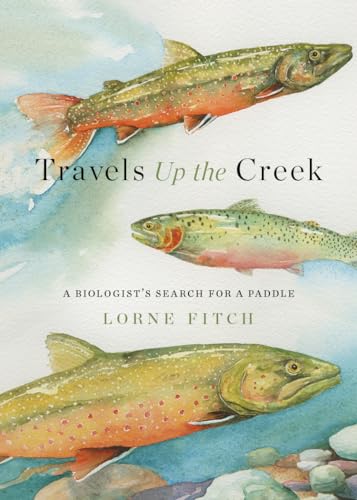
A new collection of essays that will engage readers, inspire change, raise awareness, nurture empathy, and reshape perspectives on environmental stewardship towards a sustainable future.
Travels Up the Creek intricately crafts stories of environmental awakening, drawing inspiration from Aldo Leopold, Stan Rowe, Wendell Berry, and Rachel Carson. This engaging journey confronts ecological challenges, advocating a shift in perspective and encouraging readers to embrace curiosity and scrutiny in contemplating the significance of our natural landscape. Urging environmental stewardship rooted in science, the book challenges groupthink, offering knowledge, motivation, and agency to those dedicated to creating a better world.
Exploring human-nature connections and stark realities, Lorne Fitch's new book underscores empathy, prompting readers to safeguard imperiled species and threatened places. A call to action in a world grappling with seemingly insurmountable issues, the book inspires change through education and a touch of righteous anger. A compelling guide for Earth stewards, it promises to contribute to a sustainable future for all.
Following his Streams of Consequence: Dispatches from the Conservation World, Lorne Fitch offers something new in Travels Up the Creek: A Biologist’s Search for a Paddle. Well not all new. Lorne still shares what can only be described as wisdom borne by wildness. And there is still a sharp edge whetted by science and by experience.
The author sets the tone in the preface when he says: “We should be scared, scared spitless in fact, of our current course. This could be an effective catalyst for change and adaptation instead of wishing for some technological miracle as our salvation.” When he says ‘scared spitless,’ he does not mean paralyzed by fear, he means motivated by a knowledge that to do nothing is to fail. He also acknowledges that “It’s easy to feel hopeless and it’s hard to do something about it” – but one must still do something about it.
Much of our failure to conserve a natural world capable of sustaining itself, of optimizing evolutionary opportunity, is the result of ignorance. This might be the refrain that holds the essays together. It is an ignorance pampered by affluence, ignorance unaccompanied by curiosity, ignorance with a taste for the irrational. Lorne Fitch shares a quote from Wallace Stegner who wisely pointed out, “Verifiable knowledge makes its way slowly and only under cultivation, but fable has burrs and feet and claws and wings and an indestructible sheath like a weed-seed, and can be carried almost anywhere and take rest without the benefit of soil or water.”
Much of Travels Up the Creek explores specific episodes of our failure to preserve what is most valuable. The author shares scientific insights like the relationship between measures like road density and the land-use footprint, and sediment and fish population persistence, and though the research results are exhaustive they are ‘unconscionably ignored’ by policy and practice. Lorne Fitch also shares examples of the ‘sliding baseline syndrome’ where ecosystem conditions of the distant past are thought to resemble the shared memories of a more recent past: actual changes become obscured by time and appropriate responses never come.
Possibly one of the most important messages in the book was the importance of recognizing that facts have little impact on changing minds and behaviour: “Facts, evidence and the weight of science often aren’t enough. Conflicts boil down to disagreements over values and priorities, even though they often masquerade as arguments over data. … Imagery, humour and stories [must be] used as vital pieces of effective communication.” And despite the realities being discussed in these essays, there is always humour and an engaging narrative in which people might recognize their better selves; a narrative that just might encourage social change.
“Nothing happens in environmental management until people agree to behave in ways that recognize the effects of their actions. With recognition comes responsibility, and with responsibility eventually comes accountability. Then we will understand the challenge of living the good life without abusing the generosity of the Earth.”
I can’t think of a much tougher job than someone trained as a wildlife biologist trying to save the environment in a place like Alberta. Yet author Lorne Fitch has fought that good fight for most of his adult life. This book is a collection of stories, essays really, about some of his experiences throughout his career, some of the uphill battles he’s fought, that others are still fighting. I knew of him from my days working as a communications director with the Alberta Wilderness Association when I lived in Calgary, although I never met him. Having been involved in that position for two years, I know full well what it’s like trying to get any kind of meaningful environmental protection in a place where it’s all about resource extraction. And that was over 25 years ago – it’s probably even more difficult now. Although many of the facts he lays out are quite depressing, he does provide some rays of hope, outlining what we can do to not necessarily turn back the clock, but at least make sure that there’s a clock ticking in the future. And it’s not all gloom and doom and somber writing – some of the stories he tells are peppered with humour, in many cases, poking fun at himself. Although this is all focussed on his experiences in Alberta – something I wasn’t aware of when I got the book – there are lessons for us that apply in the rest of Canada as well as just this one province. Science-based environmental stewardship is needed everywhere, even more so now than two years ago, when this book was published.
"Travels Up the Creek provides a perceptive view of environmental dilemmas in Alberta. This book successfully builds upon Fitch's previous book, Streams of Consequence. The author's extensive experience becomes evident through his fulsome descriptions and humorous anecdotes interlaced with cautionary tales. Everyone, no matter their prior knowledge of the topics covered, will learn something about Alberta's history and its approach to conservation through reading this book. I never tire of Fitch's candid storytelling." --Debborah Donnelly, Executive Director, Alberta Wilderness Association
Lorne Fitch’s Travels Up the Creek uplifts both land and community from the perspective of a professional biologist and co-founder of the riparian stewardship organization Cows & Fish. Over his long career in Alberta, Fitch has forged deep connections with communities of ranchers, farmers and researchers. Travels Up the Creek is both a celebration of the land—from places such as Hidden Creek in the eastern slopes through to the prairies and forests into which the mountain streams and rivers flow—and an unveiled look at the impacts of the climate crisis and the devaluation of scientific inquiry. Fitch is equally adept at recounting stories of the lands he’s known and worked with much of his life as he is at calling for awareness of political grandstanding and social media misinformation; the book blends research and narrative with aplomb. A story well told and intelligently and accurately sourced, he argues, can prove compelling to those who have not yet decided to take action in their own lives in support of the land: “Stories tell truths about place and the ways place can affect us. Our minds are shaped by place, as they are by our genes. Stories are the threads that connect our intellect, locate common ground and find the linkages between our history and our future....