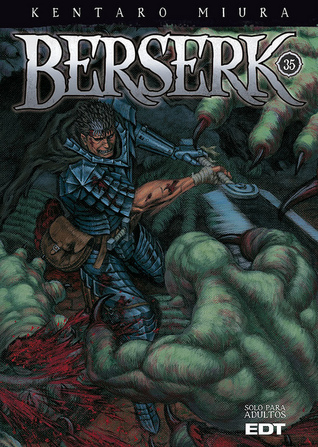
El mundo ha cambiado. Hasta el último rincón del planeta se extiende esta nueva realidad en la que campan a sus anchas monstruos y seres sobrenaturales de todo tipo que, solo unas horas antes, pertenecían al ámbito de la imaginación humana. En el centro de este nuevo mundo se materializa la inmensa e imponente capital del Halcón: “Falconia”. Griffith, que ha visto cumplido su sueño, entra en la ciudad con su Nueva Banda del Halcón y se dispone a gobernar el mundo desde ella. El mundo transmutado enseña también sus colmillos a Guts y sus compañeros, que prosiguen su travesía marítima hasta la isla de Skellig, donde se encuentra Elfhelm. ¡¡Un barco fantasma como el de las leyendas lanza su feroz ataque!! / Tomo publicado originalmente en Japón en septiembre de 2010.
Kentarou Miura (三浦建太郎) was born in Chiba City, Chiba Prefecture, Japan, in 1966. He is left-handed. In 1976, at the early age of 10, Miura made his first Manga, entitled "Miuranger", that was published for his classmates in a school publication; the manga ended up spanning 40 volumes. In 1977, Miura created his second manga called Ken e no michi (剣への道 The Way to the Sword), using Indian ink for the first time. When he was in middle school in 1979, Miura's drawing techniques improved greatly as he started using professional drawing techniques. His first dōjinshi was published, with the help of friends, in a magazine in 1982.
That same year, in 1982, Miura enrolled in an artistic curriculum in high school, where he and his classmates started publishing their works in school booklets, as well as having his first dōjinshi published in a fan-produced magazine. In 1985, Miura applied for the entrance examination of an art college in Nihon University. He submitted Futanabi for examination and was granted admission. This project was later nominated Best New Author work in Weekly Shōnen Magazine. Another Miura manga Noa was published in Weekly Shōnen Magazine the very same year. Due to a disagreement with one of the editors, the manga was stalled and eventually dropped altogether. This is approximately where Miura's career hit a slump.
In 1988, Miura bounced back with a 48-page manga known as Berserk Prototype, as an introduction to the current Berserk fantasy world. It went on to win Miura a prize from the Comi Manga School. In 1989, after receiving a doctorate degree, Kentarou started a project titled King of Wolves (王狼, ōrō?) based on a script by Buronson, writer of Hokuto no Ken. It was published in the monthly Japanese Animal House magazine in issues 5 and 7 of that year.
In 1990, a sequel is made to Ourou entitled Ourou Den (王狼伝 ōrō den, The Legend of the Wolf King) that was published as a prequel to the original in Young Animal Magazine. In the same year, the 10th issue of Animal House witnesses the first volume of the solo project Berserk was released with a relatively limited success. Miura again collaborated with Buronson on manga titled Japan, that was published in Young Animal House from the 1st issue to the 8th of 1992, and was later released as a stand-alone tankōbon. Miura's fame grew after Berserk was serialized in Young Animal in 1992 with the release of "The Golden Age" story arc and the huge success of his masterpiece made of him one of the most prominent contemporary mangakas. At this time Miura dedicates himself solely to be working on Berserk. He has indicated, however, that he intends to publish more manga in the future.
In 1997, Miura supervised the production of 25 anime episodes of Berserk that aired in the same year on NTV. Various art books and supplemental materials by Miura based on Berserk are also released. In 1999, Miura made minor contributions to the Dreamcast video game Sword of the Berserk: Guts' Rage. 2004 saw the release of yet another video game adaptation entitled Berserk Millennium Falcon Arc: Chapter of the Record of the Holy Demon War.
Since that time, the Berserk manga has spanned 34 tankōbon with no end in sight. The series has also spawned a whole host of merchandise, both official and fan-made, ranging from statues, action figures to key rings, video games, and a trading card game. In 2002, Kentarou Miura received the second place in the Osamu Tezuka Culture Award of Excellence for Berserk.[1]
Miura provided the design for the Vocaloid Kamui Gakupo, whose voice is taken from the Japanese singer and actor, Gackt.
Miura passed away on May 6, 2021 at 2:48 p.m. due to acute aortic dissection.
We can say this is another slow volume. Not much of any events happened really. First of all we get the finale of Falconia chapter, Which is the end of The Falcon of the millennium empire Arc as well. Griffiths leads his Groups to what seems to be the one thousand years kingdom, that was lost, and crumbled years ago. We are not really sure what The skeleton knight has done, after he helped Griffith (unintentionally) to create Fantasia. Then begins the Fantasia Arc, which i bet is not yet finished since the series is still at volume 40. And the Arc begins with Elf Island chapter. Now to talk about the most exciting thing in this chapter, the beauty whose picture is the opening of my review. She is called Isma, she is a mermaid Descendant or something, but they don't call them mermaids here, and she has powers we don't know anything about them yet, but our witch seen what seemed to be water spirits gathering around her, giving her a very beautiful aura, She is an interesting character, and i hope they keep her around, it shouldn't take too much convincing since her island is empty now. We also have another fight with the pirate ship, which has turned into a ghost ship now. Which leads our heroes to land on Isma's little island, and Isidiro meeting her, and the witch after him. But it turns out the island is infested with sea monsters, who serve or are part of the Old sea god. Slow volume but we are seeing now the real effects of the wind of Fantasia, which brought out all the monsters of the Astral realm, it seems to have merged the real world with the astral world, so no more do we have an interstice as we used too i guess.
Crazy-ass lovecraftian ghost pirates and sea monsters, with a dash of Innsmouth to taste. This whole ship journey gets bad flak, but it is an important voyage to an important destination, and it can't be done with without some kind of a challenge - and here we have some. It's just that it drags on a fair bit, as most things with Berserk do nowadays.
Petite ambiance à la Innsmouth dans ce tome 35 ! On assiste à la création de la cité de Falconia, à deux affrontements avec l'équipage de pirates, qui n'est pas sans faire penser à The Ghost Pirates de William Hope Hodgson, puis à une escale sur un drôle d'îlot qui lui rappelle The Shadow Over Innsmouth... avec en prime un navire qui caracole sur les falaises (!). L'ambiance de ce manga me rappelle de plus en plus celle du poème de Théophile de Viau :
'Un Corbeau devant moi croasse, Une ombre offusque mes regards, Deux belettes et deux renards Traversent l'endroit où je passe : Les pieds faillent à mon cheval, Mon laquais tombe du haut mal, J'entends craqueter le tonnerre, Un esprit se présente à moi, J'ois Charon qui m'appelle à soi, Je vois le centre de la terre.
Ce ruisseau remonte en sa source, Un bœuf gravit sur un clocher, Le sang coule de ce rocher, Un aspic s'accouple d'une ourse, Sur le haut d'une vieille tour Un serpent déchire un vautour, Le feu brûle dedans la glace, Le Soleil est devenu noir, Je vois la Lune qui va choir, Cet arbre est sorti de sa place.'
The last couple volumes have been a disappointment for me. As the series progresses Muira has removed Guts from the spotlight as anything more than a visual spectacle. As a main character he has fallen into the shadows and a new focus has been set on a more intimate ensemble of characters than in earlier volumes of Berserk. At first glance Guts appears to be a cardboard stereotype of the quiet, angry antihero one can find in a lot of adolescent-aimed media, but Muira skirted those expectations and crafted a really compelling character. Now, he is limited to standing off in the sidelines, stoically, and only reasserts his presence when the time comes to throw down against the latest crop of monsters. Where this was once Guts' story it's now...? I don't really know what's filling the void. In my opinion, the newer characters smack too much of the typical tropes that I have come to expect from anime. They are familiar character types that fail to fill out like Guts or Griffith, and pile on the antics that come with those types - and they do it in spades. I'm just not digging the new direction at all. My conclusion is that Muira doesn't know where to take Guts from here. It comes off like stalling. I mean, volume 34 and 35 feature the tired and true GHOST SHIP trope. Fucking facepalm.
Concluding the Falcon of the Millennium Empire Arc + Falconia Chapter
Emperor Ganishka was killed by Giffith, and the Skeleton Knight's sword of Actuation turned Ganishka's energy into some weird bomb with a wind that blew out from the epicenter has now changed the world. We saw medieval dragons, unicorns - all sorts of fantastical beasts popping up everywhere.
So Griffith has succeeded in his goals. He's set him self up with Charlotte, ruler of the armies, has an empire of his own now, and he's defeated his largest threat Ganishka of the Kushan empire. Here we see him manifest an enormous capital city. Huge structures and monuments. It looks glorious.
Starting Fantasia Arc / Elf Island Chapter The rest of the book focuses on Guts and co, especially Isidro and Schierke.
That wind has changed the pirates that were easily defeated into something out of Pirate's of the Caribbean. They're undead, and more powerful than ever. Also they are/or have a giant octopus squid monster. Thankfully Guts is back in action so he fends them off. After the battle the damage to the ship is so great, the team need to go to the nearest port for repairs. It happens to be a small island of fisherman, too small of a port for most ships to bother going to.
On the island is a mysterious young woman and an ominous cave. The fishermen are all avoiding the crew. Isidro goes to the cave and has a scare but talks with the woman Isma. Some funny scenes with Isidro perving on Isma and exaggerating his achievements. Schierke comes in search of Isidro. Which is unfortunate because Guts needs her to use his Berserker armor - and things go south back in the village. It turns out natives are all part of the octopus! And then the pirates come back too. Guts goes Berserk while Schierke is still on the other side of the island.
This entire review has been hidden because of spoilers.
This is the 35th volume in the Berserk series. These last few volumes have been very anti-climatic and a bit too wandering for my liking.
In this volume Guts and crew are attacked by a monstrous reincarnation of the ship and pirates they thought they had defeated a couple volumes back. They end up on a small island that is full of the same creepy lifeforms. It was kind of interesting but I was really puzzled by how this is tying into the overall story. I also feel like the overall story just isn’t actually going anywhere….
The drawing remains incredibly well done and there is a ton of action. I have no idea where we are going with this story here...and I am getting a bit frustrated with it.
Overall a good continuation of the Berserk series but a bit confusing as to wear things are going.
Guts and company have finally boarded the infamous boat, and the Millennium Falcon arch draws to a close. I have to stop here and say that Millennium's concluding scenes, Griffith’s final battle with Shiva-ascended Ganishka, and the world immersing into Fantasia, are so monumental, so staggering in their visual spectacle, that they will honestly serve as the gold standard for me in terms of just how far you can take sheer grandiosity and gravitas.
Guts has, to an extent, the most significant breakthrough in his personal journey in a long time, as he steps away from an opportunity to strike at Griffith for the sake of his friends. He considers his travelling party, his newfound family, and finds that a blind pursuit of his eternal vengeance might just rob him of what is truly most valuable (the series' central thesis right here?)
This truly inspired finale is followed up in volume 35 by a low-stakes settling into the world of Fantasia, with shiver-me-timbers pirates, a spooky Innsmouthian adventure and plenty of (so-so) slapstick comedy, this series keeping its tradition of shifting wildly between the majestic and the crude.
Ok, the ending of the Millenium Falcon arc was absolutely stunning, you could easily spend hours on these panels, even though there's barely any dialogue (which was not needed anyways). Berserk's artwork has always been highly praised, but the final battles and the Fantasia issue really set up an even higher standard, which I didn't think was possible. The main group continues to have a great dynamic, with strong character growth, like having Guts choosing to protect his newfound family over continuing his endless revenge quest. The rest of the 35th volume was pretty alright, with some tentacle zombie pirate action, and a girl who likes fishes a lot. Loved that the reaction to the fact that there is going to be some weird ritual and the gang is an offering is "what, this is happening again?? Nooo". Curious to see what else will happen on the famous boat!
Also, Kentaro Miura knew damn well how cool the Berserker Armor is and could not stop flexing it. Even all these volumes later my jaw just drops when I get to *those* panels. Berserk is one of those things that really just feels like it was made for me. It scratches an itch that only more Berserk can fill.
I will always be obsessed with the pure genius and masterwork of this series.
This volume finishes the Falcon of the Millennium Empire arc, in which so many things happen I have trouble gathering my thoughts. However, a repeated thought during this arc was that the author's mindset and tastes changed notoriously, as expected, during the around thirty years run of Berserk. This is no longer the viciously dark, uncompromising Berserk that it used to be during the haunting Golden Age arc. This is the Berserk of someone older, more serene, and kinder in a way. I can't imagine this version of the author slaughtering his precious characters the way he used to. He's been caring for some of those characters for around twenty to thirty years. They might as well be his actual children. He puts them in trouble regularly, but usually saving them just takes old protagonist Guts, now turned into a secondary character, to become more or less vicious and slaughter the enemy of the day. I do enjoy it a lot, but the thread following Guts and his companions is a sort of rom-com at this point.
The main thread that the name of this arc refers to has to do with Griffith, the legendary leader of the Band of the Hawk, who (huge spoilers for what happened to him up to this point) . He could have fucked around doing demonic stuff for the rest of eternity, but the guy had a dream he hadn't yet fulfilled. Griffith . An interesting side effect of Midland, basically fantasy Middle Ages Europe, falling apart is that its neighbor the Empire of Kushan, a sort of Islamized India, decided it was the right time to invade. Griffith . Military dark fantasy at its best.
The prominent example of how the tastes of the author have changed during this time is that he introduced an incongruous main character, the mage apprentice Schierke, a girl dressed like Gandalf. Although I like her well enough, her presence feels as if transplanted from a very different story. Berserk has always been something of a male power fantasy, with the protagonist being a muscled, hyper competent killing machine, but additionally the female companions now want his big sword (except his old girl Casca, curiously, who has been a drooling moron since the mid nineties). Schierke falls into that group. Daddy issues, I guess.
Aspects of relatively recent mangas/animes seem to come from parts of this arc. For example, the whole "wandering into a cave full of vicious mythological monsters that kidnap women and rape them because they can only reproduce that way" thing is featured prominently during a sequence in which Guts and Schierke attempt to rescue Casca and her babysitter Farnese; the former charming religious zealot is still around, and has an arc of her own.
It seems to me that the overarching arc of Berserk has been told: (spoilers for most of what happened up to this point) . What remains to tell?
The plotting has weakened, but it would have to become truly wretched for me to give the imagination and the artistry on display anything less than a five.
Not too big on this volume. Don't much care for the action on the boat. The exposition on the island is decent, but once you realize it's all a big Shadow Over Innsmouth reference, there isn't much left. The creepy sexualization of Isma is definitely unwelcome. This does pick up at the end, though. Otherwise, the continually amazing art and pre-existing love of the characters carries this volume.
In mare, i nostri affrontano di nuovo i pirati divenuti ora creature demoniache. E, costretti a fermarsi su un'isoletta per riparare la nave, cadono dalla padella alla brace.
Ma non riesco a farmi piacere questi demoni marini.
Kentaru Miura passing away so early in his life before he was able to complete a masterpiece of this scale is honestly one of the greatest tragedies of our time. This volume is the climax of the Falcon of the Millennium Empire Arc and the beginning of the Fantasia Arc, which is the final arc in the series... If you've read it then you know how fucking epic and beautiful and majestic it is. I'm in love with this story so much. I never want my journey with these characters to end.
This was bad ass moment after bad ass moment and in the end filled with awesomeness . I dont know why everyone keeps complaining about the boat saga , we are 3 volumes in and i am enjoying. This was superb as we see the effects of falconia across the world , while Guts goes on convalescent stage and he does it the only way he knows how , by kicking monster butts