

What do you think?

Alexander of Macedon, 356–323 B.C.: A Historical Biography
Until recently, popular biographers and most scholars viewed Alexander the Great as a genius with a plan, a romantic figure pursuing his vision of a united world. His dream was at times characterized as a benevolent interest in the brotherhood of man, sometimes as a brute interest in the exercise of power. Green, a Cambridge-trained classicist who is also a novelist, portrays Alexander as both a complex personality and a single-minded general, a man capable of such diverse expediencies as patricide or the massacre of civilians. Green describes his Alexander as "not only the most brilliant (and ambitious) field commander in history, but also supremely indifferent to all those administrative excellences and idealistic yearnings foisted upon him by later generations, especially those who found the conqueror, tout court, a little hard upon their liberal sensibilities."
This biography begins not with one of the universally known incidents of Alexander's life, but with an account of his father, Philip of Macedonia, whose many-territoried empire was the first on the continent of Europe to have an effectively centralized government and military. What Philip and Macedonia had to offer, Alexander made his own, but Philip and Macedonia also made Alexander form an important context for understanding Alexander himself. Yet his origins and training do not fully explain the man. After he was named hegemon of the Hellenic League, many philosophers came to congratulate Alexander, but one was conspicuous by his absence: Diogenes the Cynic, an ascetic who lived in a clay tub. Piqued and curious, Alexander himself visited the philosopher, who, when asked if there was anything Alexander could do for him, made the famous reply, "Don't stand between me and the sun." Alexander's courtiers jeered, but Alexander silenced them: "If I were not Alexander, I would be Diogenes." This remark was as unexpected in Alexander as it would be in a modern leader.
For the general reader, the book, redolent with gritty details and fully aware of Alexander's darker side, offers a gripping tale of Alexander's career. Full backnotes, fourteen maps, and chronological and genealogical tables serve readers with more specialized interests.
This biography begins not with one of the universally known incidents of Alexander's life, but with an account of his father, Philip of Macedonia, whose many-territoried empire was the first on the continent of Europe to have an effectively centralized government and military. What Philip and Macedonia had to offer, Alexander made his own, but Philip and Macedonia also made Alexander form an important context for understanding Alexander himself. Yet his origins and training do not fully explain the man. After he was named hegemon of the Hellenic League, many philosophers came to congratulate Alexander, but one was conspicuous by his absence: Diogenes the Cynic, an ascetic who lived in a clay tub. Piqued and curious, Alexander himself visited the philosopher, who, when asked if there was anything Alexander could do for him, made the famous reply, "Don't stand between me and the sun." Alexander's courtiers jeered, but Alexander silenced them: "If I were not Alexander, I would be Diogenes." This remark was as unexpected in Alexander as it would be in a modern leader.
For the general reader, the book, redolent with gritty details and fully aware of Alexander's darker side, offers a gripping tale of Alexander's career. Full backnotes, fourteen maps, and chronological and genealogical tables serve readers with more specialized interests.
674 pages, Kindle Edition
First published August 1, 1991
About the author
Peter Green
66 books92 followersThere is more than one author by this name in the database.
Peter Morris Green was a British classical scholar and novelist noted for his works on the Greco-Persian Wars, Alexander the Great and the Hellenistic Age of ancient history, generally regarded as spanning the era from the death of Alexander in 323 BC up to either the date of the Battle of Actium or the death of Augustus in 14 AD.
Peter Morris Green was a British classical scholar and novelist noted for his works on the Greco-Persian Wars, Alexander the Great and the Hellenistic Age of ancient history, generally regarded as spanning the era from the death of Alexander in 323 BC up to either the date of the Battle of Actium or the death of Augustus in 14 AD.
Ratings & Reviews
Friends & Following
Create a free account to discover what your friends think of this book!
Community Reviews
Displaying 1 - 30 of 152 reviews
Read
August 2, 2019Peter Green is incorrect in many aspects of ancient Macedonia. He refers to them as barbarians in the meaning of foreigners. In fact the Athenians referred to Sparta and Macedonia as barbarians meaning uncultured and brutish and certainly not foreigners. I have studied the Greek writings on ancient Greece for 35 years. The Macedonians had Greek names, writings, gods, months of the year, spoke a Greek dialect, all coins throughout ancient Macedonias history were Greek,. Many ancient Macedonians participated in the ancient Greek OLYMPICS. They spread Greek culture and ideals, Alexander United the Greeks against the Persians. PELLA the ancient capital of Macedonia is still in Greece today. Peter Green is a puppet for Slav Macedonian propaganda and not much of a historian.

August 26, 2020
Sincerely void of enjoyment. Other biographies like Robin Lane Fox's look magical next to this.
There is way too much Phillip in the beginning for a book on Alexander, despite admitting they rarely saw eachother.
Overall very biased and opinionated. I wish the 'theories' he had were shown as theory and kept that way. He seemed to draw many conclusions from inaccurate and biased sources. I wish it was more of a biography than an opinion piece.
Enjoyed his character studies of Alexander but the writing was empty and dull. 👎
There is way too much Phillip in the beginning for a book on Alexander, despite admitting they rarely saw eachother.
Overall very biased and opinionated. I wish the 'theories' he had were shown as theory and kept that way. He seemed to draw many conclusions from inaccurate and biased sources. I wish it was more of a biography than an opinion piece.
Enjoyed his character studies of Alexander but the writing was empty and dull. 👎

March 31, 2013
Could not get past page 50

March 3, 2019
More of a Research paper. Concludes with referring to other books :).
December 10, 2010
This was such a long and boring book that I almost didn't get through it. Ughh...I am so happy to be done with it. For one, the author just didn't have a very interesting writing style to allow the reader to get into. The writing was very dry and was just facts, I never felt like I got to know the people at all, and that is what, I think, turns people off from reading about history. If the people in the book aren't personable then readers don't get invested in the characters, and therefore don't care about them. For another, the author assumes the reader knows more about every subject that he even briefly mentions, which makes for a very confusing read. To read and understand everything that the author mentions in this book you would have to be an expert ancient historian. I am all for learning about new things when I read a book, afterall, that is why I read so many books about history, but when I have to sit there with paper in hand to write down each person or event the author mentions so I can look them up later, the author is not doing a very good job of writing. Many people gave this book five stars and the author raving reviews, and maybe I'm just missing something...or maybe you are the expert ancient historians that I mentioned earlier, and are way smarter than me. In any case, this book was not for me, and I wouldn't recommend this to anyone except maybe if they wanted an alternative to a sleeping pill at night.

December 30, 2015
I wouldn't recommend as a 1st book on the subject

November 24, 2014
Peter Green's thesis I'm p. sure: Alexander was a warmongering genius with a embarrassing god-complex, but in a super hot interesting way.

June 18, 2011
1) ''[...] Alexander used to complain to his friends that his father was anticipating him in everything---'And for me,' he said, 'he will leave no great or brilliant achievement to be displayed to the world with your aid.' 'But,' his friends objected, 'he is acquiring all this for you.' Alexander replied: 'What use are possessions to me if I achieve nothing?'''
2) ''Every individual biographer, myself included, inevitably puts as much of himself, his own background and convictions, into that Protean figure as he does of whatever historical truth he can extract from the evidence. The power and fascination of Alexander's character are undeniable, and operate as strongly on modern scholars as they did on his Macedonian veterans. The king's personality is so strong, so idiosyncratic, that it comes through despite all the propaganda, pro or con: the smears, the eulogies, the star-struck mythologizing.''
2) ''Every individual biographer, myself included, inevitably puts as much of himself, his own background and convictions, into that Protean figure as he does of whatever historical truth he can extract from the evidence. The power and fascination of Alexander's character are undeniable, and operate as strongly on modern scholars as they did on his Macedonian veterans. The king's personality is so strong, so idiosyncratic, that it comes through despite all the propaganda, pro or con: the smears, the eulogies, the star-struck mythologizing.''

February 10, 2010
Alexander being my favorite historical personality, I've read much on him. I highly recommend this book as maybe the best modern biography of the Great one.
Alexander was a complex man who realized Greek dreams by conquering the Persian Empire. He never lost a battle and at the time of his untimely death ruled more land than anyone ever had previously, or would again until Genghis Khan if I'm not mistaken. He was intelligent, a great general and soldier, and above all: lucky. Favor of the gods I suppose they would have called it back in the day.
Alexander's biggest stroke of luck was that his father Philip was killed after he had set everything up so well. Of course maybe it wasn't luck...but I digress. It was Philip who made the Macedonian army a force to be reckoned with. It was Philip who trained the generals who fought for his son in Asia. It was Philip who conquered Greece, weakening it so that all Alexander had to do before he left forever was to raze one city to the ground (Thebes) to cow the entire populace. It was Philip who taught Alexander how to be a soldier and general and king. It was Philip who brought Aristotle of all people to be his son's tutor. (This is like Obama paying Stephen Hawking to tutor Sasha and Malia, LOL.) Poor Philip. He gets little love from historians, and he received none from Alexander, who insisted he was the son of Zeus himself. Thankfully there is nice coverage by Green of the rise of Macedon under Philip!
Alexander's one failure was intrinsic to his personality. It could be no other way I suppose. Alexander won his battles partly due to his physical presence on the field of battle, and was wounded many times. Since he always won, he always had cause to celebrate, and celebrate he did with much alcohol flowing. Wounds and alcoholism coupled with the multitudinous diseases of Asia at the time meant that he would almost necessarily have a short life. Add to the mix that you're quite the assassination target when you basically rule the world, and you have a recipe for disaster. At his death his empire crumbled, and the Successors and their successors fought each other for centuries, those using Rome winning until finally Rome started doing the using and took over everything.
Alexander was a complex man who realized Greek dreams by conquering the Persian Empire. He never lost a battle and at the time of his untimely death ruled more land than anyone ever had previously, or would again until Genghis Khan if I'm not mistaken. He was intelligent, a great general and soldier, and above all: lucky. Favor of the gods I suppose they would have called it back in the day.
Alexander's biggest stroke of luck was that his father Philip was killed after he had set everything up so well. Of course maybe it wasn't luck...but I digress. It was Philip who made the Macedonian army a force to be reckoned with. It was Philip who trained the generals who fought for his son in Asia. It was Philip who conquered Greece, weakening it so that all Alexander had to do before he left forever was to raze one city to the ground (Thebes) to cow the entire populace. It was Philip who taught Alexander how to be a soldier and general and king. It was Philip who brought Aristotle of all people to be his son's tutor. (This is like Obama paying Stephen Hawking to tutor Sasha and Malia, LOL.) Poor Philip. He gets little love from historians, and he received none from Alexander, who insisted he was the son of Zeus himself. Thankfully there is nice coverage by Green of the rise of Macedon under Philip!
Alexander's one failure was intrinsic to his personality. It could be no other way I suppose. Alexander won his battles partly due to his physical presence on the field of battle, and was wounded many times. Since he always won, he always had cause to celebrate, and celebrate he did with much alcohol flowing. Wounds and alcoholism coupled with the multitudinous diseases of Asia at the time meant that he would almost necessarily have a short life. Add to the mix that you're quite the assassination target when you basically rule the world, and you have a recipe for disaster. At his death his empire crumbled, and the Successors and their successors fought each other for centuries, those using Rome winning until finally Rome started doing the using and took over everything.

February 18, 2019
I guess it is mostly superfluous at this point, more than forty years after the first printing, perhaps the most widely celebrated Alexander biography in my lifetime, and even now enjoying robust reader ratings. With combined skills as writer, researcher, teacher and translator of Greek primary sources, Peter Green bettered most of the 20th-century scholars with this primarily popular account.
For an enjoyable look at Alexander, the world he lived in and how he impacted it, this is certainly one of the best secondary accounts I have read. Some have said that Green has been too negative about Alexander. It is all here, the good and the bad and the ugly. Was Alexander great? This book should help to envision a realistic Alexander, along with other avenues of adventure to last a lifetime.
For an enjoyable look at Alexander, the world he lived in and how he impacted it, this is certainly one of the best secondary accounts I have read. Some have said that Green has been too negative about Alexander. It is all here, the good and the bad and the ugly. Was Alexander great? This book should help to envision a realistic Alexander, along with other avenues of adventure to last a lifetime.

May 27, 2013
I have a very hard time giving this book a star rating since it is not the kind of book I normally read. I liked it and learned quite a bit so I am going to give it 3 stars. I should point out that the volume of info presented is so vast that I am sure I have only retained a small percentage of it. I might say some things that could be considered spoilerish, but it is history so be forewarned. The reason I read this book is because I wanted to know more about Alexander the Great and now I do! The writing is very dry, that is what I expected and that was fine for this kind of book.
This historical biography of Alexander of Macedon begins with his father, King Philip II. Philip basically united all the Macedonians into one centralized structure. Before this they had just been many tribes. Of course, a King wants an heir and Philip's third wife, Olympias, "produced a son," Alexander. I am not going to go into detail on the various conquests. They were described as savage and bloody. Women and old men were "subjected to outrage without limit" and there were "piteously wailing children." If these things didn't happen, it was because everyone was dead. Whether just to pick a fight with another ruler or in search of gold and silver, Philip exerted his muscles over more and more territory. Alexander was just like his father and when Philip was murdered, Alexander continued conquering. Alexander wanted to conquer the world, too bad for him his geography was not quite correct. He made it into the Indus valley, just barely. I knew that he had never made it very far into India and I always wondered why. Well, eight years into his conquering campaign and his troops had had enough, they wanted to go home. His armies mutinied, then someone poisoned him and he never made it back to Macedonia.
This historical biography of Alexander of Macedon begins with his father, King Philip II. Philip basically united all the Macedonians into one centralized structure. Before this they had just been many tribes. Of course, a King wants an heir and Philip's third wife, Olympias, "produced a son," Alexander. I am not going to go into detail on the various conquests. They were described as savage and bloody. Women and old men were "subjected to outrage without limit" and there were "piteously wailing children." If these things didn't happen, it was because everyone was dead. Whether just to pick a fight with another ruler or in search of gold and silver, Philip exerted his muscles over more and more territory. Alexander was just like his father and when Philip was murdered, Alexander continued conquering. Alexander wanted to conquer the world, too bad for him his geography was not quite correct. He made it into the Indus valley, just barely. I knew that he had never made it very far into India and I always wondered why. Well, eight years into his conquering campaign and his troops had had enough, they wanted to go home. His armies mutinied, then someone poisoned him and he never made it back to Macedonia.

May 17, 2015
I did enjoy this one. Alexander the Great has been the benchmark for all military leaders/conquerors since 300 BC. Romans, Germans, and Huns all wanted to emulate the military prowess of Phillip's son. Alexander with a small army of crack Macedonians defeated the Persian Empire and moved on into India. He subjugated the then known world. His avarice and thirst for conquest knew no bounds. His creation of a strong government to solidify his empire was an afterthought. As soon as Alexander died, his empire fractured. Some outstanding military commanders are thus not destined to rule. Such was Alexander. I highly recommend the subject and the book.

September 17, 2013
To each culture and to each period in time, Alexander the Great has meant something different, and each generation that recounts his history tends to do so from a different political and social perspective. To the Republic and Empire of Rome he was a noble conqueror; to the Greeks of his time he was a tyrant; to the Indians he was no more than a passing barbarian. To Peter Green (in 1970) he is a man standing upon the shoulders of others, making his own history as he goes, and, like so many absolute rulers, touching it up in retrospect to obscure flaws and preserve the illusion of his infallibility. For all his greatness, Alexander was not perfect. Alexander is reliant upon others, much as he may have been loathe to admit. Without his army, his father, his commanders, his Macedonian core, his fame may never have reached such heights. They are the tentpole upon which all of his successes hang.
Green says as much at the outset of his work:
Nevertheless, Alexander is a powerful historical figure as an individual. So much so that his history is commandeered and contorted to espouse a variety of ideals.
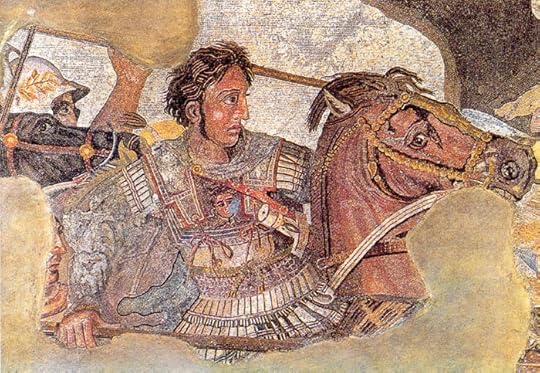
Mosaic of Alexander at the battle of Issus, BCE 333.
Green attempts to eschew these proclivities, see past the propaganda, and give an account free of ideology (though he admits this isn't possible, even for someone conscious of the possibility). Green paints a sometimes unflattering picture of Alexander. Alexander comes off as impertinent, quick-tempered, self-righteous, vengeful, surrounded by capable commanders, and the beneficiary of those who were ill-prepared to deal with an army his father had created. Granted, if Alexander had been completely devoid of ability he would not have stifled the resentful Greek city states, obliterated the massive Persian empire, quashed repeated revolts, subdued a large swath of India in spite of horrendous conditions and fierce resistance. He is, at the same time, depicted as cool under pressure, well educated in classics, a brilliant strategist, a profoundly successful manipulator, motivator, and an unprecedented logistical wunderkind. But to say he did so entirely of his own accord, built the mechanisms of government necessary to do so, and developed the processes of army training and unique characteristics of the Macedonian phalanx (considerably longer spears, for example) from the ground up would be a mistake.
Similarly, it would be a mistake to believe that wherever Alexander trod, citizens bowed to his leadership. Where Greece is concerned, nothing could be further from the truth-—Alexander’s lust for conquest presumably made him indifferent to the turmoil there that had little interest in being ruled from afar by a Macedonian king, charitable or hostile though he may be.
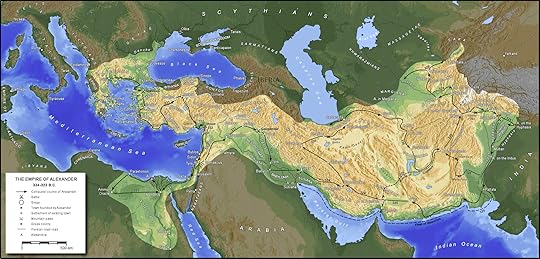
Alexander is a man raised to believe he is special, a new Achilles, and this hubris taints Green’s interpretation of him, believing he is often guided by own grandeur rather than sensibility (from a political rather than tactical standpoint, in any case), and the pursuit of a great destiny rather than the solidification of the empire he created. Alexander is lauded for his ability to suppress a wide variety of cultures and bring them under his banner, a feat that, even in this age of modern warfare and superpowers vying against meager militaries in distant countries, is all but impossible. Green sees this less an example of brilliance than an afterthought and consequence of expediency as the army moved hastily on its route through southern Asia. Essentially, conquered people remained just as they had been. Nothing changed but the landlord. Even so, revolts invariably sprang up as soon as he left, making the map of his empire something of a misrepresentation and more of a catalog of places he had been and conquered.
Perhaps most astounding about the history is how much information is available, particularly the minutiae, including, in some cases, the precise quantity of bribes to individuals. Alexander himself is to be thanked in this regard, considering he had the foresight (at least on his Asian campaign) to take not just soldiers, but historians, zoologists, botanists, and a wealth of other individuals with a mind to catalog everything they witnessed. This was a consequence of both Alexander’s tutelage under Aristotle, as well as a very concerted effort to record his history in the most favorable method possible, both for the purpose of his legacy and to quell discontent in the regions under his control.
Most refreshing is the perspective one gains from time and the ability to call upon prior biographies, from sources as ancient as Plutarch and Ptolemy, to more contemporary (relatively speaking) sources originating from the middle ages through colonial and even early 20th century, noting how they choose to present Alexander according to the sentiment and ideology of the writer and culture--something Green notes his own writing invariably suffers from as well. He notes in Alexander's time he was viewed as a tyrannical, militant autocrat; during the height of the Roman and British empires as a laudable imperialist seeking to enlighten the world through Hellenism; and a liberator from monarchy during the revolutionary periods of the late 18th and early 19th centuries. Green himself presents Alexander as a brilliant tactician, planner, and propagandist done in by megalomania brought on by his unprecedented successes and an empire he sought ever to expand rather than consolidate and secure.
From a contemporary standpoint, as one might expect, this is a wholly satisfying stance to take. The general consensus views conquerors as people seeking their own gratification and power rather than fellowship--those who do seek fellowship don't use military domination as their tool since doing so is effective against armies, but not populations.
In the end, Green's biography borders on cynical, painting Alexander less as the deity he believed himself to be and an example to which others compared themselves (notably, Julius Caesar), and more of an ambitious human with a tremendous opportunity, and both the will and acumen to see it through.
This is a stellar, humanizing work, and a brisk one, too, even at more than 500 hundred pages (including the appendix, which makes convincing sense of the cluttered details surrounding the pivotal battle at the Granicus river). For anyone interested in the subject and the period, this is an excellent place to start and a reliable place to return to.
Green says as much at the outset of his work:
“Genius Alexander had, and in full measure; yet even genius remains to a surprising extent the product of its environment. What Alexander was, Philip [Alexander’s father] and Macedonia in great part made him, and it is with them that we must begin.”
Nevertheless, Alexander is a powerful historical figure as an individual. So much so that his history is commandeered and contorted to espouse a variety of ideals.
Mosaic of Alexander at the battle of Issus, BCE 333.
Green attempts to eschew these proclivities, see past the propaganda, and give an account free of ideology (though he admits this isn't possible, even for someone conscious of the possibility). Green paints a sometimes unflattering picture of Alexander. Alexander comes off as impertinent, quick-tempered, self-righteous, vengeful, surrounded by capable commanders, and the beneficiary of those who were ill-prepared to deal with an army his father had created. Granted, if Alexander had been completely devoid of ability he would not have stifled the resentful Greek city states, obliterated the massive Persian empire, quashed repeated revolts, subdued a large swath of India in spite of horrendous conditions and fierce resistance. He is, at the same time, depicted as cool under pressure, well educated in classics, a brilliant strategist, a profoundly successful manipulator, motivator, and an unprecedented logistical wunderkind. But to say he did so entirely of his own accord, built the mechanisms of government necessary to do so, and developed the processes of army training and unique characteristics of the Macedonian phalanx (considerably longer spears, for example) from the ground up would be a mistake.
Similarly, it would be a mistake to believe that wherever Alexander trod, citizens bowed to his leadership. Where Greece is concerned, nothing could be further from the truth-—Alexander’s lust for conquest presumably made him indifferent to the turmoil there that had little interest in being ruled from afar by a Macedonian king, charitable or hostile though he may be.
Alexander is a man raised to believe he is special, a new Achilles, and this hubris taints Green’s interpretation of him, believing he is often guided by own grandeur rather than sensibility (from a political rather than tactical standpoint, in any case), and the pursuit of a great destiny rather than the solidification of the empire he created. Alexander is lauded for his ability to suppress a wide variety of cultures and bring them under his banner, a feat that, even in this age of modern warfare and superpowers vying against meager militaries in distant countries, is all but impossible. Green sees this less an example of brilliance than an afterthought and consequence of expediency as the army moved hastily on its route through southern Asia. Essentially, conquered people remained just as they had been. Nothing changed but the landlord. Even so, revolts invariably sprang up as soon as he left, making the map of his empire something of a misrepresentation and more of a catalog of places he had been and conquered.
Perhaps most astounding about the history is how much information is available, particularly the minutiae, including, in some cases, the precise quantity of bribes to individuals. Alexander himself is to be thanked in this regard, considering he had the foresight (at least on his Asian campaign) to take not just soldiers, but historians, zoologists, botanists, and a wealth of other individuals with a mind to catalog everything they witnessed. This was a consequence of both Alexander’s tutelage under Aristotle, as well as a very concerted effort to record his history in the most favorable method possible, both for the purpose of his legacy and to quell discontent in the regions under his control.
Most refreshing is the perspective one gains from time and the ability to call upon prior biographies, from sources as ancient as Plutarch and Ptolemy, to more contemporary (relatively speaking) sources originating from the middle ages through colonial and even early 20th century, noting how they choose to present Alexander according to the sentiment and ideology of the writer and culture--something Green notes his own writing invariably suffers from as well. He notes in Alexander's time he was viewed as a tyrannical, militant autocrat; during the height of the Roman and British empires as a laudable imperialist seeking to enlighten the world through Hellenism; and a liberator from monarchy during the revolutionary periods of the late 18th and early 19th centuries. Green himself presents Alexander as a brilliant tactician, planner, and propagandist done in by megalomania brought on by his unprecedented successes and an empire he sought ever to expand rather than consolidate and secure.
From a contemporary standpoint, as one might expect, this is a wholly satisfying stance to take. The general consensus views conquerors as people seeking their own gratification and power rather than fellowship--those who do seek fellowship don't use military domination as their tool since doing so is effective against armies, but not populations.
In the end, Green's biography borders on cynical, painting Alexander less as the deity he believed himself to be and an example to which others compared themselves (notably, Julius Caesar), and more of an ambitious human with a tremendous opportunity, and both the will and acumen to see it through.
This is a stellar, humanizing work, and a brisk one, too, even at more than 500 hundred pages (including the appendix, which makes convincing sense of the cluttered details surrounding the pivotal battle at the Granicus river). For anyone interested in the subject and the period, this is an excellent place to start and a reliable place to return to.

July 20, 2020
I was thinking about rating it at 4 out of 5, while also mentioning that this feels like a 5 out of 5 read. The difference in rating would have been from my expectations. What separates Peter Green from other historians is his capability of narrating events in a captivating way (see for example his Greco-Persian Wars). Unfortunately, this time he found me in not quite the right mood for that, as I felt that what I wanted was more facts and less story-telling, or at least have the balance inclined on the facts side more than on the stories side. Sometimes it can be difficult to find the facts through all the story telling, as there are no sub-headings within the chapters, and if you don't take notes you might have a difficult time finding what you're interested in (unless you want a re-read). Anyway, I don't think there is a better work on Alexander the Great out there (not that I am aware of at least), and it covers psychological, social, cultural aspects as well, so this would qualify as a 5 out of 5, in the end. Some updated maps would have been welcomed (also the dissolution of Yugoslavia in the mean time should have been mentioned) with this 2013 edition.

October 29, 2008
Green's biography of Alexander is erudite and skeptical, with a decidely old-fashioned sensibility. The Alexander that emerges from these pages is history's most gifted military commander and a regicide, a skilled manipulator of men and generous to a fault, a raging alcoholic (even compared to his alcohol-stewed macedonian compatriots) and a man of iron constitution, a world-strider and the progenitor of an empire that evaporated as soon as his heart stilled. More importantly, Green's Alexander is a megalomaniac driven by the thirst for martial glory and conquest, at the expense of all (and everyone) else.
Nothing Romantic (with a captial 'R') here. Green's analysis of sources at the end of his work, as well as the discussion of problem surrounding our knowledge of the Granicus, is particularly enlightening.
Highly Recommended.
Nothing Romantic (with a captial 'R') here. Green's analysis of sources at the end of his work, as well as the discussion of problem surrounding our knowledge of the Granicus, is particularly enlightening.
Highly Recommended.

November 3, 2017
The first couple of chapters on Philip were a little disconcerting as the author kept referring to all these inside jokes and historically-nuanced motives and stories I just wasn't familiar with. I felt like he was talking to his professor buddies. After he got that all off his chest, he really settled down into a great, readable story about Alexander's conquests. I really enjoyed this book, which was cool since I don't read a ton of ancient history. My interest is piqued now!

January 13, 2012
While Green does an excellent job reconstructing the life of Alexander factually, his attempts to psychoanalyze the famed monarch from a remove of 2500 years is farcical and full of holes.

March 22, 2016
Had to skip around a bit, much too heavy of a read, with many instances of looking up my dictionary on my iPhone while reading. I gained some overall knowledge but had to put it down. I am a savvy patient reader but this book is better suited for an already versed history buff with a good background in greek history to be able to appreciate all the incredible citing of events.
March 24, 2020
讀完講談社的亞歷山大的征服與神話
想到這本書買了一年多都沒看
趁著記憶猶新趕緊來把這本書看完
人名地名翻法都和"亞歷山大的征服與神話"類似
再不行也有附上拉丁文拼寫可以查找
所以銜接不是什麼大問題
翻譯在前半本還挺流暢的
但中段開始翻譯腔就越來越重
子句都用破折號框起來
英文愛用的反問句也忠實呈現
太多跟中文語法不合的句子變成很難閱讀
這本專注在亞歷山大行誼
史事比講談社的詳細許多
但不多談希臘化的事情
不過在亞歷山大中二的行徑之中
我們自可看出希臘化的大同世界是一個神話
因為連當代的人也不吃這一套XD
看完整本下來我只有一個感想:
亞歷山大就是個只想到自己又愛記仇的任性屁孩
很不幸的是這個屁孩在打仗上是個空前絕後的天才
苦了那些馬其頓老兵們
加上越往東走,越是剛愎自用
目的達成就迫不及待烹掉那些勞苦功高的走狗們
實在是一個爛老闆啊
作者很喜歡拿希羅名著和後世作品及史事
來格義亞歷山大的種種行為
順便在個人評論裡偷酸傳主
(這行為感覺十分英國人XD)
希臘化的名字又很難記憶
對不熟悉西洋典故的我來說
就算有註釋還是不太容易懂
要不是先讀過講談社本
這本書還是會繼續放在硬碟裡不見天日吧
對於不熟悉的事物,讀起來特別累
我現在已經深陷閱讀舒適圈之中
只想在熟悉的題材中繼續精進
對這種要重新打底的新領域,越來越缺乏探索的勇氣了Orz
想到這本書買了一年多都沒看
趁著記憶猶新趕緊來把這本書看完
人名地名翻法都和"亞歷山大的征服與神話"類似
再不行也有附上拉丁文拼寫可以查找
所以銜接不是什麼大問題
翻譯在前半本還挺流暢的
但中段開始翻譯腔就越來越重
子句都用破折號框起來
英文愛用的反問句也忠實呈現
太多跟中文語法不合的句子變成很難閱讀
這本專注在亞歷山大行誼
史事比講談社的詳細許多
但不多談希臘化的事情
不過在亞歷山大中二的行徑之中
我們自可看出希臘化的大同世界是一個神話
因為連當代的人也不吃這一套XD
看完整本下來我只有一個感想:
亞歷山大就是個只想到自己又愛記仇的任性屁孩
很不幸的是這個屁孩在打仗上是個空前絕後的天才
苦了那些馬其頓老兵們
加上越往東走,越是剛愎自用
目的達成就迫不及待烹掉那些勞苦功高的走狗們
實在是一個爛老闆啊
作者很喜歡拿希羅名著和後世作品及史事
來格義亞歷山大的種種行為
順便在個人評論裡偷酸傳主
(這行為感覺十分英國人XD)
希臘化的名字又很難記憶
對不熟悉西洋典故的我來說
就算有註釋還是不太容易懂
要不是先讀過講談社本
這本書還是會繼續放在硬碟裡不見天日吧
對於不熟悉的事物,讀起來特別累
我現在已經深陷閱讀舒適圈之中
只想在熟悉的題材中繼續精進
對這種要重新打底的新領域,越來越缺乏探索的勇氣了Orz
March 12, 2009
The best of the several biographies of Alexander that I've read. The book succeeds because Green does more than simply know his stuff; he's an elegant writer who does a wonderful job of evoking classical antiquity, and he is particularly strong when describing the world of the near East during that time. He has a novelist's knack for character and place, so the sense you get of the kind of person Alexander was (or his mother and father, Philip and Olympias, for that matter) is always strong and clear, as is his evocation of the great cities and places of antiquity: Thebes, Tyre, Sardis, Babylon. Finally, the most compelling aspect of the book is that Green, though never once straying into hyperbole or hagiography, strongly conveys the sense of wonder that some of us felt when first hearing stories of semi-legendary figures like Alexander. That he does so calmly and cooly, with stylish prose, is all to his credit. The best example of this is his masterful description of the lusty Macedonian warrior aristocracy; as you read these passages, which are sprinkled throughout the book and relate to both Philip and Alexander's career, the powerful feeling of recognition forms -- yes, you find yourself saying, that's exactly how it must have been, even though you have never sat on a horse, besieged or plundered a city, or swilled wine at a Macedonian drinking party. Very highly recommended.

December 23, 2019
"-Where is Great Alexander?
- Great Alexander lives and reigns."
- Medieval Greek proverb
Alexander still lives today. He lives in all of us. Every time we read (or write) his biographies we let him relieve his life again in a manner that we want him to, creating a vision of ourselves in his history. Today he is whoever we make him out to be - a god, a despotic dictator, a fair monarch, an excellent chief or a mad man who could never satisfy his greed. One is sure, he represents human nature to this day.
As to Peter Green, I really enjoyed his biography. It served as a great introduction to Alexander's story. It covered everything I could ask for; from the historical background to psychological aspects. It included maps and battle plans which were a nice addition. I also loved how it read more like an adventure story rather than boring and long nonfiction. The bibliography is rich and consists of countless interesting positions for those who want to expand their knowledge. Also, it's a huge bonus that Green doesn't present just one point of view, he tries to explain all of the alternatives and arguments speaking for and against them. He suggests the most probable version, yet in the end, it's up to the reader to judge.
All in all, this biography only deepened my love for Alexander, and I'm sure I'll soon find myself reading more about that fascinating man.
- Great Alexander lives and reigns."
- Medieval Greek proverb
Alexander still lives today. He lives in all of us. Every time we read (or write) his biographies we let him relieve his life again in a manner that we want him to, creating a vision of ourselves in his history. Today he is whoever we make him out to be - a god, a despotic dictator, a fair monarch, an excellent chief or a mad man who could never satisfy his greed. One is sure, he represents human nature to this day.
As to Peter Green, I really enjoyed his biography. It served as a great introduction to Alexander's story. It covered everything I could ask for; from the historical background to psychological aspects. It included maps and battle plans which were a nice addition. I also loved how it read more like an adventure story rather than boring and long nonfiction. The bibliography is rich and consists of countless interesting positions for those who want to expand their knowledge. Also, it's a huge bonus that Green doesn't present just one point of view, he tries to explain all of the alternatives and arguments speaking for and against them. He suggests the most probable version, yet in the end, it's up to the reader to judge.
All in all, this biography only deepened my love for Alexander, and I'm sure I'll soon find myself reading more about that fascinating man.

May 4, 2020
Great to get knowledge on such a vastly influential figure. Green attempts to distinguish between fact and legend despite the impossibility of that task after over 2000 years of time. Must read for history buffs as the influence of Alexander can be found on so many different men and works throughout time. There are so many interesting and little known elements to this story.

September 26, 2023
An academic work of history that strikes a perfect balance between engaging narration, discussion of sources, and analysis of events. Requires some background knowledge, but in return delivers a rivetting and in-depth account of Alexander, his mastery of politics, his personality and his entourage. I think all the 1-2 star reviews speaks volumes about who the intended audience is.

November 19, 2013
Alexander of Macedon, 356-323 B.C.: A Historical Biography
Peter Green
Read it in old Hard Cover, 617 w/ biblio+apendix+etc.
Our final Historic Side Pot of 2014 and what a resounding success. Green gives all of the elaboration of a true historian but is able to retain a lot of the flavor that makes fictitious accounts of the facts of Alexander so interesting. While some Historians summarize culturally, militarily, or politically, Green instead gives more than adequate attention to all of them. Alexander was a military genius, a practitioner of regicide (which was common in the B.C.'s), motivated, driven, and eventually succumbs to paranoia and his ego. His accomplishments are vast, at least in conquering and he was able to break the yoke of Persian hold in the Eastern Mediterranean and putting Macedon at the top of the food chain. At least for a time.
The wind up is appropriately long following his upbringing and the no small accomplishments of his father Phillip who laid the groundwork for Alexander. Green also uses this time to ensure that the reader is aware of the developments of Greece and Asia Minor as it's important to understand what was before what became. Through his mother Olympius and a convenient plot to assassinate Phillip, Alexander rises to the throne and conquest is realized. Despite the slower wind up its worthwhile and required. Once Alexander gains prominence and the conquest begins, things move quickly. Whirlwind quickly. Before you know it, the life of Alexander is at an end, as abruptly as it started, with only his legacy and deeds for the world to remember.
Also, you get to read things like this:
"A great banquet was held to celebrate the king's full recovery. This occasion gave rise to an unpleasant but all too characteristic incident. One of Alexander's most distinguished Macedonian veterans, Corragus, challenged the famous Athenian boxer Dioxippus to single combat. Dioxippus, defter than any Roman net-fighter, finished off his opponent in a matter of seconds…From now on his sycophants made endless trouble for Dioxippus, even going so far as to plant a gold cup on him at a dinner party, and then accuse him of stealing it. In the end the wretched athlete committed suicide rather than endure further prosecution."
Highly recommended.

July 5, 2018
This book took me over a year to finish because my reading was intermittent and because there is a lot of detailed information in this book, along with maps showing Alexander's progress and maps showing the placement of troops and calvary prior to and during significant battles. Being detail oriented, I spent time looking over these maps and trying to keep track of the names of significant people in the narrative. And there were a lot of names that I was unfamiliar with.
In any case, the author did an excellent job of providing relevant information and of providing hypotheses in places where the truth was questionable or unknowable about what really happened. I really enjoyed this book and feel that I now have a very good understanding of who Alexander was, where he came from, what drove him, and why he was so successful as a conqueror. The biggest take-away for me was that he was an incredible genius of a general on the battle field.
In any case, the author did an excellent job of providing relevant information and of providing hypotheses in places where the truth was questionable or unknowable about what really happened. I really enjoyed this book and feel that I now have a very good understanding of who Alexander was, where he came from, what drove him, and why he was so successful as a conqueror. The biggest take-away for me was that he was an incredible genius of a general on the battle field.

May 1, 2013
Though I love ancient Greek history I'm not a fan of Alexander the Great. However, after reading Alexander of Macedon, 356-323 B.C., I became a fan of historian and author Peter Green. While most historians are rather dry, untalented writers, Green records Alexander's story with a great deal of energy and enthusiasm for his subject. I liked the way he analyzed all the tidbits of information we know about Alexander and was able to cut through the years and the propaganda spewed by Alexander's own historians to dig out the truth. Over the years I've given this book to several friends, none of whom had an interest in Greek history, and all enjoyed it. I've read a couple of Green's other histories, like the Greco-Persian Wars, and although good, his book on Alexander is his best work.

September 30, 2012
The subject, Alexander, supplies a lot of interesting material, but in the hands of a dry writer even the most amazing history is dull. Green takes this material and writes in a way that elevates it to a history book you just can't put down, which is a rare gem. Some might criticize Green as being a storyteller instead of a historian, but if the history is incredibly boring then no one is going to read it. And Green often does come out and say "these numbers are suspect," or "this is a controversial account of this particular event" so I think he's done a great job of preserving the events around Alexander's life in a way that encourages people to read and enjoy history. I have many other such biographies (such as one about Napoleon) which I simply can't finish because they are so boring.

August 29, 2014
Beautifully written biography on Alexander the Great. Includes quite a bit on his father, Phillip. Enough detail so you know what it going on but not letters and letters of irrelevant stuff. This book read more like a novel than a dry history text.

May 30, 2020
It wasn't until I was well into reading this book that I realised that I had actually read it about 45 years ago....more or less when the first edition was published. Nevertheless, it has repaid the re-reading. Tellingly, the biography is not titled "Alexander the Great"...which rather reflects Peter Green's take on Alexander as increasingly paranoid and megalomaniac but with undeniable energy, drive, inventiveness and charisma.
Green has written almost a "Boys Own" story about Alexander and I found it irresistible. Having just worked my way through a tedious history of the Ancient Near East (pre- Alexander), I was surprised at how good a story-teller Green is. (I guess that I should not be too surprised because I have similarly been impressed with his book...the Graeco Persian Wars......(or, when I first read it it was titled "The year of Salamis").
I hadn't fully appreciated the tensions that existed between Macedon and the southern Greek States and the massive achievements of Phillip....first of all in unifying the Macedonians and second in neutralising the Greeks. Nor had I appreciated that the "Greeks" rather regarded the Macedonians as uncouth barbarians. Nor did these tensions vanish overnight when Alexander embarked on his invasion of Asia....they continued for the whole of the 11 years that Alexander spent campaigning in Asia. And one has to admire Antipater, the loyal regent remaining behind in Macedonia.....though Alexander seemed prepared to dispose of him right at the end of his campaigns. But things were more or less set up for Alexander to just take up the reins on Phillip's death and launch into the invasion of Asia.
I was impressed with the detail Green provides about the economics of Alexander's military adventures. Clearly, an invasion doesn't come cheap and Alexander seemed to be teetering on the brink of bankruptcy almost until they reached Persepolis. Clearly he was not a good money manager and those of his staff who were, seemed basically to be corrupt or corruptible. Alexander himself (according to Green) didn't place too much stock on the trappings of wealth...his idea of a good time seemed to be a successful invasion and subduing of another kingdom or satrapy.
One cannot help but be impressed with the physicality of both Alexander and his men. The number of forced marches ...and marches overnight and marches in appalling weather conditions where they covered 50 miles or more in a day ...for days on end. I once walked 50 miles in about 13 hours ...and I don't think I ever quite recovered from it. But these guys were doing it with weapons and at the end of the march they could look forward to being in the front lines of a major battle with their lives at stake. Again and again, it seems Alexander was able to pull a rabbit out of the hat in terms of his military engagements. Never, doing the obvious. Always being able to inject the element of surprise into the battle..and always being able to rely on his Macedonians. They must have been formidable fighting force but one has to empathise with them once they had reached Persepolis and felt they had had enough. I'm amazed that any of them survived the whole journey given the number of battles they had to fight...let alone having to march for thousands of km carrying arms and other supplies. At least Alexander had his horse.
Green gives us an interesting psychological portrait of Alexander: Told by his rather witch-like mother (Olympias) that he was sired by a god, believing that he had a destiny as a god ...reinforced apparently by a few oracles along the way. Combine this with a healthy does of (justifiable) paranoia.....after all, there was a lot of assassination "going around" ....including his own father .....and plenty of contenders for a power grab, plenty of potential enemies, hard to know who were your friends...and friends were always ready to be bought, plenty of people who's families or livelihoods Alexander had quashed.......and add to this his increasing megalomania as he became recognised as a god....and you have somebody who might be regarded as "complex".
Alexander was not a person to forget or forgive a slight .....had a formidable temper....increasingly over-consuming wine and adopted similar operating procedures to Ghengis Khan......relatively mild terms if a city surrendered immediately but ruthless and wanton destruction if they opposed him. Also prepared to go to enormous lengths to eliminate potential foes.....Such as the city of Tyre or some of the tribes in Iraq/Afghanistan who retreated to their impregnable rock fortresses.
Green also draws attention to Alexanders PR department who were busy putting "spin" on all the tales about Alexander and his achievements. In addition he was accompanies by a team of scholars who measured distances recorded the plants and animals, translated books, acquired astronomical knowledge and provided and intelligence service that briefed Alexander in person.
At one point in the narrative, it becomes clear that there is a clear divide between what the troops thought they had signed on for: ....a punitive expedition into Asia ...a bit of killing, plunder, and rape.....then back home to retire and enjoy the spoils of war.......And what Alexander had in mind. His idea was that this peripatetic war would be carried on as a permanent condition and the soldiers families would accompany the troops wherever they went. Just before his death he was planning on invading Arabia and then moving west to North Africa and Spain. Obviously a significant element in his success was momentum. He just kept rolling forward before opposition had the chance to get organised and oppose him in any serious way.He laid out the elements of subjugation and control bu allocating Satrapies as he went ...backed up by Macedonian garrisons...and established cities but apparently most of this fell into a heap as soon as Alexander's juggernaught had departed. Though I must admit that the Indian campaign details seemed a bit truncated and I would have liked a bit more detail on what happened after Alexander/s death. (But I guess one has to draw the line somewhere and this could be the basis of another book....hmm just checked and, sure enough, Peter Green has already written one about what happened after Alexander's death).
Alexander certainly created legends about himself. (Of course he had his own propaganda machine to help this along in the form of Callisthenes, Aristotle's nephew). Somewhere I have a whole book about "Legends of Alexander"...which is full of stories of all sorts of miraculous happenings attributed to him.
Just found that Peter Green's "day job" is something like a head hunter and he's written lots of manuals for military purposes etc.....somehow I assumed he was an academic. He has certainly written a lot of books. And this is one I would be happy to recommend. Five stars from me.
Green has written almost a "Boys Own" story about Alexander and I found it irresistible. Having just worked my way through a tedious history of the Ancient Near East (pre- Alexander), I was surprised at how good a story-teller Green is. (I guess that I should not be too surprised because I have similarly been impressed with his book...the Graeco Persian Wars......(or, when I first read it it was titled "The year of Salamis").
I hadn't fully appreciated the tensions that existed between Macedon and the southern Greek States and the massive achievements of Phillip....first of all in unifying the Macedonians and second in neutralising the Greeks. Nor had I appreciated that the "Greeks" rather regarded the Macedonians as uncouth barbarians. Nor did these tensions vanish overnight when Alexander embarked on his invasion of Asia....they continued for the whole of the 11 years that Alexander spent campaigning in Asia. And one has to admire Antipater, the loyal regent remaining behind in Macedonia.....though Alexander seemed prepared to dispose of him right at the end of his campaigns. But things were more or less set up for Alexander to just take up the reins on Phillip's death and launch into the invasion of Asia.
I was impressed with the detail Green provides about the economics of Alexander's military adventures. Clearly, an invasion doesn't come cheap and Alexander seemed to be teetering on the brink of bankruptcy almost until they reached Persepolis. Clearly he was not a good money manager and those of his staff who were, seemed basically to be corrupt or corruptible. Alexander himself (according to Green) didn't place too much stock on the trappings of wealth...his idea of a good time seemed to be a successful invasion and subduing of another kingdom or satrapy.
One cannot help but be impressed with the physicality of both Alexander and his men. The number of forced marches ...and marches overnight and marches in appalling weather conditions where they covered 50 miles or more in a day ...for days on end. I once walked 50 miles in about 13 hours ...and I don't think I ever quite recovered from it. But these guys were doing it with weapons and at the end of the march they could look forward to being in the front lines of a major battle with their lives at stake. Again and again, it seems Alexander was able to pull a rabbit out of the hat in terms of his military engagements. Never, doing the obvious. Always being able to inject the element of surprise into the battle..and always being able to rely on his Macedonians. They must have been formidable fighting force but one has to empathise with them once they had reached Persepolis and felt they had had enough. I'm amazed that any of them survived the whole journey given the number of battles they had to fight...let alone having to march for thousands of km carrying arms and other supplies. At least Alexander had his horse.
Green gives us an interesting psychological portrait of Alexander: Told by his rather witch-like mother (Olympias) that he was sired by a god, believing that he had a destiny as a god ...reinforced apparently by a few oracles along the way. Combine this with a healthy does of (justifiable) paranoia.....after all, there was a lot of assassination "going around" ....including his own father .....and plenty of contenders for a power grab, plenty of potential enemies, hard to know who were your friends...and friends were always ready to be bought, plenty of people who's families or livelihoods Alexander had quashed.......and add to this his increasing megalomania as he became recognised as a god....and you have somebody who might be regarded as "complex".
Alexander was not a person to forget or forgive a slight .....had a formidable temper....increasingly over-consuming wine and adopted similar operating procedures to Ghengis Khan......relatively mild terms if a city surrendered immediately but ruthless and wanton destruction if they opposed him. Also prepared to go to enormous lengths to eliminate potential foes.....Such as the city of Tyre or some of the tribes in Iraq/Afghanistan who retreated to their impregnable rock fortresses.
Green also draws attention to Alexanders PR department who were busy putting "spin" on all the tales about Alexander and his achievements. In addition he was accompanies by a team of scholars who measured distances recorded the plants and animals, translated books, acquired astronomical knowledge and provided and intelligence service that briefed Alexander in person.
At one point in the narrative, it becomes clear that there is a clear divide between what the troops thought they had signed on for: ....a punitive expedition into Asia ...a bit of killing, plunder, and rape.....then back home to retire and enjoy the spoils of war.......And what Alexander had in mind. His idea was that this peripatetic war would be carried on as a permanent condition and the soldiers families would accompany the troops wherever they went. Just before his death he was planning on invading Arabia and then moving west to North Africa and Spain. Obviously a significant element in his success was momentum. He just kept rolling forward before opposition had the chance to get organised and oppose him in any serious way.He laid out the elements of subjugation and control bu allocating Satrapies as he went ...backed up by Macedonian garrisons...and established cities but apparently most of this fell into a heap as soon as Alexander's juggernaught had departed. Though I must admit that the Indian campaign details seemed a bit truncated and I would have liked a bit more detail on what happened after Alexander/s death. (But I guess one has to draw the line somewhere and this could be the basis of another book....hmm just checked and, sure enough, Peter Green has already written one about what happened after Alexander's death).
Alexander certainly created legends about himself. (Of course he had his own propaganda machine to help this along in the form of Callisthenes, Aristotle's nephew). Somewhere I have a whole book about "Legends of Alexander"...which is full of stories of all sorts of miraculous happenings attributed to him.
Just found that Peter Green's "day job" is something like a head hunter and he's written lots of manuals for military purposes etc.....somehow I assumed he was an academic. He has certainly written a lot of books. And this is one I would be happy to recommend. Five stars from me.

August 11, 2020
My sole purpose in purchasing and reading this book was not familiarise with the legend of Alexander but to determine for myself whether or not he is the Zulqurnain mention in the Quran in Surah Kahf.
Zulqurnain which means Lord Of The Two Horns, is described in Surah Kahf. Three episodes of Zulqurnain are described. A journey to the East, A journey to to the West and constructing and Iron Gate to keep out the tribes of Gog and Magog.
He is desccribed in the Quran as:
'Verily We established his power on earth, and We gave him the ways and the means to all ends.'
'One (such) way he followed, until, when he reached the setting of the sun, he found it set in a spring of murky water: Near it he found a People: We said: "O Zul-qarnain! (thou hast authority,) either to punish them, or to treat them with kindness."
'Then followed he (another) way, Until, when he came to the rising of the sun, he found it rising on a people for whom We had provided no covering protection against the sun.'
'Then followed he (another) way, Till, when he came between the two mountains, he found upon their hither side a folk that scarce could understand a saying.'
'He said: "(The power) in which my Lord has established me is better (than tribute): Help me therefore with strength (and labour): I will erect a strong barrier between you and them' This is in reference to the Iron Gate he constructed to keep out Gog and Magog.
Now, for the book. Having finished reading it, unfortunately there were no episodes described by the author that corresponded exactly to the above. Yes, you learn that Alexander was a genius gifted with extraordinary charisma and had an unparalled talent for organisation.
So the question remains is Zulqurnain of the Quran, Alexander The Great? On the face of it, the eivdence is compellling. The title Lord of the two horns is applicable to Alexander, he was Lord of the West and East, Lord of the Greek states and of the Persian Empire which included Western Asia. Also Alexander was depicted on coins as having two horns in reference to his deity.
I emailed a couple of Professor of Greek History and asked them the following:
'In the Quran Alexander the Great is according to some commentators referenced by the title Lord of the two Horns. Other commentators however dispute this as Alexander the Great was not known to be a monotheist and participated in pagan practices.
However from what I have read of Alexander the Great, he was a man of lofty ideals. His references to Jupiter Ammon may have been no more than playful references to the superstition of his time. He was also a student of Aristotle who was noted for the pursuit of truth in all wordly and spiritual matters.
May I ask what is your opinion regarding this? Do you think Alexander the Great was a monotheist at heart? A man of faith as it were.'
Here are their replies:
There is general agreement that Dhul-Qarnayn in the Quran is indeed
Alexander the Great - this is not because of any true history, however, but
because of a post-Alexander fiction called the Alexander Romance, in one
version of which he visits Mecca and is converted!
'I don't think his references to Ammon were intended to be merely playful:
he was indeed very religious, but a polytheist not a monotheist who (I
think) did genuinely believe that he was in some sense a 'son of' Ammon
(ie, Egyptian Amun) - whom other Greeks also worshipped, by assimilation to
Zeus, at Cyrene and whose oracle at Siwah had already been consulted before
Alexander by for example Lysander the Spartan general.
Alexander was indeed a former student of Aristotle, who influenced him
strongly in matters of natural science (especially botany and zoology) but
seems to have had little influence on his political or religious outlook.'
So far as I can tell it is pretty much settled opinion that it is a reference to Alexander the Great and that the horns refer to the horns of Amun/Ammon with which he was often depicted. But beyond that there is much dispute and controversy.
'It is also certain that Alexander was not a monotheist in any meaningful sense and plenty of evidence for him participating in pagan cults. The main dispute concerns the meaning of the Ammon oracle at Siwah indicating he was son of Amun since all pharaohs -- and Alexander presented himself as such -- were considered somehow "sons of Ammon/Ra". Alexander and his successors presented themselves as legitimate quasi-native heirs of the last Egyptian pharaoh Nectanebo and as enemies by the same token of the Persian invaders. But there is dispute over how Alexander himself interpreted this useful designation outside the Egyptian context. He certainly also identified with Heracles who was son of Zeus (identified by Greeks with Ammon) and supposed ancestor of Alexander through his father Philip.'
Quranic commentators are divided. The most recent crop assert that Alexander was a pagan which does concur with the views from the experts. Some of the self-annointed scholars have claimed that Alexander The Great could not have been a Muslim because he drank wine which is prohibited for Muslims. Says it all is my response to that.
So the fundamental issue then in this controversy is was Alexander the God-minded ruler mentioned in the Quran or a wine-swilling megalomaniac who believed he was the son of a deity.
Upon analysing the book, I conclude the following.
1) The question of divinity.
This can be easily explained as a political tool. Alexander's father, Philip of Macedon used this same propaganda to ensure obedience and reverence amongst the troops. For illiterate Greeks the gap between men and Gods was not very big. The book describes an encounter when Alexander was bleeding and one of his followers remarked it was Ichor, a fluid that was supposedly flowed from Gods. Alexander corrected him by saying it was blood. Towards the end of his campaign, when his troops began to mutiny, he went a step further and declared that he was a God. But the purpose of this was as before. It is very hard to believe that educated Greeks took this seriously.
2) Was Alexander a pagan?
Alexander was a student of Arisotle. Aristotle from his writings infered the existence of God as a prime mover of heavenly bodies which corresponds to the arguments used in the Quran when trying to convince the unbelievers of the existence of God. Certainly, Alexander before he set off on a journey made sacrifices to the Gods, but I beleive this was for the sake of appearances. He once fought in a religious month (Daisios) in which fighting was apparently forbidden by the Gods. This leads me to doubt his devotion to the Greek Gods.
Alexander was an intellectual. He was versed in philosophy and kept the Iliad under his pillow. The educated elite Greeks, especially those who studied under Aristotle, were men who revered reason and were grounded in logic. As such I doubt such people really believed in the Greek Pantheon of Gods.
3) Character and conduct of Alexander.
Alexander was not a lustful, greedy ruler like the Roman Emperors. If anything his interest women was tepid. When his army stopped at Babylon, a city renowned for promscuity and immorality, he abstained from the practices of his soldiers. Nor was he greedy for riches. He used his purse to buy the loyalty of his men and gave away other riches.
Alexander was a compassionate and forigving man. Numerous examples of this are described in the book. When he saw the body of Darius, his arch enemy, he draped the body with his royal cloak and ensured he was given a royal burial. When during his travels he came across a tribe of misshapen men who lived in the wild, he saw to it that they were repatriated in their own homes and given sufficient money to live on.
Alexander also seemed to have a deep affinity for sages. When insulted by Diogenes, Alexander took no offence. Another time he encountered some sages who told him that despite his conquest, in the end the only piece of earth which he could lay claim to was the earth the would hold his dead body. Alexander lauded their sentiments. He always forbade his troops from enslaving priests or destroying temples or shrines. All this points to an innate spirituality.
Disregarding a lot of the romantic legends surrounding Alexander in which he is alleged to have been bisexual and have had a homosexual relationship with Hephaeston. A lot of romantic historians in the manner of medieval minstrels were prone to project their own fantasies on to historical legends. So it is safe to say such bardic tales have little or no resemblance to the truth.
Some commentators have identified Zulqurnain as Cyrus the Great. An ancient Persian king described in the Book of Daniel as a ram with two horns who was trampled on by a goat with one horn. This does not correspond to Alexander The Great even remotely. And the authenticity of the Book of Daneil is very dubious. It seems to be a hodgepodge of Aramaic, Greek and Hebrew.
As such my conclusion is that Zulqurnain in the Quran is indeed Alexander The Great.
Zulqurnain which means Lord Of The Two Horns, is described in Surah Kahf. Three episodes of Zulqurnain are described. A journey to the East, A journey to to the West and constructing and Iron Gate to keep out the tribes of Gog and Magog.
He is desccribed in the Quran as:
'Verily We established his power on earth, and We gave him the ways and the means to all ends.'
'One (such) way he followed, until, when he reached the setting of the sun, he found it set in a spring of murky water: Near it he found a People: We said: "O Zul-qarnain! (thou hast authority,) either to punish them, or to treat them with kindness."
'Then followed he (another) way, Until, when he came to the rising of the sun, he found it rising on a people for whom We had provided no covering protection against the sun.'
'Then followed he (another) way, Till, when he came between the two mountains, he found upon their hither side a folk that scarce could understand a saying.'
'He said: "(The power) in which my Lord has established me is better (than tribute): Help me therefore with strength (and labour): I will erect a strong barrier between you and them' This is in reference to the Iron Gate he constructed to keep out Gog and Magog.
Now, for the book. Having finished reading it, unfortunately there were no episodes described by the author that corresponded exactly to the above. Yes, you learn that Alexander was a genius gifted with extraordinary charisma and had an unparalled talent for organisation.
So the question remains is Zulqurnain of the Quran, Alexander The Great? On the face of it, the eivdence is compellling. The title Lord of the two horns is applicable to Alexander, he was Lord of the West and East, Lord of the Greek states and of the Persian Empire which included Western Asia. Also Alexander was depicted on coins as having two horns in reference to his deity.
I emailed a couple of Professor of Greek History and asked them the following:
'In the Quran Alexander the Great is according to some commentators referenced by the title Lord of the two Horns. Other commentators however dispute this as Alexander the Great was not known to be a monotheist and participated in pagan practices.
However from what I have read of Alexander the Great, he was a man of lofty ideals. His references to Jupiter Ammon may have been no more than playful references to the superstition of his time. He was also a student of Aristotle who was noted for the pursuit of truth in all wordly and spiritual matters.
May I ask what is your opinion regarding this? Do you think Alexander the Great was a monotheist at heart? A man of faith as it were.'
Here are their replies:
There is general agreement that Dhul-Qarnayn in the Quran is indeed
Alexander the Great - this is not because of any true history, however, but
because of a post-Alexander fiction called the Alexander Romance, in one
version of which he visits Mecca and is converted!
'I don't think his references to Ammon were intended to be merely playful:
he was indeed very religious, but a polytheist not a monotheist who (I
think) did genuinely believe that he was in some sense a 'son of' Ammon
(ie, Egyptian Amun) - whom other Greeks also worshipped, by assimilation to
Zeus, at Cyrene and whose oracle at Siwah had already been consulted before
Alexander by for example Lysander the Spartan general.
Alexander was indeed a former student of Aristotle, who influenced him
strongly in matters of natural science (especially botany and zoology) but
seems to have had little influence on his political or religious outlook.'
So far as I can tell it is pretty much settled opinion that it is a reference to Alexander the Great and that the horns refer to the horns of Amun/Ammon with which he was often depicted. But beyond that there is much dispute and controversy.
'It is also certain that Alexander was not a monotheist in any meaningful sense and plenty of evidence for him participating in pagan cults. The main dispute concerns the meaning of the Ammon oracle at Siwah indicating he was son of Amun since all pharaohs -- and Alexander presented himself as such -- were considered somehow "sons of Ammon/Ra". Alexander and his successors presented themselves as legitimate quasi-native heirs of the last Egyptian pharaoh Nectanebo and as enemies by the same token of the Persian invaders. But there is dispute over how Alexander himself interpreted this useful designation outside the Egyptian context. He certainly also identified with Heracles who was son of Zeus (identified by Greeks with Ammon) and supposed ancestor of Alexander through his father Philip.'
Quranic commentators are divided. The most recent crop assert that Alexander was a pagan which does concur with the views from the experts. Some of the self-annointed scholars have claimed that Alexander The Great could not have been a Muslim because he drank wine which is prohibited for Muslims. Says it all is my response to that.
So the fundamental issue then in this controversy is was Alexander the God-minded ruler mentioned in the Quran or a wine-swilling megalomaniac who believed he was the son of a deity.
Upon analysing the book, I conclude the following.
1) The question of divinity.
This can be easily explained as a political tool. Alexander's father, Philip of Macedon used this same propaganda to ensure obedience and reverence amongst the troops. For illiterate Greeks the gap between men and Gods was not very big. The book describes an encounter when Alexander was bleeding and one of his followers remarked it was Ichor, a fluid that was supposedly flowed from Gods. Alexander corrected him by saying it was blood. Towards the end of his campaign, when his troops began to mutiny, he went a step further and declared that he was a God. But the purpose of this was as before. It is very hard to believe that educated Greeks took this seriously.
2) Was Alexander a pagan?
Alexander was a student of Arisotle. Aristotle from his writings infered the existence of God as a prime mover of heavenly bodies which corresponds to the arguments used in the Quran when trying to convince the unbelievers of the existence of God. Certainly, Alexander before he set off on a journey made sacrifices to the Gods, but I beleive this was for the sake of appearances. He once fought in a religious month (Daisios) in which fighting was apparently forbidden by the Gods. This leads me to doubt his devotion to the Greek Gods.
Alexander was an intellectual. He was versed in philosophy and kept the Iliad under his pillow. The educated elite Greeks, especially those who studied under Aristotle, were men who revered reason and were grounded in logic. As such I doubt such people really believed in the Greek Pantheon of Gods.
3) Character and conduct of Alexander.
Alexander was not a lustful, greedy ruler like the Roman Emperors. If anything his interest women was tepid. When his army stopped at Babylon, a city renowned for promscuity and immorality, he abstained from the practices of his soldiers. Nor was he greedy for riches. He used his purse to buy the loyalty of his men and gave away other riches.
Alexander was a compassionate and forigving man. Numerous examples of this are described in the book. When he saw the body of Darius, his arch enemy, he draped the body with his royal cloak and ensured he was given a royal burial. When during his travels he came across a tribe of misshapen men who lived in the wild, he saw to it that they were repatriated in their own homes and given sufficient money to live on.
Alexander also seemed to have a deep affinity for sages. When insulted by Diogenes, Alexander took no offence. Another time he encountered some sages who told him that despite his conquest, in the end the only piece of earth which he could lay claim to was the earth the would hold his dead body. Alexander lauded their sentiments. He always forbade his troops from enslaving priests or destroying temples or shrines. All this points to an innate spirituality.
Disregarding a lot of the romantic legends surrounding Alexander in which he is alleged to have been bisexual and have had a homosexual relationship with Hephaeston. A lot of romantic historians in the manner of medieval minstrels were prone to project their own fantasies on to historical legends. So it is safe to say such bardic tales have little or no resemblance to the truth.
Some commentators have identified Zulqurnain as Cyrus the Great. An ancient Persian king described in the Book of Daniel as a ram with two horns who was trampled on by a goat with one horn. This does not correspond to Alexander The Great even remotely. And the authenticity of the Book of Daneil is very dubious. It seems to be a hodgepodge of Aramaic, Greek and Hebrew.
As such my conclusion is that Zulqurnain in the Quran is indeed Alexander The Great.
Displaying 1 - 30 of 152 reviews