

What do you think?

Epictetus: Discourses, Books 1-2
Epictetus was a crippled Greek slave of Phrygia during Nero's reign (54-68 CE) who heard lectures by the Stoic Musonius before he was freed. Expelled with other philosophers by the emperor Domitian in 89 or 92 he settled permanently in Nicopolis in Epirus. There, in a school which he called 'healing place for sick souls', he taught a practical philosophy, details of which were recorded by Arrian, a student of his, and survive in four books of Discourses and a smaller Encheiridion, a handbook which gives briefly the chief doctrines of the Discourses. He apparently lived into the reign of Hadrian (117-138 CE).
Epictetus was a teacher of Stoic ethics, broad and firm in method, sublime in thought, and now humorous, now sad or severe in spirit. How should one live righteously? Our god-given will is our paramount possession, and we must not covet others'. We must not resist fortune. Man is part of a system; humans are reasoning beings (in feeble bodies) and must conform to god's mind and the will of nature. Epictetus presents us also with a pungent picture of the perfect (Stoic) man.
The Loeb Classical Library edition of Epictetus is in two volumes.
480 pages, Hardcover
First published March 9, 2012
About the author
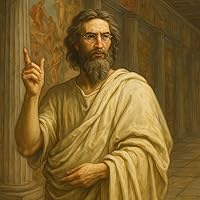
Epictetus
1,060 books2,443 followersEpictetus was a Greek Stoic philosopher. He was probably born a slave at Hierapolis, Phrygia (present day Pamukkale, Turkey), and lived in Rome until his exile to Nicopolis in northwestern Greece, where he lived most of his life and died. His teachings were noted down and published by his pupil Arrian in his Discourses. Philosophy, he taught, is a way of life and not just a theoretical discipline. To Epictetus, all external events are determined by fate, and are thus beyond our control, but we can accept whatever happens calmly and dispassionately. Individuals, however, are responsible for their own actions which they can examine and control through rigorous self-discipline. Suffering arises from trying to control what is uncontrollable, or from neglecting what is within our power. As part of the universal city that is the universe, human beings have a duty of care to all fellow humans. The person who followed these precepts would achieve happiness.
Other language versions:
Epictète
Epícteto
Epiktet
Other language versions:
Epictète
Epícteto
Epiktet
Ratings & Reviews
Friends & Following
Create a free account to discover what your friends think of this book!
Community Reviews
Displaying 1 - 24 of 24 reviews

September 2, 2013
I find it near to impossible to rate a work of antiquity as I might try to rank a contemporary work. How does one choose subtraction over addition in ranking an artifact of historical interest? The Discourses of Epictetus possess such a special status and have greater merit at the start than contemporary works. By various measures, I commend the Discourses. One measure, mentioned above, is the historical measure. Reading the Discourses is time travel. How rare and privileged is it to see the world, a world of lore, through his eyes. And there is MUCH to see not only of what Epictetus wants to show us, but of what the keen reader gets to see of the Roman world in first-second century AD/CE. That measure includes the arc of culture, philosophy, literature, customs, arts, in short, the world digested by Epictetus and experienced by the reader at his side as Epictetus reasons on a range of topics not infrequently raised by questions. There is the measure of philosophy. The Discourses are the business of philosophy, of the reasoned and deliberate life, in this case of Stoicism. One can read the Discourses to learn about the Philosophy, but as much again about navigating life that profits the reader with practical and transferable insight into living wisely and the measure of your own life. Oldfather's translation remains excellent and helpful. The Loeb pagination and format of juxtaposing the Greek and English translation offers easy and ready comparison of text and rendering.
June 20, 2020
Given our busy life schedules, we are limited in our time to read the very best books. The Discourses of Epictetus is one of those must-read books. Epictetus is second to no one, probably due to his teacher Musonius, who is a philosopher of the highest caliber. Make sure you buy this exact edition by the Harvard Univ Press (Loeb Classical Library), and also complete the Discourses with Books 3-4.
Read
March 29, 2025The more I read and reread Epictetus, the more I get the impression that the main purpose of a large number of his discourses is to express his frustration that his students constantly miss the point. He so desperately wants the best for his students and it seems to genuinely pain him when they fall short.
September 5, 2020
I did not know what to make of Epictetus at first.. At first I was like what is the Ancient Hack blabbering about ?..
but the more my life unfolds the more I find this man to be Spectacular...His teachings go beyond intellectual jabbering, and are applicable to real life...The dice Metaphor..I don't control the dice..I can only do something with what has turned up..make the best of it....What is within the will what is up to me...the dice are "indifferent"..beyond my control.. The Olympic Metaphor..What have you trained for ? to compete and be ready for the challenge..but I would rather be in the Gym..No buddy ..the lights are on...Go to work...
Witty..yet extremely serious...You are a citizen of the universe.. Now go out and be Heroic.. Am I rich ? Am I good looking ? Am I popular ? Is someone against me? If you have behaved nobly, justly, and with magnaminity...go enter the games..Those other things are nothing to us....
but the more my life unfolds the more I find this man to be Spectacular...His teachings go beyond intellectual jabbering, and are applicable to real life...The dice Metaphor..I don't control the dice..I can only do something with what has turned up..make the best of it....What is within the will what is up to me...the dice are "indifferent"..beyond my control.. The Olympic Metaphor..What have you trained for ? to compete and be ready for the challenge..but I would rather be in the Gym..No buddy ..the lights are on...Go to work...
Witty..yet extremely serious...You are a citizen of the universe.. Now go out and be Heroic.. Am I rich ? Am I good looking ? Am I popular ? Is someone against me? If you have behaved nobly, justly, and with magnaminity...go enter the games..Those other things are nothing to us....

July 20, 2008
The ideals of Stoicism are not very popular today. Only the military truly appreciates what they have to offer, and for some that alone is enough to turn them away. Yet, there is no wisdom the world needs more than what Epictetus offers. His insights are so startlingly right, his presentation so witty, his life so exemplary that we would be fools to ignore him. He teaches us, not just to be Men (as the military interprets stoicism), but to be fully Human in the best sense. Here is just a taste:
He denounces the claims of so many that we cannot agree on what to value, or call good, in men. He expounds upon how men choose a good horse, and concludes that soundness reveals itself through a horses endurance while running. "Is there nothing in a man such as running in a horse by which it will be known which is superior and inferior? Is there not modesty, fidelity, justice? Show yourself superior in these, that you may be superior as a man."
"Take care then to do nothing like a wild beast; but if you do, you have lost the character of a man; you have not fulfilled your promise."
"What do you think that Hercules would have been if there had not been such a lion, and hydra, and stag, and bear, and certain unjust and bestial men, whom Hercules used to drive away and clear out? And what would he have been doing if there had been nothing of the kind? Is it not plain that he would have wrapped himself up and have slept? In the first place, then, he would not have been a Hercules, when he was dreaming away all his life in such luxery and ease, and even if he had been one what would have been the use of him? And what the use of his arms, and of the strength of the other parts of his body, and his endurance and noble spirit, if such circumstances and occasions had not roused and exercised him?"
And where would we be without Epictetus?
He denounces the claims of so many that we cannot agree on what to value, or call good, in men. He expounds upon how men choose a good horse, and concludes that soundness reveals itself through a horses endurance while running. "Is there nothing in a man such as running in a horse by which it will be known which is superior and inferior? Is there not modesty, fidelity, justice? Show yourself superior in these, that you may be superior as a man."
"Take care then to do nothing like a wild beast; but if you do, you have lost the character of a man; you have not fulfilled your promise."
"What do you think that Hercules would have been if there had not been such a lion, and hydra, and stag, and bear, and certain unjust and bestial men, whom Hercules used to drive away and clear out? And what would he have been doing if there had been nothing of the kind? Is it not plain that he would have wrapped himself up and have slept? In the first place, then, he would not have been a Hercules, when he was dreaming away all his life in such luxery and ease, and even if he had been one what would have been the use of him? And what the use of his arms, and of the strength of the other parts of his body, and his endurance and noble spirit, if such circumstances and occasions had not roused and exercised him?"
And where would we be without Epictetus?
February 28, 2018
The kindness and compassion at the heart of this work is indescribable. No better guide in life than Epictetus. I've returned to it often. Translation is overall excellent, but the Greek is not that difficult. Great to have it there on occasion.
May 25, 2020
"You mean, then, that when you approach me you will not pay attention to me?"
"No, I pay attention only to myself. But if you wish me to say that I pay attention to you too, I tell you that I do so, but only as I pay attention to my pot."
Sassy Epictetus is sassy.

February 11, 2008
The best of the stoics. This is the sort of stuff most people probably think of when they think of philosophy. Advice on how to live your life.

January 6, 2011
A book that deserves to be read every morning.
August 22, 2026
Previously my "knowledge" of Stoic philosophy was limited to a handful of misconceptions, and I had never heard of Epictetus. However, when the Discourses came up on a list of Great Books that I'm working my way through, I was happy to give it a shot. Great move!!! Although I have thus far read only the first two books (out of four) of the Discourses, I consider it a masterpiece. Epictetus (as rendered by his student, Arrian) offers a clear explanation and compelling defense of Stoic philosophy. His advice regarding how to deal with a tyrant is especially timely and relevant. The Loeb Classical Library translation by Professor Oldfather is excellent - the language and syntax are totally accessible and Professor Oldfather strikes a perfect balance in his footnotes - enough to be helpful but not so many as to be distracting and annoying. Having just now finished the first volume of Epictetus in the Loeb series, I eagerly look forward to reading the second volume.

September 29, 2024
a philosophical staple - trains the faculty of moral purpose.
“Man, your purpose was to make yourself competent to use conformably with nature the external impressions that came to you, in desire not to fail in what you would attain, and in avoidance not to fall into what you would avoid, never suffering misfortune, never ill fortune, free, unhin-dered, unconstrained, conforming to the governance of Zeus, obeying this, well satisfied with this, blaming no one, charging no one,”
“Man, your purpose was to make yourself competent to use conformably with nature the external impressions that came to you, in desire not to fail in what you would attain, and in avoidance not to fall into what you would avoid, never suffering misfortune, never ill fortune, free, unhin-dered, unconstrained, conforming to the governance of Zeus, obeying this, well satisfied with this, blaming no one, charging no one,”
May 6, 2017
Liked Seneca and Marcus Aurelius more. Still has some great pieces of wisdom.

December 10, 2020
I really like this translation. There is just something about it. It feels original. It's not really for a beginner. There are easier ones to read.
February 14, 2021
A life changing book.

February 11, 2022
convinced me Barthe was the only human who was able to actually live
January 7, 2023
Awesome book. Very interesting how society today was similar to society back then. Everyone cares about the same pointless stuff and will continue to care about the same pointless stuff.
February 13, 2025
I liked the unstructured nature of the discourses and found wisdom in these little vignettes; I’m looking forward to reading volume 2!

June 5, 2025
Just read it for yourself.

August 29, 2010
A follower of Zeno and Chrysippus (as evidence by the numerous references), Epictetus expounds the lessons of Stoicism. On a superficial level, it’s kind of like Western Buddhism. Detachment from worldly desire being a core concept in both. Whereas Buddhism seeks to train the mind in the ways of sila (ethical behavior) to cut the chain of endless rebirth, Epictetus teaches how virtue helps you pass through the purpose of this existence.
Yes, Epictetus was a toga-hippy.
The principles behind most of Book I and II will seem fairly familiar to the modern reader. Our modern usage of the term “stoicism” covers the main premise. Calm can be maintained in the face of adversity because most adversity really shouldn’t matter. It’s the advantage of detachment. Anything can become endured because overcoming it is not the purpose.
Regardless, this is a highly quotable text and two passages that struck me as particularly interesting:
Men act like a traveller on the way to his own country who stops at an excellent inn, and, since the inn pleases him, stays there. Man, you have forgotten your purpose; you were not traveling to this but through it. Pg. 407, Book II.23.For Epictetus, the base for all action is cultivation of the mind and soul before God (the God referred to being Zeus and not the Judeo-Christian God gaining notoriety in Rome at this time). “Make it your wish to appear beautiful in the sight of God. Set your desire upon becoming pure in the presence of your pure self and of God.” Pg. 345, Book II.18. The external world must be evaluated with care to understand why there is desire for anything else. The trappings of possessions and prestige prevent true growth.
Yes, Epictetus was a toga-hippy.
The principles behind most of Book I and II will seem fairly familiar to the modern reader. Our modern usage of the term “stoicism” covers the main premise. Calm can be maintained in the face of adversity because most adversity really shouldn’t matter. It’s the advantage of detachment. Anything can become endured because overcoming it is not the purpose.
Regardless, this is a highly quotable text and two passages that struck me as particularly interesting:
Whenever you mix in society, whenever you take physical exercise, whenever you converse, do you not know that you are nourishing God, exercising God? You are bearing God about with you, you poor wretch, and know it not! Do you suppose I am speaking of some external God, made of silver or gold? It is within yourself that you bear Him, and do not perceive that you are defiling Him with impure thoughts and filthy actions. pg. 257, Book II.8.
That is why the philosophers admonish us not to be satisfied with merely learning, but to add thereto practice also, and then training. For in the course of years we have acquired the habit of doing the opposite of what we learn and have in use opinions which are the opposite of the correct ones. If, therefore, we do not also put in use the correct opinions, we shall be nothing but interpreters of other men’s judgments. For who is there among us here and now that cannot give a philosophical discourse on good and evil? {…} So, although we are unable even to fulfill the profession of man, we take on the additional profession of the philosopher- so huge a burden! pgs. 265, 267, Book II.9.

April 13, 2008
Sure, it would be almost impossible to live as a stoic all the time, but there is a comfort here that I really appreciate. I like the idea that we should accept death like one who has borrowed and appreciated something he never fully possessed. It reminds me of what I like about Thoreau--without the meandering treatises on beans.

September 17, 2013
Monumentally influential on moral thought, particularly with regard to Christianity, these short essays - presented as notes of his conversations with students - have a certain charm but there's only so much Graeco-Roman "Braveheart" philosophy I can take in a single sitting.
There is another volume containing two more books of his discourses. I am in no hurry to continue with it.
There is another volume containing two more books of his discourses. I am in no hurry to continue with it.
June 13, 2008
This was really hard to get through. If I were doing it again I'd try the Enchiridion or try a different translation (maybe one that isn't 80 years old).

August 25, 2009
Lessons in Stoicism from a master, a freed slave writing for a Roman audience. One of the sources from antiquity on Stoicism.

September 14, 2015
What can I say? I really get a kick out of reading ancient philosophy. I wish I had the well-honed mind of a philosopher.
Displaying 1 - 24 of 24 reviews