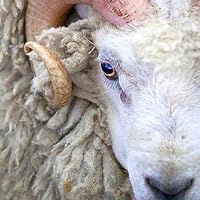
Tuk the bighorn sheep is told he will be the one to save his herd, but he is young and would rather play with his bandmates than figure out why the herd needs saving. As humans encroach further and further into their territory, there is less room for the sheep to wander, food becomes scarce, and the herd's very survival is in danger. Tuk and his friends set out to find Blue Mountain, a place that Tuk sometimes sees far in the distance and thinks might be a better home. The journey is treacherous, filled with threatening pumas and bears and dangerous lands, leading Tuk down a path that goes against every one of his instincts. Still, Tuk perseveres, reaching Blue Mountain and leading his herd into a new, safe place.
Martine Leavitt has published ten novels for young adults, most recently Calvin, which won the Governor General’s Award of Canada. My Book of Life by Angel was a finalist for the Los Angeles Times Book Prize and winner of the Canadian Library Association Young Adult Book of the Year. Other titles by Leavitt include Keturah and Lord Death, a finalist for the National Book Award, Tom Finder, winner of the Mr. Christie Award, and Heck Superhero, a finalist for the Governor General’s Award. Her novels have been published in Japan, Korea, Denmark, Germany, Switzerland, Italy and the Netherlands. Currently she teaches creative writing at Vermont College of Fine Arts, a short-residency MFA program. She lives in High River, Alberta.
This versatile author is hard to pin down since of the three books I've read by her--Keturah and Lord Death, My Book of Life by Angel and Blue Mountain--all three are quite different and yet satisfying. I love when authors continue to surprise me, and this one certainly does. In this book, suited perfectly for middle graders, Tuk seems different from the rest of the bighorn sheep from his birth. He is strong, nimble, fearless, and curious. The herd is under threat from predators, the weather, and humans, and Tuk is the one who sees the blue mountain where they need to go in order to be safe. Despite the doubts of some of the others and with the stalwart support of others in the herd, he bravely leads them onward. Along the way, the sheep must stave off threats from a wolf, a puma, a bear, and humans. The story flows as smoothly as a mountain stream, and readers will be caught up in Tuk's journey and his struggle to accept his own differences from the rest of the herd. There are coming of age experiences that change his life, and scenes of idyllic pleasure as the sheep enjoy delicious grass and leap from one precarious spot to another. Clearly, the book can be read as an animal survival tale but also as a metaphor and a reminder of nature's savage beauty and the encroachment of humans on those last wild places left on Earth. I was thoroughly mesmerized by this title and enjoyed its cyclical structure.
Tuk is a Bighorn Sheep, and when he is born it is foretold that he will save the heard from scarcity of food and the threat of predators. As Tuk leads the heard of Bighorn Sheep to the Blue Mountain, he and the heard must weigh the consequences of taking an unknown journey and decide if this will lead them to safety or to their undoing. This novel, by Martine Leavitt, touches on the environmental impact of urban sprawl, and offers a picture of what life is like for Bighorn Sheep.
This novel had many successful elements. Leavitt is a masterful wordsmith, and she was able to describe events and locations in the book quite vividly. The book included trickster tale elements, and I also picked up on traces of Native American folklore.
The characters in this story were thoughtfully planned out, which helped the reader get a glimpse of each character’s personality. The need to get to a safe place with food is what motivates and propels the characters, and each character has their place in the heard. Although the main character, Tuk, does not change much in the story, the reader is able to see him as a natural leader who can make quick decisions in stressful situations. The other characters are also well developed. Rim and Ovis are other strong leaders and Dall is the wise woman of the heard. Mouf is the weakest of the herd, and she needs constant motivation. The interactions between these characters shed light on decisions made in the story.
Conflict is successfully interwoven throughout this story. The heard deals with scarcity of food and fear of predators and humans. The conflict helps propel the story, because each difficult situation forces the heard to make a decision.
Although this book was beautifully written and had a number of positive aspects, I do think that it works as a book for children. It was very philosophical, and read more like adult fiction. I don’t see children connecting to it, and throughout the book I kept thinking, “Who is this book for?” I understand that the author was trying to share her passion for preserving the habitat of the Bighorn Sheep, but I think a nonfiction narrative would have been a more successful way to reach a youth audience.
BLUE MOUNTAIN is a National Book Award Finalist. The story is about Tuk, a young bighorn sheep, who can see the Blue Mountain, which others cannot. He knows that this is a place he must lead his herd to that will provide safety and peacefulness from the threatening humans and their machines. Along the way are many dangers and Tuk and his young friends learn to be brave and resourceful in order to stay alive. The story is very well written and reads like a fable. There is a great lesson to learn of how humans affect the environment and the existence of wild creatures. My concern is that there are so many names and characters in the first chapter that the intended audience, ages 9-12 will be easily confused. I am not sure that the cover or the story line will attract any but the most avid animal lovers.
Told from Tuk a young Bighorn sheep's point of view, this lyrical tale follows the trek he pursues along with a few other yearling bighorn sheep to find a safer home. Their herd is becoming weaker and smaller every year, due to lack of food, encroachment of humans in their territory, and predators who attack them because of their dwindling numbers, and the inherent trait of these peaceable creatures not to fight back. Tuk the largest bighorn ever seen by the herd becomes the leader traveling through dangerous wilderness in search of the Blue Mountain, which he infrequently views in the horizon. The trip is hazardous and takes a lot of courage to pursue. This powerful book inspired by the author's father who studied the endangered bighorn sheep, is so descriptive the reader can almost smell the fresh air and impending dangers. A must read for all elementary libraries.
I'm the wrong reader for this book because I hate animal stories. And this one wasn't compelling enough to help me overcome that. It's about sheep ya'll. Sheep.
A band of bighorn sheep must face many, and I mean many dangers to move the herd to a new location at Blue Mountain. For me as an adult, it was an average like. Really good, however, for one who likes characters and plot with animals. Quirky.
This is a stellar book to pique interest in animal interdependencies, conservation, migration, natural defenses, and myths and origin stories. I just adored it, and I can't wait to share it with my class.
I had the privilege of meeting an editor from Ground Wood. Ground Wood published Blue Mountain by Martine Leavitt in 2015.
The editor felt reading the Middle Grade novel would help me in my own writing.
I believe it did.
Blue Mountain is filled with adventure! The search for a new home becomes the quest. I loved reading about parts of Canada I know very little about. I respect the research and authenticity of Blue Mountain. A book I won’t soon forget!
Gentle adventure story for middle schoolers who love endangered animals. The bighorn sheep are anthropomorphized if animal fantasy is a problem for you. But their struggle for survival is real.
4.5 stars. Ransom rated 4 stars. Sojourn rated it 5 stars. Sojourn really enjoyed the bighorns fighting off the bees. Ransom liked how Tuk faught off the pumas and the wolves.
I am still unsure on my exact feelings on this book. It might be more of a 3.5, but I love Martine Leavitt's latest book, Calvin, so I am a bit biased. :) Something I'd like to mention is that it seems like a children's book. The way the story is told seems very simple and plain, but then again, so is the general plot! There isn't really much to review either; this book is less than 200 pages and is about bighorns. I think the best way to summarize this entire book is "quaint". In other words, "attractively unusual or old-fashioned." -Google. The plot is folk-like and it's characters are animals. One thing that I did enjoy was the whole way "animal perspective" was interpreted. Martine narrated the story in a way I have not personally seen before. Tuk does not have strong "human-like" characteristics. He is still relatable in some senses, but most of his emotions stem from living for survival(something we humans also face). Overall, this book wasn't bad, but it wasn't awe-inspiring either.
I'm having trouble pinning down my exact feelings on this interesting, but strange, little book. On one hand, I loved the concept and the message, but on the other hand, the writing style was hard for me to get used to.
As I mentioned, I loved the idea and message behind this book. I think it is immensely important for kids (and adults!) to understand the natural world and that our actions can affect plants and animals and ecosystems. So for that I give huge kudos to Martine Leavitt.
However, the writing style really threw me on this one. It was kind of blunt and chopping and the dialog came through very strangely for me (although since I don't speak bighorn, maybe that's how they do speak). I feel like maybe this writing style would appeal more to younger middle grade readers, since it was quite simple and they may not mind the choppiness when their own reading skills are a bit lower than my own. However, I think older readers might have some of the same issues as me (I even considered DNFing this one, but am glad I didn't).
The other thing I wasn't crazy about were the amount of characters. We are thrown a lot of names at the beginning when all the lambs were born and it was tough for me to keep track of them. Eventually they begin to become their own characters, but it was still a bit difficult for me for much of the book.
Overall, I think younger middle grade readings who are interested in nature would enjoy this book. There is quite a bit going on and some parts kind of read like a fable.
Well. This is a solid, and often lovely, animal fable. But it's not - quite - "Bambi", and it certainly isn't "Keturah and Lord Death". Tuk is the largest mountain goat kid born in generations, a natural leader. His people are under assault by predators and by man. At first, the others think Tuk might be a the leader to save them, but, when he kills a cougar kit in defense of a friend, the elders are deeply disturbed. His folk are peaceful; they do not fight back. Will Tuk become the leader he seems destined to be?
Leavitt achieves a stately tone very suitable to her story, and she keeps the reader's interest (at least, this reader!). But I was bothered by the antrhopromorphism. Animals just don't seek revenge, though they do mourn. To have the vengeful cougar pursuing the flock was a bit much.
But it's a solid story with some lovely writing. It will be interesting to hear what kids think of it.
Tuk the bighorn sheep is told he will be the one to save his herd, but he is young and would rather play with his bandmates than figure out why the herd needs saving. As humans encroach further and further into their territory, there is less room for the sheep to wander, food becomes scarce, and the herd's very survival is in danger. Tuk and his friends set out to find Blue Mountain, a place that Tuk sometimes sees far in the distance and thinks might be a better home. The journey is treacherous, filled with threatening pumas and bears and dangerous lands, leading Tuk down a path that goes against every one of his instincts. Still, Tuk perseveres, reaching Blue Mountain and leading his herd into a new, safe place.
This animal fantasy is told from the perspective of a year-old bighorn sheep who has a vision of a mountain where his dwindling herd can prosper, and leads a scouting party to ascertain whether it really exists. They face many challenges in the natural world, but the greatest for Tuk comes from man - biologists who capture and tag him. I believe this practice to be inhumane, and what Tuk submits to in order to free himself of the tag in his ear reminds me of what I've heard of animals caught in traps and what they'll resort to in order to free themselves. The things we do to animals in the name of research and supposedly for their own good disgusts me..
In the rolling Alberta foothills and majestic Rocky Mountains is born Tuk, the largest lamb born that spring among a flock of Bighorn Sheep. He is one of the few with the ability to see the "Blue Mountain", a place devoid of man and danger. The flock's territory is diminishing, the winter grazing lands inaccessible and predators hunt them relentlessly. Particularly compelling are the folktales Tuk tells his lamb-mates to calm and reassure them. Vividly descriptive of the dangers facing the Bighorn, Blue Mountain is recommended for tweens who love animal stories and can handle a realistic portrayal of the circle of life. Also a good choice for the year of the sheep.
Blue Mountain is about Tuk, a bighorn, who wants to do what's best for hid herd, since the humans started building machines that are taking up the space where the bighorns rome in the winter. Tuk has always been able to see Blue Mountain, but others call it story mountain because very few saw it and fewer believed it. Since the herd is desperate, Tuk and his team gets together and goes on an adventure to Blue Mountain - where no human, or predator could find them. Blue Mountain is about despiration, hope, and friendship.
I liked this National Book award nominee a lot. It's about a a big horned sheep called Tuk. Tuk has a vision of a blue mountain and takes a band of yearling sheep on a quest to find a better place to live. It's an arduous journey with many dangers, including a puma and a wolf with revenge on their minds, a wolverine, a chatty otter and man lurking around the edges. The story read like a folk tale but each of the characters had a really distinctive (and sometimes hilarious) voice. I thought it was great.
A touching story about a band of bighorn sheep making a journey to find a new place to live when their mountain home is threatened by encroaching human development. Along the way they encounter a wolverine, a bear, and a cougar. The young bighorn sheep, Tuk, who leads the band is put through the paces. The author doesn't spare him trouble. Tuk's responses to each confrontation are fresh.
All of Martine Leavitt's writing shows such care, thought, honesty, and intelligence. She's one of our best writers.
Blue Mountain by Martine Leavitt is told by Tuk, who is a Bighorn sheep! At first, life is good--running, jumping and playing. However, when Tuk becomes the leader of the herd, he must find a safe place for them or all will be lost.
This book was a National Book Award finalist. So that should give you some idea of just how good this is. The author wrote this book for her grandchildren, but I think young and old will enjoy it like I did! (Gerard's review)
3.5 stars really. This was one of those weird books that felt like it was written for adults more than children. It was beautifully written, philosophical, and had the folklore and trickster elements that I generally love. I was reminded a lot of "Where the Mountain Meets the Moon." There is lots of animal death, turmoil, and conflict, all of which intimately connect the reader with the reality of nature, but unfortunately, I'm not sure how many kids will really connect with the story.
Tuk, a bighorn sheep, is born to lead his herd to the fabled Blue Mountain at a time when they are threatened by predators, decreased food supply, and human encroachment. An absorbing, gracefully written story with a folkloric quality reminiscent of Watership Down.
Beautifully written, poetic, wonderful animal voices. Fable-like quality. Grades 4-7 -animals are ageless. Use, especially, as a writing example for 5th grade fractured fairy tales. This author writes her own stories for the animals to pass down with mountain as a creator.
The writing was bit flat and emotionless, but the concept was interesting and this would appeal to those who love animal or adventure stories. It's also a shorter book, so appealing for more reluctant readers.
I chose this because my students are really into animal stories and I wanted some new recommendations for them, but I'm not the audience for this book. Perhaps someone who enjoys animals stories would give it a higher rating.
While there is good information in this book and a nice story about animal survival in the wake of human incursion to their habitat, I personally felt the tone of the book was a bit stilted. This would be a good book for 3-5 grade students.