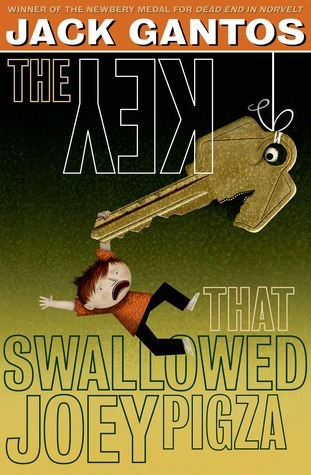
The fifth and final book in the groundbreaking Joey Pigza series brings the beloved chronicle of this wired, wacky, and wonderful boy to a crescendo of chaos and craziness, as everything goes topsy-turvy for Joey just as he starts to get his feet on the ground. With his dad MIA in the wake of appearance-altering plastic surgery, Joey must give up school to look after his new baby brother and fill in for his mom, who hospitalizes herself to deal with a bad case of postpartum blues. As his challenges mount, Joey discovers a key that could unlock the secrets to his father's whereabouts, a mystery that must be solved before Joey can even hope that his broken family might somehow come back together―if only it doesn't pull him apart first.
Jack Gantos is an American author of children's books renowned for his portrayal of fictional Joey Pigza, a boy with ADHD, and many other well known characters such as Rotten Ralph, Jack Henry, Jack Gantos (memoirs) and others. Gantos has won a number of awards, including the Newbery, the Newbery Honor, the Scott O'Dell Award, the Printz Honor, and the Sibert Honor from the American Library Association, and he has been a finalist for the National Book Award.
Gantos was born in Mount Pleasant, Pennsylvania to son of construction superintendent John Gantos and banker Elizabeth (Weaver) Gantos. The seeds for Jack Gantos' writing career were planted in sixth grade, when he read his sister's diary and decided he could write better than she could. Born in Mount Pleasant, Pennsylvania, and raised in Barbados and South Florida, Mr. Gantos began collecting anecdotes in grade school and later gathered them into stories.
After his senior year in high school (where he lived in a welfare motel) he moved to a Caribbean island (St Croix) and began to train as a builder. He soon realized that construction was not his forté and started saving for college. While in St. Croix he met a drug smuggler and was offered a chance to make 10 000 dollars by sailing to New York with 2,000 pounds of hash. With an English eccentric captain on board they set off to the big city. Once there they hung out at the Chelsea hotel and Gantos carried on dreaming about college. Then, in Jacks own words, "The **** hit the fan" and the F.B.I. burst in on him. He managed to escape and hid out in the very same welfare motel he was living during high school. However, he saw sense and turned himself in. He was sentenced to six years in prison, which he describes in his novel -HOLE IN MY LIFE-. However, after a year and a half in prison he applied to college, was accepted. He was released from prison, entered college, and soon began his writing career.
He received his BFA and his MA both from Emerson College. While in college, Jack began working on picture books with an illustrator friend. In 1976, they published their first book, Rotten Ralph. Mr. Gantos continued writing children's books and began teaching courses in children's book writing. He developed the master's degree program in children's book writing at Emerson College in Boston. In 1995 he resigned his tenured position in order to further his writing career (which turned out to be a great decision).
He married art dealer Anne A. Lower on November 11, 1989. The couple has one child, Mabel, and they live in Boston, Massachusetts.
When I finished what I thought was the last Joey Pigza book, I was despondent. I loved Joey Pigza, and I knew I was going to miss him. Well, what a delight to see The Key That Swallowed Joey Pigza on the new books shelf. And how wonderful to meet his baby brother, Carter. And to encounter Olivia, the most angry, difficult character ever depicted in children's literature. (And IMHO one of the best depictions of a person with a disability.) Anyway, Joey is still Joey, only better. While he's not hampered by his less-than-helpful parents, it's still hard for a kid to take care of a baby, even if Carter is the perfect Pigza. And Olivia is still Olivia, only better and badder. It's funny and sad and wacky. It's perfect Pigza. But I'm sad again. I've heard that this truly is the final book. Oh, well. As I get older, I'm getting more forgetful. Maybe I can wait a few years and start over again with Joey Pigza Swallowed the Key.
A note to my Illinois librarian friends: this review is in honor and loving memory of Sharon Ball, truly the perfect Pigza of a children's librarian. It is Sharon who first introduced me to Joey...and Stanley Yelnats, the gerbils of Kate Duke, and Crysanthemum and other friends of Kevin Henkes.
This last installment is the darkest book in the Pigza series. Joey always makes me laugh but there's always the dark undercurrent in these stories. Joey grows up a little more in each book and Gantos always leaves us with hope that if not all will be well with Joey, it will be as good as he and his dysfunctional family can make it. I will be interested to see how my 6th graders take to this one. I certainly have some who are living Joey's life in one way or another.
Lane Smith's new cover art for the series is a win.
The events severely strain credulity - and although some young readers will have personal or familial experience with ADHD, post-partum depression, alcoholism, divorce/estrangement, blindness, and/or babysitting, they may not realize that what unfolds is totally implausible.
Let's just pretend that it really could happen. If so, then we all need to put down our novels and get busy fixing things, because this should never happen!
On the other hand, if Gantos knows that this whole giant mess never would really happen - then how does he expect young readers to recognize this is only a comedy of errors, not dark reality? Especially when the tone of the whole book is more in line with "coping-with-darkest-reality."
I strongly believe that even in the worst case scenarios, the school nurse would NOT simply hand him a replacement medical patch & not bother to phone his mother to follow up on it; the school secretary would NOT allow him to leave school without an adult after an obviously disturbing phone call from a parent in a family where very serious issues have already been observed; a parent with post-partum depression would NOT arm herself with a meat cleaver but fail to notify one single adult in her life/neighborhood/school that her ex-husband is violent & angry & a potential kidnapper, yet she would leave a 7- to 11-month old baby alone with her middle-school-age son, who she knows is prone to accidents & impulsive behavior, especially when off his meds, which she knows he is.
IF Joey's mother trusts his ability to cope with taking care of himself AND the baby -- more than she trusts doctors, nurses, teachers, & social workers, THEN why does she take every opportunity to undercut him, and set him up for failure? IF her mental illness is so severe that it provides an explanation for her decision to abandon them and her simultaneous failure to give Joey any ounce of support (money, phone number of the hospital, food, instructions, pep-talk, ADHD medication), THEN surely during her admission to the hospital the intake nurse must have asked her about her family, and discovered that she had a family depending on her. It doesn't make sense, and it is misleading to young readers to think that a young person in Joey's implausible situation could actually cope with it.
In fact, he breezes through baby-care, house-cleaning, & shopping so effortlessly & joyously, that it might be hard for a young reader to respect Joey's mother, or care about her safe return.
The story celebrates Joey's amazing capabilities and wisdom, but the unrealistic sequence of events give it an in-authenticity that negates Gantos' desire to let readers connect with the flawed characters in order to build empathy. The result could back-fire; readers may expect all kids with ADHD to have depressed or alcoholic parents (Joey repeatedly ponders the cause-effect cycle), and to be amazingly competent, gifted, & brave.
Will young people be able to switch gears fast enough that they will want to read about a boy killing cockroaches (with his bare hands and having to force himself NOT to lick his hands after) and then read about how his baby brother is such a sweet buddha and his blind girlfriend is tired of everything around her always being black? A person with ADHD might think like that, but the rest of the population (85% of kids *don't* have ADHD) may not enjoy the extreme personality shifts.
If this is an authentic representation of people with ADHD, post-partum depression, & blindness, then they need more cohesive treatment.
This entire review has been hidden because of spoilers.
Reviewed for Horn Book. Here's a quote from it on the Barnes & Noble site (but go find and read the whole review --- I'm darned proud of it:).
*"Readers of all ages are going to cheer Joey on as he heroically deals with one over-the-top situation after another. By the time this final book of the series - as elegantly and propulsively written as the others - draws to a close, you know that no matter what the future holds, Joey's inner strength and smart, sweet nature will prevail." - The Horn Book, STARRED REVIEW
How do you rate Joey Pigza? I read Gantos' Newbery winner Dead End in Norvelt and reviewed it as "I just wasn't the type of reader for this book." Now that it's well established I'm not a "fan" what in the blazes do I do with this little disgusting genius of a book?
I haven't read any other part of the series, and I'm not sure *how* much this stands on its own, which is one of the reasons I don't think it was upper echelon Newbery worthy. The addition of the blind girl that I had no background or prior knowledge of was a bit hard to swallow. What it succeeds in doing is making you uncomfortable - on purpose, in genius ways. Gantos knows exactly what he's doing and what kind of reactions his content will inspire.
His middle grade hero with ADHD is trying to return to school when he's called home to watch his baby brother while his mother checks herself into the hospital for post-partum depression. As much as readers want to believe these are unbelievable turns of events, I've been a foster parent to a teen whose parents were basically absent drug dealers and who did exactly what Joey did: raised her younger siblings. At age 10 she got everyone up, cleaned, fed, dressed, and ready for the day. She would get bottles and anything else ready before she left for school and then would drop the baby in her mother's lap with instructions of what to do until she got home from school. I also went to school with a kid in first grade who sharpened his own pinky finger - so there's quite a bit in the book I've seen happen.
I almost had to stop reading when his dad's "leprous" face was shedding skin . . . it turned my stomach. And it was at that point I saw Gantos' genius.
I can't give it 5 stars because I kind of hated being so uncomfortable, and viscerally reacting to so much of the story in a negative way. I kind of hated it. And therein lies its genius, I recognized so many awful things that are actually happening in true life - I was made to face reality; not my reality . . . but the reality of too many children and families. Wow, is all I can say.
The final book in the series shows Joey again dealing with his crazy parents and the traumatic childhood they are giving him. Joey is older now and has become the man of the family. He adores his new baby brother and he is determined to make sure his brother turns out better than Joey. This is such a touching aspect of the story. The story is a satisfying conclusion to the series but I am still left with a feeling that Joey's parents will continue to fail him.
For the last time, author Jack Gantos returns to beloved character Joey Pigza and his exceptionally messed up family. While Joey tries to go back to school after a stint at homeschooling by his mother, things at home are not good. His mother is suffering from acute depression and worried that she may harm her new baby, Carter Jr. Joey's father is on the lam, having disappeared after having a face lift that isn't healing properly. When his mother checks herself into the hospital, Joey must stay home and take care of his baby brother while thwarting his father's plans to start life fresh with the new baby. Joey has enough to deal with in trying to get himself on an even keep once again and find the medical patches he uses to counteract his ADD, but with the help of his wisecracking, blind girlfriend Olivia, he keeps it together, and even manages to clean up the house. Filled with humor and pathos, this book leaves readers with a sense of hope that things might just work out for the Pigzas, but it won't be easy for any of them. The opening scenes describing the family's filthy, roach-infested apartment are vividly painted in an almost-too-close-for-comfort fashion. There are little touches such as how Joey uses food stamps to pay for the pizza delivered each night that make this story ring true.It's easy to see that many of Joey's problems are not of his own making, but he must do the best with the cards that he has been dealt. While I didn't want Joey and Carter to end up in foster care, I also knew that all his sudden responsibilities were a lot to put on someone like Joey. They'd be too much for any youngster. As the series comes to an end, I'm sad to say goodbye to these well-drawn characters. Anyone contemplating a teaching career will want to read all five of the Joey Pigza books.
This entire review has been hidden because of spoilers.
I read all of the Joey Pigza books and I find them to be so thoughtful, so meaningful, so sad and yet so hopeful at the same time. Joey's descriptions of ADD are what I believe to be spot on. It's so spot on that this isn't a sensitive, feel good exploration of a boy with ADD, it's gritty and challenging. You love Joey, and at the same time, you want to strangle him. You want him to succeed in life, but you know he's been handed such a tough hand that just surviving seems like victory.
The last book isn't any easier to read. Joey's mom leaves him and his baby brother alone to go seek treatment. His father is in town, but creeping around the neighborhood for who knows what reason. Joey's love of his brother is driving him to make everything better.
The back of my book has the USA Today review as saying "Stepping into Joey Pigza's skin isn't easy...but it's worth the discomforting fit." I guess that's the best way to summarize this book and the series. It's discomforting. Even the ending, although happy, seems as though it could fall apart at any moment. This is an important book and series. It's one of those that I'll be thinking of later, still not sure of what I thought about it.
Oh boy! It's been a while since I have visited with Joey Pigza, and this latest and final installment in the series was a doozy! I am totally biased when it comes to Jack Gantos, the man is a genius. He pulled out all the wacky stops on this one, and if you read it in an adult frame of mind, it will be troublesome on many levels. Child abandonment, Post-partem depression, botched plastic surgery, roach-infested homes, Mr. Fong the Chinese pizza delivery man, and, oh yeah- a blind girlfriend who shows up one night in need of new panties. Those are but a few of the story lines you will encounter in these 150 pages. Reading this book allowed me once again to experience Joey's buzzing brain and twitching body. No other book I have read provides the visceral rush of ADD like Joey Pigza. The first in the series was the best, but he sure finished with a bang.
When his mother enters the hospital to combat mental health issues, a boy must stay home from school to care for his baby brother, keep him safe from their delinquent father, and stay "pawzz-i-tive." Fifth in a series. Daniel and I both read this novel, which the Heavy Medal bloggers shortlisted for their Mock Newbery award this year - and both of us thought that the bloggers totally missed the mark. I am the first to admit that we have not read any prior Joey Pigza novels, but I thought that if they had selected this book, it must be such a wonderful work that it would stand alone. In my opinion, not the case. Chaotic, depressing, and boring. Sorry, but I really wouldn't recommend this one. Pigza fans, please tell me why I'm wrong...?
Maybe if I had read the 4 previous installments, this would have made more sense. As it is, who leaves a young boy to take care of an infant with no adult supervision? I found the whole thing unbelievable and with no redeeming qualities.
What an amazing, different middle grade book. I've read Jack Gantos' autobiography and his Norvelt books, but somehow I assumed, wrongly, that his Joey Pigza series would be more tame. Wrong!
The Key That Swallowed Joey Pigza isthe final installment in Jack Gantos's Joey Pigza series, continues the tradition of blending bizarre scenarios with deeply emotional and compelling storytelling. In this book, Joey once again finds himself in the role of the adult in a household that is anything but stable.
The story kicks off with Joey's mother suffering from severe postpartum depression, leaving Joey to care for his baby brother, Carter Junior. Joey's father, who remains a volatile and unpredictable presence, lurks around the house, intent on kidnapping the baby in the hope of using him as a fresh start for his own chaotic life. Amidst this turmoil, Joey's resilience and maturity shine as he navigates the challenges of essentially raising his brother and managing his dysfunctional parents.
Joey's character continues to be the heart of the series. His ability to handle more responsibility than any child his age should have to is both admirable and heart-wrenching. Despite the overwhelming odds, Joey's determination to keep his family together and his enduring optimism drive the narrative forward. He displays a remarkable capacity for forgiveness and understanding, even towards parents who consistently let him down.
Gantos masterfully balances the surreal and often darkly humorous elements of the story with moments of profound emotional depth. Joey's journey is one of survival, growth, and ultimately, healing. By the end of the book, Joey manages to bring his fractured family closer together, showcasing his incredible inner strength and ability to overcome adversity.
The Key That Swallowed Joey Pigza is a fitting conclusion to a series that has captured the hearts of many readers. It is a testament to Joey's enduring spirit and his journey towards self-improvement and familial reconciliation. My family loves Joey for his indomitable will and the hope he embodies. His story is a powerful reminder of the resilience of the human spirit and the transformative power of love and forgiveness
My favorite characters would probably have to Joey and joey's little baby brother.They both play a huge role in the book.My favorite event has to be when joey's mom leaves to go to hospitalize herself, and joey and his little brother all alone in his house and they have a lot of fun together,even though his little brother can't talk.I loved the style of writing because he used a lot of words that repeated events that happened in the book.I also loved the pace of the novel because it progressed but it wasn't to slow or too fast.It was a pretty odd book, so I don't think I could make any connections to it.“You gotta face the hand you're dealt with and deal with it, and make your problems be the smallest part of who you are.” I like this quote from this book because I feel like the meaning of it shines onto our everyday lives.
This book does nothing but keep you on your toes! It always has some plot twist that has the reader itching to turn the page. This is a great book to have in your library, because many young reader can relate to having to step up and become the parent to one or more of their siblings. This book is the last of the series and the language tells that throughout the book. In the book, Joey Pigza always reminds the reader of what happened before. This is very helpful because if the reader has not read the series recently, they get a refresher often. Also, the way Jack Gantoscharacter develops Joey's story makes him a very liked character throughout the whole book. Review written by Gabrielle Madike
The fifth and final book in the groundbreaking Joey Pigza series brings the beloved chronicle of this wired, wacky, and wonderful boy to a crescendo of chaos and craziness, as everything goes topsy-turvy for Joey just as he starts to get his feet on the ground. With his dad MIA in the wake of appearance-altering plastic surgery, Joey must give up school to look after his new baby brother and fill in for his mom, who hospitalizes herself to deal with a bad case of postpartum blues. As his challenges mount, Joey discovers a key that could unlock the secrets to his father's whereabouts, a mystery that must be solved before Joey can even hope that his broken family might somehow come back together—if only it doesn't pull him apart first.
All 6 books resonated with three of my kids who have ADHD. If you've not lived with ADHD, you might misunderstand the value of the series by thinking the stories irreverent, insensitive, or illogical. For kids with ADHD, they learned (1) they are not alone, (2) their family is not nearly as nuts as Joey's (YMMV, though), and (3) optimism, hope, and self-determination in the midst of chaos rather than pessimism, loneliness, and learned helplessness as some ADHD kids are in the habit of modeling. We will forever share the memory listening to the life of Joey Pigza during 6 months of car rides to and from school.
It's hard not to feel sorry for Joey Pigza, even if he is kind of annoying. His mom is a wreck, his dad left the family, and now Joey can't find his much needed medication. Oh, and he also has to take care of Carter Jr. the baby. While Jack Gantos is good at making the reader feel Joey's anxiety and troubling situations, I really don't think this series needs to continue beyond this. It seems like he basically tells the same story over and over again and novelty has worn rather thin. Next!
I found this book very interesting and easy to connect with. I also have ADD just like Joey and it is very easy to relate with his attention problems throughout the book. Joey is a young boy with attention deficit disorder and he is also hyperactive. All Joey really wanted was to have a normal family and to be happy. At first, he had a predicament because his family was the thing making him unhappy. He had to stand up and fix the problems himself. I would recommend this book to anyone my age. Personally, I don't like reading but I really enjoyed this book.
I normally love a crazy Jack Gantos story -especially his short stories, but this book was just depressing. Joey's depressed mom pulls Joey from school to take care of his infant brother while she checks herself into a psych ward. Joey's insane dad tries to break into the house and steal the baby b/c he's the good one. (Joey has severe ADHD, but his mom hides his meds so he can't take them! This alone makes her psycho!) I just didn't get it. The only character I liked was Olivia, but I'll leave you to find out about her on your own...
i’m currently a sophomore education major and i read this book as a part of my university’s curriculum for learning about disabilities. this book follows the main character jack as he navigates through his ADHD symptoms in school and deals with some complex family issues at home. i think this book is great for teaching kids about learning disabilities while also introducing some complicated family dynamics. although, some of the language used to talk about special education in the book is a little out-dated, it still provides kids with a personable perspective of learning disabilities.
This entire review has been hidden because of spoilers.
This was the first of the series that I read even though it is book #5, but I liked his other books, and this was very well done too. I especially liked reading about Joey because he's not the type of kid who is usually a main character and kids like him could really benefit from reading about someone like themselves.
This is the final book in the Joey Pigza series. Joey’s dad has left them after Carter Jr was born and mom is depressed. Joey has been taking care of Jr. This book is heartbreaking but true for so many reasons for so many children. I know the author feels the book was supposed to be funny, well the series and a lot of it is, but it’s also very sad.
Another book of exploits by Joey Pigza. We get to see some of the characters from the previous books again. Joey is trying to make good choices and there are the usual types of escapades. This book deals with some heavier topics and would be a great conversation starter for an adult with a kid.
Not sure why this is listed as the last book in the series, but I loved this book and found it heartbreaking and beautiful. We need more books that represent neurodivergent children and the struggles they face and the tools that are there to support them.