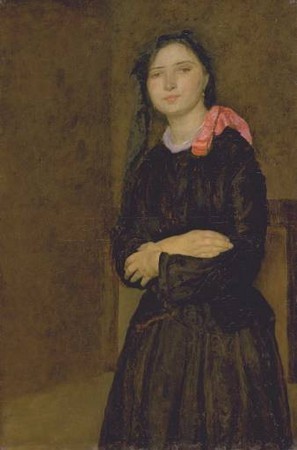
A revealing, animated biography of a sexual and intellectual rebel and a great painter
In 1942, at the height of his fame, Augustus John predicted that 'fifty years from now I shall be known as the brother of Gwen John'. Gwen John (1876-1939) is indeed now recognised as a great artistic innovator, yet for years her life remained shrouded in the myth of the solitary recluse. Born in Pembrokeshire, Gwen followed her brother to the Slade. Her future was bound up with Augustus, his women and his coteries, yet she was also daring and highly original, living determinedly in her own way.
Defiant yet shy, she painted and modelled amid the Bohemian circles of early twentieth-century Paris and embarked on a long, intense love affair with France's most legendary artistic figure, the sculptor Rodin. A friend of Symbolist poets and post-Impressionist painters, later she turned increasingly to religion, achieving a deep serenity which masked her inner turbulence and creating her haunting paintings, described as delicate and austere, restrained and still.
Based on her lively and passionate unpublished letters and lavishly illustrated, this vivid new biography challenges our prejudices about the ways we evaluate women artists and finally uncovers the life of this ardent and complicated personality, one of the finest artists of her day.
Sue Roe is an acclaimed biographer and poet with a strong interest in the visual arts. Her first biography, Gwen John : A Life (Chatto & Windus, 2001), reveals that the painter best known for her quiet, restrained portraits of women was surprisingly ardent and exuberant. The Private Lives of the Impressionists (Chatto & Windus, 2006) shows how daring the early Impressionsts seemed by the standards of their own times. In Montmartre (Penguin, 2014) illuminates Picasso’s early years in Paris, when suddenly all the arts (painting, writing, film, dance) seemed to be happening in parallel.
Sue Roe’s early scholarship was on Virginia Woolf, the subject of her PhD, and she has published a number of articles on Woolf. Her critical book, Writing and Gender: Virginia Woolf’s Writing Practice (Harvester/Wheatsheaf, 1990) explores Woolf’s processes of composition. She is co-editor of The Cambridge Companion to Virginia Woolf (Cambridge University Press, 2000) and editor of the Penguin Modern Classics edition of Jacob’s Room. Her teaching is inspired by her scholarship and her editorial experience. She has taught BA, MA and PhD students at various universities, and before that worked as a Commissioning Editor for two academic publishing houses.
These days she divides her time between research for her books, which includes exploring the galleries of Paris as well as copious reading, and writing. She likes to work with a good view of the colourful garden her partner Steve has created while she drafts – and re-drafts – her work.
Augustus John said he would be remembered as the brother of Gwen John, but judging by the review excerpts on the back of Sue Roe's calmly written biography, Gwen herself has been remembered as an eccentric. My strongest impression on reading this is that folks have simply lacked the imagination to relate to an independent, passionate, driven WOMAN. Aspects of her have to be packaged into pathological components:
"she was a recluse" = she chose to live alone for most of her life. However she knew all her neighbours, was well known in her community and had many correspondents, old friends and business connections, whom she visited, invited, and vacationed with
"she was obsessed with and utterly dependent on Rodin" = she was passionately in love with him, wrote him letters, demanded lots of sex, and was fiercely jealous. Really really weird behaviour, unless you pretend she was a man worshipping a woman, in which case the 'great love' would be praised
And so on. Gwen loved her cats, slept in the woods or her outbuildings at times, and was exacting in her choice of apartment. She was rather touchy and difficult to mollify once offended. She worked every day at her painting and drawing, working slowly, rarely keeping her promises as to timing. This is not acceptable female behaviour! Fortunately, Gwen had many sympathetic people in her life, not least her family.
On the whole this book is a pleasant read. I myself find I struggle when non-fiction messes with the timeline a lot. I can deal with the odd digression or jaunt down memory lane, but Roe befuddled me with her foreshadowing and backtracking. Through a dodgy grasp on pop neurology I relate my poor ability to integrate and synthesise to my weak drawing skills; I don't blame Roe for my confusion. And if her story of Gwen isn't crystal to me, the image of her that emerges is.
Roe writes wonderfully, with insight and clarity, about Gwen's work. That this the best aspect of the book. If you want to know how John worked, what motivated her, how she felt and thought about what she did, the answers are here, and they are rewarding. No one will accuse John of selling her soul for her extraordinary talent of capturing mood and stillness; she worked with intense spiritual focus and made many versions of each work, inching towards something that would satisfy her.
I do wish though that Roe had taken a bit more of a feminist line. Some of the things she says about John's affair with Rodin present rather an essentialist perspective on 'a woman's feelings' and it's disappointing to see John's passionate attachments to two separate women later in her life dismissed as 'confusion' rather than the possibility being left open that they were romantic.
Augustus John, the very famous British artist, predicted that 50 years after his death he would be known as Gwen John's brother.
I felt much kinship to Gwen John. She was shy and yet lived and worked as an artist. This book is probably one of the best to tell of her life and art.
I liked Gwen John before reading this. Now, I love her. Exceptionally well-researched, and based mostly on Gwen John's own letters, notebooks and correspondences, this is the best biographical insight around into the life of one of the best-loved (but overlooked) artists of the 20th century.
Gwen John is an icon. She was an introvert who never married (unusual for her time) and didn't want children (her drawings, she said, are her children); she formed deep emotional attachments to both women and men, though her passions were mostly unrequited. She lived alone, and towards the end of her life in a little hut on stilts in the woods surrounded by cats (including a toothless black cat called Valentine).
She would sleep outside under the stars, and often took solitary 'retreats' away from people for months at a time. She lived by her own rules. She lived a calm, restrained life, but inside she burnt with passions which she found hard to contain. She didn't care much for money or material things. She was deeply spiritual, and yearned for soul connections which she looked for in other people and in her Catholic faith, but never really found.
She was obsessed with the 'strangeness' and beauty of the world, and tried to convey this in her art. Her unique vision is captivating, and her style is immediately recognisable.
I think I loved this book because it really brought her personality to life, and I relate to her so much in so many ways. It was a bit on the long side, and the author tends to hedge around her queerness, saying that her attachments to women were 'confusions'. But perhaps that's because it was written in 2001. Still, I'm so in love with the Gwen I've come to understand through this book that I can't not give it 5 stars.
I had to get this after loving Sue Roe's, 'In Montmartre'. A wonderful account of an extraordinary woman and artist who, aside from her grand passion for Rodin, lived life on her own terms. I worried about her the entire time and, on more than one occasion, found myself wishing that she'd listen to her friends advice but, ultimately, Gwen John did exactly what she wanted, how she wanted and when she wanted. She was a true warrior though not, necessarily, a happy one.
Sue Roe offers us a thorough portrait of the artist, Gwen John. We follower her life beginning in Wales moving to London where she is trained in the 19th century tradition of realism and formal technique. And then in Paris, we observe Gwen as she is influenced by artists around her to experiment with tone, mood and expression.
Less well known than she deserves to be, Gwen John lived a life of resilience and fragility, carving a path for herself in a world dominated by men. A detailed and educative biography.
A quiet but intense account of a quiet but intense life. I was interested in an account of a female artist in an era when most did not gain the recognition many men did (well, that is still a problem). Her flamboyant and at the time better known artist brother Augustus John predicted that in the future he would be known as Gwen John's brother. I found myself fascinated, however, by small details such as John's precise notes as to the exact tubes of paints to use to create the look she wanted, the precariousness of financing an artistic life, and how she painted multiple versions of the same scenes, all slightly different.