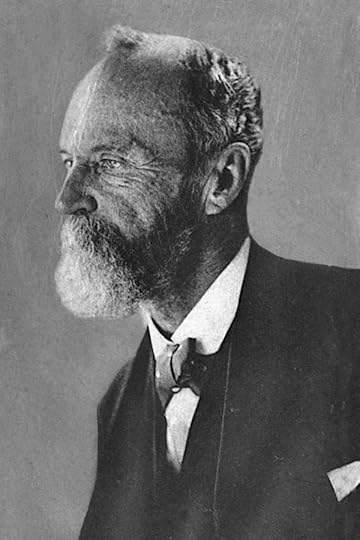
The definitive biography of the fascinating William James, whose life and writing put an indelible stamp on psychology, philosophy, teaching, and religion -- on modernism itself
Pivotal member of the Metaphysical Club, author of The Varieties of Religious Experience, eldest sibling in the extraordinary James family, William emerges here as an immensely complex and curious man.
William James, ten years in the making, draws on a vast number of unpublished letters, journals, and family records to illuminate what James himself called the "buzzing blooming confusion" of his life. Richardson shows James struggling to achieve amid the domestic chaos and intellectual brilliance of his father, his brother Henry, and his sister Alice. There are portraits of James's early years as a student at the appallingly hidebound Harvard of the 1860s. And there are the harrowing suicidal episodes, after which James, still a young man, turns from depression to action with "a heave of will." Through impassioned scholarship, Richardson illuminates James's hugely influential works: the Varieties, Principles of Psychology, Talks to Teachers, and Pragmatism.
As a longtime professor James taught courage and risk-taking. He was W.E.B. Du Bois's adviser and teacher, and he told another of his students, Gertrude Stein, to reject nothing -- that rejecting anything was the beginning of the end for an intellectual. One of the great figures in mysticism, James coined the phrase "stream of consciousness."
The son of a Unitarian minister, Robert Dale Richardson III grew up in Massachusetts and earned his bachelor's and doctorate degrees in English at Harvard University. Richardson taught at a number of colleges, including the University of Denver and Wesleyan University.
Robert Richardson characterizes his splendid biography of William James (1842 -- 1910) as seeking "to understand his life through his work, not the other way around." Richardson succeeds admirably in giving the reader the thought of William James in the many fields to which he made seminal contributions: psychology, religious studies, philosophy, pedagogy, and literature. He also offers an inspiring picture of James the man. Indeed, as Richardson shows, James's life is closely intertwined with his thought. Richardson taught for many years at the University of North Carolina and is currently an independent scholar. He has written biographies of Ralph Waldo Emerson and Henry Thoreau together with this biography of William James.
Richardson's book is written in five broad parts which subsume ninety short and readable individual sections. The first two parts of the book cover James's "Zigzag" childhood as his family, under his father, the redoubtable Henry James, Sr. crossed the Atlantic Ocean back and forth many times in search of education. James's relationship with his astonishing family, which Richardson calls the "James nation" -- his father and mother, novelist brother Henry, sister Annie, and brothers Garth and Wilkie form one of the motifs of this book.
As a young man William James was prone to ill-health, depression, and feeling of purposelessness. More than once, he considered suicide. These traits remained with him throughout life as James fought to control them and turn them to his advantage through effort, activity and will. Famously, James read the French philosopher Renouvier in 1870 which inspired him to conclude that "Our first act of freedom, if we are free, ought in all inward propriety to be to affirm that we are free." James subsequent courtship of and marriage to Alice Gibbens and his attainment of a teaching position at Harvard further committed him to a life of purposeful activity and to a confidence in himself.
The remaining three parts of Richardson's book center, respectively, upon James's great two-volume "Principles of Psychology" of 1890, his "Varieties of Religious Experience" of 1902, and, late in life, his work as a philosopher in his development of pragmatism, radical empiricism and pluralism. Richardson admirably ties James's work together to show how the philosophy arose from James's early interest in physiology and anatomy. James did revolutionary work in developing the physical basis of mental states and feelings. His interest in a full exploration of experience, together with his reading of the works of his father, led him as well to a feeling for religion and to human activity on the vision that what was noblest in man was mirrored in the universe. Richardson quotes the following passage from James as the epigraph to his book:
"If this life be not a real fight, in which something is eternally gained for the universe by success, it is no better than a game of private theatricals from which one may withdraw at will. But it feels like a real fight -- as if there were something really wild in the universe which we, with all our idealities and faithfulnesses, are needed to redeem."
James large works and famous lecture series, such as the "Varieties", "Pragmatism" and "A Pluralistic Universe" are given close attention as are many of James's essays and lesser-known works. I enjoyed reading about James's first book in which he summarized his father's religious beliefs in the course of an introductory essay of over 100 pages.
Richardson aptly relates James to American intellectual currents, exemplified by Emerson, Thoreau, Whitman, Melville, Holmes, Royce, Charles Peirce, and many others. He portrays James's thought as forward-looking, activist, pluralist, and based upon an openness to all forms of human experience -- including, notoriously, spiritualism. Richardson describes James as a founder of modernism in his teaching on the flow of consciousness. He is certainly correct about this, but it is also true that James's thought as it developed was highly metaphysical and speculative, much more so than in a great deal of contemporary philosophical thought. Richardson makes the apt point that in his emphasis of constant change and flow, James followed in the path of Heraclitus, the obscure but fascinating pre-Socratic philosopher. At many points in his study, Richardson suggests that James's primary achievement was in providing an answer to Plato and to the world of fixity, completeness, and eternal nonphysical ideas.
In 1910, shortly before his death, James wrote an essay called "A Pluralistic Mystic" about his long-time friend Benjamin Paul Blood, an eccentric philosopher, poet and mystic from upstate New York who was among the first to experiment with mind-altering drugs. Blood had written that reality and experience could never be captured by any formula:
[t]he slow round of the engraver's lathe gains but the breadth of a hair, but the difference is distributed back over the whole curve, never an instant true -- ever not quite."
In his essay on Blood, James made the phrase "ever not quite" his own. In summing up his life work in the essay, James joined cause with his subject, Blood, and concluded in language inspiring, fiery, and extravagant: "Let my last word, then, speaking in the name of intellectual philosophy, be his work: -- There is no conclusion. What has been concluded, that we might conclude in regard to it? There are no fortunes to be told, and there is no advice to be given. -- Farewell!"
Richardson has written an inspiring and learned book about a great American thinker and about the promise of leading a life of purposeful activity. Those moved to read or to reread William James may wish to pursue the two large collections of his most famous writings available from the Library of America.
By the end of the book I found myself underlining entire paragraphs, writing "Yes!" on every other page, in an absolutely satisfying, intellectual climax.
Robert Richardson uses William James' works to walk us through the mind of William James. Richardson has a keen eye for brilliant minds, having already done a biography on another great American luminary: Ralph Waldo Emerson. Richardson traces the evolution of James' thought through stoicism, anatomy and physiology, experimental psychology, quasi-existentialism, tychism, determinism, and eventually to James' great contributions to Western Thought.
James is a philosopher who wrote like a novelist. He is an iconoclast producing palpable criticisms of dualism, reductivism, materialism, Hegelianism, atomism, atemporalism, universalism, idealism, and monism. He shakes the foundations of western philosophy: Aristotle, Plato, Berkeley, Hume, and Freud. He reclaims much that has been lost in the post-modern world.
He puts philosophy in its proper place; it is nothing if it is useless in our daily lives. The 'truth' of an idea depends on its outcome, how it impacts lived experience, and not on its first principles or logic. "Fruits not roots." Ideas that do not empower human energies toward action are false, irrelevant, and useless.
He criticizes rationalism and science for being inadequate at accounting for all experience--especially the most meaningful of humans experiences found in the "inner citadels of ourselves": religious experience. "Rationality is at bottom a feeling."
James offers us Panpsychism, Radical Empiricism, Pluralism, and Pragmatism.
Pragmatism is the belief that truth is something that happens to an idea, that the truth of something is the sum of all its actual results. It is the philosophical notion that the meaning of anything is to be found in its fruits, not its roots. It is results, not origins, that matter. "ends and means can here be studied together, in the abstractest most inclusive way, so that philosophy can resolve itself into a comparative discussion of all the possible programs for man's life when man is once for all regarded as a creative being...pragmatism [is] a new militant form of religious or quasi-religious philosophy."
Panpsychisim is "the theory that all matter, or all nature is itself psychical or has a psychical aspect; that atoms and molecules, as well as plants and animals, have a rudimentary life of sensation, feeling and impulse."
Pluralism is "a restless universe, in which no single point of view can ever take in the whole scene; and to a mind possessed of the love of unity at any cost, it will no doubt remain for ever inacceptable." It may be that we each apprehend a different aspect of the one true universe; it may also be that the universe itself is not a single system but a loose collection of many separate systems.
Radical Empiricism as understood by Richardson: "Empiricism is the opposite of rationalism. Rationalism tends to emphasize universals and to make wholes prior to parts. Empiricism on the contrary lays the explanatory stress upon the part, the element, the individual, and treats the whole as a collection, and the universal as an abstraction. To be radical, an empiricism must neither admit into its constructions any element that is not directly experienced nor exclude from them any element that is directly experienced."
James' work is a protest against the intellectualizing and abstracting of philosophy. Life is to be lived, all experience is to be had, and truth is only that which matters to an individual, that which produces delicious fruits.
It is a shame William James is not as commonly read as he once was. Few thinkers have more thoroughly shaped my thinking about my place in the world and how I should understand my navigation of it.
Richardson is most definitely "the dean of American biographers".
My insomnia reading for 1.5 years was this intellectual biography of William James, the philosopher-psychologist brother of famous author Henry James and diarist Alice James (also less noted brothers Wilky and Bob, who fought in the Civil War). The family moved a lot but were part of the intellectual social scene wherever they went, hosting highly entertaining dinner parties and being a nation unto themselves.
In those days, psychology was in the philosophy department. So while William James got an M.D. as a career fallback plan (and never practiced), he is known for his groundbreaking essays and lectures about consciousness, pragmatism, radical empiricism, and religious experience. He was a social guy and hobnobbed with all the Harvard personalities of the day, whether in Cambridge or at one of his family's many vacation homes surrounded by all the right people in Newport, Maine, Keene Valley, and Chocorua.
Part of what kept me reading was being immersed in the Cantabrigian social and academic milieu of the times - no applicant for Harvard Medical School who could pay his fees or sign his note was turned down - there were no written exams because more than half the students can barely write - a student who passed five out of nine tests got an M.D. degree and a license to practice - in 1868-9 there were 13 resident graduate students enrolled in all fields in the entire Ivy League, etc. etc.
The other part was how William and his siblings dealt with their "functional nervous disorders," documented through their copious correspondence and William's writings. He turned to his inner life and developed psychological insights based on his own experiences: "Life shall be built on doing and creating and suffering." His writings on religious conversion are acknowledged as the inspiration for the founding of A.A.
I was more interested in the early days of Harvard University and what it was like to be part of such a family than in the development of modern psychology, and there's a lot about that. That's why it made for good insomnia reading. #zzzzzzzz
For Annie, who wrote, “We have less time than we knew and that time buoyant, and cloven, lucent, missile, and wild.”
I am; what I am My dust will be again.
The rain it raineth every day.
‘Tis write on Paradise’s gate Wo to the dupe who yields to fate
The understanding’s copper coin counts not with the gold of love.
William’s intellectual mood swings are related to his emotional weather.
Growing up Zigzag
I have to consider lucre.
It was clear that the younger generation of Jameses would have to paddle their own canoes.
Darling old Father, William began:
We have been so long accustomed to the hypothesis of your being taken away from us, especially during the past ten months, that the thought that this may be your last illness conveys no very sudden shock. You are old enough, you’ve given your message to the world in many ways and will not be forgotten, you are here left alone, and on the other side, let us hope and pray, dear, dear old Mother is waiting for you to join her. If you go, it will not be an inharmonious thing. Only if you are still in possession of your normal consciousness, I would like to see you once again before we part... Meanwhile, my blessed old father, I scribble this line just to tell you how full of the tenderest memories and feelings about you my heart has for the last few days have been filled. In that mysterious gulf of the past, into which the present soon will fall and go back and back, yours is still for me the central figure.
As for us... we will stand by each other, try to transmit the torch in our offspring as you did in us, and when the time comes for being gathered in I pray we may, if not all, some at least, be as ripe as you. And it comes strangely over me in bidding you goodbye how a life is but a day and expresses mainly but a single note, it is so much like the act of bidding na ordinary goodnight. Good night my sacred old Father. If I don’t see you again -- Farewell! A blessed Farewell! Your William
“If you wish me to make any statement in the Journal tell me just what will satisfy you.”
The American overtension and jerkiness and breathlessness and intensity and agony of expression are primarily social, and only secondarily physiological, phenomena.
If you should individually achieve calmness and harmony in your own person, you may depend upon it that a wave of imitation will spread from you. Unclamp your intellectual and practical machinery, and let it run free.
Pay primary attention to what we do and express, and not to care too much for what we feel. To wrestle with a bad feeling only pins our attention on it, and keeps it still fastened in the mind, whereas if we act as if from some better feeling, the old bad feeling soon folds its tent and silently steals away.
We have lost the power even of imagining what the ancient idealization of poverty could have meant. It is certain that the prevalent fear of poverty among the educated classes is the worst moral disease from which our civilization suffers. There are thousands of conjunctures in which a wealth-bound man must be a slave, whilst a man for whom poverty has no terrors becomes a freeman.
Most of us can remember the strangely moving power of passages in certain poems read when we were young, irrational doorways as they were through which the mystery of fact, the wildness and the pang of life, stole into our hearts and thrilled them.
This is a beautiful book about a beautiful man. It's long (500+ pages) and yet the story of James' life seems to fly by in reading it. Richardson has that rare quality of being both a scholarly, thorough biographer and a fine writer, and the dedication he brings to his subject here makes me want to read his books on Thoreau and Emerson. The high points of this book are too many to list, but there are a few worth special mention.
First, Richardson tells the story of James very specifically as he lived in his time and place. So the reader gets not only a portrait of the man, but a detailed one of the James family as well, and comes away with as deep an understanding as is possible this many years later of one of the most remarkable families in American history. This includes detailed portraits of Henry James Sr. (William and Henry's father), Henry James (novelist and brother to William) and, maybe most compelling, Alice James, the much-forgotten sister of William and Henry who, we see in this book, had intellectual and verbal gifts equal to those of her two more famous brothers. There is also a back story of the birth and early rise of Harvard College from the time James taught there, and side portraits of people like Oliver Wendell Holmes, Ralph Waldo Emerson and Charles Sanders Pierce.
Second, Richardson brings a detailed scholarship of modern philosophy to this book, and so is able not only to provide a rich story of the James family and their contemporaries, but also an equally rich account of the ideas and figures who defined philosophical thought in the late 19th and early 20th centuries. For anyone interested in contemporary philosophy, it's remarkable the extent to which James considered and helped give birth to the modern understanding of psychology and the cognitive sciences.
Finally, whether he meant to or not, Richardson tells the story of what it was to be an intellectual and a writer in William James' time. This might seem an obvious thing to do when writing about a man who was an intellectual and a writer, but William James here is revealed to be simultaneously a committed scholar and a human being, committed to scholarly work in equal measure to his commitments to the wider human community. His mind was, and stayed, open to almost everything and everyone. He took all kinds of experimental psychotropic drugs just to see what their effects were. He attended hundreds of seances given by people claiming to channel the dead, apparently just to see what insights these cranks might have to offer. He spoke 3 languages, read widely, and took courageous stands against the United States' invasion of the Philippines. Richardson never addresses the distinct lack of such scholars in the modern United States, but by the time he finishes his book, the comparison is there like the furniture. William James, dead now a hundred years, still has much to teach us.
A masterful biography of one of the most under-appreciated minds in the history of Western thought. James emerges as a man of remarkable character, generosity, and passion, to say nothing of his endlessly influential works such as The Principles of Psychology, Pragmatism, and The Varieties of Religious Experience. His constant battles with severe health issues, tragedy, and depression are at once inspiring and heart-wrenching. Robert Richardson's brilliant prose, passion, and extensive scholarship conjoin seamlessly to create what is one of the best books I've read this year, maybe ever.
Bertrand Russell in his "Unpopular Essays" proclaims that out of all of the philosophers he met during his long lifetime, James was “the most personally impressive.”
Russell also said of James that his great character was “in spite of a complete naturalness and absence of all apparent consciousness of being a great man.”
This highly detailed and compelling biography definitely supports Russell's conclusion.
"He surely shed light to man, and gave, of his own great spirit and beautiful genius, with splendid generosity. Of my personal loss - the extinction of so shining a presence in my own life, and from so far back...I won't pretend to speak...I feel abandoned and afraid, even as a lost child. But he is a possession, of real magnitude, and I shall find myself still living upon him to the end." - Henry James on the death of his older brother
A remarkable book that not only illuminates the life of America's premier psychologist and philosopher but also presents an all-encompassing portrait of the social, intellectual, and philosophical environment of 19th century American culture. OK, so it sounds dry, but it's not. Robertson is an excellent writer, accessible and engaging, and his biography of James lays the foundation for many of the intellectual struggles that dominate headlines early in the 21st century, most notably the evolution/deism struggle. The amount of reading and research Richardson had to do is unimaginable, but the payoff is a book that defines the intellectual life of a century.
Excellent biographies like this one illuminate the subject, of course -- James as a philosopher, James at Harvard, as brother of Henry, etc. -- but also the times, the epoch, the whole context. The "Maelstrom of Modernism" that Richardson describes is the beginning of psychology!, the emergence of an American philosophy of which James was a charter member (Pragmatism), the transition into this whole new way of thinking, with cameos by the young upstart Freud, Emerson the old gray friend of the James family. Just great stuff.
I’ve always been more interested in William’s brother, Henry, having read a fair number of his novels. But having that saying in mind, William James the psychologist, who wrote like a novelist, and Henry, the novelist, who wrote like a psychologist, I decided to read about Willaim (1841 to 1910), and this lengthy biography was a good start. Maybe next, I’ll actually read some of James’ writings, his PRINCIPLES OF PSYCHOLOGY and VARIETIES OF RELIGIOUS EXPERIENCE being the best known of his works.
Richardson’s book combines the day-to-day activities of James and his intellectual accomplishments, so in reading this biography you have the sense of James as a ordinary person, occupied with his family (five children), his siblings (three younger brothers and a younger sister), acquiring and maintaining teaching positions, extensive travel, and often ill health,, particularly periods of depression. He was a man of many interests and at times I think he could be accused of being a bit scattered.
William was constantly working out his ideas, combining philosophical and psychological concepts. He was deeply influenced by Emerson who emphasized the validity of personal experience in the s earth for truth. Another influence was Charles Pierce who held that absolute chance, or indeterminism has a huge effect on our behavior. For James the universe is not a single system, but a loose collection of many different systems. At the personal level, this means that individuals have different perceptions of reality, and these perceptions become the means of taking action and solving of problems.
This made James a controversial figure who was accused of endless relativity, that for individuals, any thing goes, what would come to be called pragmatism. James bristled all his life at being accused of being anti-intellectual. He would argue that rather than being anti-intellectual, his position was one of anti-abstraction.
Any ideas always had to be consistent with one’s personal experience. That would lead, for example, to his position in VARIETIES OF RELIGIOUS EXPERIENCE, in which he included accounts of religious experience, ranging from well known figures to ordinary people who could be easily dismissed as naive and gullible. But every individual knows what they have experienced and felt and should be included.
One way of getting perspective on James is to contrast him with Plato who searched for true and eternal truths. Plato denigrated perceptual knowledge as being unreliable. James, on the other hand, put his faith on such knowledge, writing, “It is far too little recognized how entirely the intellect is built up of practical interests.” Knowledge should always be involved with sense perception, which are based in the real world. He was open-minded, advising his students to never reject anything without closer examination.
James’ influence has been enormous, affecting the thoughts and actions of masses people, most of whom have never heard of William James. It seems to me that American culture, in particular, has come under the influence of James. Any sense of life having limits, even being tragic, has been replaced with the notion that life has limitless possibilities, that it presents problems that can always b e solved.
Generally speaking, I do not enjoy biographies. I only stated reading this one because a good friend recommended it and also loaned me his paperback copy. This biography, however, is exceptional.
I became intrigued enough to read it (which is a sizable binding) because I read William James’ book, ‘Pragmatism,’ and also his ‘Varieties of Religious Experience,’ within the last year and became very intrigued by the clarity of his reasoning.
But I needed more context. I felt like William James was describing a philosophy that made sense to my experiences as well, yet I couldn’t quite grasp why he was making such a big deal of it all. Greater context became important to me.
This biography helped tremendously. In fact, it helped so much that I can now recommend it with even more enthusiasm than what William James wrote. It is also inspiring me to study more writings of William James.
It is really incredible that William wrote as much as he did, and that this author was willing to comb through it all (and so much more) to make sense of every philosophical endeavor proposed by William.
Although I am not fully on board with some of william’s proposals, there is too much that is immensely valuable and practical for me to deny. He was on to something.
This biography is a top notch survey of one man’s spectacular life and inspirational influence in an age of alleged absolutes.
با شوق و ذوق خواندنش را شروع کردم. اما خیلی سریع ناامیدم کرد. بسیار طولانی و ملال انگیز. مجبوری با دور تند بخوانی تا مگر به چیزی ارزشمند برسی. رهایش کردم. خواندنش را توصیه نمی کنم.
This is a really complete look at James. For my purposes, I appreciated how it brought some understanding to his younger years and what he experienced in the transition to adulthood. As I'm using it to integrate ideas into a college course, the experiences he had with relationships and his own mental health are invaluable to be able to talk about.
I'm not the biggest fan of biographies--like Peter Galison, I don't think the span of a human life is useful unit of historical analysis. Events precede a person's birth and continue after their death, following their own logic. But allowing that is a problem with biographies, this one is perceptive and nuanced and informative.
Richardson knows and understands James the intellectual and James the man. For the most part he lets James speak for himself, but he isn't afraid to offer judgments, usually subtle and built on a mountain of reading. And he is fully in charge, telescoping events when they do not add much--even if they are well documented--and expanding them--even if the materials are not so much there--when the matters are of importance, especially toward the end of his life, when the documentation of his intellectual development is more scanty.
As I've said, this is an intellectual history, and unapologetically so. So Richardson spends a lot of time not only with James, but with the ideas James reacted to and against. The larger cultural context is there at times, and as needed, but not always in a great deal of depth.
The writing is graceful and knowing, warm and engaged.
How in the world I learned about this book I cannot remember. It is one of those felicitous happenings in my reading life. William James was a brilliant thinker who opened his mind to all experiences. He was chronically ill, still incredibly active physically. He was preoccupied with the things of his mind, still a good father and an exceptionally loving friend and brother. Henry James said of him: "my protector, my backer, my authority, my pride." One can read this for the American philosophy and psychology he is famous for, but the best is about the man himself. I don't know of any biography I have read that left me so admiring of its subject.
Just a fun note. After I finished this biography, I was looking about online for a book about woolly mammoths and saw a book about science and nature writing compiled by Deborah Blum. When I checked it out, I also found this title by Blum: _Ghost Hunters: William James and the Search for Scientific Proof of Life After Death_. Coincidence?
I have to collect myself to do this book justice. It's really a long slog but as an intellectual history as well as a detailed and psychologically-indepth biography of America's greatest philosopher (can we say that?) it's a must read. The older brother of Henry James was an amalgam of hard-headed academic bureaucrat; sensitive mentor to students; charismatic lecturer; workaholic who lived at least 50% of the time away from home (and had dalliances with a few ladies not his wife); and believer in mystical experiences as real (as in he went to seances). He was a gifted vernacular writer who coined some of the most memorable phrases in English -- moral equivalent of war is but one. If you're interested in Modernism and the dawn of Modern thought, this is a great book introducing, in addition to James and his brother, Charles Darwin, John Dewey and many other seminal thinkers of the period.
Two quick comments about this book: it has been inexhaustively researched. And the book itself is very long owing to the amount of research that went into it. I think that Richardson accounted for every book and article that James read and wrote in his entire life. I can't remember a biography that covered as much of the subject's life as this one. To be honest, I may have read about 60% of the book. There was a bit too much detail that I was interested in. Maybe it's because I am older, but I do not possess the attention and stamina that I used to have for long books.
That being said, what I read was largely interesting and fascinating about a very complicated and smart man. There were sections dealing with philosophical and psychological theories, that were above my intellectual bandwith. But I was very interested in William James, the man, the husband, the brother, the professor and writer.
I have made a mental tickler to go back and read this book again.
I've always been fascinated by William James - enough so that I was happy to read a 422 page intellectual biography of him. Unfortunately, Robert D. Richardson wrote a 521 page intellectual biography.
I started reading this book because I was intrigued by William James and his personal story. Also saw some good reviews. In my opinion this book is very easy to read but a bit too detailed on his personal life. I consider this a light reading.
James was an impressive man, but this intellectual biography was not quite what I was looking for. A highlight though was this quote from Emerson: "Advancing on the chaos and the dark".
This biography of James, with its promise to understand James via his own works, seemed very appealing, since I've read some of those, and was interested in others. And it does include a great deal of his works and how he related to them. It is also rather leisurely, as we are something like 220 pages in before we reach the first of those works! Reading this book on my days off took rather a while.
There is much here to like. The author is familiar with the intellectual circles the James grew up in and frequented, and lays bare the relationships and the ideas James was exposed to.
There are also a couple or three shortcomings. First, William James' prose can be somewhat challenging, and often rewards rereading, but Richardson's quotes often do not include enough of the original material to do so, so unless you have the source at hand, it can be very difficult to understand the quote. Second, while Richardson seems comfortable and competent in discussing James' philosophy and writing on religion, I don't really think he understands his shortcomings as a scientist -- James couldn't shake the idea that incommunicable personal experiences should somehow count as evidence. Although the author did make a strong effort to point out James' intellectual honesty. And sort-of third, James' life touches on so many people and so many concepts that could have benefited from additional informative footnotes; but given this book is already over 1000 pages, it is understandable that those were kept to a reasonable minimum.
I am glad that I read this, and it kept my interest throughout, which is not something I can say about every book this length!
According to my reading archive list, I read RR's Henry Thoreau: A Life of the Mind in 2005 and Emerson: The Mind on Fire in 2007. If memory serves, I bought his third volume of this trilogy in 2008. Why it's taken me 16 years to read it, I couldn't say. I was on the verge of purging it a couple of times, most recently a couple of months ago. Then my partner, a fan of WJ's work in her grad school days, suggested we read it together. And so we did, 10 pgs a day, for 52 days, a sensible schedule for a book with such challenging philosophical content, the most challenging of the trilogy. And we loved it, every single day of it. Granted, there were more than a few times that our daily discussion sessions started with, "Did you get what he was talking about here?" "Um, sort of, something to do with ... ?" But RR is so adept at summing up WJ's ideas and those of his numerous scholarly friends and rivals and the evolving connections among them over the course of his life that as the emerging big picture became increasingly clear, we got better at seeing how new ideas built on old ones.
RR is equally insightful and compelling in describing life in the multi-faceted James family. Thank God email didn't exist then or we'd be deprived of the voluminous and fascinating correspondence among them, especially that between William and younger brother Henry, who comes off as much more interesting -- sympathetic, compassionate, patient, generous, witty -- than I ever would've expected, so much so that about halfway through the book, we decided to start reading The Portrait of a Lady along side it. They complement each other quite well. You can see potential influences of W's ideas in H's novel. We began referring to this expanding collaborative project as "The James Seminar." (W. wasn't shy about criticizing H's novels in their letters, complaining about his "clotted prose" and the glacial pace of his plots. H. took it all in stride.)
RR's own prose is never less than supple and clear, and often dryly witty. He makes a grand story out of an intellectual life. This trilogy is a major contribution to the history of literature and philosophy in America. The Thoreau bio remains my favorite just because it's Thoreau, but RR's writing deepens and enriches throughout the succeeding volumes. Truly, a master of the intellectual biography.
Robert D. Richardson Jr. has given us an amazing biography of an awesome human being and one of the greatest philosophers, William James. Every chapter in this book clearly demonstrates the passion, thorough research, in-detail and intimate account and the adoration of Robert, for William James.
This book is so well written that throughout my reading time I felt myself being in the life of William James. This was the reason I took a long time to read this book, as I did not want it to finish. I am sure to miss William James, from today.
"If half the stories told him are true, William James was one of America's greatest teachers."
This man believed in giving. He strongly felt that "the well that is used most refills quickest."
James can be credited in many ways of bringing the attention to Psychology, the importance it deserves and requires, of being treated like a natural science. His focus and interest was in establishing Psychology as a practical, indeed therapeutic, tool for controlling mental states.
James's mantra was "By their fruits ye shall know them, not by their roots."
If I had read the first sentence of the Preface: "This is an intellectual biography" before choosing the book, I might not have chosen it. I have absolutely no background in philosophy or psychology. That being said, I enjoyed reading it and learned a lot. I grew enamored of James' view that materials and actions are the basis of consciousness and that studying a subject that doesn't make any difference in the world is useless.
However I most enjoyed learning about the unusual life of William James and his distinguished family. James was a thinker and a worrier. He and his first love, his cousin Minnie apparently decided that despite their feelings, they shouldn't marry. After Minnie died, James and his eventual wife Alice hemmed and hawed before marrying. A somewhat unexplored topic is whether Alice ever regretted it. James was always buried in his work and did bizarre things such as leaving for Europe by himself soon after the birth of one of their children. He apparently was also a little in love with almost every women he met and paid undue attention to several. William's brother Henry told outsiders that William's wife was"the finest woman living, only criminally sacrificed." About the same time William declined a membership in the American Academy of Arts and Letters stating in part, "And I am more encouraged to this course by the fact that my younger and shallower and vainer brother is already in the Academy." Despite their ultracandid comments about each other, the James' brothers were in fact tremendously supportive of each other.
William James had his fingers in many pies, and Richardson explores many of them in vivid detail. All in all a fascinating look into the life of a central figure in late 19th Century and early 20th Century thought.
Robert Richardson is a spectacular biographer: highly readable, never condescending, always engrossing, even when explaining philosophical ideologies. By the end of the biography, I felt I knew James well - his voice, his personality quirks, his incredible energy - so that now, as I read Varieties of Religious Experiences for the first time, it's like encountering an old friend.
Richardson offers wonderful evidence of the loving, but competitive, relationship between William and Henry. He delightfully describes qualities that characterize the people in William's life, showing us the human beings who make up William's world rather than cardboard cutouts. (Of William's mother, Richardson writes, "She had her own rules, both for life and for correspondence. Letters should be regular.") He also effectively uses the insights he's gleaned from his research, interpreting for example the critiques of William's detractors: one of whom "must have been an unusually unpleasant man" and another who "must be forgiven since his son ... was on the edge of his final collapse."
My only complaint is that Richardson isn't as open-minded about spiritualism as William James was. Richardson writes, "The present-day reader understandably shrinks from the mere mention of parapsychology and the paranormal." On the contrary, I find mediumship and spiritualism fascinating, and appreciated James' willingness to explore beyond the boundaries of 3D reality. As he said in a lecture, "There are resources in us that naturalism.... never recks of, possibilities that take our breath away, of another kind of happiness and power, based on giving up our own will and letting something higher work for us."
I love the late Robert D. Richardson Jr.'s books on Emerson and Thoreau, biographies "of the mind", meaning that he covers the basic life facts but goes much deeper into their intellectual evolution throughout the course of their lives and careers. Here, instead of brother Henry, Richardson tackles the esteemed brother, psychiatrist William and his additions to the ouevre of psychology while teaching at Harvard. I tried to really give this a fourth star, but alas, not for me. I didn't really grapple onto the psychological parts as much as I had hoped, though I did enjoy the biographical chapters. William does sit in Henry's shadow a bit too much and he deserves this study of his own. However, I would recommend for the above reasons only. I enjoyed Richardson's other books better, personally. Nonetheless, as advertised in the subtitle, we do see the late Victorian James grapple with the advent of modernism and help to bring it to birth. Best for enthusiasts of James, psychology, modernist thought, and deep intellectual concepts.
A remarkable achievement by the author, who really knows his subject and never let his painstaking research turn this work into something dull and dry. Never dull or dry also aptly describes the work, the life and the personality of William James. William James was deeply and widely conversant with the branches of psychology and philosophy and would hold his own with the most technical exponents of these disciplines, but was never beholden or trammeled by the arrogance and insularity that tradition and academia can be prone to. What mattered to him was the truth, positively and consistently using logic and reason without ignoring the lived experiences of life, and without avoiding areas, such as mysticism or religion, because they weren’t malleable to measurement or convenient categorisation. His, James’, work will live on for its substance, clarity and vigour. And this biography is a great contribution in the appreciation of James’ work and passionately lived life.
Along with Charles Darwin, William James has long been one of my two main intellectual heroes. I have been inspired by James’s The Principles of Psychology and his The Varieties of Religious Experience. I thoroughly enjoyed learning more about James’s life and the development of his pragmatism and other philosophical ideas in Robert Richardson’s biography of James. From this and other readings it is clear to me that a propensity for some sort of religious belief is a part of normal human nature. Only a minority of individuals have sufficient rationality and courage to reject entirely belief in God or some sort of supernatural beings or forces or realms, usually accompanied by a belief in some sort of life after death. James was caught in the middle. He was knowledgeable enough and rational enough to reject conventional theistic religion. Yet he longed to believe in something that goes beyond the natural realm as we know it. He believed that reason and ordinary scientific empiricism are not sufficient to answer all of our questions and needs. Thus he proposed radical empiricism and pluralism and panpsychism. And he participated in seances in the hope of finding evidence for life after death, though he was never fully convinced.
This is a long book, but worthwhile, and I find that James was a man after my heart: “his real life was in reading, reading, and yet more reading.”
It’s astonishing that he seems to have known everyone who was anyone in the late nineteenth and early twentieth centuries. His ability to interact well with so many different people is surely attributable in part to his open-mindedness about odd ideas. Also excellent is James’ ability to write such clear prose as shown in the many examples Richardson provides.
I previously began to read, but never finished, James’ three most important works: The Varieties of Religious Experience, Pragmatism, and The Principles of Psychology. Richardson inspires me to tackle these again. I’d also like to try something by James’ student and later associate, George Santayana, possibly his book on The Sense of Beauty.
This is a tour de force. All you want to know about William James and then some. Billed as an intellectual biography, which it is, it is much. The reader gets a good picture of James’ family and of his colleagues and friends. There was a quirkiness to his personality, and I’m not sure how much of his body of intellectual work stands the test of time. Yet he remains an American giant still worth reading and reading about. Now I want to read Richardson’s biographies of Emerson and Thoreau. Richardson is a good biographer.