Jump to ratings and reviews
Rate this book

Mind of the Raven

Rate this book
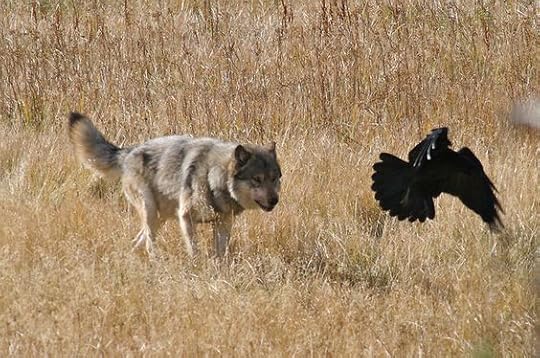
Beyond croaking, "Nevermore," what exactly do ravens do all day? Bernd Heinrich, biology professor at the University of Vermont and author of Ravens in Winter, has spent more than a decade learning the secrets of these giants of the crow family. He has observed startlingly complex activities among ravens, including strong pair-bonding, use of tools, elaborate vocal communication, and even play. Ravens are just plain smart, and we can see much of ourselves in their behavior. They seem to be affectionate, cranky, joyful, greedy, and competitive, just like us. And in Mind of the Raven, Heinrich makes no bones about attributing emotions and intellect to Corvus corax--just not the kind we humans can understand. He mostly catalogs their behaviors in the manner of a respectful anthropologist, although a few moments of proud papa show through when he describes the pet ravens he hand-raised to adulthood. Heinrich spends hundreds of loving hours feeding roadkill fragments to endlessly hungry raven chicks, and cold days in blinds watching wild ravens squabble and frolic. He is a passionate fan of his "wolf-birds," a name he gave them when he made the central discovery of the that ravens in Yellowstone National Park are dependent on wolves to kill for them. Mind of the Raven offers inspiring insight into both the lives of ravens and the mind of a truly gifted scientist. --Therese Littleton

434 pages, Paperback

First published January 1, 1994

980 people are currently reading
10430 people want to read

About the author

Bernd Heinrich

67 books684 followers
Bernd Heinrich was born in Germany (April 19, 1940) and moved to Wilton, Maine as a child. He studied at the University of Maine and UCLA and is Professor Emeritus of Biology at the University of Vermont.

He is the author of many books including Winter World, Ravens in Winter, Mind of the Raven, and Why We Run. Many of his books focus on the natural world just outside the cabin door.

Heinrich has won numerous awards for his writing and is a world class ultra-marathon runner.

He spends much of the year at a rustic cabin that he built himself in the woods near Weld, Maine.

Ratings & Reviews

What do you think?
Rate this book

Friends & Following

Create a free account to discover what your friends think of this book!

Community Reviews

5 stars
1,462 (34%)
4 stars
1,601 (38%)
3 stars
874 (20%)
2 stars
202 (4%)
1 star
55 (1%)
Displaying 1 - 30 of 505 reviews
Profile Image for Petra X.
2,455 reviews35.7k followers
September 24, 2022
Fascinating things you learn in books that may save your life one day if you are stuck in the woods (or not). Now I know how to climb a tree so tall that the branches don't even begin until 60-80 feet up.

1. Attach a fine monofilament line, anchored to the ground, to an arrow which you fire over the crown of the tree.
2. When the arrow is fired, standing in the original place, attach a much thicker line to the line you had fixed to the ground.
3. Go to where the arrow is now, the other side of the tree and haul over the thin line and the attached thicker line.
4. Discard the thin line and attach a rope, anchored to the ground, to the much thicker one.
5. Go back to the original position and haul over the rope
6. Attach the rope to a rope ladder and go back to the other side of the tree, pull up the rope ladder as far as you need and secure the rope.
7. Back to the original position and you can now climb up the rope ladder to the top of the tree.

Ingenious!
I love this book. I love all Bernd Heinrich's books. I wish I had a bow and arrow. And if I did, that I could actually shoot it that accurately and not get it stuck in the branches. Unlikely. I can't even catch a ball.
Profile Image for Ian.
982 reviews60 followers
November 23, 2023
Back at the end of April I went for a walk a few miles from where I live. Passing a steeply wooded area I noticed a buzzard circling, when a raven came out from the trees and attacked it. I surmised the raven had a nest and that the buzzard had got too close. The two birds whirled and screeched for a bit but the buzzard wasn’t long in deciding to beat a retreat, leaving the raven to return to its tree and literally crow about its victory. After watching this incident I decided I’d like to learn more.

My desire to find out more about ravens was certainly satiated by this book, which you could subtitle as “everything you ever wanted to know about ravens and a bit more besides”. There were times when I wondered whether the author really needed to include quite as much detail as he did. For all that, this was a pretty interesting read for anyone with an interest in the natural world.

When biologists study a species, they like to spot certain behaviours that they can ascribe to the species as whole. As the book progressed I kept thinking that the individual ravens described behaved in widely differing ways, and indeed the author himself makes this point. The more data he collected, the more contradictory his results became. One of the most puzzling features was the extreme caution with which ravens treated calf carcasses the author left for them in the woods of New England where he lived. It would be hours, even days, before ravens would approach a carcass, and even then they did so slowly and cautiously. From an evolutionary perspective this seemed strange. Why would a scavenging bird be afraid of the type of carcass that represented its primary food source? The answer emerged with some groundbreaking research from Yellowstone National Park following the reintroduction of wolves to that area. It turned out that ravens followed wolves on their hunts and ate exclusively from the kills that the wolves made. The ravens would ignore carcasses left by the Park Rangers only a few hundred yards away. In those parts of the US without wolves, it is suggested that ravens have taken to following human moose hunters, and the author also commented that similar behaviour has been observed at deer shoots in the Scottish Highlands. I asked a Head Gamekeeper of my acquaintance about this and he confirmed it, commenting that “a rifle shot is like a dinner bell to them” and that no sooner is a deer carcass removed than the ravens are in and about the grallochings that are left behind. It seems that ravens may have expectations – an animal killed by a wolfpack or by human hunters is something they understand, but a carcass suddenly appearing from nowhere? Their reaction would be a bit like ours if we went into our garage and found someone had left a brand-new car there.

There’s much else of interest in the book. I particularly liked the sections on how ravens communicate, on the evidence that they can display moods and emotions, and their undoubted ability to recognise individuals amongst both their own species and others, notably individual humans. The last few chapters are taken up with a discussion on raven intelligence, and whether they have consciousness. One of the problems of drawing conclusions is that the terms themselves are ill-defined, but the author does make a strong case for the abilities of ravens to problem-solve, to develop strategies and to memorize.

From now on, I’ll look at ravens in a whole new light.
Profile Image for Lori.
308 reviews96 followers
February 10, 2019
description

It’s a mix of personal anecdotes, scientific study, and speculation. Heinrich loves and respects these birds. He knows as much or more about them than anyone.

The writing is not particularly ordered, but it’s likable and I learned some things. I’m still not sure if the charm is in the telling or the ravens.
Profile Image for Chrissie.
2,811 reviews1,421 followers
December 25, 2020
This book starts out slowly; give it a chance. By the end you will see that all the separate parts hold together providing a complete, cohesive and strong argument confirming the intelligence of ravens. I knew very little about ravens when I began. Now they fascinate me, and I am convinced that Bernd Heinrich, an experimental biologist, has in a balanced fashion woven together both his own scientific experiments and numerous anecdotal stories.

The book is well organized. It starts with his capture of four 1-month-old ravens followed by description of his aviary and the birds’ maturation, pairing, nesting, copulation and hatching of subsequent generations. The original four and their offspring become individual characters to the reader. After first becoming acquainted with these basics, the book delves into the fascinating discussion of behavioral patterns, intelligence and emotions, continually gathering information from both scientific experiments and anecdotes. Their play behavior will certainly make you laugh. You will even learn how and why they come to bathe in dirty puddle water when it is freezing cold! Bathing is play, and play behavior, curiosity and intelligence are directly correlated. The symbiosis between ravens, wolves and early man is fascinating. Sources and statistics are documented. The book concludes with an exemplary summation of all that has been covered.

I wasn’t impressed with the audiobook narration by Norman Dietz. He drones on an on in a level boring tone. He makes the content sound uninteresting, which is really a shame. I am giving the narration two stars because you do hear the words clearly. If you choose the audiobook be prepared to listen to the author’s words and not what is coming through your ears!

What started in a boring fashion with what seemed unnecessary details became a totally fascinating book and wonderful reading experience. A really good book!


*********************

Additional books on animals' intelligence and emotions
Beyond Words: What Animals Think and Feel 4 stars
The Genius of Dogs: How Dogs Are Smarter than You Think 4 stars
Wesley the Owl: The Remarkable Love Story of an Owl and His Girl 5 stars

Additional books by Bernd Heinrich:
The Snoring Bird: My Family's Journey Through a Century of Biology 5 stars
Winter World: The Ingenuity of Animal Survival 4 stars
A Year in the Maine Woods 3 stars

All of the above books I can recommend. Each one offers something different, each good in its own way!
Profile Image for Brynn.
27 reviews18 followers
December 16, 2014
I had high expectations going into this book. As an amateur naturalist, and someone with degrees in wildlife biology and conservation I was already intrigued by ravens and hoped to learn more in depth about their behaviors and social structures. Instead, this book is simply a piecemeal, intricately detailing each of the author's individual experiments and observations of the birds over time with no overarching narrative to tie all the information together. Certainly, he is an authority on ravens and holds a wealth of information but the presentation of that information is unstructured (despite chapter names acting as groups), unnecessarily detailed, and often dull. The ravens themselves are not uninteresting, however having to tease out the tidbits of meaning from the rest of the descriptive chaff was tedious. By the end I was skimming whole pages. The author truly needed an editor, or ghost writer, here to help create a narrative worthy of these birds.
Profile Image for Hana.
522 reviews369 followers
October 16, 2016
What do ravens think about?


I'm moving up the phylogenetic tree from my recent read about mollusc minds (The Soul of an Octopus: A Surprising Exploration into the Wonder of Consciousness) to birds. Mind of the Raven is another great book about creature consciousness. I'll read just about anything Bernd Heinrich writes--I'm a major fan. My all time favorite (as a New Englander) is Winter World: The Ingenuity of Animal Survival. Mind of the Raven is more a series of studies in behavioral ecology and for many readers it will be a two star read at best. But I love ravens and I'm always up for some serious science especially when leavened with personal anecdotes about the most endearing birds in the world.

Ravens are among the bird world's most accomplished flyers--dive bombing...


And doing formation acrobatics in mid-air...


Ravens seem to fall in love and form monogamous pair bonds....


Ravens are intensely social....


Sometimes they are territorial...


They are highly vocal with a whole range of extremely loud calls that seem to be specific to regions.


Ravens are omnivorous but mostly they prefer high fat, high protein food, especially when feeding their young. Given a choice they'll eat the yolk of chicken eggs and leave the egg whites. They love corn chips. When it comes to scavenging animal carcasses (their usual method), they will go for the fat every time. Yum! Ravens have evolved complex relationships with top predators. In Yellowstone that means wolves. Ravens do aerial reconnaissance and seem to lead top hunting predators (wolves and humans) to prime prey.


What do they think about us?

Profile Image for Trilby.
Author 2 books18 followers
February 19, 2013
I got this book after spending a couple of summers on our land (now with cabin) in the North Woods. The ravens are omnipresent there, winter and summer. As I watched them wheel through the sky and heard their haunting cries, my curiosity about them was piqued.
This book far exceeded my expectations. Heinrich, a biologist by profession, presents insights into ravens' behavior garnered from his decade-long study of the wolf-birds. It was amazing the lengtbs that Heinrich would go to get a close glimpse into their lives--from gathering roadkill to feed them, to traveling to Europe and the Arctic to study them.
Heinrich presents some of his raven subjects as fully-rounded "characters", as individuals with distinct personalities. The enthusiasm that drives his quest to know the birds is infectious. I was eager to see what Heinrichs and his raven subjects would do next.
Now,as I watch the ravens circling overhead, I have enormous respect for their intelligence and some understanding of how they live. The Mind of the Raven is required reading for anyone fascinated with ravens, or their cousins, the crows.
Profile Image for Camelia Rose.
894 reviews115 followers
May 2, 2021
Bernd Heinrich is an American naturalist and a behavioral ecologist. Mind of the Raven is a collection of raven studies based on wild ravens and the author's own hand reared ravens. It covers a wide range of topics from individual ravens to raven's social life, social structure, bonding, nesting and parenting, to how ravens recognize humans and other ravens, to the symbiosis between ravens and wolves and between ravens and human hunters, and to raven intelligence and complex behaviors such as playing, puzzle solving and tool using.

Ravens are smart, social birds, and each raven can show distinct individuality in temperament, behavior and intelligence. Ravens are especially good at picking up visual cues, but not scents. Some ravens can mimic sounds and voices as well as patriots can.

Chapter 26 Testing Raven Intelligence: "It is hardly to be expected that human, animal would be qualitatively different from all others. The psychologists who have studied learning in rats and pigeons have assumed and found similarities across species. If that is anthropomorphizing, I am all for it. There is no evidence to suggest that humans have some new or different, mysterious vital essence that other animals lack."

The audiobook is well-narrated. It would be great that in the future, for a book like this, recordings of sounds (such as raven calls) could be included.
Profile Image for Keegan.
24 reviews24 followers
June 2, 2009
Mind of the Raven, by Bernd Heinrich

A great scientific study of Ravens. The observations gave me a clear picture of the animal that played a crucial role in human history, inspired trickster myths, and stirred our collective imagination. I read this book along with Lewis Hyde's Trickster Makes this World, and they are excellent companions. Hyde's book is an excellent exploration of trickster mythology, but he does not credit the animals spirits themselves for enough inspiration and interplay that they gave to our ancestors and still give to us. He seems to think that our ancestors imposed allegories of our imagination onto random animal figures, but I disagree, as I discuss later, and Bernd's work supports my ideas.
Among my favorite observations of his are that no two Raven's are alike. They are both a creative species, and creative individuals, who differ from each other as much as they differ from other species. Very little of their learning appears to be pre-programed, they problem solve and imagine solutions for themselves as they grow.
One of their most intelligent adaptations has been to learn to lead carnivores like wolves and men to hunting grounds so that they can scavenge remains, and also to lead these same carnivores, once they trust the birds' signals, into traps so they can eat the carnivore. In this way they escape from the predator-prey dichotomy, are an agent of neither side, but remain in a constant, undefined flux. I believe that our ancestors observed this, which inspired their trickster myths, and those that learned the deepest lessons of these myths, kept their societies in flux, so as not to create any strict laws, for eventually a situation will arise where exceptions need to be made to even the laws that sound most basic, otherwise tragedy will ensue. Think “thou shall not kill” and abortion, the death penalty, doctor assisted suicide. The individual and culture that does not keep a nimble enough mind to deal with all of these situations as they arise will crumble, govern with a cold, iron hand, or worse...

Some thoughts inspired by some of the observations:
132: Sharks are not fast enough to catch dolphins, so they don't try. Dogs are not fast enough to catch squirrels so they try and fail. Raven are not fast enough to catch squirrels, so they change the rules. They anticipate where one will run if chased. One Raven waits there while another gives chase, knowing he cannot catch the squirrel but also knowing that the other Raven will catch it and share it.
Hawks can catch squirrels and Ravens can watch. A Raven cannot kill a hawk, but they can try hard enough to distract the hawk while another Raven, hiding and waiting, steals the squirrel.

145: We respect the Raven spirit when we are Ravenous. He leads us to meat, teaches us the tricks to hunt for ourselves. When we become too settled, we frame him differently, we see his mischievousness as a threat to our order. Our mind-forged manacles make us short-sighted.
While reading this book and Trickster Makes this World, refining my ideas about the trickster spirit, I had a deep personal dilemma as my ideas (or idealizations) conflicted with the concerns of my daily life. My neighbors were burglarized, and this stressed me out far more than it needed to. I was not robbed, but I stayed awake at night, listening for the tiniest noises, and researched tenants' rights during the day. This was largely because our building is not secure (the front door is not self-closing or self-locking) and our super was suspected of committing the burglary. The incident vilified a trait I admire and strive to emulate. Raven would not work hard, stockpiling his goods and believing they could never be taken from him. Beaver would, and Raven would steal from him, proving him wrong. Man thought everything was perfectly arranged, living in a tightly shut clamshell, until Raven smashed that clam, killing those who clung to the shell, but exposing the survivors to the greater world.
Of course, whoever burgled my neighbors' apartment does not live outside the system. By robbing them, the entered the criminal justice system, the policed predator-prey relationship. Thieves are not present day tricksters. They never were, with the possible exception of Robin Hoods. Still, there is something to be learned from this: it is foolish to feel too secure in ones system of order. In our culture of multiculturalism, thousands of them collide at every crossroads (in this case, the domestic (me), the criminal (my super), the capitalist (my landlord), the state (the police), under a huge umbrella of a huge fucked up system that disenfranchised the Puerto Rican that probably robbed my two white neighbors). Raven is the God of the Crossroads. Here, all interesting revelations can emerge. Questions of whose things were stolen – who has rights to a computer while others don't anyway? - arise.
My neighbors can afford new things and if my super stole them, it is because he has HIV, two pregnant teenage daughters, and an addiction. Raven would see there are larger problems to be dealt with than theft. Dealing with them requires much more imagination than buying another lock – but no one will be truly safe until we do.

Bernd's observations in the last few chapters are profound. After painstakingly documenting Raven behavior and intelligence through most of the book (which was nearly as painstaking to read) he pulls his observations together and reflects deeply on evolution, consciousness, and intelligence. His best point about animal intelligence, is that it is silly to assume animals have an entirely other sort of consciousness than ourselves because the vast majority of our intelligence developed along with/through them.
One of his last points is that Raven, dolphin, and ape consciousness is most like our own because of their ability to predict situations – to “create memories,” as he puts it. For some reason, the most obvious, important word to describe their behavior eludes him: imagination.
Ravens can accurately imagine how other animals and objects will react to their actions without pre-programming or trial-and-error. There are obvious reasons that accurate imagination would be beneficial in the evolution of Ravens – for example, they need to be able to feed among carnivors, so they must be able to imagine how certain predators such as wolves and humans will react to their presence, both as a species and individuals.
Play has an obvious role in the development of the imagination. Bernd makes the interesting observation that 'play' is defined as activity that has no material benefits, but upon closer investigation it has vast benefits. Play often develops muscles, reactions, and reasoning that will ultimately benefit species and individuals materially. It makes individuals and species happier and more well-adjusted: 2 crucial elements to future success. And perhaps most importantly, it stimulates and sharpens the imagination.
Both species and individuals that have accurate, active imaginations are more successful and have more to teach us, which ties into Lewis Hyde's discussion of the trickster. Hyde notes the individuals with the trickster spirit who expand our consciousness, but I think he misses the 'species' side of things. He glosses over the animistic trickster and anthropomorphizes them to say they are merely representations of human attributes like Hermes. But they are more. Like all good metaphors, they are first and foremost their physical reality. The cold, we snow that falls all over Dublin at the end of The Dead may represent death or paralysis or whatever, but it is first and foremost cold, wet snow. Joyce's clear image, crafted from his playful penmanship, can mean so much more than its material reality because of Joyce's accurate, active imagination (even if he claimed never to have one).
Raven is first and foremost a big black bird with an active, accurate imagination. Our ancestors saw the genius of his imagination. He became the hero of their stories because they saw his wisdom, and by watching him closely they learned much about their own trickster spirits and the world itself. They did not simply impose their trickster imagination on a random animal. I wish Hyde would have made this concession, but if you read Bernd's book along with it, the point will become clear.
Profile Image for Dan.
133 reviews
June 30, 2009
Ravens and crows have a reputation for being smart. In this beautiful book, Heinrich asks if ravens act by carrying out a series of innate, programmed behaviors, or if they're capable of thinking, planning ahead, and emotion.

I picked this book up after seeing a particularly social raven taunt some tourists on Vancouver island. What a weird bird.

Each chapter is laid out as an experiment. Can ravens recognized individual humans? Heinrich approaches the ravens in his aviary in a Halloween mask, in a kimono, or walking with a limp. Do ravens experience curiosity? Heinrich introduces his ravens to coins, turtles, cheerios, and cheetos (they love cheetos). Can ravens plan ahead? Heinrich ties a piece of salami to a string and dangles it from a branch to see if the ravens can figure out how to get the meat.

He concludes that ravens are conscious animals who use curiosity and play to explore how their world works and adapt to new situations and experiences; who have the ability to recognize other ravens and individuals of other species, including humans, dogs, and wolves; who can plan in their heads and then carry it out; and who experience the emotion of pain, love, and much more.

Most pop science books I've read focus more on the conclusions of scientific inquiry--they tell here's how the world works. Heinrich's writing shows the scientific process at work. His writing focuses more on his method than on his conclusions. And he's an enthusiastic explorer who will climb a tree in Maine in a freezing rain to get a peak inside a raven couple's nest.

Profile Image for Jakub.
813 reviews71 followers
September 15, 2022
Informative, interesting and written in a approachable manner. You can feel the passion and the respect the author has for the crows and he is able to convey why he sees them as special. The only minor gripe I have is the appearance of the "I am right and the academic world does not see it" grumblings in one part of the book. It's not a serious case but still...
Profile Image for Aliya.
31 reviews1 follower
March 3, 2019
I wanted to enjoy this book so badly, but the writing is dull and arid. Somehow, the author made a fascinating subject completely uninteresting. He talks way too much about himself and not enough about the birds he’s studying.
Profile Image for Chris.
2,079 reviews29 followers
July 29, 2020
Dry, dull, and tedious on what should have been an exciting topic. Had to stop at page 115, one quarter through. Such a disappointment.
Profile Image for Missy LeBlanc Ivey.
609 reviews52 followers
May 20, 2021
Originally published in 2007. I really would have enjoyed this book more if we had ravens in this area, in Southeast Texas, but, we don’t. They are mostly Yankee birds. Come to think of it, I’ve never even seen a crow out here on our ten acres, which is kind of in the country and surrounded by woods on two sides. Now why is that? Not enough food source? I have seen some crows in town in parking lots of malls and hospitals, but never even a crow around here.

I found parts of this book very interesting, and other parts kind of long, tedious and drawn out. This author’s research was focused more in a controlled environment, although he was able to study ravens pretty intensely out in the wild, too. He owned two aviaries, one in Vermont, and his main ½-acre aviary in Maine, where he captured, raised a few, and studied ravens throughout the 1990’s. Since science research progresses one tiny little step at a time, I’m sure his observations will add to the understanding of ravens and their behavior. And if you live where ravens live, you, at least, will now have more knowledge and understanding of what some of their calls and postures mean after reading this book.

I’m not sure how he ever managed to find time to get married and have children. The time it takes to feed and study these birds is incredible. I can’t imagine how often he had to go out hunting down dead carcasses and preparing them to be fed to his subjects day-in and day-out. Ravens eat an incredibly large amount of food, and feed about every two hours. Plus, the time to sit for hours upon hours in the freezing rain and snow just observing, or sitting inside his home and observing secretly through his bedroom window that opened up to the aviary, where he may have had up to 20 birds at any one time. Add the time he took to plan and prepare for activities to test their ability to be able to problem solve through a situation or not, and all the traveling he did to other countries just to observe ravens from another point of view. And keep in mind the fact that he had to keep a detailed log of the whole process on top of it all. And now, here is the book, detailing it all in just one volume…just for our pleasure. I wish we had ravens around here so I could observe them.
Profile Image for Judy.
3,542 reviews66 followers
May 31, 2021
From now on I'll pay more attention to the corvids. Of course, I always notice them and sometimes I even confidently declare 'crows' or 'raven.' But all too often, I'm left settling for 'corvid.'

From the Preface
My goal here is not to be authoritative. Instead, I sketch the world of a magnificent bird that, as we shall see, has been associated with humankind from prehistoric times when we became hunters. I focus largely on unpublished observations, experiments, and experiences that I hope will engage you to participate in the quest of exploring another mind.

Examples of Interesting Info
p 108: Adults can begin to breed at the age of 3 years, but sometimes do not until 7.
I think I would have guessed first breeding at age 2 or 3; definitely not 7.

P 149: After the young stopped begging, she stood at the nest edge looking at them, repeatedly making soft low grr-krr sounds that induce hungry young to gape. She was making sure they had enough.
I like the idea of raven parents talking to their young.

p 195: We know infinitely less about vocal communication in ravens than we know about the call of a frog, a cricket, or the zebra finch. That disparity reflects not so much lack of interest as our inability to get replicable data. The more complex and specific a communication system becomes, the more random-sounding and arbitrary it will appear.
But of course! It makes so much sense when someone states the obvious.

p 225: A raven is afraid of what it knows to be dangerous, but that seems to be the least of its fears. Most of all, it is afraid of events that violate its expectations. Perhaps, like us, they fear what they do not understand.
Humans attributed large-scale frightening events to gods. I doubt that ravens do that. Based on Heirnrich's observations, ravens observe anything unusual. That's wisdom.

p 230: In Yellowstone, the wolves of each pack kill an elk on average every 1.5 days.
That's a heavier kill-rate than I expected. Maybe wolves would solve the elk problem in RMNP.

p 253: ... a raven can live longer than a half century ...
But what's their average life span?

This book is more than a life history of ravens. It explains by example how science works. I especially appreciated Heinrich's descriptions of the strategies he used to gather information about the birds.
Profile Image for Silvana.
1,299 reviews1,239 followers
April 4, 2020
3.5 stars rounded down. Not exactly a page turner, but the book did successfully provide me some insights on the fascinating mind of one of the corvidae family members. It might be more enjoyable if it's a bit shorter.

Now, I love to mix my interests in SFF and nonfiction. This book was one of the references from Ka: Dar Oakley in the Ruin of Ymr, which was one of my most favorite reads two years ago. I became more fascinated with crows and decided to read this, especially since some friends at the NFBC group also recommended it.

It did not disappoint. The author was clearly passionate about ravens. There are lots of experiments - some were downright hilarious - he did directly on his pet ravens and many wild ones. Ravens are unpredictable, they have so many contradictions it's hard to pinpoint their basic behavior. They could be afraid of a pile of Cheetos while they often pull wolves' tails without fear. They are one of nature's premier scavengers, yet they feared animal carcasses.

Ravens are often called wolf birds since they have been forming symbiotic relationship with wolves for thousands of years. They, being intelligent and adaptable animals, have shifted allegiance to humans - the other mammalian hunters - where wolves do not exist. It is totally understandable that Odin in the Viking myth had two ravens on his shoulders for 'mind' and 'memory' as well as two wolves at his side for hunting.

In 2016, years after this book's publication, experts claimed that ravens possess a basic Theory of Mind, the ability to attribute mental states like seeing to others. Heinrich, in this book, concluded that "....ravens are able to manipulate mental images for solving problems. They are aware of some aspects of their private reality, seeing with their minds at least some of what they have seen with their eyes."

So, yeah, their minds are fascinating.
Profile Image for Tamhack.
328 reviews9 followers
August 26, 2013
This was more of experiments with ravens. I did learn some interesting items of ravens and their characters.
"With ravens, the line between interpretation and fact is commonly a thin one, but as Mark Pavelka, who studied ravens for the United States Fish and Wildlife Service, said, "With other animals you can usually throw out 90 percent of the stories you hear about them as exaggerations. With ravens, it's the opposite. No matter how strange or amazing the story, chances are pretty good that at least some raven somewhere actually did that." That is because ravens are individuals. Ants. aren't.

Pg. 30-Ravens share information.
Pg 34- "Despite his young age, Jakob's tongue and mouth lining were black. Only those ravens who have learned to be subordinate in the presence of superiors -and in a crowd of ravens, almost all encounter social superiors-does the mouth lining remain pink for several years. Jakob's mouth color alone showed that he had already established himself as the alpha in the household."
pg 45- "Merlin has emotions. He also remembers faces and events that he associates with them. He has moods. I do not know if he is a thinking being, but there is not doubt he is a feeling one"

Pg 57--"Is education possibly a process of trading awareness for things of less worth?"

pg 65-" It would be difficult to overestimate the importance of learning in the life of ravens. Even so, much of learning involves expression of the behavior that is inherited to varying degrees, and released only by specific stimuli at specific times. And as every parent knows, an important aspect of the learning process is simply gaining exposure to what is important. Perhaps the largest part of our educational process, and perhaps also the ravens', involves mechanisms for gaining exposure to appropriate stimuli. These mechanisms may have several components. In ravens, youngsters gain the specific experience appropriate for the species' lifestyle by following their parents. Moreover, curiosity allows them to take advantage of this experience and enhances encounters with relevant objects or things."

Pg. 150- Ravens and most other birds have not evolved behavior to reject young from their own nests, even when these young may look odd to them, because foreign young would normally almost never be deposited there. It is sometimes a different story with eggs that could become stranger's young. An egg could be laid into a neighbor's nest accidentally, and some bird species specialize in parasitizing other parents by dumping their eggs off to surrogate parents. They not longer build any nest of their own. The best-known examples of this are cuckoos in the Old word and cowbirds in the New."

Pg. 173-- sounds, Vision is important in recognition.

Ravens are flexible.

Pg. 197- "Some raven calls they recorded were common to all the birds, but the majority could be learned and culturally passed on."

Pg. 203- "Body language is also extremely important to ravens."

Pg 215- "...status is central to many aspects of raven behavior. High status is costly to show and to maintain. In ravens, it is based on large size, and large body size requires much food. High status is shown by displays, and displays invite challenge. Nevertheless, the benefits of high status are many. Only high-status birds can consistently reveal their sex, and thus only they can be sexy potential mates. They become good providers because they can defend food bonanzas when it is critical to do so. Status determines who may feel first at prized food, and also who can afford to allow others to act as a shield by "testing" dangerous food."

P225-" A raven is afraid of what it knows to be dangerous, but that seems to be the least of its fears. Most of all, it is afraid of events that violate its expectations. Perhaps, like us, they fear what they do not understand. If they can fear the unknown, then that implies that they know."

Pg. 269- Animals exhibit consistency of response only where it serves their individual interest. The necessity for consistent response with respect to treatment of others is obvious among social animals....

Pg. 287- Ravens like to bathe every 3 to 4 days. Temperature is unimportant. "Perhaps the most important factors determining whether a raven will take a bath is whether it sees another bathing."

Pg. 311- ...ravens act with thought and intelligence. " Intelligence is not merely consciousness or awareness alone. It is not just complex behavior. Intelligences is not just super-detailed memory, rapid learning, complex vocal communication, play behavior, or tool use. Intelligence many or may not be related to all of these things, and some kinds of intelligence require them, but they are not what intelligence is. Intelligence is doing the right thing under a novel situation..."

Pg 342--"Consciousness is necessary to confirm value." "Our values are emotional rewards that allow us to do otherwise proximally senseless things that have not immediate reward whatsoever. The same idea applies to a raven pulling a string. The bird gets no tangible reward from all the intermediated steps before it reaches the food. And it can only get ant emotional satisfaction for the senseless act of pulling on a string, as such, unless that act satisfies a thought or mental scenario of getting what the string will provide."
" Some believe that consciousness and the thinking derived from it are mad e possible only with linguistic ability. According to that very narrow view, humans are indeed the only conscious beings. But who of us translated everything we are aware of, thinks, or feels, into words? Who thinks only with sentences? ...."
Profile Image for Ian Beardsell.
275 reviews36 followers
January 25, 2021
Bernd Heinrich has probably become my favourite naturalist author. Earlier in 2020, I read A Year in the Maine Woods, which was a nicely paced journal of his year spent studying the natural surroundings of his cabin in Maine. The Mind of the Raven is a book much more focused on the scientific method and field study of this professor's favourite subject: Corvus corax, the raven.

Although perhaps a bit more rigorous and in-depth than the meandering and contemplative "year in the woods" journal, Heinrich still maintains the uncanny ability to befriend the reader. He brings you into his daily routine of climbing trees, splitting up cow carcasses, and writing research papers, all the while making you feel like you are hanging out with your easy-going thesis professor or perhaps an eccentric uncle who is really into ravens. You get a glimpse into the life of a field scientist, but it is not the daunting, white-lab coat and tedious, research-grant applying scientist, but a friendly, down-to-earth fellow who will infect you with his enthusiasm for, not only the fascinating world of ravens, but the beauty of all the natural world and its creatures.

The more time I spend out in the forests of my native British Columbia, the more I have come to appreciate the intelligence of corvids such as ravens, crows, magpies and nut-hatches. Heinrich is uncovering a lot of evidence about how intelligent ravens really may be, to the point of raising very pointed and important questions regarding the nature of mind and consciousness. The scientific community has been very fixed on the idea that most of the intelligent-like behavior seen in animals can often be attributed to unintended training imposed by humans or unconscious adaptations to the environment. Heinrich, among others, is starting to build a case that animals may have a higher level of consciousness than previously suspected. They apparently can recognize different individuals in different species, form emotional attachments (even amongst different species), and even predict simple future events and problem solve, all of which shows a mind that is flexible at thinking somewhat abstractly and perhaps consciously. Scientists are finally starting to probe long-held ideas regarding consciousness and mind, huge questions that humans have thought about for centuries. Perhaps animals will help us sort out some of these tantalizing yet difficult questions. We definitely have far to go, but the endless process holds rewards to which Heinrich alludes near the end of the book.
The "climb" to the ravens [up the trees in forests where the author studies them] has sometimes been hard but the results have been deeply satisfying. I feel that I've won a wider vantage point for seeing some of the raven's [behaviours], much as I then had a vantage point for viewing the forest. There is no end to the forest, and there is no end to the mind. Indeed, the greater the complexity, the more it is mind, as the more trees there are, the more it is a forest. It can never be encompassed fully.

Profile Image for    Jonathan Mckay.
710 reviews87 followers
January 13, 2020
3rd book of 2020.

Sometimes I wonder if every topic is interesting when the right level of curiosity is brought to bear. Bernd Heinrich makes Ravens, and just about anything related to the forests of Maine interesting. In fact, Berndt could have written a book about paint drying and I would still like it. The book is structured with narrative, followed by info from published academic studies, and more general implications about cognition and intelligence at the end.

Heinrich deftly combines his own anecdotes about 'his interesting friends' the ravens with controlled studies, and while he has clear intuitions about hypotheses without nature-worthy evidence, he certainly convinced me about his opinions. I appreciate how he has dialed in the parameters of raven intelligence dismissing many anecdotes as impractical, but marveling over ones proving an important point, such as the pattern of peck marks on a moose carcass to remove an entire chunk of fat. That ravens posses such memory and geospacial reasoning is amazing.

He then brings it back to criticizing some of the prevailing beliefs about intelligence, specifically, that animals and especially birds are simply automatons, and unable to plan or reason, as well as building out the idea for a continuum of intelligence, and even pointing out that some signs of intelligence, such as play, are things we don't have a very good definition for. These last few chapters were exactly what I wanted to get out of the book and I appreciate that the author included them.
Profile Image for Claudia.
1,288 reviews39 followers
May 7, 2020
You have to wonder what prompted a noted naturalist who had previously worked with bumblebees to move over to ravens. But he did and he writes of his experiences in Vermont, Maine and across the world.

Sections range from banding infant hatchlings to discover what they are being fed, vocal communications, partners and mating pairs, adoption of other hatchlings (one of his regular pairs abandoned 4 young and Bernd transferred them to the nest of another pair who raised them to adulthood). Caching behaviors as well as interaction with other predator birds as well as wolves which can involve plucking at tails and tail feathers and running away as well as eating at the same carcass. Playing which can be as sliding in the snow, to hanging upside down from a branch, and performing barrel rolls while flying. And eventually, Heinrich's experiments that tested raven intelligence.

Of course, he also includes many, many anecdotes not only from his own experiences but those of other human interactions and observations. The book winds to an end with a discussion of whether ravens possess emotions. A conscious? How they have adapted their shyness and caution to new situations. Apparently the world that ravens live in is far more complex that everyday humans could ever imagine. But reading Heinrich's book, you will get an idea.

The only complaint I can relate is as a ebook, the pictures are quite small and if you attempt to blow them up - all black-and-white - they blur and details are lost. Even the line drawings blur and grow out of focus.

2020-090

Profile Image for Corvus.
743 reviews272 followers
Read
October 11, 2022
DNF, early in its already very dated. Claiming ravens are exceptional in ways we already know many other birds are as well if not all of them. Saying other animals just live practically as automatons. After the introduction, we learn the author climbed trees and stole the babies of ravens out of them to study and "parent." You're a kidnapper dude, not a parent. Hell, I disagree with captive breeding birds but he literally could have bought one. I suppose those families are split up for profit as well though. I don't know how people can claim to truly understand other animals and admire them while also being completely ok with doing this to them. The narrator is also kinda annoying. He sounds straight out of gone with the wind.
Profile Image for Kevin McAllister.
548 reviews31 followers
July 7, 2012
As a professor of biology at The University of Vermont its understandable that the author of this book ; Bernd Heinrich would want to write a detailed, specific, and scientific account of the mind of ravens; and he does just that throughout the book. But as a lover and admirer of ravens he also waxes poetic about them again and again. Blending the science with the myth and lore of ravens could have been a really good idea for a book but unfortunately, for me, the author didn't quite pull it off. The science and the mythology always remained separate and their just wasn't a cohesiveness to the book that I felt it could have had.
Profile Image for Eric.
4,177 reviews33 followers
November 30, 2017
The fifth star might be just a touch over the top, but this was so much raw fun to listen, even with some side notes on anthropomorphizing his raven colleagues, that I just could not quit listening. Now, I have to say that Heinrich might have better titled this "Mind of the Author Studying Ravens," but that would be somewhat a quibble. He is certainly dedicated to his subject. He told us up front that as soon as a person thinks he understands the raven, they will be proven wrong by someone finding other results, so I suppose you could say he equivocates - no matter; the view of ravens associated with death was just more grist for his mill
499 reviews
September 20, 2014
I'm a little astounded at all the rave reviews of this book. It's not even really a book. More like a serious of field notes about ravens. Some of the notes are interesting, some are boring, some overly detailed, some really poorly written, some just odd. Like in the end of the book, when the author is complaining about getting his papers rejected from journals. I did enjoy reading about some of the experiments with the ravens, but what I got from the book was "Ravens do weird things. We don't know why."
Profile Image for Elizabeth☮ .
1,818 reviews14 followers
dnf
December 1, 2017
I have wanted to read this book for so long. I was excited to receive it as part of a book exchange.

I read one hundred pages and found myself losing momentum. This isn’t quite what I was expecting. There is too much detail about the day to day activities of the research teams of which Heinrich is a member.

I skipped to the chapters that looked more engaging, but I just couldn’t finish it.
Profile Image for Melissa  Jeanette.
161 reviews19 followers
April 23, 2023
Fascinating, never dull, but sometimes gruesome. Most of the time, I really enjoyed this book. I found it very interesting and often even fascinating. Ravens are pretty incredible and I loved learning about them. However, there’s also lots of talk of corpse eating, which I suppose is inevitable when discussing scavengers; but it occasionally turned my stomach. And I felt a little uncomfortable with some of the experiments. But, I’m glad I kept reading despite occasional discomfort and squeamishness because they’re were some pretty incredible moments with the ravens and I would have missed out on a really touching ending otherwise. 3.5 stars overall.


Side note: one of the most important things I learned is, if a raven is making a huge racket near you, look around, because you might be a cougar’s lunch if you don’t.
Profile Image for Elena Marjineanu.
54 reviews2 followers
December 21, 2020
I could have never imagined there would come a day I'd read a book exclusively about ravens. Needless to say, I've learned an awful lot about the most intelligent birds on earth and now I love this magnificent world even more.
Profile Image for Meesh .
13 reviews
February 8, 2025
I wish I had raven friends. I don't want to start collecting road kill to feed them though.
Profile Image for Soozee.
53 reviews
September 6, 2013
I appreciated the juicy tidbits and unique observations about Ravens this book had to offer but I'd prefer the author wrote with more help from his editor.
He writes like a scientist, which is to be expected, however it doesn't make for fluid reading.
In the final chapters, I felt he wrote defensively--like he had to prove that this text was worthy of respect in the scientific community.
I loved it and found it tedious all at the same time.
Profile Image for Chelsea.
95 reviews1 follower
June 29, 2017
New personal rule: If I make it to halfway through a book, I can put it on my "read" shelf instead of my "quitter" shelf.

HOW DO YOU MAKE A BOOK ABOUT RAVENS BORING??

Possibly would be better for actual naturalists; I couldn't slog through any more descriptions of piles of meat in the woods.
Displaying 1 - 30 of 505 reviews

Can't find what you're looking for?

Get help and learn more about the design.