

What do you think?

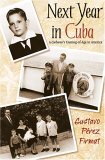
Next Year in Cuba: A Cubano's Coming-Of-Age in America
Gustavo Pérez Firmat arrived in America with his family at the age of eleven. Victims of Castro's revolution, the Pérez family put their life on hold, waiting for Castro's fall. Each Christmas, along with other Cuban families in the neighborhood, they celebrated with the cry, "Next year in Cuba." Growing up in the Dade County school system, and graduating from college in Florida, Pérez Firmat was insulated from America by the nurturing sights and sound of Little Havana. It wasn't until he left home to attend graduate school at the University of Michigan that he realized, as the Cuba of his birth receded farther into the past, he had become no longer wholly Cubano, but increasingly a man of two heritages and two countries.
- GenresNonfiction
213 pages, Paperback
First published August 1, 1995
About the author
Gustavo Perez Firmat
22 books12 followersGustavo Pérez Firmat was born in Havana, Cuba, and raised in Miami, Florida.
He is best known for his memoir, Next Year in Cuba, available in Spanish as El año que viene estamos en Cuba, and for Life on the Hyphen, a study of Cuban-American culture, also available in Spanish as Vidas en vilo. His most recent book, A Cuban in Mayberry, is an affectionate and personal look at one of America’s best-loved TV shows, “The Andy Griffith Show.” He has also published several collections of poetry in English and Spanish—Scar Tissue, Cincuenta lecciones de exilio y desexilio, Bilingual Blues, Equivocaciones, Carolina Cuban—and a novel, Anything but Love. His books of literary and cultural criticism include The Havana Habit, Tongue Ties, The Cuban Condition, Literature and Liminality and Idle Fictions. He divides his time between New York City and Chapel Hill, North Carolina.
He is best known for his memoir, Next Year in Cuba, available in Spanish as El año que viene estamos en Cuba, and for Life on the Hyphen, a study of Cuban-American culture, also available in Spanish as Vidas en vilo. His most recent book, A Cuban in Mayberry, is an affectionate and personal look at one of America’s best-loved TV shows, “The Andy Griffith Show.” He has also published several collections of poetry in English and Spanish—Scar Tissue, Cincuenta lecciones de exilio y desexilio, Bilingual Blues, Equivocaciones, Carolina Cuban—and a novel, Anything but Love. His books of literary and cultural criticism include The Havana Habit, Tongue Ties, The Cuban Condition, Literature and Liminality and Idle Fictions. He divides his time between New York City and Chapel Hill, North Carolina.
Ratings & Reviews
Friends & Following
Create a free account to discover what your friends think of this book!
Community Reviews
Displaying 1 - 10 of 10 reviews
February 26, 2011
Perez Firmat fled Cuba with his family in 1960 when he was about 10 years old. The first part of the book, focusing on his first years here and the general Cuban experience, was somewhat interesting and helpful in understanding the difference between exile and immigration. The author was married to a Cuban woman for 15 years with whom he had two children. He left her for Mary Anne, a married American woman who had children of her own. The two eventually left their spouses and married. The second half of the book descends into cathartic psychotherapy as the author struggles with his relationship with his father, his brother, his affair, and his Cuban/American identity.
The author shows no sympathy for any but his own exile community of formerly wealthy Cubans. He complains about the influence of other hispanic groups moving into Miami in the eighties, without considering the influence that the influx of Cubans had on Miami. He notes that his mother has to do chores that she never did in Cuba, but doesn't give a thought to the experience of servants left behind. He claims that the Cuban Revolution cost him his father, partly because his father was no longer the man he was in Cuba, and partly because if they had stayed in Cuba, he would have had no choice but to be a chip off the old block and follow his father’s footsteps into the family business. No appreciation at all for the choices and freedom that America gave him to find his own destiny.
The author shows no sympathy for any but his own exile community of formerly wealthy Cubans. He complains about the influence of other hispanic groups moving into Miami in the eighties, without considering the influence that the influx of Cubans had on Miami. He notes that his mother has to do chores that she never did in Cuba, but doesn't give a thought to the experience of servants left behind. He claims that the Cuban Revolution cost him his father, partly because his father was no longer the man he was in Cuba, and partly because if they had stayed in Cuba, he would have had no choice but to be a chip off the old block and follow his father’s footsteps into the family business. No appreciation at all for the choices and freedom that America gave him to find his own destiny.

November 23, 2022
Deja tú el contenido, ¡la prosa! Qué tortura.

March 10, 2013
I recommend this book to anyone who wants to read a perfect example of Cuban Literature and their experience in the US. Examples of "exilio" and what it does to people. I enjoyed reading this book. Read it in three days, by chapter. Enjoyable and easy to follow.

Want to Read
November 9, 2007Recommended over in the SDMB November 2007 book thread. We have several family friends who are Cuban exiles from this generation, so I think it would be interesting to read.
April 13, 2019
Loaned to me by a friend whose family was part of this same Cuban exile, I found this book fascinating. Learning the difference from choosing to be an immigrant and being in a holding pattern, hoping to return home, as an exiled person, makes entry into another culture a different experience.

September 5, 2019
Yuck. Just yuck

November 7, 2020
Less forthcoming than Carlos Eire in terms of the alienation resulting from exile. Eire doesn't mind parodying himself; Perez Firmat is slightly more guarded. I felt at times as if he was holding back, concealing the full extent of his pain. Not that I blame him for it. The flashcard mystery in chapter 8 was brilliant--the most riveting section of the book in my view. He really ought to have submitted that to the New Yorker. His reflections on teaching as love-making were also fascinating.

September 13, 2024
todo un baño de nostalgia. por primera vez pude sentir en carne propia el exilio, no porque sea el mío, sino porque es el de alguien más, que batalla por saber quién es y a dónde pertenece después de tanto tiempo. una narrativa increíble, lo que algo machista. el autor explica su añoranza por una Cuba que ya no existe, por una Cuba burguesa, que me sorprende que no viera de esa forma, más bien era la Cuba ideal para él. es así que, pude sentir el dolor de perder todo, o perder lo que para el autor era su realidad y lo que era suyo, y realmente duele. Alejo Carpentier dijo: “es imposible volver sobre los pasos perdidos” pero hasta que punto somos capaces de asimilar eso? siempre estaremos aferrados a lo que fue, o lo que no fue. genial.
This entire review has been hidden because of spoilers.
January 25, 2022
[4 stars] "el exilio es una mutilación"
Displaying 1 - 10 of 10 reviews