

What do you think?

Θέλεις να μιλήσουμε για τη συναίνεση; Επιλογές ως το άπειρο
Τι είναι η συναίνεση;
Γιατί είναι σημαντική; Πώς μπορούμε να μάθουμε να σεβόμαστε τα όρια των άλλων ανθρώπων και να δείξουμε στους άλλους τα δικά μας όρια; Πώς μπορούμε να μάθουμε να λέμε τη λέξη "όχι";
Ένας οδηγός που με έξυπνο, μοντέρνο αλλά και σωστά τεκμηριωμένο τρόπο εξηγεί πώς μπορούμε να πούμε "ναι" ή "όχι" σε πολλές και διαφορετικές εκφάνσεις της ζωής μας: από το να διαλέξουμε την πίτσα που μας αρέσει μέχρι να αντιμετωπίσουμε κάποιον που μας εκφοβίζει.
(από το οπισθόφυλλο του βιβλίου)
Γιατί είναι σημαντική; Πώς μπορούμε να μάθουμε να σεβόμαστε τα όρια των άλλων ανθρώπων και να δείξουμε στους άλλους τα δικά μας όρια; Πώς μπορούμε να μάθουμε να λέμε τη λέξη "όχι";
Ένας οδηγός που με έξυπνο, μοντέρνο αλλά και σωστά τεκμηριωμένο τρόπο εξηγεί πώς μπορούμε να πούμε "ναι" ή "όχι" σε πολλές και διαφορετικές εκφάνσεις της ζωής μας: από το να διαλέξουμε την πίτσα που μας αρέσει μέχρι να αντιμετωπίσουμε κάποιον που μας εκφοβίζει.
(από το οπισθόφυλλο του βιβλίου)
159 pages, Paperback
First published January 26, 2021
Ratings & Reviews
Friends & Following
Create a free account to discover what your friends think of this book!
Community Reviews
Displaying 1 - 30 of 65 reviews

January 9, 2021
Important stuff!
Can We Talk About Consent? is a mutli-chapter guide to consent and agency loaded with bright illustrations. The guide talks about consent generally AND consent around sex. the book is full of tips about how to ask someone for consent and also how to say no AND (also very important) what to do if you tell someone no and they don't listen to you.
I think it is very important to teach kids about consent starting at a young age. This book is targeted at people high school aged and older. It is a little dense for the younger set, but you can definitely read it and pull out some important stuff to share with younger kids. That is what I plan to do! My kids are in elementary school and I plan to discuss the asking and saying no tips with them. Also, accepting a no from someone else without continuing to pester them about it.
Thank you to the publisher for the review copy!
Can We Talk About Consent? is a mutli-chapter guide to consent and agency loaded with bright illustrations. The guide talks about consent generally AND consent around sex. the book is full of tips about how to ask someone for consent and also how to say no AND (also very important) what to do if you tell someone no and they don't listen to you.
I think it is very important to teach kids about consent starting at a young age. This book is targeted at people high school aged and older. It is a little dense for the younger set, but you can definitely read it and pull out some important stuff to share with younger kids. That is what I plan to do! My kids are in elementary school and I plan to discuss the asking and saying no tips with them. Also, accepting a no from someone else without continuing to pester them about it.
Thank you to the publisher for the review copy!

December 4, 2020
Consent is such an ambiguous issue that it is not a surprise to see an entire book dedicated to it, targeting the age group of 14+.
If you look at this book in terms of its content alone, the book has done a great job. Right from the start, it builds up on the idea of consent, how it means different things to different people, how we can recognise consent through body language. I loved the idea of "should story". Even concept in the book is explained through practical examples from daily life that make the application of the concept that much easier.
At the same time, I can't help feeling that the book would have had greater impact as a talk rather than a book. The language is very much as used in informative sessions and doesn't lend itself that well to writing. Further, there is a mismatch between the content and the illustrations. The content target a mature reader with even sex included as a topic (and it does go very much in detail into sex, thereby restricting the minimum target age group of the book.) But the illustrations seem a bit childish in comparison. I'm not taking away anything from the quality of the illustrations; they are truly fabulous and the artist's efforts are commendable. But looking at the sketches gives an idea that this book is meant for younger audiences, while reading it clarifies that it is not for anyone below 15.
Overall, an informative read that could have been better structured and presented.
I received an advance review copy of the book for free from NetGalley, and I am leaving this review voluntarily.
*************************************
Join me on the Facebook group, Readers Forever! , for more reviews, book-related discussions and fun.
If you look at this book in terms of its content alone, the book has done a great job. Right from the start, it builds up on the idea of consent, how it means different things to different people, how we can recognise consent through body language. I loved the idea of "should story". Even concept in the book is explained through practical examples from daily life that make the application of the concept that much easier.
At the same time, I can't help feeling that the book would have had greater impact as a talk rather than a book. The language is very much as used in informative sessions and doesn't lend itself that well to writing. Further, there is a mismatch between the content and the illustrations. The content target a mature reader with even sex included as a topic (and it does go very much in detail into sex, thereby restricting the minimum target age group of the book.) But the illustrations seem a bit childish in comparison. I'm not taking away anything from the quality of the illustrations; they are truly fabulous and the artist's efforts are commendable. But looking at the sketches gives an idea that this book is meant for younger audiences, while reading it clarifies that it is not for anyone below 15.
Overall, an informative read that could have been better structured and presented.
I received an advance review copy of the book for free from NetGalley, and I am leaving this review voluntarily.
*************************************
Join me on the Facebook group, Readers Forever! , for more reviews, book-related discussions and fun.
January 31, 2021
Hot damn! A perfectly written and illustrated book about consent for young adults that taught me a few really interesting things as well. Consent has become about so much more than "Can I sex this person nao y/n?". It's become an entire system to give people the respect & autonomy that they deserve. Autonomy over their bodies, their emotions, their health & safety concerns, their pronouns, their life and their privacy. I love it!
Three interesting things about this book:
Right on top of the bat it explains that it's important to develop the skill of knowing what you do and don't want. It also explains this isn't some natural thing you just magically know, but that it's a muscle and practice that you DO.
Second awesome thing. It points out that "Would you like me to do x with you, yes or no?" doesn't offer a lot of agency as opposed to more open-ended questions or offering a variety of choices. "How would you like to be greeted?" gives a lot more room than "Would you like a hug?".
Third awesome thing! It offers a variable scale (scales!) of consent, so you can be a -7, -2, +1 or a +8 to something - which is a great improvement over the tired old "Hell Yes or No!" that doesn't take asexuality, aromanticism, anxiety and neurodiversity into account.
Oh, and it also tackles intersectionality along the way, like any good consent book should. (Gha, secret fourth awesome thing!). I'm a fan!
Three interesting things about this book:
Right on top of the bat it explains that it's important to develop the skill of knowing what you do and don't want. It also explains this isn't some natural thing you just magically know, but that it's a muscle and practice that you DO.
Second awesome thing. It points out that "Would you like me to do x with you, yes or no?" doesn't offer a lot of agency as opposed to more open-ended questions or offering a variety of choices. "How would you like to be greeted?" gives a lot more room than "Would you like a hug?".
Third awesome thing! It offers a variable scale (scales!) of consent, so you can be a -7, -2, +1 or a +8 to something - which is a great improvement over the tired old "Hell Yes or No!" that doesn't take asexuality, aromanticism, anxiety and neurodiversity into account.
Oh, and it also tackles intersectionality along the way, like any good consent book should. (Gha, secret fourth awesome thing!). I'm a fan!

September 9, 2021
Αν έπρεπε να πω κάτι για αυτό το βιβλίο είναι “γιατί δεν υπήρχε όταν εγώ ήμουν έφηβης”. Θα με είχε γλυτώσει και μένα και τους φίλους μου από πολλά που μάθαμε με τον άσχημο τρόπο. Πάρτε το, ξεφυλλίστε το, διαβάστε το, αν θέλετε κάντε το δώρο στα παιδιά σας και τα παιδιά των φίλων σας, αφήστε το στη βιβλιοθήκη τους να το ανακαλύψουν μόνα τους ή ακόμα καλύτερα, πηγαίνετε μαζί τους στο βιβλιοπωλείο και πείτε τους “διάβασα καλά λόγια για αυτό, θες μήπως να το δεις;” ή απλώς μιλήστε τους για αυτό, αλλα πάνω από όλα, διαβάστε το εσείς. Γιατί κι εμείς οι ενήλικες, ακριβώς επειδή μάθαμε με τον λάθος τρόπο, θα μεταφέρουμε στα παιδιά μας τον τρόπο που μας έμαθαν. Ένα βιβλίο που ανοίγει μυαλά, δίνει αφορμές για συζητήσεις και (θέλουμε να ελπίζουμε όιτ) οδηγεί σε ένα μέλλον πιο αισιόδοξο όπου το όχι θα σημαίνει όχι και ο καθένας θα μάθει να σέβεται τις αποφάσεις των γύρω του.

January 11, 2022
A good overall book, I haven’t seen another on this topic for this age range. Some of it was a bit cringe which you will find in any book written by a middle age person for teens but the topics were important. I would have liked some book recommendations at the end for readers to go into more details on the political chapters at the end. It felt a little rushed and unfinished in this especially as it went quite deep into feminism but not homophobia, racism and ableism. Got quite sick of the pizza references but I would be quite happy for my child to read this but I don’t think it’s entirely comprehensive

January 31, 2021
Thank you NetGalley and Quarto Publishing Group – Frances Lincoln Children's Books for the digital advance reading copy of this book.
This book has a lot of great information and explains consent in an easy to understand format with fun analogies like the pizza shop (you will understand this when you read it).
I would have given this book a higher score but the printing on the colored backgrounds is really hard to read even if you aren't color blind. My husband walked in while I was reading this book on the computer and he nearly puked. In case you couldn't guess he is color blind and having printing on a colored background, and multiples colors featured so prominently on each page, is torture to his eyes.
This book has a lot of great information and explains consent in an easy to understand format with fun analogies like the pizza shop (you will understand this when you read it).
I would have given this book a higher score but the printing on the colored backgrounds is really hard to read even if you aren't color blind. My husband walked in while I was reading this book on the computer and he nearly puked. In case you couldn't guess he is color blind and having printing on a colored background, and multiples colors featured so prominently on each page, is torture to his eyes.

December 25, 2020
It's short, thought-provoking, and very informative - I feel like I've learned a lot while reading this book. The topics presented can feel hard to tackle in a face-to-face conversation. Instead, here they are presented in a simple way, with fun analogies and a bit of humor to keep you entertained. The author somehow manages to make the book appealing to a broader audience than his target one. I would recommend this book to anyone.
Arc kindly provided by NetGalley in exchange for an honest review.
Arc kindly provided by NetGalley in exchange for an honest review.

December 17, 2020
The publisher kindly offered me a reader copy via NetGalley. Yet, this is an honest review of the book expressing my own opinion.
I absolutely loved this book. As a future English teacher, I want to have this book in my hands in every classroom and work with it and the kids. This is noted a Children's nonfiction, but it would be extremely beneficial for adults. Adults may need more background information and such, but the author delves into things that I--an adult-- haven't thought about.
What I loved the most was that the author talks about power dynamics and interesectionality. Consent is about being able and free to choose, and that has resonated with me. Why do we say yes? To please ourselves or someone else? Is is the same for others who haven't had the same privilege and freedom?
The author also talks about nonconsensual actions and provides a list of people to talk to. It was delicately done. But I felt like it was too delicately as in the author could have delved into it more. The more discourse happens beforehand, the more it can prevent from bad things to happen.
The illustrations were too distracting and took too much space in my e-ARC. It is Children's Nonfiction, but I found the illustrations took much from the actual words, and the words were too important to miss. Furthermore, the author has a chapter about "isms" which I found well done and necessary. I really liked that it was included. But in my opinion, it was a miss not to include Islamophobia and discrimination against people with a different religion. Not when women who wear hijab or niqab can get verbally or physically assaulted for wearing hijab or niqab. Not when there's such antisemitism in political parties in the author's country. It was a very important miss.
Alas, no book can be perfect, and in my opinion, dialog about consent is of utmost importance, and this book can be easily used by educators and parents for their children, but fellow adults, don't dismiss it too soon. I think you'll learn something, too, if you read it. But it's up to YOU.
4 stars – ⭐⭐⭐⭐
Author: Justin Hancock
Publisher: Quarto Publishing Group – Frances Lincoln Children's Books
I absolutely loved this book. As a future English teacher, I want to have this book in my hands in every classroom and work with it and the kids. This is noted a Children's nonfiction, but it would be extremely beneficial for adults. Adults may need more background information and such, but the author delves into things that I--an adult-- haven't thought about.
What I loved the most was that the author talks about power dynamics and interesectionality. Consent is about being able and free to choose, and that has resonated with me. Why do we say yes? To please ourselves or someone else? Is is the same for others who haven't had the same privilege and freedom?
The author also talks about nonconsensual actions and provides a list of people to talk to. It was delicately done. But I felt like it was too delicately as in the author could have delved into it more. The more discourse happens beforehand, the more it can prevent from bad things to happen.
The illustrations were too distracting and took too much space in my e-ARC. It is Children's Nonfiction, but I found the illustrations took much from the actual words, and the words were too important to miss. Furthermore, the author has a chapter about "isms" which I found well done and necessary. I really liked that it was included. But in my opinion, it was a miss not to include Islamophobia and discrimination against people with a different religion. Not when women who wear hijab or niqab can get verbally or physically assaulted for wearing hijab or niqab. Not when there's such antisemitism in political parties in the author's country. It was a very important miss.
Alas, no book can be perfect, and in my opinion, dialog about consent is of utmost importance, and this book can be easily used by educators and parents for their children, but fellow adults, don't dismiss it too soon. I think you'll learn something, too, if you read it. But it's up to YOU.
4 stars – ⭐⭐⭐⭐
Author: Justin Hancock
Publisher: Quarto Publishing Group – Frances Lincoln Children's Books

April 21, 2021
Takes all the right tacks, informative and with a sense of humour.
An important topic. As both general discussion and debatable topic, and specific look at an area that modern life means is uppermost in many minds, in popular culture and news.
I was really impressed by the way the author broadens the scope of the book, not just with the silly focus on pizza (which does make sense in context), but leads to the most serious sections with wider examples and situations. Looking at how groups decide on cinema choices was a good way in, even if some of the example conversations his participants share seemed a little artificial and very much not how people talk to each other.
The over-bright graphic novel colours and stylised art illustrations made this stand out - it didn't seem too 'young' but also was clearly for a young-ish audience. Lots of pages with simple thoughts, questions, short paragraphs contrasted with longer pages of text, with diverse characters and 'timeless' styles of settings and clothes didn't make this feel as though it was trying to be too contemporary and therefore soon to be out-of-date.
It's chatty and informal while still making some fairly serious points and with proper terminology (agency, asexuality). It makes the reader comfortable with different options, showing non-judgmental attitudes towards different choices, and not shying away from the more mature topics covered.
The 'sex' chapter is great. It really does give the reader a full picture of consent and sexual situations, and not just the obvious ones. The build-up with the ideas of giving consent all come together here and seem logical and are easy to follow.
There are resources at the end with suggestions of websites and organisations to turn to for more information.
This is a really good resource for secondary schools/teachers, parents of teenagers and young people working out what the 'rules' are.
For ages 13 and above, as parents deem fit.
With thanks to the publisher for the sample reading copy.
An important topic. As both general discussion and debatable topic, and specific look at an area that modern life means is uppermost in many minds, in popular culture and news.
I was really impressed by the way the author broadens the scope of the book, not just with the silly focus on pizza (which does make sense in context), but leads to the most serious sections with wider examples and situations. Looking at how groups decide on cinema choices was a good way in, even if some of the example conversations his participants share seemed a little artificial and very much not how people talk to each other.
The over-bright graphic novel colours and stylised art illustrations made this stand out - it didn't seem too 'young' but also was clearly for a young-ish audience. Lots of pages with simple thoughts, questions, short paragraphs contrasted with longer pages of text, with diverse characters and 'timeless' styles of settings and clothes didn't make this feel as though it was trying to be too contemporary and therefore soon to be out-of-date.
It's chatty and informal while still making some fairly serious points and with proper terminology (agency, asexuality). It makes the reader comfortable with different options, showing non-judgmental attitudes towards different choices, and not shying away from the more mature topics covered.
The 'sex' chapter is great. It really does give the reader a full picture of consent and sexual situations, and not just the obvious ones. The build-up with the ideas of giving consent all come together here and seem logical and are easy to follow.
There are resources at the end with suggestions of websites and organisations to turn to for more information.
This is a really good resource for secondary schools/teachers, parents of teenagers and young people working out what the 'rules' are.
For ages 13 and above, as parents deem fit.
With thanks to the publisher for the sample reading copy.

June 23, 2022
Un livre qui parle du consentement, mais pas seulement dans la sphère sexuelle. Du consentement dans la vie de tous les jours, le livre est divisé en plusieurs chapitres. D'abord centré sur soi : comment apprendre à savoir ce qu'on veut ? Comment prendre des décisions ? Comment dire non ? Ensuite un chapitre centré sur les autres : comment respecter le non, comment savoir si la personne en face est consentante ? Tellement de questions passionnantes, le livre explique bien comment le consentement est essentiel dans la vie de tous les jours. Le style de l'auteur est simple, didactique et donne le bon ton pour s'adresser aux ado. Bref, gros coup de coeur ! Livre essentiel !

November 30, 2020
I got to read this on the plane coming back from a trip and it took me less than 30 minutes (as an adult). I think the illustrations were maybe too young for a 14 year old. I think this is definitely more middle grade in both content and in looks. The content itself is amazing and important. I was really excited to see that this book is coming out because it't s a great segue for conversations with your kids that can sometimes be difficult.

February 18, 2024
A brief and detailed book about consent. Consent does not just limits to sex and sexual activities, it is beyond that from choosing toppings on your chosen desired pizza to consent of greeting. To identify what triggers other person, what makes them uncomfortable as counted as no consent as an after-affect of certain approach. Talks about how we can make our and our community a better and safe place by rightfully practicing consent.

July 22, 2021
Good idea but horrible format. The illustrations are nice but the writing is small and barely important. It’s more part of the visuals. It might work in a large picture book size but a small size is just lousy. It made me disinterested in reading the book. The prose is very good but the format doesn’t serve it well.

January 14, 2021
I received a copy of this from the publisher Frances Lincoln Children’s Books, and Netgalley in return for an honest review.
I requested this one when a friend of mine told me about it when we were having a conversation about consent and how to bring up the subject with my 12 year old daughter. I’m glad she showed me this book as it is quite good.The book is not only about sexual consent but consent in all different manner of things. It starts asking you if you are happy to continue the book, which at first I laughed at but then the more the book goes on, I realised it’s actually a great way to get any young person who is reading the book, to understand consent is around so much in our everyday lives.
There is a section on sexual consent, and it does warn you beforehand so you know whether you want to continue on, or skip that chapter.
The author has written this book well, and uses pizza a lot as a reference, having to house from all the different pizzas on a menu etc. It sounds weird but makes sense when you read it!
I’d recommend this to people looking to understand consent, or even like me, just wondering on how to talk about it with a child.
I requested this one when a friend of mine told me about it when we were having a conversation about consent and how to bring up the subject with my 12 year old daughter. I’m glad she showed me this book as it is quite good.The book is not only about sexual consent but consent in all different manner of things. It starts asking you if you are happy to continue the book, which at first I laughed at but then the more the book goes on, I realised it’s actually a great way to get any young person who is reading the book, to understand consent is around so much in our everyday lives.
There is a section on sexual consent, and it does warn you beforehand so you know whether you want to continue on, or skip that chapter.
The author has written this book well, and uses pizza a lot as a reference, having to house from all the different pizzas on a menu etc. It sounds weird but makes sense when you read it!
I’d recommend this to people looking to understand consent, or even like me, just wondering on how to talk about it with a child.

March 21, 2021
Fantastic book for teenagers. Very knowledgeable and well written with fantastic illustrations. I got a few things out of it too and I am very much not a teenager anymore!

December 27, 2025
I liked it, didn't love it.
Positives:
Discussed intersectionality, didn't just do consent from a sex lens and actually took it out into the real world. It gave appropriate content warnings, didn't get too graphic, gave real life examples of what consent can look like.
Negatives:
"Sadly some people are going to put us in a position where we have to say 'no' sometimes.
We shouldn't be put in these situations in the first place and shouldn't need to say 'no'."
This is a weird sentence from the author. Isn't the whole point of having autonomy being able to and confident enough to say no when the option is given? Not everyone will ask the right question but there shouldn't be any fear in asking someone "do you want a hug" or "can I do x" and their answer or your answer being no. That to me IS a huge part of consent so I'm not 100% sure on what the author is getting at here. How is anyone supposed to not put me in a situation where I can say no? (This is not about sex yet just fyi, just general autonomy and consent).
The whole idea of "learn to ask consensually" is great, but it alludes to the idea that we can't ever ask yes or no questions, or that if you just 'find the perfect way to ask questions', no one will ever have to say no. That doesn't make sense and I don't love this continued theme throughout the book. I like the way he phrases 'consensual questions' in terms of ways to ask that don't put pressure on a person, but you ARE allowed to ask questions where a possible answer is no, and you're allowed to answer questions with a no. This is kind of inevitable.
Positives:
Discussed intersectionality, didn't just do consent from a sex lens and actually took it out into the real world. It gave appropriate content warnings, didn't get too graphic, gave real life examples of what consent can look like.
Negatives:
"Sadly some people are going to put us in a position where we have to say 'no' sometimes.
We shouldn't be put in these situations in the first place and shouldn't need to say 'no'."
This is a weird sentence from the author. Isn't the whole point of having autonomy being able to and confident enough to say no when the option is given? Not everyone will ask the right question but there shouldn't be any fear in asking someone "do you want a hug" or "can I do x" and their answer or your answer being no. That to me IS a huge part of consent so I'm not 100% sure on what the author is getting at here. How is anyone supposed to not put me in a situation where I can say no? (This is not about sex yet just fyi, just general autonomy and consent).
The whole idea of "learn to ask consensually" is great, but it alludes to the idea that we can't ever ask yes or no questions, or that if you just 'find the perfect way to ask questions', no one will ever have to say no. That doesn't make sense and I don't love this continued theme throughout the book. I like the way he phrases 'consensual questions' in terms of ways to ask that don't put pressure on a person, but you ARE allowed to ask questions where a possible answer is no, and you're allowed to answer questions with a no. This is kind of inevitable.

November 24, 2020
"Can We Talk About Consent?" is an extremely valuable resource aimed at young people aged 14 and over. I loved everything about it! The language is accessible, for starters. Justin Hancock kicks us off with a legal definition of consent before presenting different scenarios and analogies. He also explicitly invites the reader to decide for themself whether to continue reading. Hancock uses plain language to discuss tricky issues such as individual and collective agency, power and privilege and provides a catalyst for young people to have conversations about consent.
Although this is a book about so much more than consent alone. It's about our ability to make choices and how to be assertive, whilst acknowledging that everyone has different preferences, sexually and otherwise. For me, the section on "Negotiating A Greeting" normalises what would often be viewed as an ASD response and I found the concept of bringing that into the mainstream refreshing.
Hancock also explores peer pressure, drugs and alcohol, activism and politics. It is made clear throughout that the section on sex can be skipped if desired.
I thought that the Toni Morrison quote was beautifully utilised. Towards the end there are several practical activities which lay out the framework for decision-making in a simple (but not patronising) format. Just when you think it can't possibly get any better, there is a Glossary, Resources section plus signposting for various national services. Justin Hancock really has thought of everything! A particular highlight for me was the inclusion of Should Stories as I hadn't heard the term before but it makes such perfect sense.
Fuchsia MacAree's illustrations throughout the book are vibrant, colourful and diverse bringing the text to life brilliantly.
Although this is a book about so much more than consent alone. It's about our ability to make choices and how to be assertive, whilst acknowledging that everyone has different preferences, sexually and otherwise. For me, the section on "Negotiating A Greeting" normalises what would often be viewed as an ASD response and I found the concept of bringing that into the mainstream refreshing.
Hancock also explores peer pressure, drugs and alcohol, activism and politics. It is made clear throughout that the section on sex can be skipped if desired.
I thought that the Toni Morrison quote was beautifully utilised. Towards the end there are several practical activities which lay out the framework for decision-making in a simple (but not patronising) format. Just when you think it can't possibly get any better, there is a Glossary, Resources section plus signposting for various national services. Justin Hancock really has thought of everything! A particular highlight for me was the inclusion of Should Stories as I hadn't heard the term before but it makes such perfect sense.
Fuchsia MacAree's illustrations throughout the book are vibrant, colourful and diverse bringing the text to life brilliantly.

September 24, 2023
Good content but sometimes a little clumsy with the analogies. I’m glad it was written. My kids said they didn’t enjoy it but they did listen.

September 18, 2021
I've been teaching about and working with consent issues since the 1990s myself, so I was thrilled to see this book geared toward tweens and teens. However, it had some technical problems and and I had a couple of disagreements with the arguments.
While a bright and colorful scheme may seem eye-catching and engaging, it actually made the small font type of most of the text challenging to read. Talking about consent in a world where so many of us lack the power to have many choices, shouldn't a book about it make it easy to read the words themselves, not harder? I did life the general flow of the book from one subject to another, it felt logical and approachable. However, the pizza metaphor went on for quite some time and time was something often ignored in the reasons why most of us don't invest in getting fully informed consent for everything.
I was impressed that identity (both one's own and that which others label us with) was addressed as challenges to giving consent. I actually wish more pages were spent on those issues and that it was placed earlier in the book. There was a contradiction that shocked me. Earlier we are told that only saying "yes" is giving consent and yet in the section about sex we are told that is it okay to say "maybe" and to accept "maybe"... Of all the activities that can harm us by having consent denied or ignored, I'd argue that sex is a major arena where deep damage can be done. Furthermore, a great deal is made of the person asking figuring out when consent stops or isn't given by using ridiculous things like facial expressions, eye contact, body language, tone of voice, etc, even though the book also admits that some people have problem understanding all of that context and that indeed all of those signals vary by person and by experience. I think we are more helpful and empowering if we teach people to clearly communicate and say what they mean, not assume that someone will understand them looking away or making a different type of noise.
I do want to applaud author Justin Hancock for tackling this subject matter in an engaging and, for the most part, an honest way. It isn't easy and sadly after decades of work, it often feels like little has been changed, so we need more books like this that also improve upon this one.
While a bright and colorful scheme may seem eye-catching and engaging, it actually made the small font type of most of the text challenging to read. Talking about consent in a world where so many of us lack the power to have many choices, shouldn't a book about it make it easy to read the words themselves, not harder? I did life the general flow of the book from one subject to another, it felt logical and approachable. However, the pizza metaphor went on for quite some time and time was something often ignored in the reasons why most of us don't invest in getting fully informed consent for everything.
I was impressed that identity (both one's own and that which others label us with) was addressed as challenges to giving consent. I actually wish more pages were spent on those issues and that it was placed earlier in the book. There was a contradiction that shocked me. Earlier we are told that only saying "yes" is giving consent and yet in the section about sex we are told that is it okay to say "maybe" and to accept "maybe"... Of all the activities that can harm us by having consent denied or ignored, I'd argue that sex is a major arena where deep damage can be done. Furthermore, a great deal is made of the person asking figuring out when consent stops or isn't given by using ridiculous things like facial expressions, eye contact, body language, tone of voice, etc, even though the book also admits that some people have problem understanding all of that context and that indeed all of those signals vary by person and by experience. I think we are more helpful and empowering if we teach people to clearly communicate and say what they mean, not assume that someone will understand them looking away or making a different type of noise.
I do want to applaud author Justin Hancock for tackling this subject matter in an engaging and, for the most part, an honest way. It isn't easy and sadly after decades of work, it often feels like little has been changed, so we need more books like this that also improve upon this one.

April 4, 2021
Consent is a big concept. But not everyone understands what it means or how to make sure it's properly given and received.
That's where Can We Talk About Consent?: A Book About Freedom, Choices, and Agreement (2021) by Justin Hancock, illustrated by Fuchsia Macaree comes in.
Find it on Bookshop.
Hancock uses his experience from his work as a sex and relationship educator to break down how consent works in a few areas in this book geared toward younger readers including:
how we greet each other
how to choose things for ourselves
how we say no to things
communicating and respecting choices in sexual relationships
the factors that can affect a person's ability to choose
how to empower other people by giving them consent
The book itself says it's for readers age 14 and up (likely because sex is mentioned and because some pages are text heavy) but if read together with discussion, this can work for younger readers as well.
Hancock's no-nonsense text is approachable with clear examples (and a lot of pizza metaphors) to break down this crucially important topic. Macaree's illustrations add a lot of pop and variety to the book and also represent people with a realistic variety of skin tones and appearances.
Unfortunately, the design of the book itself makes Can We Talk About Consent? nearly unreadable in places and favors gimmicky page spreads in favor of clearly sharing information.
The book has full color illustrations and is printed on glossy paper. This with the small text and narrow trim size, means the book has small print. Compounding the issue: some of the illustrations are very low contrast like this one with speech bubbles that are dark green with black text:
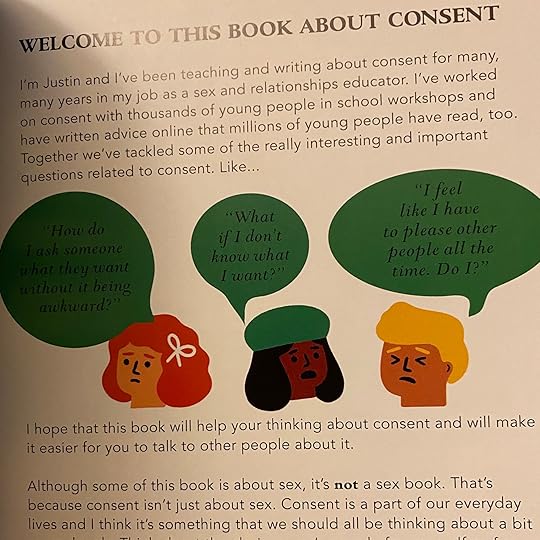 Meanwhile other page spreads have completely bizarre layouts including one shaped like a pizza (I cannot overstate the amount of pizza in this book) where the most important information ("If consent is about choices and freedom, then it's more than just avoiding something we don't want.") is not only buried at the bottom of the page but printed upside down.
 Can We Talk About Consent? shares a ton of important and valuable information (including a glossary and additional resources). Unfortunately a book design that seemingly failed to consider that this book has to be read makes it difficult to easily interface with much of that information--particularly for anyone who is visually impaired or needs larger and clearer text to read.
That's where Can We Talk About Consent?: A Book About Freedom, Choices, and Agreement (2021) by Justin Hancock, illustrated by Fuchsia Macaree comes in.
Find it on Bookshop.
Hancock uses his experience from his work as a sex and relationship educator to break down how consent works in a few areas in this book geared toward younger readers including:
how we greet each other
how to choose things for ourselves
how we say no to things
communicating and respecting choices in sexual relationships
the factors that can affect a person's ability to choose
how to empower other people by giving them consent
The book itself says it's for readers age 14 and up (likely because sex is mentioned and because some pages are text heavy) but if read together with discussion, this can work for younger readers as well.
Hancock's no-nonsense text is approachable with clear examples (and a lot of pizza metaphors) to break down this crucially important topic. Macaree's illustrations add a lot of pop and variety to the book and also represent people with a realistic variety of skin tones and appearances.
Unfortunately, the design of the book itself makes Can We Talk About Consent? nearly unreadable in places and favors gimmicky page spreads in favor of clearly sharing information.
The book has full color illustrations and is printed on glossy paper. This with the small text and narrow trim size, means the book has small print. Compounding the issue: some of the illustrations are very low contrast like this one with speech bubbles that are dark green with black text:
 Meanwhile other page spreads have completely bizarre layouts including one shaped like a pizza (I cannot overstate the amount of pizza in this book) where the most important information ("If consent is about choices and freedom, then it's more than just avoiding something we don't want.") is not only buried at the bottom of the page but printed upside down.
 Can We Talk About Consent? shares a ton of important and valuable information (including a glossary and additional resources). Unfortunately a book design that seemingly failed to consider that this book has to be read makes it difficult to easily interface with much of that information--particularly for anyone who is visually impaired or needs larger and clearer text to read.
August 22, 2021
Pretty biased review as I'm personally a huge fan of Justin. However, I loved this book on a number of levels. As a sex and relationships educator myself, this book is categorically the most useful tool I have come across for explaining the nuances of consent. This book talks 21st century consent. The book discusses power, privilege and society in relation to our ability to consent to others as well as how to be more consensual to ourselves. It's excellent. I talk about consent most days and even I found this incredibly useful for both my practice and personal life. Reading this book is an act of self care and defiance against a world that doesn't really want you to be your authentic self. The artwork in the book is spectacular and fits every page so perfectly. The book was also such an easy read and despite it taking me nearly 2 months to finish that's more to do with my poor time management than the actual content of the book. All information is presented in such an accessible way that it never feels like a chore to read. The book is perfect for young people but adults too - and that's due to Justin's brill writing which never feels patronising. It feels like a friend has written this for you! Thank you Justin.

April 23, 2021
First, a note about the physical book itself. The illustrations use bold, bright colors to add a lighter note to a topic that can be fraught with tension. But the text of the book is sometimes printed on areas of the page that is hard to read. A last glance before going to the printers would have alleviated this.
Now to the text of the book. Yes, this is a topic that all should be informed about. The author makes it approachable by starting with an example of two people ordering pizza together. How do they both consent to the same thing? Was is the process. By using a reoccurring theme of using pizza as an example it makes what may be a frightening conversation easier.
Did you ever think about greeting someone? Do you shake their hand? a hug? What if the person does not like to be touched? The author says to negotiate a greeting. It may should weird but it helps to make a person comfortable abiding and realizing consent.
Do I rec this book to others? Yes, important topic done in a manner easily comprehended. The author has taught on this subject for many years and is knowledgeable.
Now to the text of the book. Yes, this is a topic that all should be informed about. The author makes it approachable by starting with an example of two people ordering pizza together. How do they both consent to the same thing? Was is the process. By using a reoccurring theme of using pizza as an example it makes what may be a frightening conversation easier.
Did you ever think about greeting someone? Do you shake their hand? a hug? What if the person does not like to be touched? The author says to negotiate a greeting. It may should weird but it helps to make a person comfortable abiding and realizing consent.
Do I rec this book to others? Yes, important topic done in a manner easily comprehended. The author has taught on this subject for many years and is knowledgeable.

January 15, 2021
Thank you to NetGalley & the Quarto Publishing Group for sending me a digital ARC for review.
A wonderful book!
The author has managed to highlight such an important and vast topic in very simple and accessible terms. As a 20-something person reading this, it warms my heart to know that a resource such as this exists that can be used to start the conversation about self-agency with younger people, unlike the lack of opportunities I myself faced as a teenager or even now as an adult.
A person from any age group could read this and they would find that it is a pretty good way to cover the basics regarding consent that we all wish we knew more about. The illustrations really enhance the reading experience and I was very impressed with the breakdown of topics (agency, greetings, sex) which helped convey the author's messages much more conveniently. The 'activity' section at the end was something I felt would be super helpful for the younger target audience of the book.
Definitely a recommended read!
A wonderful book!
The author has managed to highlight such an important and vast topic in very simple and accessible terms. As a 20-something person reading this, it warms my heart to know that a resource such as this exists that can be used to start the conversation about self-agency with younger people, unlike the lack of opportunities I myself faced as a teenager or even now as an adult.
A person from any age group could read this and they would find that it is a pretty good way to cover the basics regarding consent that we all wish we knew more about. The illustrations really enhance the reading experience and I was very impressed with the breakdown of topics (agency, greetings, sex) which helped convey the author's messages much more conveniently. The 'activity' section at the end was something I felt would be super helpful for the younger target audience of the book.
Definitely a recommended read!

January 27, 2021
I want to express my gratitude to Netgalley and Frances Lincoln Children's Books for giving me the chance to read this book in exchange for an honest review.
Something in the title, cover and synopsis said to me that this could be an amazing reading and it was.
At the beggining, I thought that the book was about sex, an aproximation to young people without more expectations. Yet, I started reading and this was totally different.
Justin Hancock is a wonderful writer, in addition it has a magic and close way to talk about consent, besides "serious" topics. This book not only has with sex as reference, but also it talking about all the situations that you can find day a day in with you have to take a decision.
Additionally the text has a perfect companion, the illustrations. Fuchsia Macaree choosed splendidly the drawings to all the pages.
I thought that it is an awesome reading to all the ages, maybe it could have a huge impact on teens (14 and above).
To sum up, a perfect and modern reading to open your mind, as well as know more about something esencial, consent.
Something in the title, cover and synopsis said to me that this could be an amazing reading and it was.
At the beggining, I thought that the book was about sex, an aproximation to young people without more expectations. Yet, I started reading and this was totally different.
Justin Hancock is a wonderful writer, in addition it has a magic and close way to talk about consent, besides "serious" topics. This book not only has with sex as reference, but also it talking about all the situations that you can find day a day in with you have to take a decision.
Additionally the text has a perfect companion, the illustrations. Fuchsia Macaree choosed splendidly the drawings to all the pages.
I thought that it is an awesome reading to all the ages, maybe it could have a huge impact on teens (14 and above).
To sum up, a perfect and modern reading to open your mind, as well as know more about something esencial, consent.

March 29, 2023
Thank you Justin Hancock for such an inspiring book! Hancock guides readers through consent in a conversational way that is not weird at all and has great analogies. I also really love the illustrations (shout out to Fuchsia MacAree)! This book made me feel comfortable and I like how it asks for your consent while teaching about consent. This book is also divided up into sections, so if you ever want to jump to a section, it is really easy to just dive in instead of needing the background information. Although it seems long, I was mildly intrigued and it did not feel like a drag to finish although I don't think you have to read this book cover to cover. If you want to learn more about consent and how to give people their agency, this should be a book on your list!
Side note: It would be really cool if there was a kid's version of this book because the illustrations are great and I think taking the main ideas and applying them at a lower level would be really cool for younger people to read.
Side note: It would be really cool if there was a kid's version of this book because the illustrations are great and I think taking the main ideas and applying them at a lower level would be really cool for younger people to read.

December 6, 2020
I received an electronic ARC from Quarto Publishing Group – Frances Lincoln Children's Books through NetGalley.
An all in one guide to explaining consent and agency and why it's important to know about both. Hancock uses clear analogies to define terms and explain choices. Though this is written for middle school and young adults, adults of all ages would benefit from a review of this information.
The pizza and movie analogies work because they provide humor to the underlying seriousness of the actual topics being covered. The shorter chapter style lets readers move through the material quickly and revisit the topics as needed.
I appreciate that Hancock covers far broader topics than sexual consent. Sex is a critical consent/choice/agency area but it is not the only place young people need to feel empowered to state their choices and feel safe in doing so.
One I recommend every family purchase to inspire dialogue on these critical topics.
An all in one guide to explaining consent and agency and why it's important to know about both. Hancock uses clear analogies to define terms and explain choices. Though this is written for middle school and young adults, adults of all ages would benefit from a review of this information.
The pizza and movie analogies work because they provide humor to the underlying seriousness of the actual topics being covered. The shorter chapter style lets readers move through the material quickly and revisit the topics as needed.
I appreciate that Hancock covers far broader topics than sexual consent. Sex is a critical consent/choice/agency area but it is not the only place young people need to feel empowered to state their choices and feel safe in doing so.
One I recommend every family purchase to inspire dialogue on these critical topics.

January 1, 2021
For many, talking about consent implies physical relationships but Hancock takes a wider, holistic approach and considers decisions we all have to make in everyday life as well as within non-physical relationships.
The book looks at various aspects such as how we greet each other, how we choose things and what affects our ability to say no. It covers how power dynamics impact on relationships, peer pressure and the different ways people have of indicating negativity, such as via body language. It also links self-esteem and empowerment to the ability to give consent.
There are some important messages in this book such as “an absence of a no does not mean a yes” and “you should only have to say no once”. The book makes good use of font sizes and styles, and the pages are filled with bright colourful illustrations and practical examples.
However, despite its slightly cartoonish nature, it is aimed at 14+ years as the chapter on sex is quite detailed.
The book looks at various aspects such as how we greet each other, how we choose things and what affects our ability to say no. It covers how power dynamics impact on relationships, peer pressure and the different ways people have of indicating negativity, such as via body language. It also links self-esteem and empowerment to the ability to give consent.
There are some important messages in this book such as “an absence of a no does not mean a yes” and “you should only have to say no once”. The book makes good use of font sizes and styles, and the pages are filled with bright colourful illustrations and practical examples.
However, despite its slightly cartoonish nature, it is aimed at 14+ years as the chapter on sex is quite detailed.

October 16, 2021
A clear and enticing description of what consent means, both in a larger sense and in particular when negotiating relationships, particularly intimate ones. I liked the extended example of the pizza shop, and the hand-shaking demonstration.
I thought it was a bit parochial, in that the assumption was that this method of communicating was the superior one, and being less explicit is inherently worse. I'm uncomfortable with that premise, although I personally do like explicit negotiations. But just because it's easier for me that way doesn't mean it's morally better than a "hint culture" type of person.
That's a quibble; in general I appreciate the way the text explains without condescending and how the illustrations encourage the reader to continue while underlining the important points.
I thought it was a bit parochial, in that the assumption was that this method of communicating was the superior one, and being less explicit is inherently worse. I'm uncomfortable with that premise, although I personally do like explicit negotiations. But just because it's easier for me that way doesn't mean it's morally better than a "hint culture" type of person.
That's a quibble; in general I appreciate the way the text explains without condescending and how the illustrations encourage the reader to continue while underlining the important points.

June 14, 2025
Reading this book was a surprisingly engaging experience. I hadn’t anticipated that many illustrations, but they were visually stunning.
The author weaves discussions of consent alongside themes like gender and "isms" (social expectations about what you should do). A standout takeaway? "A no is always a no, and the absence of a no doesn’t equate to a yes."
This clarity is refreshing, yet the book’s limited scope feels like a missed opportunity. While it passionately advocates for free self-expression and thoughtful listening to others' needs, it barely skims the surface of how social expectations shape consent. If it does broach the topic, the analysis sometimes lacks depth—a disappointment, though I recognize it wasn’t the book’s primary focus.
Overall, the content is solid with no major flaws. It’s thought-provoking, urging readers to reflect on communication and boundaries.
The author weaves discussions of consent alongside themes like gender and "isms" (social expectations about what you should do). A standout takeaway? "A no is always a no, and the absence of a no doesn’t equate to a yes."
This clarity is refreshing, yet the book’s limited scope feels like a missed opportunity. While it passionately advocates for free self-expression and thoughtful listening to others' needs, it barely skims the surface of how social expectations shape consent. If it does broach the topic, the analysis sometimes lacks depth—a disappointment, though I recognize it wasn’t the book’s primary focus.
Overall, the content is solid with no major flaws. It’s thought-provoking, urging readers to reflect on communication and boundaries.
April 25, 2021
I received a copy of this book through the Amazon Vine program in exchange for an honest review.
This is a cute book!
There's drawings throughout the book that give it a sort of graphic novel like feel. The author uses a lot of pizza metaphors and examples to explain concepts around consent. From figuring out what you want, to how to talk about it, and what consent looks like in groups this book covers a lot. There's an emphasis on how a lack of no does not mean yes and what you can do if someone violates your boundaries. The book also talks about the differences between a yes, no, and maybe and what you can do with each.
It's a short and interesting read that talks about what consent can look like and what it means.
This is a cute book!
There's drawings throughout the book that give it a sort of graphic novel like feel. The author uses a lot of pizza metaphors and examples to explain concepts around consent. From figuring out what you want, to how to talk about it, and what consent looks like in groups this book covers a lot. There's an emphasis on how a lack of no does not mean yes and what you can do if someone violates your boundaries. The book also talks about the differences between a yes, no, and maybe and what you can do with each.
It's a short and interesting read that talks about what consent can look like and what it means.
Displaying 1 - 30 of 65 reviews